
Secondary Butyl Alcohol Market Size and Share
Market Overview
| Study Period | 2021 - 2031 |
|---|---|
| Market Size (2026) | USD 1.22 Billion |
| Market Size (2031) | USD 1.58 Billion |
| Growth Rate (2026 - 2031) | 5.24 % |
| Fastest Growing Market | Asia-Pacific |
| Largest Market | Asia-Pacific |
| Market Concentration | Medium |
Major Players *Disclaimer: Major Players sorted in no particular order Image © Mordor Intelligence. Reuse requires attribution under CC BY 4.0. | |
Secondary Butyl Alcohol Market Analysis by Mordor Intelligence
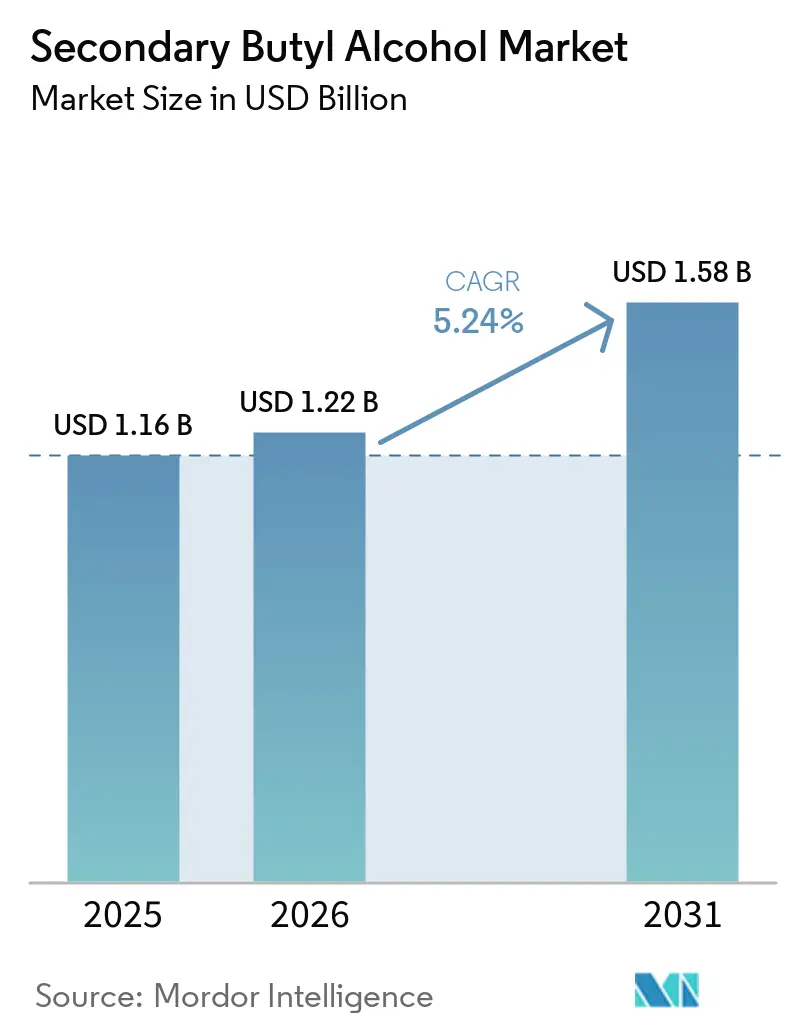
The Secondary Butyl Alcohol Market was valued at USD 1.16 billion in 2025 and is estimated to grow from USD 1.22 billion in 2026 to reach USD 1.58 billion by 2031, at a CAGR of 5.24% during the forecast period (2026–2031). Secondary butyl alcohol remains closely tied to methyl ethyl ketone production, which connects demand to coatings, adhesives, printing inks, and industrial cleaning. This linkage supports demand but also exposes producers to pressure when methyl ethyl ketone margins weaken. Higher-purity solvent demand from pharmaceutical manufacturing and specialty chemical uses provides a separate source of demand. Asia-Pacific combines integrated C4 processing, downstream manufacturing, and expanding pharmaceutical capacity, while Western suppliers compete through product purity, registered products, and dependable deliveries. The secondary butyl alcohol market continues to depend on the balance between methyl ethyl ketone capacity, feedstock availability, compliance requirements, and demand for specialized grades.
Key Report Takeaways
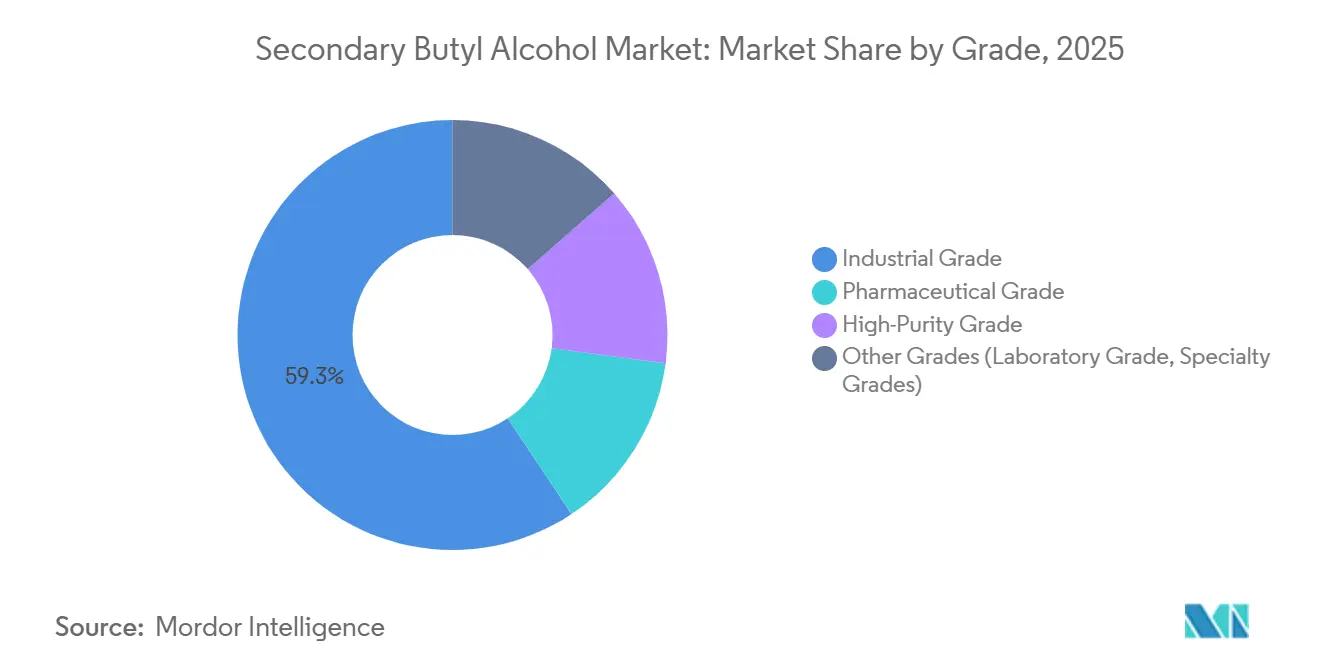
- By grade, industrial grade held 59.34% of the secondary butyl alcohol market share in 2025, while pharmaceutical grade is projected to expand at a 6.14% CAGR through 2031.
- By form, liquid held 71.45% of the secondary butyl alcohol market share in 2025, while solutions and blends are projected to expand at a 5.87% CAGR through 2031.
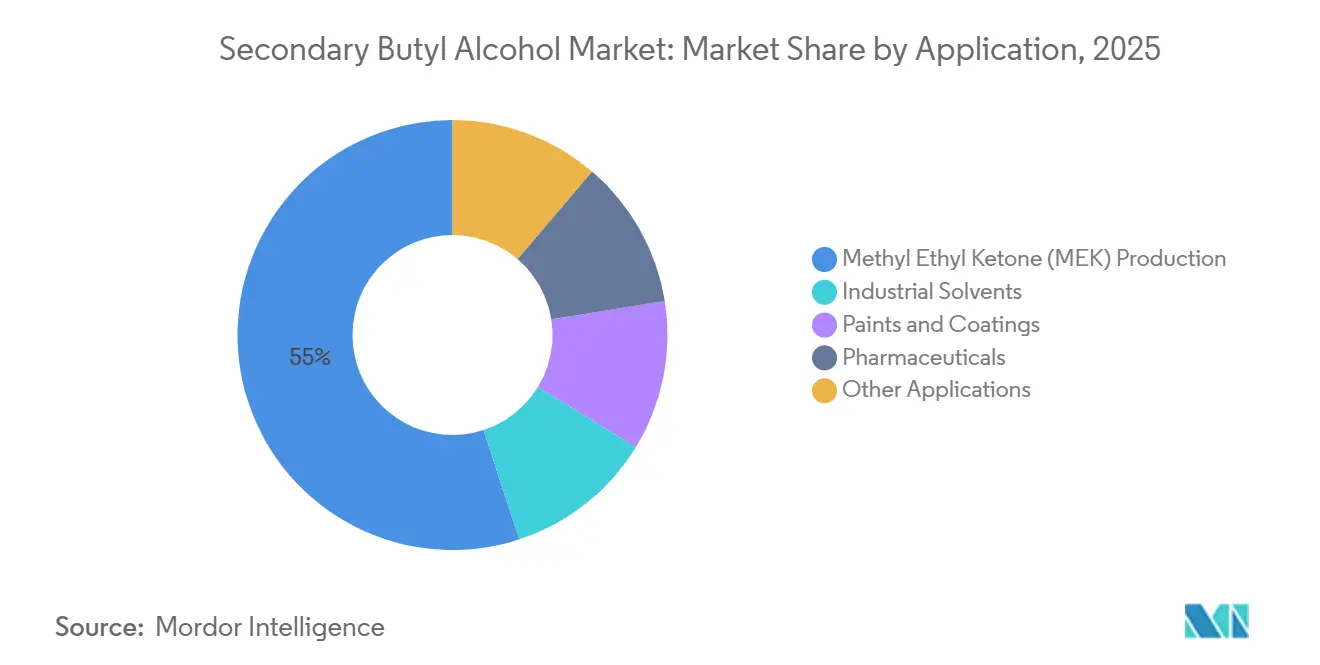
- By application, Methyl Ethyl Ketone (MEK) production held 55.03% of the secondary butyl alcohol market size in 2025, while pharmaceuticals are projected to expand at a 6.28% CAGR through 2031.
- By geography, Asia-Pacific held 42.61% of the secondary butyl alcohol market size in 2025 and is projected to expand at a 5.92% CAGR through 2031.
Note: Market size and forecast figures in this report are generated using Mordor Intelligence’s proprietary estimation framework, updated with the latest available data and insights as of January 2026.
Market Trends and Insights
Drivers Impact Analysis of Secondary Butyl Alcohol Market*
| Driver | (~) % Impact on CAGR Forecast | Geographic Relevance | Impact Timeline |
|---|---|---|---|
| Expanding Methyl Ethyl Ketone Production Capacity | +1.5% | Asia-Pacific (China dominant), spill-over to South & Southeast Asia | Medium term (2-4 years) |
| Growth in Industrial Coatings and Adhesives | +1.2% | Global, with strongest pull in Asia-Pacific and MENA infrastructure build | Medium term (2-4 years) |
| Pharmaceutical and API Manufacturing Expansion | +1.0% | Asia-Pacific (India & China CDMO clusters), North America, Europe | Long term (≥ 4 years) |
| Rising Demand for High-Purity Solvent Grades | +0.7% | North America, Europe, East Asia (semiconductor & pharma hubs) | Long term (≥ 4 years) |
| Integrated C4 Feedstock and Petrochemical Clusters | +0.5% | Middle East, Asia-Pacific (China, India, South Korea) | Short term (≤ 2 years) |
| Low-VOC Formulation and Solvent-Recovery Optimization | +0.3% | North America & EU; spill-over to ASEAN through multinational supply chains | Medium term (2-4 years) |
| Source: Mordor Intelligence | |||
Expanding Methyl Ethyl Ketone Production Capacity
Secondary butyl alcohol is used as a direct feedstock for methyl ethyl ketone through catalytic dehydrogenation. This process makes additional methyl ethyl ketone capacity a direct source of secondary butyl alcohol demand. China had an effective methyl ethyl ketone capacity of 1.097 million metric tons in 2025, although weaker downstream demand limited operating rates. Zibo Qixiang Tengda Chemical Co., Ltd. planned a CNY 360 million (approximately USD 50 million) optimization project with 250,000 metric tons per year of secondary butyl alcohol capacity and 400,000 metric tons per year of secondary butyl acetate capacity. The project is expected to offer a producer greater flexibility between external sales, methyl ethyl ketone production, and sec-butyl acetate output.
Growth in Industrial Coatings and Adhesives
Industrial coatings and adhesives form an important secondary demand base for secondary butyl alcohol. The solvent can function as a coupling agent in water-reducible systems, a paint-stripping medium, and an intermediate for specialty surfactants. Automotive, packaging, and medical bonding applications have supported solvent-borne adhesive demand where water-based systems face heat or chemical resistance limits. Industrial infrastructure, protective structures, and maintenance work also require coatings with durable performance. These uses give the secondary butyl alcohol market exposure to several manufacturing and construction value chains. They also reduce exclusive reliance on a single chemical outlet.
Pharmaceutical and API Manufacturing Expansion
Pharmaceutical grade material is used in synthesis and purification processes that require controlled quality specifications. India and China are expanding their active pharmaceutical ingredient and contract development and manufacturing organization capabilities. This expansion increases solvent throughput requirements in manufacturing plants and associated purification operations. Pharmaceutical use is distinct from industrial methyl ethyl ketone production and follows different qualification requirements. That separation gives the secondary butyl alcohol market a demand stream that is less directly linked to methyl ethyl ketone cycles.
Rising Demand for High-Purity Solvent Grades
High-purity secondary butyl alcohol serves smaller but higher-value applications in semiconductor cleaning, electronic formulations, and fine chemical synthesis. These applications require tight limits for metallic contamination and process residues. Controlled evaporation behavior and low residue characteristics support use in specialized cleaning and photoresist-related processes. Semiconductor fabrication at advanced nodes has increased attention to solvent specification and quality consistency. The Semiconductor Industry Association has highlighted the importance of secure and reliable supply chains for semiconductor manufacturing inputs. The European Chemicals Agency also maintains the Candidate List for substances of very great concern, which informs substitution decisions across affected supply chains[1].
Restraints Impact Analysis of Secondary Butyl Alcohol Market*
| Restraint | (~) % Impact on CAGR Forecast | Geographic Relevance | Impact Timeline |
|---|---|---|---|
| Volatility in C4 Hydrocarbon Feedstock Costs | -1.5% | Global, most acute in regions without integrated refinery access (South Asia, SEA, Latin America) | Short term (≤ 2 years) |
| Substitution by Ethyl Acetate, Isopropanol and N-Butanol | -1.2% | North America & EU (regulatory substitution), Asia-Pacific (price-driven switching) | Medium term (2-4 years) |
| VOC, Worker-Exposure and Chemical-Compliance Costs | -0.8% | Europe (REACH, IED), North America (EPA HAP rules (CAA Title III), OSHA standards) | Medium term (2-4 years) |
| Limited Standalone SBA Capacity and MEK Value-Chain Dependence | -0.6% | Global, most limiting in markets without integrated C4 producers | Long term (≥ 4 years) |
| Source: Mordor Intelligence | |||
Volatility in C4 Hydrocarbon Feedstock Costs
Secondary butyl alcohol is produced mainly through acid-catalyzed hydration of n-butylene from C4 refinery or cracker streams. Its cost base is therefore sensitive to refining conditions, cracker operating rates, and C4 availability. When steam crackers reduce operating rates, co-produced C4 volumes can decline at the same time as downstream demand weakens. This combination can raise feedstock costs and compress producer margins. Producers outside integrated refining networks are more exposed because they buy C4 feedstock on spot terms. This exposure is most acute in South Asia, Southeast Asia, and Latin America.
Substitution by Ethyl Acetate, Isopropanol and N-Butanol
Ethyl acetate, isopropyl alcohol, and n-butanol compete with secondary butyl alcohol in several solvent uses. These alternatives are widely produced and available at established commercial purity grades. Customers can switch products when price, regulatory status, application performance, or availability changes. Ethyl acetate can serve in coatings, chromatography, and process chemistry uses. Isopropyl alcohol has a broad manufacturing infrastructure and established use in cleaning and pharmaceutical settings. This competition limits the pricing power of suppliers serving standard solvent applications.
*Our forecasts treat driver/restraint impacts as directional, not additive. The impact forecasts reflect baseline growth, mix effects, and variable interactions.
Secondary Butyl Alcohol Market Segment Analysis
By Grade:
Industrial Grade Anchors the Revenue Base, Pharmaceutical Grade Gains MomentumIndustrial grade held 59.34% of global revenue in 2025. The grade was primarily used in methyl ethyl ketone production and industrial solvent applications. Its purity requirements are functional rather than pharmacopeial in many integrated facilities. Much of this material is consumed internally by C4 processors or transferred to adjacent methyl ethyl ketone units. Internal transfers make pricing less visible than a conventional spot market transaction.
High-purity grade and other grades, including laboratory and specialty grades, serve electronics, research, and specialty chemical applications. These grades require more extensive testing and purification. Pharmaceutical grade is projected to expand at a 6.14% CAGR through 2031, supported by active pharmaceutical ingredient production in India and China. Certified supply is concentrated among producers with established purification and analytical capabilities. This difference between Asian demand growth and Western specialty supply is expected to support demand for qualified material and dependable delivery programs.

By Form:
Liquid Dominates Revenue While Solutions and Blends Gain MomentumLiquid held 71.45% of the secondary butyl alcohol market size in 2025. Its lead reflected the importance of neat solvent use in methyl ethyl ketone production and industrial applications. Bulk shipments commonly move in tanks and road tankers between producers and connected chemical sites. These applications generally require a straightforward liquid feedstock rather than a specialty mixture. Other forms, including custom formulations and reagent preparations, address laboratory and specialty chemistry uses. Liquid is expected to retain its importance in the secondary butyl alcohol market because the core methyl ethyl ketone value chain requires a direct material stream.
Solutions and blends are expected to advance at a 5.87% CAGR through 2031. Coatings formulators use blends to manage volatile organic compound limits while maintaining surface and drying performance. Suppliers can combine secondary butyl alcohol with glycol ethers or higher-flash-point ketones for defined performance requirements. Pre-engineered blends can reduce formulation testing and documentation work for customers. This increases the value of technical service, application knowledge, and dependable product specifications. The secondary butyl alcohol industry is expected to see greater value creation in formulated products than in standard liquid shipments.
By Application:
Methyl Ethyl Ketone Production Dependence Defines Market Structure, Pharmaceuticals AccelerateMethyl ethyl ketone production held 55.03% of the secondary butyl alcohol market size in 2025. It is the main channel linking secondary butyl alcohol demand with paints, coatings, adhesives, and industrial cleaning demand. Integrated producers convert secondary butyl alcohol through catalytic dehydrogenation and use connected assets to manage material flows. Industrial solvents, paints, and coatings form the next important application cluster. In these applications, secondary butyl alcohol supports water-reducible systems and specialty surfactant production. Other applications include printing inks, chemical intermediates, plasticizers, and flavors and fragrances.
Pharmaceuticals are expected to expand at a 6.28% CAGR through 2031. The segment is expected to benefit from active pharmaceutical ingredient capacity growth and demand for qualified process solvents. Secondary butyl alcohol also supports sec-butyl acetate production, which provides an additional route for producers. Zibo Qixiang Tengda Chemical's proposed project includes 400,000 metric tons per year of sec-butyl acetate capacity and 250,000 metric tons per year of secondary butyl alcohol capacity. This allocation is expected to give the producer a choice between traditional methyl ethyl ketone output and derivative production. The secondary butyl alcohol market is expected to become less dependent on a single outlet when derivative routes grow alongside pharmaceutical demand.
Geography Analysis
APAC Secondary Butyl Alcohol Market
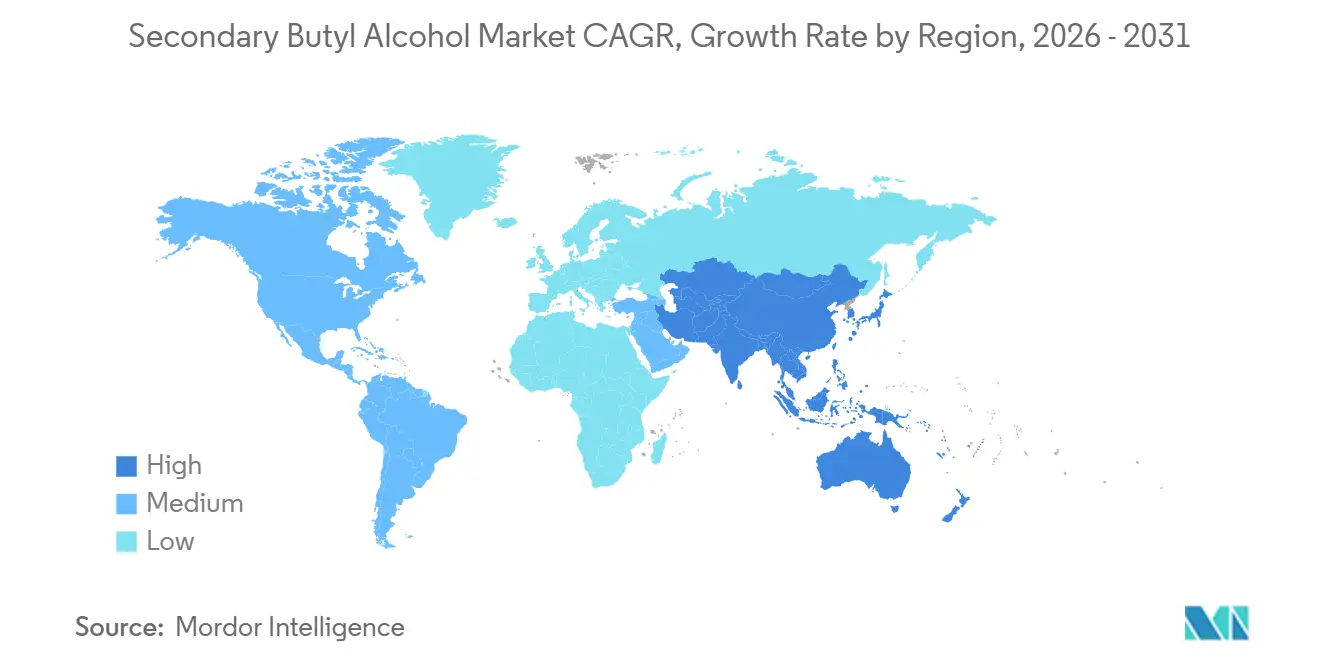
Asia-Pacific held 42.61% of the secondary butyl alcohol market share in 2025 and is expected to advance at a 5.92% CAGR through 2031. China, India, Japan, South Korea, and the Association of Southeast Asian Nations countries combine C4 feedstock, industrial capacity, and pharmaceutical manufacturing demand. China is the leading regional production center because its processors have integrated refinery and cracker feedstock. Chinese methyl ethyl ketone capacity reached 1.097 million metric tons in 2025, while lower operating rates showed the importance of utilization rather than nameplate capacity. India and the Association of Southeast Asian Nations countries continue to support incremental demand through pharmaceutical production and construction-related coatings.
North America and Europe Secondary Butyl Alcohol Market
Within the secondary butyl alcohol market, North America has a stable but supply-constrained position because methyl ethyl ketone consumed in the United States is imported. Domestic secondary butyl alcohol demand is therefore concentrated in standalone solvent, specialty chemical intermediate, and lubricant additive precursor uses. The Gulf Coast has an estimated 200,000 to 300,000 metric tons per year of secondary butyl alcohol nameplate capacity and benefits from shale-linked natural gas liquids processing. Europe has established specification-grade suppliers and demanding chemical compliance requirements. The European Commission's Registration, Evaluation, Authorisation and Restriction of Chemicals (REACH) framework remains central to compliance for companies operating in or exporting to the region. These conditions favor suppliers that can provide registered products, strong documentation, and consistent quality.
MEA and South America Secondary Butyl Alcohol Market
South America is import-dependent and is led by Brazil and Argentina in construction and automotive refinish coatings demand. Freight costs and tariff changes can therefore influence delivered solvent costs in the region. The Middle East and Africa demand remains smaller but has upstream relevance through integrated petrochemical investments. SABIC's Fujian project is expected to add new ethylene capacity in China and create associated C4 streams for regional processors. Saudi Arabian industrial development, including construction activity linked to NEOM, supports wider industrial solvent demand.
Competitive Landscape
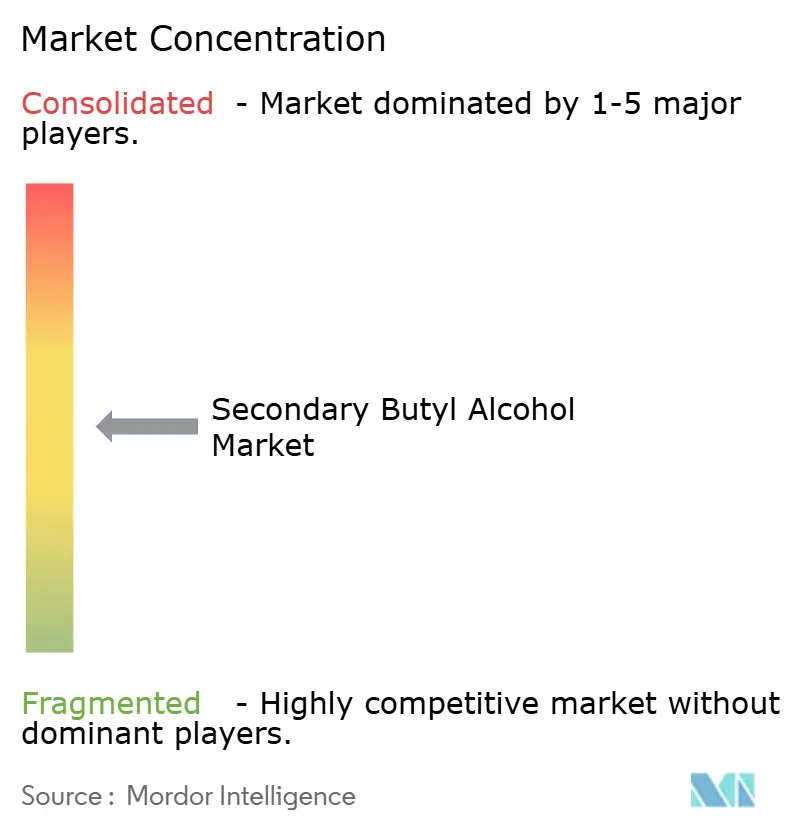
The secondary butyl alcohol market is moderately concentrated, with the top five players including Exxon Mobil Corporation, CETEX Petrochemicals Limited, Maruzen Petrochemical, Shell plc, and PetroChina Company Limited. These producers benefit from integrated C4 refinery feedstock, lower-cost operations, and deep C4 processing networks. ExxonMobil and INEOS compete through purity specifications, product registration, logistics, and supply security. Exxon Mobil Corporation identifies secondary butyl alcohol in its product portfolio for industrial applications[2]. The split between Asian volume producers and Western specification-grade suppliers shapes competition across the secondary butyl alcohol market.
Chinese producers have scale advantages in commodity-grade output but may require additional investment to serve pharmacopeial and electronic-grade applications. Western producers have established testing and qualification capabilities but face higher production cost structures. Zibo Qixiang Tengda Chemical's proposed CNY 360 million (approximately USD 50 million) project illustrates a strategy built around chain optimization and derivative flexibility. The project is expected to combine new secondary butyl alcohol capacity with a larger sec-butyl acetate unit. This structure is expected to allow the company to manage the methyl ethyl ketone cycle through several product outlets. It also shows why integrated projects are more common than new standalone secondary butyl alcohol facilities.
The Methyl Ethyl Ketone and Secondary Butyl Alcohol Solvent REACH Consortium includes companies working on REACH-related requirements for these substances. CETEX Petrochemicals has an opportunity to serve Indian pharmaceutical customers through regional supply and potential United States Pharmacopeia-grade material. Indovinya markets sec-Butyl Alcohol under the ULTRASOLVE L 1100 trade name for industrial applications. LG Chem reported petrochemical capacity information that reflects the scale of regional C4 derivative processing. Competition depends on whether suppliers can combine feedstock access, certification, product quality, and reliable customer service.
Secondary Butyl Alcohol Industry Leaders
-
Exxon Mobil Corporation
-
Maruzen Petrochemical
-
Shell plc
-
PetroChina Company Limited
-
CETEX Petrochemicals Limited
- *Disclaimer: Major Players sorted in no particular order
Secondary Butyl Alcohol Market Companies Covered in this Report
- ATAMAN KIMYA
- CETEX Petrochemicals Limited
- China Petroleum & Chemical Corporation
- Exxon Mobil Corporation
- Indorama Ventures Public Company Limited.
- INEOS
- LG Chem
- Maruzen Petrochemical
- Mitsui Chemicals, Inc.
- PetroChina Company Limited
- SABIC
- Shell plc
- Xinjiang Dushanzi TianLi High & New Tech
- Zhejiang Realsun Chemical Co., Ltd.
- Zhejiang Xinhua Chemical Co.,Ltd.
- Zibo Qixiang Tengda Chemical Co., Ltd.
Recent Industry Developments in Secondary Butyl Alcohol Market
- April 2026: Zibo Qixiang Tengda Chemical signed a cooperation agreement with Bluesail Medical, extending its downstream reach into healthcare-adjacent chemical supply. This development reflects the broader C4 chemical cluster's expansion into non-traditional application markets for Secondary Butyl Alcohol (SBA) derivatives.
- February 2026: Qixiang Tengda Chemical's new materials plant commenced trial operations, adding downstream product diversification to the Zibo complex beyond traditional Secondary Butyl Alcohol (SBA) and MEK commodities.
Global Secondary Butyl Alcohol Market Report Scope
Secondary butyl alcohol is a colorless organic solvent widely used as a chemical intermediate and industrial solvent in various manufacturing processes. It is primarily utilized in the production of methyl ethyl ketone (MEK) and finds applications in paints, coatings, pharmaceuticals, specialty chemicals, and other industrial formulations due to its favorable solvent properties.
The Secondary Butyl Alcohol Market is segmented by grade, form, application, and geography. By grade, the market is segmented into industrial grade, pharmaceutical grade, high-purity grade, and other grades (including laboratory grade and specialty grades). By form, the market is segmented into liquid, solutions and blends, and other forms (including custom formulations and reagent preparations). By application, the market is segmented into methyl ethyl ketone (MEK) production, industrial solvents, paints and coatings, pharmaceuticals, and other applications (including printing inks, chemical intermediates, plasticizers, flavors and fragrances, and specialty chemicals). The report also covers the market size and forecasts for secondary butyl alcohol in 16 countries across major regions. For each segment, the market sizing and forecasts have been done on the basis of value (USD).
| Industrial Grade |
| Pharmaceutical Grade |
| High-Purity Grade |
| Other Grades (Laboratory Grade, Specialty Grades) |
| Liquid |
| Solutions and Blends |
| Other Forms (Custom Formulations, Reagent Preparations) |
| Methyl Ethyl Ketone (MEK) Production |
| Industrial Solvents |
| Paints and Coatings |
| Pharmaceuticals |
| Other Applications (Printing Inks, Chemical Intermediates, Plasticizers, Flavors and Fragrances, Specialty Chemicals) |
| Asia-Pacific | China |
| India | |
| Japan | |
| South Korea | |
| ASEAN Countries | |
| Rest of Asia-Pacific | |
| North America | United States |
| Canada | |
| Mexico | |
| Europe | Germany |
| United Kingdom | |
| France | |
| Italy | |
| NORDIC Countries | |
| Russia | |
| Rest of Europe | |
| South America | Brazil |
| Argentina | |
| Rest of South America | |
| Middle East and Africa | Saudi Arabia |
| South Africa | |
| Rest of Middle East and Africa |
| By Grade | Industrial Grade | |
| Pharmaceutical Grade | ||
| High-Purity Grade | ||
| Other Grades (Laboratory Grade, Specialty Grades) | ||
| By Form | Liquid | |
| Solutions and Blends | ||
| Other Forms (Custom Formulations, Reagent Preparations) | ||
| By Application | Methyl Ethyl Ketone (MEK) Production | |
| Industrial Solvents | ||
| Paints and Coatings | ||
| Pharmaceuticals | ||
| Other Applications (Printing Inks, Chemical Intermediates, Plasticizers, Flavors and Fragrances, Specialty Chemicals) | ||
| By Geography | Asia-Pacific | China |
| India | ||
| Japan | ||
| South Korea | ||
| ASEAN Countries | ||
| Rest of Asia-Pacific | ||
| North America | United States | |
| Canada | ||
| Mexico | ||
| Europe | Germany | |
| United Kingdom | ||
| France | ||
| Italy | ||
| NORDIC Countries | ||
| Russia | ||
| Rest of Europe | ||
| South America | Brazil | |
| Argentina | ||
| Rest of South America | ||
| Middle East and Africa | Saudi Arabia | |
| South Africa | ||
| Rest of Middle East and Africa | ||
Key Questions Answered in the Report
What is the size of the secondary butyl alcohol market?
The secondary butyl alcohol market stands at USD 1.22 billion in 2026 and is projected to reach USD 1.58 billion by 2031.
Which grade is expected to grow fastest through 2031?
Pharmaceutical grade is projected to expand at a 6.14% CAGR through 2031.
Which application led the market demand in 2025?
Methyl Ethyl Ketone (MEK) production held 55.03% of revenue in 2025.
Which region is expected to grow fastest through 2031?
Asia-Pacific is projected to expand at a 5.92% CAGR through 2031.