
Saudi Arabia Secure Logistics Market Size and Share
Market Overview
| Study Period | 2021 - 2032 |
|---|---|
| Forecast Data Period | 2027 - 2032 |
| Base Year Market Size (2026) | USD 0.66 Billion |
| Market Size (2027) | USD 0.71 Billion |
| Market Size (2032) | USD 1.03 Billion |
| Growth Rate (2027 - 2032) | 7.72 % |
| Market Concentration | Medium |
Major Players *Disclaimer: Major Players sorted in no particular order Image © Mordor Intelligence. Reuse requires attribution under CC BY 4.0. | |
Saudi Arabia Secure Logistics Market Analysis by Mordor Intelligence
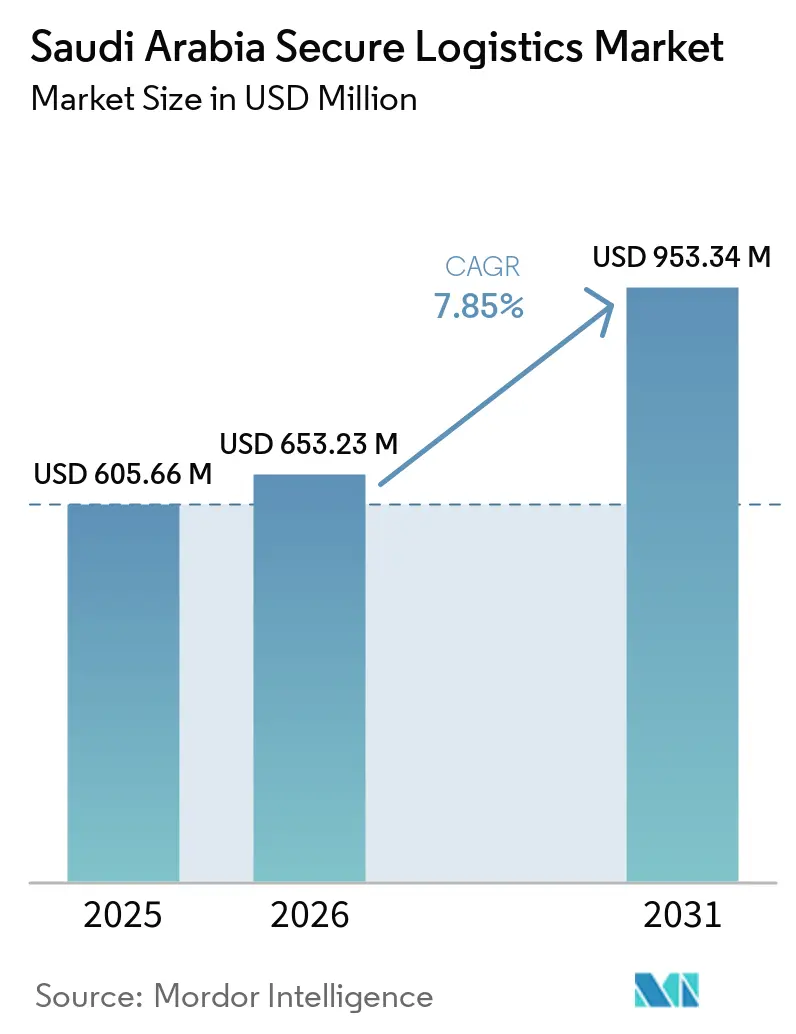
The Saudi Arabia secure logistics market size is valued at USD 0.66 billion in 2026 and is estimated to grow from USD 0.71 billion in 2027 to reach USD 1.03 billion by 2032, at a CAGR of 7.72% during the forecast period (2027-2032).
Vision 2030 is expanding the country’s logistics base through new ports, bonded warehouses, logistics zones, and multimodal corridors, which increase the number of places where high-value goods require controlled custody. Cash distribution remains important because banks, ATMs, retailers, and regulated entities require licensed armored transport and formal handling procedures. Gold, jewelry, and other high-value cargo add a second demand stream that is less tied to routine retail cash collection. The Saudi Arabia secure logistics market also benefits when banks outsource cash processing, vaulting, ATM replenishment, and reconciliation work to specialist operators. Digital payments and rising fleet, insurance, and compliance costs limit some routine cash-in-transit activity, which increases the value of operators with diversified services and established technology platforms.
Key Report Takeaways
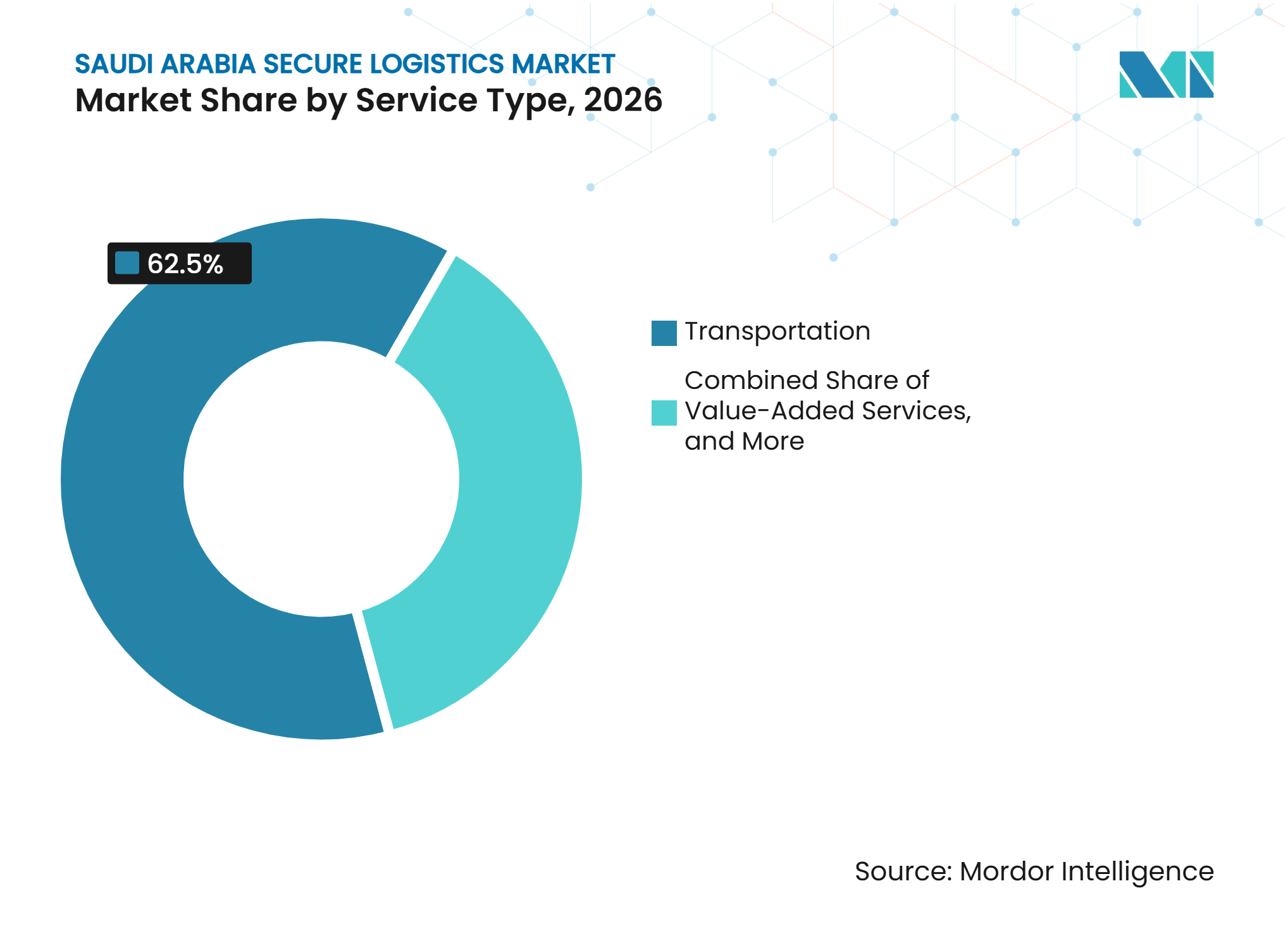
- By service type, transportation held 62.50% of the Saudi Arabia secure logistics market share in 2026, while value-added services are forecast to grow at an 8.81% CAGR through 2032.
- By application, cash management held 48.15% of the Saudi Arabia secure logistics market size in 2026, while jewelry and precious metals are forecast to grow at an 8.68% CAGR through 2032.
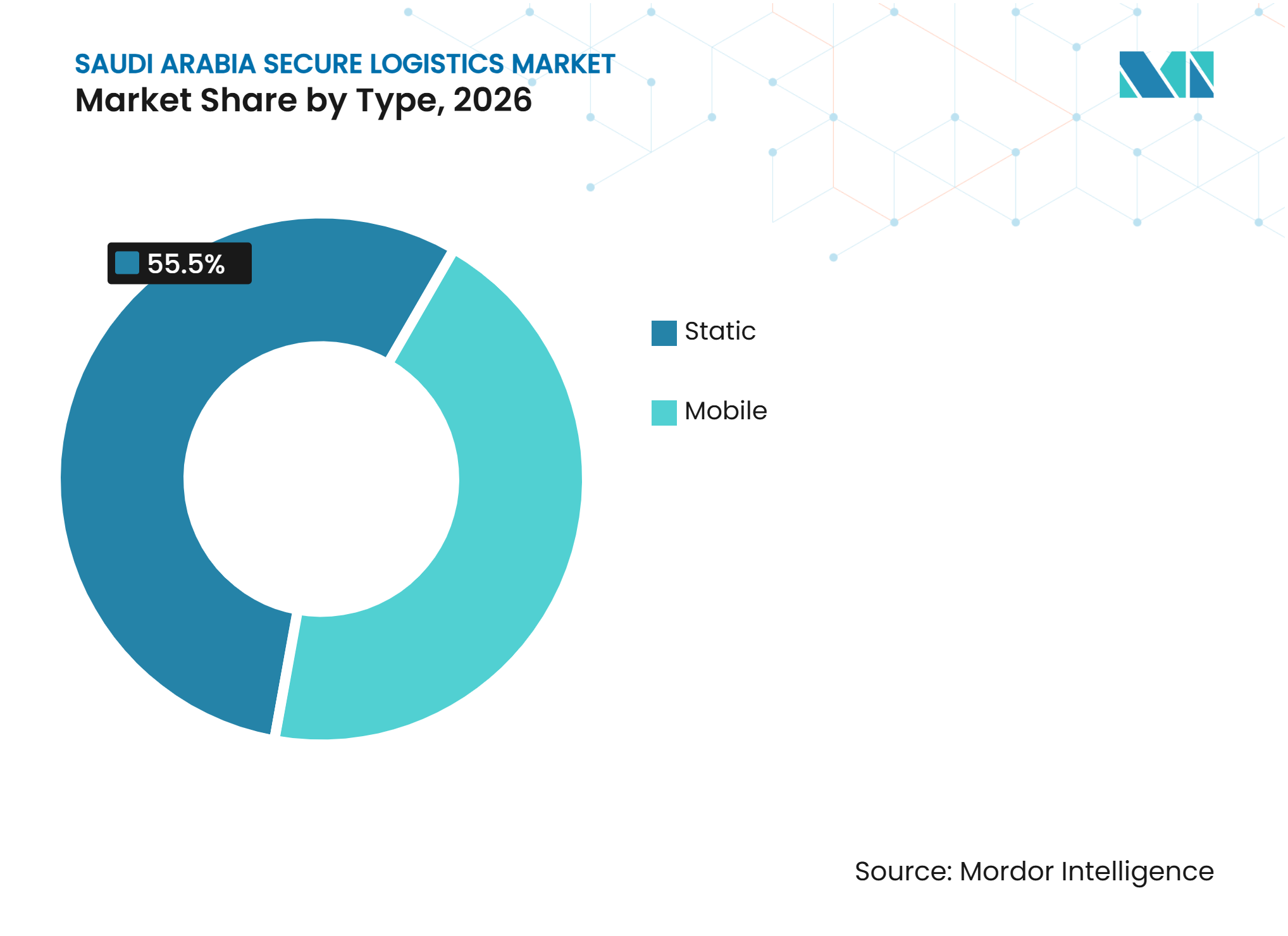
- By type, static secure logistics held 55.50% of sector revenue in 2026, while mobile solutions are forecast to grow at an 8.06% CAGR through 2032.
- By end user, financial institutions held 44.25% of sector revenue in 2026, while retailers are forecast to grow at a 7.95% CAGR through 2032.
Note: Market numbers in this report are based on Mordor Intelligence's proprietary estimation framework, which combines nine months of actuals with Q4 projections for base year 2026.
Saudi arabia contributes to a system defined not by any single country or region but by the interaction of many. The global secure logistics market data by Mordor Intelligence represents that combined structure.
Market Trends and Insights
Drivers Impact Analysis of Saudi Arabia Secure Logistics Market*
| Driver | (~) % Impact on CAGR Forecast | Geographic Relevance | Impact Timeline |
|---|---|---|---|
| Vision 2030 Logistics Investment and Infrastructure Buildout | +2.0% | National, concentrated in Riyadh, Jeddah, and Dammam | Long term (≥ 4 years) |
| Banking, ATM, and Cash-Handling Network Expansion | +1.5% | National, with early density gains in Riyadh, Jeddah, and Eastern Province | Medium term (2-4 years) |
| High-Value Goods, Gold, and Jewelry Flows | +1.3% | National, especially Jeddah, Riyadh, and Taif gold corridors | Medium term (2-4 years) |
| Outsourcing, Custody Controls, and Fleet Visibility | +1.1% | National, led by banking and retail clusters | Medium term (2-4 years) |
| Mandated Chain-of-Custody, Smart-Container, and Armored-Vehicle Controls | +0.9% | National, compliance-driven across licensed operators | Short term (≤ 2 years) |
| Digitized Fleet Visibility and Command-Center Operations | +0.7% | National, with faster adoption in Riyadh and Jeddah | Medium term (2-4 years) |
| Source: Mordor Intelligence | |||
Vision 2030 Logistics-Hub Investment and Infrastructure Buildout
Vision 2030 logistics investment supports Saudi Arabia secure logistics market because every new logistics site creates additional custody points for valuable goods. The National Industrial Development and Logistics Programme and the National Transport and Logistics Strategy guide investment in ports, warehouses, transport corridors, and logistics facilities. SAL Logistics Services and Sela signed a SAR 4 billion (USD 1.06 billion) agreement in March 2025 to develop the SAL Logistics Zone at Falcon City in northern Riyadh, covering more than 1.5 million m² of Class A warehousing and multimodal infrastructure. Large logistics parks concentrate goods in places where dedicated vault services, controlled access, and armored intermodal transfers become more relevant. SAL reported that warehouse occupancy exceeded 97%, while demand for warehouse space is forecast to exceed supply by 10 million m² by 2030. These conditions support secure storage and transport demand across the Saudi Arabia secure logistics market as capacity expands.
Expansion of Banking, ATM, and Cash-Handling Networks
Bank branches and ATM networks continue to generate daily cash-servicing requirements for licensed cash-in-transit operators. Saudi Arabia registered 14,674 ATMs in 2025. Al Rajhi Bank operated 4,327 ATMs and Saudi National Bank operated around 3,800 ATMs in 2025, which created dense replenishment and maintenance routes. American Express Saudi Arabia and Bank AlJazira agreed in 2025 to provide access to more than 600 additional ATMs across the Kingdom. SAMA requires dual supervision, CCTV recording, reconciliation against meter readings, and separation of ATM replenishment from certain maintenance functions. These requirements make specialist outsourcing a practical choice for banks seeking compliant, repeatable service.
Growth in High-Value Goods, Gold, and Jewelry Flows
Gold and jewelry movements add a distinct service opportunity within the Saudi Arabia secure logistics market because these goods require tightly controlled handling from airport or port arrival to final delivery. Saudi gold jewelry demand increased 35% year-over-year to 11.5 tons in the first quarter of 2025, according to World Gold Council data. India’s gem and jewelry exports to Saudi Arabia rose 45% to USD 151.5 million in fiscal year (FY) 2025, while studded gold jewelry exports increased 55% to USD 129.3 million. These shipments require secure airport handling, custody documentation, specialized insurance, and armored last-mile delivery. Domestic operators have room to build greater capability in this area, while international operators can bring established precious-metals processes. The Saudi Arabia secure logistics market can, therefore, capture higher-value assignments even where standard cash runs face pricing pressure.
Outsourcing, Custody Controls, and Fleet Visibility
Outsourcing cash processing, ATM replenishment, and vault operations gives banks access to purpose-built facilities without committing equivalent capital internally. AMNCO operated more than 400 armored vehicles and 7 specialized Money Business Centers across the Kingdom in 2025. APSG's command-and-control center monitored more than 4,500 ATMs and over 300 armored vehicles, demonstrating the operating scale available to dedicated specialists. SAMA’s rules limit field teams to defined custody tasks and require controls around cassettes, transport, and reconciliation. Smart containers, fleet tracking, and command centers help operators document compliance and respond to route events in real time. These capabilities give the Saudi Arabia secure logistics market a stronger service base beyond basic armored transport.
Restraints Impact Analysis of Saudi Arabia Secure Logistics Market*
| Restraint | (~) % Impact on CAGR Forecast | Geographic Relevance | Impact Timeline |
|---|---|---|---|
| High Armored-Fleet, Insurance, and Compliance Costs | -1.3% | National, concentrated in major metro fleets in Riyadh, Jeddah, and Dammam. | Short term (≤ 2 years) |
| Cash-to-Digital Payment Migration in Routine Retail Transactions | -1.0% | Urban clusters, with early spillover to secondary cities | Long term (≥ 4 years) |
| Route Disruption and Insurance Exposure on Cross-Border and Red Sea Corridors | -0.7% | Jeddah, Yanbu, and Red Sea port corridors | Short term (≤ 2 years) |
| Scarcity and Retention Challenges for Cleared Armored-Operations Personnel | -0.5% | National, with acute pressure in smaller cities | Medium term (2-4 years) |
| Source: Mordor Intelligence | |||
High Armored-Fleet, Insurance, and Compliance Costs
SAMA rules impose high technical and staffing requirements on cash transportation providers. Cash-transport vehicles need to meet VPAM6 bulletproof armor standards, and the operational life of a vehicle is limited to 5 years from entry into service. A compliant crew includes a driver, an armed guard, and an armed companion using encrypted communications. The same framework requires tracking and security controls for cash containers, along with security screening and licensing obligations. These requirements raise recurring fleet replacement, insurance, CCTV maintenance, staffing, and technology costs. They favor established providers in the Saudi Arabia secure logistics market that can spread fixed costs across larger fleets and broader contracts.
Cash-to-Digital Payment Migration and Cross-Border Operating Exposure
Electronic payments accounted for 85% of Saudi retail transactions in 2025, rising from 79% in 2024, according to SAMA. Visa reported that 22% of consumer transactions in Saudi Arabia remained cash-based in January 2025. Lower cash use at supermarkets, fuel stations, and restaurants can reduce pickup frequency and route density without reducing fleet and labor costs at the same rate. Cross-border high-value freight also faces route disruption and insurance exposure around Red Sea corridors, which can add pressure to secure cargo margins. Operators serving smaller cities also need qualified personnel who can meet clearance, security, and operating requirements. Diversification across cash management, vault operations, and high-value goods logistics can reduce the effect of these constraints on the Saudi Arabia secure logistics market.
*Our forecasts treat driver/restraint impacts as directional, not additive. The impact forecasts reflect baseline growth, mix effects, and variable interactions.
Saudi Arabia Secure Logistics Market Segment Analysis
By Service Type:
Transportation Leads While Value-Added Services ExpandTransportation held 62.50% of the Saudi Arabia secure logistics market size in 2026. This share reflects the central role of armored cash-in-transit routes for bank branches, ATM networks, retail outlets, and regulated entities. Road transport remains the main mode because banking and retail activity is concentrated in Riyadh, Jeddah, and Dammam. Air transport is used for selective gold and jewelry consignments that require high-security handling. Mandatory cash-transport requirements provide a recurring base for transportation providers.[1] The transport segment also depends on disciplined scheduling, verified collection and handover, secure loading, cassette delivery, incident reporting, and end-of-day reconciliation because route density influences each vehicle’s economics and service reliability.
Value-added services are forecast to grow at an 8.81% CAGR through 2032. This group includes cash processing, currency sorting, coin management, reconciliation, and ATM cash forecasting. These contract-based services can lessen exposure to price competition on individual transport runs while giving customers a defined operating process for counting, preparation, storage, reporting, and scheduled replenishment. Providers with proprietary cash centers can build recurring revenue from financial institutions that choose to outsource back-office activity. The Saudi Arabia secure logistics industry is, therefore, moving toward a more balanced revenue mix between transport and managed services.


By Application:
Cash Management Retains Scale While Jewelry Adds ValueCash management held 48.15% of the Saudi Arabia secure logistics market share in 2026. Banks, currency exchangers, ATMs, retail outlets, and SAMA-regulated entities require formal cash movement and custody processes. SAMA rules require licensed providers for cash transportation services, which gives the segment a compliance-based demand floor. The segment benefits from the continuing scale of branches and ATM networks. It also relies on safe cash centers where inventory can be counted, stored, prepared, sealed, recorded, and transferred under controlled conditions with clear accountability between each handling stage. This makes cash management the core operating volume for many service providers.
Jewelry and precious metals are forecast to grow at an 8.68% CAGR through 2032. Higher gold and jewelry movement increases the need for secured airport freight handling, controlled documentation, and armored last-mile delivery. Saudi jewelry demand rose during the first quarter of 2025, and Indian suppliers also reported increased shipments to Saudi Arabia.[2] Per-consignment value is higher than for routine cash runs, which supports specialized handling, secure temporary storage, documented release procedures, dedicated insurance, and carefully planned transport between entry points, commercial centers, wholesalers, and retailers. Diamonds, manufacturing, and others represent smaller applications that include sensitive equipment, pharmaceutical goods, and industrial cargo. These categories widen the customer base as infrastructure and industrial projects expand. The Saudi Arabia secure logistics market can use these applications to reduce dependence on conventional cash collections.
By Type:
Static Facilities Lead While Mobile Services Improve Route EfficiencyStatic secure logistics held 55.50% of sector revenue in 2026. Fixed vault facilities, secure storage locations, and cash-processing centers are central to large cash-management programs. ATM cassette filling takes place in compliant fixed facilities before mobile teams begin their routes. SAMA requires CCTV monitoring and dual supervision for ATM cassette filling.[3] Financial institutions and government entities also require controlled facilities for their custody programs, including spaces where funds, records, equipment, and high-value items can be received, checked, stored, prepared, and released under documented controls. These requirements sustain demand for static infrastructure even as transport activity expands.
Mobile solutions are forecast to grow at an 8.06% CAGR through 2032. This category includes armored road transport, mobile ATM replenishment, and field cash-handling services. Fleet visibility tools can improve route management, vehicle oversight, and incident response. Mobile teams still require compliant facilities and documented processes at the start and end of each assignment. Operators that combine mobile capacity with cash centers can offer integrated service rather than isolated transport, linking route planning, crew oversight, vehicle monitoring, collection reporting, cassette replenishment, and customer reconciliation within one operating model. The Saudi Arabia secure logistics market benefits when these providers link physical security with digital monitoring. This approach can improve service consistency across large urban and regional networks.

By End User:
Financial Institutions Lead While Retailers Build DemandFinancial institutions held 44.25% of sector revenue in 2026. This position reflects contractual and regulatory requirements for armored transportation, ATM servicing, and cash distribution across regulated banking activity. Al Rajhi Bank, Saudi National Bank, and Riyad Bank maintained extensive service footprints in 2025. Financial institutions need reliable service contracts because cash movement, cassette replenishment, reconciliation, secure holding, route reporting, and exception management cannot be handled informally. Their recurring demand gives providers predictable volumes and longer customer relationships. Government customers add another stable source of large and structured assignments.
Retailers are forecast to grow at a 7.95% CAGR through 2032. New malls, supermarkets, food and beverage outlets, and specialty retail formats create additional locations for cash collection. These outlets can still require frequent collections even as digital payments increase their share of transactions. Retail demand, therefore, complements financial-institution demand rather than replacing it, especially when collection services cover scheduled pickup, verified handover, secure transfer, recordkeeping, and the return of funds to the banking system. Government projects and retail expansion also create more sites where valuable goods and cash need controlled movement. Providers that operate national route networks can serve both bank and retailer locations efficiently. The Saudi Arabia secure logistics market may remain linked to the physical growth of consumer and service activity.
Geography Analysis
Riyadh is the largest revenue concentration point in Saudi Arabia secure logistics market because it combines financial, government, and logistics activity. The city hosts SAMA, major bank branch networks, and developing logistics infrastructure around Malham and Falcon City. Government projects and commercial development create demand for secure document transport, payroll cash handling, and high-value goods custody. SAL and Sela’s Falcon City project covers more than 1.5 million square meters and adds logistics capacity near the capital’s principal corridors. Riyadh’s concentration of banks, public contracts, and service activity supports dense armored transport routes. It also provides a leading setting for command centers, tracking systems, integrated fleet operations, cash-center services, and the coordinated movement of cash, documents, equipment, and high-value inventory between commercial, public, and logistics locations.
The Western Region is a major secure logistics market area in Saudi Arabia because Jeddah connects maritime trade with Makkah and Madinah. Jeddah Islamic Port supports the movement of imported high-value cargo, including goods that require secured transfer from bonded areas to wholesalers and retailers. The Haramain corridor also creates opportunities for station-linked security and cash-handling requirements. AMNCO secured a SAR 96.2 million (USD 25.63 million) contract in January 2025 for industrial security and patrol services on the Haramain High-Speed Railway. The region’s port exposure also makes insurance, route disruption, cargo documentation, controlled transfers, secure temporary storage, and careful scheduling important considerations for operators serving cross-border high-value cargo.
The Eastern Province supports the Saudi Arabia secure logistics market through industrial sites, contractors, port activity, and regional cash-handling needs. Dammam and Al-Khobar serve petrochemical, offshore, and industrial customers that require secure movement of sensitive goods and documents. Mawani signed a SAR 200 million (USD 53.29 million) logistics-zone agreement at King Abdulaziz Port in Dammam in 2025. The project adds warehousing close to a major maritime gateway and can shorten the secure transfer path for high-value imports. Taif, Qassim, and Asir contribute regional cash-handling demand through local commerce, payroll cycles, and banking activity. Regional service coverage remains important because operators must balance route reach, fleet availability, secure storage access, staff deployment, customer response times, and compliance costs across a large geographic area.
The secure logistics market is analyzed by Mordor Intelligence across multiple other geographies, with in-depth regional assessments available for Middle East.
Competitive Landscape
Market Concentration
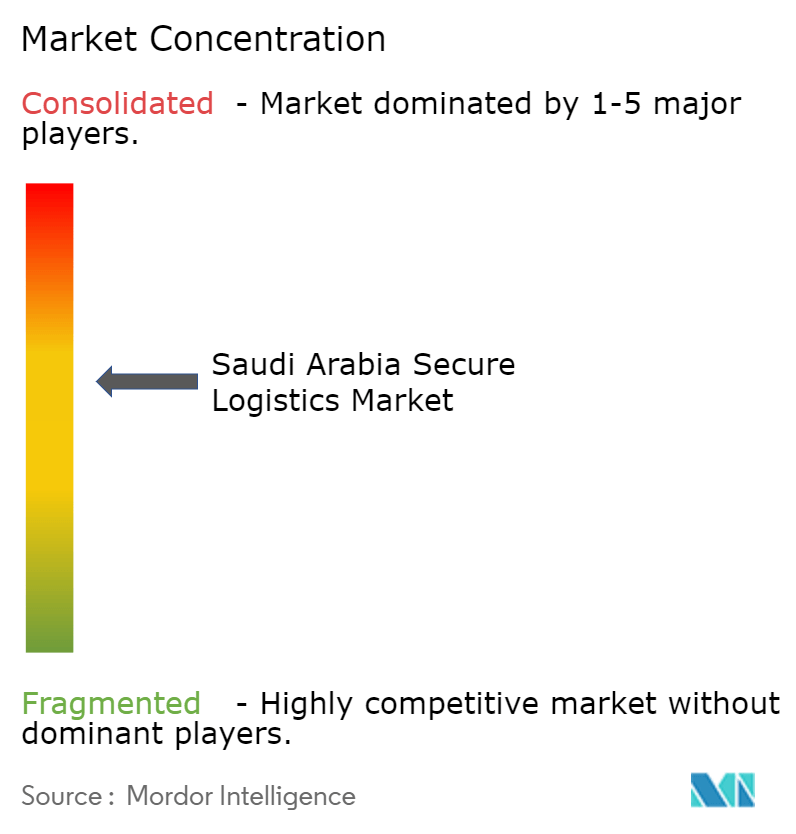
The Saudi Arabia secure logistics market is moderately consolidated among leading licensed providers and fragmented across smaller operators. Domestic specialists including SANID, AMNCO, APSG, Alfareeq, and Hemaia Group benefit from local licensing knowledge, government relationships, and workforces aligned with Saudi requirements. International companies including Brink’s, GardaWorld, Prosegur Cash, Loomis, G4S, and Securitas compete where customers require multinational processes, cash automation, insurance frameworks, or specialist high-value cargo services. Competitive strength depends on the ability to operate compliant fleets, secure facilities, cash centers, tracking systems, trained crews, formal custody procedures, insurance arrangements, and customer reporting systems that remain dependable across daily routes. The main barriers include vehicle standards, the 5-year fleet replacement cycle, licensing, capital needs, and regular compliance audits.[4]
Technology is becoming an important point of differentiation in the Saudi Arabia secure logistics market. Command-and-control centers can oversee routes, vehicle status, ATM activity, and incident response across large service networks. APSG reported the capacity to monitor more than 4,500 ATMs and over 300 armored vehicles through its command-and-control operations. Prosegur Cash is associated with smart-container and cash automation approaches that reduce manual handling in the custody chain. SAL’s 2025 memorandum of understanding with STC focused on AI- and IoT-enabled logistics solutions, including shipment monitoring and supply-chain workflows. These moves show why integrated monitoring, automated processes, live route visibility, documented handovers, exception alerts, and consolidated reporting can support premium contracts and help operators manage complex customer requirements.
White-space opportunities center on precious-metals logistics and technology-enabled cash management. Specialists such as Malca-Amit and Ferrari Group have global experience in high-value cargo, although their Saudi footprint is more limited than that of leading local providers. Banks can place value on outsourced services that combine ATM cash forecasting, reconciliation, cash centers, and route execution. The proposed blockchain framework for container release at NEOM Port reflects continuing interest in better documentation and custody records for port logistics. Well-capitalized providers are better placed to fund vehicle upgrades, telematics, secure facilities, smart-container systems, specialized staff, cash-center capacity, and the operating controls required to win larger or more complex assignments. Smaller operators face greater pressure when these investments are required before they can compete for larger contracts.
Saudi Arabia Secure Logistics Industry Leaders
-
Saudi Financial Support Services Company (SANID)
-
Advanced Private Security Group (APSG)
-
AMNCO
-
Metras Security Services
-
Alfareeq Security Services
- *Disclaimer: Major Players sorted in no particular order
Saudi Arabia Secure Logistics Market Companies Covered in this Report
- Saudi Financial Support Services Company (SANID)
- Advanced Private Security Group (APSG)
- AMNCO
- Metras Security Services
- Alfareeq Security Services
- The Brink’s Company
- G4S Limited
- GardaWorld Security Corporation
- Prosegur Cash, S.A.
- Loomis AB
- Ferrari Group
- DHL Group
- Al-Muwaffaq Security Services (MSS)
- Securitas AB
- Saudi Security Company
- Sarim Security Guard Company
- Hemaia Group
- Malca-Amit
- ETS Risk Management
Recent Industry Developments in Saudi Arabia Secure Logistics Market
- August 2026: SAL Logistics Services received the IATA Security Management System (SeMS) Level 1 (Suitable) certification, becoming the first company in Saudi Arabia and the second across the Middle East and North Africa to earn the designation. The certification, conferred by IATA at its Geneva headquarters, validates SAL's risk-based security management framework across cargo handling and ground operations, directly strengthening the confidence of airlines, freight forwarders, and government regulators in SAL's capacity to manage high-value and sensitive cargo consignments in line with Saudi Vision 2030 and the National Transport and Logistics Strategy.
- March 2025: Saudi Ports Authority (Mawani) signed a SAR 200 million (USD 53.29 million) logistics zone agreement at King Abdulaziz Port in Dammam covering 197,000 square meters, aligned with the National Transport and Logistics Strategy, adding proximity secure warehousing adjacent to the Eastern Province's primary maritime gateway.
- March 2025: SAL Logistics Services signed an MoU with STC during the LEAP 2025 technology conference to jointly develop AI- and IoT-enabled logistics solutions, including shipment monitoring and AI-enabled supply chain workflows, signaling that real-time digital visibility is becoming a baseline expectation for secure cargo categories.
- January 2025: AMNCO (BATIC subsidiary) secured a SAR 96.2 million (USD 25.63 million) three-year security contract from Saudi Arabia's Ministry of Transport and Logistics Services for 24/7 industrial security and patrols on the Haramain High-Speed Railway, connecting Makkah, Madinah, Jeddah, and King Abdullah Economic City. The award marks one of the largest dedicated secure logistics/security infrastructure contracts in the Kingdom and materially strengthens AMNCO's positioning for future transport-hub mandates.
Saudi Arabia Secure Logistics Market Report Scope
Segmentation Overview
| Transportation | Road |
| Rail | |
| Air | |
| Sea and Inland Waterways | |
| Warehousing and Storage (including Secure Storage and Vault Services) | |
| Value-added Services |
| Cash Management |
| Diamonds |
| Jewelry and Precious Metal |
| Manufacturing |
| Others |
| Static |
| Mobile |
| Financial Institutions |
| Retailers |
| Government |
| Others |
| By Service Type | Transportation | Road |
| Rail | ||
| Air | ||
| Sea and Inland Waterways | ||
| Warehousing and Storage (including Secure Storage and Vault Services) | ||
| Value-added Services | ||
| By Application | Cash Management | |
| Diamonds | ||
| Jewelry and Precious Metal | ||
| Manufacturing | ||
| Others | ||
| By Type | Static | |
| Mobile | ||
| By End User | Financial Institutions | |
| Retailers | ||
| Government | ||
| Others |
Key Questions Answered in the Report
What is the projected Saudi Arabia secure logistics market size by 2032?
The Saudi Arabia secure logistics market is forecast to reach USD 1.03 billion by 2032, growing at a 7.72% CAGR from 2027. The outlook reflects demand for licensed cash handling, high-value cargo custody, managed cash operations, and secure transport services across expanding logistics infrastructure.
Which service has the largest share of secure logistics revenue in Saudi Arabia?
Transportation led with a 62.50% share in 2026 because banks, ATMs, retailers, currency exchangers, and regulated entities require armored transport and controlled cash handling. Road routes dominate daily servicing, while air transport supports selected high-security gold and jewelry movements.
What application is growing fastest in Saudi secure logistics?
Jewelry and precious metals are forecast to grow at an 8.68% CAGR through 2032, supported by high-value cargo movements and demand for controlled handling. The application requires secure airport or port transfers, documented custody, temporary storage, specialized insurance, and armored last-mile delivery.
Why do banks outsource cash-management operations in Saudi Arabia?
Specialist providers operate compliant cash centers, armored fleets, and monitoring systems, which help banks meet SAMA rules for ATM replenishment and cash custody. Outsourcing can combine cash processing, currency sorting, ATM servicing, route management, reconciliation, reporting, and vault operations under a defined service model.
How do digital payments affect cash-in-transit providers?
Electronic payments can reduce routine retail cash pickups, but cash still accounted for 22% of consumer transactions in January 2025. Operators with cash centers, vault operations, high-value goods services, and efficient route management are better able to balance lower pickup density in some retail locations.
What are the main barriers to entry for secure logistics providers?
VPAM6 vehicle standards, the 5-year vehicle life limit, licensing requirements, trained crews, secure facilities, and tracking systems require sustained capital investment. New providers also need operational processes for verified handovers, compliance reporting, cash custody, vehicle monitoring, insurance, and customer response across distributed service routes.