
Market Overview
| Study Period | 2021 - 2031 |
|---|---|
| Forecast Data Period | 2026 - 2031 |
| Base Year Market Size (2025) | USD 23.57 Million |
| Market Size (2026) | USD 25.13 Million |
| Market Size (2031) | USD 34.63 Million |
| Growth Rate (2026 - 2031) | 6.62 % |
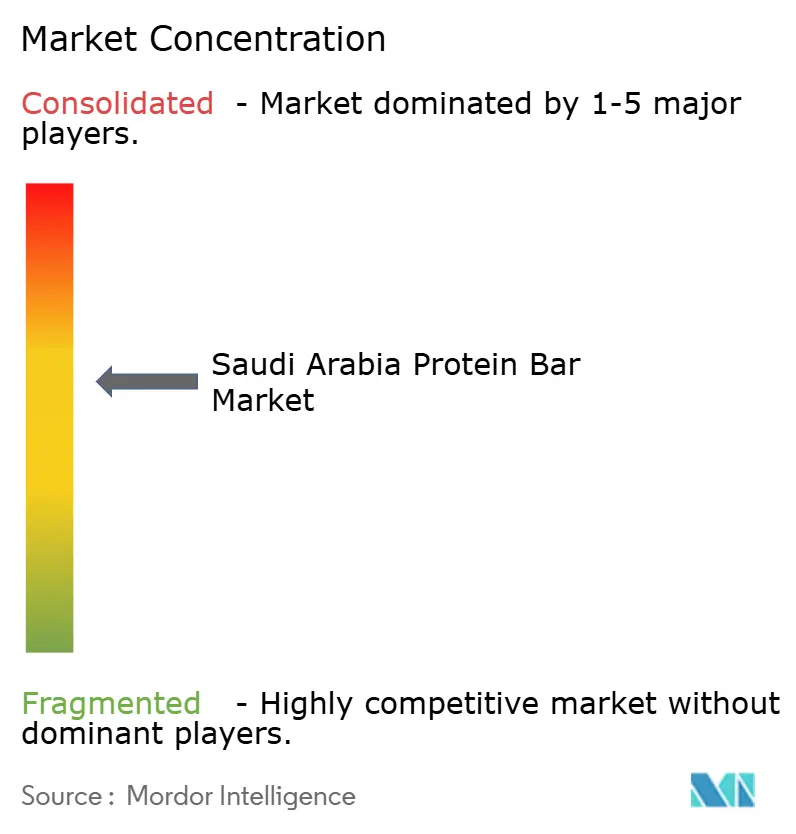
| Market Concentration | Medium |
Major Players *Disclaimer: Major Players sorted in no particular order Image © Mordor Intelligence. Reuse requires attribution under CC BY 4.0. | |
Saudi Arabia Protein Bar Market Analysis by Mordor Intelligence
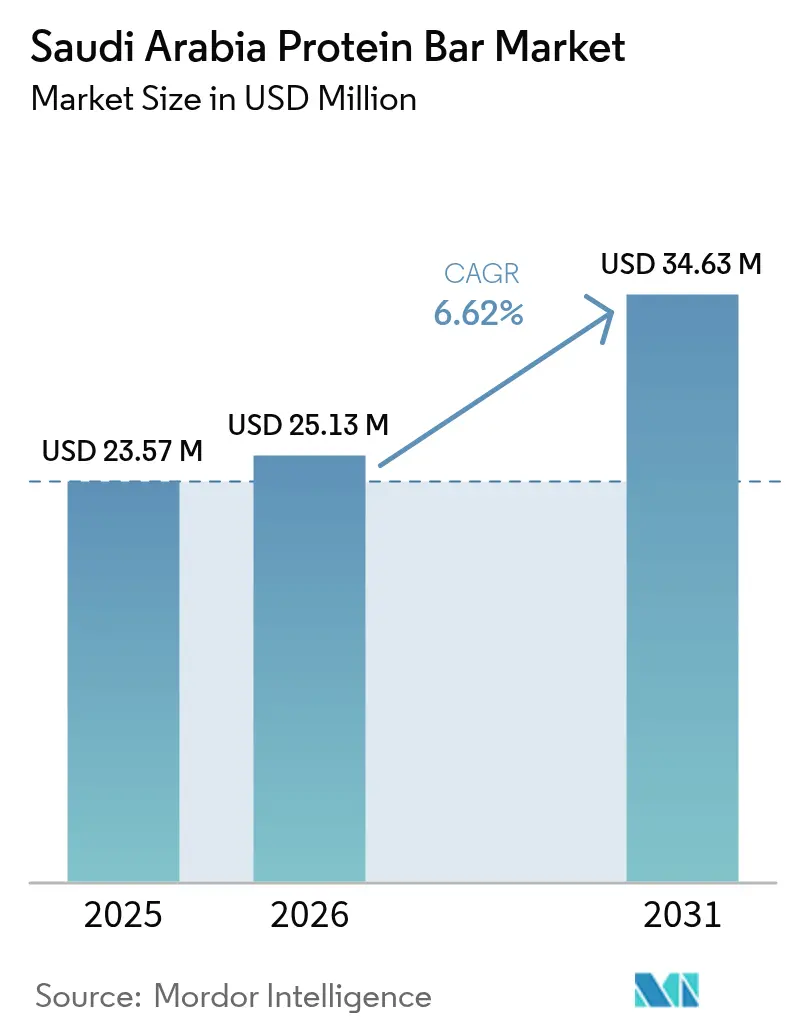
The Saudi Arabia protein bar market size was valued at USD 23.57 million in 2025 and estimated to grow from USD 25.13 million in 2026 to reach USD 34.63 million by 2031, at a CAGR of 6.62% during the forecast period (2026-2031). This steady climb mirrors the Kingdom’s Vision 2030 focus on healthier living, the mainstreaming of fitness culture, and the widening availability of convenient on-the-go nutrition. Structural reform has opened new female-only fitness centers, e-commerce platforms have shortened the path to purchase, and major retailers now dedicate premium shelf space to functional snacks. International brands continue to introduce differentiated formulations, while local firms experiment with date-based protein bars that align with cultural tastes and could benefit from subsidy programs aimed at stimulating domestic food manufacture. Competitive intensity is moderate, giving both entrenched multinational leaders and agile Saudi innovators room to defend or grow share through localization, ingredient sourcing shifts, and digital marketing that targets the nation’s youthful consumer base.
Key Report Takeaways
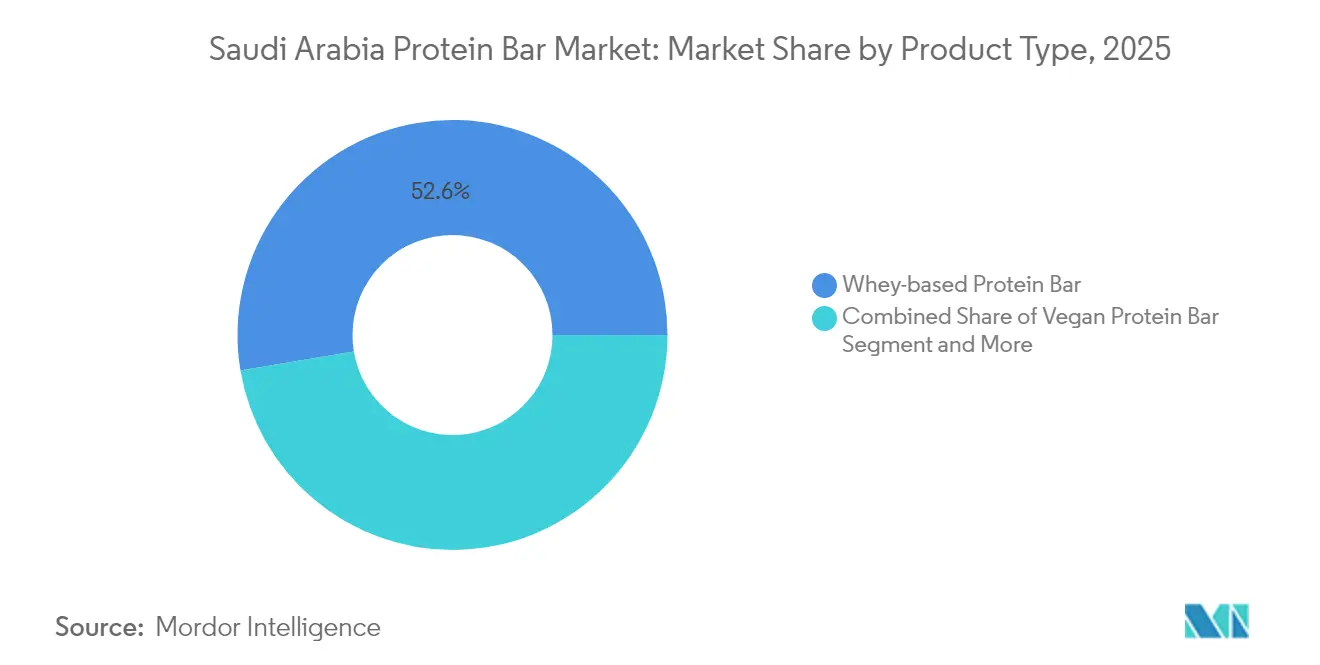
- By type, whey-based protein bars led with 52.64% of the Saudi Arabia protein bar market share in 2025, while vegan protein bar tends to be the fastest type, registering a CAGR of 11.12%, through 2031.
- By function, post-workout recovery accounted for 32.22% share of the Saudi Arabia protein bar market size in 2025 and sports nutrition lead, registering a CAGR of 9.71%, through 2031.
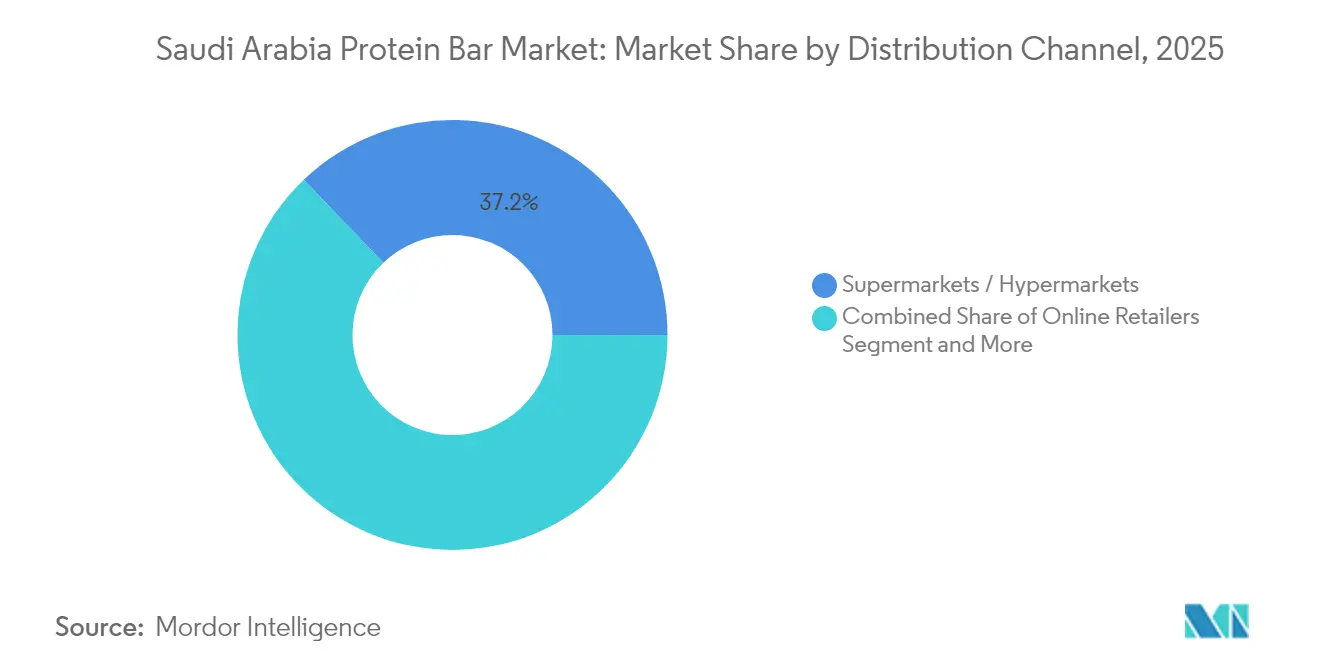
- By distribution channel, supermarkets and hypermarkets captured 37.16% share of the Saudi Arabia protein bar market size in 2025, while online retailers are advancing at a 12.45% CAGR through 2031.
Note: Market size and forecast figures in this report are generated using Mordor Intelligence’s proprietary estimation framework, updated with the latest available data and insights as of 2026.
Saudi Arabia Protein Bar Market Trends and Insights
Drivers Impact Analysis*
| Driver | ( ) % Impact on CAGR Forecast | Geographic Relevance | Impact Timeline |
|---|---|---|---|
| Rising health & fitness culture among youth | +1.5% | National, concentrated in Riyadh, Jeddah, Dammam | Medium term (2-4 years) |
| Increasing demand for convenient on-the-go nutrition | +1.8% | National, urban concentration | Short term (≤ 2 years) |
| Expansion of modern retail & e-commerce penetration | +2.1% | National, led by major cities | Short term (≤ 2 years) |
| Government healthy-living initiatives (Vision 2030) | +0.9% | National | Long term (≥ 4 years) |
| Surge in female gym memberships post-reform | +1.2% | National, particularly urban centers | Medium term (2-4 years) |
| Localization of date-based protein bars & subsidy support | +0.8% | National, manufacturing hub focus | Long term (≥ 4 years) |
| Source: Mordor Intelligence | |||
Rising Health & Fitness Culture Among Youth
Saudi Arabia counts 63% of its residents under 30, creating a demographic powerhouse that expects fitness facilities to be as accessible as coffee shops. Gyms such as GymNation are partnering with local investors to roll out spacious, low-priced clubs in Riyadh, Jeddah, and Dammam, normalizing structured exercise across socioeconomic tiers. Government-led “Sports for All” campaigns channel Vision 2030 budgets into community events, university leagues, and workplace wellness competitions, all of which integrate protein bars into post-activity routines. Social media magnifies these shifts: Saudi influencers post workout videos and “snack hauls” that feature the newest flavors, while global athletes visiting for high-profile boxing or Formula E events endorse portable protein. The Saudi Arabia protein bar market therefore enjoys a pipeline of first-time buyers who quickly graduate to habitual use once they associate bars with performance gains.
Increasing Demand for Convenient On-the-Go Nutrition
The pace of urban employment, particularly on Vision 2030 mega-projects such as NEOM, leaves little room for seated meals. Busy professionals reach for individually wrapped bars that deliver 15–20 g of protein in seconds, sidestepping time and refrigeration constraints. Portable nutrition spikes during Ramadan: consumers rely on bars to supply protein between sunset iftar and the pre-dawn suhoor, smoothing energy levels during daylight fasting hours. Foodservice operators now place branded bar displays near cashier zones, encouraging impulse purchases at gyms, petrol stations, and co-working cafés. To sustain demand, manufacturers promote multi-bar “office pack” formats, aligning with employers’ wellness programs and bulk-ordering platforms. All these factors keep the Saudi Arabia protein bar market in view of professionals striving to balance dietary quality with demanding schedules.
Expansion of Modern Retail & E-Commerce Penetration
Panda operates 198 hypermarkets and four distribution centers, Tamimi Markets plans to double its 90-store footprint, and Al Othaim runs 256 branches nationwide. Each chain devotes end-caps and eye-level shelves to functional snacks, backed by point-of-sale education that demystifies protein content and flavors. Simultaneously, grocery apps supported by government digitalization policies deliver nationwide, offering same-day or next-day drop across the Kingdom. With year-round temperatures exceeding 40 °C, producers rely on cold-chain logistics specialists such as Abbar Foods to preserve bar texture and prevent fat bloom during transit. E-commerce sites allow consumers to filter by protein grams, allergen status, and halal certification, increasing the chance of first-time trials. Subscription models further embed buying habits, translating retail infrastructure improvements directly into Saudi Arabia protein bar market value.
Government Healthy-Living Initiatives (Vision 2030)
Vision 2030’s Quality of Life Program stipulates the construction of sports facilities, cycling paths, and public parks in every major city. The National Center for Health Promotion now funds awareness campaigns on balanced diets, with televised segments that feature protein bars as post-exercise refueling tools. The Saudi Food and Drug Authority revised nutrition-labeling regulations in 2024, forcing brands to disclose complete amino-acid profiles and sugar-alcohol content. Transparent labels reward premium formulations and nudge consumer choice toward bars with cleaner ingredient lists. Complementing demand-side signals, the National Industrial Development and Logistics Program extends duty exemptions on imported machinery for local bar production lines, encouraging manufacturers to shift assembly and wrapping to Saudi plants over the long term. Policy coherence therefore underpins both the supply and the demand for protein bars.
Restraints Impact Analysis*
| Restraint | ( ) % Impact on CAGR Forecast | Geographic Relevance | Impact Timeline |
|---|---|---|---|
| High landed cost due to import dependency | –0.7% | National, stronger in price-sensitive segments | Short term (≤ 2 years) |
| Competition from alternative snack formats | –0.5% | National, modern retail channels | Medium term (2-4 years) |
| Impending sugar-content tax extension to bars | –0.4% | National | Medium term (2-4 years) |
| Shelf-life & cold-chain hurdles in desert climate | –0.3% | National, rural distribution | Short term (≤ 2 years) |
| Source: Mordor Intelligence | |||
High Landed Cost Due to Import Dependency
Specialty ingredients such as whey isolate and chicory-root fiber arrive through Jeddah Islamic Port, incurring freight surcharges and currency-related volatility. Post-COVID freight prices have stabilized yet remain 18–22% above 2019 baselines, pushing up ex-factory prices. The imposition of 15% VAT in 2020 and selective excise duties on sugary foods further compress retail margins. PepsiCo’s USD 300 million expansion in Dammam underscores industry commitment to curbing import reliance, but local procurement still cannot supply micronized leucine or certain heat-stable enzymes at commercial scale. Brands must choose between absorbing extra costs, downsizing bar weight, or passing rises to consumers—each option risking volume softness in the Saudi Arabia protein bar market’s value segment.
Competition from Alternative Snack Formats
Protein-fortified yogurts from Almarai, sugar-free protein cookies from Nestlé’s FITNESS line, and high-protein camel-milk shakes all encroach on occasions historically owned by bars. The reformulation of traditional Saudi ma'amoul with added pea protein offers familiar taste at competitive price points, seducing consumers who would otherwise experiment with imported bars. Nestlé’s FITNESS No Sugar Protein Bar leverages a household brand identity that eases shopper hesitation in front of crowded snack aisles. As cross-category protein options proliferate, companies must invest in flavor innovation, portion versatility, and experiential marketing to keep the Saudi Arabia protein bar market from ceding share to wider snack alternatives.
*Our forecasts treat driver/restraint impacts as directional, not additive. The impact forecasts reflect baseline growth, mix effects, and variable interactions.
Segment Analysis
By Type: Whey Dominance Meets Vegan Acceleration
The whey-based segment represented 52.64% of the Saudi Arabia protein bar market share in 2025, underpinning overall category leadership through brands such as Quest, Atkins, and Optimum Nutrition. Whey’s superior amino-acid spectrum and rapid absorption resonate with gym-centric consumers seeking proven performance benefits. Larger players secure price advantages by leveraging global whey procurement contracts, while domestic importers maintain chilled facilities to protect protein integrity during sea transit. The segment also profits from medical endorsement: sports-science clinics embedded in Riyadh’s King Abdullah Sports City often recommend 20 g whey snacks post-session. Consequently, the Saudi Arabia protein bar market size attributable to whey formulations is expected to expand in line with new gym buildouts and personal-trainer adoption of protein tracking apps that link directly to bar purchase reminders.
Vegan bars, forecast to grow at an 11.12% CAGR through 2031, ride a wave of plant-based curiosity among millennials and Gen Z Muslims who see ethical and environmental value in alt-protein sources. Simply Good Foods’ acquisition of OWYN extends a ready-to-drink loyalist pool into bar formats, giving cross-channel leverage. Domestically, SMEs blend Saudi dates with chickpea or fava-bean protein to achieve 12–15 g protein targets without soy or dairy allergens. Retailers allocate “plant powered” shelves to differentiate these SKUs from legacy whey, and e-commerce algorithms surface vegan bundles during Eco-Friendly Week promotions. Should import tariffs on pea protein isolate taper under prospective GCC agreements, vegan bars could approach price parity with whey, pushing the Saudi Arabia protein bar market size for plant-based lines beyond current projections.

By Function: Recovery Focus Drives Sports Nutrition Expansion
Post-workout recovery bars captured 32.22% of the Saudi Arabia protein bar market share in 2025. Their positioning, centered on muscle repair within the anabolic window, fits narratives promoted by gym influencers and physiotherapists. Formulations typically pair 20 g protein with 2 g creatine and electrolytes, marketing a “one-pack solution” for post-training needs. These SKUs enjoy distribution privileges at gym reception counters, where impulse grabbing is common after exhausting sessions. Packaging frequently includes QR codes linking to body-composition tracking apps, embedding bars in holistic self-improvement journeys that reinforce brand loyalty across urban fitness clusters.
Sports-nutrition-specific bars, while only nascent, are advancing at a 9.71% CAGR, signaling a transition from generic recovery to sport-tailored macronutrient ratios. Marathon-oriented bars fine-tune maltodextrin-to-fructose matrices for endurance fuel, whereas strength-athlete bars emphasize higher leucine for muscle protein synthesis. The Ministry of Sport’s increased funding for federations—fencing, climbing, triathlon—creates discipline-specific academies that stock such bars in onsite vending machines. Manufacturers co-sponsor race events, providing sample kits inside registration packs and capturing CRM data for targeted remarketing. This deep vertical integration positions performance-centric SKUs as premium extensions within the Saudi Arabia protein bar market.
By Distribution Channel: Traditional Retail Strength Faces Digital Disruption
Supermarkets and hypermarkets commanded a 37.16% slice of the Saudi Arabia protein bar market size in 2025, benefitting from weekly grocery habits and trust in well-lit aisles. End-cap displays featuring clear calorie counts encourage trial among family shoppers seeking better-for-you snacks for school lunchboxes. Retailers allocate loyalty-program points multipliers to protein-bar purchases during White Friday sales, lifting volumes without permanent price erosion. Instore dieticians conduct weekend demos, explaining amino-acid profiles and steering consumers toward multi-flavor variety packs that increase average basket value. While foot traffic remains robust, supermarkets face mounting pressure to differentiate as online platforms erode convenience advantages once exclusive to brick-and-mortar.
Online retailers, scaling at 12.45% CAGR, exploit frictionless checkout, nationwide reach, and algorithm-driven personalization that suggests bars based on previous searches for whey protein powder or calorie-tracking apps. E-pharmacies such as Nahdi Online add credibility by vetting ingredient lists and offering pharmacist chat support. Subscription models deliver 12-bar monthly boxes with rotating flavors, locking households into recurring revenue streams and generating predictive demand curves that optimize factory scheduling. Flash-sales timed around sunset during Ramadan create surge orders, addressed by expanded fulfillment centers near Jeddah and Riyadh airports. With rising smartphone penetration already above 93%, the Saudi Arabia protein bar market sees digital as both the fastest-growing end-point and a data goldmine for micro-targeted product development.
Geography Analysis
Riyadh accounts for the single-largest share of the Saudi Arabia protein bar market, reflecting the city’s 7.8 million population, highest gym density per capita, and concentration of corporate headquarters that purchase wellness packages for employees. Disposable incomes support premium bars priced 15–28% above national averages, and café-adjacent fitness studios feed steady demand for grab-and-go post-workout snacks. Jeddah follows as a commercial hub with strong expatriate presence, whose familiarity with international fitness products accelerates brand trial and pushes flavor diversification beyond date and chocolate toward peanut butter crunch and blueberry muffin variants. The Eastern Province, buoyed by Aramco employment clusters, exhibits high weekday morning sales as shift workers buy bars en route to industrial sites.
Secondary urban centers—Medina, Taif, Khobar—are poised for catch-up, driven by government mandates for balanced regional development. As malls open in these cities, anchor hypermarkets replicate health aisles seen in Riyadh and Jeddah, ensuring consistent product set. Yet distribution still contends with hot-chain breaches along long desert highways, pressing suppliers to equip trucks with real-time temperature telemetry and contingency stopovers at refrigerated depots. Rural penetration remains lowest; however, the Ministry of Municipal and Rural Affairs funds 18 new logistics hubs that could shorten lead times and mitigate melt risks. For the Saudi Arabia protein bar market, geography thus dictates iterative network investment, flavor adaptation to conservative palates, and phased marketing spend calibrated to urban income strata.
Regulatory Landscape
Protein bars marketed in Saudi Arabia fall under the Saudi Food and Drug Authority (SFDA) oversight as foods with special nutritional uses (including complementary sport foods), which makes pre-market compliance on composition, labeling, and claims central to launch planning. For market access, products and establishments must be registered through SFDA digital systems, including the Ghad platform for food product registration. Imported consignments are handled through SFDA food import control procedures and clearance workflows that use the Fasah trade platform.
Claims and labeling are enforced through SFDA-aligned/GSO technical requirements, including Arabic or bilingual labeling and substantiation rules for nutrition and health claims under SFDA guidance. Protein-related claims require defined qualifying criteria and scientific evidence. For transparency in out-of-home channels, a key anchor is the SFDA requirement for detailed nutrition disclosure on food establishment menus, effective July 1, 2025, which raises the documentation burden for brands that sell protein bars through gyms, cafes, and other foodservice-adjacent points of sale.
Value Chain Analysis
The value chain starts with imported ingredient inputs, such as whey fractions, fibers, and functional inclusions, alongside locally sourced components like dates. Production then typically moves through blending and forming or extrusion, optional enrobing, and flow-wrap packaging. Scale and entry depend on SFDA licensing and operational compliance for manufacturing sites and warehouses under the Food Law and related technical requirements, including labeling and storage standards. Clearance and traceability for imported materials and finished goods are supported by SFDA digital processes (Ghad) and trade clearance workflows (Fasah).
Downstream, distribution splits across modern retail (hypermarkets and supermarkets), pharmacy and specialty nutrition channels, convenience outlets, and e-commerce, where assortment, claims clarity, and temperature resilience affect conversion. With Saudi Arabia's heat exposure, cold-chain capable storage and transport, along with compliant warehousing practices, remain important to protect texture and shelf stability, particularly for chocolate-coated or higher-fat formulations. Vision 2030 localization initiatives and food security programs support gradual shifts toward domestic processing and packaging, but import reliance for specialized inputs continues to shape cost structures and supplier bargaining power.
Competitive Landscape
Global multinationals PepsiCo, Simply Good Foods, and Nestlé command shelf visibility through aggressive trade-marketing budgets, but local powerhouse Almarai leverages cold-chain prowess and brand familiarity to defend share in dairy-adjacent snack bars. Moderate concentration (6/10) reflects this tussle between scale and local insight. PepsiCo’s Dammam expansion adds extruded bar lines capable of running both whey and plant-based matrices, shortening replenishment cycles, and reducing the forex exposure attached to finished-goods imports. Simply Good Foods cross-sells Atkins snack bars in pharmacies where OWYN vegan shakes sit, broadening health baskets at complementary price points. Nestlé capitalizes on its first Saudi factory to roll out FITNESS-branded bars that pair naturally with the company’s breakfast-cereal franchise, tapping household trust established over decades.
Local innovators exploit cultural white space. SMEs package date-caramel flavors in gold foil, signaling premium gifting potential during Eid and National Day. Niche players experiment with camel-milk whey, seeking functional differentiation and story-telling resonance. Female-led startups craft bars sized for women’s caloric needs, marketing them through Instagram Live workouts hosted by certified trainers. To increase barriers to entry, incumbents sign long-term exclusives with Tamimi and Panda for prime shelf real estate, while digital natives secure top-of-search positions via keyword bidding wars on noon.com and Amazon.sa. The Saudi Arabia protein bar market therefore balances global heft with grassroots ingenuity, forging a dynamic yet disciplined playing field where localization and supply-chain agility are decisive.
Saudi Arabia Protein Bar Industry Leaders
-
PepsiCo
-
The Simply Good Foods Co.
-
General Mills
-
Barebells Functional Foods
-
Almarai Co.
- *Disclaimer: Major Players sorted in no particular order
Market Opportunities and Future Outlook
Localization of manufacturing and packaging is one of the clearest near-to-medium term opportunities, supported by government prioritization of food processing under Vision 2030 and the licensing frameworks that enable scalable domestic production under SFDA oversight. Program-led infrastructure such as the Jeddah Food Cluster (launched in 2024) is designed to bundle logistics, laboratories, storage, and workforce support for food manufacturers, which gives protein bar players a more practical route to shorten lead times, reduce reliance on finished-goods imports, and build export-ready quality systems.
Demand opportunities also center on nutrition positioning that is compliant and clearly substantiated as transparency requirements tighten. With detailed nutrition information mandated on menus from July 1, 2025, brands that already maintain strong nutritional analysis and claims substantiation can expand in gym-adjacent and cafe-style points of sale with less rework. In parallel, date-based and other culturally localized formulations provide room for differentiation within mainstream retail and online search filters. SFDA digital registration and licensing workflows for products, facilities, and food clearance also favor companies that bring regulatory documentation, artwork control, and import clearance planning into their go-to-market process early.
Recent Industry Developments
- May 2026: Barebells Functional Foods expanded its branded in-store execution by rolling out a dedicated, fully branded shelf at the WOQOD fuel and convenience network. The move highlights a push to win more impulse and on-the-go occasions through convenience formats and high-visibility retail theatre, a channel play that maps to similar forecourt and convenience store dynamics used for functional snacking in the Gulf.
- April 2026: The Simply Good Foods Company reiterated its portfolio strategy across nutritional snacking brands (including Quest, Atkins, and OWYN) in its SEC reporting and investor communications. The continued emphasis on protein-forward, lifestyle-oriented snacking supports further SKU rationalization and channel focus in wellness-led retail environments that overlap with Saudi Arabia's pharmacies, modern trade, and e-commerce.
- November 2024: The SFDA issued updated guidance for food product registration, reinforcing structured pre-market documentation and digital registration workflows for both imported and locally manufactured foods. Tighter registration discipline raises the compliance advantage for brands with strong label governance and verified claim substantiation, while increasing the setup burden for smaller entrants relying on rapid artwork changes.
Research Methodology Framework and Report Scope
Market Definition and Coverage
For this methodology, the market covers retail and online sales of protein bars in Saudi Arabia, counted in value terms as consumer spending on finished, packaged protein bars across mainstream and nutrition-focused channels.
Scope exclusions: We exclude protein powders, ready-to-drink shakes, confectionery bars without a protein positioning, and foodservice-only sales that are not tracked through retail channels.
Segmentation Overview
- By Type
- Vegan Protein Bar
- Whey-based Protein Bar
- Mixed Type Protein Bars
- By Function
- Meal-Replacement
- Post-Workout Recovery
- Sports Nutrition
- Others (Dietary Supplements, Energy Boost)
- By Distribution Channel
- Supermarkets / Hypermarkets
- Convenience and Grocery Stores
- Specialty Nutrition Stores
- Online Retailers
- Others
Data Sources, Market Sizing, and Validation
Desk Research
Desk work started by mapping how snack and functional food products are classified in Saudi Arabia, then aligning that with how protein bars are typically labeled and sold. To keep the inputs grounded, we referenced public sources such as Saudi Food and Drug Authority updates, General Authority for Statistics releases, Saudi Customs trade statistics, and other government publications that point to packaged food demand and imports.
We also reviewed brand-level announcements and category commentary from company filings and investor presentations, along with reputable press and retailer communications to understand distribution shifts and pricing direction. Where helpful, a paid subscription database was used for company financials and a separate paid dataset for import and export shipment-level checks to sense-check category flow. This list is not exhaustive, and many other sources were used for data collection, validation, and clarification during the research process.
Primary Interviews and Surveys
Primary work focused on confirming how protein bars are defined at shelf level, how pricing and promotions move over the year, and how much of demand is sold through general retail versus specialized nutrition outlets. We spoke with a mix of manufacturers, distributors, retailers, and category managers, and we checked assumptions with fitness and nutrition channel participants to clarify demand drivers and channel share splits across the country.
Distribution of primary research fieldwork respondents
| Company type | Respondent position |
|---|---|
| Top tier: 32% | CXOs: 13% |
| Mid tier: 51% | Functional/Unit leaders: 31% |
| Smaller Players: 17% | Managers: 56% |
Market-Sizing & Forecasting
Sizing started with a top-down build that reconstructs the Saudi Arabia demand pool from packaged snack and functional food spending signals, then filters it into the protein bar category using channel splits and category penetration validated in interviews. To keep totals realistic, we corroborated them with selective bottom-up approximations such as sampled SKU price points, observed promotion intensity, and volume proxies taken from distributor and retailer checks.
Inputs used in the model included average retail selling price ranges by channel, the share of online versus offline sales, the mix between regular and vegan-positioned protein bars, promotional frequency during peak shopping periods (including major seasonal weeks), and imported-versus-local supply signals where relevant. Forecasting was run using scenario analysis, with the base case and alternate cases driven by how fast modern retail expands, how online conversion improves for health products, and how pricing normalizes after promotion cycles. When a data gap appeared for smaller formats or niche channels, we handled it through conservative share allocation and then re-tested the assumption in follow-up calls before finalizing the totals.
Data Validation & Update Cycle
Outputs were checked in multiple ways so that unusual jumps did not pass through without explanation. We compared the modeled trend line with independent signals such as channel growth direction, import flow movement for comparable snack categories, and confirmed pricing behavior, then re-checked any variances that did not match what respondents described.
Before sign-off, the model went through step-by-step analyst reviews, including unit-consistency checks, currency timing checks, and year-on-year reasonableness tests across type and channel splits. Reports are refreshed annually, and interim updates are triggered when material events occur, such as sharp pricing resets, channel regulation changes, or meaningful shifts in distribution. Right before delivery, a final pass is done so clients receive the most up-to-date view based on the latest available information.
Mordor Intelligence's Saudi Arabia Protein Bar Market Sizing Compared With Other Published Estimates
Published market sizes for protein bars in Saudi Arabia can differ a lot, even when the same years are mentioned, because the counting rules are not consistent. Differences usually come from what products are treated as a protein bar, which channels are counted, and how average selling prices are projected forward.
Some published figures roll up adjacent nutrition items like meal replacement bars, sports nutrition snacks, or other functional foods, and this can increase the reported total. In Mordor Intelligence's model, the value is limited to finished protein bars sold through tracked retail and online channels, and figures are refreshed against current channel pricing and mix checks to avoid overstating spillover from nearby categories.
Benchmark comparison
| Source | Market Size | Gaps in Research Methodology |
|---|---|---|
| Mordor Intelligence | USD 23.57 M (2025) | |
| Industry Publisher A | USD 30.00 M (2024) | Often uses a wider basket that can include broader sports nutrition or snack bar groupings, and the year basis can reflect a different price level and retail mix that is not reconciled to channel-specific price checks. |
| Market Bulletin B | USD 3.10 M (2024) | Typically reflects a narrow interpretation of the category, with limited channel coverage or under-counting of modern retail and online volumes, which can compress the total when distribution expansion is not captured. |
Overall, the spread is mainly explained by how widely the category is defined and whether channel coverage and pricing are updated in line with how shoppers actually buy protein bars in the country. By keeping product inclusion rules clear, validating channel splits through interviews, and using repeatable price and mix inputs, the estimate stays traceable and practical for planning.
Key Questions Answered in the Report
How large is the Saudi Arabia protein bar market in 2026?
The Saudi Arabia protein bar market size is USD 25.13 million in 2026.
What is the projected CAGR of protein bar sales in Saudi Arabia through 2031?
Sales are forecast to post a 6.62% CAGR over 2026-2031.
What is the projected CAGR of protein bar sales in Saudi Arabia through 2031?
Sales are forecast to post a 6.62% CAGR over 2026-2031.
Which protein source dominates bar formulations sold in Saudi Arabia?
Whey-based bars lead with 52.64% market share in 2025.
Why are vegan protein bars growing faster than other types?
Demand stems from rising plant-based diets and local innovations that blend Saudi dates with pea or rice protein, driving an 11.12% CAGR.