
Market Overview
| Study Period | 2020 - 2031 |
|---|---|
| Forecast Data Period | 2026 - 2031 |
| Base Year Market Size (2025) | USD 2.85 Billion |
| Market Size (2026) | USD 3.23 Billion |
| Market Size (2031) | USD 6.08 Billion |
| Growth Rate (2026 - 2031) | 13.45 % |
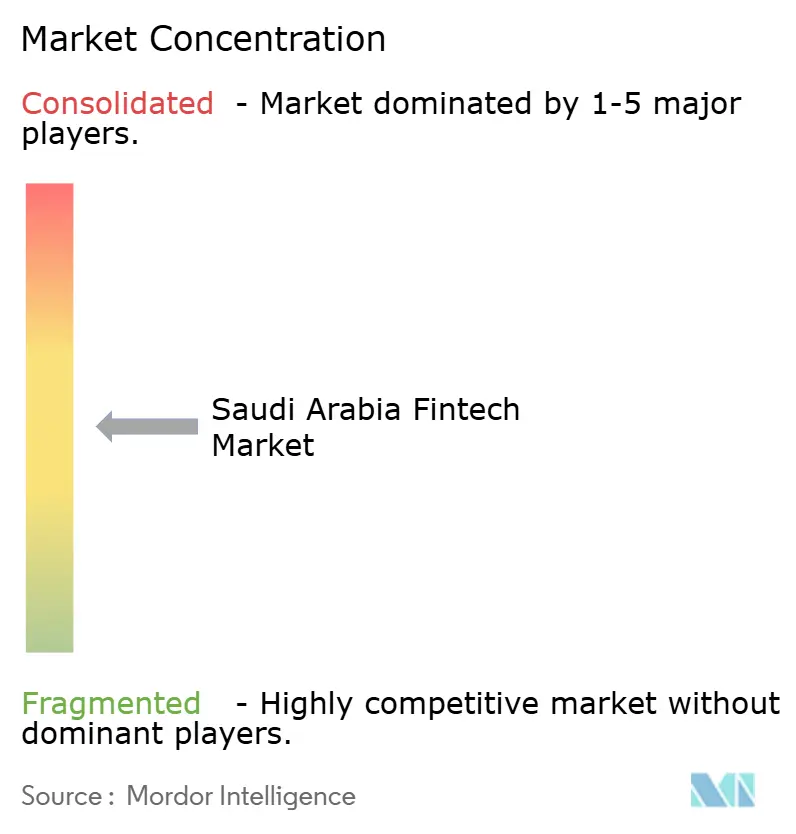
| Market Concentration | Medium |
Major Players
*Disclaimer: Major Players sorted in no particular order Image © Mordor Intelligence. Reuse requires attribution under CC BY 4.0. |
|
Saudi Arabia Fintech Market Analysis by Mordor Intelligence
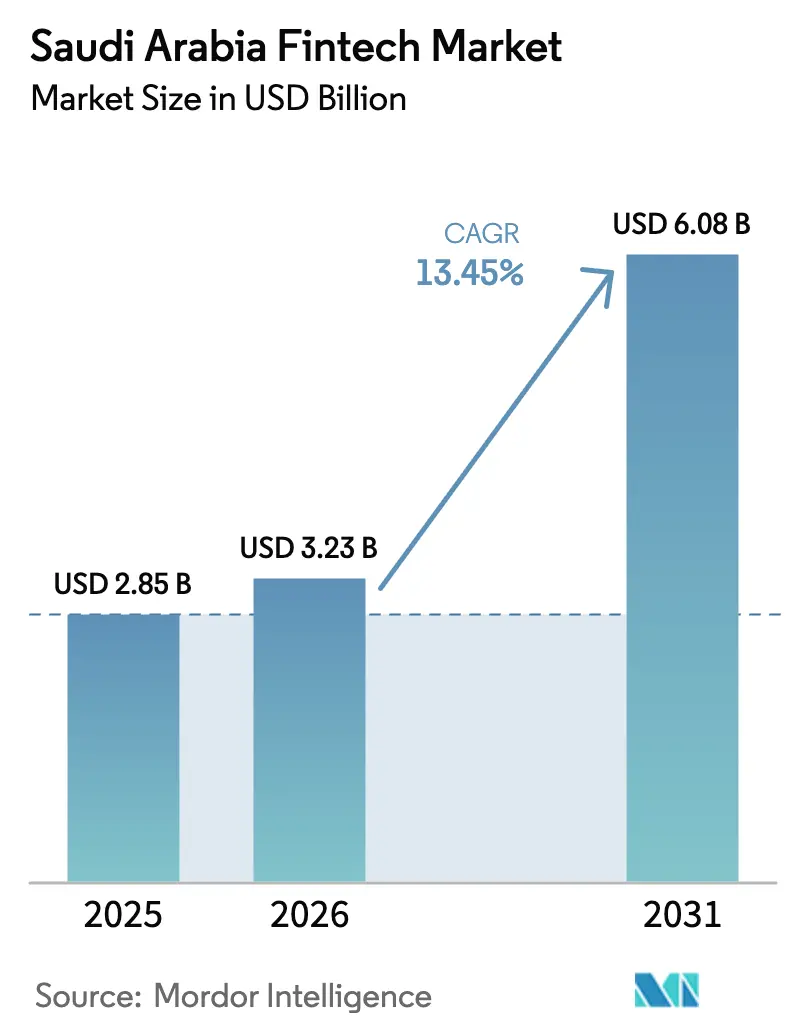
The Saudi Arabia Fintech Market size was valued at USD 2.85 billion in 2025 and is estimated to grow from USD 3.23 billion in 2026 to reach USD 6.08 billion by 2031, at a CAGR of 13.45% during the forecast period (2026-2031).
The growth pattern reflects policy-led modernization that embeds finance in commerce, public services, and everyday transactions. Open banking APIs and embedded finance models shift financial access from traditional channels into retail and digital ecosystems, which is changing product design and customer journeys. Regulatory clarity and targeted licensing have expanded the number of licensed firms and concentrated investment in scalable use cases tied to Vision 2030 programs. The operating environment also benefits from agile infrastructure, with national payment rails and consent-based data access in place to enable wider fintech adoption.
Key operating indicators support the momentum observed in the Saudi Arabian fintech market. By mid-2025, the ecosystem crossed 261 licensed firms, created 11,046 direct jobs, and attracted SAR 7.9 billion (USD 2.1 billion) in cumulative funding, outpacing earlier targets by a wide margin. Electronic payments accounted for 79% of all retail transactions in 2024, while near-field communication payment adoption reached 94%, which positioned the Kingdom at the top of global rankings on this metric.
Key Report Takeaways
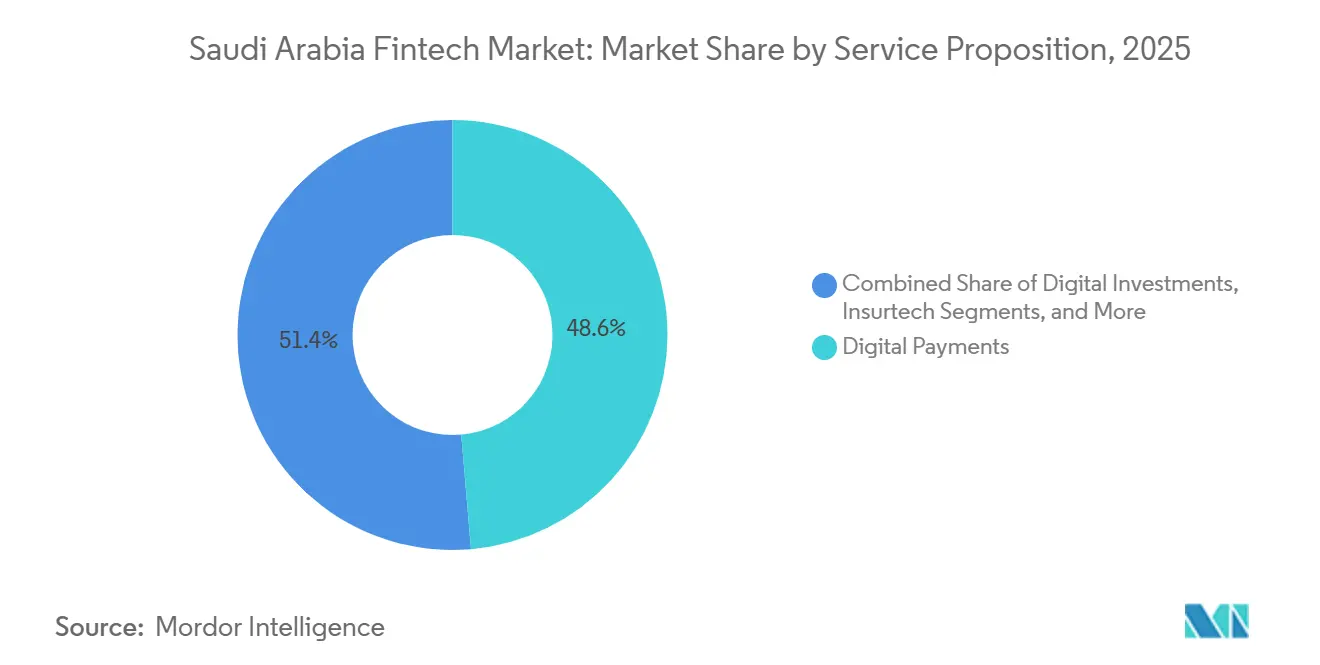
- By service proposition, digital payments led with 48.62% market share in 2025; neobanking is forecasted to expand at a 16.31% CAGR to 2031.
- By end-user, the retail segment held 64.17% share in 2025; business services recorded the highest projected CAGR at 14.02% through 2031.
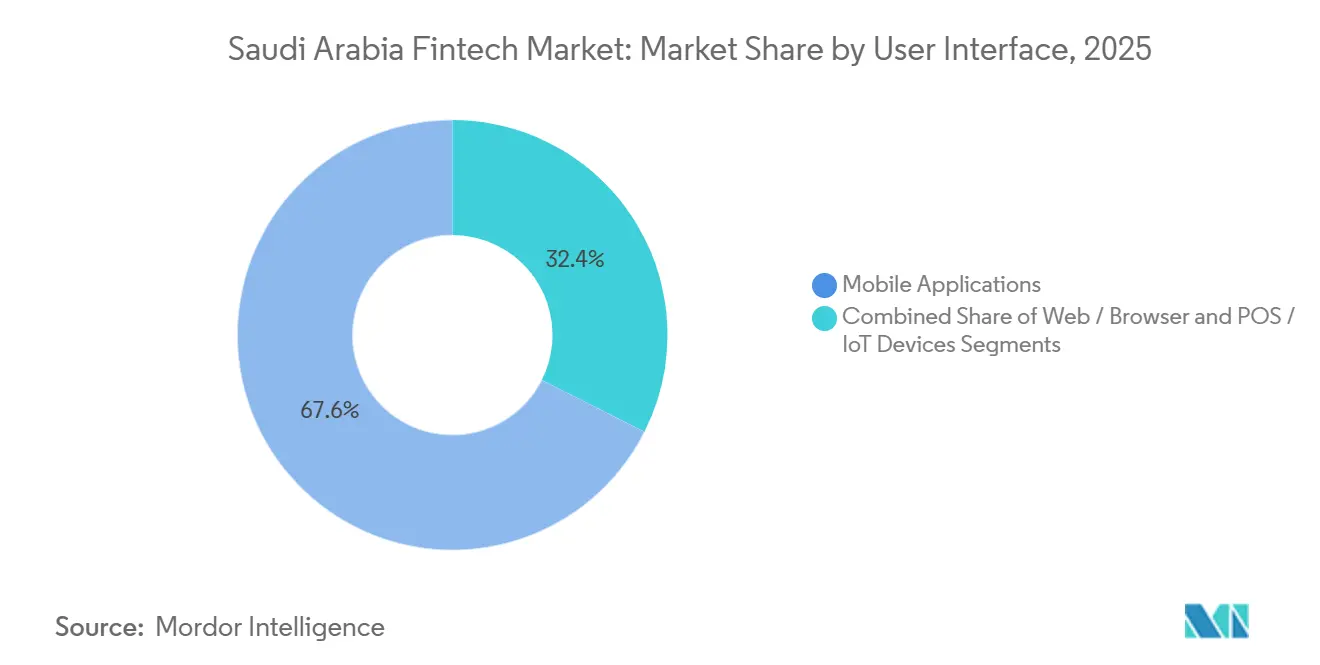
- By user interface, mobile applications accounted for a 67.59% share in 2025; the mobile segment is advancing at a 15.27% CAGR through 2031.
Note: Market size and forecast figures in this report are generated using Mordor Intelligence’s proprietary estimation framework, updated with the latest available data and insights as of January 2026.
Saudi Arabia Fintech Market Trends and Insights
Drivers Impact Analysis*
| Driver | (~) % Impact on CAGR Forecast | Geographic Relevance | Impact Timeline |
|---|---|---|---|
| National Vision 2030 digital transformation mandate | +3.2% | National, strongest in Riyadh, Jeddah, and Eastern Province technology hubs | Medium term (2-4 years) |
| High smartphone penetration and youth-driven mobile uptake | +2.8% | National, acute in urban centers with 99% internet connectivity | Short term (≤ 2 years) |
| SAMA open-banking framework rollout | +2.5% | National, early concentration in major banks and licensed fintechs in the Central Region | Medium term (2-4 years) |
| Hajj and Umrah-driven seasonal digital payment spikes | +1.4% | Makkah and Madinah regions, with nationwide spillover to hospitality and transport | Short term (≤ 2 years) |
| SME credit gap propelling alternative lending | +2.1% | National, the highest intensity in manufacturing and retail across provinces | Long term (≥ 4 years) |
| Rising preference for Shariah-compliant products | +1.5% | National, stronger in conservative regions and government-linked enterprises | Medium term (2-4 years) |
| Source: Mordor Intelligence | |||


National Vision 2030 Digital Transformation Mandate Fueling Fintech Adoption
The Financial Sector Development Program’s push to scale licensed fintechs that align regulatory approvals with employment and GDP-linked outcomes has accelerated licensing throughput. Regulatory sandboxes for open banking and peer-to-peer models confer a protected experimentation period that establishes early leadership advantages. The mandate is reinforced by sovereign coordination, where capital allocation aligns with Vision 2030 KPIs such as SME financing penetration, non-cash transaction share, and skilled job creation in fintech. Access to national rails like the Mada network and the real-time Sarie system is a further differentiator, while the Personal Data Protection Law, effective since September 2024, has raised compliance thresholds for cross-border entrants through data residency rules and defined penalties[1]ICLG Editors, “Fintech Laws and Regulations Report 2025-2026: Saudi Arabia,” ICLG, iclg.com.
High Smartphone Penetration Enabling Mobile Payment Uptake Across Saudi Youth
Smartphone penetration intersects with a demographic skew, which concentrates demand for mobile-first financial products. The shift to mobile channels is visible in banking usage patterns, with a clear preference for app-based account access and transaction management that reduces distribution costs for providers. This preference fuels growth in categories where mobile delivery lowers distribution costs. Digital wallets expanded to 14.4 million active customers in 2024, up 52% year-over-year, while mobile point-of-sale terminals surged 18% to reach 2 million units. The generational split in digital wallet adoption for cross-border payments is 63% among Generation Z versus 28% among baby boomers, suggesting that cohort replacement alone will drive adoption curves upward over the next decade. Competitive ordering reflects these habits, as STC Pay’s wallet is among the most widely used alongside global platforms, with security frameworks and national cybersecurity standards reinforcing user trust[2]PYMNTS, "Saudi Small Businesses Rethink Payments for a Faster Future," PYMNTS, pymnts.com.
Launch of SAMA Open-Banking Framework Accelerating API-Led Innovation
SAMA’s staged open-banking implementation, beginning with account information services in November 2022 and expanding to payment initiation services in September 2024, emphasizes stability and security as adoption scales. Mandatory participation for licensed banks and optional participation for fintechs have broadened the perimeter of API-ready institutions as payment initiation became available, which helped push up digital service adoption. The 680% surge in open-banking transactions at Alinma and Bank Albilad stems from their early deployment of Banking-as-a-Service APIs, which allow fintechs to white-label bank products and split revenue rather than compete for direct customer relationships. Transaction volumes at banks that enabled Banking-as-a-Service APIs rose quickly as white-label arrangements let fintechs package bank products without competing for primary relationships.
Hajj & Umrah Pilgrim Volume Driving Seasonal Digital Payment Spikes
Religious tourism creates a concentrated test bed for digital payments, where millions of pilgrims transact over compressed timeframes and across many languages and device conditions. Wallets built for pilgrim use cases processed high shares of on-site transactions digitally in 2024, which validated system capacity and offline mode designs under peak loads. These volumes drive practical enhancements, such as faster biometric checks, AI-enabled ID verification, and streamlined onboarding flows for transient visitors who still need KYC-compliant solutions. Regulatory expectations for anti-money-laundering controls apply even to short-stay users, which has pushed innovation in mobile identity capture and risk scoring. Providers extend the pilgrim relationship beyond travel by bundling insurance, halal investment, and zakat calculators into wallets, which convert seasonal usage into year-round engagement in the Saudi Arabia fintech market[3]Inside Saudi, "Shaping the future of finance," Inside Saudi, insidesaudi.media.
Restraints Impact Analysis*
| Restraint | (~) % Impact on CAGR Forecast | Geographic Relevance | Impact Timeline |
|---|---|---|---|
| Dominance of cash in small retail outside major cities | -1.8% | Southern Region, rural Asir, Jazan, Najran, with fintech penetration of 50% vs 82% in the Central Region | Long term (≥ 4 years) |
| Limited availability of local tech talent | -1.4% | National, with acute shortages in Riyadh and Eastern Province for AI/ML and cybersecurity | Medium term (2-4 years) |
| Stringent cybersecurity and data-residency rules | -0.9% | National, with a stronger effect on international and cross-border providers | Short term (≤ 2 years) |
| Consumer trust concerns around non-bank digital lenders | -0.6% | National, higher among older demographics and rural areas | Medium term (2-4 years) |
| Source: Mordor Intelligence | |||
Dominance of Cash in Small Retail Transactions Outside Major Cities
While major urban centers approach cashless parity, many rural markets still favor cash for small-value transactions. Informal supply chains and undocumented credit arrangements sustain cash usage among small retailers in southern provinces, where digitization can disrupt tacit agreements. Reported cash shares across micro-segments such as day labor, street food, and household services remain persistent even as terminals spread. Bridging the gap requires embedded lending solutions that can replace supplier credit, tax frameworks attuned to irregular incomes, and targeted financial literacy interventions. Government-backed credit guarantees that leverage faster risk assessment show how public programs can reduce friction for informal participants as digital rails expand.
Limited Availability of Local Tech Talent Constraining Product Development
A visible gap between job openings and qualified local hires has emerged as fintech companies scale products and operations in Riyadh and other hubs. Regulations such as SAMA’s cybersecurity framework and integration demands with Mada and Sarie call for specialized engineers and security professionals. Government programs announced to upskill youth and expand digital capabilities are moving forward, but current demand outpaces supply for roles that support API security, cloud infrastructure, and AI-driven services. Localization policies add pressure to hire and promote nationals in leadership roles, which lengthens time-to-market as in-house training cycles extend product schedules. Salary inflation for senior engineers has also narrowed historic cost advantages over other regional hubs, which can tilt execution benefits toward large banks with deeper training budgets and longer payback horizons[4]International Monetary Fund Staff, “Saudi Arabia: 2025 Article IV Consultation—Press Release; and Staff Report,” IMF, imf.org.
*Our forecasts treat driver/restraint impacts as directional, not additive. The impact forecasts reflect baseline growth, mix effects, and variable interactions.
Segment Analysis
By Service Proposition: Neobanking Leads Growth Despite Digital Payments’ Market Dominance
Digital payments’ 48.62% share of the Saudi Arabia fintech market size in 2025 reflects entrenched advantages across domestic rails, merchant acceptance, and consumer familiarity. The next growth leg is expected from neobanking, which carries a 16.31% forecast CAGR, supported by three licensed digital banks and digital units of incumbents that target customers open to app-only account relationships. Licensing scarcity through 2024 elevated demand and customer acquisition as new digital banks converted large wallet user bases and onboarded customers quickly once approved, which shaped early growth patterns for the Saudi Arabia fintech market.
Product approvals shape the trajectory of insurance and investment categories in the Saudi Arabian fintech market. Insurtech momentum followed a successful public listing for a leading aggregator in 2024, while new product approvals, such as marine coverage in late 2024 and the move toward broader life insurance licensing, have expanded the addressable base. A general SME insurance bundle is advancing through regulatory review, with expected timelines that influence growth in small business coverage adoption. A pipeline of wealth and savings apps is active, and selective fundraising has supported new offerings while compliance and partner bank integrations proceed.


By End-User: Business Services Accelerate as Embedded Finance Unlocks SME Workflows
Retail users held 64.17% in 2025, but business services are projected to grow faster at a 14.02% CAGR as embedded finance integrates into daily SME workflows. Embedded payments, instant settlement, and credit at the point of sale remove friction for small merchants that previously lacked formal borrowing options, which aligns with the shift toward platforms that process transactions and provide working capital in the same interface. Players serving merchants report large customer bases and multi-billion-dollar annual processing volumes, which signal the size of workflows that fintech providers can convert into credit and treasury products for the Saudi Arabian fintech market. Bank-fintech partnerships bring underwriting to terminals and inventory systems through open-banking arrangements, which give SMEs real-time access to financing tied to verified cash flows rather than collateral.
Retail growth is still solid, though gains in urban areas now require more nuanced propositions for older users and rural communities where cash remains entrenched. Business services benefit from regulatory timing that permits supply-chain financing and invoice-based products, which expands when large enterprises participate through structured working capital programs. Alternative lenders and crowdfunding platforms have developed product sets that move approvals into hours rather than weeks, which attracts SMEs that need speed and predictability. As these models compound, value creation is expected to tilt toward B2B use cases that convert transaction data into credit signals and simplify working capital cycles across the Saudi Arabia fintech market.
By User Interface: Mobile Applications Sustain Leadership as Super-App Strategies Converge
Mobile interfaces held 67.59% share in 2025 and are posting the fastest growth at a 15.27% CAGR, backed by smartphone ubiquity and cohort preferences for app-first engagement. Web interfaces retain relevance for enterprise-grade functions, including treasury, reconciliation, and reporting, where desktop displays and workflows remain competitive. POS and IoT endpoints are expanding from a smaller base with a focus on SoftPOS to reduce hardware barriers for micro-merchants that want contactless acceptance. Regional providers have demonstrated SoftPOS deployments across thousands of merchants, which validates the model and accelerates merchant-side digitization for the Saudi Arabia fintech market.
Interface strategies are converging toward super apps that combine payments, lending, savings, insurance, and lifestyle services inside a single app experience. BNPL leaders have moved to add spending accounts, cards, and budgeting tools, while new digital banks unify telecom-linked accounts and wallets into one interface. Open APIs enable these bundles by letting third parties embed financial features into non-financial apps, which further increases reach and share of customer time. The Saudi Arabia fintech market continues to shift toward mobile consent and granular permission controls, which gives mobile apps a usability edge for PDPL-compliant data sharing.
Geography Analysis
In 2025, the Central Region, anchored by Riyadh, held a significant share of Saudi Arabia's fintech market value. The Western Region, which includes Jeddah and Makkah, accounted for a notable portion. The Eastern Province accounted for a smaller share, with the remaining value distributed across the other regions. Riyadh's significance is supported by the presence of SAMA and the Capital Market Authority, which provide advantages in licensing and regulatory engagement. This centralization facilitates adoption cycles and speeds up product approvals. Venture funding density and a pipeline of late-stage companies further reinforce the lead, as high-profile fundraises and secondaries signal investor confidence in scaling enterprises. The Western Region benefits from tourism-season volumes that validate stress scenarios for payment systems, which then inform broader rollout across the Saudi Arabia fintech market. Seasonality remains a planning consideration in Makkah and Madinah, although product teams leverage the spikes to refine multi-lingual and offline flows for future growth.
The Eastern Province presents a distinct profile where legacy enterprise workflows in energy-related sectors slow the pace of consumer-side adoption. Business models that rely on embedded finance have expanded presence in restaurants, retail, and services, which positions the region to catch up as product-market fit improves. As the Saudi Arabia fintech market matures across provinces, early focus on major cities is giving way to targeted expansion into industrial and commercial clusters. Local bank partnerships and cloud-enabled infrastructure help reduce the setup burden for new deployments outside Riyadh, which supports faster regional scale-up.
Southern and Northern provinces together represent 7% of activity and face higher hurdles, such as cash preference in the informal economy and smaller pools of fintech talent. National rules on data protection and cybersecurity apply uniformly, which ensures user protections but can raise fixed costs for providers expanding into smaller markets. The Personal Data Protection Law’s data-residency requirements favor in-Kingdom hosting and mobile-first consent capture, while uniform payment rails reduce variability in acceptance and settlement times. Providers in the Saudi Arabia fintech market adopt a phased expansion approach into these provinces, focusing on embedded lending, simplified compliance, and agent-assisted onboarding to address local constraints. Over the forecast period, steady infrastructure gains and targeted literacy initiatives are expected to sustain broader adoption beyond core cities.
Regulatory Landscape
Saudi Arabia fintech regulation is anchored by the Saudi Central Bank (SAMA) for banking, payments, finance and insurance activities, and by the Capital Market Authority (CMA) for securities and capital-markets-related fintech. The SAMA Rulebook lays out pathways through its Regulatory Sandbox (with an always-open application posture) and licensing routes under the Law of Payments and Payment Services and related implementing regulations, while the CMA runs a FinTech Lab and operates an ExPermit framework for capital market experimentation and authorization.
Recent actions also point to tighter governance alongside enablement. In June 2026, SAMA launched an enhanced Regulatory Sandbox service focused on improving the applicant experience, while the open banking program moved from staged implementation (AIS first, then PIS) toward broader commercialization. That shift has increased the compliance premium around cybersecurity, data handling, and consent. The direction aligns with Vision 2030 and the Financial Sector Development Program, including a national fintech scale target of 525 fintech companies by 2030, with licensing, sandboxing, and supervised pilots as core routes to market entry.
Value Chain Analysis
The Saudi Arabia fintech value chain begins with regulators and ecosystem enablers, primarily SAMA and the CMA, supported by FinTech Saudi and Vision 2030 programs that coordinate policy, talent, and ecosystem development. The infrastructure layer covers domestic payment rails and acceptance networks, bank connectivity for account and payment initiation under the open banking framework, and identity and KYC/AML tooling, alongside cloud and cybersecurity controls shaped by local compliance requirements. Product providers then build consumer and SME propositions across payments, BNPL, digital lending, insurtech and wealth, distributing through mobile apps, merchant POS/SoftPOS, e-commerce platforms, and bank-fintech partnerships.
On the demand and distribution side, banks and large merchants act as key aggregators of flows, while enterprise and government-linked ecosystems generate high-volume use cases. Supply-chain and SME finance show the partnership-heavy chain: large enterprises and financial institutions collaborate with fintech platforms to digitize trade workflows and working capital, including solutions involving Aramco, SIDF and Taulia, and bank-platform collaborations such as Al Rajhi Bank with RATL Technology (Muhide). Bottlenecks concentrate on specialist talent for integration and security, plus the time and cost required to meet SAMA/CMA supervision and productize open-banking-enabled underwriting and payment initiation at scale.
Competitive Landscape
The Saudi Arabia fintech market remains moderately fragmented with licensed firms across payments, lending, insurtech, wealth, and digital banking, while a smaller set of scale players capture outsized funding and mindshare. Payment acceptance shows elevated concentration, with one provider reporting a 75% share in its core category and sustained processing capacity gains following core system modernization. Alternative lending remains distributed across multiple SAMA-licensed platforms, which have supported experimentation in invoice financing, revenue-based lending, and supply chain finance. Category differences in regulatory friction shape competition in the Saudi Arabian fintech market, with neobanking constrained by license scarcity and embedded finance benefiting from broader partner integrations.
Strategic moves reflect three recurring playbooks in the Saudi Arabian fintech market. First, horizontal integration through acquisitions and product bundling expands the share of wallet and lowers switching in consumer and SME segments. A BNPL leader moved to acquire a SAMA-licensed wallet to broaden into spending accounts and money management, while a regional spend management firm acquired a local corporate card provider to fast-track its Kingdom rollout. Second, embedded finance specialists leverage distribution, bringing lending and expense tools directly into merchant and enterprise workflows at the point of sale and through partner networks. Third, infrastructure providers monetize the digital plumbing of payments orchestration, tokenization, and open banking connectivity to banks and fintechs that prefer to buy rather than build.
Technology deployment is a differentiator in credit decisioning, real-time payment routing, and ledger modernization as providers scale the Saudi Arabia fintech market. Lenders have raised larger warehouse and credit facilities to accelerate originations, while orchestration platforms reported large transaction volumes on Saudi-built systems to serve local clients securely. Experiments in cross-border settlement using multi-CBDC models are active at the central bank level, which may influence future foreign payment flows. Regulatory clarity around BNPL, PDPL, and open banking, along with CMA permitting for investment and crowdfunding categories, has become a core dimension of competitive positioning. Well-capitalized players that meet higher compliance thresholds and can partner with banks have structural advantages as the market moves into a consolidation phase.
Saudi Arabia Fintech Industry Leaders
-
STC Pay
-
HyperPay
-
Geidea
-
Tamara
-
Hala
- *Disclaimer: Major Players sorted in no particular order

Market Opportunities and Future Outlook
Open banking commercialization and licensing create a clear whitespace for API-led products that extend beyond account aggregation into payment initiation, embedded lending, and workflow-based treasury for SMEs. As SAMA expands structured routes to market (sandbox plus licensing) and the Payments and Payment Services Law defines the perimeter for payment service providers, fintechs and banks gain clearer building blocks for Banking-as-a-Service, merchant-linked credit, and data-consented underwriting that converts transaction histories into credit signals.
SME and embedded finance opportunities are also supported by visible capital formation and market entry actions in 2026. SILQ closed a USD 20 million Shariah-compliant structured financing facility from Gemcorp to support embedded finance through its Fina proposition, and Arib raised USD 23.5 million (led by Merak Capital) to expand infrastructure and financing products. Together, these deals reinforce investment in scaled credit rails and product depth. Consolidation and capability acquisition in regulated alternative finance continued as Beehive completed a majority stake acquisition of SAMA-regulated debt crowdfunding platform Themar Al Aamal, while payments ecosystems extended partnerships, including Sav naming Visa as its exclusive card network for the UAE and Saudi Arabia, which broadens card-based distribution options for fintech-led propositions.
Recent Industry Developments
- July 2026: TotalPay received Saudi Central Bank (SAMA) approval to operate as an e-commerce payment technical service provider in Saudi Arabia. The approval formalizes a new entrant in payment enablement for online merchants and platforms. It also reinforces the market shift toward regulated technical and orchestration capabilities that support higher-volume digital commerce.
- June 2026: Tabby secured consumer finance and SME finance licenses from SAMA, expanding its regulatory permissions beyond BNPL into longer-tenor consumer financing and business working capital. The approval broadens the addressable product set across retail and merchant ecosystems. It also raises the competitive bar by embedding finance propositions inside a supervised, license-led operating model.
- March 2026: HyperPay was awarded National Payment Gateway (NPG) certification by SAMA, validating alignment with national payment technical and compliance standards. Certification strengthens positioning with banks, merchants, and large enterprises that require certified gateways for critical payment flows. The step supports scaling of processing volumes and enterprise-grade onboarding in a market where compliance credentials influence vendor selection.


Research Methodology Framework and Report Scope
Market Definition and Coverage
For this study, the Saudi Arabia fintech market is defined as revenue earned inside the Kingdom from technology-enabled financial products and services where money is held, moved, or intermediated through digital channels (such as apps, web, and POS-connected flows).
Scope exclusions: We do not count cryptocurrency mining, pure technology outsourcing, or banks' internal IT spending that is not sold as a fintech service.
Segmentation Overview
-
By Service Proposition
- Digital Payments
- Digital Lending and Financing
- Digital Investments
- Insurtech
- Neobanking
-
By End-User
- Retail
- Businesses
-
By User Interface
- Mobile Applications
- Web / Browser
- POS / IoT Devices
Data Sources, Market Sizing, and Validation
Desk Research
Desk work starts with the official signals that explain how quickly digital finance is being adopted in Saudi Arabia, and what is changing in rules and customer usage. We leaned on public sources such as SAMA releases and regulatory updates, the Saudi Central Bank sandbox and licensing communications, Vision 2030 and related government program updates, as well as Saudi Arabia General Authority for Statistics publications for population and macro context.
To ground the model in real activity, we also reviewed sector indicators and disclosures, such as annual reports and presentations of listed financial institutions, fintech ecosystem updates from reputed professional services publications, and payments and commerce data points reported by trusted press. In parallel, we used paid subscriptions for company financials and news intelligence, plus a patent database to check product direction and timing. The desk sources listed here are illustrative, and many other public and paid references were used for data collection, cross-checks, and clarification.
Primary Interviews and Surveys
Primary validation was done through expert interviews and structured surveys across fintech operators, banks and payment ecosystem participants, merchants, and enabling service providers that support regulated delivery. We used these discussions to confirm revenue logic (how fees and take rates are applied to volumes), pricing movement, product mix shifts, and the pace of adoption across key customer cohorts in Saudi Arabia. When desk signals were thin or inconsistent, we revisited those areas with follow-up questions to tighten the assumptions.
Distribution of primary research fieldwork respondents
| Company type | Respondent position |
|---|---|
| Top tier: 29% | CXOs: 14% |
| Mid tier: 49% | Functional/Unit leaders: 35% |
| Smaller Players: 22% | Managers: 51% |
Market-Sizing & Forecasting
Sizing was built using a top-down approach where regulated digital financial activity in the Kingdom is reconstructed into service revenues, and then aligned to what providers can realistically earn across the period. We mapped the market to revenue pools tied to payments, digital lending and financing, digital investments, insurtech, and neobanking, and then checked the totals using selective bottom-up approximations like sampled provider revenue ranges, channel checks with merchants, and typical take-rate or fee schedules applied to observed volumes.
A few practical inputs shaped the model, including growth in cashless and e-commerce usage, active digital account and wallet adoption, merchant acceptance expansion, credit demand for consumers and SMEs, pricing and fee compression or expansion by product type, and the timing of regulatory licensing and sandbox graduations. Where provider disclosures were limited, we filled gaps using peer-group ranges agreed in interviews, and we only scaled those results when they matched external activity signals. Forecasts were developed using scenario analysis supported by expert views on policy timing, product launches, and consumer behavior shifts, and then stress-tested with simple time-series checks when the historical pattern was stable enough to use.
Data Validation & Update Cycle
Validation is handled through several checks so that single-source errors do not flow into the final totals. We compare model outputs against independent signals like major regulatory milestones, publicly visible adoption trends, and revenue reasonableness versus the addressable customer base, and then anomalies are reviewed and corrected with targeted re-checks.
Before sign-off, the work is reviewed in steps by another analyst who challenges the math, the assumptions, and the year-on-year movements. Reports are refreshed annually, and we also do interim updates when material events occur, such as major rule changes or sharp shifts in payments or credit conditions. Right before delivery, we run a final pass so clients receive the latest updated view available at that time.
Mordor Intelligence's Saudi Arabia Fintech Market Size Compared With Other Published Estimates
Published market sizes for Saudi Arabia fintech often differ because each publisher draws the boundary of fintech differently, and they also use different ways to convert activity into revenue. The year selected as a base, the handling of currency timing, and whether adjacent areas are included can all create a noticeable spread.
By tracking regulated provider revenue pools and refresh timing, Mordor Intelligence keeps the total tied to in-Kingdom fintech service revenues (payments, lending and financing, investments, insurtech, and neobanking) instead of mixing in crypto mining, pure IT outsourcing, or internal bank technology spend. Some estimates also anchor on a different base year and then apply a single growth path across all services, which can understate fast-changing areas or overstate slower ones when pricing and adoption move differently by product.
Benchmark comparison
| Source | Market Size | Gaps in Research Methodology |
|---|---|---|
| Mordor Intelligence | USD 2.85 B (2025) | |
| Regional Consultancy A | USD 1.90 B (2024) | Uses an earlier base year and a narrower revenue capture that can miss newer monetization streams, and it may apply broad growth assumptions without rechecking product-level fee and take-rate changes. |
| Trade Publisher B | USD 2.10 B (2025) | Leans on high-level ecosystem indicators and mixed definitions of fintech that can shift the boundary between financial services revenue and supporting technology spend, with limited visibility on regulated-provider revenue attribution. |
The comparison shows that most differences come from what is counted as fintech revenue, which year anchors the model, and how activity is translated into earnings using fees and take rates. Our approach stays repeatable because the market is built from clear demand and policy signals, and then cross-checked with interview-based reality checks before the final number is locked.


Key Questions Answered in the Report
What is the current size and expected growth of the Saudi Arabia fintech market?
The Saudi Arabia fintech market size is USD 3.23 billion in 2026 and is forecast to reach USD 6.08 billion by 2031 at a 13.45% CAGR.
Which segment is growing fastest within the Saudi Arabia fintech market?
Neobanking is the fastest-growing segment with a projected 16.31% CAGR through 2031, while digital payments currently lead by share at 48.62%.
How do demographics influence adoption in the Saudi Arabia fintech market?
High smartphone penetration and a young population drive mobile-first usage, which supports wallet adoption, SoftPOS acceptance, and super-app strategies.
What factors shape B2B growth in the Saudi Arabia fintech market?
Embedded finance in SME workflows, POS-linked lending, and supply chain financing are accelerating business services at a 14.02% CAGR.
Which regions lead the Saudi Arabia fintech market and where is growth strongest?
Riyadh leads by value with the Central Region at 45% in 2025, while the Eastern Province is expected to grow at 16.9% through 2031.
What compliance themes matter most in the Saudi Arabia fintech market?
Open banking, PDPL-driven data consent, and cybersecurity standards are the key compliance anchors that guide bank-fintech partnerships and product design.
Page last updated on:


 Your data is secure and never sold or shared.


