
- Africa
- Albania
- Argentina
- Asia
- Australia
- Austria
- Bahrain
- Belgium
- Brazil
- Bulgaria
- Canada
- Chile
- China
- Croatia
- Czech Republic
- Denmark
- Egypt
- Europe
- Finland
- France
- Germany
- Greece
- Hong Kong
- Hungary
- Iceland
- India
- Indonesia
- Ireland
- Italy
- Japan
- Kuwait
- Latvia
- Lithuania
- Luxembourg
- Malaysia
- Malta
- Mexico
- Middle East
- Middle East and Africa
- Moldova
- Netherlands
- New Zealand
- Nigeria
- Norway
- Oman
- Panama
- Philippines
- Poland
- Portugal
- Qatar
- Romania
- Serbia
- Singapore
- Slovenia
- South Africa
- South America
- South Korea
- Spain
- Sweden
- Switzerland
- Taiwan
- United Arab Emirates
- United Kingdom
- United States
- Vietnam
Saudi Arabia Facility Management Market Analysis by Mordor Intelligence
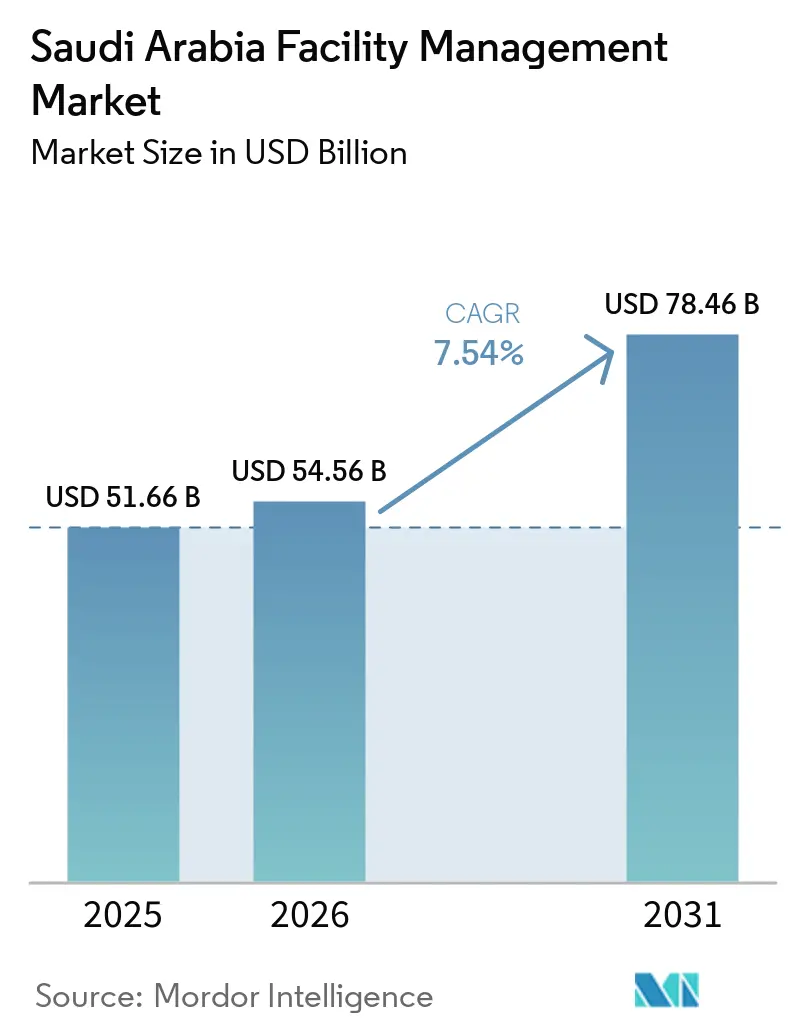
The Saudi Arabia facility management market size was valued at USD 54.56 billion in 2026 and estimated to grow from USD 58.67 billion in 2027 to reach USD 83.1 billion by 2032, at a CAGR of 7.21% during the forecast period (2027-2032).
Saudi Arabia’s expanding infrastructure and integrated school-service mandates broaden the operating responsibilities available to facility management (FM) providers. Sustainability requirements and software adoption initiatives also favor providers that connect technical upkeep with practical site execution. Yet recruitment exposure and payment-withholding rights can make the ability to staff and fund delivery a limit on expansion. Competitive responses range from mobile maintenance for smaller businesses to international integration among providers serving complex facilities. Providers combining integrated scope, deployable staff and collectible terms are better placed to serve complex commercial and healthcare estates than suppliers pursuing contract wins alone.
Key Report Takeaways
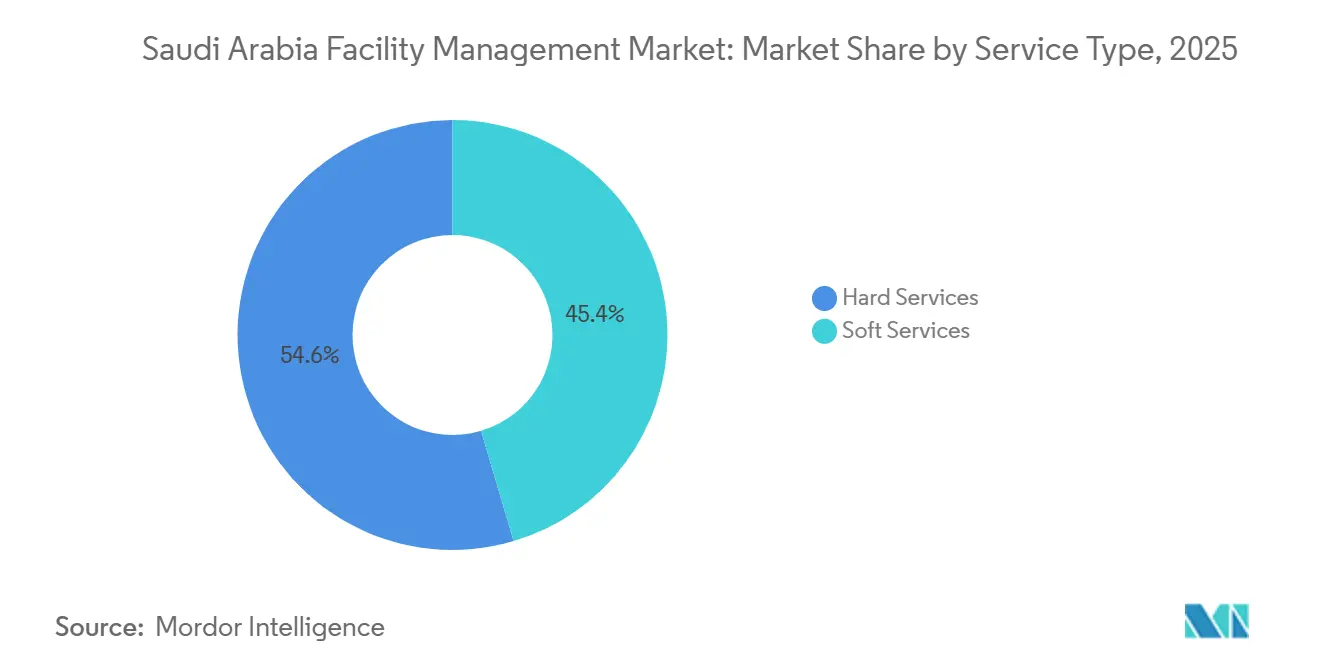
- By service type, hard services held a 54.31% Saudi Arabia facility management market share in 2026, while soft services are forecast to grow fastest at a 7.86% CAGR during 2027-2032.
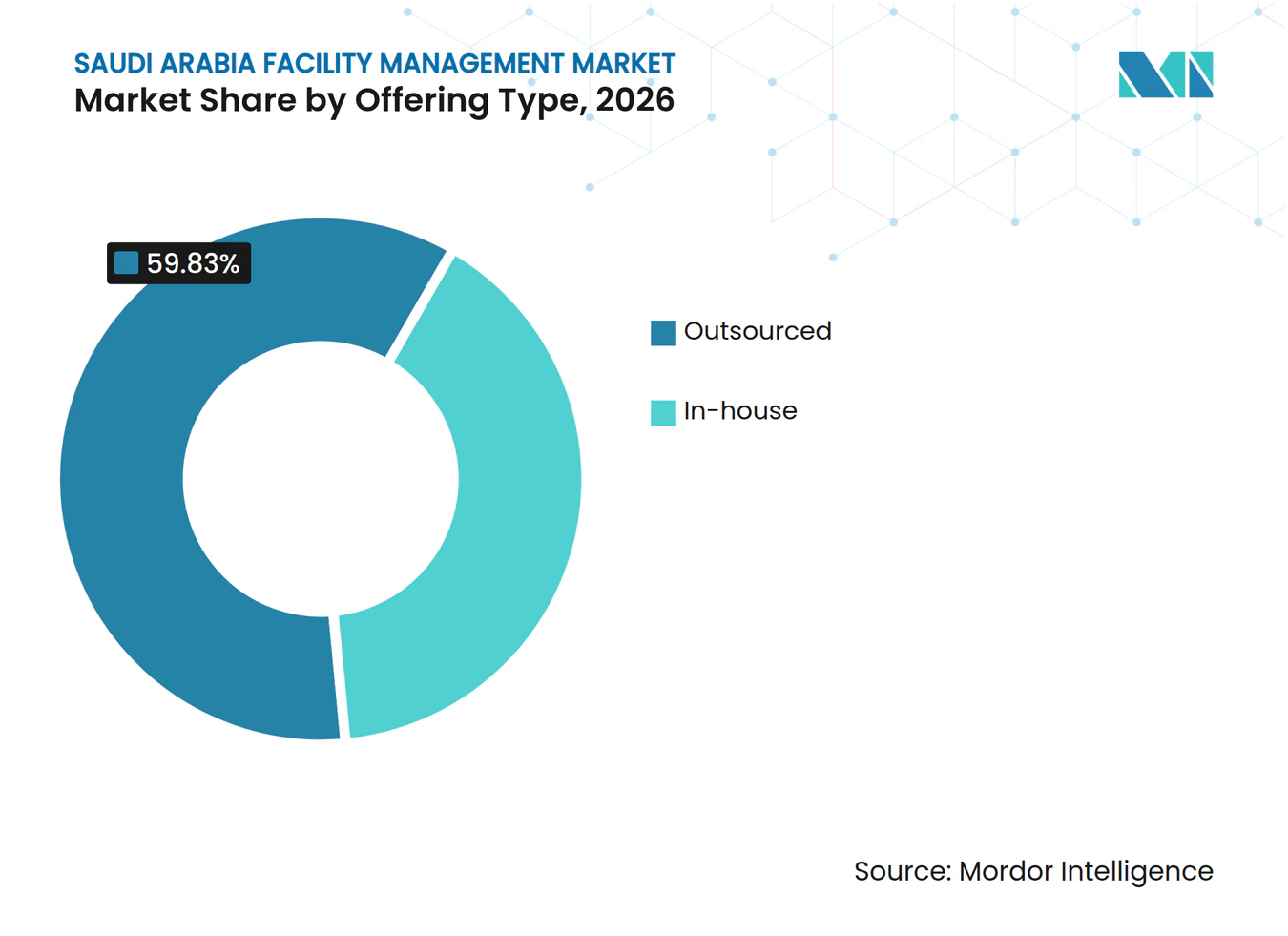
- Within offering types, outsourced services held a 59.83% share of the Saudi Arabia facility management market size in 2026 and are forecast to grow fastest at a CAGR of 8.05% during 2027-2032.
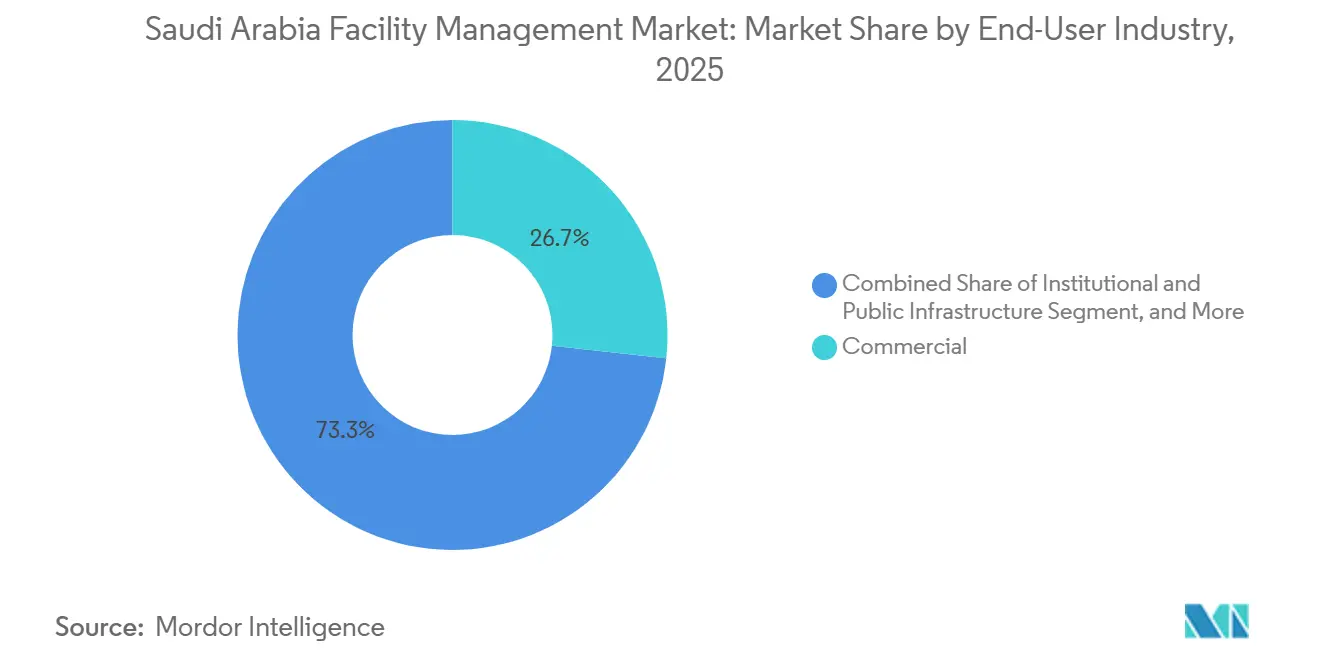
- Across end-user industries, commercial facilities led with a 26.62% share in 2026, while healthcare is forecast to grow fastest at a CAGR of 9.18% during 2027-2032.
Note: Market numbers in this report are based on Mordor Intelligence's proprietary estimation framework, which combines nine months of actuals with Q4 projections for base year 2026.
Market Trends and Insights
Drivers Impact Analysis of Saudi Arabia Facility Management Market*
| Driver | (~) % Impact on CAGR Forecast | Geographic Relevance | Impact Timeline |
|---|---|---|---|
| Vision 2030 infrastructure expansion | +2.4% | Nationwide | Long term (≥ 4 years) |
| Technology adoption in building management | +1.8% | Nationwide | Medium term (2-4 years) |
| Outsourcing and service integration | +1.7% | Central region and Qassim | Short term (≤ 2 years) |
| Sustainability and ESG compliance | +1.5% | Nationwide | Medium term (2-4 years) |
| Giga-projects (NEOM, Red Sea, Qiddiya) driving integrated FM demand | +1.1% | Qiddiya City public realm | Medium term (2-4 years) |
| Government-led privatization of municipal services | +0.6% | Jeddah, Qassim, Al-Jouf, Eastern Region and Northern Borders | Medium term (2-4 years) |
| Source: Mordor Intelligence | |||
Vision 2030 infrastructure expansion
Infrastructure expansion broadens the operating footprint that facility managers must be able to maintain after construction handover. Saudi Arabia’s water transmission pipeline length expanded 150%, from 7,400 kilometers in 2016 to 18,500 kilometers in 2025.[1] A longer network creates a wider potential maintenance territory, making service coverage an important commercial consideration. The Royal Commission for Riyadh City began implementing 12 infrastructure projects in FY2025, including the Second Southern Ring Road and Dirab Road developments. These starts add a separate transport-related source of prospective operating work as assets enter service. The opportunity therefore favors maintenance capacity that can follow dispersed infrastructure rather than depend on a single construction handover.
Technology adoption in building management
Technology adoption can broaden demand for FM services by making digital operation part of the service scope. In January 2026, Saudi FM provider Muheel selected MRI Software’s integrated facilities-management solution and announced plans to deploy and adopt it across its FM contracts. MRI’s assigned role included implementation, configuration, training and ongoing technical support, while Muheel would lead operational deployment and adoption. A deployment spanning FM contracts can link the technology purchase to an ongoing requirement for digitally capable facility operation. For an FM provider, the opportunity is to connect software support with consistent execution across the contracted estate.
Outsourcing and service integration
Combining school support services can give the buyer a defined route for coordinating maintenance with everyday facility operations. On July 7, 2026, Shalfa Facilities Management signed a 26-month work order covering cleaning, maintenance and gatekeeper services at school buildings in Qassim. The work fell under an integrated FM framework covering school buildings and private institutes in the Central region. Grouping these tasks creates a commercial opportunity for a provider able to connect technical upkeep with site-access and cleaning responsibilities. It also makes the boundaries between those responsibilities important when the buyer assesses delivery across its school estate. Integrated outsourcing can therefore deepen the provider’s role within an existing service relationship, provided coordination is built into the contracted scope.
Sustainability and ESG compliance
Sustainability compliance connects maintenance capability with the operating requirements attached to covered buildings. The 2024 Saudi Green Building Code covers energy and water conservation, resource efficiency, waste requirements and carbon-emissions reduction across design, implementation and operation.[2] Saudi Arabia’s integrated building code applies to classified public and private building work, including operation and maintenance. For existing buildings undergoing renovation, use changes, expansion, modification or demolition, application depends on an accredited engineering office’s technical feasibility report covering possible engineering solutions. These conditions make the building’s applicable requirements central to defining a credible sustainability service. FM providers can capture operating work by translating those specific requirements into a maintainable service scope, with the engineering assessment setting the practical boundary.
Restraints Impact Analysis of Saudi Arabia Facility Management Market*
| Restraint | (~) % Impact on CAGR Forecast | Geographic Relevance | Impact Timeline |
|---|---|---|---|
| Skilled-labor shortages linked to Saudization | -0.8% | Nationwide | Medium term (2-4 years) |
| Contract stability and working-capital pressure | -0.6% | Nationwide | Short term (≤ 2 years) |
| Low digital readiness among small FM providers | -0.3% | Nationwide | Medium term (2-4 years) |
| Delays in payments across public-sector contracts | -0.2% | Nationwide | Short term (≤ 2 years) |
| Source: Mordor Intelligence | |||
Skilled-labor shortages linked to Saudization
Recruitment needs can constrain FM expansion when the required operational skills are difficult to secure locally. In its 2025 prospectus, EFSIM said it may face difficulty recruiting skilled Saudi nationals for certain operational roles, potentially increasing recruitment timelines, training costs and labor expenses. The company also identified strong competition for qualified Saudi talent in facilities management, where demand for skilled personnel often exceeds supply. That combination can make workforce availability a limit on the operating capacity a supplier can responsibly commit. On August 7, 2025, EFSIM launched mobile training for its own frontline housekeeping and FM teams, including technology and automation modules. The training targets existing teams, while the supply of qualified Saudi talent can prolong recruitment and increase labor costs.
Contract stability and working-capital pressure
Contractual payment rights can make an FM supplier’s ability to fund delivery depend on more than completing service work. In its 2025 prospectus, EFSIM said most of its contracts allowed clients to withhold payment in specified circumstances. Those circumstances included service-level disputes, contractual terms, alleged company breaches and invoicing requirements, with prolonged delay or nonpayment a possible consequence. This mechanism links operational acceptance and invoice compliance to the cash available from a contract. For a supplier considering additional assignments, the risk is that delivery capacity must be financed while a payment dispute is unresolved. Contract growth can consequently enlarge the funds tied to contested invoices before it produces usable operating cash.
*Our forecasts treat driver/restraint impacts as directional, not additive. The impact forecasts reflect baseline growth, mix effects, and variable interactions.
Saudi Arabia Facility Management Market Segment Analysis
By Service Type:
Technical Responsibilities Anchor Recurring WorkHard services accounted for a 54.31% share of the Saudi Arabia facility management market size in 2026. On August 15, 2026, Muheel Facilities Management announced a multi-year total FM award for the Gulf Cooperation Council Interconnection Authority headquarters in Dammam, covering hard, soft and specialized services. That arrangement can make technical delivery central to the buyer’s assessment of an integrated contractor, because the wider service package depends on functioning facility assets.
Soft services are the fastest-growing segment, forecast to expand at a CAGR of 7.86% during 2027-2032. On June 3, 2026, Shalfa Facilities Management signed a 36-month contract with the Ministry of Tourism to operate, maintain and clean its buildings complex and main warehouse in Riyadh. Cleaning formed the soft-service component of a package that also included operation and maintenance. The contract places both the buildings complex and main warehouse within that bundled scope. Access to this work therefore depends on combining cleaning delivery with the contract’s technical responsibilities.



By Offering Type:
Integrated Mandates Support External ProvidersOutsourced services represented a 59.83% Saudi Arabia facility management market share in 2026 and formed the largest and fastest-growing segment, with a forecast CAGR of 8.05% during 2027-2032. Facilities Management Company (FMCO) announced in September 2026 that it had been awarded a total facilities management contract with Saudi Aramco. That award illustrates how an external provider can receive an operating mandate from a major asset owner, creating a commercial route for integrated delivery. For the contractor, the attraction is the breadth of responsibility available under a total FM relationship, which can bring several service capabilities into one customer account.
Outsourced delivery also creates a route for established operators to expand the value of their business across customer relationships. Integrated FM provider EFSIM reported 21% year-over-year growth in total company revenue in H1 2026 compared with H1 2025. In September 2026, EFSIM’s CEO said the company’s project backlog provided strong visibility into future earnings and cash flows. An outsourced provider can therefore use its contracted future work to sequence service capacity beyond the latest revenue period.

By End-user Industry:
Commercial Scale and Healthcare Operating MandatesCommercial facilities were the largest end-user segment, accounting for 26.62% of market spending in 2026. On April 14, 2026, Saudi Real Estate Company signed a 12-month integrated FM contract with its 60%-owned subsidiary, the Saudi-Korean Company for Maintenance and Properties Management (Mumtalakat), covering its residential and commercial properties in Riyadh. Mumtalakat’s affiliation makes this a related-party delivery model, with the property owner using an affiliated FM provider to service its estate. For commercial buyers, the example highlights an organizational boundary between owning property and organizing its FM work. Demand for commercial FM can therefore sit within the owner’s recurring property operations even when the service provider belongs to the same group.
Healthcare (public and private facilities) is the fastest-growing segment, forecast to record a CAGR of 9.18% during 2027-2032. In July 2026, the Ministry of Health said the SEH Healthcare consortium would manage, operate and maintain Riyadh’s 150-bed SABIC Specialized Behavioral Healthcare Hospital and provide medical and non-medical services for 15 years. Operations were expected to begin in early 2027 under performance indicators agreed with the Ministry. Such an operating mandate can make facility performance part of the healthcare service commitment, giving maintenance a standing role alongside clinical delivery. The long operating term favors providers able to price lifecycle upkeep before services begin, since maintenance costs accompany the consortium’s performance commitment.
Geography Analysis
Jeddah’s industrial-city assets provide a Western region example in which an FM mandate can extend across individual properties and the infrastructure linking a wider estate. On June 1, 2025, Shalfa Facilities Management signed a 24-month contract with the Saudi Authority for Industrial Cities and Technology Zones (MODON), covering the operation and maintenance of MODON-owned buildings and assets in Jeddah. The Jeddah contract included factories, unleased ready-built warehouses, external facilities and shared industrial-city infrastructure. That combination makes shared-asset responsibility part of the commercial scope, because an operator must organize building-level work alongside upkeep of the estate’s common facilities.
In April 2026, Muheel Facilities Management added 2 Rotana hotels to its pest-control portfolio, reaching 4 properties and coverage across all Rotana-operated hotels in Riyadh. The Central region example illustrates multi-property reach through one specialist service. In January 2025, Muheel announced an integrated hard- and soft-services award for the Rabwa residential compound in Riyadh. That award included mechanical, electrical and plumbing maintenance, housekeeping, landscaping, pest control, waste management, security and public-area maintenance. Riyadh suppliers can therefore pursue either a narrow service across several hotels or a broad operating scope at a single residential community.
In April 2026, Muheel Facilities Management secured a multi-year soft-services contract with Saudi Aramco Total Refining and Petrochemical Company (SATORP) for facilities in Jubail Industrial City. The Eastern Province example places soft-service demand within a refining and petrochemical estate, giving it a different operating context from Jeddah’s shared industrial-city infrastructure. For Eastern Province providers, entry into this industrial customer base can therefore come through specialized support services without requiring a refinery operations mandate.
Regulatory Framework and Outlook
Selected jurisdictions are compared from the perspective of an FM provider employing covered technical-engineering workers and conducting Ministry-approved commercial activities. The national comparison covers workforce conditions, while the Riyadh column applies the same national manual and Balady licensing process to covered establishments located in Riyadh. Together, these requirements affect the staffing and operating permissions a provider must assemble for its service business.
Regulatory Table of Saudi Arabia Facility Management Market
| Decision factor | Saudi Arabia | Riyadh |
|---|---|---|
| Primary authority | Ministry of Human Resources and Social Development (HRSD) | Ministry of Municipalities and Housing; General Directorate of Civil Defense |
| Key instruments or direction | Technical-engineering localization with accreditation and wage conditions | Balady commercial licensing and safety permitting for approved activities; covered-workforce localization |
| Commercial effect | Staffing-mix and qualification requirements for covered employers | Commercial-license and safety-permit process alongside covered-employer staffing obligations |
| Current policy attractiveness | Medium | Medium |
| Future direction of policy attractiveness | Hardening | Hardening |
| Source: Mordor Intelligence | ||
National workforce conditions support a Medium rating, and the Riyadh rating also reflects the Balady commercial-license and safety-permit process for Ministry-approved activities. HRSD’s 2025 manual phases in 30% Saudization over 5 years from July 27, 2025, for private establishments employing at least 5 listed technical-engineering workers, with professional accreditation and minimum registered wages for counted Saudis. The national manual also applies to covered establishments located in Riyadh, so both Hardening judgments reflect its scheduled workforce progression. For a covered Riyadh provider, licensing and safety permitting establish the premises pathway, while workforce composition creates a separate compliance workload.
Value Chain Stages
The value chain compares how contracted scope becomes staffed operating capacity and then recurring service delivery. EFSIM reported that its revenue mainly comes from FM services, including hard and soft services, account management and additional work. This revenue structure places value capture in both the core service obligation and work added beyond the original scope. The commercial challenge is to translate that scope into deployable capacity without losing control of delivery responsibilities.
Value Chain Analysis Table of Saudi Arabia Facility Management Market
| Primary activity | Key participants | Value capture | Bottleneck | Resilience response |
|---|---|---|---|---|
| Contract scoping and account management | Integrated FM providers such as EFSIM | FM and account-management service revenue | Ambiguous boundaries between included and additional work | Define service responsibilities and variation approvals |
| Workforce mobilization | FM employers such as EFSIM | Contracted FM service revenue | Staffing pace relative to committed delivery scope | Sequence team onboarding with the start of contracted work |
| Facility operations and maintenance | FM delivery providers such as SATCO and soft-service providers such as Muheel | Maintenance and soft-service contract revenue | Coordinating technical and soft-service tasks at the facility | Align the site schedule with role-specific supervision |
| Source: Mordor Intelligence | ||||
EFSIM onboarded over 800 professionals in H1 2025 to support delivery across its flagship projects. That action illustrates why an award needs a corresponding mobilization capability before its service scope can become operating revenue. For integrated delivery, resilience depends on connecting account responsibility, workforce readiness and site execution.
Competitive Landscape
Market Concentration
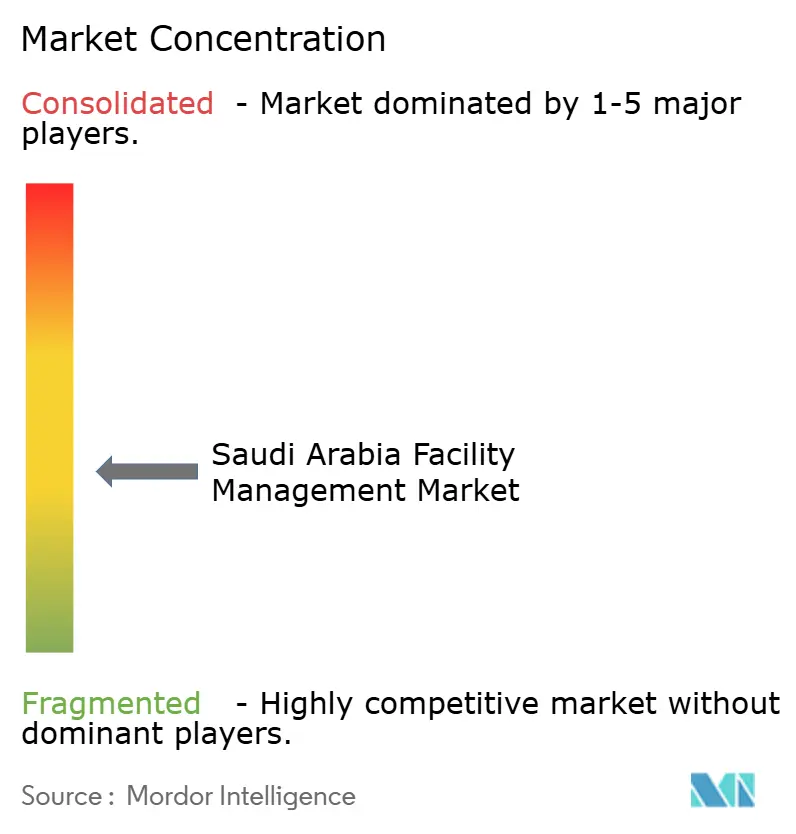
Competition is fragmented among integrated operators and suppliers with different delivery models, making operating capability a meaningful source of differentiation. SETE Energy Saudia for Industrial Projects Ltd (SETE Saudia) provides total FM, while ZOMCO (Zamil Operations and Maintenance), a wholly owned Zamil Group subsidiary, provides integrated FM and operations and maintenance across Saudi Arabia. Almajal G4S supplies FM, Initial Saudi Group offers integrated FM, and EFSIM Facilities Management Company provides FM solutions. In 2025, ZOMCO reported that it was awarded the integrated facilities management contract for the SPPC Tower at Riyadh’s King Abdullah Financial District. The award positions ZOMCO to compete for integrated mandates at Riyadh’s financial-district commercial properties.
In November 2025, Initial Saudi Group launched a mobile engineering service for small and medium-sized enterprises (SMEs), described as Saudi Arabia’s first such offering.[3] The service replaced traditional static on-site arrangements with rapid-response engineering teams delivering professional building maintenance. For SME clients, the commercial appeal is access to specialist maintenance through a mobile team, making coverage design an alternative to a resident staffing commitment. Suppliers competing on this basis need to match promised response times with deployable engineering capacity, because availability has commercial value only when the team can reach the facility.
In 2026, FMTECH reported integration with JLL after JLL took a strategic stake in FMTECH. FMTECH’s stated Saudi operating scope covers mission-critical, commercial, hospitality, healthcare, data-center and advanced-manufacturing facilities. The combination creates a potential route to compete for complex facilities through technical specialization as well as broader delivery resources. SBC 801 sets building fire and explosion protection requirements, including emergency and evacuation plans and firefighting systems. For providers bidding on healthcare and data-center facilities within that scope, the commercial test is how their delivery commitments address emergency-plan and firefighting-system readiness.
Saudi Arabia Facility Management Industry Leaders
-
SETE Energy Saudia for Industrial Projects Ltd (SETE Saudia)
-
ZOMCO (Zamil Operations and Maintenance)
-
Almajal G4S
-
Initial Saudi Group
-
EFSIM Facilities Management Company
- *Disclaimer: Major Players sorted in no particular order
Saudi Arabia Facility Management Market Companies Covered in this Report
- SETE Energy Saudia for Industrial Projects Ltd (SETE Saudia)
- ZOMCO (Zamil Operations and Maintenance)
- Almajal G4S
- Initial Saudi Group
- EFSIM Facilities Management Company
- SAMAMA Holding Group
- Olive Arabia Co. Ltd
- AL-YAMAMA Group
- Khidmah Sole Proprietorship LLC
- ENGIE Solutions (Engie Group)
- Abdulmohsen Al Tamimi Contracting
- Facilities Management Company (FMCO)
- Al Suwaidi Holding Company, KSA
- Enova Facilities Management Services LLC
- Saudi Binladin Group – Operation and Maintenance
- Zahran Facilities Management
- AMNCO Facility Management
- Muheel Facilities Management
- Al-Hajry Overseas
- Shalfa Facilities Management
- SAMAYA FM
- Safari FM
- Serco Middle East (Serco Group PLC)
Key Opportunities for Market Participants
The comparison examines FM opportunities during the proposed Umm Al-Qura University Hospital’s transition from rehabilitation to sustained operation. In June 2026, Umm Al-Qura University and the National Center for Privatization invited interest in completing and operating the 391-bed Makkah hospital, including clinical care, FM and supporting medical services. After the July 21, 2026, deadline for expressions of interest, September 28 results recorded 73 respondents, including 13 in the combined contracting and facility-management category. The FM opportunity is to translate that broad development mandate into specific operating responsibilities that a qualified provider can deliver.
Market Opportunities Table of Saudi Arabia Facility Management Market
| Opportunity | Why now | Buyer / lead segment | Recommended play | Main barrier | Likely beneficiaries |
|---|---|---|---|---|---|
| FM readiness during hospital rehabilitation | Remaining works and hospital activation form part of the proposed scope | Hospital project developer and operating team | Define maintainable assets, handover records and FM responsibilities during completion planning | Coordination between construction completion and operational readiness | Healthcare FM operators such as SAMAMA O&M |
| Long-term hospital asset maintenance | Proposed 30-year integrated hospital contract | Hospital operating team | Build lifecycle maintenance responsibilities into the facility-service scope | Resources and accountability over a long operating commitment | Technical healthcare-maintenance providers such as SAMAMA O&M |
| Nonclinical facility-support delivery | FM sits alongside clinical and supporting-service responsibilities in the proposed model | Hospital operations lead | Offer defined housekeeping, pest-control and safety-support capabilities | Clear boundaries between clinical duties and FM support | Healthcare support-service providers such as SAMAMA O&M |
| Source: Mordor Intelligence | |||||
SAMAMA O&M provides healthcare-facility operations alongside housekeeping, pest control, fire-safety and security services in Saudi Arabia. Such capabilities illustrate how an FM provider could address technical and nontechnical needs within a hospital operating model. The central opening is maintenance and support delivery designed around the transition from rehabilitation to routine use, with clinical and facility responsibilities clearly allocated.
Recent Industry Developments in Saudi Arabia Facility Management Market
- Sep 2026: Facilities Management Company (FMCO) announced that it had been awarded a total facilities management contract with Saudi Aramco.
- Aug 2026: Muheel Facilities Management announced a multi-year total facilities management award for the Gulf Cooperation Council Interconnection Authority headquarters in Dammam, covering hard, soft and specialized services.
- Jul 2026: Shalfa Facilities Management signed a 26-month work order for cleaning, maintenance and gatekeeper services at school buildings in Qassim under an integrated FM framework covering schools and private institutes in the Central region.
Saudi Arabia Facility Management Market Report Scope and Research Methodology
Market Definition and Coverage
Saudi Arabia facility management market measures annual spending on services that operate, maintain, and support buildings and infrastructure in Saudi Arabia. It covers hard and soft services provided in-house or outsourced across commercial, hospitality, institutional and public, healthcare, industrial, and other end-user facilities.
Scope exclusions: Building construction and major capital renovation, standalone sales of FM equipment and building systems, real estate rent and property sales or ownership transfers, utility commodity bills, and facility management services performed outside Saudi Arabia are excluded.
Segments Covered in This Report
- By Service Type
- Hard Services
- Asset Management
- MEP and HVAC Services
- Fire Systems and Safety
- Other Hard FM Services
- Soft Services
- Office Support and Security
- Cleaning Services
- Catering Services
- Other Soft FM Services
- Hard Services
- By Offering Type
- In-house
- Outsourced
- Single FM
- Bundled FM
- Integrated FM
- By End-user Industry
- Commercial (IT and Telecom, Retail and Warehouses, etc.)
- Hospitality (Hotels, Eateries, Large-scale Restaurants)
- Institutional and Public Infrastructure (Govt, Education, Transportation)
- Healthcare (Public and Private Facilities)
- Industrial and Process (Manufacturing, Energy, Mining)
- Other End-user Industries (Multi-housing, Entertainment, Sports and Leisure)
Data Sources, Market Sizing, and Validation
Desk Research
Official Saudi sources such as the General Authority for Statistics' population estimates, the Vision 2030 Annual Report, EXPRO's National Manual of Assets and Facilities Management, and the Saudi Building Code Center's Green Building Code describe demographic demand, infrastructure activity, public asset operations, and operating requirements that inform market drivers and forecast inputs. These sources help distinguish the recurring facility base and maintenance responsibilities from construction activity and standalone asset purchases.
Company prospectuses and annual filings, government procurement notices, and reputable Saudi business reporting can supplement those public baselines by cross-checking service scopes, contract timing, disclosed values, and provider activity. These sources are illustrative rather than exhaustive, and additional sources inform collection, validation, and clarification.
Primary Interviews and Surveys
Interviews and structured questionnaires would target Saudi Arabia facility owners, occupiers, procurement leads, FM provider executives, and service-line managers across commercial, public, healthcare, hospitality, and industrial facilities. Responses would test secondary estimates for contract scope, in-house versus outsourced delivery, service prices, and the timing of asset handovers, with each input checked against public tenders, company disclosures, and facility-level evidence. Where a segment or price input remains thin, analysts would seek a targeted follow-up and document the proxy and range used before carrying it into the market model.
Distribution of primary research fieldwork respondents
| Company type | Respondent position | Region |
|---|---|---|
| Top tier: 30% | CXOs: 20% | |
| Mid tier: 45% | Functional/Unit leaders: 35% | |
| Smaller Players: 25% | Managers: 45% |
Market-Sizing & Forecasting
The model starts with a top-down estimate of annual Saudi Arabia spending on facility operation, maintenance, and support, then checks selected totals with supplier roll-ups and sampled contract value per facility or site. Core inputs include occupied and newly handed-over facility stock, population and activity indicators by end-user group, public contract and tender values, service labor and input costs, and the in-house versus outsourced delivery mix. Together they indicate the size and annual value of work that can enter the FM boundary. Analysts use the sources to build service-type, offering-type, and end-user shares from reported contract scopes and facility expenditure patterns, then apply scenario analysis to asset handovers, outsourcing, and service-cost changes over the forecast period. If a contract value or facility count is missing, comparable disclosed contracts and documented facility-type intensity ranges support a bounded estimate, which is checked against the top-down total. Primary respondents would test the direction and sensitivity of each key variable forecast, with disagreements prompting targeted follow-up or a wider scenario range rather than an assumed consensus.
Data Validation & Update Cycle
Analysts triangulate the spending model against independent facility, tender, supplier, and public investment signals, then check that service, delivery, and end-user estimates reconcile to the market total. They investigate unusual year-to-year changes, inconsistent contract values, and shifts in segment shares, resolving anomalies with source review and targeted respondent re-contact when scope, timing, or pricing evidence changes. A second analyst reviews the reconciliations and explanations before sign-off, followed by an annual refresh, an interim review after material policy or project events, and a fresh pre-delivery pass.
Mordor Intelligence's Saudi Arabia Facility Management Market Size Compared Against Other Published Estimates
Published estimates can differ in the transactions and products they count and the inputs used to model demand. Saudi Arabia facility management market measures annual spending on services that operate, maintain, and support buildings and infrastructure in Saudi Arabia.
Key Gap Drivers include the study's defined coverage and market-specific modeling choices. Core inputs include occupied and newly handed-over facility stock, population and activity indicators by end-user group, public contract and tender values, service labor and input costs, and the in-house versus outsourced delivery mix.
Benchmark comparison
| Source | Market Size | Gaps in Research Methodology |
|---|---|---|
| Mordor Intelligence | USD 58.67 B (2027) | |
| Regional Consultancy A | USD 52 B (2025) | At its 2025 base, this estimate is 11.4% below this report's 2027 value of USD 58.67 B, 2 years later. The Regional Consultancy A 2025 base year precedes the report's 2027 value by two years. |
| Global Consultancy B | USD 51.23 B (2025) | At its 2025 base, this estimate is 12.7% below this report's 2027 value of USD 58.67 B, 2 years later. The Global Consultancy B 2025 base year precedes the report's 2027 value by two years. |
Mordor Intelligence's analysts triangulate the spending model against independent facility, tender, supplier, and public investment signals, then check that service, delivery, and end-user estimates reconcile to the market total.
Key Questions Answered in the Report
What is the Saudi Arabia facility management market size and growth outlook?
The market is estimated at USD 58.67 billion in 2027 and forecast to reach USD 83.1 billion by 2032, at a 7.21% CAGR during 2027-2032.
Which factors support demand for facility management services in Saudi Arabia?
Infrastructure expansion, integrated contracts, sustainability requirements and software adoption support demand. Shalfa signed a 26-month Qassim school-service work order in July 2026.
Which service category leads Saudi facility management spending?
Hard services held 54.31% of spending in 2026, while soft services are forecast to grow fastest at a 7.86% CAGR during 2027-2032.
Which companies compete in Saudi facility management?
Major providers include SETE Energy Saudia for Industrial Projects Ltd (SETE Saudia), ZOMCO (Zamil Operations and Maintenance), Almajal G4S, Initial Saudi Group and EFSIM Facilities Management Company.
What challenges shape the outlook for Saudi facility management providers?
Recruitment and collection risks can limit expansion. EFSIM’s 2025 prospectus identified possible delays and higher costs in recruiting skilled Saudi nationals for certain operational roles.
What distinguishes regional demand for facility management within Saudi Arabia?
Shalfa’s 2025 MODON contract in Jeddah covered industrial-city assets. In April 2026, Muheel announced pest-control coverage across all 4 Rotana-operated hotels in Riyadh.