Saudi Arabia Data Center Networking Market Size and Share
Market Overview
| Study Period | 2020 - 2031 |
|---|---|
| Forecast Data Period | 2026 - 2031 |
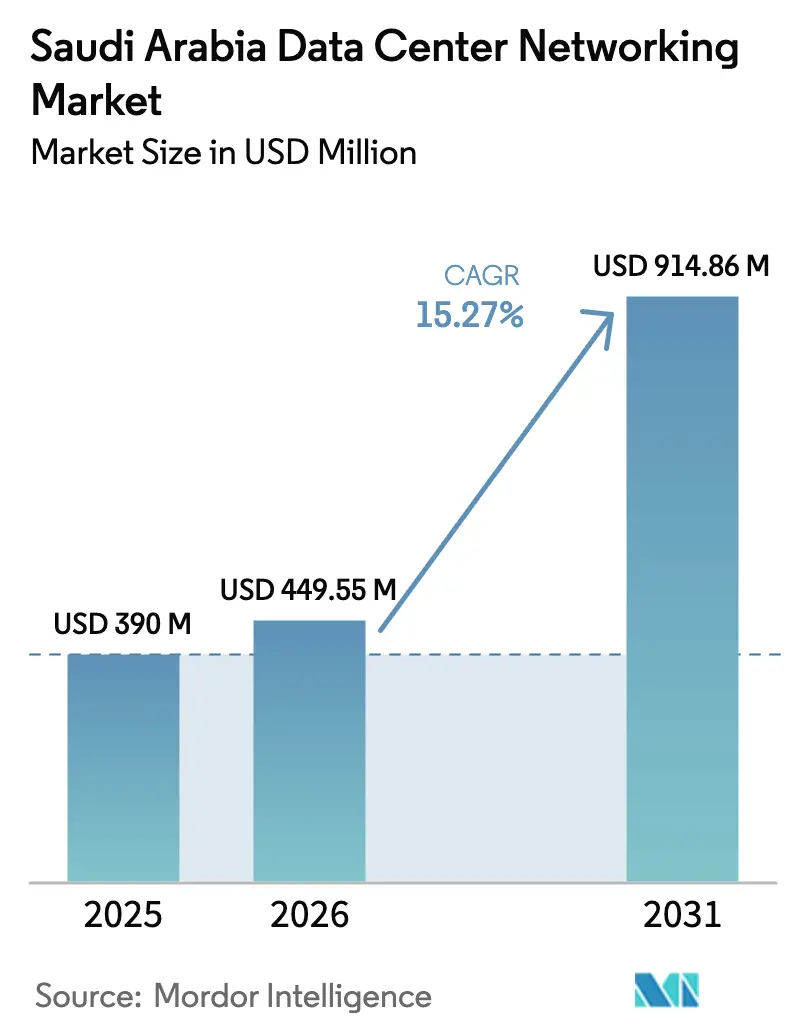
| Base Year Market Size (2025) | USD 390 Million |
| Market Size (2026) | USD 449.55 Million |
| Market Size (2031) | USD 914.86 Million |
| Growth Rate (2026 - 2031) | 15.27% CAGR |
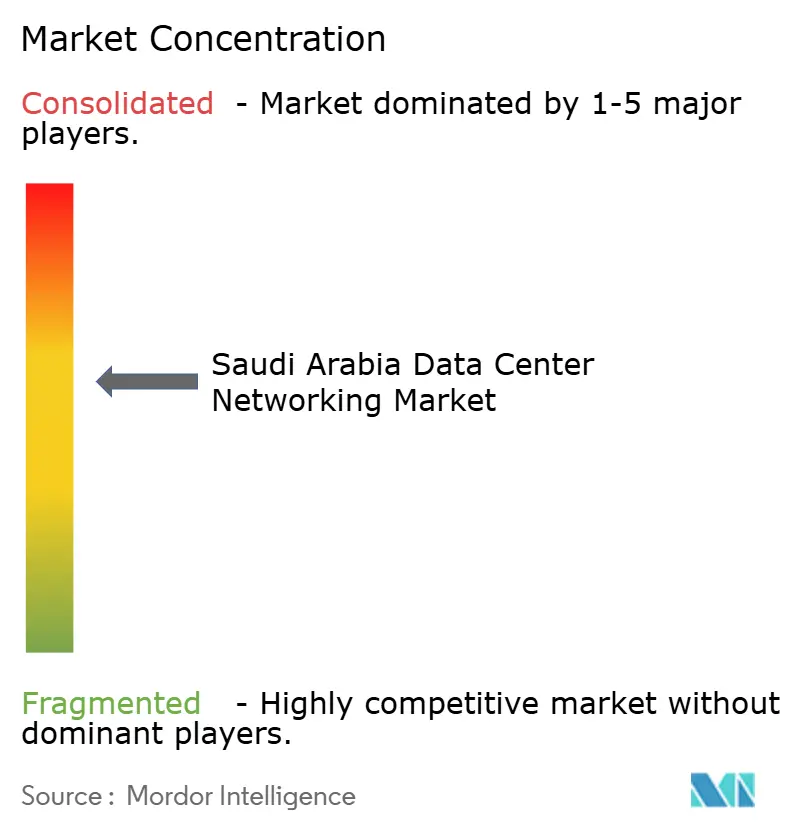
| Market Concentration | Medium |
Major Players *Disclaimer: Major Players sorted in no particular order Image © Mordor Intelligence. Reuse requires attribution under CC BY 4.0. | |
Saudi Arabia Data Center Networking Market Analysis by Mordor Intelligence
The Saudi Arabia Data Center Networking market size is expected to grow from USD 390 million in 2025 to USD 449.55 million in 2026 and is forecast to reach USD 914.86 million by 2031 at 15.27% CAGR over 2026-2031. Strong policy support under Vision 2030, a USD 18 billion government data-center program, and hyperscale cloud region roll-outs are shifting capital from hydrocarbon assets to digital infrastructure. Rising AI and high-performance computing (HPC) workloads are accelerating upgrades to spine-leaf architectures and pushing demand for >100 GbE switching fabrics. Data-localization mandates under the Cloud Computing Regulatory Framework (CCRF) are forcing global providers to build in-country capacity, bolstering domestic networking spend. Renewable-energy power-purchase agreements (PPAs) attached to giga-projects like NEOM are simultaneously lowering operating costs and reinforcing sustainability goals, making green networking a differentiator for investors.
Key Report Takeaways
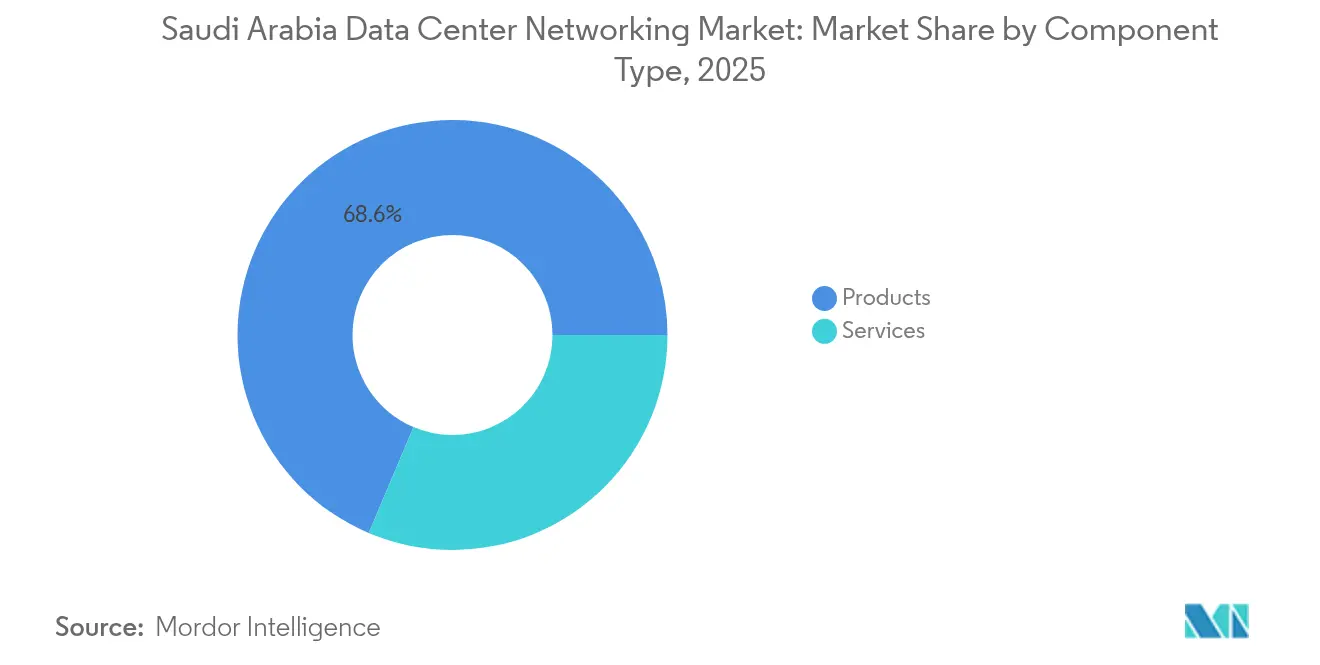
- By component, Products captured 68.63% of Saudi Arabia Data Center Networking market share in 2025, while Services are projected to expand at an 18.08% CAGR to 2031.
- By end-user, IT & Telecommunications led with 35.92% revenue share in 2025; Government & Defense is advancing at a 17.62% CAGR through 2031.
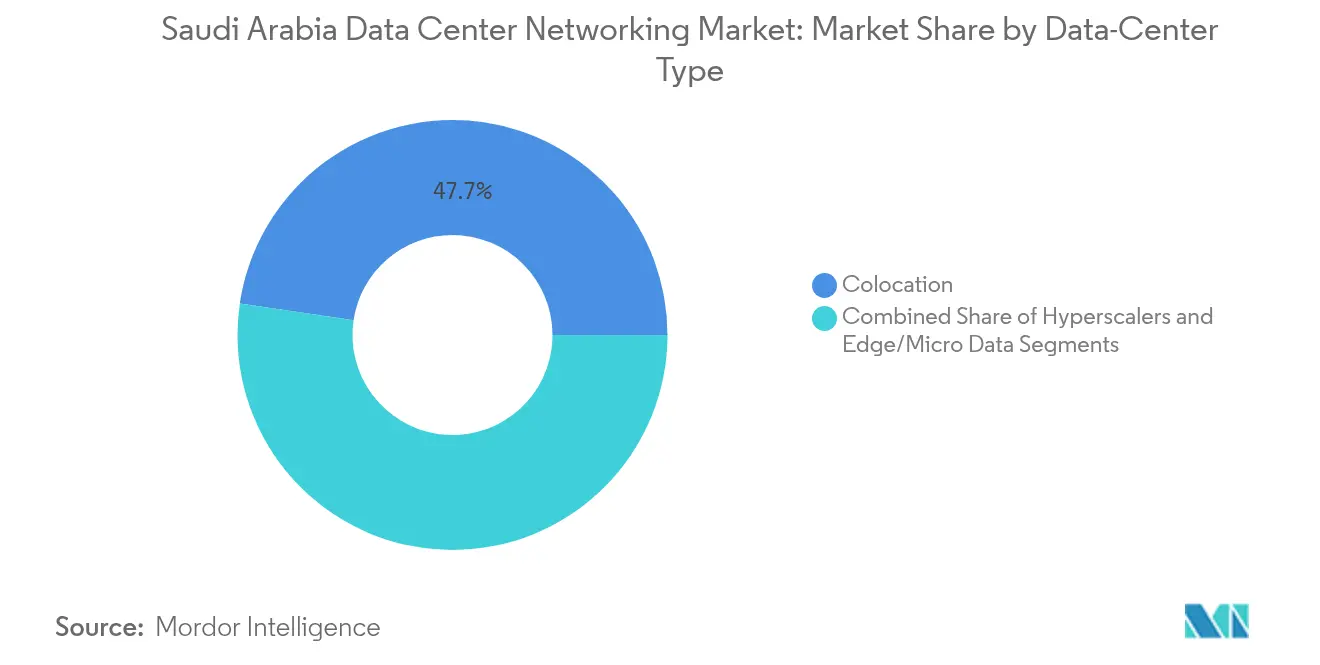
- By data-center type, Colocation achieved 47.66% share of the Saudi Arabia Data Center Networking market in 2025, whereas Hyperscalers/Cloud Service Providers are growing at 18.97% CAGR to 2031.
- By bandwidth, 25–40 GbE held 33.71% share of the Saudi Arabia Data Center Networking market size in 2025; >100 GbE is the fastest-rising segment at a 20.02% CAGR.
Note: Market size and forecast figures in this report are generated using Mordor Intelligence’s proprietary estimation framework, updated with the latest available data and insights as of 2026.
The contribution of Saudi arabia is incorporated into a multi-country and multi-region total that reflects the full breadth of industry. The data center networking market size by Mordor Intelligence expresses that combined magnitude.
Saudi Arabia Data Center Networking Market Trends and Insights
Drivers Impact Analysis*
| Driver | (~) % Impact on CAGR Forecast | Geographic Relevance | Impact Timeline |
|---|---|---|---|
| Vision 2030 USD 18 billion national data-center program | +4.2% | National, concentrated in Riyadh, Jeddah, Dammam | Long term (≥ 4 years) |
| Hyperscale cloud region roll-outs (AWS, Google, Oracle) | +3.8% | National, with primary hubs in major cities | Medium term (2-4 years) |
| AI/HPC build-outs (e.g., Aramco "Dammam-7") | +2.9% | Regional clusters in Eastern Province, expanding nationally | Medium term (2-4 years) |
| Renewable-energy PPAs enabling green DC networking | +1.7% | NEOM, Red Sea Project, national expansion | Long term (≥ 4 years) |
| Data-localization mandates (CCRF) | +2.1% | National, affecting all sectors | Short term (≤ 2 years) |
| Source: Mordor Intelligence | |||
Vision 2030 USD 18 Billion National Data-Center Program
The program targets more than 1,300 MW of capacity by 2030, far exceeding the 360 MW gap projected for the next five years. Each additional megawatt drives 15–20% incremental networking spend, stimulating multi-vendor competition for Ethernet switching, optical transport, and software-defined networking (SDN) controllers. Local integrators such as Al Moammar Information Systems are scaling from 300 MW toward 1,000 MW, demonstrating how indigenous firms are repositioning to capture hyperscale demand.[1]Argaam, “Al Moammar Expands Capacity Above 1,000 MW,” argaam.com The initiative also embeds renewable-energy PPAs, forcing vendors to optimize for power budgets and heat management in desert climates.
Hyperscale Cloud Region Roll-Outs
Oracle’s second public cloud region went live in August 2024 with an explicit AI focus.[2]Oracle Corporation, “Oracle Opens Second Cloud Region in Saudi Arabia,” oracle.com Microsoft completed construction of its Saudi region in December 2024, while AWS confirmed a 2026 launch window. Hyperscalers favor spine-leaf fabrics, 400 GbE optics, and open-standard automation, accelerating the Saudi Arabia Data Center Networking market beyond traditional three-tier designs. Rapid adoption of programmable interfaces is also fostering local software ecosystems around intent-based networking and telemetry analytics.
AI/HPC Build-Outs (e.g., Aramco “Dammam-7”)
Aramco’s Dammam-7 supercomputer ranks among the world’s top systems, necessitating InfiniBand, Remote Direct Memory Access (RDMA) protocols, and terabit-scale backbones. HUMAIN’s partnership with NVIDIA to deploy 18,000 GPUs further fuels ultra-low latency requirements, heightening demand for congestion-aware routing and real-time performance monitoring. SDAIA’s 24 MW Riyadh AI facility reinforces AI-first network design principles such as non-blocking fabrics and GPU-to-GPU messaging.
Data-Localization Mandates (CCRF)
The CCRF compels sensitive workloads—especially in finance and government—to remain on Saudi soil, forcing cloud providers to build in-country zones and redundant interconnects. Resulting architectures replicate cloud availability-zone topologies domestically, boosting demand for metro fiber rings, encryption at rest and in transit, and sovereign key-management systems.
Restraints Impact Analysis*
| Restraint | (~) % Impact on CAGR Forecast | Geographic Relevance | Impact Timeline |
|---|---|---|---|
| High capex and import-driven supply chain exposure | -2.8% | National, affecting all market segments | Short term (≤ 2 years) |
| Certified talent shortage in advanced networking | -1.9% | National, concentrated in technical hubs | Medium term (2-4 years) |
| Data-sovereignty and human-rights scrutiny | -1.4% | National, affecting international vendors | Short term (≤ 2 years) |
| Cooling-water scarcity and sustainability limits | -1.1% | Desert regions, affecting large-scale deployments | Long term (≥ 4 years) |
| Source: Mordor Intelligence | |||
High Capex and Import-Driven Supply Chain Exposure
More than 85% of network hardware is imported, exposing operators to USD-SAR currency swings and logistics delays. Local-content rules require partial assembly inside the Kingdom, inflating cost structures for smaller firms. U.S. suppliers cite dual-use export controls and in-country testing mandates as barriers, extending deployment lead times and compressing margins.
Certified Talent Shortage in Advanced Networking
The National Strategy for Data & AI aims to skill 20,000 specialists by 2030, yet high-end SDN, AI fabric, and quantum-networking expertise remain scarce. C4IR Saudi Arabia’s 2024 survey of 150 SMEs noted deployment delays averaging three months due to engineering shortfalls. Reliance on foreign consultants pushes opex higher and limits the pace at which the Saudi Arabia Data Center Networking market can absorb next-generation platforms.
*Our forecasts treat driver/restraint impacts as directional, not additive. The impact forecasts reflect baseline growth, mix effects, and variable interactions.
Segment Analysis
By Component: Services Acceleration Outpaces Products
Products held 68.63% of the Saudi Arabia Data Center Networking market in 2025, anchored by Ethernet switches for spine-leaf fabrics. Routers and SAN gear are giving way to converged architectures, while SDN controllers are mainstreaming as automation becomes imperative. The Saudi Arabia Data Center Networking market size attached to Products is tracking a flatter curve as hyperscalers negotiate volume discounts and embrace open-switching hardware. Conversely, Services are growing 18.08% annually as operators seek integration assistance, proactive support, and managed network operations.
Demand for installation, integration, and consulting stems directly from skills gaps; large enterprises prefer turnkey blueprints that align with CCRF compliance. Managed Network Services monetize AI-driven analytics for congestion, latency, and power optimization, shifting revenue from one-off sales to recurring annuities. Training programs fetch premium rates as they address certifications in DevNet, Kubernetes networking, and Zero Trust segmentation. This service-led momentum is re-shaping vendor positioning in the Saudi Arabia Data Center Networking market.


By End-User: Government & Defense Surge Reshapes Priorities
IT & Telecommunications commanded 35.92% share in 2025 due to incumbents’ metro fiber and submarine-cable assets, but sovereign cloud mandates propel Government & Defense at 17.62% CAGR through 2031. Saudi Data & AI Authority initiatives require secure, GPU-dense clusters; thus, government tenders specify on-chip encryption and deterministic latency. Banking and financial services invest steadily yet remain constrained by compliance-driven architectures that value resilience over raw throughput.
Government momentum injects higher-spec procurement standards, compelling vendors to certify with national security agencies. Defense-grade segmentation, multi-factor cryptography, and air-gapped enclaves are now baseline features, raising the overall technical bar across the Saudi Arabia Data Center Networking market. As public-sector demand scales, price ceilings ease, benefiting premium hardware vendors and managed-service providers alike.
By Data-Center Type: Hyperscaler Momentum Challenges Colocation
Colocation providers retained 47.66% share in 2025, leveraging neutral facilities to serve enterprises, yet hyperscalers are expanding at 18.97% CAGR. Microsoft, Oracle, and AWS prefer bespoke campuses with 400 GbE backbones and direct-to-chip liquid cooling. Local hosters respond by adding AI-ready cages, higher power densities, and cloud-connect fabrics to stay relevant.
Edge and micro-data centers remain nascent but critical for 5G densification, smart-city surveillance, and real-time crowd management at events such as the Hajj. These micro-sites require compact, ruggedized switching capable of fan-less operation in harsh climates. The diversification of facility types broadens solution portfolios, enlarging the reachable Saudi Arabia Data Center Networking market size for vendors that span hyperscale cores and distributed edges.
By Bandwidth: Ultra-High Speed Adoption Accelerates
The less than or equals to 10 GbE segment is declining as legacy enterprises refresh their infrastructure. 25–40 GbE still leads with 33.71% share, covering mid-tier server links and storage interconnects. However, >100 GbE is surging at 20.02% CAGR, reflecting GPU cluster proliferation. Nokia and STC’s 1 Tbps DWDM field trial proves that backbone optics can already exceed workload demand, paving the way for terabit Ethernet.
Enterprises stepping from 40 GbE straight to 400 GbE aim to future-proof Capex and cut aggregation layers. Storage traffic, east-west AI traffic, and disaggregated databases drive the need for lossless fabrics and congestion-control algorithms. Dynamics in bandwidth tiers therefore underpin a volume swing toward optical modules, high-density QSFP-DD ports, and time-sensitive network telemetry across the Saudi Arabia Data Center Networking market.
Geography Analysis
Riyadh, Jeddah, and Dammam account for nearly 75% of capital deployment. Riyadh dominates due to federal agencies, hyperscale zones, and SDAIA’s 24 MW AI site, creating concentrated pull for low-latency metro fiber rings. Jeddah benefits from submarine-cable adjacency; AWS’s January 2025 CloudFront Edge node halves content latency for western users. Dammam anchors energy-sector HPC, with Aramco’s Dammam-7 and Groq’s planned inferencing cluster demanding deterministic, high-bandwidth fabrics.
NEOM and Red Sea Project locations introduce edge-heavy architectures, combining renewable-powered data hubs with smart-city sensors. DataVolt’s USD 5 billion net-zero campus in Oxagon integrates on-site solar and wind, forcing network gear to meet stringent temperature and vibration tolerances. Nationally, 13 submarine systems plus the Saudi Vision Cable extend routes to Europe and Asia, positioning the Kingdom as a regional transit node and multiplying the Saudi Arabia Data Center Networking market’s relevance for international traffic flows.
The geographic shift toward giga-projects and coastal transit hubs redistributes spend beyond legacy metro clusters, compelling vendors to tailor SKUs for desertized environments and modular edge enclosures. This dispersion broadens channel opportunities for system integrators versed in both hyperscale and edge-micro deployments, strengthening competitive intensity across regions within the Saudi Arabia Data Center Networking industry.
Mordor Intelligence provides coverage of the data center networking market across other key regional markets, including North America, South America, and Middle East, each with their regulatory frameworks and demand patterns. Detailed country-level analysis extends to France, Sweden, United States, Brazil, Malaysia, and Vietnam incorporating local coverage and market participation, as required.
Regulatory Landscape
Saudi Arabia’s data center networking deployments are shaped by the Communications, Space and Technology Commission (CST), which regulates telecom infrastructure and has formalized requirements for data center service providers through its Data Center Services Regulations. These sit alongside national cloud governance, including the Cloud Computing Regulatory Framework (CCRF) cited in the market as a driver of in-country build-outs for sensitive workloads. As a result, compliance expectations tend to increase demand for encryption, resilient interconnects, and network operations that can be audited within the Kingdom.
CST also sets connectivity and traffic exchange rules through Interconnection Regulations and a dedicated permit framework for Internet Exchange Services (IXP). For operators and vendors, these instruments affect how carrier-neutral cross-connects, metro rings, and multi-tenant fabrics are designed and contracted, particularly for colocation providers and cloud regions that must evidence compliant interconnect and service continuity under local registration and licensing expectations.
Value Chain Analysis
The value chain starts with silicon and compute platforms that shape switching and transport requirements, especially AI/HPC accelerators and CPUs from NVIDIA and AMD, alongside switching ASICs such as Cisco’s Silicon One used in high-capacity fabrics. These components feed into server OEMs, including Dell Technologies and HPE, and networking OEMs, including Cisco, Arista, Huawei, Juniper, Nokia, and others, which supply Ethernet switching, routing, optical interconnects, and security appliances. System software then spans SDN controllers, automation, and telemetry needed for spine-leaf and high-bandwidth architectures.
Midstream work is carried out by local and regional integrators and operators that design, deploy, and operate networks for hyperscalers, government entities, and colocation providers. The report context points to local integrators such as Al Moammar Information Systems scaling to support large builds. Downstream demand is pulled together by state and sovereign-AI programs and large operators, including HUMAIN as a state-backed platform for sovereign AI services, alongside telecom groups such as stc and Mobily that bundle fiber backhaul, cross-connects, and managed services. The supply chain remains import-heavy for networking hardware, while local-content expectations favor partial in-Kingdom assembly and services-led engagement, which elevates the role of installation, integration, and support partners in meeting delivery timelines.
Competitive Landscape
Global incumbents such as Cisco, Huawei, Dell, and Juniper compete alongside regional telcos STC, Mobily, and Zain KSA, yielding a moderately concentrated field. Cisco reports 51% of its USD 54 billion FY 2024 revenue from subscriptions, reflecting a pivot toward software and managed solutions. Huawei’s share in government bids is constrained by security scrutiny, steering it toward private-sector and energy clients. Nokia’s planned USD 2.3 billion acquisition of Infinera underscores consolidation around optical interconnect excellence, an area critical for hyperscale inter-campus routes.
Local carriers exploit last-mile fiber and cross-connect privileges, bundling connectivity, colocation, and managed network services. STC’s 147,000 km fiber footprint backs its Sonic terrestrial corridor with Ooredoo, enhancing redundancy for hyperscale traffic bursts. Mobily’s USD 905 million subsea push co-funds new landing stations, locking in transit revenue from Asia-Europe latency optimizations.
White-space opportunities include quantum-ready key distribution, AI-optimized network operating systems, and immersion-cooling compliant switching. Start-ups offering open-network Linux stacks are gaining proof-of-concept traction at NEOM. Meanwhile, vendors unable to certify sovereign-cloud compliance risk disqualification from lucrative public-sector contracts, tightening barriers to entry and raising the strategic stakes in the Saudi Arabia Data Center Networking market.
Saudi Arabia Data Center Networking Industry Leaders
Cisco Systems, Inc.
Huawei Technologies Co., Ltd.
Dell Technologies Inc.
Hewlett Packard Enterprise Company
Arista Networks, Inc.
- *Disclaimer: Major Players sorted in no particular order

Market Opportunities and Future Outlook
Government-led capacity targets and named build programs create specific whitespace for higher-speed fabrics, optical interconnect, and compliant managed services. Saudi Arabia’s National Data Center Strategy (MCIT and SDAIA, launched June 2025) sets a capacity target of 1.5 GW by 2030, while PIF-backed HUMAIN has communicated a multi-year capacity ambition of 6.6 GW over the next decade and has partnered with global technology suppliers. In networking terms, these initiatives translate into demand for >100 GbE switching, dense optical modules, and automation stacks that can replicate cloud availability-zone designs domestically under CCRF-aligned data localization.
AI-first infrastructure rollouts provide a near-term catalyst for specialized data center networking, including lossless Ethernet, RDMA-capable architectures, and congestion-aware operations tooling. The announced HUMAIN, AMD, and Cisco joint venture targeting 1 GW of AI infrastructure by 2030, with an initial 100 MW phase arriving in 2026, supports vendor opportunities around validated AI fabric designs, secure segmentation, and high-capacity inter-campus connectivity. As national data center capacity expands, the addressable base for lifecycle services, network refresh, and telemetry-driven managed network operations also widens, particularly as desert-climate constraints and liquid-cooling adoption raise the need for power-aware and resilient networking designs.
Recent Industry Developments
- June 2026: Emircom launched an optical networking hub in Riyadh to provide a sandbox for testing high-capacity data transmission, cloud networking, and AI computing workloads. The launch expands local experimentation capabilities for AI and digital infrastructure and supports readiness for hyperscale deployments.
- June 2026: NHC Innovation (National Housing Company) partnered with Huawei, Lenovo, and ByteDance to deploy advanced data infrastructure and smart city technologies. The partnership strengthens vendor ecosystem and AI-ready data-center capabilities with major global players.
- May 2026: Huawei appointed GAPP as an official cloud solutions distributor in Saudi Arabia to support enterprise access to AI and cloud infrastructure. The arrangement broadens local cloud and AI deployment channels and connects with data-center networking growth across the Kingdom.


Research Methodology Framework and Report Scope
Market Definition and Coverage
For this study, the market covers spending in Saudi Arabia on networking equipment and related software used inside data centers to move traffic reliably between servers, storage, and external networks, including upgrades and expansions tied to new capacity.
Scope exclusions: We exclude telecom access networks, end-user campus LAN outside data center sites, and application-layer services that are not sold as data center networking.
Segmentation Overview
- By Component
- Products
- Ethernet Switches
- Routers
- Storage Area Network (SAN)
- Application Delivery Controllers (ADC)
- Network Security Appliances
- Software-Defined Networking (SDN) Controllers
- Optical Interconnects
- Services
- Installation and Integration
- Training and Consulting
- Support and Maintenance
- Managed Network Services
- Products
- By End-User
- IT and Telecommunications
- Banking, Financial Services and Insurance (BFSI)
- Government and Defense
- Media and Entertainment
- Healthcare and Life Sciences
- Manufacturing and Industrial
- Other End-Users
- By Data-Center Type
- Colocation
- Hyperscalers/Cloud Service Providers
- Edge/Micro Data Centers
- By Bandwidth
- LessThan equals to 10 GbE
- 25–40 GbE
- 50–100 GbE
- Greater Than 100 GbE
Data Sources, Market Sizing, and Validation
Desk Research
Desk research is used to set the demand context and anchor the model to real-world build activity in Saudi Arabia. We review public programs and digital infrastructure targets, then translate them into likely data center additions that would require switching and routing capacity.
Useful inputs come from official and open sources such as the Communications, Space and Technology Commission (CST), the Saudi Central Bank (SAMA) for macro indicators, the General Authority for Statistics (GASTAT), and international sources such as the ITU and World Bank for connectivity and traffic proxies. We also use company filings, investor presentations, and reputable press for expansion timelines. For hardware intensity checks, we use paid subscriptions for company financials and intelligence, patent databases, and shipment-level import and export checks where product flows are available. This list is not exhaustive, and we consulted additional sources for data collection, cross-checking, and clarification.
Primary Interviews and Surveys
Primary work is used to validate what the desk research cannot show clearly, mainly the mix of networking products being deployed and the timing of purchase cycles. We speak with data center operators, systems integrators, distributors, and enterprise IT teams across major demand pockets in the Kingdom. This lets us confirm and adjust assumptions on refresh cycles, port speeds, and pricing.
Distribution of primary research fieldwork respondents
| Company type | Respondent position | Region |
|---|---|---|
| Top tier: 38% | CXOs: 20% | |
| Mid tier: 41% | Functional/Unit leaders: 24% | |
| Smaller Players: 21% | Managers: 56% |
Market-Sizing & Forecasting
Sizing starts with a top-down build where data center expansion signals in Saudi Arabia are translated into networking demand using practical engineering and procurement ratios. Capacity additions, rack density direction, and expected shifts in port speeds (for example, higher adoption of 25G, 100G, and above) are used to reconstruct the addressable equipment value, and then the result is split across replacement and new-build cycles.
To keep the model grounded, we also run selective bottom-up approximations as checks, such as sampled average selling price (ASP) by product type multiplied by estimated unit volumes. We incorporate channel feedback on the share of projects that are supply constrained versus budget constrained. Typical inputs include announced site builds, government-led digital programs, cloud and colocation leasing momentum, energy and cooling constraints that affect density, and import patterns for relevant hardware categories. Forecasting is done using scenario analysis supported by expert views, where the base case reflects expected commissioning timelines and a reasonable ASP progression path that accounts for mix shift and price erosion. When a bottom-up check has gaps, for example private deal pricing that is not disclosed, we use ranges first, then narrow them using interview validation and consistency with the top-down totals.
Data Validation & Update Cycle
Validation is done through multiple checks so the final number is not dependent on one data source. We compare model outputs with independent signals like build announcements, capacity commissioning pace, and import intensity, then investigate sharp year-on-year jumps that are not explained by project timing.
Before sign-off, we review assumptions and calculations in steps, and we trigger follow-up outreach when interview feedback conflicts with observed deployment trends. Reports are refreshed annually, with interim updates when material events occur, such as major project delays, new regulatory requirements, or meaningful pricing moves. Right before delivery, we review the latest public updates again so clients receive the most current view.
Mordor Intelligence's Saudi Arabia Data Center Networking Market Sizing Compared With Other Published Estimates
Published market sizes for Saudi Arabia data center networking can vary even when the topic sounds identical, because each publisher sets different boundaries on what is counted and which year is treated as the current reference point. Differences also come from how pricing is handled, especially when product mix is shifting to higher-speed ports and when exchange-rate timing changes the USD view.
A refresh-led gap shows up when one estimate uses earlier-year pricing and a simple flat ASP, while another adjusts quarterly for mix shift between switch speeds, router throughput needs, and delivery timing of large build-outs. Currency conversion choices, whether services are bundled with hardware, and how much replacement demand is assumed versus greenfield demand can further move the headline value.
Benchmark comparison
| Source | Market Size | Gaps in Research Methodology |
|---|---|---|
| Mordor Intelligence | USD 449.55 M (2026) | |
| Industry Blog A | USD 401.10 M (2024) | Uses an earlier base year and does not clearly show how ASPs are updated as deployments move to higher-speed switching, which can understate the current USD value when mix shifts quickly. |
| Regional Consultancy B | USD 2200.00 M (2028) | Appears to bundle adjacent networking and IT infrastructure beyond data center networking and applies aggressive forward assumptions without showing a stepwise validation against in-country deployment timing. |
The spread across the three figures mainly reflects timing and boundary choices, and it becomes larger when pricing and project schedules are not refreshed in a consistent way. In our work, quarterly checks on deal timing, currency conversion windows, and speed-mix driven ASP movement are used before publishing, which helps keep the estimate current and repeatable, a modeling discipline applied by Mordor Intelligence.


Key Questions Answered in the Report
What is the current value of the Saudi Arabia Data Center Networking market?
The Saudi Arabia Data Center Networking market size stands at USD 449.55 million in 2026 and is projected to reach USD 914.86 million by 2031.
Which component segment is growing fastest?
Services are expanding at an 18.08% CAGR as enterprises outsource integration, managed operations, and AI-driven optimization.
Why are Greater Than 100 GbE links gaining traction so quickly?
AI and HPC workloads demand massive east-west bandwidth; hyperscalers are skipping interim speeds and standardizing on 400 GbE and above.
How do data-localization rules affect international cloud providers?
CCRF mandates force global hyperscalers to establish in-country regions, driving local network build-outs and redundant interconnects.
What regions inside Saudi Arabia attract the most networking investment?
Riyadh leads due to government agencies and hyperscale zones, followed by Jeddah for submarine-cable access and Dammam for energy-sector HPC.
Which companies dominate optical interconnect solutions?
Nokia, Ciena, and Huawei head the optical segment, while STC Group leverages its fiber corridors for carrier-neutral capacity offerings.
Page last updated on: