
Market Overview
| Study Period | 2020 - 2031 |
|---|---|
| Forecast Data Period | 2026 - 2031 |
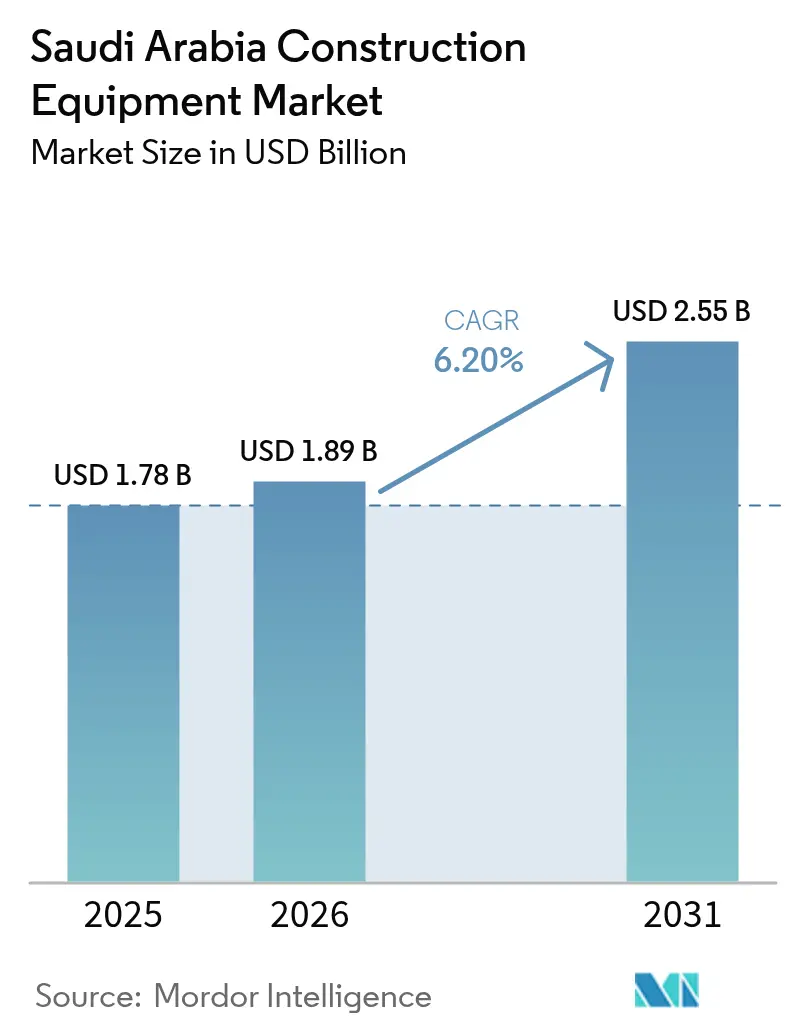
| Base Year Market Size (2025) | USD 1.78 Billion |
| Market Size (2026) | USD 1.89 Billion |
| Market Size (2031) | USD 2.55 Billion |
| Growth Rate (2026 - 2031) | 6.20 % |
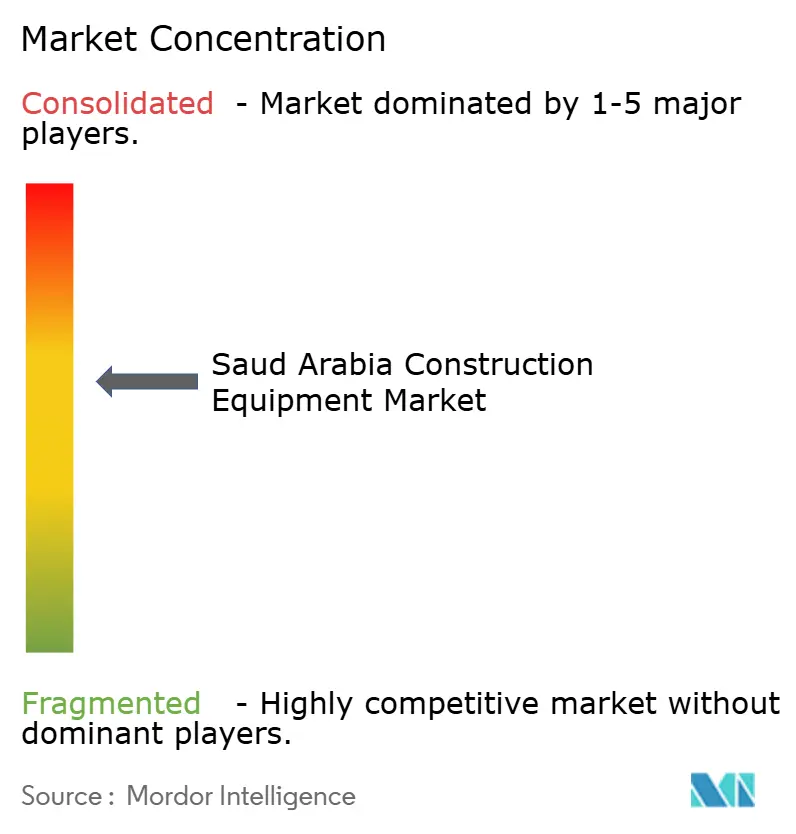
| Market Concentration | Medium |
Major Players *Disclaimer: Major Players sorted in no particular order Image © Mordor Intelligence. Reuse requires attribution under CC BY 4.0. | |
Saudi Arabia Construction Equipment Market Analysis by Mordor Intelligence
The Saudi Arabia construction equipment market size is expected to grow from USD 1.78 billion in 2025 to USD 1.89 billion in 2026 and is forecast to reach USD 2.55 billion by 2031 at 6.2% CAGR over 2026-2031. The expansion is powered by the USD 1.5 trillion Vision 2030 giga-project pipeline, rental-driven fleet optimization, and accelerating demand for earth-moving machines fitted with telematics. Equipment localization incentives, mandatory AI-based safety features in public tenders, and draft Tier-4f emission norms add structural tailwinds. Meanwhile, volatile steel prices, a skilled operator shortage, and grid limitations for on-site charging place measurable, yet manageable, constraints on market velocity. Competitive intensity is rising as Chinese manufacturers gain share through pricing, and global OEMs form Saudi joint ventures to satisfy local-content rules, all of which reshape service models and technology roadmaps in the Saudi Arabia construction equipment market.
Key Report Takeaways
- By machinery type, earth-moving equipment held 46.35% of the Saudi Arabia construction equipment market share in 2025, while excavators are projected to record the fastest 8.30% CAGR through 2031.
- By power source, diesel maintained a 78.95% share of the Saudi Arabia construction equipment market size in 2025, whereas battery-electric equipment is forecasted to grow at a 20.10% CAGR to 2031.
- By sector type, building applications accounted for 42.80% of the Saudi Arabia construction equipment market size in 2025; infrastructure is projected to advance at an 11.10% CAGR through 2031.
- By power output, the 201–400 HP class led with 37.10% of Saudi Arabia construction equipment market share in 2025, while units below 100 HP are projected to exhibit the highest 9.55% CAGR.
- By region, Central Saudi Arabia commanded 35.40% of the Saudi Arabia construction equipment market share in 2025; the Western region is projected to show the strongest 8.30% CAGR through 2031.
Note: Market size and forecast figures in this report are generated using Mordor Intelligence’s proprietary estimation framework, updated with the latest available data and insights as of 2026.
Saudi Arabia Construction Equipment Market Trends and Insights
Drivers Impact Analysis*
| Driver | (~) % Impact on CAGR Forecast | Geographic Relevance | Impact Timeline |
|---|---|---|---|
| Vision-2030 Giga-Project Pipeline | +1.2% | Central, Western, Eastern | Long term (≥ 4 years) |
| Demand for NEOM/Red Sea | +0.9% | Western, Northern | Medium term (2-4 years) |
| Rental Preference Cutting Capex and Labour Costs | +0.7% | Central, Western, Eastern | Short term (≤ 2 years) |
| Local-Content Rules | +0.5% | Central, Eastern | Medium term (2-4 years) |
| AI-Telematics Mandate | +0.3% | Central, Western | Short term (≤ 2 years) |
| Tier-4f Emission Norms | +0.2% | Central, Western, Eastern | Long term (≥ 4 years) |
| Source: Mordor Intelligence | |||
Vision-2030 Giga-Project Pipeline Worth USD 1.5 Trillion
The pipeline of mega-developments such as NEOM, the Red Sea Project, Diriyah Gate, and Qiddiya is recalibrating demand toward high-capacity excavators, autonomous bulldozers, and specialized tunneling rigs. NEOM alone is investing heavily for robotic construction systems, compelling OEMs to integrate AI telematics and remote operation modules into Saudi Arabia construction equipment market offerings. Contractors prefer long-term rental agreements because equipment life cycles trail the multi-decade project timelines, lowering balance-sheet stress while meeting rapid technology refresh needs. Government bond issuances and sovereign wealth fund spending smooth cash-flow visibility, providing contractors with financing certainty that reinforces equipment procurement planning[1]“Giga-Projects Pipeline Overview,” vision2030.gov.sa Source: Public Investment Fund, “Infrastructure Investment Strategy,” Vision 2030 Program, pif.gov.sa.
Earth-Moving Demand for NEOM/Red Sea
NEOM’s 26,500 km² desert terrain requires continuous grading, cut-and-fill operations, and large-scale soil stabilization, driving 24/7 deployment of crawler excavators, articulated dump trucks, and motor graders. Coastal elements of the Red Sea Project call for amphibious excavators and low-vibration piling rigs to protect coral ecosystems. Sustainability clauses built into both projects favor diesel-electric hybrids and battery-powered compact loaders, catalyzing power-source diversification in the Saudi Arabia construction equipment market. Remote locations elevate the value of predictive maintenance software and on-site parts stock, differentiating OEMs with robust service footprints[2]“Sustainable Development Requirements,” NEOM Company, neom.com.
Rental Preference to Cut Capex and Labor Costs
Rental penetration in the Saudi Arabia construction equipment market is rising as contractors hedge against steel-price volatility and compressed project margins. Full-service rental contracts include certified operators, thereby mitigating the Kingdom’s skilled operator shortage and keeping projects in regulatory compliance. Fleet owners scale assets up or down in line with project phases, reducing idle-time overhead. Rental firms are standardizing telematics across mixed OEM fleets, enabling contractors to benchmark machine utilization and fuel burn, which further strengthens the rental value proposition in cost-sensitive bids.
Local-Content Rules Driving OEM Localization
Saudi-made content thresholds incentivize global OEMs to assemble excavators, tower cranes, and concrete pumps within the Kingdom. Partnerships with domestic industrial groups give OEMs duty exemptions and preferential treatment in public tenders. Local sourcing requirements extend to hydraulics, undercarriage components, and control software, injecting new revenue potential for Saudi suppliers and shortening lead times for end-users. SASO certification aligns localized production quality with international standards, ensuring machines remain export-eligible to the wider Middle East and North Africa region.
Restraints Impact Analysis*
| Restraint | (~) % Impact on CAGR Forecast | Geographic Relevance | Impact Timeline |
|---|---|---|---|
| Volatile Steel and Freight Prices | -0.8% | Central, Eastern, Western | Short term (≤ 2 years) |
| Skilled Operator Shortage | -0.6% | Central, Western, Eastern | Medium term (2-4 years) |
| Grid Limits | -0.4% | Western, Northern | Medium term (2-4 years) |
| Water Scarcity | -0.3% | Northern, Eastern | Long term (≥ 4 years) |
| Source: Mordor Intelligence | |||
Volatile Steel and Freight Prices
Surging global steel benchmarks raise manufacturing costs for excavator booms, crane masts, and chassis frames. Though new Saudi steel capacity aims to inject supply stability, rapid infrastructure demand keeps domestic prices elevated, compelling OEMs to implement quarterly price surcharges. Ocean-freight spikes tied to Red Sea security disruptions layer further cost pressure, nudging buyers toward localized assembly where shipping exposure is limited. Higher acquisition costs speed up the shift to rental contracts, as contractors offload price risk onto fleet owners.
Skilled Operator Shortage
Amendments to the 2025 Labor Law mandate structured training programs for Saudi nationals, yet heavy-equipment operation remains outside traditional engineering curricula. Contractors report bid delays because qualified operators for 200-ton cranes and GPS-guided graders are scarce. OEMs respond by embedding joystick-mode assist, automated grade control, and augmented-reality diagnostics to lower skill thresholds. The skills gap also pushes higher wages, which in turn intensifies demand for autonomous and semi-autonomous machinery within the Saudi Arabia construction equipment market.
*Our forecasts treat driver/restraint impacts as directional, not additive. The impact forecasts reflect baseline growth, mix effects, and variable interactions.
Segment Analysis
By Machinery Type: Earth-Moving Equipment Dominates Mega-Projects
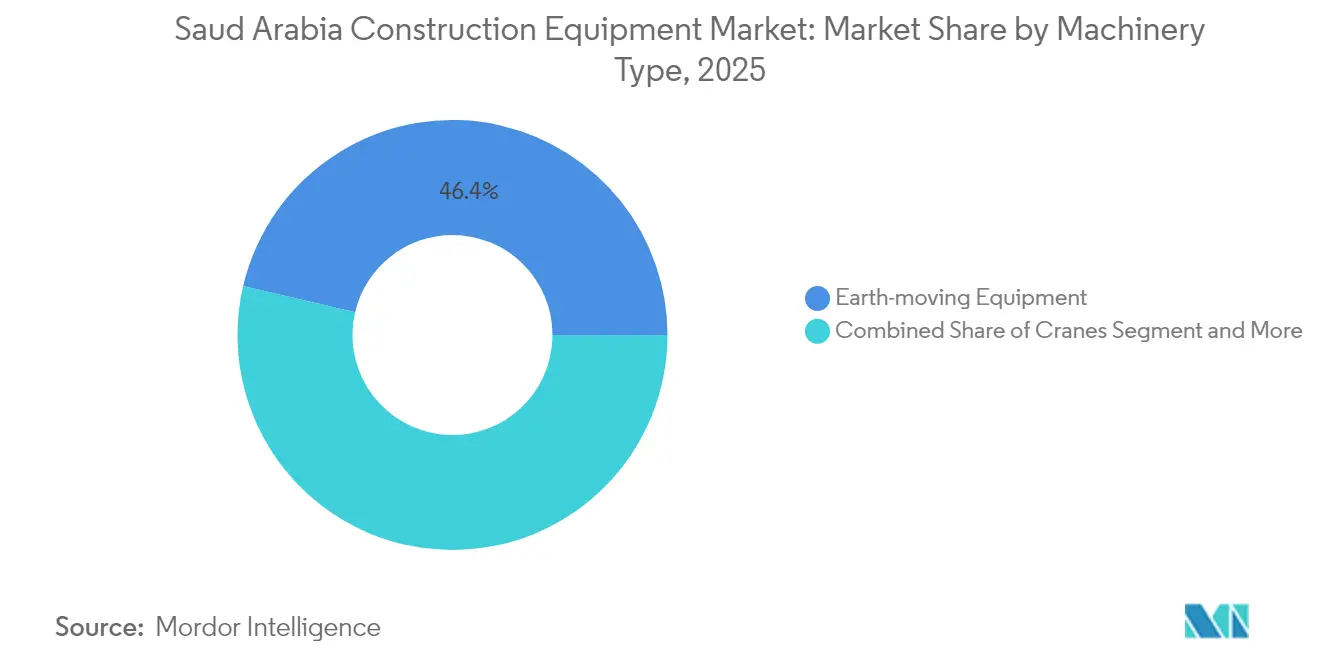
Earth-moving equipment captured 46.35% of Saudi Arabia construction equipment market share in 2025, underscoring its indispensability to desert grading, megacity foundation work, and logistics-corridor construction. Excavators top the growth chart at 8.30% CAGR, empowered by Vision 2030 backlogs that demand high-cycle duty across multiple simultaneous giga-sites. Bulldozers and graders benefit from multi-lane highway projects that interconnect Riyadh, NEOM, and Red Sea corridors, while crawler cranes sustain mid-single-digit growth on the back of vertical mixed-use towers. Concrete pumps and mixers remain essential for residential output bursts, whereas aerial work platforms stake relevance amid stricter worker-safety codes in urban settings.
The machinery mix is trending toward specialized sub-categories. Tunnel borers find niche acceleration in Riyadh Metro extensions, and stone crushers anchor aggregate self-sufficiency drives in Tabuk Province. High-capacity material-handling trucks serve port modernizations at King Abdullah Port, feeding export supply chains. Precision drilling rigs align with renewable-energy park installations, while compact backhoe loaders service urban infill projects. The broader Saudi Arabia construction equipment market therefore demands product diversity, pushing OEMs to widen portfolios and engage in selective local assembly of high-volume models.


By Power Source: Electric Transition Accelerates Despite Diesel Dominance
Diesel engines sustained a wide 78.95% share of the Saudi Arabia construction equipment market in 2025, owing to their high power density and ubiquitous service infrastructure. Yet battery-electric units clock a 20.10% CAGR to 2031, supported by sustainability mandates at giga-projects and falling lithium-ion pack costs. Interim hybrid platforms grow in step with Tier-4f emissions compliance, blending fuel savings with dependable refueling logistics.
Grid constraints at remote Western and Northern job sites complicate rapid electrification, but developers are piloting solar-plus-storage microgrids to solve charging bottlenecks. Hydrogen fuel-cell prototypes are undergoing field trials tied to the Kingdom’s green-hydrogen export ambitions. Diesel OEMs defend market share via telematics-based fuel-efficiency upgrades, while rental companies hedge with blended fleets that meet current diesel demand and emergent electric requirements within the Saudi Arabia construction equipment market.
By Sector Type: Infrastructure Growth Outpaces Building Dominance
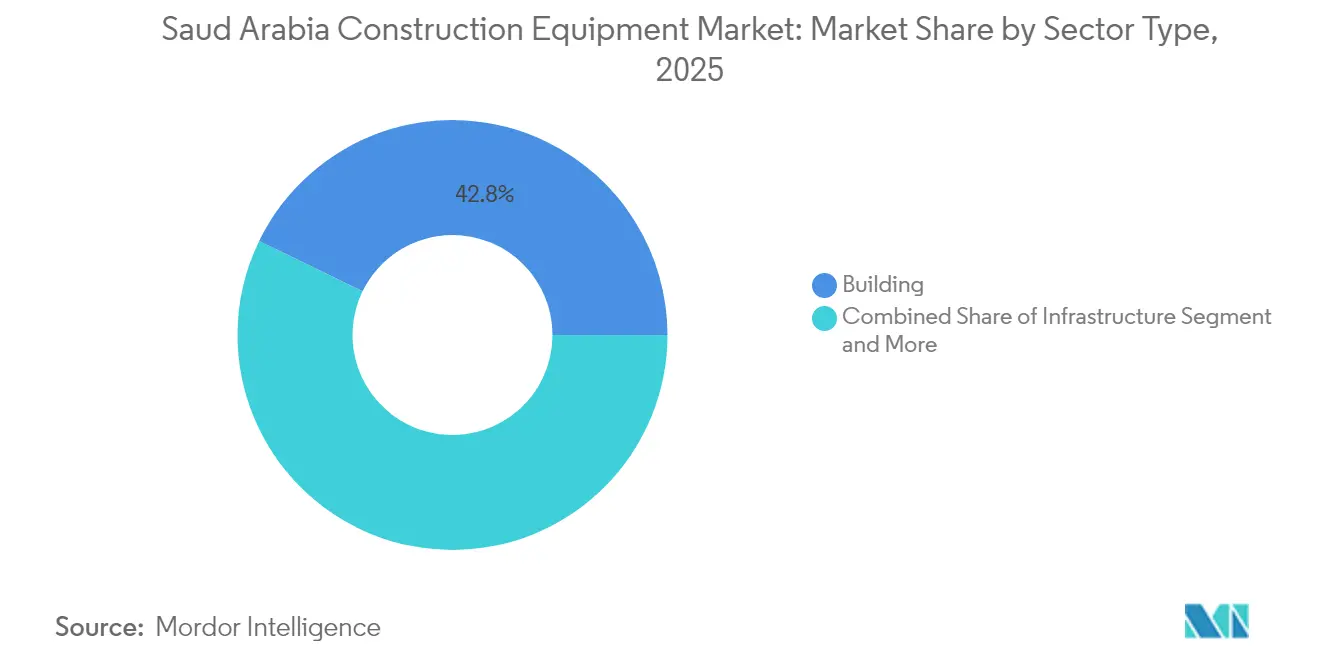
Building applications held a 42.80% share of the Saudi Arabian construction equipment market in 2025, feeding Riyadh’s skyline and residential expansions across secondary cities. Nonetheless, infrastructure spending posts an 11.10% CAGR through 2031, powered by 10,000 km of new highways, regional airport upgrades, and nationwide rail connectivity that dovetail with the logistics strategy under Vision 2030. Energy-sector equipment demand stabilizes as combined-cycle power plants and wind farms replace aging oil-fired assets.
Mining requisitions strengthen as the Kingdom unpacks mineral riches ranging from phosphates to rare earths. Sector diversification yields mixed equipment needs: twin-boom tunneling rigs for metro systems, tower cranes for high-rise hotels, amphibious excavators for coastal tourism marinas, and heavy-duty forklifts for petrochemical terminals. Emerging industrial clusters at Ras Al Khair and Jazan call for grader fleets and batching plants, adding multi-year depth to the Saudi Arabia construction equipment market booking pipeline.
By Power Output: Mid-Range Equipment Leads Market Positioning
Machines rated 201–400 HP dominated with 37.10% of Saudi Arabia construction equipment market share in 2025, balancing torque demands with transport and fuel-burn efficiency. Below-100 HP units post the fastest 9.55% CAGR, aided by alleyway projects, smart-city retrofits, and the rental sector’s appetite for versatile skid-steers. The 101–200 HP tranche supports mid-rise commercial builds, while 400-plus HP giants remain staples for mass earth-moving and quarrying, albeit under rising fuel-economy scrutiny.
Product selection is migrating toward intelligent power management. OEMs employ load-sensing hydraulics and idle-shutdown logic to cut fuel consumption across size classes. Operators in densely populated zones gravitate toward compact electric mini-excavators that comply with noise ordinances, while 600 HP bulldozers reserved for NEOM’s backbone infrastructure increasingly feature pre-wired autonomous-ready controls, evidencing a nuanced segmentation of the Saudi Arabia construction equipment market.
Geography Analysis
Central Saudi Arabia preserved a 35.40% share of the Saudi Arabia construction equipment market in 2025 on the strength of Riyadh’s public and private capex cycle. Projects such as New Murabba, King Salman Park, and multiple data-center campuses demand an array of earth-moving and vertical-construction machinery. A mature dealer network ensures rapid parts availability and comprehensive service programs, lowering machine downtime and sustaining long-term fleet utilization. Continuous metro expansions and high-capacity bus corridors reinforce recurrent demand for compact graders, tunnel-boring machines, and road pavers. Steady municipal spending cushions Central region contractors from commodity-price turbulence, sustaining predictable ordering patterns within the Saudi Arabia construction equipment market.
The Western region ranks pole in growth with an 8.30% CAGR through 2031. Coastal topography necessitates specialized amphibious excavators, corrosion-resistant cranes, and low-ground-pressure loaders. Makkah and Madinah’s Hajj modernizations inject seasonal demand peaks for tower cranes, modular accommodation handlers, and rapid-set concrete pumps. Jeddah’s commercial redevelopment, port capacity expansions, and “New Jeddah Downtown” transform the city into a logistics and tourism nexus, requiring a diversified equipment palette and bolstering service footprints. Western region contractors increasingly value rental contracts bundled with OEM maintenance to offset harsh saline operating environments.
Eastern, Northern, and Southern regions deliver moderate yet resilient upside. The Eastern Province leverages petrochemical and steel investments, relying on heavy-duty crawlers, forklifts, and concrete batch plants. Northern corridors benefit from rail extensions toward Jordan and Iraq, stimulating orders for tracklaying machines and ballast regulators. Southern agriculture zones adopt compact tractors, excavators, and self-propelled sprayers to modernize irrigation networks. While these regions lag in dealer density, Vision 2030’s geographic-diversification push continues to unlock distributed demand pockets across the Saudi Arabia construction equipment market.
Regulatory Landscape
Saudi Arabia governs construction and heavy equipment through the Saudi Standards, Metrology and Quality Organization (SASO), including the Heavy Equipment Regulatory Center (HERC) established by Council of Ministers Decision No. 488 (April 2021). Import and market-access compliance for regulated products are enforced through SASO requirements and the SABER electronic portal under the Saleem product safety program, which supports product registration and certificate workflows used in customs clearance.
Operational compliance also covers asset and operator governance. Equipment owners register heavy equipment through the Unified National Platform (my.gov.sa) with HERC for inspection and licensing, and HERC issues conditions covering importation controls, training entity controls, and operator licensing and qualification rules (2023). On the trade side, ZATCA administers customs and tariffs, including the GCC-wide 12-digit integrated tariff system in effect from January 1, 2025, and late-2025 tariff schedule amendments affecting selected HS codes for industrial machinery. That increases the need for importers and distributors to manage classification and landed-cost planning more actively.
Value Chain Analysis
The value chain starts with global OEM design and component supply, including powertrains, hydraulics, undercarriage, electronics, and telematics. Equipment then ships into Saudi Arabia through importers and local industrial partners, followed by assembly or customization where localization thresholds apply. Distribution and aftersales are handled through dealer-led networks that combine sales, rentals, service bays, and parts logistics in key demand centers (notably Riyadh, Jeddah, and Dammam), with project logistics extending into remote giga-project sites where uptime depends on mobile service teams, on-site parts stocking, and predictive maintenance workflows.
Localization programs are also shifting midstream nodes from import-only models toward in-country production and fabrication. The National Industrial Development Center (NIDC) has stated an ambition for 50% localization in the machinery and equipment sector by 2030, supported by Public Investment Fund (PIF) Supplier Development Program initiatives aimed at local sourcing and supplier capability building. Recent examples include the SENNEBOGEN and PWS joint venture to establish a Dammam production facility for lattice boom crawler cranes with an investment volume of SAR 220 million, along with local tower-crane manufacturing initiatives structured via joint ventures. Downstream, large project owners and contractors increasingly procure through full-service rentals and framework agreements, shifting value toward fleet management, certified operators, compliance documentation, and high-availability parts and reman support.
Competitive Landscape
The Saudi Arabia construction equipment market is moderately fragmented. Caterpillar leads through its joint venture with Zahid Tractor, showcasing the strategic value of integrated sales, rental, and service hubs in Riyadh, Jeddah, and Dammam. Komatsu trails, though fiscal-year unit deliveries dipped because of delayed governmental purchasing cycles, prompting investment in local remanufacturing to fortify after-sales income streams. Chinese brand XCMG advances by fielding cost-competitive loaders and cranes bundled with extended-warranty packages. European tower-crane maker Wolffkran broke ground on an assembly plant, reflecting how local-content mandates reshape fixed-asset localization strategies.
Hitachi Construction Machinery’s high-tonnage ZX890LCH-7G excavator launch introduces bulk-earth-moving competence suited for giga-site basements, signaling larger payload trends in the Saudi Arabia construction equipment market. Competitive differentiation is migrating toward digital service ecosystems. OEMs deploy cloud-based telematics suites for fuel tracking, preventive maintenance, and remote diagnostics. Rental companies like Bin Quraya integrate mixed-OEM data flows into single dashboards, empowering contractors with machine-level cost analytics. Regulatory rigor around SASO certification and AI-based safety systems sets a baseline compliance hurdle, likely nudging smaller import-only entrants to either partner locally or exit.
Green-finance incentives tied to lower-emission machinery create white-space for innovators delivering battery-electric or hydrogen-fuel-cell platforms, reshaping future share dynamics. Long-term, OEMs able to blend technology innovation, local manufacturing, and rental-ready financial solutions are best positioned to defend and grow their footprints. Consolidation remains a credible scenario as capital-intensive localization weeds out suppliers lacking balance-sheet depth, supporting a gradual upward drift in market concentration within the Saudi Arabia construction equipment market.
Saudi Arabia Construction Equipment Industry Leaders
Komatsu Ltd
Volvo Construction Equipment Corporation
Caterpillar Incorporation
Hitachi Construction Machinery Co. Ltd
XCMG
- *Disclaimer: Major Players sorted in no particular order

Market Opportunities and Future Outlook
Compliance-led digitization and safety governance create whitespace for OEMs, dealers, and rental companies that can package equipment with verifiable documentation, inspections, and operator qualification support. With SASO HERC as a dedicated regulator for heavy equipment, mandatory import workflows via SABER, and asset registration through my.gov.sa, integrated offerings can reduce administrative friction for contractors operating mixed fleets. In parallel, report context also points to public and giga-project tender requirements tied to AI-based safety features and telematics adoption, supporting demand for connected-machine retrofits, subscription telematics, and dealer-run condition-monitoring centers across earth-moving and lifting fleets.
Localization and local manufacturing partnerships are a second opportunity area, anchored by active industrial policy and on-the-ground investments. NIDC targets 50% localization in machinery and equipment by 2030, while PIF supplier development initiatives back supply chain localization, encouraging OEMs to expand assembly, fabrication, and parts warehousing within the Kingdom. The June 2026 SENNEBOGEN-PWS joint venture (SAR 220 million) for crawler crane production in Dammam shows operational momentum behind heavy-lift equipment localization, with adjacent opportunities in component sourcing, remanufacturing, and field-service capacity in Western and Northern giga-project corridors. Electrification also offers a practical entry point for compact and duty-cycle-suitable machines, supported by giga-project sustainability clauses in the report context and demonstrated by Saudi Readymix deploying a fully battery-electric wheel loader operating in extreme summer conditions, which strengthens the case for charging solutions, mixed-fleet rental models, and application-specific electrified equipment packages.
Recent Industry Developments
- July 2026: Saudi Readymix deployed Saudi Arabia's first fully battery-electric wheel loader, supplied by XCMG, and reported operation through the 2025 and 2026 summer seasons in temperatures exceeding 50 degrees Celsius. The deployment provides a local proof point for electrified loaders in harsh duty cycles and supports contractors and rental firms evaluating low-emission equipment packages for giga-project sustainability clauses.
- June 2026: SENNEBOGEN and PWS, alongside the National Industrial Development Center (NIDC), announced a joint venture to locally produce lattice boom crawler cranes in Dammam with an investment volume of SAR 220 million. The move expands in-country manufacturing capability for heavy lifting equipment and aligns OEM go-to-market models with localization and public-tender requirements.
- September 2025: Hitachi Construction Machinery Middle East delivered 7th-generation ZX890LCH-7G excavators to dealer Arabian Truck and Construction Equipment Co. (ATEC) for heavy-duty excavation and specialized lifting tasks. The delivery refreshes high-tonnage earthmoving availability through a key Saudi channel partner and supports equipment supply for large-scale basement and mass excavation workloads across giga-project sites.


Research Methodology Framework and Report Scope
Market Definition and Coverage
For this methodology, the market covers the value of construction equipment sold and used in Saudi Arabia for building, infrastructure, energy, and related site development work. It includes major equipment classes used for earthmoving, lifting, road work, concrete, and material handling, counted in USD.
Scope exclusions: We exclude general industrial machinery that is not mainly used for construction activity, along with purely hand tools and small consumer-grade equipment.
Segmentation Overview
- By Machinery Type
- Cranes
- Earth-moving Equipment
- Motor Graders
- Excavators
- Loaders (Wheel, Backhoe, Skid-steer)
- Material Handling Equipment
- Telescopic Handlers
- Forklifts
- Bulldozers
- Dump Trucks
- Aerial Work Platforms
- Road Construction Equipment (Pavers, Compactors)
- Concrete Equipment (Mixers, Pumps)
- Drilling and Foundation Equipment
- Stone Crushers and Screening Equipment
- Tunnelling Equipment
- By Power Source
- Diesel
- Hybrid
- Battery-Electric
- Hydrogen Fuel-cell
- By Sector Type
- Building (Residential, Commercial, Mixed-use, Airports, Sports)
- Infrastructure (Roads, Bridges, Rail, Ports, Waste-water)
- Energy (Oil and Gas, Power and Water)
- Mining and Quarrying
- Industrial (Manufacturing, Logistics)
- Utilities (Desalination, Renewable Energy)
- By Power Output
- Below 100 HP
- 101 to 200 HP
- 201 to 400 HP
- Above 400 HP
- By Region (Saudi)
- Central
- Western
- Eastern
- Northern
- Southern
Data Sources, Market Sizing, and Validation
Desk Research
Desk research was used to set the Saudi Arabia demand context and define what should be counted as construction equipment. We reviewed public sources such as the Saudi General Authority for Statistics (GASTAT), Saudi Central Bank (SAMA) releases, and Ministry of Municipal and Rural Affairs and Housing updates to understand construction activity and investment cycles.
We also referred to sources such as UN Comtrade for import trends by relevant equipment HS codes, Customs and port statistics where available, and trade association and industry body publications that discuss fleet turnover and rental penetration. To align pricing and availability signals, we checked company annual reports, investor presentations, and reputable press coverage of project awards and delivery timelines. In addition, paid subscriptions that provide company financials and intelligence, shipment-level trade views, and patent databases were used selectively to validate player presence and technology adoption. This list is illustrative, and many other public and paid sources were also used for data collection, validation, and clarification.
Primary Interviews and Surveys
Primary work was used to pressure-test the assumptions that desk sources cannot confirm cleanly, especially pricing ranges, typical utilization, and near-term demand shifts tied to project schedules. We spoke with a spread of stakeholders such as contractors, rental companies, distributors, and service providers, and we also included viewpoints from project and equipment managers across key demand centers within the Kingdom. Inputs from these discussions were then used to adjust penetration, replacement, and pricing logic so the market total stays realistic.
Distribution of primary research fieldwork respondents
| Company type | Respondent position |
|---|---|
| Top tier: 29% | CXOs: 14% |
| Mid tier: 57% | Functional/Unit leaders: 37% |
| Smaller Players: 14% | Managers: 49% |
Market-Sizing & Forecasting
The core sizing model starts with a top-down demand reconstruction that links construction activity in Saudi Arabia to equipment need, and then converts that need into value using country-specific price bands. When the demand pool is built, it is broken into major equipment groups so different purchase cycles and utilization patterns can be reflected before the totals are added back up.
In practice, a few inputs do most of the work, and we keep them traceable. These include public construction output and fixed investment indicators, the pipeline of large building and infrastructure projects, equipment import direction for relevant product lines, rental fleet share and replacement timing, and average selling price movement by equipment class and power output. To keep the total grounded, the results are checked with selective bottom-up approximations such as distributor channel feedback, sampled unit volumes multiplied by typical ASPs, and sanity checks against the active fleet expansion implied by rental and contractor plans.
For forecasting, scenario analysis is used because project award timing and delivery phasing can swing year-to-year demand in this market. We build a base case and then test upside and downside cases around project starts, execution speed, and price inflation, and the final curve reflects the consensus ranges heard in interviews.
Data Validation & Update Cycle
We validate the model by comparing outputs against independent signals such as construction activity indicators, import direction, and field feedback on order books, lead times, and utilization. Any large variance triggers a review of the underlying drivers, after which assumptions are corrected and re-checked before sign-off.
A second analyst review is completed to catch inconsistencies across segments and to confirm the arithmetic and logic remain consistent across the time series. The report is refreshed annually, and interim updates are made when material events occur, such as major policy shifts, demand shocks, or large project re-phasing. Before delivery, we complete a fresh final pass so clients receive the most current view available at that time.
Mordor Intelligence's Saudi Arabia Construction Equipment Market Estimate Compared With Other Published Estimates
Published market values for Saudi Arabia construction equipment often vary because each publisher sets different boundaries on what counts as equipment and how demand is converted into USD value. Differences also come from the year chosen for pricing, how rental fleet purchases are treated, and whether the estimate is anchored to observed trade and project signals or mainly to broad macro growth.
Import direction for key equipment groups, along with project award flow and distributor channel checks, are the evidence points that keep Mordor Intelligence tied to the actual purchase cycle, and this reduces the risk of counting adjacent industrial machines or double-counting rental fleet turnover. In addition, some published figures lean on aggressive execution assumptions for mega-project timelines, and others compress the scope to only heavy earthmoving, which can shift the total in either direction.
Benchmark comparison
| Source | Market Size | Gaps in Research Methodology |
|---|---|---|
| Mordor Intelligence | USD 1.78 B (2025) | |
| Industry Publication A | USD 1.40 B (2024) | Uses a different base year and is typically presented as a headline value without clear treatment of rental fleet replacement and power-source mix, which can understate value when ASPs are moving. |
| Global Research Outlet B | USD 3.50 B (2025) | Often reflects a heavier equipment-only framing with broader add-ons or looser category boundaries, and it may apply faster project execution and price inflation assumptions without cross-checking against trade and channel signals. |
The comparison shows that the spread is mostly explained by scope boundaries, base-year pricing, and how purchase cycles are linked to project timing. By keeping the value build tied to observable demand signals and simple, checkable assumptions, we can present a market total that is easier to reproduce and stress-test when conditions change.


Key Questions Answered in the Report
What is the forecasted value of the Saudi Arabia construction equipment market by 2031?
The market is expected to reach USD 2.55 billion by 2031, growing at a 6.2% CAGR.
What is the market size of the Saudi Arabia construction equipment market in 2026?
The market size is USD 1.89 billion in 2026.
Which machinery type currently holds the largest share in Saudi Arabia?
Earth-moving equipment leads with a 46.35% share.
Which power source is growing fastest in the Kingdom’s construction equipment space?
Battery-electric equipment is projected to expand at a 20.10% CAGR through 2031.
Which region is the fastest-growing market within Saudi Arabia?
The Western region, driven by Red Sea and Hajj projects, posts an 8.30% CAGR.
How are local-content rules affecting global OEM strategies?
They push OEMs to establish Saudi assembly plants and source components locally to qualify for public-tender advantages and tariff relief.
What is the biggest short-term restraint on market growth?
Volatile steel and freight costs reduce purchasing budgets and encourage rental over ownership.
Page last updated on:


 Your data is secure and never sold or shared.


