
Market Overview
| Study Period | 2020 - 2031 |
|---|---|
| Forecast Data Period | 2026 - 2031 |
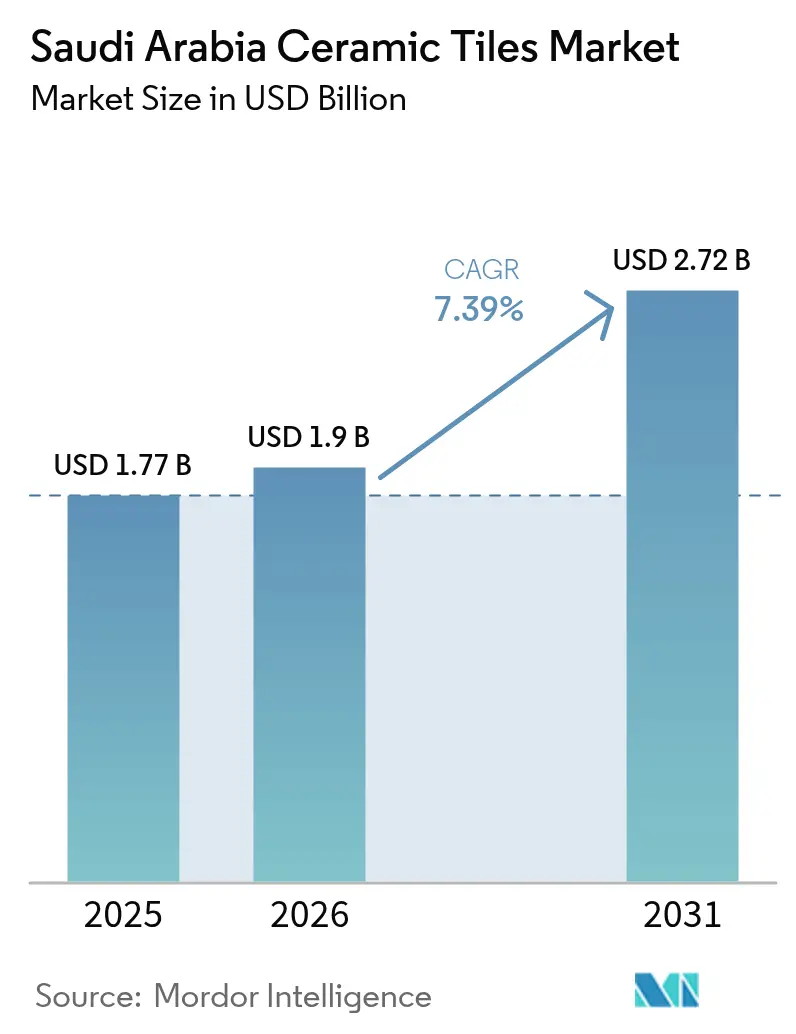
| Base Year Market Size (2025) | USD 1.77 Billion |
| Market Size (2026) | USD 1.9 Billion |
| Market Size (2031) | USD 2.72 Billion |
| Growth Rate (2026 - 2031) | 7.39 % |
| Market Concentration | Medium |
Major Players *Disclaimer: Major Players sorted in no particular order Image © Mordor Intelligence. Reuse requires attribution under CC BY 4.0. | |
Saudi Arabia Ceramic Tiles Market Analysis by Mordor Intelligence
Saudi Arabia ceramic tiles market size in 2026 is estimated at USD 1.90 billion, growing from 2025 value of USD 1.77 billion with 2031 projections showing USD 2.72 billion, growing at 7.39% CAGR over 2026-2031. Massive construction spending tied to Vision 2030, highlighted by mega-projects such as NEOM’s SAR 1.3 billion (USD 0.35 billion) automation joint venture and ROSHN’s SAR 37.5 billion (USD 10.0 billion) residential contracts, is the primary volume catalyst. The USD 950 billion national project pipeline, equal to 62% of total MENA construction value, positions the Kingdom as the world’s largest construction arena by 2028 [1]JLL, “Saudi Construction Pipeline Outlook 2025,” jll.com. Climate-driven shifts toward porcelain and glazed surfaces, together with a premium turn to large-format and anti-bacterial finishes, are reshaping product specifications. Mandatory 70% local-content thresholds under the IKTVA program and rising natural-gas tariffs are further steering manufacturers toward efficient kilns and dry-granulation technology that lowers gas use from 46 m³/ton to 15 m³/ton [2]Saudi Aramco, “IKTVA Program Supplier Manual 2024,” aramco.com
Key Report Takeaways
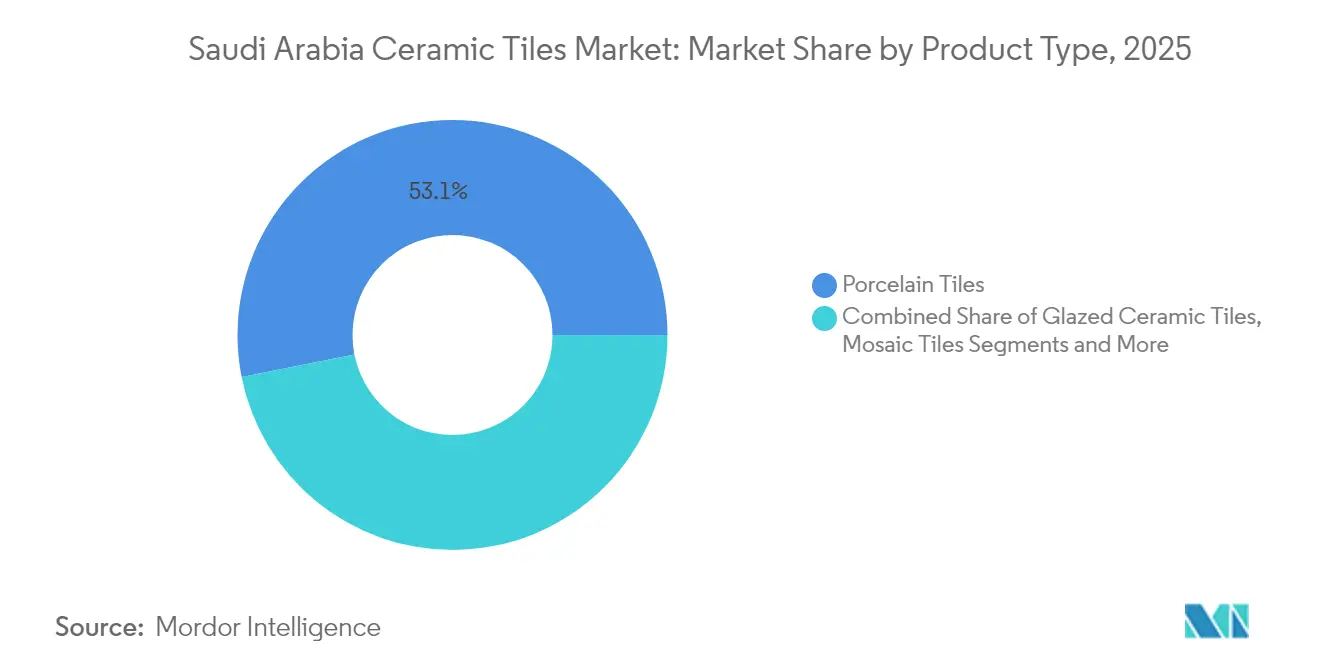
- By product type, porcelain tiles held 53.12% of Saudi Arabia ceramic tiles market share in 2025 while unglazed tiles are projected to record the fastest 8.10% CAGR to 2031.
- By application, floor coverings captured 61.78% of the Saudi Arabia ceramic tiles market size in 2025 and are expected to advance at a 7.72% CAGR through 2031.
- By end-user, residential construction accounted for 59.34% of 2025 revenue and is on track for an 7.86% CAGR on the back of more than 400,000 new housing units in the pipeline.
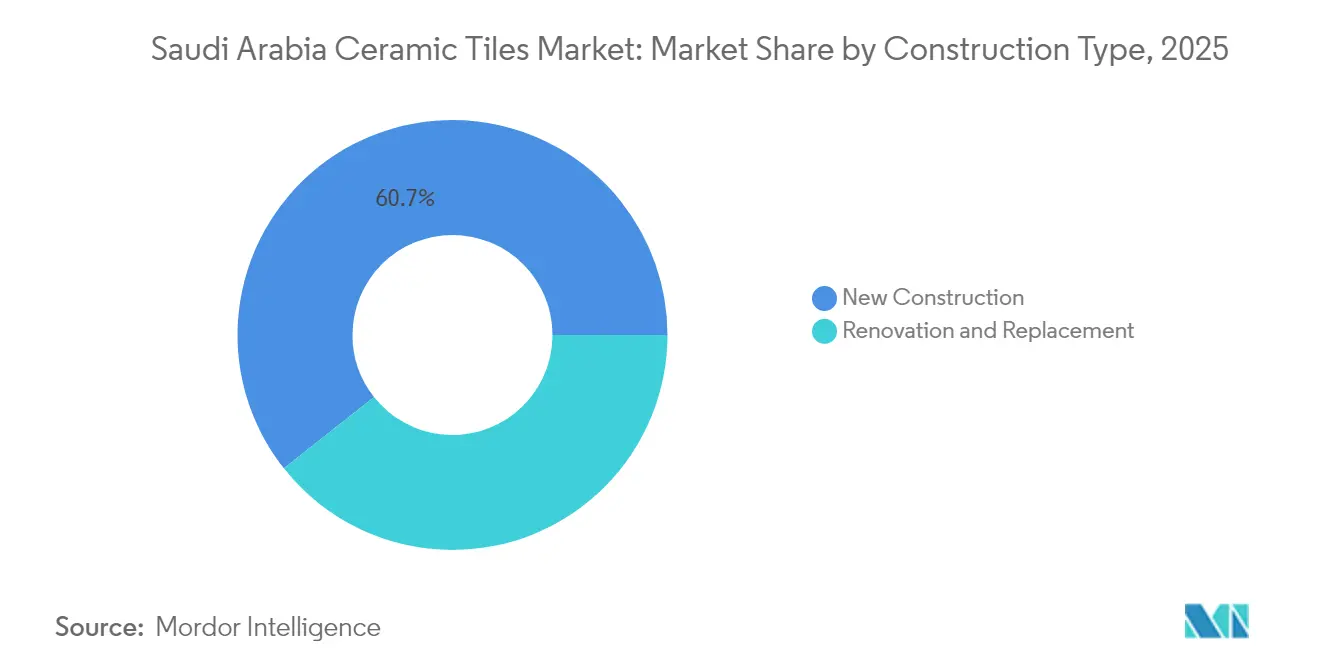
- By construction type, new-build activity contributed 60.65% of demand in 2025, expanding at an 8.18% CAGR as giga-projects move from design to execution.
- By distribution channel, specialty tile stores led with 47.55% share in 2025, whereas online platforms represent the fastest-growing outlet at an 7.96% CAGR.
- By geography, Riyadh commanded 31.75% of 2025 sales; the Eastern Province is the quickest climber with a 7.52% CAGR through 2031.
Note: Market size and forecast figures in this report are generated using Mordor Intelligence’s proprietary estimation framework, updated with the latest available data and insights as of 2026.
Saudi Arabia Ceramic Tiles Market Trends and Insights
Drivers Impact Analysis*
| Driver | (~) (%) Impact on CAGR Forecast | Geographic Relevance | Impact Timeline |
|---|---|---|---|
| Surge in residential construction | +1.8% | Nationwide; early gains in Riyadh, Eastern Province, Makkah | Medium term (2-4 years) |
| Mega-projects (NEOM, Red Sea, Qiddiya) | +2.1% | Western & Northern regions; spillover to Riyadh | Long term (≥ 4 years) |
| Climate-driven preference for porcelain | +0.9% | Country-wide; strongest in Eastern & Western regions | Short term (≤ 2 years) |
| Premiumization toward large-format tiles | +1.2% | Riyadh, Makkah, Madinah | Medium term (2-4 years) |
| Adoption of energy-efficient kilns | +0.7% | National industrial clusters | Short term (≤ 2 years) |
| Local-content incentives | +1.1% | National; focus on Eastern Province industrial hubs | Medium term (2-4 years) |
| Source: Mordor Intelligence | |||


Surge in Residential Construction Under Vision 2030 Housing Schemes
Vision 2030 aims to lift the home-ownership rate above 70% by 2030, and ROSHN alone plans 400,000 units across nine cities, including the 30,000-unit SEDRA community in northern Riyadh. [3]ROSHN, “SEDRA Master Plan Overview,” roshn.sa. Government-backed mortgages and infrastructure outlays are encouraging private developers to accelerate ground-breaking schedules, locking in multi-year demand visibility for ceramic floor and wall packages. Standards issued by SASO now require higher energy efficiency and low-VOC finishes, pressuring suppliers to deliver compliant tile formulations. Rising suburban projects in secondary cities are broadening geographic consumption beyond Riyadh, Jeddah, and Dammam. Collectively these factors underpin sustained volume growth for producers meeting local-content and sustainability benchmarks.
Mega-Projects Boosting Tile Demand Through NEOM, Red Sea, and Qiddiya
NEOM’s SAR 1.3 billion (USD 0.35 billion) robotics investment with Samsung C&T signals unprecedented construction scale, with early civil works already consuming large-format porcelain for infrastructure command centers. The Port of NEOM, designed for net-zero operations, mandates high-performance, chemically resistant flooring for logistics halls exposed to salt spray. Red Sea Global requires durable, UV-stable glazed tiles for resort boardwalks, while Qiddiya’s entertainment venues specify anti-slip ceramic for pedestrian zones and aquatic attractions. Phased rollouts ensure overlapping procurement cycles, smoothing order intake for tile makers through 2029. Successful material trials at these giga-sites are expected to ripple into conventional projects nationwide.
Climate-Driven Preference for Porcelain and Glazed Tiles
Porcelain’s sub-0.5% water-absorption rate delivers dimensional stability during daily 20 °C temperature swings common in Riyadh summers. Glazed finishes minimize dust adhesion, simplifying maintenance in desert environments where airborne particulates exceed 200 µg/m³ on peak days. Recent R-&D has embedded silver-ion antimicrobial layers into porcelain glazes, supporting infection-control protocols in expanding healthcare and hospitality facilities. Light-toned surfaces reflect solar gain, trimming interior cooling loads and aligning with the Kingdom’s building-energy code. Architects now prespecify porcelain for façades in coastal sites such as Jeddah Corniche to avoid efflorescence, further widening its usage envelope.
Premiumization Toward Large-Format and Anti-Bacterial Tiles
Tile dimensions above 600 mm×600 mm are increasingly standard in luxury villas and Grade-A offices where seamless aesthetics and reduced grout maintenance drive specifier decisions. On NEOM pilot plots, robotic setters laid 1,200 mm×2,400 mm slabs 25% faster than traditional sizes, demonstrating labor savings that offset higher unit prices. Healthcare campuses in Dammam have shifted purchase orders to titanium-dioxide coated porcelain that provides continuous antimicrobial protection, dovetailing with Ministry of Health hygiene directives. Digital inkjet printing now renders marble-look slabs at 600 dpi, meeting high-end design briefs while avoiding natural stone’s weight and porosity drawbacks. Producers capable of large-format firing and advanced surface treatments command price premiums up to 18% over commodity SKUs.
Restraints Impact Analysis*
| Restraint | (~) (%) Impact on CAGR Forecast | Geographic Relevance | Impact Timeline |
|---|---|---|---|
| Raw-material and energy cost volatility | -1.4% | Nationwide; highest in Eastern Province clusters | Short term (≤ 2 years) |
| Price-led competition from Asian imports | -0.8% | Whole market; acute in Riyadh & Dammam | Medium term (2-4 years) |
| Water-scarcity constraints | -0.6% | Central & northern regions | Long term (≥ 4 years) |
| Stricter silica-dust emission regulations | -0.3% | Established manufacturing zones | Medium term (2-4 years) |
| Source: Mordor Intelligence | |||
Raw-Material and Energy Cost Volatility
Global price swings in clay, feldspar, and silica sand can lift production costs by up to 20% within a quarter, compressing margins for smaller Saudi kilns that lack hedging programs. Domestic energy reforms raised natural-gas tariffs, forcing a shift to energy-saving presses and low-friction rollers that demand fresh capex. Limited local clay reserves oblige import reliance, exposing buyers to currency swings versus EUR and CNY. The Ministry of Industry’s plan to issue 22 quarry licenses may ease pressure, yet full output is not expected before 2027. [4]Ministry of Industry & Mineral Resources, “Quarry Licensing Round III,” mim.gov.sa Volatility complicates fixed-price tenders for giga-projects where penalties apply for late delivery or price escalation.
Price-Led Competition From Asian Imports
The 2023 removal of GCC anti-dumping duties on Indian tiles reopened a trade lane once subject to surcharges of 106%, pushing CIF prices down by 12-15%. Indian shipments rebounded from USD 245 million in 2022 toward pre-duty levels, while Chinese suppliers exploit scale economies to undercut domestic quotes in the mid-market. Private developers, less bound by IKTVA, increasingly award contracts to importers offering 60-day payment terms and consolidated container loads. Local brands respond by promoting faster delivery, customized cutting, and on-site technical support—services importers struggle to match. Nevertheless, sustained price pressure may push smaller Saudi plants into mergers or niche specializations.
*Our forecasts treat driver/restraint impacts as directional, not additive. The impact forecasts reflect baseline growth, mix effects, and variable interactions.
Segment Analysis
By Product Type: Porcelain Dominance Drives Premium Shift
Porcelain held 53.12% of 2025 revenue owing to its sub-0.5% water absorption, thermal-shock endurance, and superior abrasion resistance, attributes ideally matched to harsh Gulf climates. Saudi Arabia ceramic tiles market size for porcelain is projected to extend its lead as architects favor 20 mm outdoor slabs and slim 6 mm interior panels that cut structural weight without sacrificing strength. Unglazed tiles, while cost-efficient, are positioned for workshops and budget housing; still, their 8.10% CAGR makes them the fastest-growing slice due to condensed firing cycles that lower selling prices. Glazed formats keep a foothold in hospitality and retail décor where stain-proof finishes command premiums. Digital-printing advances allow all segments to replicate marble, travertine, and hardwood visuals, erasing aesthetic gaps between porcelain and legacy products.
Manufacturers investing in SACMI CONTINUA+ lines can press porcelain slabs up to 30 mm thick with less than 1.5% waste, raising yields and positioning plants for mega-project tender lists. Energy-reduced roller kilns let producers widen color palettes without cost spikes, unlocking margin lift in premium designs. Unglazed output benefits from localized clay beneficiation in Eastern Province, trimming freight costs and carbon footprint. Producers that bundle matching skirting and step tiles secure add-on revenues while simplifying contractor procurement. Over the forecast horizon, product-portfolio breadth will differentiate winners more than sheer capacity volume.


By Application: Floor Tiles Lead Through Durability Demands
Floor installations represented 61.78% of 2025 turnover as every new villa, apartment, or shopping mall requires large-area coverage versus selective wall cladding. Saudi Arabia ceramic tiles market share for floor products is forecast to stay above 60% given giga-project footprints exceeding 2 million m² of gross floor area each. Wall applications grow steadily as bathroom and kitchen renovations adopt 300 mm×900 mm glazed options that minimize grout joints. Roofing remains niche because flat concrete roofs dominate local architecture, though heritage restorations in Diriyah deploy clay barrel tiles for authenticity. High-traffic commercial venues mandate PEI Class 4 or Class 5 floor ratings, effectively steering demand to porcelain and high-fired ceramics.
The rise of radiant-cooling slabs in luxury residences supports thicker porcelain floor modules that integrate hydronic coils, adding technical complexity and value per square meter. Mall developers in Jeddah and Khobar specify oversized 1,000 mm tiles to create uninterrupted visual planes that enhance shopper experience. Advanced slip-resistant micro-texture glazes are adopted in airport concourses to meet ICAO safety codes. Wall-tile suppliers market stain-proof inks that resist turmeric and coffee splashes, responding to local cuisine influences. Overall, application-driven specification adds resilience to average selling prices even as raw-material volatility persists.
By End-User: Residential Sector Drives Volume Growth
Residential projects captured 59.34% of demand in 2025 and will expand at 7.86% CAGR as Vision 2030 accelerates housing handovers across 30+ master-planned communities. Saudi Arabia ceramic tiles market size gains in residential will concentrate on 400×400 mm porcelain formats ideal for standard villa layouts. Commercial demand fragments across hospitality, healthcare, retail, and office builds, each requiring tailored slip ratings, chemical resistance, or design motifs. Hospitals lean toward anti-bacterial glazes certified to ISO 22196, while hotels seek wood-look planks for guest-room warmth without maintenance burden. Educational campuses undergo refurbishment programs that retrofit durable floor tiles into high-traffic corridors, swelling medium-term institutional orders.
Developers now exploit Building Information Modeling to pre-specify tile SKU codes, allowing manufacturers to align production batches months ahead, reducing supply shocks. Design-and-build contractors for Riyadh Metro stations favor granite-effect porcelain for mezzanine floors to ensure 30-year lifecycle durability. Leasing-driven office towers install large-format lobby tiles to create premium first impressions, driving higher value per square meter relative to standard residential kitchens. End-user requirements around lifecycle cost and maintenance ease increasingly outweigh first-cost considerations, advantaging suppliers with proven performance data.
By Construction Type: New Construction Dominates Development Pipeline
New-build orders supplied 60.65% of total square meters in 2025, powered by a USD 950 billion national backlog that remains unrivaled globally. The Saudi Arabia ceramic tiles market size tied to new construction is projected to outpace renovation as giga-projects cross into intensive finishing phases between 2026 and 2029. Renovation demand still rises as Riyadh’s 1990s apartment stock cycles into refit stage, with occupants swapping small-format ceramics for seamless 600 mm floor plates. New-build projects leverage economies of scale, ordering entire shipments of matching tiles, skirting, and trim to streamline installation logistics. Conversely, renovations emphasize premium looks and rapid-cure adhesives to minimize downtime, pushing unit prices higher.
Prefabrication methods gain traction, with bathroom pods arriving on-site pre-tiled, reducing wet-work hours by 40% and elevating quality consistency. Dry-lay mock-ups on factory floors allow specifiers to approve color shade and tonality before shipment, cutting rework. Contractors increasingly demand just-in-time deliveries synced with slab-pour schedules, compelling suppliers to digitize production planning. In renovation, dustless tile-removal systems shorten project timelines, encouraging more frequent upgrades. Together, these trends cement dual growth tracks: high-volume price-sensitive new builds and agile, specification-rich retrofit jobs.
By Distribution Channel: Specialty Stores Maintain Market Leadership
Specialist tile retailers controlled 47.55% of 2025 revenue by providing mock-up rooms and in-store consultants who guide selection on PEI ratings, shade variation, and grout color compatibility. Online portals, although only 5.30% of sales today, will log an 7.96% CAGR as contractors increasingly source via B2B marketplaces offering real-time inventory and digital datasheets. Home-improvement chains appeal to DIY renovators looking for immediate stock and turnkey accessory packs. Direct-to-contractor deals dominate giga-projects, with manufacturers staging inventory at site-adjacent depots to curb handling damage. Multichannel strategies, where a brand showcases flagship showrooms, maintains e-commerce, and services key accounts directly, are becoming standard.
Augmented-reality apps letting homeowners “see” tiles on their floors drive retail engagement, lifting conversion rates by 12–15% according to pilot studies in Jeddah. Loyalty programs offering next-day delivery of cut-size inserts attract repeat small-scale contractors. Specialty shops host CPD seminars for architects on slip-resistance testing, reinforcing thought-leadership positioning. Online price-matching guarantees expand but are offset by shipping-insurance fees that sustain margin. Overall, distribution influence is shifting from pure product availability to bundled service and technical-support capabilities.
Geography Analysis
Riyadh Region generated 31.75% of 2025 tile turnover, anchored by flagship neighborhoods such as SEDRA where 30,000 villas are under construction. A steady pipeline of ministerial headquarters and financial-district towers further stabilizes demand, especially for high-specification lobby and façade ceramics. Localized production units in Sudair Industrial City shorten lead times, granting Riyadh retailers stock versatility across colorways and sizes. Rapid metro expansion boosts station-fit-out orders, including high-abrasion porcelain for concourse floors. Retail-driven foot-traffic growth in shopping centers like The Avenues Riyadh sustains replacement cycles for slip-resistant mall walkways.
Eastern Province posts the fastest 7.52% CAGR, fueled by petrochemical complexes in Jubail and mining clusters in Wa’ad Al-Shamal that require factory flooring and worker housing. Quarries licensed in Dammam and Hafr Al-Batin improve raw-material access, prompting two kiln expansions slated for 2026. Port upgrades at King Fahd Industrial Port ease import of glazes and polishing pads, while highway links drop freight costs into the Empty Quarter projects. Industrial diversification plans also spur demand for acid-resistant service corridors inside chemical plants. Residential demand climbs as expatriate workforces settle in new integrated communities, boosting sales of mid-priced porcelain.
Makkah and Madinah share uplift from pilgrimage infrastructure where slip-resistant and easy-clean tiles are mandated for ablution areas. Western and Northern Regions, led by NEOM and Red Sea luxury resorts, order large-format, salt-spray-resistant slabs for coastal installations. Northern residential clusters leverage proximity to Jordan and Egypt supply chains, promoting cross-border sourcing synergies. In the South, Jazan’s port-city revamp and Asir’s tourism strategy nurture steady but smaller off-take volumes. Nationwide logistics upgrades, including land bridge rail lines, gradually smooth regional price differentials, but design preferences-light colors in desert interiors and darker tones on humid coasts-will preserve localized SKU mixes.
Regulatory Landscape
Saudi Arabia regulates ceramic tiles under the SASO Technical Regulation for Building Materials, Part 4 (Bricks, Tiles, Ceramics, Sanitary Ware and Related Products). Market entry and sale require Saudi Quality Mark (SQM) compliance, mandatory since September 13, 2019, operationalized through the SALEEM SABER platform via Certificates of Conformity using applicable conformity assessment models. On the trade and customs side, import clearance ties into ZATCA procedures and correct HS classification, with the GCC unified integrated customs tariff at the 12-digit level implemented from January 1, 2025. Typical import duty treatment is commonly cited around 5% ad valorem on CIF value, alongside port and inspection charges; importers may also face an Importer Declaration Form process linked to obtaining the S-CoC in SABER.
Value Chain Analysis
The value chain starts with mineral inputs (clay, feldspar, silica) and consumables (inks, glazes, packaging), then moves through body preparation, pressing, glazing and digital printing, firing, and finishing (rectification, polishing). Quality testing follows before warehousing and delivery. Domestic manufacturers and converters anchor production in industrial clusters, with operators such as Saudi Ceramic Company running multi-factory footprints in Riyadh industrial zones. Imported inputs remain relevant for certain feedstocks and specialized inkjet/glaze formulations.
Compliance and QA are embedded into the chain because ceramic tiles must meet SASO requirements and typically need SQM certification for sale and for entry through ports. This makes factory controls, traceable test reports, and approved-lab testing a practical gate to both government-led and private procurement. Downstream, product flows through specialty tile retailers and wholesale nodes (notably Riyadh and Jeddah), home-improvement outlets, e-commerce storefronts, and direct sales to contractors and developers. For giga-project procurement, direct-to-developer and direct-to-main-contractor supply with staged inventory near sites has increased the importance of logistics planning and service capabilities, including shade matching, cut-to-size supply, and rapid replacement. Importers remain active in the mid-market, but lead times, customs clearance steps, and after-sales technical support can shift share toward suppliers that combine certified products with local stock, showroom networks, and site-adjacent delivery execution.
Competitive Landscape
The market remains moderately fragmented; no player holds more than a majority share, and the top five collectively hold significant market share in 2024, leaving room for niche entrants. Saudi Ceramic Company leverages its domestic quartz-rich clay resources to supply mass-market SKUs at competitive cost while retaining pricing power in sanitaryware cross-sales. Arabian Ceramics Manufacturing Company differentiates itself via low-porosity porcelain slabs certified for chemical-plant floors, targeting the Eastern Province industrial boom. International majors RAK Ceramics and Kajaria Ceramics deepen local footprints through Riyadh showrooms and joint procurement ventures to satisfy IKTVA quotas, narrowing the historical edge enjoyed by incumbents. Importers from India, revitalized by duty elimination, challenge on price but face delays in customs clearance and post-sales service responsiveness.
Technology investment is the prime performance separator. Plants installing Industry 4.0 sensor grids report 3% scrap reduction and 6% overall-equipment-effectiveness gains, translating directly into bid competitiveness for giga-projects. SACMI CONTINUA+ slab presses, which trim hydraulic-oil use 90% and curb waste below 1.5%, are operational at two Saudi sites, giving early adopters a marketing storyline around sustainability. Digital printing heads capable of 400×1200 dpi output allow firms to tailor micro-batch designs for boutique projects, locking in higher margins. Local firms also benefit from preferential financing at 2% below prevailing commercial rates under NIDLP, partially offsetting scale deficits against Asian giants.
Strategic alliances proliferate. A 2025 memorandum between a domestic kiln builder and a Spanish glaze specialist aims to localize anti-bacterial coating production, cutting imports by 40 containers annually. RAK Ceramics’ new 600 m² Riyadh flagship illustrates a direct-to-specifer approach, offering mock-up spaces that accelerate decision cycles. Meanwhile, Saudi Ceramics’ 8.25 million m²/year porcelain plant, inaugurated July 2024, raises national capacity by roughly 7%, mitigating supply-risk perceptions among giga-project managers. Competitive intensity is expected to rise as energy subsidies fade and compliance costs climb, pushing low-efficiency kilns toward consolidation or closure.
Saudi Arabia Ceramic Tiles Industry Leaders
Saudi Ceramics
RAK Ceramics
Al Jawdah Ceramics
Future Ceramics
Arabian Ceramics
- *Disclaimer: Major Players sorted in no particular order


Market Opportunities and Future Outlook
Premium large-format and performance surfaces create visible whitespace in a market where mega-projects and institutional builds specify higher-value porcelain, anti-slip finishes, and hygienic/anti-bacterial glazes. The NEOM, Red Sea Global, and Qiddiya procurement profiles highlighted in the report context point to a clear pull for suppliers that can deliver certified large-format slabs, matching trims, and tight shade control at scale. On the demand side, the report context points to an active pipeline, including mid-2026 output momentum reported for the construction sector and elevated residential activity readings, supporting continued tendering for floor and wall packages rather than only replacement demand.
Localization and compliance-linked offerings also create room for both domestic producers and foreign brands operating through compliant, onshore channels. SASO Part 4 requirements and the mandatory SQM pathway through SABER increase the value of turnkey compliance support, covering testing, documentation, labeling, and traceability. That structure tends to favor suppliers that can shorten the path from specification to on-site delivery for contractors. Industry coordination through bodies such as the National Committee for Ceramic and Porcelain Manufacturers (Council of Saudi Chambers) further indicates an organized push around local manufacturing and value-chain development. It also aligns with investments in efficient kilns, advanced surfaces, and digitally printed designer collections that match the Kingdom's evolving specifications.
Recent Industry Developments
- April 2026: Saudi Ceramic Company disclosed a board-approved reassessment of the useful lives of property, plant, and equipment following a specialized study. The change informs capital planning around kiln and line equipment and could influence reinvestment capacity.
- January 2026: Saudi Ceramic Company opened a new showroom in the Al-Nuzha District of Riyadh, taking its retail showroom count in the Kingdom to 67. The added footprint strengthens route-to-market and supports faster specification-to-purchase conversion through on-site guidance.
- July 2024: Saudi Ceramics began trial production at its new porcelain facility with 8.25 million m2 annual capacity, backed by a SAR 249.3 million (USD 66.9 million) investment. The capacity addition increases domestic availability of higher-spec porcelain suited to mega-project and institutional requirements, reducing reliance on imported volumes for premium SKUs.


Research Methodology Framework and Report Scope
Market Definition and Coverage
For this study, the market covers revenue earned from ceramic tiles sold for installation in Saudi Arabia, across floor and wall use in new build and renovation, measured at the point of sale into the local market.
Scope exclusions: We exclude adhesives, grouts, sealants, tools, installation labor, sanitaryware, and natural stone flooring products.
Segmentation Overview
- By Product Type
- Porcelain Tiles
- Glazed Ceramic Tiles
- Unglazed Ceramic Tiles
- Mosaic Tiles
- Others (Decorative, Patterned, Handmade)
- By Application
- Floor
- Wall
- Roofing
- By End-User
- Residential
- Commercial
- Hospitality (Hotels, Resorts)
- Retail Spaces
- Offices & Institutions
- Healthcare
- Educational Facilities
- Transport Hubs (Airports, Metro, Bus Terminals)
- Other Commercial Users
- By Construction Type
- New Construction
- Renovation and Replacement
- By Distribution Channel
- Specialty Tile & Stone Stores
- Home Improvement & DIY Stores
- Online Retail
- Direct Sales to Contractors
- By Geography
- Riyadh Region
- Makkah & Madinah Region
- Eastern Province
- Western & Northern Regions
- Southern Region (Asir, Jazan)
Data Sources, Market Sizing, and Validation
Desk Research
We started by mapping the demand environment for building finishes in Saudi Arabia, so the sizing logic stays tied to real construction activity. Public sources were used to track the direction and pace of projects and permits, including General Authority for Statistics (construction and housing indicators), the Saudi Central Bank (macro and price series), and Ministry of Municipal and Rural Affairs and Housing releases on housing programs.
Trade and supply indicators were then checked to understand how much of tile demand is fulfilled locally versus through imports. Where available, we used Saudi Customs import statistics, UN Comtrade, and standards references such as SASO to capture product and compliance context. We also reviewed company annual reports, investor presentations, and reputable business press to sanity check capacity additions, pricing movement, and channel behavior. Paid subscriptions were used selectively for company financials and intelligence, patent lookups for product shifts, and shipment-level import or export checks to validate directional signals. The sources listed here are illustrative, and many other public references were also used for data collection, cross-checking, and clarification.
Primary Interviews and Surveys
After the initial model was built, we validated key assumptions through interviews and structured surveys with manufacturers, distributors, contractors, and large project buyers, so the numbers reflect how tiles are actually specified and procured. Because this is a single-country market, discussions concentrated on major demand centers and project corridors within Saudi Arabia, then were cross-checked with importers and retail channels to avoid over-weighting a single route to market.
Distribution of primary research fieldwork respondents
| Company type | Respondent position |
|---|---|
| Top tier: 29% | CXOs: 15% |
| Mid tier: 56% | Functional/Unit leaders: 39% |
| Smaller Players: 15% | Managers: 46% |
Market-Sizing & Forecasting
The core sizing approach was top-down, where construction output signals and tile usage intensity were used to reconstruct the addressable demand pool for ceramic tiles in Saudi Arabia, then translated into value using observed price levels. To keep the model realistic, results were corroborated with selective bottom-up checks, such as sample volume by channel multiplied by average selling prices, and supplier and distributor roll-ups for key metros, with gaps adjusted when coverage was incomplete.
A few inputs drove the results most strongly, including housing completions and building permits, non-residential project starts, renovation momentum (especially in hospitality and retail), import volumes versus local production availability, and product mix shifts such as porcelain and large-format tiles that change the average price per square meter. Where a bottom-up check could not cover the full market, missing pieces were handled through clearly stated expansion factors that were validated during channel discussions.
For forecasting, scenario analysis was used to keep the outlook aligned with expected project execution timelines, macro sensitivity, and expert views on pricing and mix. Growth and price paths were stress-tested against the pace of new project awards and delivery schedules, then finalized once assumptions aligned with what market participants expected for the next cycle.
Data Validation & Update Cycle
Each major output was validated through multiple checks, and any disagreements were investigated before being accepted. We compared the market total against independent indicators, including construction activity trends, import directionality, and price movement, then reviewed outliers at the segment and channel level to confirm the logic still held.
A multi-step internal review was completed, and respondents were re-contacted when a variance could not be explained by seasonality, one-off project timing, or currency and pricing effects. Reports are refreshed annually, with interim updates triggered by material events such as policy changes, major capacity additions, or demand shocks, and a final pre-delivery pass is done so clients receive the latest updated view.
Mordor Intelligence's Saudi Arabia Ceramic Tiles Market Size Versus Other Published Estimates
Published market values can differ because the scope is not always aligned, and some estimates rely more heavily on shipment signals while others place more weight on construction demand or pricing assumptions. Variances also show up when the year used for currency conversion, inflation treatment, and refresh frequency are not the same.
The table shows a noticeable spread. In the Mordor Intelligence model, the value is tied to ceramic tiles sold for installation within Saudi Arabia, with porcelain counted as part of ceramic tiles and natural stone flooring kept outside the scope, which shifts totals versus broader interior finishes tallies.
Benchmark comparison
| Source | Market Size | Gaps in Research Methodology |
|---|---|---|
| Mordor Intelligence | USD 1.77 B (2025) | |
| Trade Publication A | USD 3.15 B (2024) | Often blends ceramic tiles with other floor and wall covering categories, and it may apply faster price and mix uplift without validating it against import trends and project delivery timing. |
| Industry Report B | USD 1.65 B (2024) | May apply a narrower channel cut that misses parts of contractor-led procurement, and it can understate porcelain and large-format pricing effects when averages are held flat across the period. |
Looking across the three figures, most of the difference is explained by what is included in the product scope and how demand and pricing are translated into value. When we keep assumptions traceable to construction activity, trade direction, and channel feedback, the market size becomes easier to reproduce and compare across years.


Key Questions Answered in the Report
What is the current value of the Saudi Arabia ceramic tiles market?
The market stands at USD 1.90 billion in 2026 and is projected to reach USD 2.72 billion by 2031.
Which product category leads sales?
Porcelain tiles dominate with 53.12% share owing to their durability and low water absorption.
How fast is online distribution growing?
Online retail is expanding at an 7.96% CAGR, the fastest among all sales channels.
Why are large-format tiles gaining popularity?
They reduce grout lines, speed up installation, and satisfy aesthetic preferences in luxury and mega-project applications.
Which region is the fastest-growing consumer of ceramic tiles?
The Eastern Province posts a 7.52% CAGR due to extensive industrial and mining investments.
How will energy reforms affect manufacturers?
Higher gas prices are pushing plants to adopt energy-efficient kilns and dry-granulation to protect margins.
Page last updated on:


 Your data is secure and never sold or shared.


