
Saudi Arabia Car Rental And Leasing Market Size and Share
Market Overview
| Study Period | 2020 - 2031 |
|---|---|
| Forecast Data Period | 2026 - 2031 |
| Base Year Market Size (2025) | USD 2.87 Billion |
| Market Size (2026) | USD 3.07 Billion |
| Market Size (2031) | USD 4.33 Billion |
| Growth Rate (2026 - 2031) | 7.09 % |
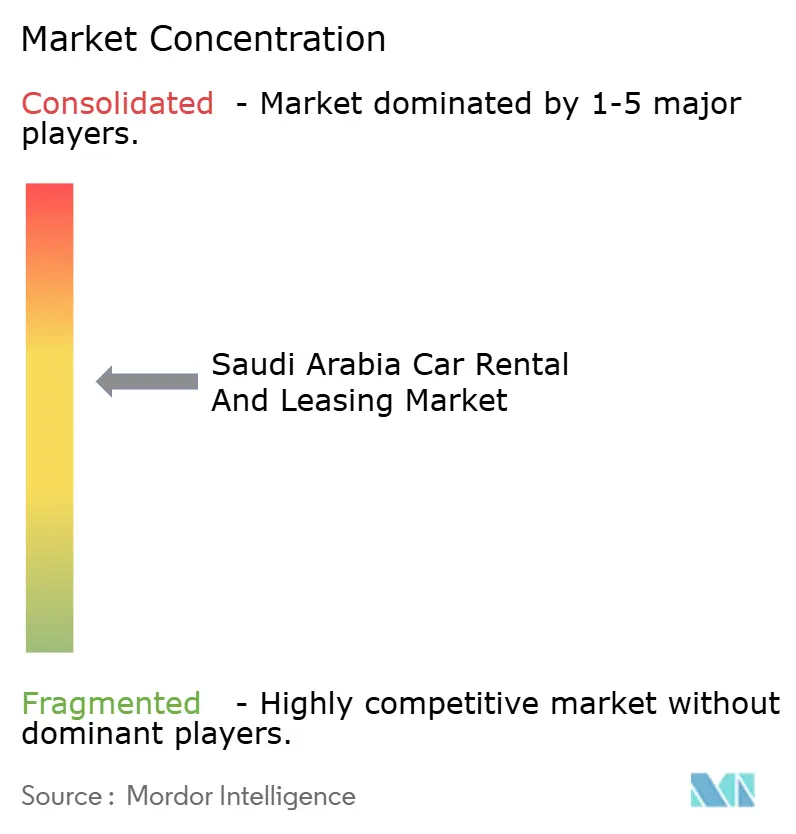
| Market Concentration | Medium |
Major Players *Disclaimer: Major Players sorted in no particular order Image © Mordor Intelligence. Reuse requires attribution under CC BY 4.0. | |
Saudi Arabia Car Rental And Leasing Market Analysis by Mordor Intelligence
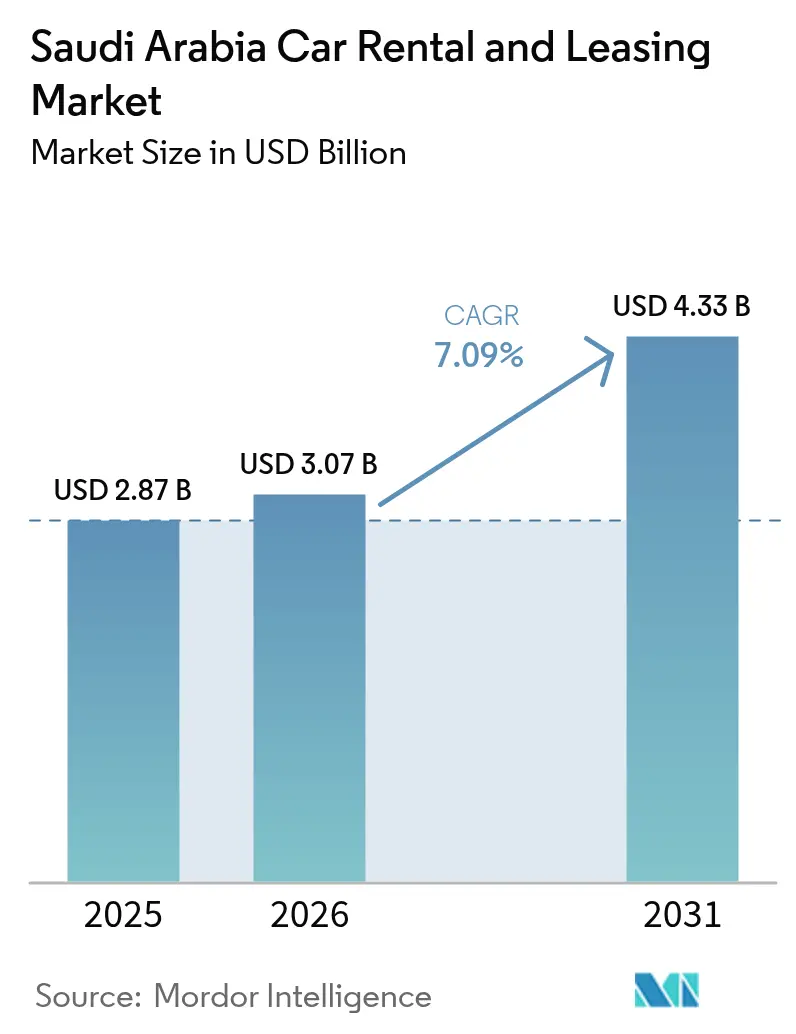
The Saudi Arabia Car Rental And Leasing Market size in 2026 is estimated at USD 3.07 billion, growing from 2025 value of USD 2.87 billion with 2031 projections showing USD 4.33 billion, growing at 7.09% CAGR over 2026-2031. Rising tourism, corporate fleet outsourcing, and Vision 2030 infrastructure commitments underpin steady demand expansion as the Kingdom transitions toward a diverse service economy. Online booking platforms, continue to streamline transactions and widen customer reach, while self-drive preferences, anchor consumer autonomy trends. Short-term rentals still lead overall volumes; however, corporate cost-optimization pushes long-term leasing to outpace the broader Saudi Arabia car rental and leasing market. Consolidation among large operators, coupled with technology-driven platforms such as SHIFT, intensifies competitive differentiation centered on digital convenience, predictive maintenance, and fleet electrification readiness.
Key Report Takeaways
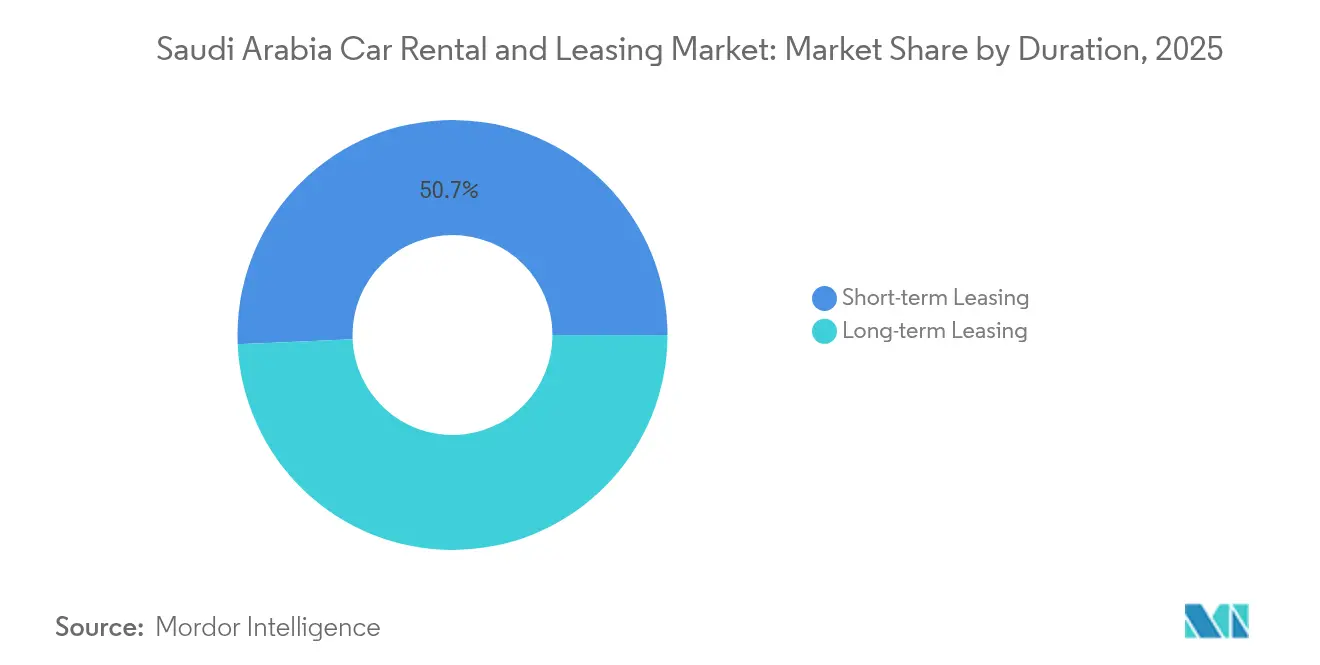
- By duration, short-term leasing held 50.68% of the Saudi Arabia car rental and leasing market share in 2025,long-term leasing is advancing at an anticipated 7.22% CAGR through 2031.
- By vehicle type, economy and budget cars commanded 62.85% share of the Saudi Arabia car rental and leasing market size in 2025, the premium and luxury segment is on track for 7.34% CAGR between 2026 and 2031.
- By body type, sedans accounted for 45.12% of the Saudi Arabia car rental and leasing market share in 2025; SUVs are projected to register a 7.36% CAGR through 2031.
- By booking type, online channels captured 71.05% of the Saudi Arabia car rental and leasing market share in 2025; online reservations are forecast to expand at 7.21% CAGR to 2031.
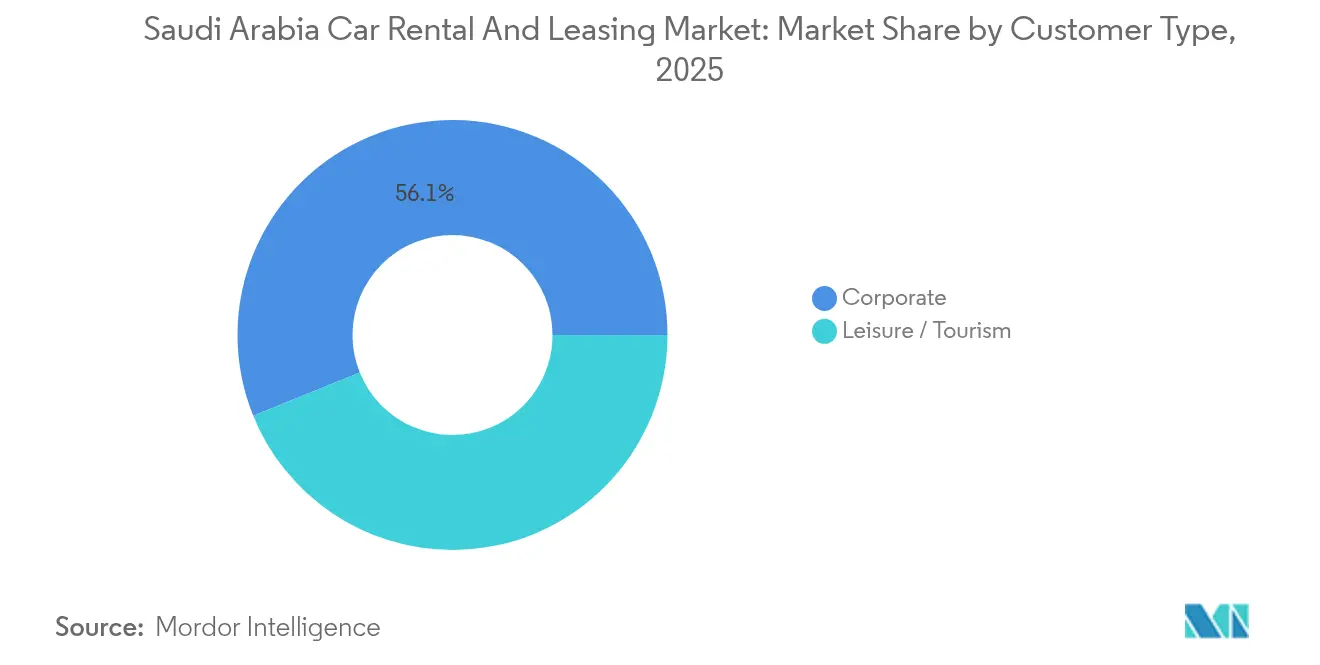
- By customer type, corporate accounts captured 56.12% revenue share of the Saudi Arabia car rental and leasing market in 2025, leisure and tourism demand is projected to expand at 7.17% CAGR to 2031.
- By rental mode, self-drive arrangements held 76.98% of the Saudi Arabia car rental and leasing market share in 2025; chauffeur-driven services are set to record the highest 7.15% CAGR over the same period.
Note: Market size and forecast figures in this report are generated using Mordor Intelligence’s proprietary estimation framework, updated with the latest available data and insights as of 2026.
Market Trends and Insights
Drivers Impact Analysis of Saudi Arabia Car Rental And Leasing Market*
| Driver | (~) % Impact on CAGR Forecast | Geographic Relevance | Impact Timeline |
|---|---|---|---|
| Expansion Of Leisure & Religious Tourism | +1.8% | National, with peaks in Mecca, Medina, Riyadh | Long term (≥ 4 years) |
| Vision 2030 Entertainment Mega-Projects | +1.5% | NEOM, Qiddiya, Red Sea Project regions | Long term (≥ 4 years) |
| Surge In Logistics and E-Commerce Demand | +1.2% | National, concentrated in Riyadh, Jeddah, Dammam | Medium term (2-4 years) |
| Government Fleet-Outsourcing Mandates | +1.0% | National, government sector focus | Medium term (2-4 years) |
| Electrification Incentives | +0.8% | Urban centers, Riyadh priority | Long term (≥ 4 years) |
| AI-Based Predictive Maintenance Cuts TCO | +0.6% | National, technology-enabled fleets | Short term (≤ 2 years) |
| Source: Mordor Intelligence | |||
Expansion Of Leisure & Religious Tourism
Religious pilgrimages generate predictable but intense spikes, prompting dynamic pricing and fleet redeployment strategies around Mecca and Medina. Vision 2030 targets 30 million pilgrims yearly, boosts year-round utilization, and reduces seasonality risk[1]. Leisure travelers pursuing desert, coastal, and heritage itineraries extend rental durations and favor premium SUVs. Simplified International Driving Permit processing expands self-drive adoption among foreign visitors. Integrated service models now package insurance, navigation, and multilingual assistance to capture tourist loyalty.
Vision 2030 Entertainment Mega-Projects
NEOM’s car-free blueprint compels operators to innovate with feeder services and mobility-as-a-service collaborations outside the core city limits[2]. Once attractions launch, Qiddiya and the Red Sea Project fuel demand for commercial vehicles during construction and upscale rentals. Incoming expatriate workforces rely on long-term leasing for reliable personal transportation under flexible contracts. Proximity-based service hubs reduce response times and enable premium vehicle availability for high-income tourists. Aggregated project zones offer predictable returns that justify fleet expansions and specialized vehicle acquisitions.
Surge In Logistics & E-Commerce Demand
Commercial vehicle leasing accelerates as e-commerce turnovers climb and delivery surges reach three-fifths during Hajj and Ramadan peaks. Logistics firms prefer long-term contracts that avoid capital outlays, facilitate quick fleet scaling, and ensure compliance with emission rules. Seasonal volatility pushes operators toward flexible rental terms that balance utilization with cost control. Government support for digital commerce and last-mile infrastructure widens the customer base for refrigerated vans and parcel trucks. Fleet managers leverage telematics to optimize routing, minimize idle time, and enhance vehicle turnaround efficiency.
Government Fleet-Outsourcing Mandates
State agencies increasingly replace owned vehicles with service contracts that guarantee uptime, standardized maintenance, and transparent costs. Standardized leasing templates expedite procurement while enforcing fuel-efficiency and safety benchmarks. Performance-linked contracts favor providers with digital fleet management and predictive maintenance capability. Long tenures and fixed monthly payments stabilize cash flows, enabling operators to invest in telematics. EV pilots, Public sector outsourcing has bolstered Budget Saudi’s long-term revenue visibility following its AutoWorld acquisition.
Restraints Impact Analysis of Saudi Arabia Car Rental And Leasing Market*
| Restraint | (~) % Impact on CAGR Forecast | Geographic Relevance | Impact Timeline |
|---|---|---|---|
| Inflation-Driven Cost Escalation | -1.3% | National, affecting operational costs | Short term (≤ 2 years) |
| High Fleet-Financing Interest Rates | -0.9% | National, capital-intensive operators | Medium term (2-4 years) |
| Lagging EV-Charging Infrastructure | -0.6% | Urban centers, highway corridors | Medium term (2-4 years) |
| Strict Traffic-Violation Penalties | -0.4% | National, enforcement concentration in cities | Short term (≤ 2 years) |
| Source: Mordor Intelligence | |||
Inflation-Driven Cost Escalation
Fuel, parts, and insurance premiums climb faster than headline inflation and compress margins Unpredictable fuel pricing complicates multi-year contract negotiations, prompting hedging or surcharges Global semiconductor shortages extend vehicle delivery lead times and elevate acquisition costs, delaying fleet refresh cycles Higher accident rates lift insurance premiums, particularly for luxury and commercial vans Operators respond with bulk procurement, preventive maintenance, and telematics-guided driving behavior analytics to mitigate expenses.
Lagging EV-Charging Infrastructure
The planned deployment of thousands of chargers covers urban cores yet underserved intercity corridors. Range anxiety restricts tourism and business uptake of electric rentals despite incentives. Slow rollout of fast-charging technology prolongs vehicle turnaround times, reducing fleet utilization. Operators weigh early adoption advantages against residual value uncertainty and infrastructure delays. Until highway coverage improves, large-scale electrification of rental fleets remains constrained, postponing total cost-of-ownership benefits.
*Our forecasts treat driver/restraint impacts as directional, not additive. The impact forecasts reflect baseline growth, mix effects, and variable interactions.
Saudi Arabia Car Rental And Leasing Market Segment Analysis
By Duration:
Long-Term Gains MomentumShort-term arrangements retained 50.68% of the Saudi Arabia car rental and leasing market share in 2025 by catering to tourism surges and business travel recovery. The Saudi Arabia car rental and leasing market size attributable to long-term contracts is forecast to double between 2023 and 2025 under Budget Saudi’s expansion roadmap. Integrated digital portals allow clients to pivot between daily and multi-year plans without administrative friction. Long-term contracts contributed 7.22% CAGR, nearly matching overall Saudi Arabia car rental and leasing market growth, as corporations and government agencies prioritize predictable monthly expenses over outright purchases.
Shift in payment preferences shapes asset-light supply chains, permitting rapid fleet rightsizing during demand volatility Corporate sustainability aims also push for low-emission vehicles, which are easier to pilot under long-term leases than outright purchases The Saudi Arabia car rental and leasing market benefits from tax deductions tied to service contracts, encouraging businesses to extend contract tenures Tourism-led short-term volumes still contribute cash-flow peaks, especially during Hajj and entertainment events.

By Vehicle Type:
Premium Segment AcceleratesThanks to competitive pricing, economy vehicles captured 62.85% of the Saudi Arabia car rental and leasing market share in 2025. Yet the premium category, growing at 7.34% CAGR, records above-average revenue per day as customers pursue elevated travel experiences. Corporate executives and high-end tourists gravitate toward technology-rich sedans and SUVs furnished with connectivity features.
Digital booking engines showcase premium inventory with transparent upgrade pricing, nudging customers toward higher categories Rising disposable incomes, coupled with luxury hospitality growth along the Red Sea coast, reinforce demand for prestige marques The Saudi Arabia car rental and leasing market size for premium vehicles is projected to grow exponentially by 2031 as operators expand brand-specific fleets Loyalty programs and chauffeur add-ons lock in repeat clientele and lift utilization ratios.
By Body Type:
SUV Demand SurgesBy body type, sedans accounted for 45.12% of the Saudi Arabia car rental and leasing market share in 2025. SUVs are clocking the fastest 7.36% CAGR, propelled by family travel, desert tourism, and perceived safety advantages. Sedans still hold more than two-fifths of volume share due to cost efficiency for corporate mobility. Enhanced road infrastructure encourages off-city adventures, boosting SUV rentals.
Telematics analytics reveal higher retention among SUV renters, prompting operators to adjust procurement toward crossover and midsize SUV categories. The Saudi Arabia car rental and leasing market size attached to SUVs is predicted to grow exponentially by 2031 under sustained tourism traffic. Seasonal package promotions bundle GPS, camping gear, and extra insurance for off-road journeys, increasing ancillary revenue.
By Booking Type:
Digital Dominance ContinuesOnline reservations constitute 71.05% of the Saudi Arabia car rental and leasing market share in 2025, and expand at 7.21% CAGR as consumers seek frictionless comparison and instant confirmations. Algorithms refine dynamic pricing to maximize occupancy and revenue per vehicle.
Legacy walk-in channels persist for institutional contracts where personalized negotiation remains integral The Saudi Arabia car rental and leasing market gains operational savings from paperless processes, including e-payments and mobile key handoffs. Bilingual chatbots and AI-powered support accelerate resolution times, raising net promoter scores among domestic and foreign clients.
By Customer Type:
Leisure Tourism MomentumCorporate users provided 56.12% of the Saudi Arabia car rental and leasing market share in 2025, yet leisure demand, expanding at 7.17% CAGR, is closing the gap under Vision 2030 tourist inflows. Packages catered to pilgrims combine extended mileage, inclusive insurance, and flexible drop-off points across Mecca and Medina.
Season-pass bundles encourage repeat leisure rentals among domestic travelers frequenting coastal resorts. If visitation targets hold, the Saudi Arabia car rental and leasing market size drawn from leisure customers could top by 2031. Cross-selling of Wi-Fi hotspots and child-safety seats raises ancillary revenue margins.
By Rental Mode:
Self-Drive Preferences PersistSelf-drive options control 76.98% of the Saudi Arabia car rental and leasing market share in 2025, mirroring cultural preference for privacy and autonomy. Chauffeur services, growing at a 7.15% CAGR, gain traction with luxury tourists, senior citizens, and female travelers seeking convenience and safety assurances.
Post-2018 female licensing reforms unlocked a new self-drive demographic, elevating weekday utilization rates. Autonomous-vehicle pilots slated for 2025-2026 may spawn hybrid models, combining self-drive flexibility with AI-supervised safety features. The Saudi Arabia car rental and leasing market positions driver training and background checks as service differentiators for chauffeur segments.
Geography Analysis
Riyadh, Jeddah, and Dammam collectively generate roughly three-fifth of nationwide rentals, anchored by governmental, commercial, and industrial activities that demand predictable mobility solutions Riyadh, the administrative and financial nucleus, leads absolute volume, supported by a dense network of business travelers and expatriate residents Jeddah merges commercial logistics with a gateway role for religious tourism, driving dual-purpose vehicle demand that blends corporate reliability with extended pilgrim itineraries.
The Northern region contributes more than half of Lumi Rental’s revenue, highlighting efficiency gains from hub-and-spoke deployments concentrated near mega-project sites. Dammam capitalizes on cross-border energy trade, maintaining steady corporate leasing and specialized documentation services for GCC travel. The Saudi Arabia car rental and leasing market sees average daily rental durations stretch in the Eastern Province due to project-based expatriate assignments.
Emerging destinations like NEOM, Qiddiya, and Amaala shift future demand poles as construction peaks and operational phases commence. Operators prepare satellite depots and flexible fleets to serve car-free urban cores and resort logistics perimeters The Saudi Arabia car rental and leasing market size attributable to these growth corridors is set to rise notably post-2026, diversifying geographic revenue distribution beyond the traditional three-city axis.
Regulatory Landscape
Saudi Arabia car rental and rental brokerage activities are regulated by the Transport General Authority (TGA) through licensing and executive regulations that set operating conditions for rental companies and brokers. In February 2025, amendments to the regulation governing car rental and rental broker activity were published in Umm Al-Qura (Issue 5073), reinforcing compliance expectations around licensed operation and standardized contracting practices.
In June 2026, the TGA Board approved further amendments to the Executive Regulation for the activity of private car rental and rental brokerage (Decision 9/2 TR/4/2026). Across the framework, operators face compliance anchors including a SAR 100,000 financial guarantee requirement (with exemptions for entrepreneurial establishments), mandatory issuance of rental contracts via the TGA-designated electronic contract system, and fleet roadworthiness aligned with Saudi Standards, Metrology and Quality Organization (SASO) technical requirements, including periodic technical inspection rules.
Value Chain Analysis
The value chain starts with fleet sourcing and financing (OEMs, authorized dealers, and leasing finance partners), followed by importation and in-country logistics, branch and airport distribution, and customer acquisition through online platforms and corporate and government procurement. Vehicle logistics, storage yards, and outbound delivery capabilities are becoming more systematized as Saudi builds domestic automotive capacity. Starlinks, for instance, operates large-scale automotive yard infrastructure across Riyadh, Jeddah, and Dammam, supporting fleet flows and turnaround for rental and leasing operators.
Operations and aftersales form the cost and service backbone, including maintenance networks, spare parts supply, telematics, insurance, and residual value management through used-vehicle remarketing. Regulatory checkpoints shape the chain end-to-end, including TGA licensing for land transport activity, the SAR 100,000 financial guarantee, and compulsory use of the TGA-designated electronic contract system, with penalties for non-compliance. Upstream localization initiatives also affect fleet economics over time. TASARU Mobility Investments is developing the TASARU Supplier Hub in King Abdullah Economic City (KAEC) and signing localization agreements with global Tier-1 suppliers (e.g., Shin Young, JVIS, BENTELER), which can improve parts availability and service responsiveness for large fleets.
Competitive Landscape
More than 600 licensed firms compete, yet consolidation is accelerating. Budget Saudi’s acquisition of AutoWorld elevated its share significantly and unlocked millions in annual synergies. Lumi, Theeb, and Yelo invest in telematics and branch networks to dispute market leadership, while international brands such as Hertz and Avis sustain premium niches via global loyalty integration.
Technology shapes differentiation: SHIFT’s mobile-only interface and automated pick-up kiosks yield higher customer satisfaction and lower labor overhead. AI-enabled predictive maintenance cuts fleet downtime and supports government procurement standards on uptime ratios. The Saudi Arabia car rental and leasing market rewards data-rich platforms that forecast demand, optimize pricing, and steer fleet mix decisions.
Capital allocation focuses on electrification pilots and SUV procurement to align with user preference data. Operators pursue strategic partnerships with EV-charging suppliers to secure infrastructure near high-traffic branches. Franchise agreements and co-branding with hospitality chains embed rental desks at hotels and airports, extending distribution reach and capturing impulse bookings.
Saudi Arabia Car Rental And Leasing Industry Leaders
-
Hertz Corporation
-
Hanco Automotive
-
Budget Rent a Car
-
Theeb Rent A Car
-
Lumi Car Rentals
- *Disclaimer: Major Players sorted in no particular order
Saudi Arabia Car Rental And Leasing Market Companies Covered in this Report
- Hertz Corporation
- Sixt SE
- Avis Budget Group Inc.
- Strong Rent a Car
- Auto Rent
- Key Car Rental
- Hanco Automotive
- National Car Rental
- Ejaro
- Budget Rent-A-Car (United Intl. Transportation Co.)
- Turo
- Best Rent A Car
- Yelo (Al Wefaq Transportation)
- Zipcar
- Europcar Mobility Group
- Bin Hadi
- Samara Land Transportation Services
- Theeb Rent A Car
- Esar International Group
- Autoworld (Al-Jazira Equipment Co.)
- Lumi Rental Co.
- Uber Carshare KSA
Read Analysis of Saudi Arabia Car Rental And Leasing Companies
Market Opportunities and Future Outlook
Network buildout beyond the Riyadh-Jeddah-Dammam axis remains an actionable whitespace as operators expand into secondary cities and new demand corridors linked to tourism and giga-project logistics. Lumi added branches in Qassim (February 2026) and expanded further with new locations in Tabuk, Taif, and Jeddah (June 2026), while Theeb added new branches in Mahayil Aseer and Abha (July 2026). These steps widen service access for leisure travelers and project-linked workforces, and they expand the addressable pool for both self-drive rentals and long-term corporate leases in regions that have historically had less dense branch coverage.
A second opportunity set sits at the intersection of regulation-led formalization and digital execution. The TGA requires rental contracts to be issued through the designated electronic contract system and continues to update operating rules, including the June 2026 executive regulation amendments. That raises the value of compliant, automated contracting, fleet tracking, and proof-of-receipt workflows across retail and corporate use cases. At the same time, revenue diversification through lifecycle fleet management, including used-vehicle remarketing and service bundling, gains relevance as large operators scale fleet sizes and aim to control residual values and utilization, particularly in long-term leasing programs serving corporate and government accounts.
Recent Industry Developments in Saudi Arabia Car Rental And Leasing Market
- July 2026: Theeb Rent a Car opened two new branches in Mahayil Aseer and Abha, expanding its nationwide network to 72 branches. The added coverage strengthens access in the Aseer region and supports demand dispersion beyond the largest metro areas. A larger branch footprint also improves fleet repositioning flexibility during seasonal travel peaks.
- June 2026: The Transport General Authority approved amendments to the Executive Regulation for private car rental and rental brokerage activities (Decision 9/2 TR/4/2026). The update reinforces compliance requirements that affect licensing, contracting workflows, and operating practices across both rental operators and brokers. Ongoing regulatory updates raise the bar for standardized, system-driven processes, particularly around electronic contracting.
- June 2024: United International Transportation Co. (Budget Saudi) finalized its acquisition of AutoWorld. The deal expanded Budget Saudi's scale and strengthened its ability to compete on fleet breadth, procurement terms, and corporate leasing coverage. Consolidation at this level can also influence pricing discipline and availability in high-volume locations such as airports and major cities.
Saudi Arabia Car Rental And Leasing Market Report Scope and Research Methodology
Market Definition and Coverage
For this study, the market covers the total value earned in Saudi Arabia from renting passenger cars on a short-term basis and leasing them on a longer-term basis, including consumer and corporate demand booked through online and offline channels.
Scope exclusions: We exclude vehicle sales, vehicle financing and insurance revenues, and third-party travel commissions that do not belong to rental or leasing service income.
Segments Covered in This Report
- By Duration
- Short-term Leasing
- Long-term Leasing
- By Vehicle Type
- Economy / Budget
- Premium / Luxury
- By Body Type
- Hatchback
- Sedan
- Multi-Utility Vehicle
- Sports Utility Vehicle
- By Booking Type
- Online
- Offline
- By Customer Type
- Corporate
- Leisure / Tourism
- By Rental Mode
- Self-drive
- Chauffeur-driven
Data Sources, Market Sizing, and Validation
Desk Research
Desk research was used to set the market boundaries and build the starting demand and supply picture for Saudi Arabia. We reviewed public data series that help explain fleet activity and usage, such as the General Authority for Statistics, the Saudi Central Bank (SAMA) releases, the Ministry of Tourism publications, and the General Authority of Civil Aviation traffic updates.
To align assumptions with real operating conditions, we also referred to sources such as the World Bank macro indicators, UN Comtrade for trade signals that can influence fleet replenishment, and peer-reviewed papers that discuss leasing adoption and mobility behavior. Company annual reports, investor presentations, and reputable press coverage were used to map service models and pricing direction. Where public detail was thin, we used a paid subscription for company financials and news selectively to cross-check revenue splits. These are illustrative examples, and many other public sources were also used to collect data, validate points, and clarify open questions.
Primary Interviews and Surveys
Primary work focused on validating what the market is really charging and how quickly fleets are turning, since public data does not explain utilization and net pricing well. We spoke with a mix of corporate mobility buyers, local operators, and channel partners to confirm lease duration patterns, seasonality around travel, and how online booking is changing conversion.
Because this is a Saudi Arabia only market, interviews were centered on the main demand hubs and airport corridors. We then checked responses with operators that serve industrial and project locations, so the final model reflects both leisure and corporate usage.
Distribution of primary research fieldwork respondents
| Company type | Respondent position |
|---|---|
| Top tier: 26% | CXOs: 14% |
| Mid tier: 59% | Functional/Unit leaders: 27% |
| Smaller Players: 15% | Managers: 59% |
Market-Sizing & Forecasting
Sizing starts with a top-down rebuild of service revenue in the country using a demand-pool logic. Fleet availability and utilization are converted into billable days, and then into value through observed price bands. We then check the output with selective bottom-up approximations using sampled operator revenue ranges, channel checks on daily and monthly rate cards, and a simple volume times ASP build for key corridors to confirm the totals remain realistic.
Key inputs we use include fleet size direction and replacement cycles, rental-day utilization, mix of short-term versus long-term contracts, the share of corporate accounts versus leisure and tourism, and the shift from offline counters to online bookings. When operator disclosure has gaps, assumptions are filled using interview medians and stress-tested so a single outlier does not move the total.
For forecasting, we use scenario analysis that links demand to travel and macro signals, then applies expected pricing movement and mix change over time. Assumptions are reviewed with primary respondents to keep the forward curve consistent with capacity plans, expected tourism flow, and corporate outsourcing behavior.
Data Validation & Update Cycle
Validation is done through multiple checks. Model outputs are compared with independent signals like travel activity, macro spending direction, and visible pricing ranges, and then the drivers are rechecked when a mismatch shows up. If an anomaly is found, we revisit the underlying utilization, mix, or pricing assumption and, where needed, re-contact a respondent group to confirm what changed.
Before sign-off, the work is reviewed in steps by another analyst so calculation logic, units, and year labels are consistent. Reports are refreshed annually, and interim updates are done when material events occur, such as sharp changes in demand conditions or policy moves that can alter rental activity. Right before delivery, we do a final pass so clients receive the most current view possible.
Mordor Intelligence's Saudi Arabia Car Rental and Leasing Market Size Versus Other Published Estimates
Published market values for this space can differ because some studies mix short-term rentals with broader mobility services, and others apply different ways to treat corporate leasing revenue and chauffeur-driven activity. Timing also matters, since price and utilization can swing with tourism peaks and fleet availability, which makes the chosen base year and refresh cadence important.
Key gaps usually come from how revenue is counted, which part of the fleet is assumed to be active, and whether online discounts and corporate contract rates are reflected in average pricing. Currency conversion timing and whether estimates are built from a travel-led demand pool or from an operator roll-up can also shift results, even when everyone is looking at the same country.
Benchmark comparison
| Source | Market Size | Gaps in Research Methodology |
|---|---|---|
| Mordor Intelligence | USD 2.87 B (2025) | |
| Trade Journal A | USD 2.30 B (2024) | Uses an earlier base year and a shorter horizon, and the value appears to lean on a broader rentals-only lens with limited adjustment for corporate leasing mix and net pricing versus listed rates. |
| Regional Consultancy B | USD 2.51 B (2025) | Includes adjacent formats like subscriptions in the same bucket and applies a higher growth posture, which can lift the counted revenue pool when pricing and utilization are not normalized to typical contract terms. |
By tracking utilization, contract-duration mix, and net realized rate movement through the year, the market size estimate from Mordor Intelligence keeps the Saudi total tied to billable demand rather than list prices, which explains most of the spread versus the two benchmarks. With the same scope rules applied across years, the final estimate stays traceable to clear inputs and can be repeated when new travel or fleet signals come in.
Key Questions Answered in the Report
How large is the Saudi Arabia car rental and leasing market in 2026?
It stands at USD 3.07 billion, expanding toward USD 4.33 billion by 2031.
Which rental duration category is growing fastest?
Long-term leasing, advancing at 7.22% CAGR on the back of corporate and government outsourcing.
What portion of bookings take place online?
Digital platforms account for 71.05% of all reservations, a share that is still climbing.
Which vehicle body type is seeing the strongest demand lift?
SUVs, growing at 7.36% CAGR due to tourism and family travel preferences.
How intense is competition among leading rental companies?
The top five firms control significant revenue, signaling moderate consolidation with active M&A and digital differentiation.