Saudi Arabia Big Data And Artificial Intelligence Market Size and Share
Market Overview
| Study Period | 2020 - 2031 |
|---|---|
| Forecast Data Period | 2026 - 2031 |
| Base Year Market Size (2025) | USD 0.51 Billion |
| Market Size (2026) | USD 0.68 Billion |
| Market Size (2031) | USD 2.81 Billion |
| Growth Rate (2026 - 2031) | 32.87% CAGR |
| Market Concentration | Medium |
Major Players *Disclaimer: Major Players sorted in no particular order Image © Mordor Intelligence. Reuse requires attribution under CC BY 4.0. | |
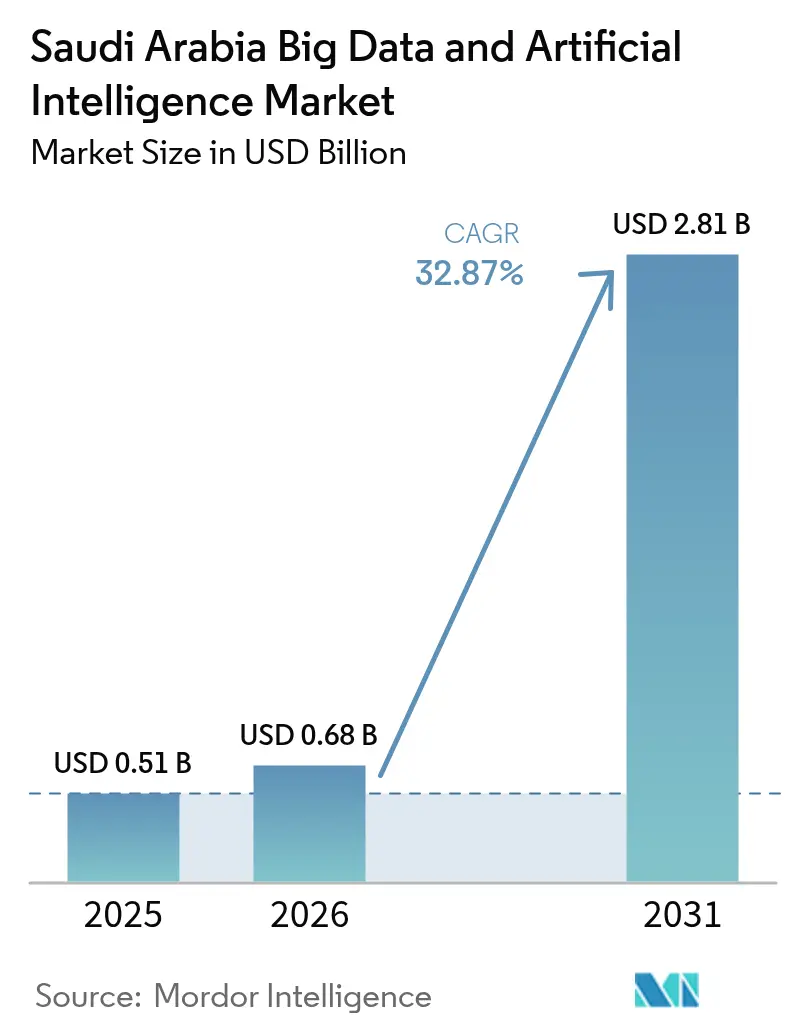
Saudi Arabia Big Data And Artificial Intelligence Market Analysis by Mordor Intelligence
The Saudi Arabia big data and artificial intelligence market size was valued at USD 0.51 billion in 2025 and estimated to grow from USD 0.68 billion in 2026 to reach USD 2.81 billion by 2031, at a CAGR of 32.87% during the forecast period (2026-2031). The surge is propelled by Vision 2030 investment pledges, a USD 40 billion sovereign AI fund launched in 2024, and NEOM’s sensor network that now streams more than 1 petabyte of data every day.[1]Jensen Huang, “Saudi Arabia and NVIDIA to Build AI Factories,” NVIDIA News, nvidia.com Software commands 45.32% revenue as Arabic-language large models mature, while services post the fastest 36.30% CAGR on rising DataOps and MLOps demand. Enterprises already rely on on-premises and hybrid deployments for 59.47% of workloads, yet public-cloud usage is expanding at 37.90% CAGR thanks to hyperscaler build-outs. The Saudi Arabia big data and artificial intelligence market benefits additionally from mandatory e-invoicing that has digitized 85% of transactions and produced billions of structured invoices ripe for analytics.[2]Saudi Zakat, Tax and Customs Authority, “E-Invoicing Phase 2 Overview,” zatca.gov.sa
Key Report Takeaways
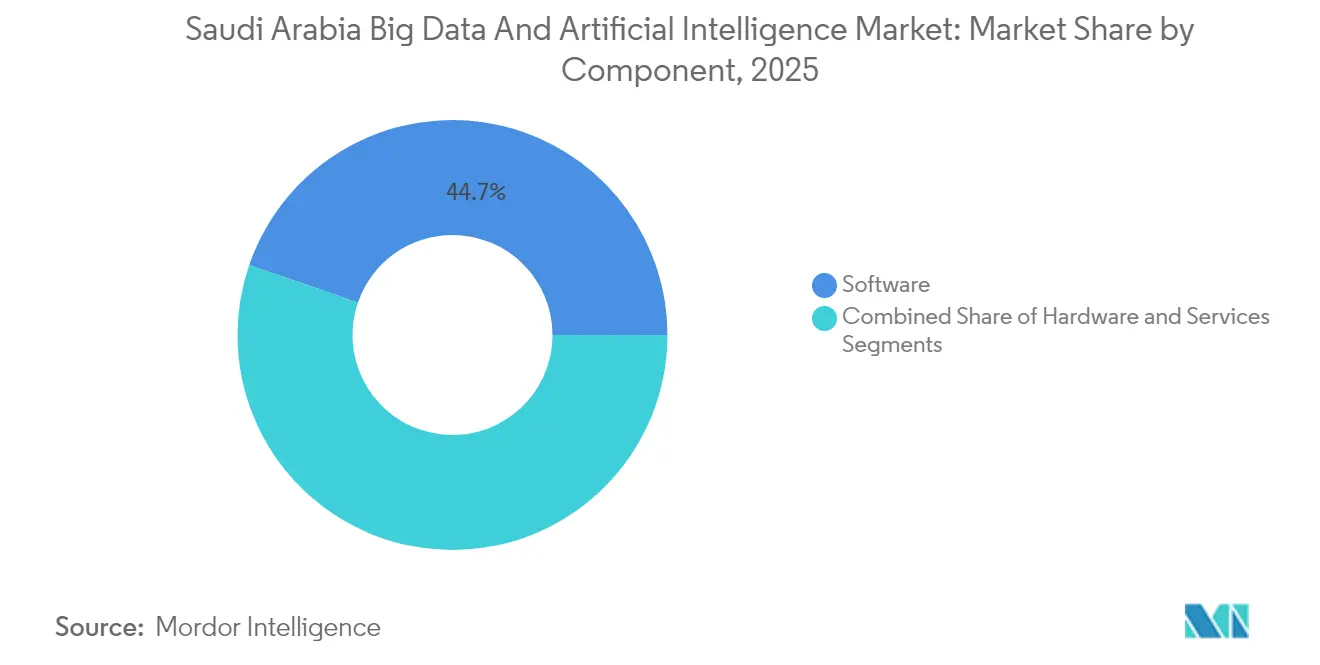
- By component, software held 44.72% of the Saudi Arabia big data and artificial intelligence market share in 2025.
- Services are projected to record the strongest 34.85% CAGR to 2031.
- By organization size, large enterprises accounted for 68.71% share of the Saudi Arabia big data and artificial intelligence market size in 2025, while SMEs are poised to climb at 36.20% CAGR through 2031.
- By end-user vertical, BFSI led with 21.34% revenue share in 2025; healthcare is advancing at a 36.16% CAGR to 2031.
Note: Market size and forecast figures in this report are generated using Mordor Intelligence’s proprietary estimation framework, updated with the latest available data and insights as of 2026.
Saudi Arabia Big Data And Artificial Intelligence Market Trends and Insights
Drivers Impact Analysis*
| Driver | (~) % Impact on CAGR Forecast | Geographic Relevance | Impact Timeline |
|---|---|---|---|
| National AI Strategy funding surge | +8.20% | National, concentrated in Riyadh and Eastern Province | Medium term (2-4 years) |
| NEOM sensor-data explosion | +6.80% | Northern region, spillover to national infrastructure | Long term (≥4 years) |
| Mandatory e-Invoicing roll-out | +5.10% | National, with early gains in Riyadh, Jeddah, Dammam | Short term (≤2 years) |
| Cloud-First workload migration | +4.90% | National, led by government and large enterprises | Medium term (2-4 years) |
| Green-hydrogen analytics demand | +3.70% | Eastern Province and NEOM industrial zones | Long term (≥4 years) |
| Arabic Gen-AI localisation efforts | +2.80% | National, with research hubs in Riyadh and Khobar | Medium term (2-4 years) |
| Source: Mordor Intelligence | |||
National AI Strategy Funding Surge
The USD 100 billion Project Transcendence budget has underwritten 14 hyperscale campuses and bulk GPU purchases that include an 18,000-GPU supercomputer delivered under the HUMAIN-NVIDIA alliance. The Public Investment Fund lifted U.S. tech allocations to USD 26.7 billion in 2024, focusing on AI chips and software. AMD and Microsoft added separate build-outs, giving Saudi developers privileged access to next-generation accelerators. These moves accelerate sovereign model training for Arabic tasks and set cost hurdles that deter late-market entrants. Businesses reap spillover gains through lower-latency domestic inference services and a maturing local talent ecosystem.
NEOM Sensor-Data Explosion
Daily data volumes in the NEOM region now exceed 1 petabyte, captured from autonomous shuttles, air-quality probes, and utility meters. DataVolt’s liquid-cooled centers near Tabuk process streams in real time for traffic routing and carbon-neutral energy balancing. Aramco and Qualcomm have co-deployed edge rigs that trim industrial energy use by 40% through predictive maintenance. The resulting trove of labelled Arabic datasets supports speech formalization, dialect mapping, and context reinforcement, sharpening regional LLM performance and enabling exportable smart-city blueprints.
Mandatory E-Invoicing Roll-Out
Phase 2 of ZATCA’s “Fatoora” mandate has produced more than 2.8 billion XML invoices, instantly accessible through standard APIs. Banks apply graph analytics to those flows to flag tax evasion, while retailers mine item-level tags for demand forecasts. SMEs, newly digitized, tap pay-as-you-go dashboards that replicate enterprise-grade insights without capex. International systems integrate seamlessly because invoices follow a globally accepted UBL schema, positioning exporters for automated reconciliation.
Cloud-First Workload Migration
Saudi cloud spend is forecast to top USD 4.7 billion by 2027 as Alibaba Cloud, Tencent, and Microsoft commission multi-zone regions. STC-Alibaba’s joint venture opened two local facilities that host encrypted multitenant AI training clusters, and Microsoft earmarked USD 1.5 billion for additional capacity. Rapid elasticity lets healthcare apps run imaging inference bursts at peak times while scaling back overnight. Lower entry thresholds entice SMEs to deploy AI services that would be infeasible in self-hosted racks.
Restraints Impact Analysis*
| Restraint | (~) % Impact on CAGR Forecast | Geographic Relevance | Impact Timeline |
|---|---|---|---|
| Senior data-science talent gap | -4.30% | National, most acute in Riyadh and Eastern Province | Medium term (2-4 years) |
| Fragmented data-governance standards | -3.80% | National, affecting cross-sector integration | Short term (≤2 years) |
| Legacy OT systems in oil and gas | -2.90% | Eastern Province industrial complexes | Long term (≥4 years) |
| Data-sovereignty for sensitive workloads | -2.10% | National, particularly government and defense sectors | Medium term (2-4 years) |
| Source: Mordor Intelligence | |||
Senior Data-Science Talent Gap
The SAMAI scheme aims to train 1 million citizens by 2030, yet demand already triples supply. Competing employers bid salaries 50% above Gulf averages, squeezing startup burn rates. Universities have added joint degrees with MIT and KAUST, but near-term relief depends on imported expertise paired with accelerated upskilling bootcamps.
Fragmented Data-Governance Standards
Sectoral regulators interpret the Personal Data Protection Law inconsistently, forcing firms to juggle divergent consent protocols. BFSI players often over-restrict data pooling, which hampers cross-sell models. SDAIA’s Standard Contractual Clauses promise eventual harmonization, yet until adoption widens, project approvals face costly legal reviews.
*Our forecasts treat driver/restraint impacts as directional, not additive. The impact forecasts reflect baseline growth, mix effects, and variable interactions.
Segment Analysis
By Component: Software Dominance Drives Arabic AI Innovation
Software captured 44.72% revenue in 2025, reflecting the early monetization of language models and analytics engines customized for Arabic. The Saudi Arabia big data and artificial intelligence market size for software is projected to outpace hardware because recurring license fees and platform subscriptions accelerate top-line gains. Intensified investment in ALLaM and ArabianGPT keeps localization capabilities ahead of imported products, creating defensible moats. Services, though smaller, post a 34.85% CAGR as enterprises engage integrators for data pipeline orchestration and model retraining.
Vendors bundle software with managed services, blurring segment lines yet elevating gross margins. Hyper-vertical modules now surround ERP cores, automating invoice validation, Arabic voice chatbots, and reservoir optimization. Open-source packages such as Wan2.1, downloaded more than 2.2 million times, seed ecosystems for startups building compliant toolchains. This flywheel ensures the Saudi Arabia big data and artificial intelligence market maintains localized intellectual property that circulates royalty income domestically.


By Organization Size: SME Acceleration Reshapes Market Dynamics
Large enterprises generated 68.71% of 2025 revenue after early pilots in predictive maintenance, robo-advisory, and real-time fraud detection. Their adoption curves reflect multi-year digital-core programs and captive data lakes. Yet SMEs now record a 36.20% CAGR because cloud platforms shrink entry barriers. The Saudi Arabia big data and artificial intelligence market share commanded by SMEs is expected to widen each year as subscription-based AI suites replace upfront licenses.
Government procurement quotas that favour local suppliers encourage small firms to embed AI in niche solutions, from halal-compliance scanning to Arabic sentiment analytics. Further acceleration comes from fintech open-banking rules that expose customer data via secure APIs, letting SME developers craft micro-services atop bank rails. Aggregated, these forces diversify revenue streams and lessen concentration risk in the Saudi Arabia big data and artificial intelligence market.
By End-User Vertical: Healthcare Emerges as Growth Leader
BFSI retained 21.34% revenue in 2025, with banks automating credit scoring and insurers piloting telematics-based pricing. Still, healthcare now races ahead at 36.16% CAGR through 2031, supported by Seha Virtual Hospital’s 1.6 million AI-triaged consultations and AI pathology screening at King Fahad Medical City. The Saudi Arabia big data and artificial intelligence market size allocated to healthcare is primed to jump as reimbursement codes start rewarding AI-assisted diagnostics.
Improved imaging throughput reduces referral backlogs, while symptom-triage chatbots lower primary-care visits. Regulatory sandboxes allow algorithm upgrades without restarting certification, motivating suppliers to iterate quickly. In parallel, wearable device integrations feed personalized treatment models, a trend that spills over to wellness and fitness sub-segments.
By Deployment Model: Cloud Migration Accelerates Despite Sovereignty Concerns
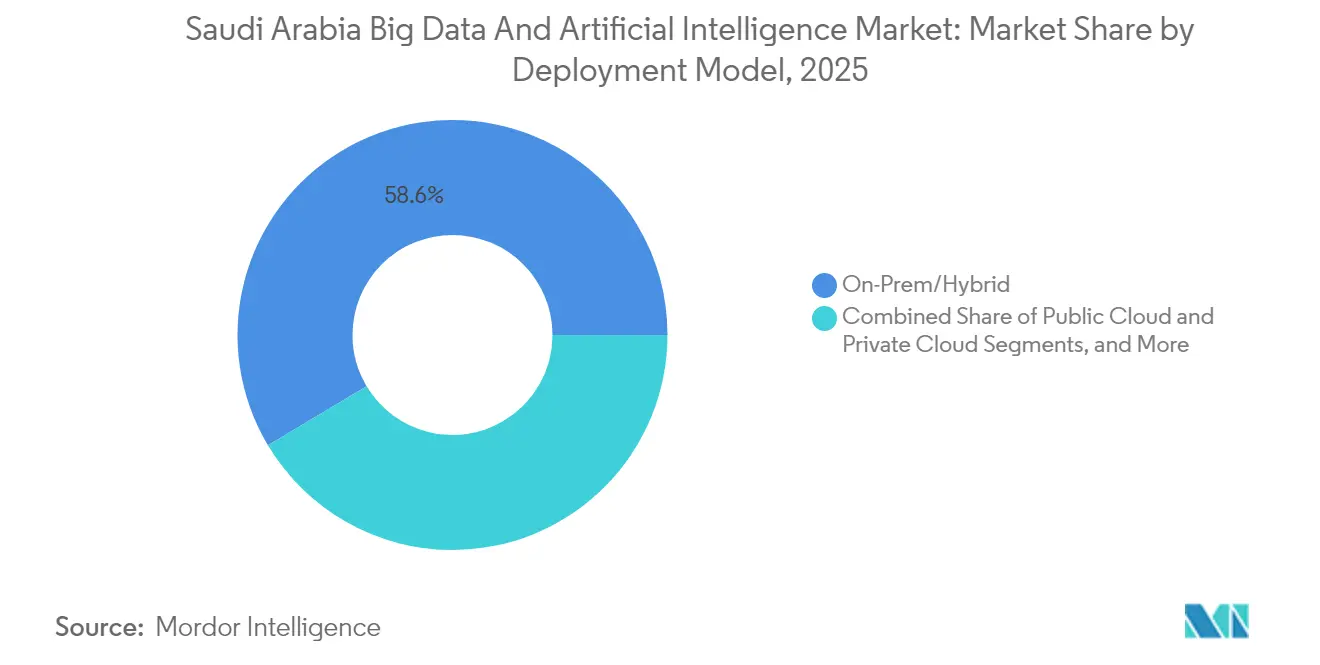
On-premises and hybrid environments secured 58.57% of 2025 spending because ministries demand physical control of sensitive data. The public cloud sub-segment, however, shows a 35.63% CAGR as clarified residency clauses ease compliance fears. Hyperscalers deliver dedicated compute zones with sovereign key management, persuading banks and hospitals to offload training runs.
Hybrid patterns dominate models trained on cloud GPUs and then deployed on local inference gateways. Such schemes exploit elasticity while limiting outbound traffic. Over time, private-cloud offerings from SCCC and Alibaba-STC blur the boundary by placing hyperscale racks in customer-owned cages. This continuum ensures the Saudi Arabia big data and artificial intelligence market continues to diversify deployment choices.
By Technology: Machine Learning Leads Practical Applications
Supervised machine learning remains the workhorse for anomaly detection, churn prediction, and dynamic pricing across retail and telecom. Businesses favour its interpretability and narrower data requirements. Deep-learning adoption accelerates where vision and language tasks dominate, assisted by NVIDIA Grace Blackwell chips now available through HUMAIN clusters. Natural language processing ranks high in strategic priority because 400 million Arabic speakers require culturally aligned interfaces.
Edge-AI applications rise as 5G coverage expands and latency budgets tighten. Aramco shows 40% energy savings via on-site inference, and NEOM’s traffic lights react in under 15 milliseconds to camera feeds. Big-data analytics platforms still supply the feature-engineering backbone, but their prominence gradually recedes as end-to-end AI pipelines merge ETL and model governance. The technology blend assures the Saudi Arabia big data and artificial intelligence market sustains both breadth and depth of use cases.
Geography Analysis
Riyadh anchors the Saudi Arabia big data and artificial intelligence market, hosting SDAIA, HUMAIN, and most venture funding. The capital’s corridor boasts five hyperscale zones that together exceed 500 megawatts of IT load. Eastern Province leverages hydrocarbons and green-hydrogen plants to justify AI optimization clusters that manage refinery throughput and renewables balancing. NEOM stands out for smart-city deployments whose data spillovers nurture nationwide model performance.
Cross-border positioning further fortifies competitiveness. Saudi data centers interconnect to Marseille and Mumbai cables, providing sub-100-millisecond latency to Europe and Asia. This geography allows the Kingdom to attract international AI workloads that seek politically stable yet energy-efficient hosting. Regulatory leadership, particularly the Personal Data Protection Law, grants legal certainty that many neighbouring states still refine, motivating multinational firms to anchor regional headquarters in Riyadh.
Provincial digitization programs extend AI outside megacities. Qassim pilots drone-based crop analytics, Asir deploys wildfire prediction, and Tabuk runs aquaculture feed optimization. These grassroots projects widen data diversity and test AI robustness in varied climates. The cumulative effect raises the floor for national AI maturity and sustains the Saudi Arabia big data and artificial intelligence market growth trajectory.
Regulatory Landscape
Saudi Arabia regulates data and AI through the Saudi Data and Artificial Intelligence Authority (SDAIA), established by the Council of Ministers, while the National Data Management Office (NDMO) issues national policies, standards, and controls for data management and personal data protection. For AI development and deployment, the Kingdom has published Principles and Controls of AI Ethics that require transparency, fairness, and accountability across the lifecycle. It has also issued Generative AI Guidelines for government entities, which call for bias checks in training data and privacy and legal review for sensitive use cases.
Digital government compliance is further shaped by the Digital Government Authority (DGA), including Digital Government Policies (V2.0) and the Digital Government Strategy (2025-2030). These instruments guide how public entities digitize services and govern data and AI solutions, pushing enterprises and vendors toward auditable governance, contractually enforced third-party compliance, and residency-aware deployment architectures aligned with the Personal Data Protection Law and NDMO controls.
Value Chain Analysis
Upstream inputs focus on compute hardware (GPUs, servers, networking), cloud and colocation capacity, and high-quality datasets generated by national digitization programs and smart-city instrumentation. This includes ZATCA e-invoicing data and NEOM sensor streams. The midstream stack is built around hyperscalers and domestic infrastructure platforms offering data residency-aligned cloud services and sovereign AI capacity anchored by HUMAIN, alongside systems integrators that operationalize DataOps and MLOps for ministries, state-owned enterprises, and regulated sectors. Model building and application development are increasingly shaped by SDAIA and NDMO governance artifacts, including the AI Adoption Framework and Generative AI guidance for the public sector.
Downstream delivery moves through enterprise software vendors, managed service providers, telecom-led edge and connectivity ecosystems, and sector solution specialists that package analytics and Arabic language AI for BFSI, healthcare, energy, and government workflows. Physical infrastructure build-out remains a key enabler: in January 2026 SDAIA initiated the Hexagon government data center project in Riyadh (480 MW), with construction led by Albawani, and stc group infrastructure subsidiaries such as Center3 expand local data center capacity to support compliant training and inference. Demand constraints are most visible in senior AI talent availability and in cross-entity data governance alignment, which increases compliance and integration work for multi-agency deployments.
Competitive Landscape
Market structure is moderately fragmented, yet consolidation accelerates as sovereign alliances crystallize. HUMAIN’s multi-billion-dollar GPU purchases secure privileged capacity, nudging rivals to pool resources or specialize in vertical niches. Microsoft, AWS, Google Cloud, and Alibaba compete vigorously for enterprise workloads, yet must localize through joint ventures or reseller pacts to satisfy residency rules. This duality fosters coopetition: hyperscalers share infrastructure investments but diverge on platform services.
Domestic champions flourish in Arabic-centric tooling. Intelmatix applies decision-intelligence engines to logistics, Tarjama localizes enterprise content, and vminds.ai aggregates consumer apps into a super-app model. Funding rounds above USD 20 million signal maturing investor confidence. International chipmakers push reference-architecture labs in Riyadh to seed demand for their accelerators, creating downstream business for system integrators.
Edge device ecosystems also evolve. STC supplies 5G connected routers that bundle computer vision inferencing, while Aramco’s in-house AI group sells industrial models to external petrochemical firms. Vendors offering turnkey governance modules win contracts as compliance costs climb. Overall, diverse strategies ensure that the Saudi Arabia big data and artificial intelligence market continues to foster both global scale and local specialization.[4]Microsoft Corporation, “Middle East Cloud Region Expansion,” news.microsoft.com
Saudi Arabia Big Data And Artificial Intelligence Industry Leaders
Microsoft Corporation
Nvidia Corporation
Amazon Web Services Inc.
SAP SE
Intel Corporation
- *Disclaimer: Major Players sorted in no particular order


Market Opportunities and Future Outlook
The public sector provides a near-term commercialization lane as governance requirements become more explicit and standardized. The Council of Ministers designated 2026 as the Year of Artificial Intelligence, and SDAIA published a Public Sector Adoption Framework in April 2026 that sets binding obligations for government entities and state-owned enterprises across data governance, model accountability, transparency, human oversight, and risk management. This formalization is creating demand for tooling and services that operationalize compliance, including model monitoring, audit logging, lineage, privacy controls, and sector-ready templates designed to align with procurement processes.
Infrastructure-backed opportunities are also expanding through programmatic financing and partnerships that broaden the domestic compute pool. In May 2026 HUMAIN and the Saudi National Infrastructure Fund (SNIB) closed a USD 1.2 billion financing framework to expand AI compute and data center capacity, and in July 2026 HUMAIN and Cohere announced a partnership tied to dedicated AI infrastructure for frontier model development. Together with ongoing cloud-first migration and data-residency constraints that keep many workloads on-premises or hybrid, these moves create whitespace for sovereign cloud adjacencies such as secure MLOps, hybrid orchestration, inference gateways, and vertical AI offerings that monetize national datasets including ZATCA e-invoicing and smart-city telemetry.
Recent Industry Developments
- July 2026: HUMAIN and Cohere announced a strategic compute collaboration, committing 50 MW of dedicated AI compute for frontier model development in the Kingdom, with infrastructure slated to be live by Q4 2027. The partnership tightens the linkage between sovereign infrastructure build-out and model R&D capacity, reinforcing local availability of large-scale training and inference resources.
- May 2026: HUMAIN and Accenture announced a strategic collaboration to accelerate AI adoption across public and private sector organizations in Saudi Arabia. The tie-up strengthens delivery capacity for enterprise-scale deployment, including governance, operating models, and implementation services needed to move beyond pilots into production programs.
- November 2025: HUMAIN, AMD, and Cisco announced plans to form a joint venture to deploy AI infrastructure at scale, with an initial 100 MW phase 1 in Saudi Arabia targeted to begin operations in 2026. The combination of silicon, networking, and sovereign-platform sponsorship broadens the supplier ecosystem competing to serve domestic AI factories and large enterprise workloads.


Research Methodology Framework and Report Scope
Market Definition and Coverage
This market covers spending in Saudi Arabia on big data and artificial intelligence solutions that help collect, store, manage, and analyze data, and then apply AI models to automate decisions or improve outcomes across business and government use cases.
Scope exclusions: Consumer devices and general purpose IT hardware that is not primarily purchased for big data or AI workloads are excluded from this market sizing.
Segmentation Overview
- By Component
- Hardware
- Software
- Services
- By Organisation Size
- SMEs
- Large Enterprises
- By End-User Vertical
- IT and Telecom
- Retail and e-Commerce
- Public and Government Institutions
- Banking, Financial Services and Insurance (BFSI)
- Healthcare
- Energy (Oil, Gas and Utilities)
- Construction and Manufacturing
- Other End-User Verticals (Tourism, Transport, Education)
- By Deployment Model
- On-Premises / Hybrid
- Public Cloud
- Private Cloud
- By Technology
- Machine Learning
- Deep Learning
- Natural Language Processing
- Computer Vision
- Big-Data Analytics Platforms
- Edge-AI
Data Sources, Market Sizing, and Validation
Desk Research
Desk research is used to set the country context and to anchor the demand drivers that shape adoption of analytics and AI in Saudi Arabia. We reviewed public sources such as the Saudi Central Bank for BFSI digitization signals, the Communications, Space and Technology Commission for ICT indicators, and the Saudi Data and AI Authority for national data and AI initiatives.
We also used publications such as the World Bank and the International Telecommunication Union for cross-checks on macro and connectivity trends. We then reviewed company annual reports, investor presentations, and reputable press coverage to confirm product direction and buyer priorities. Where it helped validate market math, we referred to paid subscriptions that provide company financials and intelligence, news and financials, patent databases, and an import and export shipment level database for selected compute and storage related signals. The sources named above are illustrative, and many other public and paid references were also used to clarify, validate, and fill data gaps.
Primary Interviews and Surveys
Primary work was done through expert interviews and structured surveys with buyers and supply-side participants, so we could confirm adoption pace, typical deal shapes, and where budgets are shifting. Respondent input covered public sector buyers and regulated industries, large enterprises and SMEs, and delivery partners that support data platforms and AI deployments. We then used those findings to challenge desk assumptions and close visibility gaps in the model build.
Distribution of primary research fieldwork respondents
| Company type | Respondent position | Region |
|---|---|---|
| Top tier: 36% | CXOs: 12% | |
| Mid tier: 50% | Functional/Unit leaders: 34% | |
| Smaller Players: 14% | Managers: 54% |
Market-Sizing & Forecasting
The market is modeled using top-down and bottom-up logic, with most weight placed on a demand pool build-up linked to Saudi enterprise and government digitization. In practice, we reconstruct spend by aligning end user adoption with solution categories (software, services, and enabling hardware), then apply realistic penetration and budget shares by vertical to arrive at an overall market value.
To keep the model grounded, we track inputs such as cloud adoption signals, data center capacity additions, AI and analytics staffing and program ramp-up, e-government project momentum, and the mix shift from on-premises to managed and cloud delivery. Pricing is handled through a practical ASP progression that reflects contract length, managed service attachment, and the move toward consumption-based pricing where it is relevant. Forecasts are built using scenario analysis supported by primary feedback on budgets, procurement timing, and regulatory readiness, and then the outcomes are checked against observed momentum in adjacent ICT spending.
Selective bottom-up approximations are used to validate totals, including sampled provider revenue splits, channel checks, and volume times price sanity checks for enabling infrastructure where disclosure is limited. When a sub-segment lacks direct visibility, we use constrained proxies, such as installed base growth and project pipeline signals, and we cap results to stay consistent with buyer budget envelopes shared in interviews.
Data Validation & Update Cycle
Validation is done through multiple rounds of cross-checks so the final number stays consistent with real-world demand signals. We compare model outputs against independent indicators, review outliers at the segment level, and recheck assumptions when any one variable shifts more than expected.
Before sign-off, the full model is reviewed by another analyst to confirm calculations, unit consistency, and that the inputs match the defined scope. The report is refreshed each year, and interim updates are triggered when major policy moves, hyperscale investment announcements, or large public sector programs create material changes. Right before delivery, we run a final pass to reflect the latest available updates in prices, adoption signals, and macro context.
Mordor Intelligence's Saudi Arabia Big Data and Artificial Intelligence Market Size Compared Against Other Published Estimates
Published market sizes for Saudi Arabia big data and AI can look far apart because the included cost items are not always the same, and because forecasting assumptions can be more or less aggressive. Differences also show up when one estimate reports only software and services, while another rolls in broader digital transformation spend that is indirectly linked.
General purpose enterprise IT spend, such as standard servers and storage not purchased for data platform or AI workloads, sits outside Mordor Intelligence's scope, which is one practical reason the totals can differ from wider ICT style estimates. Gaps also come from how firms treat public sector programs, the pace of cloud migration, and how fast AI use cases move from pilots to scaled deployments, followed by timing differences in currency conversion and how recently pricing and adoption rates were refreshed.
Benchmark comparison
| Source | Market Size | Gaps in Research Methodology |
|---|---|---|
| Mordor Intelligence | USD 0.51 B (2025) | |
| Industry PR Wire A | USD 48.18 B (2033) | Uses a longer horizon and a larger combined value pool, and the definition can be interpreted to include broader digital and data investments that are not strictly tied to big data and AI solution spend. |
| Regional Consultancy B | USD 1.30 B (2024) | Different base year and likely different inclusion of enabling infrastructure and managed services, which can shift the starting point and make year-to-year comparisons less direct. |
The spread in published numbers is largely explained by scope width, year selection, and how pricing and adoption are carried forward into the forecast. When the model ties spending to clear buyer groups, solution categories, and a small set of observable demand indicators, the result becomes easier to reconcile and repeat over time.


Key Questions Answered in the Report
What is the forecast revenue for Saudi AI solutions by 2031?
The Saudi Arabia big data and artificial intelligence market is projected to reach USD 2.81 billion by 2031.
Which sector is growing fastest in AI adoption across the Kingdom?
Healthcare leads with a 36.16% CAGR, driven by telemedicine and AI diagnostics programs.
How are SMEs benefiting from Saudi AI initiatives?
Cloud-first policies and mandatory e-invoicing have lowered entry barriers, enabling SMEs to adopt pay-as-you-go AI analytics rapidly.
Why do many firms still favor on-premises deployment?
Data-sovereignty mandates for government and defense workloads keep 58.57% of deployments on-premises or hybrid.
Which geographic zones host the bulk of AI data centers?
Riyadh concentrates most hyperscale campuses, while Eastern Province and NEOM add capacity for industrial and smart-city workloads.
What is the biggest restraint on AI growth?
A senior data-science talent gap persists, with demand outpacing supply by roughly three to one, raising salary costs.
Page last updated on: