
Saudi Arabia Architectural Paints Market Size and Share
Market Overview
| Study Period | 2021 - 2031 |
|---|---|
| Forecast Data Period | 2026 - 2031 |
| Base Year Market Size (2025) | USD 1.04 Billion |
| Market Size (2026) | USD 1.09 Billion |
| Market Size (2031) | USD 1.38 Billion |
| Growth Rate (2026 - 2031) | 4.89 % |
| Market Concentration | Medium |
Major Players *Disclaimer: Major Players sorted in no particular order Image © Mordor Intelligence. Reuse requires attribution under CC BY 4.0. | |
Saudi Arabia Architectural Paints Market Analysis by Mordor Intelligence
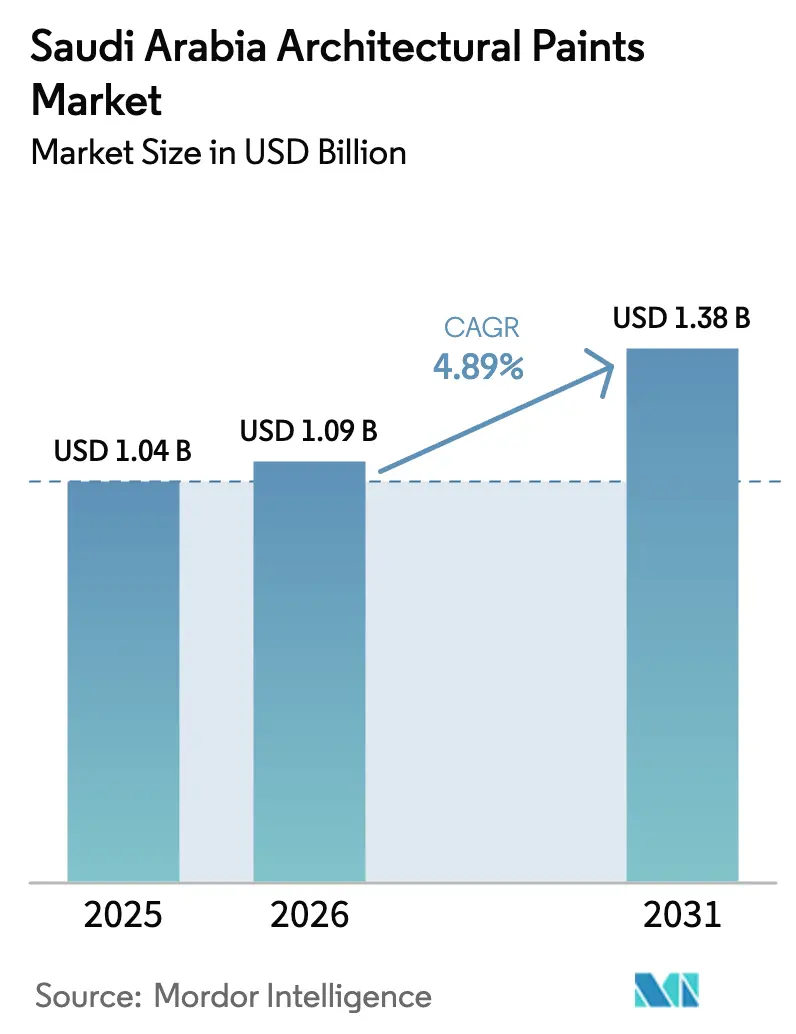
The Saudi Arabia Architectural Paints Market size is projected to be USD 1.04 billion in 2025, USD 1.09 billion in 2026, and reach USD 1.38 billion by 2031, growing at a CAGR of 4.89% from 2026 to 2031. This headline expansion is rooted less in sheer volumes and more in a pivot toward premium, low-VOC and polyurethane systems specified for Vision 2030 giga-projects. Water-borne technology already constitutes more than half of sales, professional applicators control two-thirds of demand, and vertical integration is emerging as the surest hedge against crude-linked feedstock swings. Forthcoming Saudi Building Code revisions, an accelerating tourism pipeline exceeding 55,000 hotel rooms, and anti-dumping duties on titanium dioxide imports combine to reshape cost structures and supplier strategies. While aluminum composite panel cladding is shrinking repaint cycles in high-rise projects, the surge of luxury resorts and heritage restorations keeps the Saudi Arabia architectural coatings market moving steadily upward.
Key Report Takeaways
- By resin type, acrylics commanded 46.38% of the Saudi Arabia architectural coatings market size in 2025, while polyurethane recorded the fastest 5.48% CAGR to 2031.
- By technology, water-borne systems captured 52.47% of the Saudi Arabia architectural coatings market share in 2025 and are expanding at a 5.51% CAGR through 2031.
- By end-user industry, the residential segment held 58.89% of 2025 revenue; in contrast, commercial construction is advancing at a 5.32% CAGR through 2031.
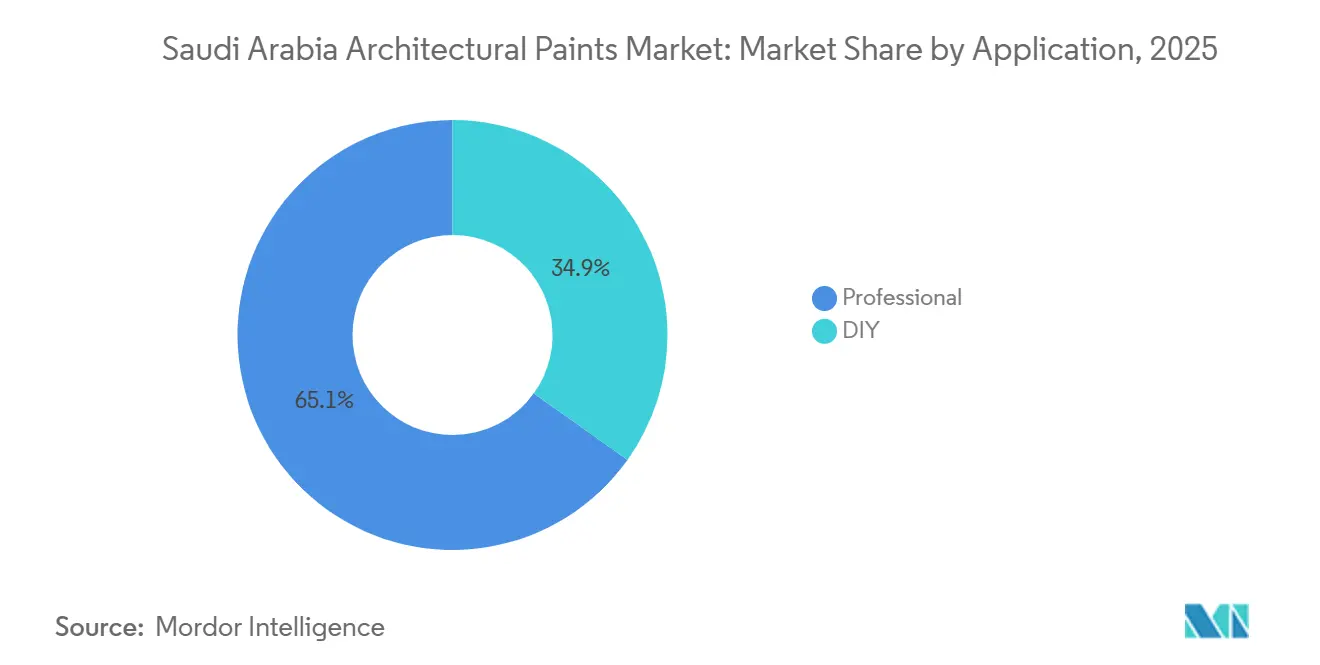
- By application channel, professional contractors controlled 65.12% of 2025 volume, whereas the DIY segment posts the briskest 5.46% CAGR to 2031.
Note: Market size and forecast figures in this report are generated using Mordor Intelligence’s proprietary estimation framework, updated with the latest available data and insights as of January 2026.
Saudi Arabia Architectural Paints Market Trends and Insights
Drivers Impact Analysis*
| Driver | (~) % Impact on CAGR Forecast | Geographic Relevance | Impact Timeline |
|---|---|---|---|
| Growth of construction sector in Saudi Arabia | +1.2% | Riyadh, Jeddah, Eastern Province | Medium term (2-4 years) |
| Increasing commercial construction backed by tourism boom | +0.9% | Makkah, Madinah, Red Sea coast | Short term (≤ 2 years) |
| Stricter energy-efficiency codes driving demand for high-performance coatings | +0.7% | Riyadh, NEOM | Long term (≥ 4 years) |
| Expansion of giga-projects (NEOM, The Line) creating premium paint demand | +1.1% | NEOM, Riyadh, Red Sea coast, Diriyah | Medium term (2-4 years) |
| Emerging preference for low-VOC and water-borne systems due to Green Saudi Initiative | +0.6% | Urban centers nationwide | Long term (≥ 4 years) |
| Source: Mordor Intelligence | |||
Growth of Construction Sector in Saudi Arabia
The Kingdom recorded 309,525 active building projects in 2024, sustaining baseline demand even though construction grew 4.6% year-on-year—slightly below the 4.89% CAGR expected for the Saudi Arabia architectural coatings market[1]. Rising real-estate lending, buoyant office occupancy of 89% in Riyadh, and mandated delivery of 300,000 housing units each year collectively reinforce residential dominance. Yet the faster tempo of commercial projects tied to tourism signals an emerging shift toward higher-margin epoxy and polyurethane finishes for lobbies, façades, and parking structures. Multinationals able to document ASTM performance are gaining specification advantages, while smaller local firms relying on generic alkyds risk exclusion from large tenders.
Increasing Commercial Construction Backed by Tourism Boom
Saudi Arabia greeted 109 million visitors in 2024, fueling over 150 hotel projects with 55,000 rooms and lifting the Saudi Arabia architectural coatings market through demand for LEED-compliant, low-VOC interiors. Red Sea Project resorts mandate pure acrylic and silicone-modified exteriors, Diriyah Gate’s USD 63.2 billion masterplan requires UV-stable earth-tone finishes, and Qiddiya’s entertainment hub stimulates textured decorative demand. Frequent refurbishment cycles in luxury hotels elevate recurring sales, reinforcing the commercial segment’s 5.32% CAGR through 2031.
Stricter Energy-Efficiency Codes Driving Demand for High-Performance Coatings
Saudi Building Code chapters 601-602 oblige thermal insulation, propelling uptake of cool-roof and heat-reflective systems that cut cooling loads by up to 30%. A 2024 KFUPM study confirmed a 13% energy saving from exterior insulation with acrylic plaster, bolstering specifications for high-performance water-borne products. LEED and Estidama frameworks supply the de facto VOC limits absent from SBC, and Greenguard-certified launches such as Jotun’s Fenomastic Wonderwall Lux illustrate how suppliers win premium project approvals.
Expansion of Giga-Projects (NEOM, The Line) Creating Premium Paint Demand
NEOM’s Sindalah island opened in December 2024 with marine-grade epoxy and polyurethane coatings that cost 40-60% more than standard emulsions. Although The Line was scaled back, its USD 100 billion budget still underwrites vertical infrastructure demanding antimicrobial, fire-rated coatings. Riyadh’s New Murabba alone is forecast to consume 50 million liters between 2026-2030, equating to 4.6% of annual national demand. Vertically integrated suppliers able to guarantee resin and pigment supply are positioned to capture these high-value tenders.
Restraints Impact Analysis*
| Restraint | (~) % Impact on CAGR Forecast | Geographic Relevance | Impact Timeline |
|---|---|---|---|
| Volatility in crude-oil linked raw-material prices | -0.8% | Nationwide | Short term (≤ 2 years) |
| Rising popularity of exterior cladding systems reducing repaint cycles | -0.5% | Riyadh, Jeddah high-rises | Medium term (2-4 years) |
| Growing import of lower-priced Turkish and Asian paints in DIY channel | -0.3% | Nationwide retail | Short term (≤ 2 years) |
| Source: Mordor Intelligence | |||
Volatility in Crude-Oil Linked Raw-Material Prices
Titanium dioxide spot prices surged from USD 2,024/t in December 2024 to above USD 2,200/t three months later, and impending anti-dumping duties of 18-34% on Chinese TiO₂ would further strain margins[2]. Polypropylene costs continue to shadow Brent crude swings, challenging smaller manufacturers without long-term contracts. Aramco’s August 2024 move to lift its Petro Rabigh stake to roughly 60% aims to stabilize feedstock but underscores capital intensity in the value chain.
Rising Popularity of Exterior Cladding Systems Reducing Repaints
Aluminum composite panels accounted for 30-35% of new façade area in Riyadh and Jeddah in 2024, rising to 50-60% in towers over 20 stories. Ventilated cladding eliminates 5-7 year repaint cycles, trimming exterior demand in the Saudi Arabia architectural coatings market. Coil-coated PVDF panels with 20-25 year warranties shift expenditure away from liquid finishes, squeezing growth within the commercial high-rise envelope.
*Our forecasts treat driver/restraint impacts as directional, not additive. The impact forecasts reflect baseline growth, mix effects, and variable interactions.
Segment Analysis
By Resin Type: Acrylic Dominance Anchored by UV Resistance
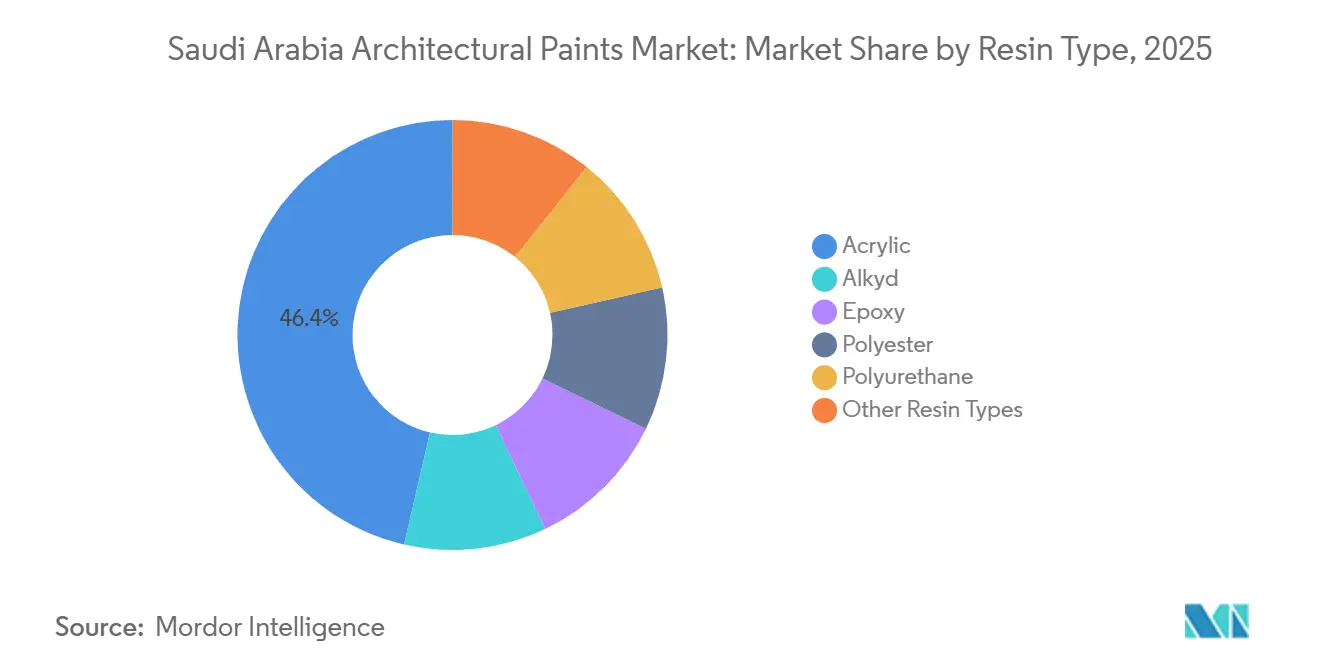
Acrylics held 46.38% of the Saudi Arabia architectural coatings market share in 2025 because of superior UV stability, forgiving application, and water-borne compatibility. Polyurethane’s 5.48% CAGR, however, signals mounting preference for abrasion-resistant coatings in mega-projects and industrial corridors. Vertically integrated leaders such as National Paints offset feedstock shocks through captive resin plants, while smaller players reliant on spot purchases face shrinking spreads. Acrylic will remain dominant in the Saudi Arabia architectural coatings market through 2031, yet its share could soften by two to three points as polyurethane and epoxy systems penetrate premium segments.

By Technology: Water-Borne Gains Reflect Regulatory and Health Tailwinds
Water-borne systems captured 52.47% of the Saudi Arabia architectural coatings market in 2025, and their 5.51% CAGR eclipses overall industry growth. Solvent-borne finishes still command critical roles in marine, industrial, and fast-dry exterior jobs, but prolonged reliance on 300-400 g/L VOC alkyds is increasingly untenable on giga-project sites adopting LEED criteria. Hempel’s water-based Jeddah line and Jotun’s Greenguard launches typify the investment trajectory needed to serve this expanding niche.
By End-user Industry: Commercial Outpaces Residential on Tourism Catalyst
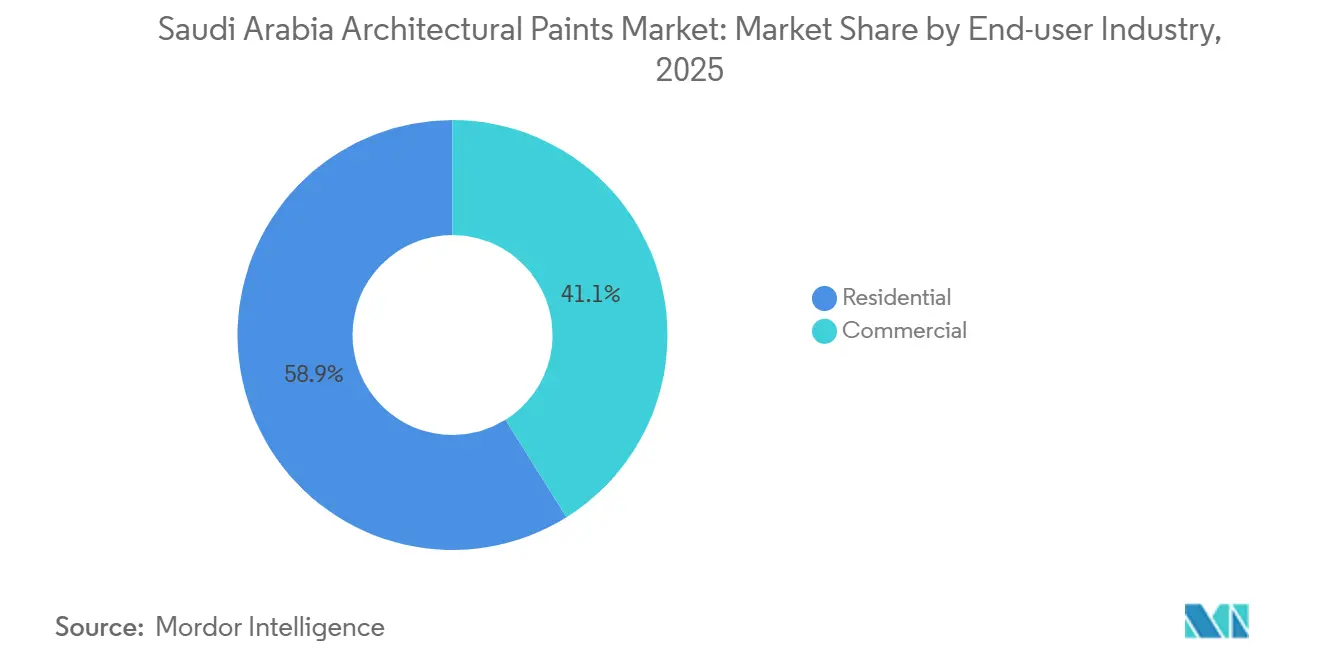
Residential projects generated 58.89% of revenue in 2025 under Ministry of Housing quotas, yet the commercial segment’s 5.32% CAGR is rewriting the mix as hotel, retail, and office renovations escalate. The Saudi Arabia architectural coatings market size allocated to residential builds may fall below 56% by 2031, whereas commercial refurbishments will keep water-borne and polyurethane grades in sustained demand.
By Application: Professional Channel Dominance Masks DIY Disruption
Professional contractors consumed 65.12% of the 2025 volume, controlling procurement for giga-projects and mass housing. Nevertheless, DIY demand is accelerating through online color tools, omnichannel retail, and Western chain entrants. Should e-commerce penetration hit 46% of retail by 2030, DIY share could approach 40%, challenging suppliers to adapt packaging, tinting logistics, and marketing.
Geography Analysis
Riyadh, Jeddah, and the Eastern Province collectively generated nearly 70% of 2025 demand, a dominance unlikely to fade as New Murabba, Diriyah Gate, King Salman Park, and multiple petrochemical expansions advance. NEOM and the northwestern Red Sea coast, while a smaller base, represent the fastest-growing pocket of the Saudi Arabia architectural coatings market, commanding premiums for marine-grade and low-VOC systems. Makkah and Madinah experience episodic surges tied to pilgrim seasons, while southern and border provinces lag, constrained by lower private investment. Trade flows reveal upside for backward integration: Saudi Arabia exported USD 286 million in acrylic polymers against USD 195 million in imports during 2022, yet the Kingdom still brings in significant finished coatings. Proposed duties on Chinese TiO₂ and painted aluminum sheets tilt the field toward domestic producers capable of capturing upstream value and ensuring pigment security.
Value Chain Analysis
The Saudi architectural paints value chain starts with petrochemical and mineral feedstocks, including resins/solvents and pigments, which are converted into binders, dispersions, and additives before being formulated and tinted into interior and exterior decorative coatings. For local manufacturers, pigment exposure is a persistent upstream risk. Titanium dioxide is also subject to trade measures such as the General Authority of Foreign Trade anti-dumping investigation (18-34% proposed on Chinese TiO2 in the market context), which can move into pack prices when inventories are lean.
In the midstream, Saudi-based producers and multinationals run local blending and manufacturing to support large projects and mass housing, supported by procurement frameworks that reward localization. Local Content and Government Procurement Authority requirements for government contracts and the Made in Saudi program threshold (40% added value or locally sourced main components for registration) encourage suppliers to localize more of resin handling, dispersion, and packaging. Downstream, two routes dominate: project specification supply via professional contractors and distributors serving giga-project contractors and public housing, and a retail or DIY channel increasingly dependent on tinting infrastructure, smaller pack sizes, and faster last-mile fulfillment.
Competitive Landscape
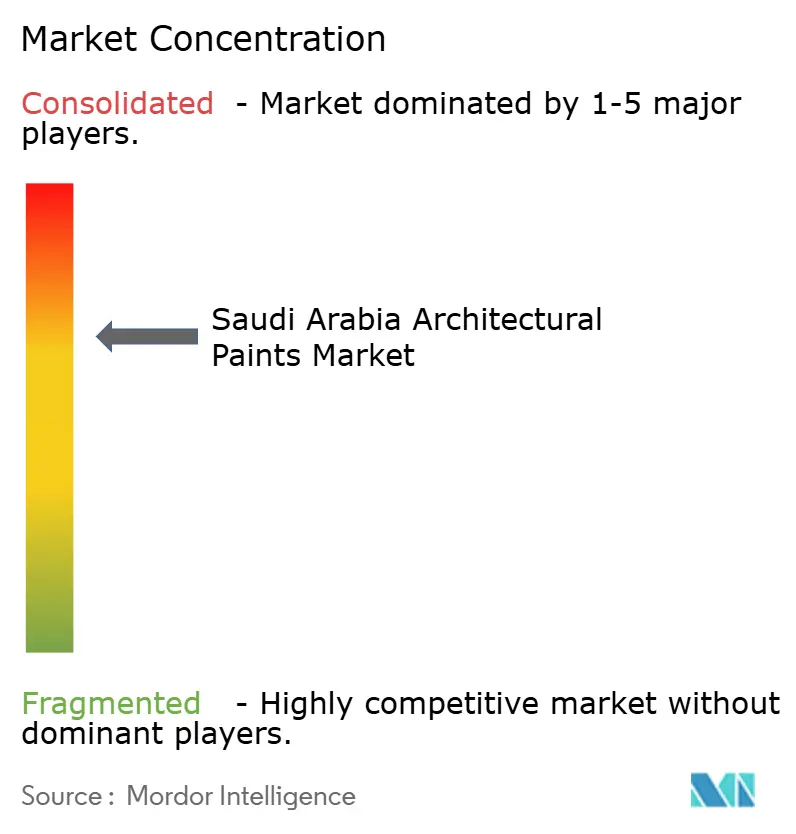
The Saudi Arabia Architectural Paints market is moderately consolidated. Multinationals such as AkzoNobel, Jotun, PPG, Sherwin-Williams, and Hempel retain specification pull in premium segments but struggle to match local pricing in commodity acrylics. SIPCO’s 2025 acquisitions of Premium Paints and Excellent Paints highlight an accelerating consolidation cycle as firms seek volume leverage against raw-material volatility. Emerging opportunities hinge on cool-roof, antimicrobial, and coil-coated solutions, while digital tinting and AI advice tools gain traction in customer engagement. Compliance burdens around substances of very great concern elevate entry barriers and favor players with global stewardship programs in place.
Saudi Arabia Architectural Paints Industry Leaders
-
Jotun
-
Jazeera Paints
-
Hempel A/S
-
NATIONAL PAINTS FACTORIES CO. LTD.
-
Caparol Paints
- *Disclaimer: Major Players sorted in no particular order
Market Opportunities and Future Outlook
White-space is opening around formulations and documentation that help projects meet environmental and performance requirements, especially low-VOC water-borne systems that align with SASO technical regulation on paints and varnishes and procurement preferences tied to government-led construction. As Vision 2030 initiatives and public housing programs standardize submittals and approvals, suppliers with tested cool-roof or solar-reflective coatings, antimicrobial interior systems, and high-durability polyurethane and epoxy finishes can move into higher-margin specifications rather than being limited to commodity acrylic emulsions.
Localization-linked opportunities extend beyond finished paint production into upstream and supporting capabilities that reduce import dependence and compress lead times. Aramco-linked localization programs, including IKTVA targets referenced in the evidence pack, and LCGPA scoring mechanisms create room for investment in pigment dispersion, resin compounding, packaging, and automated tinting networks that support contractors at scale. In 2026, Hempel Decorative Middle East engaging MODON on local content development at its Jeddah factory reflects this policy alignment, supporting further build-out of locally anchored supply chains for architectural coatings.
Recent Industry Developments
- June 2026: Hempel Decorative Middle East announced partnership with Mabani to provide coating solutions aligned with Saudi Vision 2030 building quality standards. The collaboration aligns with Vision 2030 standards and local relevance, strengthening local content credentials and market position in Saudi Arabia.
- May 2026: Jazeera Paints opened its first branch in Qatar (Salwa Road, Doha) in partnership with Al Hattab Trading Company as exclusive distributor. This expansion taps Gulf market demand from Qatar infrastructure and broadens access to Saudi-led project pipelines in the Gulf.
- April 2026: Hempel Decorative Middle East collaborated with Asalet Al Khaleej Company to supply coating solutions for the 368-unit Avonier Al Fursan residential project in Riyadh. The project demonstrates execution capability and supply chain engagement in key Saudi developments.
Research Methodology Framework and Report Scope
Market Definition and Coverage
This market covers revenues earned from architectural paints used to decorate and protect interior and exterior building surfaces in Saudi Arabia, covering both new construction and repainting activity. Values are reported in USD at the ex-factory stage and at the channel level.
Scope exclusions: Industrial, automotive, marine, and protective coatings used mainly for corrosion control on equipment and infrastructure are excluded from this market.
Segmentation Overview
- By Resin Type
- Acrylic
- Alkyd
- Epoxy
- Polyester
- Polyurethane
- Other Resin Types
- By Technology
- Water-borne
- Solvent-borne
- By End-User Industry
- Commercial
- Residential
- By Application
- Professional
- DIY
Data Sources, Market Sizing, and Validation
Desk Research
Desk research starts with anchoring the demand environment for housing and commercial buildings in Saudi Arabia, since repaint cycles and new handovers drive paint pull-through. Public data sources such as Saudi Arabia General Authority for Statistics releases, Saudi Building Code references, and SASO technical regulations for paints and varnishes are reviewed to interpret compliance needs and to infer likely formulation shifts. We also review customs and trade statistics where available, and we use research papers and standards documents that describe VOC limits and common architectural resin systems.
To translate activity into market value, we use company filings, investor decks, press coverage, and association or standards-body publications to map product mix changes, pricing pressure, and channel structure. Select paid database subscriptions are used only where they add company financial intelligence, patent screening is used for binder and additive trends, and shipment-level import and export checks are used when trade flows materially affect the Kingdom. The sources listed here are illustrative only, and many other public and paid references are reviewed to collect data, validate it, and clarify open questions.
Primary Interviews and Surveys
Primary work is used to test how much demand is linked to new projects versus maintenance repainting, and how specifications are changing in residential and commercial buildings across Saudi Arabia. We speak with manufacturers, distributors, contractors, applicators, and large buyers to confirm typical pack sizes, price bands, and what drives upgrades, for example low-odor, low-VOC, washability, and exterior durability. Because it is a country market, coverage focuses on Saudi Arabia and includes views from major urban demand centers and project-led regions where construction pipelines are active.
Distribution of primary research fieldwork respondents
| Company type | Respondent position |
|---|---|
| Top tier: 38% | CXOs: 14% |
| Mid tier: 46% | Functional/Unit leaders: 32% |
| Smaller Players: 16% | Managers: 54% |
Market-Sizing & Forecasting
Sizing is built mainly using a top-down approach, where construction activity signals and repaint intensity are converted into an addressable architectural paint demand pool, which is then valued using realistic price ladders. For Saudi Arabia, inputs typically include residential and commercial completions, renovation and fit-out intensity, the split between professional and DIY application, the shift toward water-borne systems, and resin mix movement that changes average selling prices. Where data becomes thin, conservative ranges are applied and then tightened after follow-up calls, so assumptions remain aligned with what is seen on sites and in stores.
Those totals are corroborated with selective bottom-up approximations to keep the model grounded, including supplier and distributor roll-ups for a sampled set of product families, plus sampled ASP times volume logic for common interior emulsions and exterior paints. Forecasting is done using scenario analysis supported by simple regression checks, where drivers such as construction pipeline momentum, housing turnover, and raw material pass-through are stress-tested with primary feedback. When a variable is volatile, we keep the math straightforward and document the assumption so it can be repeated and updated quickly.
Data Validation & Update Cycle
Validation is handled through multi-step checks where model outputs are compared against independent signals, and any unusual jumps are traced back to pricing, mix, or volume inputs. We also run variance checks across segments, followed by an internal analyst review so calculation logic and assumptions remain consistent across years. If an input looks out of line with what respondents report, re-contacts are triggered and the model is adjusted only after the reason is clearly understood.
Reports refresh annually, and interim updates are made when material events shift demand or pricing conditions. Before delivery, a final pass is performed to capture the latest public releases and any new insights from recent conversations, so clients receive the most current view available at that time.
Mordor Intelligence's Saudi Arabia Architectural Paints Market Size Compared Against Other Published Estimates
Published market numbers for Saudi Arabia architectural paints often vary, even when they appear to cover similar products. Differences usually reflect how each publisher defines architectural scope, which price point is assumed, and whether the estimate is refreshed after major project updates and regulation-related shifts.
The main gap comes from scope mixing, where protective and industrial coatings sometimes get counted alongside building decorative paints. Mordor Intelligence counts only architectural paints tied to residential and commercial building surfaces and then updates ASP progression using fresh channel feedback for the 2026 base.
Benchmark comparison
| Source | Market Size | Gaps in Research Methodology |
|---|---|---|
| Mordor Intelligence | USD 1.09 B (2026) | |
| Trade Journal A | USD 1.22 B (2025) | Often reported as a broader decorative coatings number, with partial inclusion of adjacent categories and a prior-year currency and price basis that can inflate comparisons versus a 2026 reset. |
| Regional Consultancy B | USD 0.95 B (2026) | Uses a more conservative demand build that leans heavily on new-build volumes, with limited adjustment for repainting intensity and premiumization that lifts realized pricing in urban projects. |
The spread across the three figures is largely explained by whether repaint demand is fully captured and whether non-architectural coatings are blended into the total. Our approach stays traceable to a few clear drivers, and it is cross-checked with selective roll-ups and interview-led reality checks so the output can be replicated and updated without overcomplicating the math.
Key Questions Answered in the Report
How fast is demand growing for coatings specified in Saudi giga-projects?
How fast is demand growing for coatings specified in Saudi giga-projects?
Which resin category is gaining the most share?
Which resin category is gaining the most share?
What is driving the shift toward water-borne formulations?
What is driving the shift toward water-borne formulations?
Will DIY channels overtake professional contractors?
Will DIY channels overtake professional contractors?
How are raw-material duties affecting costs?
Proposed anti-dumping tariffs of 18-34% on Chinese TiO₂ and 7.1-20% on painted aluminum sheets could raise pigment and coil-coat costs, pressuring margins for manufacturers lacking long-term supply contracts.
What is the current market size of Saudi Arabia Architectural Paints Market?
The Saudi Arabia Architectural Paints Market size is estimated at USD 1.09 billion in 2026, and is expected to reach USD 1.38 billion by 2031, at a CAGR of 4.89% during the forecast period (2026-2031).