
Market Overview
| Study Period | 2020 - 2031 |
|---|---|
| Forecast Data Period | 2026 - 2031 |
| Historical Data Period | 2020 - 2024 |
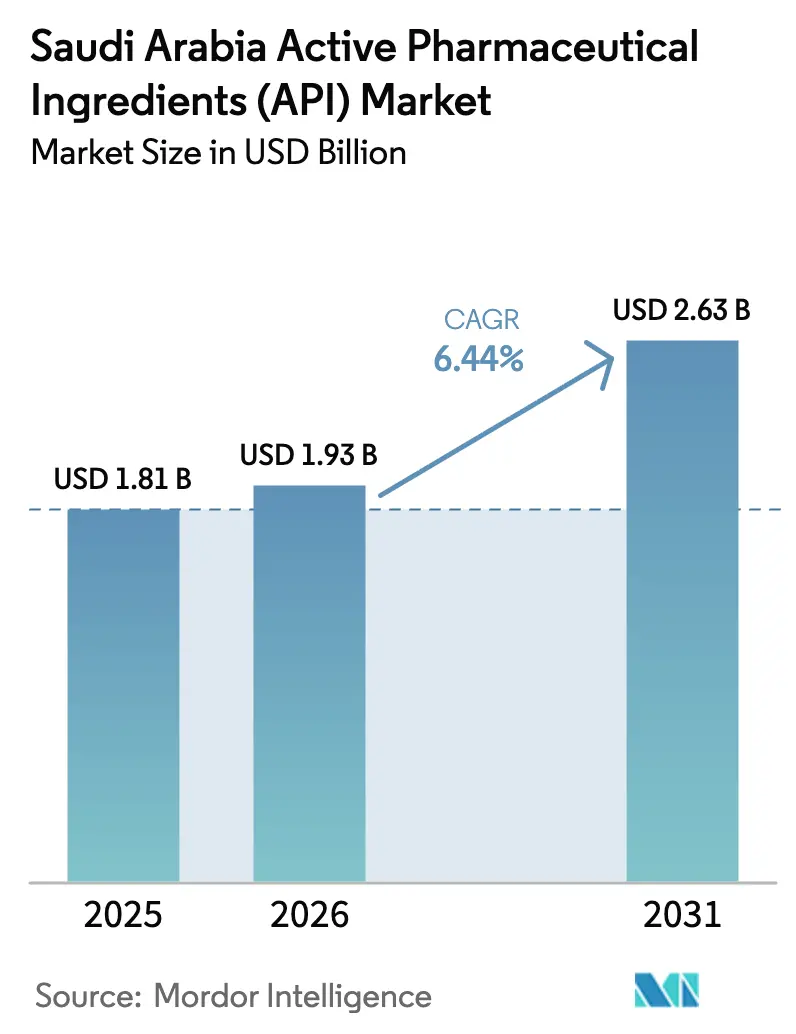
| Base Year Market Size (2025) | USD 1.81 Billion |
| Market Size (2026) | USD 1.93 Billion |
| Market Size (2031) | USD 2.63 Billion |
| Growth Rate (2026 - 2031) | 6.44 % |
Major Players *Disclaimer: Major Players sorted in no particular order Image © Mordor Intelligence. Reuse requires attribution under CC BY 4.0. | |
Saudi Arabia Active Pharmaceutical Ingredients (API) Market Analysis by Mordor Intelligence
The Saudi Arabia Active Pharmaceutical Ingredients market size is expected to grow from USD 1.81 billion in 2025 to USD 1.93 billion in 2026 and is forecast to reach USD 2.63 billion by 2031 at 6.44% CAGR over 2026-2031. Vision 2030 incentives, the National Biotechnology Strategy, and a combined SAR 260 billion healthcare and social development budget allocation are steering the sector toward self-sufficiency while attracting multinational contract developers. Demand also benefits from a 16.4% diabetes prevalence and a 14.9% rise in cardiovascular disease diagnoses, which together elevate chronic-care prescriptions. Supply-side momentum stems from government-backed biologics clusters in King Abdullah Economic City (KAEC) and Jeddah, 50-year tax holidays in the Special Integrated Logistics Zone, and streamlined approvals under the Breakthrough Medicine Program. Near-source strategies gained urgency after Red Sea shipping disruptions, prompting firms to anchor production inside the Saudi Arabia Active Pharmaceutical Ingredients market for regional resilience.
Key Report Takeaways
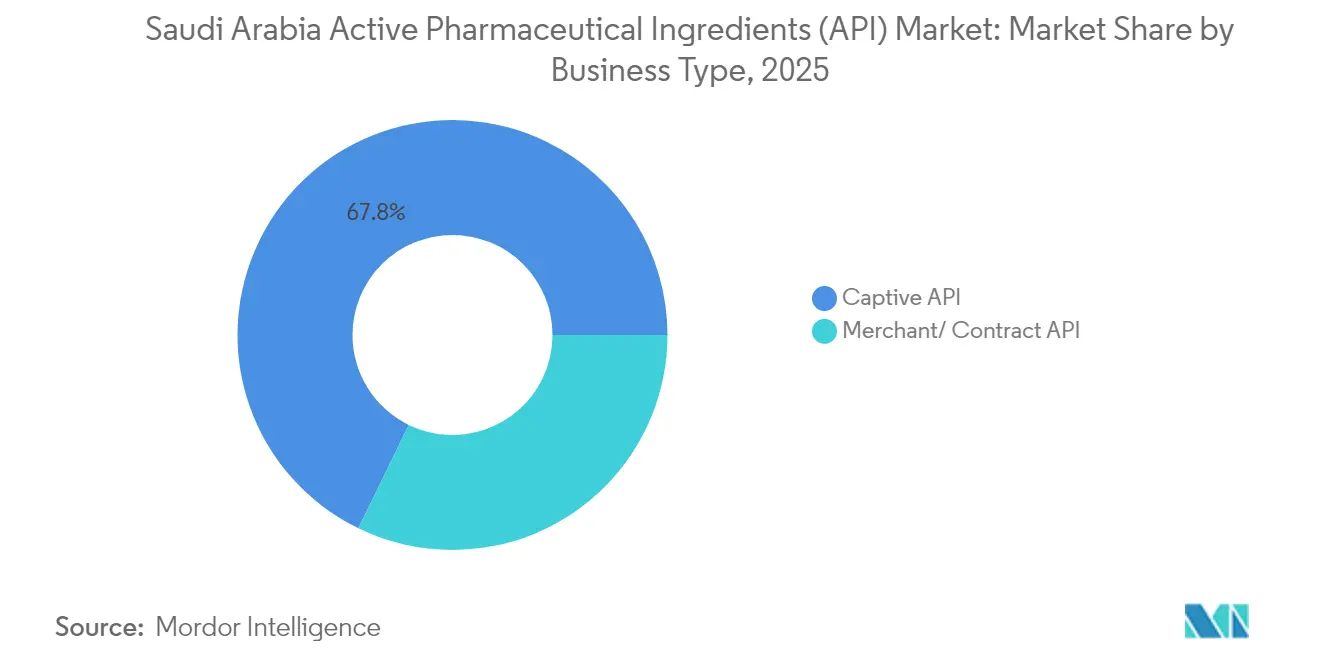
- Captive API production led with 67.79% of the Saudi Arabia Active Pharmaceutical Ingredients market share in 2025, while merchant manufacturing posted the fastest 6.86% CAGR through 2031.
- Synthetic APIs captured 76.05% revenue in 2025; biotech APIs are advancing at a 6.9% CAGR to 2031.
- Small-molecule compounds held 69.15% of 2025 value, whereas large-molecule biologics are projected to grow at a 6.95% CAGR.
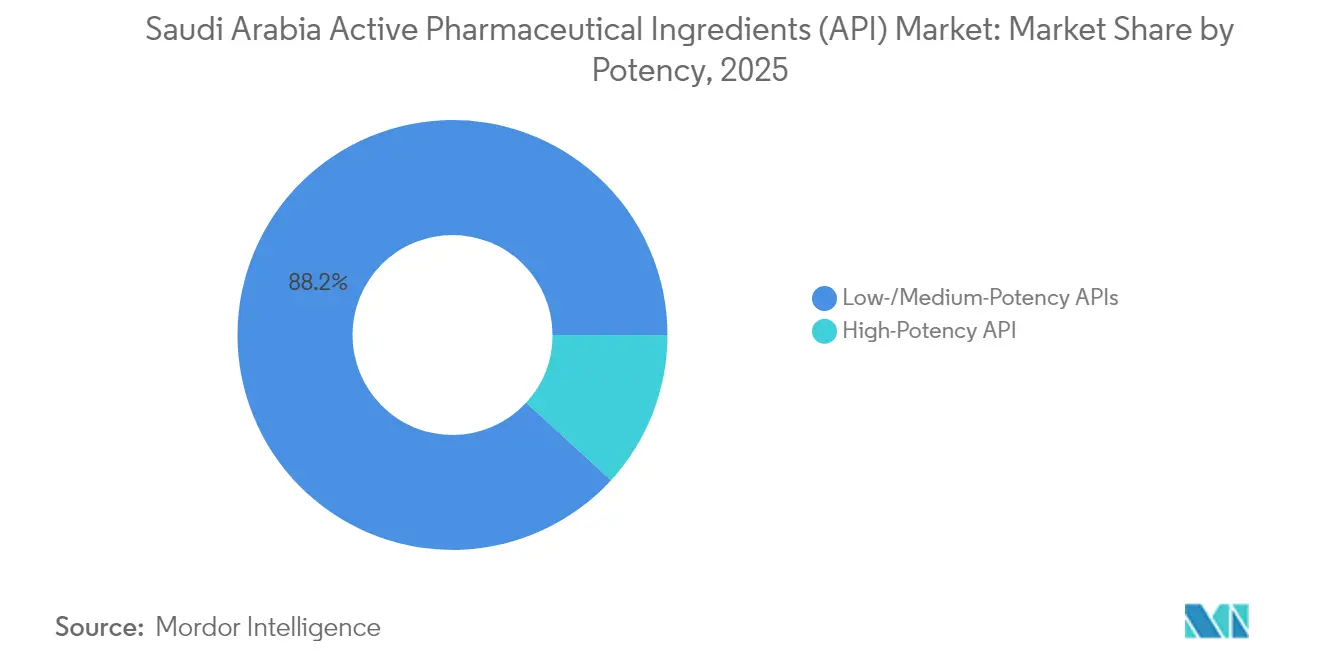
- Low/medium-potency substances represented 88.20% of 2025 sales; high-potency APIs are rising at a 6.99% CAGR.
- Cardiovascular therapies commanded 28.55% share in 2025, yet oncology is set to expand at a 7.04% CAGR to 2031.
- Pharmaceutical companies retained 68.55% share in 2025, with CDMOs pacing at 6.83% CAGR.
Note: Market size and forecast figures in this report are generated using Mordor Intelligence’s proprietary estimation framework, updated with the latest available data and insights as of 2026.
Saudi Arabia Active Pharmaceutical Ingredients (API) Market Trends and Insights
Drivers Impact Analysis*
| Driver | (~) % Impact on CAGR Forecast | Geographic Relevance | Impact Timeline |
|---|---|---|---|
| Vision 2030 localization incentives & NIDLP subsidies | +1.2% | National, concentrated in KAEC & Jeddah | Medium term (2-4 years) |
| Mandatory local-content quotas in MoH tenders | +0.8% | National, with priority in government procurement | Short term (≤ 2 years) |
| Rising chronic-disease burden expanding domestic drug demand | +1.0% | National, highest in urban centers | Long term (≥ 4 years) |
| Biologics cluster investments at KAEC & Jeddah for mAbs/viral-vector APIs | +0.7% | Regional, KAEC & Jeddah industrial zones | Medium term (2-4 years) |
| CDMO tax-free industrial-zone appeal to global partners | +0.6% | National, focused on Special Economic Zones | Medium term (2-4 years) |
| Import-route disruptions accelerating near-source API production | +0.5% | National, with spillover to GCC region | Short term (≤ 2 years) |
| Source: Mordor Intelligence | |||
Vision 2030 Localization Incentives & NIDLP Subsidies
Government cash grants, 30-year tax relief, and fast-track approvals make local production financially compelling. More than 350 multinationals secured Regional Headquarters licenses by March 2024, many converting distribution outposts into full-scale plants. Novo Nordisk and Sanofi signed 2024 insulin tie-ups with NUPCO, signaling momentum for domestically sourced inputs. Reduced import reliance could trim external API spend by 25% over the forecast horizon.
Mandatory Local-Content Quotas in MoH Tenders
Pharmaceutical bids covering about 60% of national drug purchases now score highest when ingredients are Saudi-made. NUPCO bundles multi-year purchase guarantees, ensuring plant utilization and de-risking capital expenditure. Global players have partnered with local firms solely to preserve access to this protected channel. Early adopters gain predictable demand, which supports financing for capacity expansions inside the Saudi Arabia Active Pharmaceutical Ingredients market.
Rising Chronic-Disease Burden Expanding Domestic Drug Demand
Diabetes alone costs SAR 17 billion annually and continues to rise alongside hypertension and obesity. Universal insurance slated for 2026 will widen treatment access, locking in repetitive demand for cardiovascular, metabolic, and oncology APIs. Urban lifestyles intensify prevalence, assuring sustained volume growth. Chronic-care regimens require uninterrupted supply, prompting manufacturers to localize primary intermediate lines to avoid freight and tariff volatility.
Biologics Cluster Investments at KAEC & Jeddah
KFSHRC-Germfree’s modular ATMP campus and deep-water export lanes give Saudi plants an edge in cold-chain biologics. Government grants targeting 11,000 biotech jobs nurture monoclonal antibody and viral-vector lines, anchoring the Saudi Arabia Active Pharmaceutical Ingredients market as a regional supply base for high-margin biologics. Co-location with logistics corridors shortens time to clinical sites, a critical factor for temperature-sensitive therapies.
Restraints Impact Analysis*
| Restraint | (~) % Impact on CAGR Forecast | Geographic Relevance | Impact Timeline |
|---|---|---|---|
| Scarcity of GMP-experienced chemical-engineering talent | -0.9% | National, acute in specialized manufacturing zones | Long term (≥ 4 years) |
| Continued reliance on imported key starting materials | -0.6% | National, with supply chain vulnerabilities | Medium term (2-4 years) |
| High energy & water footprint vs national sustainability targets | -0.4% | National, concentrated in industrial zones | Long term (≥ 4 years) |
| Lengthy SFDA plant-approval cycle slowing time-to-market | -0.3% | National, affecting all manufacturers | Short term (≤ 2 years) |
| Source: Mordor Intelligence | |||
Scarcity of GMP-Experienced Chemical-Engineering Talent
Industrial expansion needs engineers with sterile-processing expertise, yet Saudization policies cap expatriate hiring. An estimated 175,000 extra health-sector professionals are required by 2030, leaving the Saudi Arabia Active Pharmaceutical Ingredients market short of critical skill sets. Companies now fund accelerated curricula and overseas fellowships to bridge gaps. Although training pipelines have begun to scale, staffing constraints still slow facility ramp-up and inflate wage costs.
Continued Reliance on Imported Key Starting Materials
Roughly 80% of raw intermediates still arrive from Asia, exposing manufacturers to freight shocks and regulatory differences. SABIC’s upstream projects focus on bulk chemicals rather than specialized precursors, delaying full value-chain localization. Firms hedge by diversifying suppliers, yet any extended shipping disruption could squeeze inventories and raise working-capital requirements.
*Our forecasts treat driver/restraint impacts as directional, not additive. The impact forecasts reflect baseline growth, mix effects, and variable interactions.
Segment Analysis
By Business Model: Captive Operations Hold Scale While Contract Manufacturing Gains Pace
Captive plants accounted for 67.79% of 2025 revenue, as integrated drug makers prefer in-house control over quality and intellectual property. SPIMACO’s vertically aligned campus in Jeddah achieved 97% utilization, reinforcing its 6% overall share in the Saudi Arabia Active Pharmaceutical Ingredients market. The model locks down supply security for chronic-care molecules, supports predictable lines, and limits audit complexity.
Merchant production, though smaller in absolute terms, is advancing at a 6.86% CAGR. Zero-tax zones and long-term land leases entice global CDMOs to locate batch lines locally for Middle East and Africa fulfillment. Sudair Pharmaceutical City’s plug-and-play modules allow rapid scale-up, while plans by WuXi AppTec to explore a Gulf hub underline growing confidence among multinational contractors.


By Synthesis Type: Synthetic Dominance Continues as Biotech Gathers Momentum
Synthetic compounds captured 76.05% of 2025 turnover because petrochemical feedstocks remain inexpensive and plentiful. Cardiovascular and diabetes therapies, still dominated by small-molecule drugs, sustain base-load demand, keeping utilization high across older multipurpose reactors. The Saudi Arabia Active Pharmaceutical Ingredients market size for established synthetic lines therefore benefits from economies of scale and minimal technology risk.
Biotech-derived APIs are expanding at a 6.9% CAGR, propelled by the National Biotechnology Strategy and KAEC’s large fermentation vessels. NEOM’s precision-fermentation equity investment in Liberation Labs widens applications into enzymes and nutritional proteins, foreshadowing more diverse revenue streams inside the sector.
By Molecule Size: Small-Molecule Foundations Complement Large-Molecule Upswing
Small molecules retained 69.15% of 2025 activity due to entrenched mass-market therapies and favorable cost-of-goods. Jamjoom’s dermatology and ophthalmology portfolio demonstrates ongoing room for process innovation within traditional chemistry pipelines. These efficiencies allow producers to serve dense chronic-disease demand while generating reliable cash flows.
Large molecules are growing fastest at 6.95% CAGR as hospitals embrace monoclonal antibodies and cell-based regimens. Modular cleanrooms at KAEC enable rapid switching between biologic campaigns, which reduces downtime and boosts the Saudi Arabia Active Pharmaceutical Ingredients market size attributable to biologics. As clinical guidelines shift toward targeted therapies, large-molecule plants capture an increasing share of new product launches.
By Potency: High-Potency Increment Fueled by Oncology Needs
Low and medium-potency ingredients generated 88.20% of 2025 sales, reflecting continuing volume in hypertension, diabetes, and respiratory drugs. Such plants require standard containment, supporting economies of scale and predictable scheduling.
High-potency APIs are advancing 6.99% annually as oncology protocols proliferate. SPIMACO’s SAR 272 million cytotoxic line, co-financed by AstraZeneca, adds isolator suites and sub-micro-gram air handling to manufacture antibody–drug conjugate payloads, setting higher barriers to entry. Tighter regulatory oversight also supports premium pricing and specialization.
By Therapeutic Area: Cardiovascular Anchors Volume; Oncology Leads Growth
Cardiovascular APIs held 28.55% market share in 2025 because hypertension affects 11.1% of Riyadh adults. Consistent dosing keeps batch campaigns long and repetitive, anchoring baseline revenue.
Oncology substances are advancing at 7.04% CAGR, buoyed by earlier diagnostics and government cancer-center buildouts. KFSHRC protocols increasingly require monoclonal antibody intermediates, strengthening localization imperatives and lifting high-potency demand.
By End User: Integrated Pharma Dominates as CDMOs Accelerate
Domestic and multinational drug makers controlled 68.55% share in 2025, leveraging owned facilities for supply security. Regional-headquarters incentives lure global brand owners to embed R&D alongside manufacturing, reinforcing vertical integration.
CDMOs are scaling at 6.83% CAGR as sponsors outsource to contain fixed costs. Duty-free equipment imports inside the Special Integrated Logistics Zone translate into thin-margin agility attractive to Western biotech start-ups running Gulf-based clinical trials.
Geography Analysis
Saudi Arabia commands roughly 60% of GCC healthcare outlays, positioning the Saudi Arabia Active Pharmaceutical Ingredients market as the region’s anchor tenant. KAEC’s deep-water port shortens freight routes to African and European buyers, while 100% foreign ownership aligns with multinational governance requirements. Import-substitution quotas push firms to install lysine fermenters and spray-dryers near Jeddah, thereby increasing local content in chronic-care supply chains.
GCC harmonization under the Gulf Health Council simplifies registration requirements for exports. Jamjoom enjoyed 19.2% expansion in fellow GCC states, illustrating export scalability nurtured by Saudi batch capacity. North Africa’s USD 17 billion pharmaceutical spend represents additional pull: Avalon Pharma lifted exports 85% by leveraging Saudi certificates of analysis accredited by WHO prequalification.
Logistics diversification remains a strong selling point. Multiple Red Sea and Gulf ports plus a planned east-to-west land bridge reduce reliance on Suez-linked passages that recently faced insurance premiums and security delays. These corridors reinforce the Saudi Arabia Active Pharmaceutical Ingredients market in safeguarding just-in-time supply chains for MENA formulators
Regulatory Landscape
Saudi Arabia regulates APIs and finished pharmaceuticals primarily through the Saudi Food and Drug Authority (SFDA), which requires GMP compliance for manufacturers supplying the local market. SFDA licensing for pharmaceutical manufacturing is handled through its electronic system and includes an on-site inspection to confirm technical readiness and GMP implementation, making inspection outcomes and readiness documentation important gating factors for capacity additions and tech transfers.
Market entry and lifecycle compliance are guided by SFDA's broader Regulatory Framework for drug approvals, including product file validation against technical regulations and specifications, as well as manufacturer and product registration rules for pharmaceutical, herbal, and health product manufacturers. In May 2026, SFDA published an updated GMP guideline (version 4.4), reinforcing the need for quality-system maturity and alignment with internationally recognized GMP expectations for both domestic sites and imported-product oversight.
Value Chain Analysis
Saudi Arabia's API value chain remains import-led at the upstream end, with industry sources indicating that domestic API production accounts for less than 1% of total annual API demand. The chain typically begins with imported key starting materials and intermediates, followed by local and in-country operations across process development, synthesis or fermentation, purification, and quality control release, before moving into finished-dosage manufacturing and distribution through regulated procurement and commercial channels.
SFDA sits at the center of compliance and throughput, with manufacturing licenses tied to inspections and ongoing GMP adherence, and regulatory requirements shaping documentation, testing, and release practices across both locally made and imported inputs. On the enabling side, Vision 2030 programs such as the National Industrial Development and Logistics Program (NIDLP) support supply-chain resilience through domestic logistics, storage, and manufacturing capability buildout, reinforcing industrial clustering (for example, KAEC and Jeddah) and making logistics-zone infrastructure and quality-assurance capacity part of the operating model.
Competitive Landscape
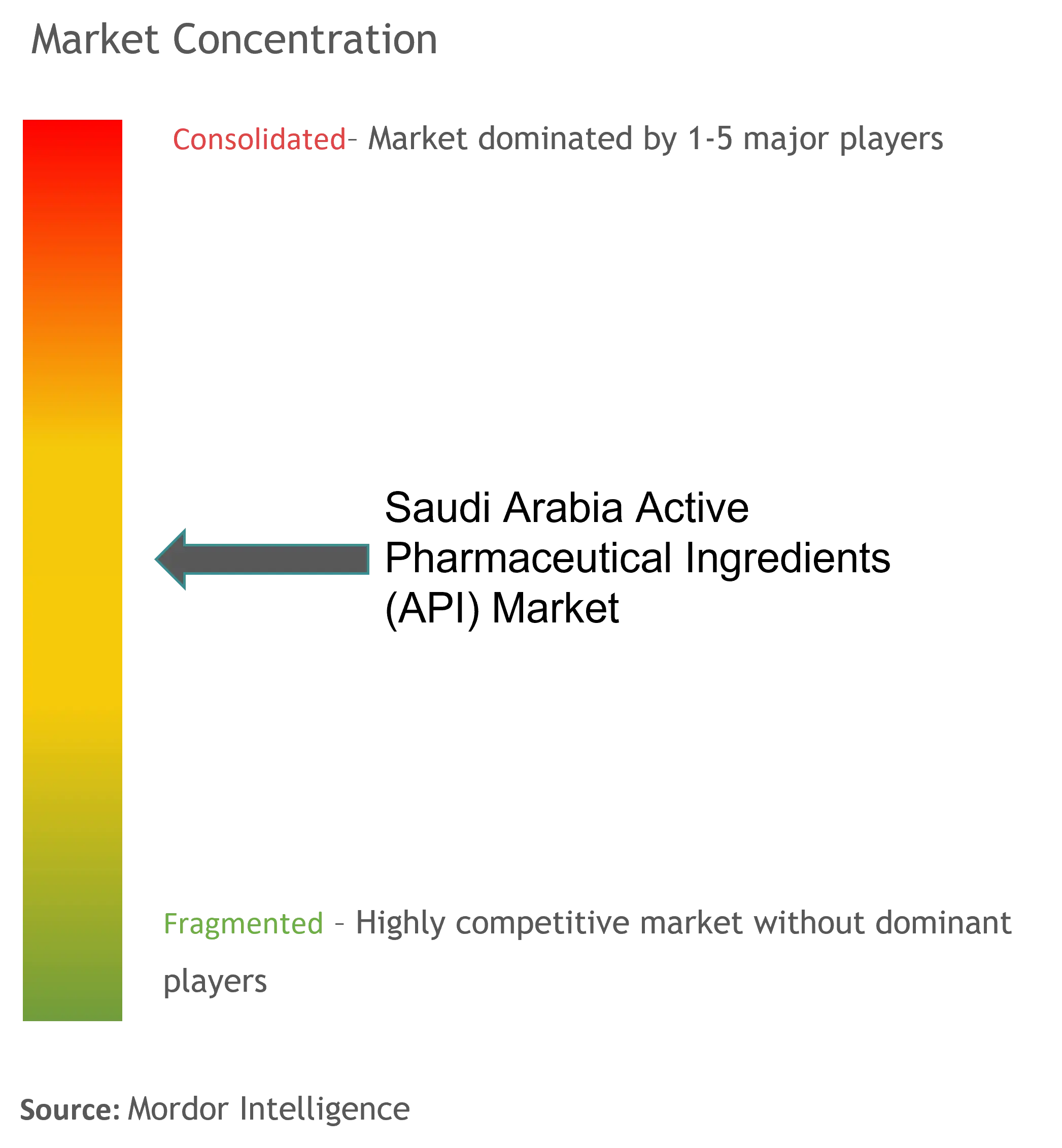
The field remains moderately fragmented; the five largest domestic and foreign players capture significant portion of total sales, leaving ample opportunity for niche specialists. SPIMACO’s reflects advantages from end-to-end oncology lines and high visibility in public procurement. International entrants such as Hikma leverage regional acquisitions to deepen therapeutic catalogs and secure multi-year tenders.
Merger-control filings rose 16% in Q1 2025, with 80% involving overseas investors, signaling intensifying consolidation and technology-transfer deals. Biotech-specific investments create white-space differentiation; KFSHRC’s ATMP site enables viral-vector APIs rarely manufactured locally, giving early movers premium pricing room.
Regulatory agility further shapes competitive posture. The Breakthrough Medicine Program trims dossier review cycles, allowing innovators to commercialize faster while adhering to ICH-aligned quality. Firms with robust regulatory affairs teams gain a head start over generic-heavy rivals, underscoring why local liaison offices become strategic assets in the Saudi Arabia Active Pharmaceutical Ingredients market.
Saudi Arabia Active Pharmaceutical Ingredients (API) Industry Leaders
Pfizer, Inc.
Aurobindo Pharma
Novartis AG
BASF SE
Viatris Inc.
- *Disclaimer: Major Players sorted in no particular order

Market Opportunities and Future Outlook
Localization white space remains most visible in upstream APIs and key starting materials, since domestic output is still a small fraction of national demand. This creates room for import substitution in high-volume chronic therapy molecules and in selected high-value biologics intermediates. NIDLP provides a clear demand-side and industrial-policy anchor by targeting localization of 40% of the pharmaceutical industry market value, alongside cluster development in locations such as KAEC and Jeddah, which supports co-location of manufacturing, quality labs, and compliant storage for regulated inputs.
Opportunities also show up in regulated enabling services that shorten time-to-approval and improve compliance outcomes, including SFDA-ready quality systems, analytical method development, and inspection preparedness for new or expanded plants using SFDA's licensing and inspection pathway. On the investment and partnership front, February 2026 announcements around STADA's plan to invest more than EUR 85 million in a Saudi manufacturing hub at Sudair City for Industry and Businesses, and May 2026 Jamjoom Pharma's acquisition of a Pfizer manufacturing facility, point to active capacity-building and technology-transfer pathways that can extend into localized API and intermediate sourcing programs aligned with government procurement priorities.
Recent Industry Developments
- July 2026: Aurobindo Pharma's delegation led by the Senior VP met with the Embassy of India in Riyadh to discuss ongoing operations and growth plans for its Saudi Arabian subsidiary. The engagement highlights regional capacity expansion and alignment with Vision 2030 pharma objectives, signaling a strengthened local footprint.
- May 2026: Jamjoom Pharma completed the acquisition of a Pfizer pharmaceutical manufacturing facility in Saudi Arabia. The deal expands local API and finished-dose production capacity, strengthening in-country manufacturing footprint and potential for multi-year regional tenders.
- April 2026: Jamjoom Pharma signed a local manufacturing agreement with Viatris Arabia Ltd. to manufacture products across multiple therapeutic areas locally. The agreement increases Saudi based API and drug-manufacturing activity and supports supply security under Vision 2030.


Research Methodology Framework and Report Scope
Market Definition and Coverage
For this methodology, the market covers the value of active pharmaceutical ingredients (APIs) supplied for making finished medicines in Saudi Arabia, including locally made and imported APIs that go into prescription and OTC drugs.
Scope exclusions: Excludes finished dosage forms, packaging materials, and routine contract manufacturing services that do not involve API production or API trading.
Segmentation Overview
- By Business Mode
- Captive API
- Merchant / Contract API
- By Synthesis Type
- Synthetic APIs
- Biotech APIs
- By Molecule Size
- Small-Molecule
- Large-Molecule / Biologics
- By Potency
- High-Potency APIs (HPAPI)
- Low/Medium-Potency APIs
- By Therapeutic Area
- Oncology
- Cardiovascular
- Metabolic Disorders (Diabetes)
- Infectious Diseases
- CNS & Neurology
- Respiratory
- Other Therapeutic Areas
- By End-User
- Domestic Pharma Manufacturers
- Multinational Pharma Subsidiaries (KSA)
- CDMOs / CMOs
- Hospitals & Research Institutes
Data Sources, Market Sizing, and Validation
Desk Research
Desk research is used to set the market frame and to anchor variables that cannot be guessed reliably from company updates alone. We use public sources such as Saudi Food and Drug Authority updates, Saudi General Authority for Statistics releases, UN Comtrade trade flows for pharmaceutical chemicals, and World Health Organization health indicators that shape demand for chronic therapies.
We also review peer reviewed journals on pharmaceutical manufacturing, official policy releases tied to industrial localization programs, and company filings and investor presentations that discuss capacity additions, product focus, and revenue exposure to the Kingdom. Where needed, paid subscriptions for company financials and news are used to standardize currency treatment, track corporate actions, and reduce the risk of missing smaller but still relevant disclosures. The sources named here are illustrative only, and additional public documents and datasets were used for data collection, validation, and clarification.
Primary Interviews and Surveys
Primary work is used to test demand and supply assumptions that are difficult to confirm in public data, such as API sourcing mix, local production depth, and typical pricing movement by chemistry type. We interview and survey stakeholders across manufacturers, importers and distributors, and large buyers, and we balance feedback across Saudi Arabia, with external regional viewpoints where cross border procurement affects local availability.
Distribution of primary research fieldwork respondents
| Company type | Respondent position |
|---|---|
| Top tier: 26% | CXOs: 18% |
| Mid tier: 55% | Functional/Unit leaders: 36% |
| Smaller Players: 19% | Managers: 46% |
Market-Sizing & Forecasting
Sizing starts with a top-down build where Saudi Arabia demand for finished medicines is translated into API value using therapy mix signals, manufacturing intensity, and import reliance patterns, which are then cross checked against trade and production indicators. After setting the demand pool, we use selective bottom-up approximations to keep totals realistic, such as rolling up a sample of supplier and distributor revenues tied to APIs, then validating implied average selling prices against interview ranges.
Key inputs that shape the model include the split between imported versus locally produced APIs, shifts in chronic disease treatment volumes (for example diabetes and cardiovascular therapy demand), regulatory approvals and product registrations that indicate pipeline expansion, capacity or localization announcements that change domestic supply, and price movement by major chemistry families. Forecasting uses scenario analysis supported by expert views, with the base case linked to localization execution pace and import substitution timing, and sensitivities applied to currency conversion timing and ASP progression. Where bottom-up coverage is incomplete for smaller traders, the gap is handled through calibrated ratios using observed import values and typical distribution margins from interviews.
Data Validation & Update Cycle
Outputs are validated through multiple checks so the final number stays tied to real market signals. We compare modeled totals against independent indicators such as API import values, manufacturing activity cues, and the implied API intensity per unit of finished medicine consumption, then investigate outliers before sign-off.
A second analyst review is completed to test assumptions, units, and year alignment, and respondents may be re-contacted when a variance cannot be explained using public information. The report is refreshed annually, and interim updates are triggered when a material policy change, plant start-up, or trade shift could move the near term outlook. Before delivery, a final pass is done to ensure the latest disclosures and macro indicators are reflected.
Mordor Intelligence's Saudi Arabia Active Pharmaceutical Ingredients API Market Estimate Compared With Other Published Estimates
Published market sizes for Saudi Arabia APIs can appear far apart because the term API is not treated the same way across studies, and year anchors and currency timing are not always aligned. Differences typically come from scope choices, pricing build-ups, and how import flows are converted into local consumption value.
A frequent gap driver is whether the estimate counts only APIs used for finished drug manufacturing in the country, or whether it also adds adjacent chemical intermediates, excipients, or broad pharmaceutical ingredients trade codes without filtering. Another driver is ASP logic, where some estimates apply a single blended price curve, while others separate high volume generics from higher value biologic related inputs, which can change the implied value quickly as mix shifts. The table points to the largest spread coming from narrow versus broad product mapping and the use of trade-code filtering with interview checks, which is the key modeling choice described by Mordor Intelligence.
Benchmark comparison
| Source | Market Size | Gaps in Research Methodology |
|---|---|---|
| Mordor Intelligence | USD 1.81 B (2025) | |
| Trade Publisher A | USD 0.29 B (2024) | Uses a narrower interpretation that appears closer to merchant API sales only, and it anchors on a different base year with limited visibility on how captive API use for local manufacturing is treated. |
| Industry Advisory B | USD 2.20 B (2024) | Likely includes a broader bucket that can fold in intermediates and loosely matched chemical imports, and it does not clearly show how currency conversion timing and therapy mix are validated through local stakeholder checks. |
Overall, benchmark differences can be explained by what is counted as an API, how imports are mapped into use in Saudi Arabia, and whether pricing is separated by mix rather than blended. With the scope, variables, and checks written into the model steps, buyers can trace the number back to observable demand and supply signals and update it when conditions change.


Key Questions Answered in the Report
How large is the Saudi Arabia Active Pharmaceutical Ingredients market today?
The Saudi Arabia Active Pharmaceutical Ingredients market size stood at USD 1.93 billion in 2026 and is expected to reach USD 2.63 billion by 2031.
What growth rate is expected through 2031?
The sector is forecast to expand at a 6.44% CAGR between 2026 and 2031, propelled by Vision 2030 incentives and rising chronic-disease prevalence.
Which segment is expanding fastest?
Oncology APIs lead growth with a projected 7.04% CAGR through 2031, supported by new cancer-drug manufacturing partnerships.
How are biologics influencing production patterns?
Government-backed clusters in KAEC and Jeddah are accelerating biotech API capacity, pushing biologics output toward a 6.9% CAGR.
What policy tools support localization?
Vision 2030 subsidies, mandatory local-content quotas, 50-year tax holidays in logistics zones, and the Breakthrough Medicine Program all fast-track domestic API manufacture.
What challenges could slow expansion?
Skill shortages in GMP-trained engineers and dependence on imported starting materials remain key bottlenecks to rapid scale-up.
Page last updated on:


 Your data is secure and never sold or shared.


