
Market Overview
| Study Period | 2020 - 2031 |
|---|---|
| Forecast Data Period | 2026 - 2031 |
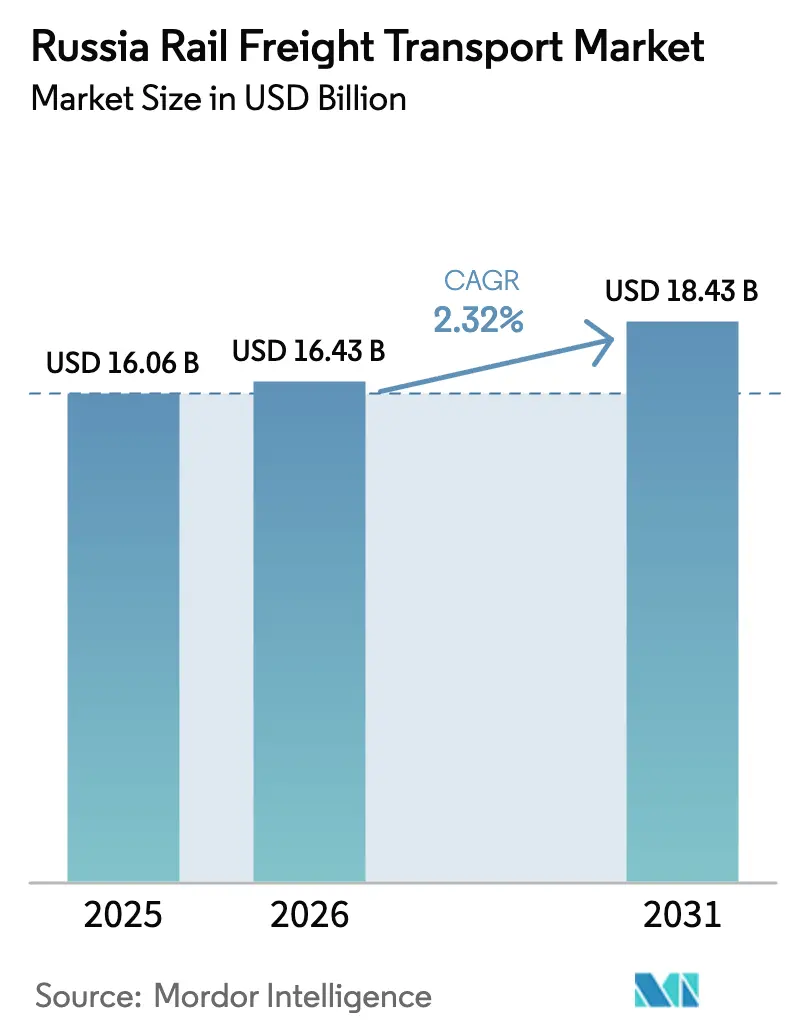
| Base Year Market Size (2025) | USD 16.06 Billion |
| Market Size (2026) | USD 16.43 Billion |
| Market Size (2031) | USD 18.43 Billion |
| Growth Rate (2026 - 2031) | 2.32 % |
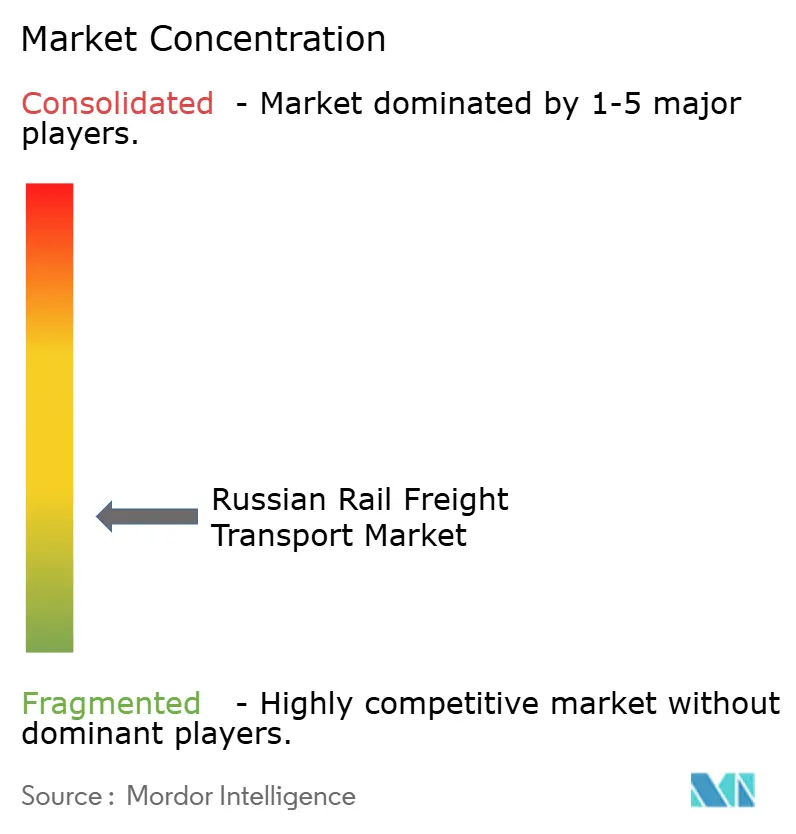
| Market Concentration | Low |
Major Players *Disclaimer: Major Players sorted in no particular order Image © Mordor Intelligence. Reuse requires attribution under CC BY 4.0. | |
Russia Rail Freight Transport Market Analysis by Mordor Intelligence
Russia Rail Freight Transport Market size in 2026 is estimated at USD 16.43 billion, growing from 2025 value of USD 16.06 billion with 2031 projections showing USD 18.43 billion, growing at 2.32% CAGR over 2026-2031.
A decisive shift toward Asia-facing routes is reshaping traffic flows, even as Western sanctions squeeze access to modern locomotives and slow capacity gains. Heavy government investment amounting to 2.7 trillion rubles (USD 30.0 billion) is concentrated on the Trans-Siberian and Baikal-Amur corridors, underpinning long-haul bulk exports and providing a safety valve for rising container demand. Digital scheduling platforms are steadily reducing empty-run kilometers, signaling that data-driven reliability, not fleet size alone, will determine future competitive positioning. Bulk commodities still anchor revenues, yet faster growth in containerised and value-added services suggests the market is quietly diversifying its earnings base without abandoning its traditional strengths.
Key Report Takeaways
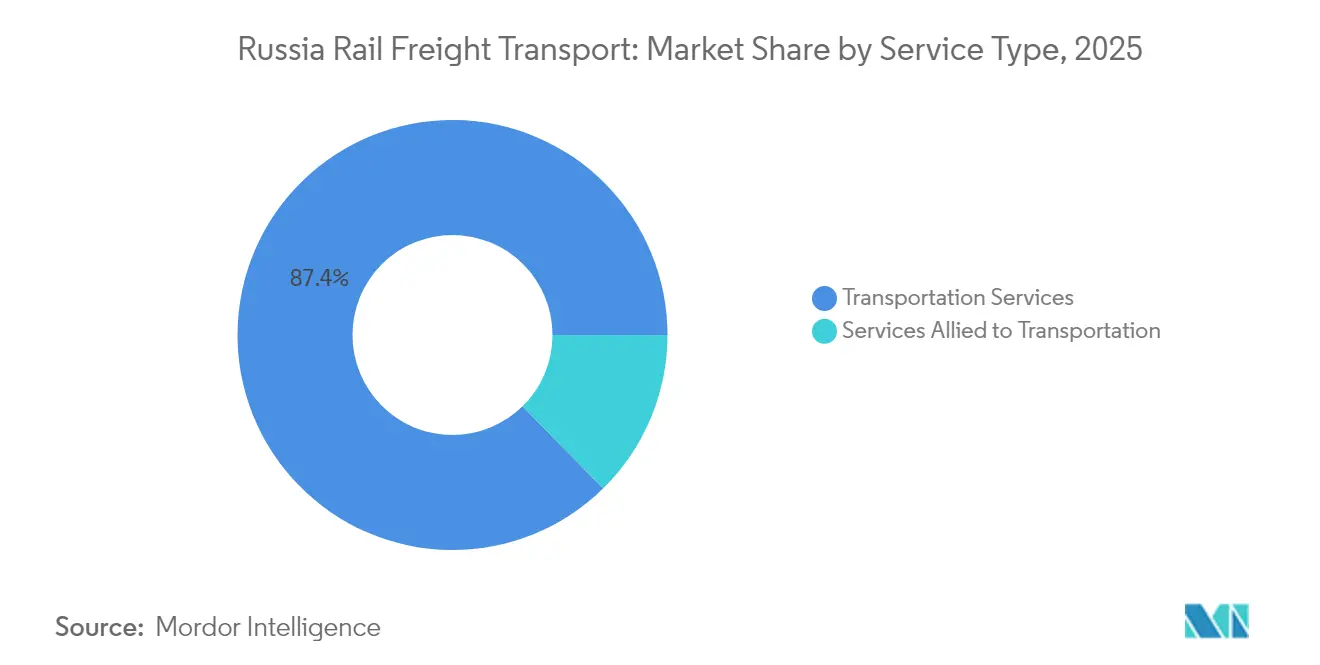
- By service type, Transportation captured 87.35 % of the Russia Rail Freight Transport market share in 2025, while the Russia Rail Freight Transport market size for Services Allied to Transportation is projected to grow at a 6.23 % CAGR through 2031.
- By cargo type, Dry Bulk accounted for 57.10 % of the Russia Rail Freight Transport market share in 2025, and the Russia Rail Freight Transport market size for Containerised/Intermodal services is forecast to expand at an 7.88 % CAGR to 2031.
- By end-user industry, Mining & Minerals held 35.45 % of the Russia Rail Freight Transport market share in 2025, whereas the Russia Rail Freight Transport market size tied to Retail & FMCG is expected to advance at a 9.18 % CAGR between 2026-2031.
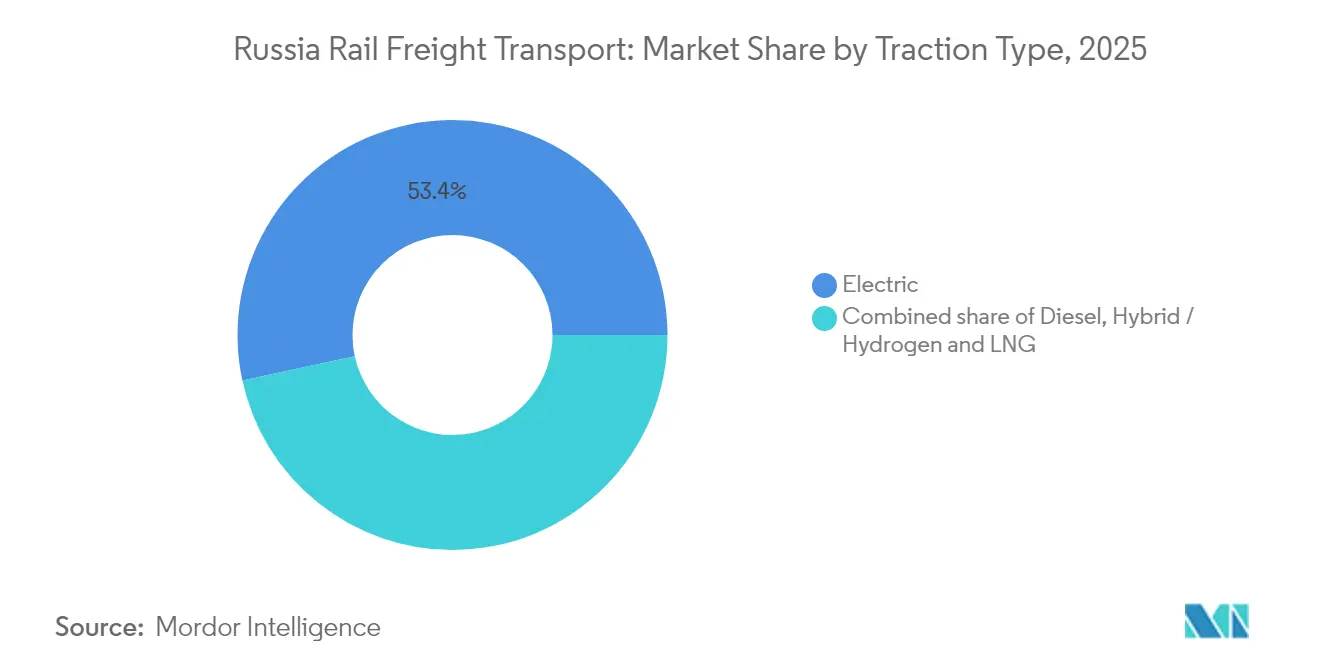
- By traction type, Electric locomotives commanded 53.40 % of the Russia Rail Freight Transport market share in 2025, and the Russia Rail Freight Transport market size derived from Hybrid/Hydrogen & LNG traction is anticipated to increase at a 9.86 % CAGR over the same period.
- By destination, Domestic movements dominated with a 89.25 % Russia Rail Freight Transport market share in 2025, while the Russia Rail Freight Transport market size for International/Cross-border flows is set to grow at a 6.82 % CAGR from 2026-2031.
Note: Market size and forecast figures in this report are generated using Mordor Intelligence’s proprietary estimation framework, updated with the latest available data and insights as of 2026.
Russia Rail Freight Transport Market Trends and Insights
Drivers Impact Analysis*
| Drivers | (~) % Impact on Market CAGR Forecast | Geographic Relevance | Timeline |
|---|---|---|---|
| Surge in Asia–Europe Transit Volumes via Russia | +0.80% | Trans-Siberian, Far East | Medium term (3-4 yrs) |
| Government Subsidies for Far-East Export Corridor | +0.70% | Eastern Siberia, Far East | Medium term (3-4 yrs) |
| Expansion of Northern Sea-Route Intermodal Hubs | +0.40% | Arctic Regions | Long term (≥ 5 yrs) |
| Digital Scheduling Platform Adoption | +0.30% | Nationwide | Short term (≤ 2 yrs) |
| Green transit shift from road to rail for bulk commodities | +0.20% | Nationwide mining belts | Long term (≥ 5 yrs) |
| Accelerated rolling-stock fleet modernisation programs | +0.30% | Depot clusters in Central & Far-East Russia | Medium term (3-4 yrs) |
| Source: Mordor Intelligence | |||
Surge in Asia–Europe Transit Volumes via Russia
Rail traffic between Russia and China rose by 20 % in 2024, a jump attributed to shippers diverting cargo from disrupted maritime lanes. Transit times of 14-25 days on rail now compare favorably with longer ocean voyages, prompting freight forwarders to lock in multi-year block-train contracts. This demand spike spurs operators to lengthen trains and reserve wagon fleets, effectively deepening the rail corridor’s competitiveness even without large tariff reductions. Capacity pressures, however, highlight the need for additional passing tracks and digital slot allocation, a change that may funnel more investment into network optimization rather than pure track mileage.
Government Subsidies for Far-East Export Corridor
Moscow committed 366 billion rubles (USD 4.07 billion) for Trans-Siberian and Baikal-Amur upgrades in 2024 and plans further injections through 2032. Subsidized tariffs on east-bound export flows lower logistics costs for miners and grain traders, encouraging heavier train loads toward Pacific ports. Early evidence shows shorter queuing times at key yards, signaling that funds are easing operational choke points even before full project completion. A knock-on effect is that private wagon owners reposition assets eastward, subtly redistributing railcar availability across the wider network.
Expansion of Northern Sea-Route-linked Intermodal Hubs
Rail-to-sea interchanges in Arctic ports are under construction to connect the mainland grid with the Northern Sea Route, where ice-breakers extend the sailing season. Planned hubs aim to trim 30 %-50 % off Asia-to-Europe transit times once operational, giving exporters an incentive to bypass the Suez Canal. Even in pilot phase the scheme is steering container operators to test mixed rail-icebreaker service patterns that did not exist five years ago. The resulting freight data will likely influence future capacity planning decisions on both rail sidings and Arctic terminals.
Digital Scheduling Platform (RZD Digital Freight) Adoption
RZD’s Digital Freight platform brings real-time car tracking, automated slot booking, and dynamic pricing onto a single interface [1]. Early adopters report fewer empty-run kilometers, implying that asset turns, not sheer wagon counts, could become the primary utilisation metric. The state budget lines up 500 million rubles (USD 5.6 million) for wider rollout in 2025 tadviser.ru, underscoring official belief that software can unlock latent capacity faster than building new track. As more shippers migrate to electronic documents, customs clearance times are falling, reinforcing the competitive edge of digital-ready operators.
Restraints Impact Analysis*
| Restraint | (~) % Impact on Market CAGR Forecast | Geographic Relevance | Timeline |
|---|---|---|---|
| Western Sanctions Restricting Access to Advanced Locomotives | -0.60% | Network-wide, especially export routes | Medium term (3-4 yrs) |
| Congestion at China–Mongolia Border Crossings | -0.40% | Zabaikalsk–Manzhouli & related border posts | Short term (≤ 2 yrs) |
| Limited last-mile rail connectivity to Arctic ports | -0.30% | Northern Russia; Arctic hinterland | Long term (≥ 5 yrs) |
| Rising track-access tariffs for private operators | -0.30% | Nationwide, with sharper effect on secondary lines | Short term (≤ 2 yrs) |
| Source: Mordor Intelligence | |||
Western Sanctions Restricting Access to Advanced Locomotives
Sanctions cut off critical spare parts, leaving almost 50 000 trains delayed or suspended during 2024. The locomotive shortfall explains up to 93 % of the year’s loading decline, dwarfing other operational factors. In response, domestic manufacturers fast-track natural-gas locomotive lines, although ramp-up speed lags near-term demand curves. Until the new builds arrive, network planners must juggle tight power-unit allocations, often prioritizing higher-yield container flows over lower-margin bulk.
Congestion at China–Mongolia Border Crossings
Despite a 26 % traffic rise, the Zabaikalsk-Manzhouli checkpoint suffers recurrent queues tied to gauge changes and security checks. Automated inspection tools have cut document processing to five minutes in trial runs, yet physical siding limits still slow wagon turnover. Train planners increasingly schedule departures during off-peak cross-border windows, a workaround that improves punctuality but complicates domestic timetables. Investments in dual-gauge yards could smooth flow, though funding battles remain unresolved.
*Our forecasts treat driver/restraint impacts as directional, not additive. The impact forecasts reflect baseline growth, mix effects, and variable interactions.
Segment Analysis
Service Type: Transportation Dominates While Allied Services Gain Ground
Transportation services account for 87.35 % Russia Rail Freight Transport market share in 2025, reflecting the network’s core role in moving bulk and containerized goods over vast distances. Within this dominant slice, long-haul coal flows remain the single biggest revenue generator, but intermodal trainsets are gaining frequency on high-yield East-West corridors. Operators note that the new capacity funded for the eastern corridor is already pre-booked by coal, grain, and container customers, suggesting stable utilisation rates for the next investment cycle. An important nuance is that transport providers increasingly bundle guaranteed wagon availability with digital tracking, making service quality, not only price, the selling point.
Demand for wagon maintenance, storage, and switching rises as shippers diversify cargo types and routes, triggering a need for specialised yards and repair depots. RZD’s digital document workflow simplifies handoffs, which in turn raises customer expectations around 24/7 visibility and doorstep logistics. Consequently, allied-service providers invest in data analytics and cold-chain facilities, nudging the rail ecosystem toward full-stack logistics solutions.

Cargo Type: Bulk Commodities Reign While Containerization Accelerates
Dry bulk holds 57.10 % Russia Rail Freight Transport market share in 2025, underpinned by coal, ores, and grain exports that routinely travel 1,500 kilometers or more. The current wave of Asian demand encourages miners to sign multi-year contracts that stabilise wagon demand, reducing spot-rate volatility. Operators respond by deploying heavier axle-load wagons, extracting more ton-kilometers per locomotive under tight power-unit supply. Roughly half of new siding upgrades on the Baikal-Amur line now include bulk-friendly wagon tipplers, a subtle design choice that locks in future volume scalability.
Containerised and intermodal cargo grows fastest at an 7.88 % forecast CAGR, supported by new logistics hubs such as FESCO’s planned facility in Zabaikalsk valued at EUR 40 million (USD 44 million). Increasing e-commerce flows and just-in-time manufacturing imports from China accelerate the shift toward higher-value box traffic. Railcar pools are gradually adding 40-foot high-cube containers fitted for temperature-controlled goods, widening the appeal of rail for perishables. This segment’s expansion creates a buffer against commodity price swings, a diversification that benefits network cash-flow stability.
End-user Industry: Mining Leads While Retail Shows Strongest Growth
Mining and minerals command 35.45 % Russia Rail Freight Transport market share in 2025, mirroring the country’s resource-oriented economy. Haul lengths for ferrous metals exceed 1,900 kilometers, a distance that cements rail as the only economical mode for inland mine-to-port delivery. Producers that pivot cargo to Far-East ports now lock in slots two seasons ahead, indicating confidence in rail corridor reliability despite locomotive shortages. Network planners thus prioritise track-duplication projects near mining clusters to hedge against cyclical surges.
Retail and fast-moving consumer goods record the highest growth, forecast at 9.18 % CAGR through 2031. Online shopping boom and rising disposable income in secondary Russian cities generate new east-to-west backhaul opportunities for containers otherwise returning empty. Rail operators partner with fulfilment centres to create scheduled “e-commerce trains,” an initiative that improves wagon round-trip economics. The trend implies that consumer-driven traffic could one day offset part of the coal volume decline expected under decarbonisation scenarios.
Traction Type: Electric Dominance with Hydrogen Emerging as Game-Changer
Electric traction holds 53.40 % Russia Rail Freight Transport market size, due to a nationwide electrification share above 85 %. Electric locomotives anchor reliable, high-tonnage services, giving rail a cost and emissions edge on long hauls. Recent sub-station upgrades raise catenary capacity, enabling heavier trains without new rolling stock, a cost-effective productivity lever amid import restrictions. Operators also test energy-regeneration schemes where downhill braking feeds power back to the grid, an innovation that could shave operating costs further.
Hybrid, hydrogen, and LNG locomotives grow at 9.86 % forecast CAGR, albeit from a low base, stimulated by plans to convert 25 % of the fleet to natural gas by 2030. Pilot LNG routes already demonstrate 15-25 % fuel savings, a margin attractive to private wagon owners under tight rate environments. Hydrogen prototypes promise zero carbon tailpipe emissions, but comparable NOx levels to diesel keep regulators cautious. Nonetheless, the experimental units accumulate valuable performance data that will guide future fleet renewal cycles.
Destination: Domestic Market Prevails While Cross-border Shows Higher Growth
Domestic moves account for 89.25 % Russia Rail Freight Transport market share in 2025, a figure reflecting the country’s sheer landmass and inland resource deposits. Ongoing upgrades shorten average transit times between Western Siberia and Pacific ports, a reduction that helps domestic shippers compete in Asian coal tenders. As digital platforms standardise documentation, small and mid-sized Russian firms find domestic rail more accessible, broadening the user base beyond large conglomerates. This wider adoption helps smooth volume seasonality, particularly during agricultural peak seasons.
Cross-border freight of the Russian Rail Freight Transport industry is set to grow at 6.82 % CAGR to 2031. New Sino-Russian cooperation agreements streamline customs, while investments in the North-South Transport Corridor open access to Iran and India. Train services increasingly use unified tracking numbers valid across three countries, reducing administrative friction and boosting schedule reliability. Greater certainty, in turn, invites third-country forwarders to channel Europe-bound cargo through Russian land routes, diversifying customer portfolios for domestic operators.
Regulatory Landscape
Russia rail freight remains anchored by Russian Railways (RZD) as the infrastructure owner and access-setter, with policy actions increasingly shaping routing, asset control, and pricing. On 1 July 2026, Russia closed seven rail border crossings with Estonia, Latvia, and Finland, which pushed some flows to reroute via alternative corridors and Russian seaports. The change highlights how cross-border permissions can quickly shift network utilization.
In parallel, the legal framework around sector assets tightened. On 26 May 2026, President Vladimir Putin signed a law clarifying procedures for the turnover and state registration of railway transport assets after privatization, affecting how ownership and separation of property are documented. Funding and state oversight also intersect with market structure, since RZD has evaluated selling a 49% stake in Federal Freight Company (FFC). Any transaction would require approval by the Russian Federal Property Management Agency and the Russian government, with proceeds linked to financing RZD investment plans.
Value Chain Analysis
The value chain begins with cargo owners such as mining and minerals, oil and chemicals, agriculture, manufacturing, and retail. They contract freight capacity through RZD-affiliated and private operators that provide wagons, traction, dispatching, and allied services such as maintenance, switching, and storage. RZD controls the backbone infrastructure and dispatch, while fleet-heavy operators like Federal Freight Company (FFC) and other private wagon owners supply rolling stock and operational coverage across regions. FFC alone operates about 134,300 pieces of rolling stock through a multi-branch structure.
On the intermodal layer, terminal and equipment capacity links rail line-haul with shipper distribution, and operators have been expanding handling capacity to capture container growth. Container shipments on the RZD network increased 1.9% in January to May 2026 to 3.25 million TEU, reinforcing the role of terminals and inland hubs in throughput. TransContainer, part of Delo Group, reflects this layer through investments such as the completion of a 45-ton gantry crane installation at the Pridacha terminal in Voronezh (May 2026), aimed at improving container handling performance and supporting higher-frequency scheduled services.
Competitive Landscape
Russian Railways (RZD) owns the track infrastructure and sets access terms, giving it pivotal influence over the Russia Rail Freight Transport industry structure. Private operators such as Freight One, TransContainer, Globaltrans, and Federal Freight Company focus on wagon fleets and niche services, collectively controlling 88 % of market railcars [2]. Competitive advantage increasingly hinges on the ability to bundle rolling stock with digital scheduling, creating a service moat that is not easily replicated by late adopters.
Strategic alliances are reshaping value chains, illustrated by SIBUR and SG-trans forming a joint venture for LPG transport worth 9.4 billion rubles (USD 104.4 million) [3]. Such vertical moves lock in captive cargo flows, reducing exposure to spot-market volatility and guaranteeing asset utilisation. Similar partnerships appear in refrigerated container pools targeting agricultural exports, indicating that product-specific rail solutions are gaining traction. These vertical plays subtly fragment market share, as integrated logistics groups capture portions previously serviced by general-purpose wagon operators.
Technology acts as a new battleground, with RZD rolling out artificial neural-network mass-measuring systems that remove the need for precise wheel positioning. Early adopters gain faster weighbridge throughput, reinforcing punctuality commitments to shippers. Meanwhile, smaller operators test blockchain-based asset-sharing platforms to maximise idle wagon days. As technology lowers entry barriers for service innovation, competitive dynamics may tilt toward agile firms that marry specialized hardware with flexible software, rather than scale alone.
Russia Rail Freight Transport Industry Leaders
-
Russian Railways (RZD)
-
TransContainer
-
Freight One (PGK)
-
Globaltrans Investment PLC
-
Federal Freight Company (FFC)
- *Disclaimer: Major Players sorted in no particular order
Market Opportunities and Future Outlook
A near-term opportunity is emerging in corridor-specific pricing and service design as RZD adjusts tariff levers to stimulate targeted commodity and export flows. Recent discounts provide concrete whitespace for shippers and operators to re-optimize routing and packaging: RZD introduced a 34.7% tariff discount for transporting metal pipes from Buzhaninovo and a 15.6% reduction for steel sheet moves to the same station. Chemical exports also receive support through a 10.6% export tariff reduction for urea from Sala to Luzhskaya station (Leningrad region), linked to shipments to Ust-Luga. Separately, a 17.4% discount for natural gasoline tank-wagon movements from Tatarstan to Leningrad and Murmansk is active through 2028, creating room for longer-horizon contracts and dedicated train products around those lanes.
Intermodal scaling across the Trans-Siberian spine also supports higher-value cargo conversion into rail, particularly where terminal productivity rises faster than mainline capacity. In March 2026, key terminals reported sharp container-handling growth (Kleschikha in Novosibirsk +33%, Batareinaya in Irkutsk +44%, and Bazaikha in Krasnoyarsk +24%), pointing to where additional scheduled services, warehousing, and value-added handling can be layered. The container mix is broadening as well, with January to May 2026 container shipments rising for chemicals and soda (+6%), ferrous metals (+4.5%), grain (+33.8%), and oil/petroleum products (+14.4%). This points to opportunities for specialized equipment pools, including temperature-controlled boxes, and more integrated door-to-door offerings that reduce empty repositioning and improve asset turns.
Recent Industry Developments
- July 2026: Export cargo to sea ports reached 161 million tons in H1 2026, up 4% year-on-year. The export volume signals a shift toward export-oriented routes and stronger linkages to maritime gateways, supporting higher throughput on eastern corridors.
- July 2026: Grain loading in June 2026 rose 1.4x to 1.8 million tons, with 120 thousand tons moved in containers. Grain supply chains are using rail for both bulk and containerized transport, which can change the revenue mix and the KPIs operators prioritize.
- July 2026: Russian Railways (RZD) reported June 2026 freight loading volume of 90.2 million tons, a 1 percent increase year-on-year. Freight turnover in June rose 4.5 percent to 209.9 billion tariff ton-km, reflecting steady throughput growth and favorable tariff absorption.
Research Methodology Framework and Report Scope
Market Definition and Coverage
This market covers the value earned from moving goods by rail within Russia, including the rail haul service and related freight service charges billed to the shipper. It is measured in USD and reflects commercial rail freight activity across major domestic corridors and border-linked flows.
Scope exclusions: Passenger rail services, informal transport activity, and non-rail modes (such as road, sea, and air) are excluded from this market sizing.
Segmentation Overview
- By Service Type
- Transportation
- Services Allied to Transportation (Maintenance, Switching, Storage)
- By Cargo Type
- Containerised / Intermodal
- Dry Bulk (Coal, Ores, Grains)
- Liquid Bulk (Crude, Chemicals)
- Break-bulk & Project Cargo
- By End-user Industry
- Mining & Minerals
- Oil, Gas & Chemicals
- Agriculture & Food
- Manufacturing & Automotive
- Retail & FMCG
- Construction Materials & Others
- By Traction Type
- Diesel
- Electric
- Hybrid / Hydrogen & LNG
- By Destination
- Domestic
- International / Cross-border
Data Sources, Market Sizing, and Validation
Desk Research
Desk research was used to set the factual base for volumes, cargo mix, and network constraints that shape rail freight demand in Russia. We relied on public statistics and operator disclosures to understand how freight tonnage and ton-km move by commodity groups, and how those patterns shift with export routes and industrial output.
Commonly referenced sources included official publications such as Russian Federal State Statistics Service (Rosstat), the Ministry of Transport of the Russian Federation, operator and infrastructure owner annual reports, and international trade statistics from bodies such as UN Comtrade. We also used supporting materials like customs and port corridor updates, investor presentations, and reputable news and financials sources to time-check major disruptions. Where it improved consistency, paid subscriptions were used for company financials and intelligence, shipment-level import and export context, and patent databases for rail technology themes. These examples are illustrative only, and many other sources were reviewed for data collection, validation, and clarification.
Primary Interviews and Surveys
Interviews and surveys with freight shippers, rail operators, wagon owners, forwarders, terminal managers, and logistics buyers in Russia clarify tariff movement, cargo mix, empty-car effects, service fees, and gaps in reported traffic. Analysts use these responses to test secondary inputs and adjust the final estimate where reported operating conditions differ from the public series.
Distribution of primary research fieldwork respondents
| Company type | Respondent position |
|---|---|
| Top tier: 28% | CXOs: 15% |
| Mid tier: 47% | Functional/Unit leaders: 33% |
| Smaller Players: 25% | Managers: 52% |
Market-Sizing & Forecasting
Sizing started from a top-down build where freight demand was reconstructed using Russia-specific rail activity signals, then translated into revenue using service-level price logic. In practice, the demand pool was anchored on rail freight volumes and cargo turnover patterns, and then adjusted for shifts in export destinations, corridor congestion, and the mix of bulk versus higher yield cargo.
To keep the model realistic, a few key inputs carried most of the weight, such as total rail freight tonnage, ton-km intensity by route, commodity mix (coal, metals, oil products, grain, and containers where relevant), average tariff and surcharge progression, and observable capacity constraints on key lines. Bottom-up approximations were used selectively, such as checking sampled operator revenue disclosures, shipper and forwarder rate discussions, and implied revenue per ton for major cargo groups. This helped close gaps where published data was not detailed.
For forecasting, scenario analysis was applied and guided by expected industrial output, trade rerouting intensity, and infrastructure capacity additions, then smoothed through the period so short-term shocks did not overdrive the long-range view. Where data gaps existed for smaller cargo pockets or private arrangements, conservative assumptions were used and then rechecked in primary calls so the final totals stayed internally consistent.
Data Validation & Update Cycle
Model outputs were cross-checked against independent signals, such as reported network loading trends, corridor utilization updates, and shipper commentary on rate moves. When numbers drifted too far from these reference indicators, the driver assumptions were revisited, and the team re-contacted interviewees to confirm whether a change was structural or temporary.
Before sign-off, variance checks were run at multiple levels so totals aligned with expected behavior across volumes, pricing, and cargo mix. The logic was also reviewed by more than one analyst to reduce avoidable errors. Reports are refreshed annually, with interim updates triggered by material events that can change freight flows, tariffs, or capacity availability. Right before delivery, a fresh pass is completed so clients receive the most up-to-date view supported by the same repeatable steps.
Mordor Intelligence's Russian Rail Freight Transport Market Size Versus Other Published Estimates
Published market sizes for Russia rail freight often do not line up because groups use different revenue boundaries, different base years, and different methods to translate tons moved into USD values. The spread becomes larger when some studies mix in wider logistics services, or when currency conversion timing is not handled consistently.
The table shows a wide range that is largely explained by what is counted as rail freight revenue and how pricing is updated through the base year. In Mordor Intelligence's model, the total is tied to rail freight transport service revenues in Russia, and it is kept separate from broader freight forwarding and multi-modal logistics fees. Rate progression and corridor constraints are validated through operator and shipper checks.
Benchmark comparison
| Source | Market Size | Gaps in Research Methodology |
|---|---|---|
| Mordor Intelligence | USD 16.06 B (2025) | |
| Global Consultancy A | USD 71.00 B (2024) | Uses a wider logistics revenue scope that blends rail with forwarding and value added services, and applies blended FX and inflation assumptions that raise the USD total. |
| Sector Analyst B | USD 16.00 B (2025) | Similar headline level, but differences come from cargo coverage choices and how private or in-plant rail movements are treated, which shifts volume to revenue conversion. |
Taken together, the comparison suggests the largest gaps are not about rail activity itself, but about where the rail-only revenue line is drawn and how price updates are carried into the base year. By keeping the steps traceable to volumes, mix, and tariffs, the estimate remains easier to replicate and to reconcile with real-world operating signals.
Key Questions Answered in the Report
What is the current Russia Rail Freight Transport market size?
The market is valued at USD 16.43 billion in 2026.
How fast is the Russia Rail Freight Transport industry expected to grow?
It is forecast to expand at a CAGR of 2.32 % between 2026 and 2031.
Which cargo type dominates the Russia Rail Freight Transport market share?
Dry bulk commodities, led by coal, ores, and grains, account for 57.10% of total volumes.
Why are eastern corridors a focus for investment?
They connect Russian exporters to rising Asian demand and relieve pressure from western sanction-affected routes.
How important is digitalisation to future rail competitiveness in Russia?
Digital scheduling and tracking platforms reduce empty runs and speed customs clearance, making them central to capacity and service quality gains.
What environmental advantage does Russian rail offer over road transport?
With 53.40 % electric traction, rail emits significantly fewer greenhouse gases on long hauls than diesel trucking, aligning with carbon-reduction goals.