
Market Overview
| Study Period | 2020 - 2031 |
|---|---|
| Forecast Data Period | 2026 - 2031 |
| Base Year Market Size (2025) | USD 7.15 Billion |
| Market Size (2026) | USD 7.75 Billion |
| Market Size (2031) | USD 11.56 Billion |
| Growth Rate (2026 - 2031) | 8.34 % |
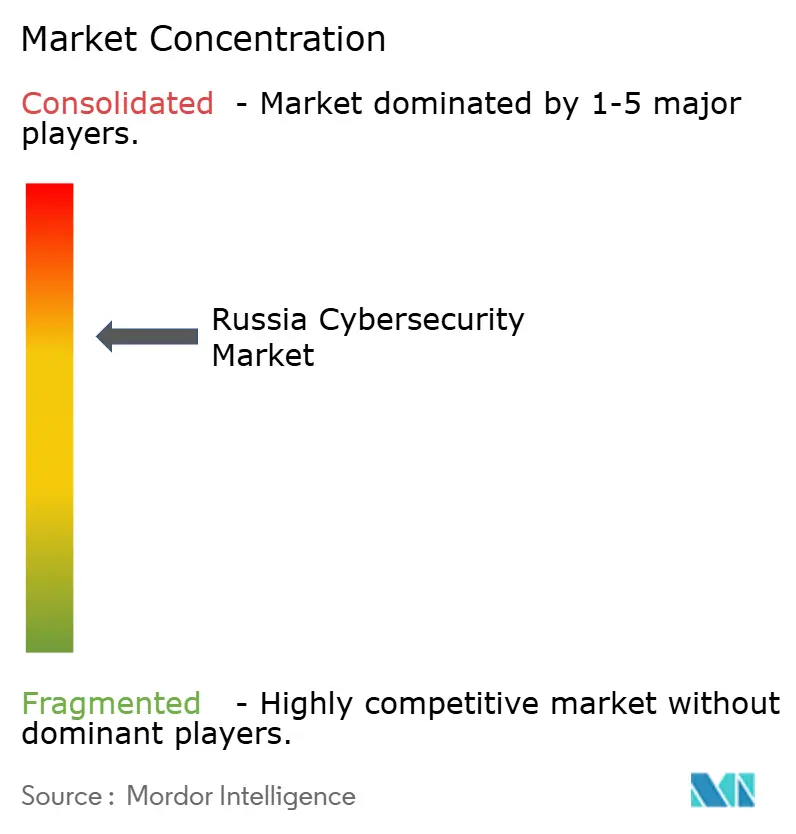
| Market Concentration | Medium |
Major Players *Disclaimer: Major Players sorted in no particular order Image © Mordor Intelligence. Reuse requires attribution under CC BY 4.0. | |
Russia Cybersecurity Market Analysis by Mordor Intelligence
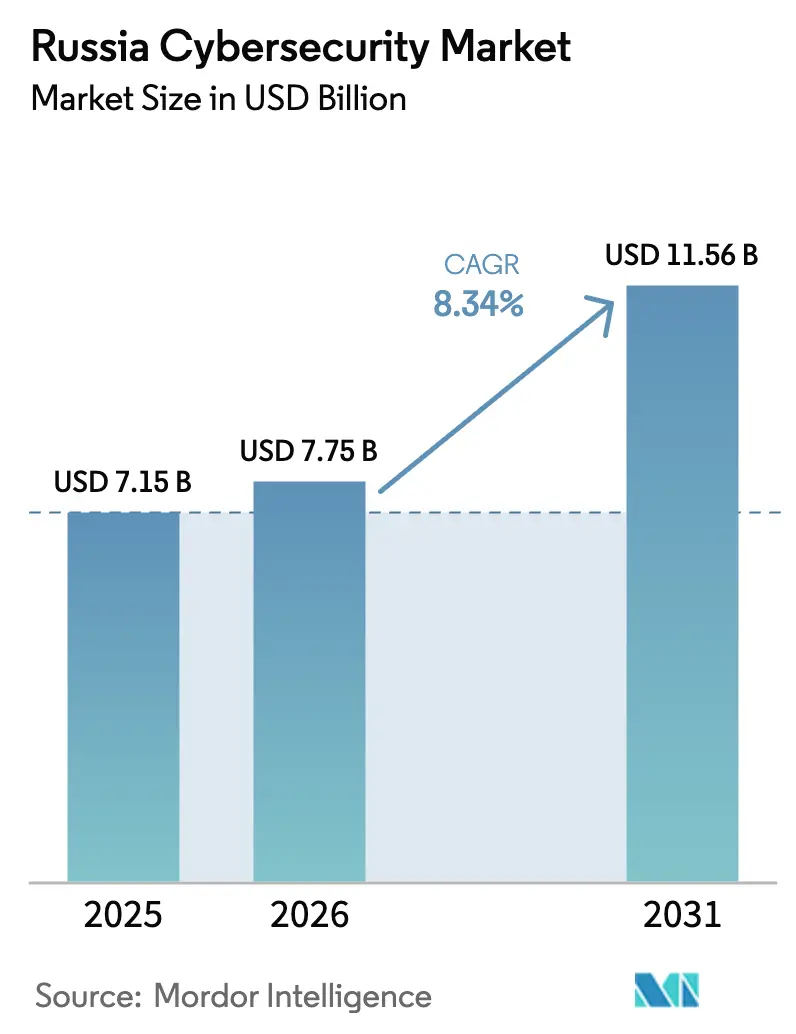
The Russia cybersecurity market size was valued at USD 7.15 billion in 2025 and estimated to grow from USD 7.75 billion in 2026 to reach USD 11.56 billion by 2031, at a CAGR of 8.34% during the forecast period (2026-2031). Market expansion is propelled by the state’s digital-sovereignty agenda, which mandates certified Russian solutions across critical information infrastructure and drives steady budget allocations even in a constrained macroeconomic climate. Rising ransomware losses, stricter data-localisation rules, and compulsory annual security audits are prompting enterprises—especially in banking, energy, and healthcare—to prioritise cyber outlays over other IT spending. Domestic cloud-and-data-centre build-outs by players such as Rostelecom create fresh demand for zero-trust architectures, while import-substitution policies lift revenue visibility for Russian vendors that can replace sanctioned hardware.
Key Report Takeaways
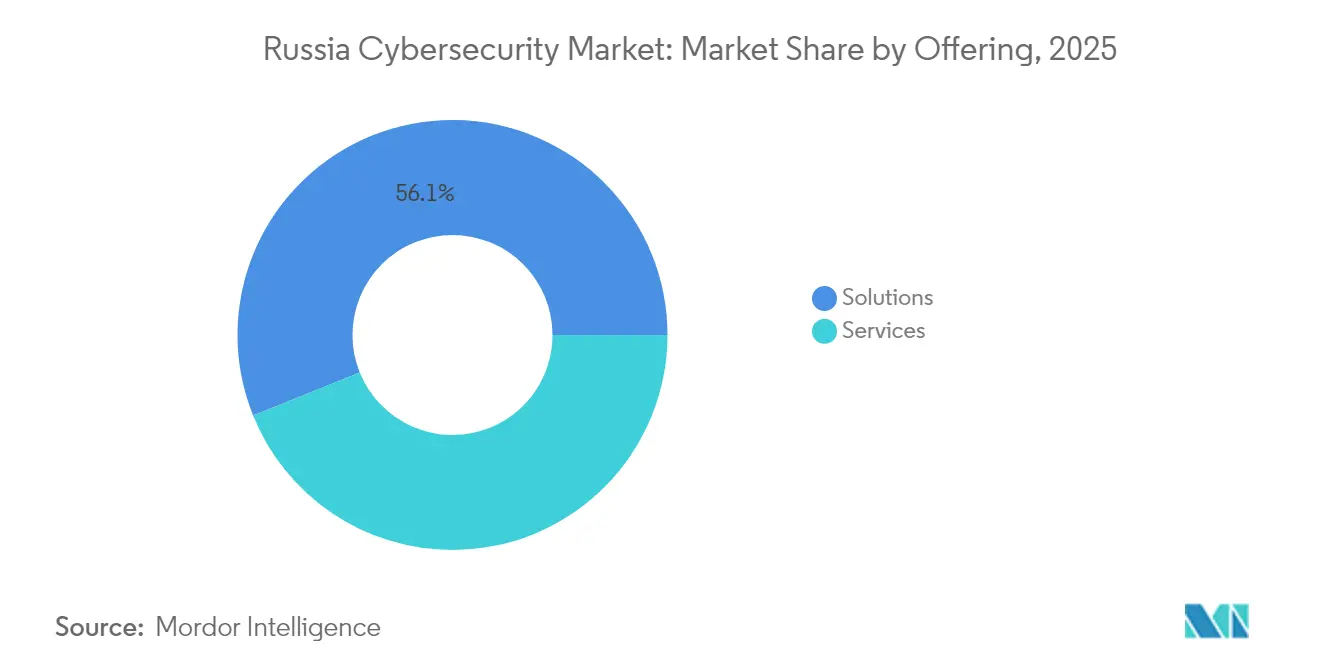
- By offering, solutions held 56.10% Russia cybersecurity market share in 2025; services post the fastest 2026-2031 CAGR at 9.75%.
- By deployment mode, on-premise accounted for 61.55% revenue share of the Russia cybersecurity market in 2025 and cloud deployment is forecast to grow at an 11.25% CAGR through 2031.
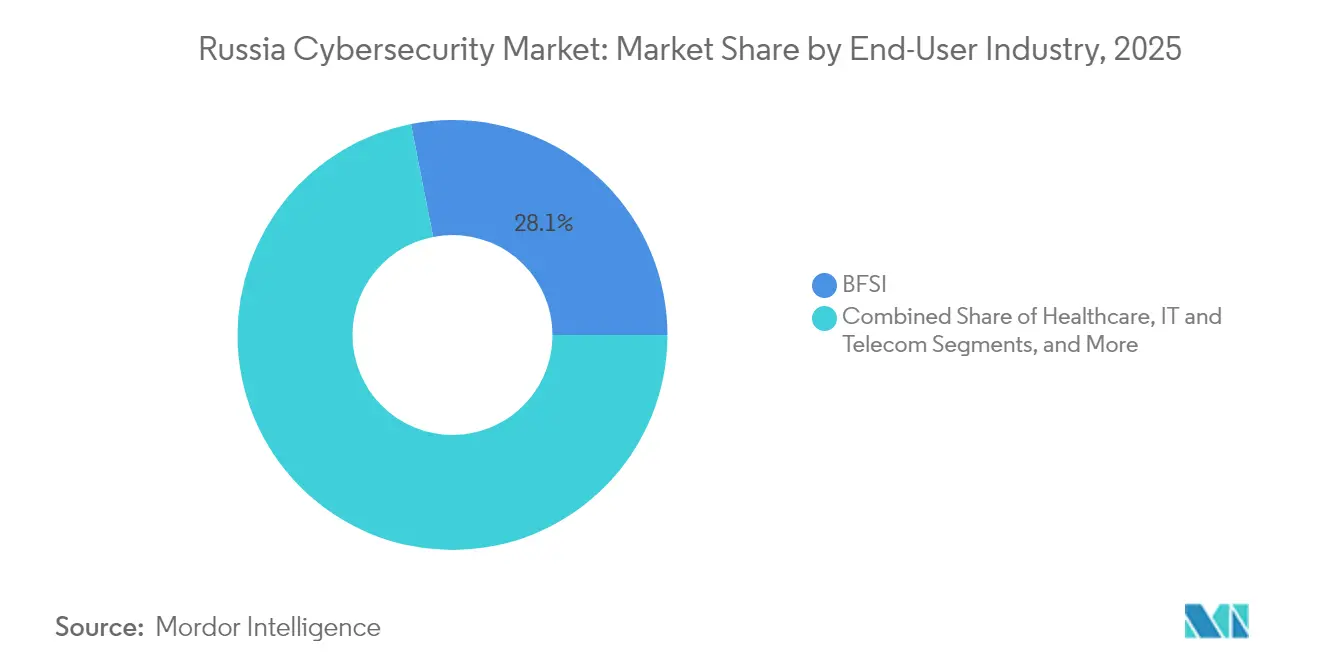
- By end-user industry, BFSI led with 28.10% share in 2025, while healthcare is projected to expand at a 12.05% CAGR to 2031.
- By end-user enterprise size, large enterprises controlled 66.60% of the Russia cybersecurity market in 2025; SMEs record the highest 10.35% CAGR over 2026-2031.
Note: Market size and forecast figures in this report are generated using Mordor Intelligence’s proprietary estimation framework, updated with the latest available data and insights as of 2026.
Russia Cybersecurity Market Trends and Insights
Drivers Impact Analysis*
| Driver | (~) % Impact on CAGR Forecast | Geographic Relevance | Impact Timeline |
|---|---|---|---|
| Digital Sovereignty Push and Import Substitution Mandates in Russian IT Security Ecosystem | +2.1% | National | Medium term (2-4 years) |
| Surge in State-Led Critical Infrastructure Protection Programs Post-Ukraine Conflict | +1.8% | Moscow and St Petersburg first | Short term (≤2 years) |
| Rapid Expansion of Domestic Cloud and Data Center Footprint Driving Zero-Trust Adoption | +1.5% | Major urban hubs | Medium term (2-4 years) |
| Proliferation of Industrial IoT in Oil and Gas and Utilities Requiring OT Security Controls | +1.2% | Resource-rich regions | Medium term (2-4 years) |
| Escalating Ransomware-as-a-Service Attacks Targeting Russian SMEs | +0.9% | Nationwide | Short term (≤2 years) |
| Mandatory data-localisation laws raising on-prem demand | +0.7% | Nationwide | Short term (≤2 years) |
| Source: Mordor Intelligence | |||
Digital Sovereignty Push and Import Substitution Mandates in Russian IT Security Ecosystem
Russia cybersecurity market participants are experiencing a structurally protected environment after the December 2024 import-substitution decree that blocks many foreign products. Decree 1875 bars many foreign IT goods from public procurement and enforces a “second-one-out” rule that privileges bids listing Russian origin. As a result, local vendors such as Kaspersky and Positive Technologies report pipeline growth that outstrips hiring capacity, while ministries require certified domestic crypto algorithms in every new deployment.
Surge in State-Led Critical Infrastructure Protection Programs Post-Ukraine Conflict
Regulatory updates issued by the Federal Security Service (FSB) have turned critical-infrastructure protection from an IT responsibility into a board-level compliance mandate. FSB Order 239 and the Ministry of Transport’s 2024 methodology oblige utilities, airports and railways to feed telemetry into a unified state platform. Incident data show average downtime per attack falling from 65 hours in 2018 to 1 hour in 2024, proving regulatory pressure accelerates defence maturity [1].
Rapid Expansion of Domestic Cloud and Data Center Footprint Driving Zero-Trust Adoption
Rostelecom’s July 2024 Moscow facility and BitRiver’s 100 MW Far-East campus expand national compute by more than 20 %, prompting enterprises to shift workloads off-premise. Each migration drives uptake of micro-segmentation and zero-trust controls certified under Russian standards. With each capacity increment, enterprises move non-critical workloads off-premise and then confront compliance clauses that require zero-trust segmentation. Early adopters such as Bank Primorye show that cloud-based web-application firewalls can neutralise millions of events per quarter without adding staff, which implies operating-cost efficiencies that incentivise further migration.
Proliferation of Industrial IoT in Oil and Gas and Utilities Requiring OT Security Controls
Kaspersky ICS-CERT uncovered CVE-2023-47610 in Cinterion modems, highlighting systemic OT exposure. Energy firms responded by fast-tracking protocol-aware intrusion-prevention systems, and plant audits report measurable reductions in unplanned downtime [2]. Following the advisory, several state-owned energy utilities accelerated procurement of protocol-aware intrusion-prevention systems, illustrating that headline vulnerabilities can move budgets at short notice.
Restraints Impact Analysis*
| Restraint | (~) % Impact on CAGR Forecast | Geographic Relevance | Impact Timeline |
|---|---|---|---|
| Talent Drain Due to Emigration and Military Mobilization Impacting Cyber Workforce | -1.7% | Tech hubs | Long term (≥5 years) |
| US/EU Export Controls Limiting Access to Advanced Security Hardware and Updates | -1.5% | National | Medium term (2-4 years) |
| Budget Compression in Non-Resource Sectors Amid Macroeconomic Sanctions | -1.0% | Sector-specific | Short term (≤2 years) |
| Fragmented Federal Procurement Processes Delaying Security Modernization | -0.6% | Government verticals | Medium term (2-4 years) |
| Source: Mordor Intelligence | |||
Talent Drain Due to Emigration and Military Mobilization Impacting Cyber Workforce
Positive Technologies finds vacancy growth in information security outrunning graduate supply three-to-one, sending average security-analyst pay 25 % above national IT wages. Organisations compensate by automating tier-1 triage through ML-powered XDR platforms.
US/EU Export Controls Limiting Access to Advanced Security Hardware and Updates
September 2024 US Commerce rules pull selected enterprise software and firmware into licence regimes, freezing updates on Western appliances already installed in Russian networks. Operators resort to grey imports, which escalate maintenance costs and spur domestic ASIC design.
*Our forecasts treat driver/restraint impacts as directional, not additive. The impact forecasts reflect baseline growth, mix effects, and variable interactions.
Segment Analysis
By Offering: Solutions Hold Leadership While Services Accelerate
Solutions generated 56.10% of Russia cybersecurity market share in 2025, underscoring the historic preference for capital purchases and in-house operation. Revenue remains anchored in network firewalls, endpoint protection and Secure Web Gateways that satisfy FSB certification protocols. Yet the addressable pool is gradually tilting toward services as enterprises struggle to staff 24/7 security centres. Managed detection and response packages priced on a per-node basis allow even mid-sized banks to activate threat hunting without hiring, a shift that lifts the services CAGR to 9.75% through 2031.
Rising adoption of service-bundled XDR platforms indicates that organisations value outcome-based billing more than feature counts. Vendors now bundle compliance audits, incident retainer hours and threat-intel feeds, positioning services as an operating-expense hedge against volatile hardware supply. As a result, annual recurring revenue grows faster than licence sales, and the Russia cybersecurity market size attached to services could exceed USD 5.4 billion by 2031 if current renewals hold.

By Deployment Mode: Cloud Momentum Outpaces On-Prem Dominance
On-premise deployment already captured 61.55% of the Russia cybersecurity market share in 2025, a pattern reinforced by strict data-sovereignty laws that keep sensitive workloads behind agency firewalls. Compliance requirements under FSB Order 239 mean that operators labelled as critical information infrastructure must store audit logs locally for multiple years, entrenching on-site storage demand. Domestic hyperscalers deliver isolated government regions that comply with data-localisation law, giving risk-averse ministries a migration path. This trust foundation drives an 11.25% CAGR for cloud-deployed controls, whereas on-prem investments plateau as amortised appliances reach end-of-life without Western firmware updates.
Hybrid blueprints that keep keys on premises but run analytics in sovereign clouds dominate new RFPs. Such patterns shorten patch cycles and reduce capex, proving attractive amid tight credit conditions. Consequently, Russia cybersecurity market references increasingly cite micro-segmentation and cloud Workload Protection Platforms as mandatory checklist items rather than advanced options.
By End-User Industry: BFSI Leads, Healthcare Races Ahead
The banking, financial services and insurance community accounted for 28.10% of Russia cybersecurity market revenue in 2025. Mandatory penetration tests under Central Bank Directive 683-P and the rollout of the digital ruble spur continuous refresh of fraud-analytics modules and behavioural biometrics . Despite that heft, the healthcare vertical is set to record the fastest 12.05% CAGR to 2031, propelled by electronic medical-record rollouts and telemedicine expansion into remote oblasts.
Hospitals now rank as critical information-infrastructure operators, subjecting them to FSB Order 239 log-retention and incident reporting rules. Procurement data show a pivot toward agentless network access-control and medical-device micro-segmentation. Vendors that embed HL7 protocol awareness secure strategic footholds, hinting that healthcare could overtake energy as the second-largest slice of the Russia cybersecurity market before 2031.
By End-user Enterprise Size: Large Enterprises Dominate While SMEs Pick Up Pace
Large organisations commanded 66.60% of 2025 spending, reflecting the deep pockets of oil majors, telcos and state banks. Framework contracts worth USD 50-100 million lock in multi-year refreshes of SIEM, vulnerability scanning and privileged-access management suites. These deals underscore the market’s dependence on a few hundred top-tier buyers.
SMEs, though smaller today, deliver a 10.35% CAGR through 2031 as ransomware insurance clauses demand basic controls. Government grants that subsidise up to 80 % of software-acquisition costs for small exporters further democratise protection. As subscription models proliferate, the Russia cybersecurity industry gains a long-tail revenue stream that cushions cyclical swings in mega-projects.
Geography Analysis
Moscow and the broader Central Federal District represent the single largest node of Russia cybersecurity market activity. Headquarters of banks, federal ministries and domestic hyperscalers concentrate procurement here, and pilot compliance frameworks often debut in the capital before national rollout. Contract data reveal that more than 45 % of new SOC build-outs in 2024 originated in Moscow, confirming the district’s bellwether status.
The Volga and Ural districts form the industrial engine room, covering refineries, automotive plants and metal smelters. Elevated OT-security demand follows highly publicised PLC vulnerabilities uncovered in 2024, pushing asset owners to deploy passive anomaly-detection sensors across production networks. Resultant orders boosted regional market value by double digits, strengthening the Russia cybersecurity market footprint beyond its administrative core.
The Far Eastern and Siberian districts, though less populous, gain strategic heft from energy-intensive data-centre projects leveraging surplus hydropower. BitRiver’s 100 MW campus near Irkutsk anchors a nascent high-performance-computing corridor, prompting specialised cybersecurity tooling for immersion-cooled racks and containerised edge nodes. Ongoing smart-port projects in Vladivostok add maritime-security niches, rounding out a geographically diversified revenue portfolio.
Regulatory Landscape
Russia cybersecurity regulation is anchored in the Critical Information Infrastructure (CII) regime under Federal Law No. 187-FZ, reinforced by import-substitution requirements that steer CII operators and public entities toward software listed in the Unified Register of Russian Software. Regulatory and supervisory roles are split across FSTEC (technical protection requirements and certification), the FSB (including GosSOPKA-related incident response expectations for CII), and Roskomnadzor (personal data and hosting oversight). In practice, these compliance requirements influence product selection, audit scope, and evidence retention across BFSI, transport, and utilities.
Multiple 2025-2026 updates increased the compliance burden and raised stakes for non-compliance. Penalty regimes for data leaks and CII violations were escalated by legislative packages effective from May 30, 2025, including turnover-based fines and criminal liability. On March 1, 2026, FSTEC Order No. 117 replaced the legacy Order No. 17 (2013) for government information systems protection requirements. PNST 1045-2026 also introduced a standardized confirmation process for Trusted Software and Hardware Complexes (DPAK) used in CII, reinforcing certification-driven procurement and lifecycle controls.
Value Chain Analysis
The Russia cybersecurity value chain starts with policy-setting and enforcement by state regulators, primarily FSTEC (technical requirements and certification pathways for protected systems and CII), the FSB (incident response and threat reporting expectations through national mechanisms such as GosSOPKA), and Roskomnadzor (personal-data oversight and related compliance controls). These bodies then shape procurement checklists that prioritize certified domestic cryptography, validated development processes, and locally compliant logging and monitoring, which drives demand for SIEM, XDR/MDR, vulnerability management, and secure infrastructure products.
Upstream supply is shaped by domestic software and appliance vendors, systems integrators, and managed security providers that operationalize compliance through implementation, SOC build-outs, and recurring monitoring. Industry associations such as the Information and Computer Technologies Industry Association (APKIT) and the Federation of Information Security of Russia (FIBR) also coordinate between government and suppliers, including through committees focused on information security and standardization initiatives (for example, alignment around development-process and trusted-software requirements). Downstream, large enterprises and CII operators (banks, telecoms, energy, transport, and healthcare) drive most demand via tenders and framework contracts, while SMEs increasingly consume packaged endpoint, cloud security, and managed services through channel partners and subscription models.
Competitive Landscape
Domestic champions continue to consolidate share as sanctions sideline many Western brands. Kaspersky remains the reference vendor, pairing endpoint dominance with an April 2024 XDR launch that auto-triages 70 % of alerts without analyst oversight [4]. Positive Technologies scales by integrating network sensors with its MaxPatrol SIEM, giving customers single-console visibility—a capability prized by resource-strained SOCs.
Partnerships with non-sanctioning countries accelerate product roadmaps. Rostelecom-Solar’s MoU with a Chinese chipset supplier enables next-gen firewall appliances optimised for Russian GOST crypto. Exclusive distribution clauses embedded in such deals grant early movers a scale moat, reinforcing their grip on the Russia cybersecurity market.
Talent scarcity drives a premium on automation. Vendors embedding machine-learning engines that draft incident-response playbooks win bids where buyers cannot fill Level-1 analyst roles. As a result, platform convergence intensifies: endpoint, network and cloud sensors now ship under unified licence contracts, ratcheting up switching costs and nudging the Russia cybersecurity industry toward an oligopolistic structure.
Russia Cybersecurity Industry Leaders
-
Kaspersky Lab
-
Positive Technologies
-
Solar Security
-
Group-IB
-
Bi.Zone
- *Disclaimer: Major Players sorted in no particular order
Market Opportunities and Future Outlook
A near-term opportunity sits in compliance-led modernization as CII and government information-system operators align controls with the March 1, 2026 shift to FSTEC Order No. 117 and adopt trusted technology stacks formalized under PNST 1045-2026 for DPAK in CII. Vendors that can evidence certified secure development, accelerate audits, and integrate telemetry stand to capture budget being redirected from legacy Western appliances constrained by export controls and update limitations. At the same time, the Ministry of Digital Development planning for a national anti-fraud platform from March 1, 2026 adds whitespace for fraud intelligence, identity, and API security capabilities that can integrate with state-led workflows.
Platformization and automation also create additional headroom where staffing constraints persist, particularly for managed services and integrated detection and response. Market activity reflects this shift: Kaspersky introduced Hunt Hub (January 2026) and expanded its threat intelligence reporting into an interactive content hub (May 2026), pointing to product direction centered on operational transparency, faster triage, and intelligence-driven workflows for SOC teams. On the mass-market and long-tail side, BI.ZONE Antivirus Lite (July 2026) broadens endpoint adoption and can expand upgrade funnels into paid tiers, while joint threat research (such as Kaspersky and BI.ZONE tracking PipeMagic activity) shows how vendors can differentiate through collaborative intelligence and faster detection content delivery.
Recent Industry Developments
- July 2026: Solar Group - Announced a strategy for 2026 focusing on AI integration and protection against new threat sources to maintain market leadership. The move strengthens its product roadmap by embedding adaptive AI safeguards and expanding partnerships with security analytics providers. This contributes to a broader trend of differentiating through automated threat detection in the domestic market.
- July 2026: Roskomnadzor - Reported blocking 2,615 phishing resources and 389 sites distributing malicious software in June 2026. The action reduces the attack surface for Russian users and signals tightening enforcement of cyber hygiene. Operators of protective services may accelerate local incident response and user awareness campaigns.
- July 2026: Domestic Industry - Accelerated development of a domestic system for software code signing following the mass revocation of SSL certificates by GlobalSign in June 2026. The capacity addition strengthens supply chain resilience for Russian software vendors by enabling trusted signing within the country. The move aligns with import substitution and sovereignty goals, potentially boosting local adoption of secure software development practices.
Research Methodology Framework and Report Scope
Market Definition and Coverage
For this report, the Russia cybersecurity market covers spending on cybersecurity solutions and services used to prevent, detect, and respond to digital threats across Russian organizations, measured in value terms and captured across cloud and on-premise deployments.
Scope exclusions: Pure consumer antivirus and non-security IT infrastructure spend that does not have a cybersecurity function are excluded from the market totals.
Segmentation Overview
- By Offering
- Solutions
- Application Security
- Cloud Security
- Data Security
- Identity and Access Management
- Infrastructure Protection
- Integrated Risk Management
- Network Security
- End-point Security
- Services
- Professional Services
- Managed Services
- Solutions
- By Deployment Mode
- Cloud
- On-Premise
- By End-user Industry
- BFSI
- Healthcare
- IT and Telecom
- Industrial and Defense
- Retail and E-commerce
- Energy and Utilities
- Manufacturing
- Others
- By End-user Enterprise Size
- Large Enterprises
- Small and Medium Enterprises (SMEs)
Data Sources, Market Sizing, and Validation
Desk Research
Desk work was used to build the base structure of the model and to pin down Russia-specific demand signals that influence cybersecurity budgets. We referred to public sources such as Rosstat releases on ICT and business activity, Central Bank of Russia publications for BFSI context, and official regulator and standards updates that shape compliance-driven security purchases.
We also checked trade and technology indicators, such as customs and trade statistics where relevant for security hardware movement, and open patent databases to see which security themes are getting filed locally, which helps validate where spending is likely to concentrate. Annual reports, management commentary, and reputable press coverage were used to understand how procurement cycles, import-substitution priorities, and cloud migration choices can shift the cybersecurity mix across solutions and services. For validation and normalization, we used paid subscriptions for company financials and intelligence, plus news and financials. The source list here is illustrative only, since many other references were used for data collection, cross-checking, and clarification.
Primary Interviews and Surveys
Our fieldwork covers Russian cybersecurity suppliers, integrators, service providers, buyers, and regulators. Interviews and surveys clarify spending direction, pricing, adoption timing, and gaps in published revenue within Russia. Conflicting answers are checked against procurement records and incident evidence.
Distribution of primary research fieldwork respondents
| Company type | Respondent position |
|---|---|
| Top tier: 30% | CXOs: 15% |
| Mid tier: 45% | Functional/Unit leaders: 30% |
| Smaller Players: 25% | Managers: 55% |
Market-Sizing & Forecasting
Sizing starts with a top-down build where Russia's addressable cybersecurity demand is reconstructed from IT and digitalization spend patterns, compliance intensity, and the mix of cloud versus on-premise deployments, which then points to the security share that is typically allocated across industries. To keep the totals realistic, we corroborated the output with selective bottom-up checks using sampled pricing and volume logic for common security categories, plus channel checks on services attachment rates and renewal behavior.
Inputs were chosen to match how cybersecurity is bought and budgeted in Russia, so variables such as public and regulated-sector security mandates, incident and ransomware pressure reported by enterprises, enterprise migration toward domestic cloud and data centers, and the balance between solutions and services were treated as key model drivers. Where a category has uneven public visibility, assumptions were bridged using proxy indicators (for example, installed base exposure in large organizations and typical security stack coverage) and then adjusted after expert review.
For forecasting, scenario analysis was used and anchored to consensus ranges from primary discussions, because the market is sensitive to policy shifts and procurement timing. Growth rates by major end-user groups were subsequently reconciled back to the total market pathway so the forecast stays consistent with the same demand pool and pricing logic each year.
Data Validation & Update Cycle
Validation is done through triangulation across desk indicators, interview feedback, and internal consistency checks in the model, so outliers do not pass through without explanation. Analysts compare the implied spend per enterprise and per regulated sector against independent signals, and then review sudden jumps in category shares, price curves, and services mix before numbers are signed off.
The work is reviewed in multiple steps, and re-contacts are triggered when a key assumption moves, such as a visible change in procurement rules, a major shift in deployment preferences, or an unexpected pricing reset. Reports are refreshed annually, and interim updates are made when material events occur, followed by a final pre-delivery pass so clients receive the latest updated view.
Mordor Intelligence's Russia Cybersecurity Market Size Compared Against Other Published Estimates
Published market sizes for Russia cybersecurity do not always match because each publisher draws the boundary differently and then applies different pricing and currency assumptions. Differences also come from whether the estimate follows customer spend versus supplier revenue, and whether services are counted as full contract value or only recurring portions.
By tracking category-level pricing and refresh timing, Mordor Intelligence keeps the model tied to a consistent solutions plus services scope in USD terms, which reduces swings caused by ruble-based reporting and partial scope rollups.
Benchmark comparison
| Source | Market Size | Gaps in Research Methodology |
|---|---|---|
| Mordor Intelligence | USD 7.15 B (2025) | |
| Industry Analyst Portal A | USD 3.63 B (2024) | The estimate is stated in rubles and presented as a preliminary range, and the disclosed notes do not clearly separate solutions versus services or specify whether totals reflect supplier revenue or end-user spend. |
| Policy Think Tank B | USD 3.48 B (2024) | The figure is derived from ruble-denominated customer-side totals and then depends heavily on conversion timing, and some spending categories may be grouped differently across protection tools and security services. |
The comparison mainly shows that currency timing and scope boundaries can easily move the market value by billions when converted to USD. When category coverage, services treatment, and the spend-versus-revenue viewpoint are kept consistent year to year, the resulting number becomes easier to audit and reuse for planning.
Key Questions Answered in the Report
What is the projected value of the Russia cybersecurity market by 2031?
The market is forecast to reach USD 11.56 billion by 2031, growing at an 8.34% CAGR.
Which deployment mode shows the fastest growth in Russia’s cybersecurity landscape?
Cloud-based deployment leads with an 11.25% CAGR for 2026-2031 as domestic hyperscalers expand capacity.
Why is the healthcare sector the quickest-expanding end-user segment?
Electronic medical-record rollouts and telemedicine initiatives push healthcare spending at a 12.05% CAGR through 2031.
How do import-substitution mandates influence vendor selection?
Decree 1875 favours certified Russian solutions, boosting order pipelines for domestic providers and limiting foreign bids.