
Market Overview
| Study Period | 2021 - 2031 |
|---|---|
| Forecast Data Period | 2026 - 2031 |
| Historical Data Period | 2021 - 2024 |
| Market Volume (2026) | 484.62 Million liters |
| Market Volume (2031) | 487.05 Million liters |
| Growth Rate (2026 - 2031) | 0.10 % |
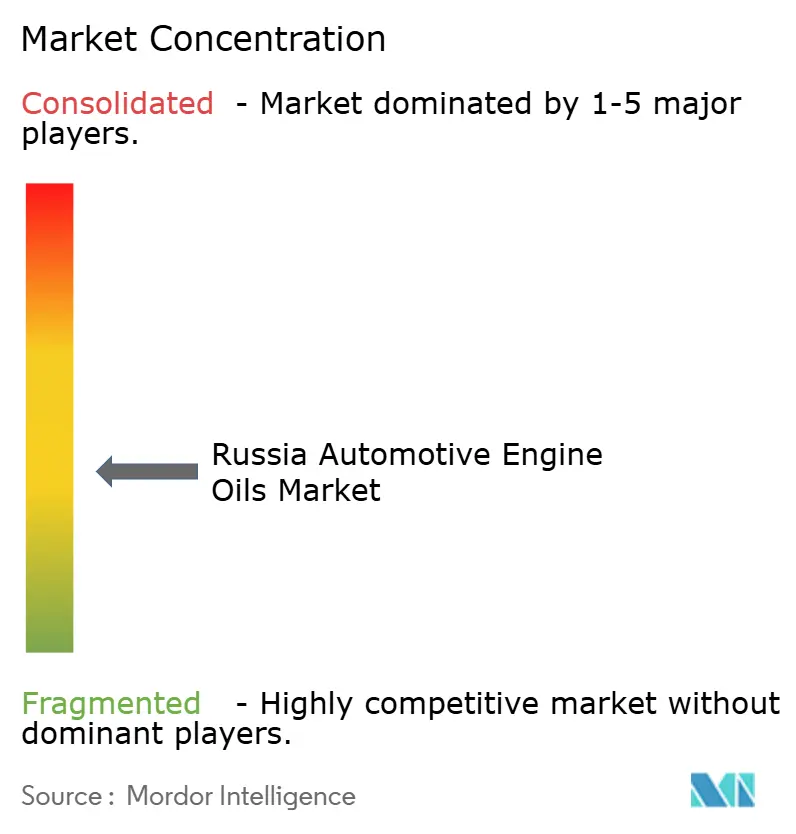
| Market Concentration | Medium |
Major Players *Disclaimer: Major Players sorted in no particular order Image © Mordor Intelligence. Reuse requires attribution under CC BY 4.0. | |
Russia Automotive Engine Oils Market Analysis by Mordor Intelligence
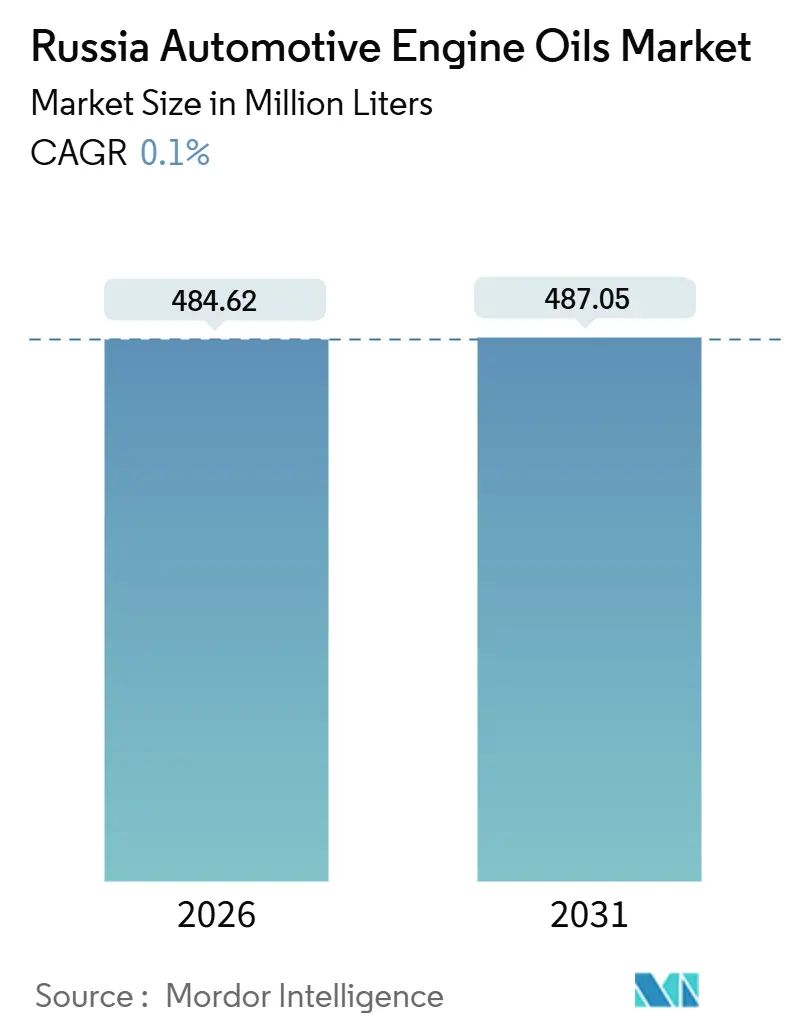
The Russian Automotive Engine Oils Market size is estimated at 484.62 million liters in 2026, and is expected to reach 487.05 million liters by 2031, at a CAGR of 0.10% during the forecast period (2026-2031). This near-flat trajectory conceals a structural overhaul in supply chains and consumption patterns. The rapid departure of Western OEMs after 2022 collapsed local vehicle assembly, yet the national fleet keeps aging, so total mileage and lubricant change-outs remain broadly intact. Domestic refiners now lead the shift from imported to locally blended oils as Gazpromneft-Lubricants, Lukoil, and Rosneft channel crude-to-retail integration advantages into price and logistics resilience. Demand is also tilting toward higher-margin synthetics as the Omsk GIDP complex unlocks Group III base-oil capacity. Meanwhile, a mandatory digital product-marking regime effective September 2025 raises compliance costs for small blenders and funnels share toward IT-capable majors.
Key Report Takeaways
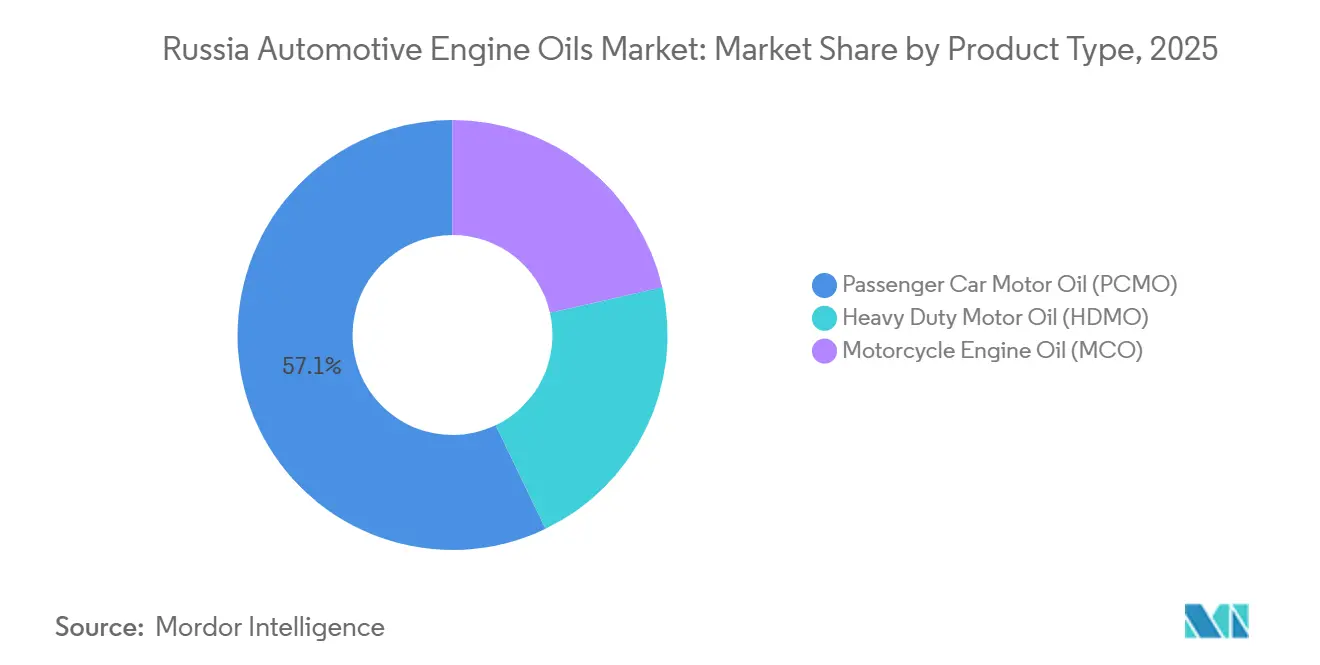
- By product type, passenger car motor oil commanded 57.12% of the Russia automotive engine oils market share in 2025, while motorcycle engine oil is projected to record the fastest 0.24% CAGR through 2031.
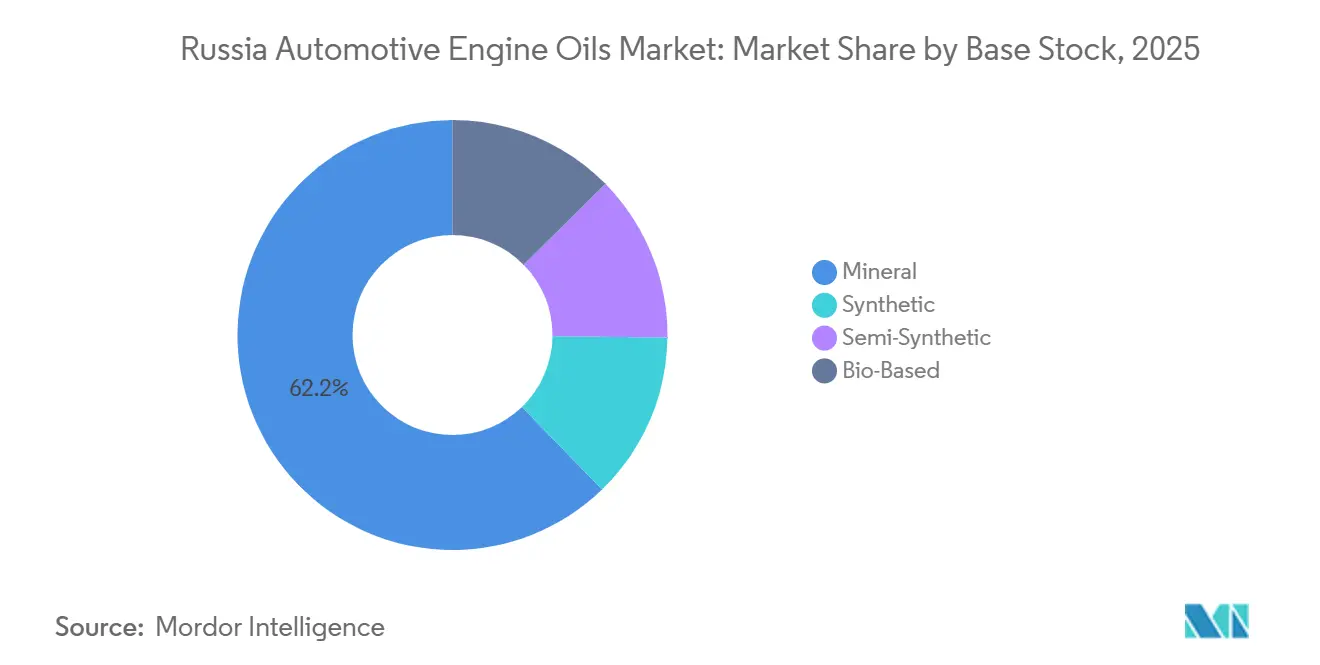
- By base stock, mineral oils captured 62.23% of the 2025 Russia automotive engine oils market size, whereas synthetic oils are forecast to expand at a 0.35% CAGR between 2026 and 2031.
Note: Market size and forecast figures in this report are generated using Mordor Intelligence’s proprietary estimation framework, updated with the latest available data and insights as of January 2026.
Russia Automotive Engine Oils Market Trends and Insights
Drivers Impact Analysis*
| Drivers | (~) % Impact on CAGR Forecast | Geographic Relevance | Impact Timeline |
|---|---|---|---|
| Fleet-mileage rebound amid aging parc | +0.04% | Moscow, St. Petersburg, Far East | Medium term (2-4 years) |
| Accelerating shift to synthetic and low-viscosity oils | +0.03% | National; early uptake in cold-climate Far East | Medium term (2-4 years) |
| Import-substitution and localization of blending capacity | +0.02% | Omsk, Volgograd, Nizhnekamsk, Kaluga | Short term (≤ 2 years) |
| Expansion of e-commerce lubricant channels | +0.01% | Tier-1 cities | Long term (≥ 4 years) |
| Mandatory digital product-marking regime | +0.01% | National | Short term (≤ 2 years) |
| Source: Mordor Intelligence | |||
Fleet-Mileage Rebound Amid Aging Parc
The average age of the Russian vehicle fleet rose in 2025 because owners delayed replacement after Western OEMs withdrew. Older engines consume more oil due to worn components, so every extra kilometer traveled increases lubricant replacement frequency. Passenger-car travel recovered to pre-pandemic levels in 2025 according to national highway-toll statistics, amplifying oil sales in the aftermarket. Light-commercial vans that service e-commerce and grocery delivery are also clocking higher mileage, reinforcing baseline demand. This driver provides a modest but steady uplift that offsets volume lost from the slump in new-car sales.
Accelerating Shift to Synthetic and Low-Viscosity Oils
Gazpromneft-Lubricants restarted the Omsk GIDP hydro-isomerization complex in 2024, tripling synthetic base-oil output and removing a critical import bottleneck[1]. Domestic Group III supply cuts freight costs and shields buyers from currency volatility, so fleets in Siberia and the Far East are migrating from 10W-40 mineral grades to 0W and 5W synthetics that improve cold-start protection. Lukoil and Rosneft quickly followed with formulation upgrades that align with Euro 5 emission norms still applied to domestic fuels. Although synthetics remain a premium purchase, higher drain intervals and fuel-economy gains make the total-cost-of-ownership argument compelling for taxis, ride-hailing fleets, and corporate car-sharing operators.
Import-Substitution and Localization of Blending Capacity
Rosneft operates around six lubricant plants, while Lukoil runs nine facilities that cover Group I to Group III production. These refiners gained market share as foreign majors exited in 2022, leaving volumes and blending lines idle. Gazpromneft achieved “technological sovereignty” in October 2025 by launching Russia’s first in-country synthetic sulfonate additive production, enabling 100% domestic content in premium oils. Localization cushions the Russia automotive engine oils market from sanctions risk and currency swings, while also fulfilling state import-substitution mandates that give priority in public tenders.
Expansion of E-Commerce Lubricant Channels
Online sales accounted for a single-digit share of lubricant retail volume in 2025 but are rising fast on the back of nationwide courier networks. Major platforms now bundle next-day delivery with used-oil collection, appealing to do-it-yourself consumers in Moscow and St. Petersburg. Gazpromneft’s 2025 partnership with ROLF integrates click-and-collect ordering into its G-Energy Service centers, where customers book oil changes online and arrive at pre-staged bays. The forthcoming digital marking regime will generate real-time inventory data that e-commerce operators can mine to optimize regional stock, widening the price gap with brick-and-mortar outlets.
Restraints Impact Analysis*
| Restraints | (~) % Impact on CAGR Forecast | Geographic Relevance | Impact Timeline |
|---|---|---|---|
| OEM exits shrink new-vehicle production base | -0.03% | Kaliningrad, Kaluga, Togliatti | Short term (≤ 2 years) |
| Gradual electrification dampening long-term demand | -0.01% | Moscow, St. Petersburg | Long term (≥ 4 years) |
| Expiry of foreign quality certificates | -0.02% | National | Short term (≤ 2 years) |
| Source: Mordor Intelligence | |||
OEM Exits Shrink New-Vehicle Production Base
AvtoVAZ output fell in 2025 after global brands withdrew capital and parts support, and most foreign assembly plants in Kaluga and Kaliningrad remain mothballed. New-car sales consequently collapsed, reducing factory-fill lubricant volumes and aftermarket upgrades linked to warranty compliance. Chinese marques now dominate imports, yet their smaller displacement engines hold less oil and specify longer drain intervals, trimming per-unit fluid demand. Regional economies that depended on vehicle assembly have also lost freight movements, squeezing heavy-duty oil consumption tied to component logistics.
Gradual Electrification Dampening Long-Term Demand
In 2025, Russia had a limited number of battery-electric passenger cars on its roads. However, with the influx of affordable Chinese SUVs through Far Eastern ports, this number is set to grow rapidly. Each electric vehicle's operation reduces engine oil consumption. The procurement of electric buses by municipalities in Moscow and St. Petersburg is poised to amplify this trend, especially concerning commercial-vehicle lubricant volumes in the 2030s. While the immediate impact on Russia's automotive engine oils market remains minimal, major refiners' strategic planners are already forecasting a potential decline in volume should EV penetration increase significantly by 2031.
*Our forecasts treat driver/restraint impacts as directional, not additive. The impact forecasts reflect baseline growth, mix effects, and variable interactions.
Segment Analysis
By Product Type: PCMO Dominates While MCO Gathers Speed
Passenger car motor oil generated 57.12% of the 2025 Russia automotive engine oils market size as the aging light-duty fleet continues to rely on routine oil changes for reliability. Volume growth remains muted, yet price-mix is improving because older engines increasingly accept 5W-30 synthetics when mineral stockouts occur. Heavy-duty motor oil sales track freight traffic; refrigerated and long-haul operators prioritize drain-interval extension to cut downtime, favoring semi-synthetic formulations blended by Rosneft.
Motorcycle engine oil is small in absolute liters but will post the quickest 0.24% CAGR to 2031. Two-wheeler registrations hit a record in 2024 as Chinese brands such as Regulmoto and Racer filled the vacuum left by European and Japanese exits[2]. Entry-level bikes use single-cylinder engines that shear oil rapidly, so annual drain frequency is high. Urban riders in Moscow prefer branded semi-synthetics, whereas provincial users stay with low-priced mineral MCOs. The combined effect leaves total liters small yet strategically important for brand diversification.

By Base Stock: Mineral Still Leads, Synthetic Expands
Mineral oils accounted for 62.23% of Russia's automotive engine oils market share in 2025 because many engines designed before 2010 still specify Group I formulations. However, synthetic products will advance at a 0.35% CAGR to 2031 thanks to Gazpromneft’s Group III stream that underpins competitively priced 0W-20 and 5W-30 grades. Semi-synthetics remain the bridge option for vehicles 8-12 years old as owners seek better cold-crank performance without the full cost of PAO-based fluids.
TAIF-SM’s Nizhnekamsk facility uniquely produces domestic Group IV PAO ranging from PAO-2 to PAO-1000, offering pour points down to -60 °C and enabling niche products for Arctic service fleets. Price sensitivity still caps broad adoption, yet corporate fleets with telematics-monitored fuel-economy targets are shifting procurement toward synthetics. Rising excise taxes on high-viscosity mineral oils also tilt the cost equation and nudge distributors to stock more 5W-30 synthetic SKUs.
Geography Analysis
Across the vast expanse of Russia, the automotive engine oils market showcases pronounced regional disparities, influenced by both climate and economic conditions. In Moscow and St. Petersburg, a high vehicle density combined with a consumer inclination towards premium synthetics results in these cities generating a significant portion of the market's value. For instance, taxi fleets in Moscow, opting for 5W-30 synthetic blends and changing oil regularly, ensure a consistent demand for quick-service chains run by industry giants Gazpromneft and Lukoil.
In the Far East, where winter temperatures plunge below –40 °C, the necessity for 0W-XX viscosity grades becomes evident. Gazpromneft, capitalizing on this demand, dispatches finished lubricants from its Omsk refinery. These are transported by rail to depots in Vladivostok and Magadan, where local dosing of cold-flow improvers takes place. Meanwhile, in the southern agricultural centers of Krasnodar and Rostov, the summer heat and dusty conditions lead to a preference for thicker 10W-40 mineral oils in tractors and harvesters. Rosneft, recognizing this demand, utilizes its Volgograd refinery's proximity to these markets, often bundling bulk oil deliveries with diesel-fuel contracts.
Industrial cities like Kaluga, Kaliningrad, and Togliatti, once bustling with foreign OEM assembly, now grapple with dwindling lubricant demand. The shutdown of local plants has curtailed both commuter traffic and supply-chain trucking. On the other hand, clusters in Siberian mining and Ural steel continue to drive a robust demand for heavy-duty motor oils. Starting September 2025, a nationwide digital marking regime aims to close regional loopholes that have historically allowed counterfeit oils to infiltrate border areas, paving the way for a more unified brand portfolio across Russia.
Regulatory Landscape
Automotive engine oils sold in Russia are covered by EAEU Technical Regulation TR TS 030/2012 (requirements for lubricants, oils, and special fluids), with conformity assessment and product information duties applying to both domestic producers and importers. A major recent change is mandatory identification-based labeling (DataMatrix) for selected lubricants and automotive fluids introduced by Government Decree No. 1683 dated November 30, 2024, with subsequent amendments via Decree No. 2136 dated December 25, 2025. These updates move the packaged-goods requirements into force from March 1, 2026 and tighten traceability expectations across retail and service channels.
Standardization and test-method alignment remain anchored by Rosstandart and GOST classifications used in the market, including GOST 17479.1-2015 for classification. On the trade and supply-stability side, the Cabinet of Ministers temporarily zeroed import duties on certain petroleum products through mid-2026. Separately, July 2026 government activity around extending the imported damper mechanism to diesel fuel pointed to continued fiscal tools for managing downstream fuels and related lubricant logistics during periods of export controls and supply volatility.
Value Chain Analysis
The value chain starts with base oil and key chemical inputs (base stocks and additives), then moves through blending, packaging, and distribution to workshops, quick-service chains, forecourts, fleets, and e-commerce. Since 2022, the chain has been reorganized around vertically integrated domestic groups, with Gazpromneft-Lubricants, Lukoil, and Rosneft using refinery-to-retail assets to secure base stocks and manage nationwide delivery. Additive sourcing has been a sensitivity point, leading to localization steps such as Gazpromneft-Lubricants starting synthetic sulfonate additive production at Omsk in October 2025. Even so, the broader supply stack still includes imported components routed via China and intermediaries.
Downstream, distribution is widening beyond traditional forecourts and wholesalers into platform-driven retail and service booking, while compliance is increasingly treated as part of distribution capability. The Chestny Znak digital product-marking regime, which becomes mandatory for motor oils from September 1, 2025, adds serialization, scanning, and data-integration requirements across manufacturing, warehousing, and point-of-sale. This favors IT-capable producers and large distributors. At the same time, expiring pre-2022 foreign quality certificates and constrained pathways to renew them under sanctions increase documentation and testing burdens, weighing more on parallel imports and some smaller blenders than on integrated majors.
Competitive Landscape
The Russian Automotive Engine Oils Market is moderately fragmented. Vertically integrated energy majors now set the tone in the Russia automotive engine oils market. These companies own the bulk of base-oil refining, blending, additive production, and retail forecourts, giving them unrivaled supply-chain control. Second-tier domestic producers carve niches in premium PAO-based synthetics and private-label mineral oils, respectively. Parallel imports of Shell and Castrol brands continue but are gradually squeezed by traceability rules and tighter customs inspection.
Russia Automotive Engine Oils Industry Leaders
-
Shell Plc
-
BP plc
-
Exxon Mobil Corporation
-
Gazpromneft-Lubricants Ltd.
-
Lukoil
- *Disclaimer: Major Players sorted in no particular order
Market Opportunities and Future Outlook
An opportunity area is premiumization enabled by domestic production of higher-purity and specialty components, which reduces exposure to parallel-import constraints and improves formulation control. Gazpromneft-Lubricants moving into industrial production of white oils at its Omsk Lubricants Plant in March 2026 is a concrete signal of deeper localization of high-purity inputs. It supports broader product portfolios and enables suppliers to address applications that previously relied on imported feedstocks. This also aligns with the market shift toward synthetics and low-viscosity grades already supported by domestic Group III availability.
Another opportunity is institutional and regional offtake tied to public infrastructure and industrial programs, where supply reliability and traceability are valued alongside price. In June 2026, Gazprom Neft signed a strategic cooperation agreement with the Vladimir Region government to increase supplies of high-tech lubricants (over 1,000 lubricant items referenced) and related products for transport and road construction needs, showing how regional procurement and industrial customers can be targeted through structured supply relationships. In parallel, tightening traceability rules, with mandatory marking from 2025 and in-force packaging requirements from March 2026, creates whitespace for majors and scaled distributors to win share by offering compliant, verified supply to workshops and fleets seeking to reduce counterfeit and warranty-risk exposure.
Recent Industry Developments
- July 2026: Gazpromneft-Lubricants signed a cooperation agreement with the government of the Ryazan Region to expand supplies of lubricants and technical fluids to local industries. The arrangement supports structured regional demand capture and strengthens distribution planning around industrial users and service networks.
- August 2025: Lukoil launched LUKOIL GENESIS ARMORTECH 5W-40 and LUKOIL GENESIS ARMORTECH CN 5W-40 formulated to the API SQ specification. The launch broadened the locally available lineup for passenger cars and helped defend branded share as traceability requirements and import substitution continued to reshape the retail mix.
- December 2024: Gazpromneft-Lubricants increased output of base synthetic components for automotive and industrial oils after commissioning a hydro-isodewaxing complex at its Omsk site. Higher domestic availability of synthetic components supported the shift toward synthetic and low-viscosity engine oil grades and reduced reliance on imported base stocks.
Research Methodology Framework and Report Scope
Market Definition and Coverage
For this study, we size automotive engine oils sold for use in on-road vehicles in Russia, covering lubricants used for routine oil changes and service fill, measured primarily in liters and then converted to value.
Scope exclusions: We exclude non-automotive lubricants (industrial oils, marine, aviation) and non-engine oil automotive fluids such as transmission, brake, and hydraulic fluids.
Segmentation Overview
- By Product Type
- Passenger Car Motor Oil (PCMO)
- 0W-XX
- 5W-XX
- 10W-XX
- 15W-XX
- Monogrades
- Other Grades
- Heavy Duty Motor Oil (HDMO)
- 0W-XX
- 5W-XX
- 10W-XX
- 15W-XX
- Monogrades
- Other Grades
- Motorcycle Engine Oil (MCO)
- 0W-XX
- 5W-XX
- 10W-XX
- 15W-XX
- Monogrades
- Other Grades
- Passenger Car Motor Oil (PCMO)
- By Base Stock
- Mineral
- Synthetic
- Semi-Synthetic
- Bio-Based
Data Sources, Market Sizing, and Validation
Desk Research
Desk research starts with building the demand pool and the operating context for engine oil consumption in Russia. We rely on public and official references such as the Federal State Statistics Service (Rosstat), the Eurasian Economic Commission customs statistics, UNECE vehicle-related statistics, and technical and regulatory materials from the Eurasian Economic Union and relevant GOST standard bodies.
To translate these references into usable sizing inputs, we also review manufacturer technical documents (SAE viscosity and performance specifications), vehicle parc and sales summaries from reputable industry bodies, and broad disclosures from company reports and investor materials. In addition, we use a paid subscription source for company financials and another for shipment-level import and export signals to sanity-check directionally how supply is moving across the border. The sources listed here are illustrative, and many other public documents and datasets were also used to collect, verify, and clarify inputs.
Primary Interviews and Surveys
We use expert interviews and surveys with lubricant producers, distributors, service workshops, fleet operators, retailers, and procurement managers in Russia. Their input checks drain intervals, liters per service, product mix, local blending, imports, and channel pricing. These findings fill gaps and triangulate the final model.
Distribution of primary research fieldwork respondents
| Company type | Respondent position |
|---|---|
| Top tier: 28% | CXOs: 18% |
| Mid tier: 47% | Functional/Unit leaders: 32% |
| Smaller Players: 25% | Managers: 50% |
Market-Sizing & Forecasting
Market sizing is built using a top-down and bottom-up approach, but the core model is top-down. We reconstruct engine oil demand by linking the vehicle parc and annual mileage to oil sump capacity and average drain intervals, and then filter that demand through the split by gasoline and diesel use, and by passenger car, commercial vehicle, and motorcycle activity.
Those volumes are then converted to value using a practical price build-up that reflects base oil trends, additive intensity, and the typical price ladder across mineral, semi-synthetic, and synthetic grades. To keep the totals realistic, we corroborate the result with selective bottom-up checks, such as sampled retail and workshop pricing, a channel check on pack sizes and trade margins, and a supplier-side roll-up for a small set of representative participants, followed by gap-filling for unreported volumes using observed share ranges.
For forecasting, we lean on scenario analysis, because the outlook depends on vehicle parc stability, import substitution, and service behavior changes, not only on GDP. Key inputs used include parc aging and scrappage pace, annual mileage recovery, drain interval shifts (especially for newer oils), the mix change toward higher-performance grades, and any compliance-driven packaging and traceability requirements that can change channel costs. Assumptions are adjusted only after they are reviewed with primary respondents and they match the direction of the observable indicators.
Data Validation & Update Cycle
Validation is done through multiple checks before sign-off. We compare modeled consumption against independent signals such as apparent supply (production plus imports minus exports), reported lubricant totals, and known seasonality patterns tied to service activity, and then outliers are rechecked at the input level.
If a variance is material, we revisit the assumptions, re-contact a subset of interviewees, and document the adjustment logic so the model stays traceable. Reports are refreshed annually, and interim updates are made when major policy, trade, or macro events change the demand pool, followed by a final pre-delivery review to make sure clients receive the latest view.
Mordor Intelligence's Russia Automotive Engine Oils Market Sizing Compared With Other Published Estimates
Published market sizes for Russia automotive engine oils often do not match because the scope boundary is not always the same, and the unit of measurement differs, with some sources reporting value only and others reporting volume first. Differences also come from how pricing is handled, how the mix between mineral and synthetic is assumed to shift, and whether the update cadence captures recent channel changes.
Import and export shipment signals, combined with vehicle parc direction and workshop service activity checks, are the evidence points that keep Mordor Intelligence tied to a liters-first demand pool for 2026 before translating that volume into value using a consistent price build-up.
Benchmark comparison
| Source | Market Size | Gaps in Research Methodology |
|---|---|---|
| Mordor Intelligence | USD 1.55 B (2026) | |
| Global Consultancy A | USD 3.80 B (2026) | This figure appears to use a broad revenue frame that can fold in wider lubricant retail markups and adjacent automotive fluids, which can inflate value versus an engine-oil-only liters build converted with typical channel margins. |
| Industry Publisher B | USD 1.87 B (2024) | This estimate is for automotive lubricants overall rather than only engine oils, and the year is different, so its value level also reflects a different product mix and currency timing versus a 2026 engine-oil-only model. |
The spread in the table is mainly explained by product boundary and conversion choices, not by a single growth assumption. By anchoring the sizing on observable demand drivers, and then applying repeatable price and mix logic, the final number stays easier to reconcile with real-world volumes and trade signals.
Key Questions Answered in the Report
What is the volume outlook for the Russia automotive engine oils market?
The market is forecast at 484.62 million litres in 2026 and is forecast to reach 487.05 million litres, registering a CAGR of 0.10%.
Why are synthetic oils gaining share in Russia?
Domestic Group III and PAO capacity from Gazpromneft and TAIF-SM reduces import reliance and narrows the price premium, prompting fleet buyers to switch for better cold-start and fuel-saving benefits.
How will electric vehicles affect lubricant demand?
EV penetration is still low, but each additional EV removes annual engine oil demand.
Which product segment is growing the fastest?
Motorcycle engine oil is projected to grow at a 0.24% CAGR to 2031, thanks to record two-wheeler sales led by Chinese brands.
What regulation could reshape market competition?
The digital product-marking system that becomes mandatory nationwide in September 2025 will raise entry barriers for small blenders and curb counterfeit sales.
Which companies dominate the supply chain?
Gazpromneft-Lubricants, Lukoil, and Rosneft together control most Russian base-oil refining, blending, and branded retail distribution.