
Market Overview
| Study Period | 2021 - 2031 |
|---|---|
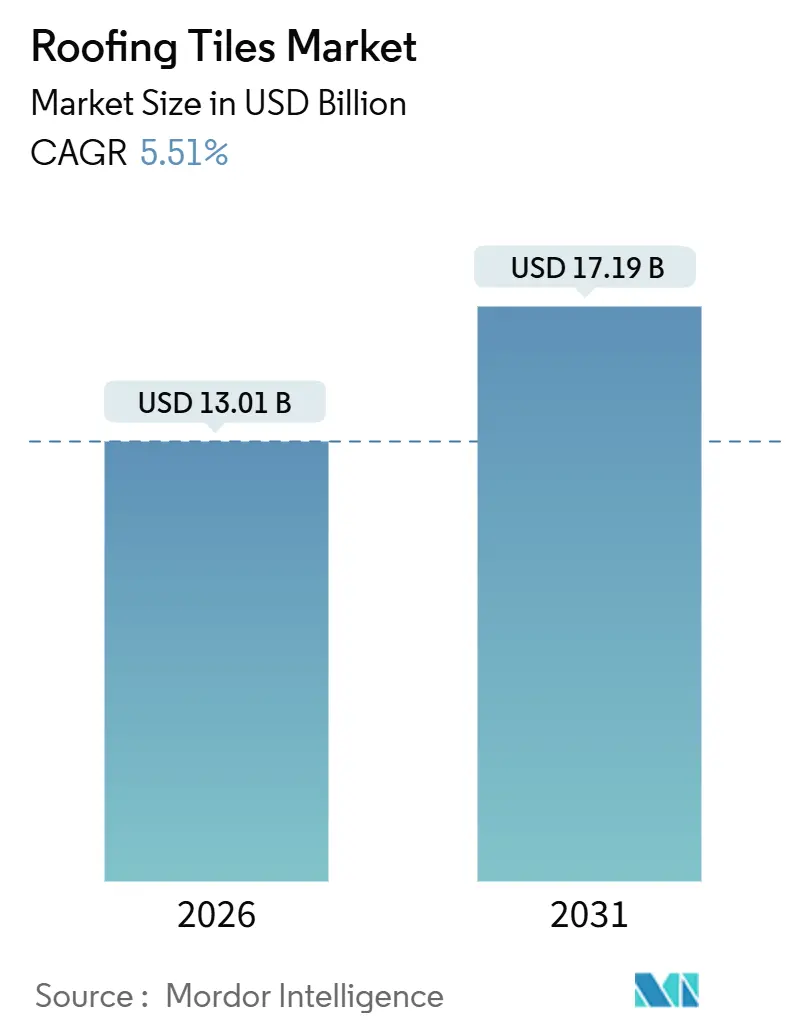
| Market Size (2026) | USD 13.01 Billion |
| Market Size (2031) | USD 17.19 Billion |
| Growth Rate (2026 - 2031) | 5.51 % |
| Fastest Growing Market | Asia-Pacific |
| Largest Market | Europe |
| Market Concentration | Medium |
Major Players *Disclaimer: Major Players sorted in no particular order Image © Mordor Intelligence. Reuse requires attribution under CC BY 4.0. | |
Roofing Tiles Market Analysis by Mordor Intelligence
The Roofing Tiles Market size is estimated at USD 13.01 billion in 2026, and is expected to reach USD 17.19 billion by 2031, at a CAGR of 5.51% during the forecast period (2026-2031). Heightened climate volatility, stricter energy codes, and evolving insurance underwriting are reshaping roof-system specifications in favor of durable, cool-reflective tiles that surpass commodity asphalt shingles. Concrete tiles kept momentum through 2025 because of their cost advantage and Class A fire performance, yet clay tiles are expanding faster as heritage-zone approvals and premium coastal demand accelerate adoption. Insurance surcharges on non-impact-rated roofs, combined with utility rebates for cool surfaces, have intensified homeowner migration to high-SRI tile solutions. On the supply side, vertically integrated manufacturers are investing in low-carbon kilns and photovoltaic-ready profiles to comply with carbon-border rules and to monetize renovation incentives across major economies.
Key Report Takeaways
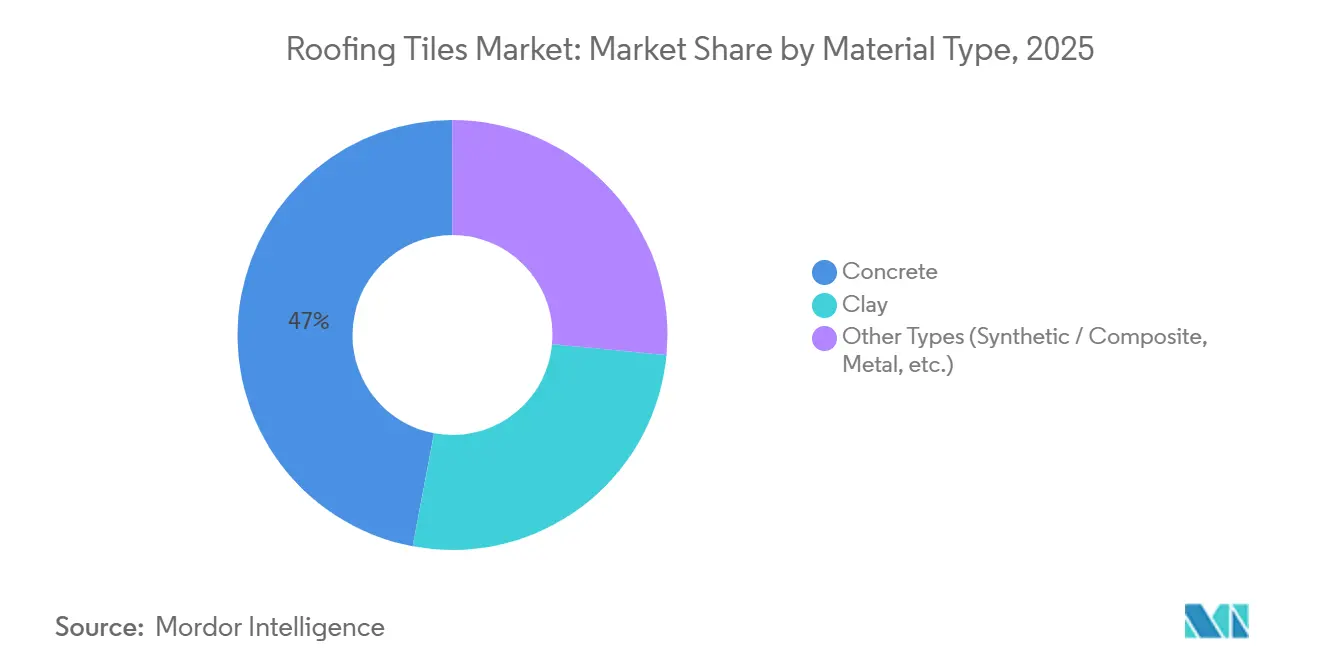
- By material type, concrete maintained a 47.05% roofing tiles market share in 2025 while clay is advancing at a 6.74% CAGR through 2031.
- By construction activity, new construction captured 54.25% of the roofing tiles market size in 2025 and is expected to accelerate at a 6.68% CAGR through 2031.
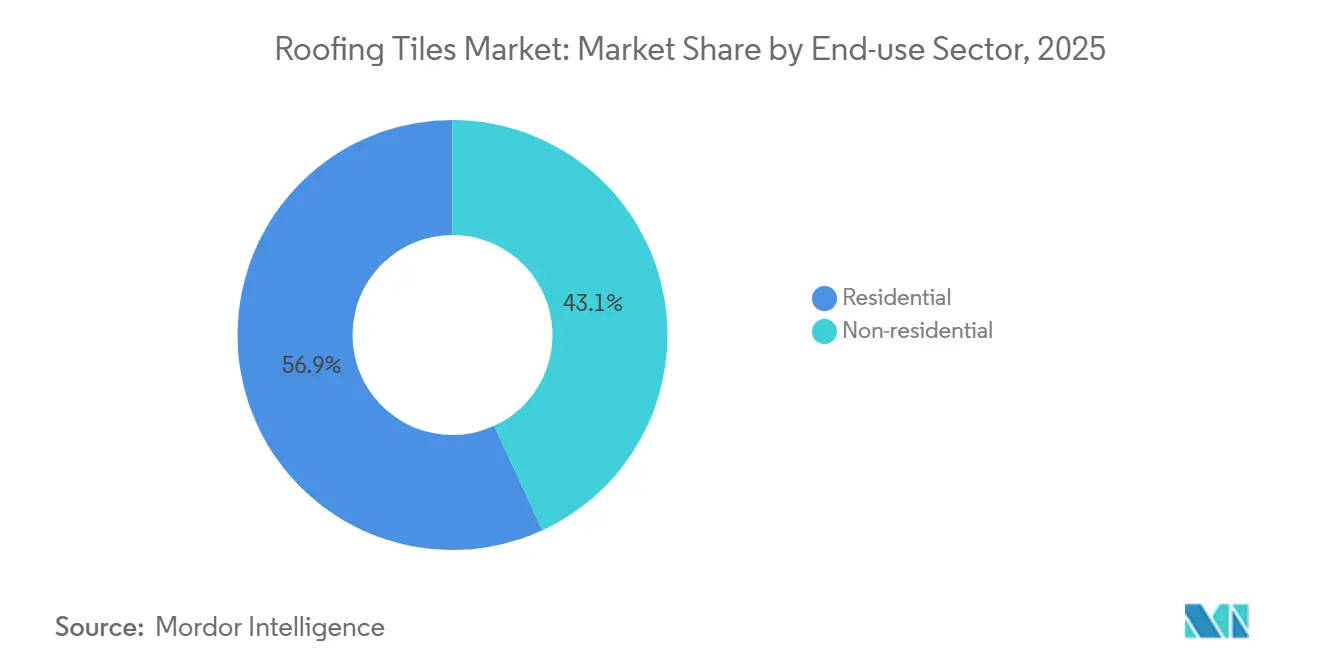
- By end-use sector, residential held 56.87% share of the roofing tiles market size in 2025 and is expanding at a 7.05% CAGR to 2031.
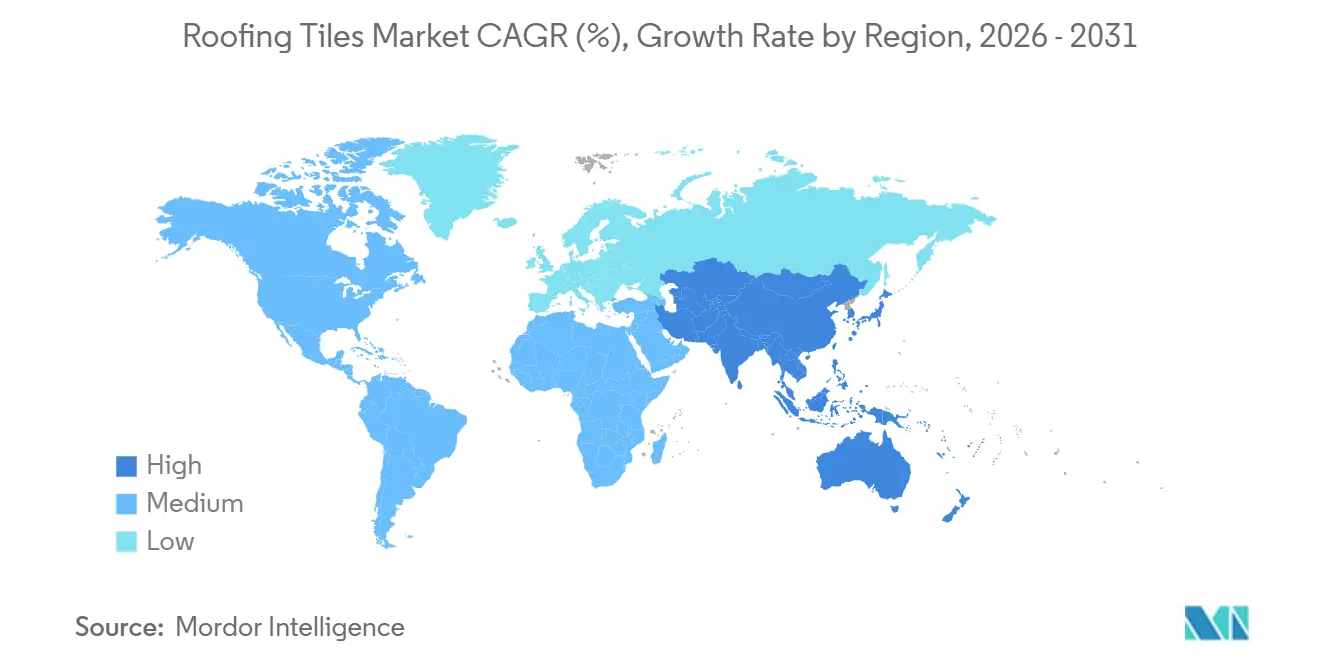
- By geography, Europe accounted for 40.02% of the roofing tiles market in 2025, whereas Asia-Pacific is the fastest-growing region with a 7.19% CAGR through 2031.
Note: Market size and forecast figures in this report are generated using Mordor Intelligence’s proprietary estimation framework, updated with the latest available data and insights as of January 2026.
Market Trends and Insights
Drivers Impact Analysis of Roofing Tiles Market*
| Driver | (~) % Impact on CAGR Forecast | Geographic Relevance | Impact Timeline |
|---|---|---|---|
| Rising urbanization and new-build activity in APAC and Africa | +1.2% | Asia-Pacific core, spill-over to Middle East and Africa | Long term (≥ 4 years) |
| Aging housing stock drives reroofing demand in North America and Europe | +0.9% | North America and Europe | Medium term (2-4 years) |
| Concrete-tile substitution for asphalt after extreme-weather insurance losses | +0.8% | North America (coastal and hail-prone states), Europe (storm zones) | Short term (≤ 2 years) |
| Mandatory cool-roof codes in heat-island cities | +0.7% | Global, with early gains in California, EU member states, Middle East | Medium term (2-4 years) |
| 3D-printed lightweight tiles shorten installation time and cut logistics costs | +0.3% | North America, Europe (pilot deployments) | Long term (≥ 4 years) |
| Carbon-border levies accelerate adoption of low-carbon kiln technology | +0.5% | Europe (CBAM enforcement), spill-over to export-oriented APAC manufacturers | Long term (≥ 4 years) |
| Source: Mordor Intelligence | |||
Rising Urbanization and New-Build Activity
Residential starts in India, Indonesia, Vietnam, and the Philippines are expanding as urban populations grow and public infrastructure programs unlock greenfield housing. Workforce migration into secondary cities supports demand for weather-resilient roofs that mitigate heat-island effects and qualify for government energy incentives. Developers in Saudi Arabia and the UAE are specifying high-SRI tile systems for mega-projects to satisfy national energy-efficiency frameworks. Lightweight concrete profiles with 20-30% lower mass are enabling use on wood-framed structures in emerging markets, widening the addressable base. Manufacturers are localizing production in Southeast Asia to minimize freight costs and navigate carbon-border policies.
Aging Housing Stock Fuels Reroofing
North American and European roofs installed during post-war booms are reaching end-of-life, compressing the reroof cycle to 15-18 years in high-UV or coastal zones. France’s Climate & Resilience Act targets 370,000 annual home renovations through 2030, and many projects include roof upgrades that reduce winter heat loss by up to 40%. In the United States, homeowners spent USD 45.8 billion on roofing projects in 2023, with insurers in hail-prone states requiring Class 4 impact ratings to retain coverage. Programs such as California Title 24 boost demand for cool-roof tiles that deliver measurable energy savings and qualify for utility rebates.
Concrete-Tile Substitution After Extreme-Weather Losses
Insured roof losses reached USD 31 billion in 2024, with hailstorms and hurricanes disproportionately damaging asphalt shingle roofs lacking Class 4 impact ratings[1]. Insurers in Texas, Florida, and Colorado now impose surcharges exceeding 30% on non-rated roofs, prompting a shift toward concrete and clay tiles that meet ASTM D3746 and UL 2218 standards. Eagle Roofing Products expanded its North Las Vegas facility in 2025 to serve this insurance-driven demand, adding regional capacity for tiles that deliver superior compressive strength above 6,000 psi. European windstorms are producing similar specification shifts as policies mandate wind-uplift testing per EN 14437.
Mandatory Cool-Roof Codes in Heat-Island Cities
California Title 24 requires a minimum Solar Reflectance Index (SRI) of 64 on steep-slope residential roofs in several climate zones, redirecting specifications toward clay and concrete tiles with reflective coatings. The EU Energy Performance of Buildings Directive 2024/1275 compels member states to embed cool-roof thresholds in national codes by 2026, accelerating adoption in France, Spain, and Italy. Middle Eastern authorities are adopting parallel measures to curb cooling loads in commercial facilities. High-SRI tiles cut roof surface temperatures by up to 50 °F, reducing HVAC demand by 10–15% and helping projects secure LEED credits.
Restraints Impact Analysis of Roofing Tiles Market*
| Restraint | (~) % Impact on CAGR Forecast | Geographic Relevance | Impact Timeline |
|---|---|---|---|
| Cost-competitive asphalt shingles and metal panels | -0.6% | Global, most acute in North America price-sensitive new-build | Short term (≤ 2 years) |
| Skilled-labor shortages raise installation costs | -0.4% | North America, Europe | Medium term (2-4 years) |
| Volatile energy prices disrupt clay-kiln economics | -0.3% | Europe, Asia-Pacific (natural gas-dependent producers) | Short term (≤ 2 years) |
| Water-extraction limits in drought-prone regions | -0.2% | North America (Southwest), Spain, Australia | Long term (≥ 4 years) |
| Source: Mordor Intelligence | |||
Cost-Competitive Asphalt Shingles and Metal Panels
Asphalt shingles retain a major share of U.S. residential roofing because installed costs remain 40-50% lower than those of concrete or clay tiles.
Skilled-Labor Shortages Raise Installation Costs
Median U.S. roofer wages rose to USD 50,970 in 2024, reflecting a tight labor pool and increasing competition for installers skilled in tile systems that require battens, flashings, and underlayment[2]. Labor accounts for USD 3.00–5.00 per square foot on tile jobs, compared with USD 1.50–2.50 for asphalt shingles, constraining uptake in price-sensitive segments. Edilians Academy certified more than 400 roofers in 2023 to expand the labor pipeline for photovoltaic-integrated tiles. Lightweight profiles and interlocking designs are simplifying installation, yet wage inflation remains a near-term headwind.
*Our forecasts treat driver/restraint impacts as directional, not additive. The impact forecasts reflect baseline growth, mix effects, and variable interactions.
Roofing Tiles Market Segment Analysis
By Material Type:
Concrete Still Leads While Clay Gains Premium ShareConcrete commanded a 47.05% roofing tiles market share in 2025 due to cost efficacy and compressive strength, yet clay is growing at a 6.74% CAGR on heritage-zone preference and premium coastal demand. Wienerberger’s CO₂-neutral plant in Hungary produces 3 million m² annually and underscores investment in low-carbon tile production. Clay suppliers such as Edilians offer more than 380 colors, helping historic districts comply with SRI requirements without altering vernacular aesthetics. Synthetic composites, including BRAVA’s recycled-polyethylene lines, are carving niche share in salt-spray environments with 50-year warranties. Recycled-aggregate concrete tiles, 15-20% lighter than legacy products, enable installation on wood-framed roofs without deck reinforcement.
Concrete tiles were used largely in multifamily and commercial projects in 2025 because structural load limits are more generous, while clay tiles primarily served premium residential demand. Clay is projected to capture the fastest growth as production lines retrofit to low-carbon kilns and photovoltaic-ready formats. Manufacturers are diversifying into metal and fiber-cement tiles, yet these materials combined capture low volumes through 2026.
By Construction Activity:
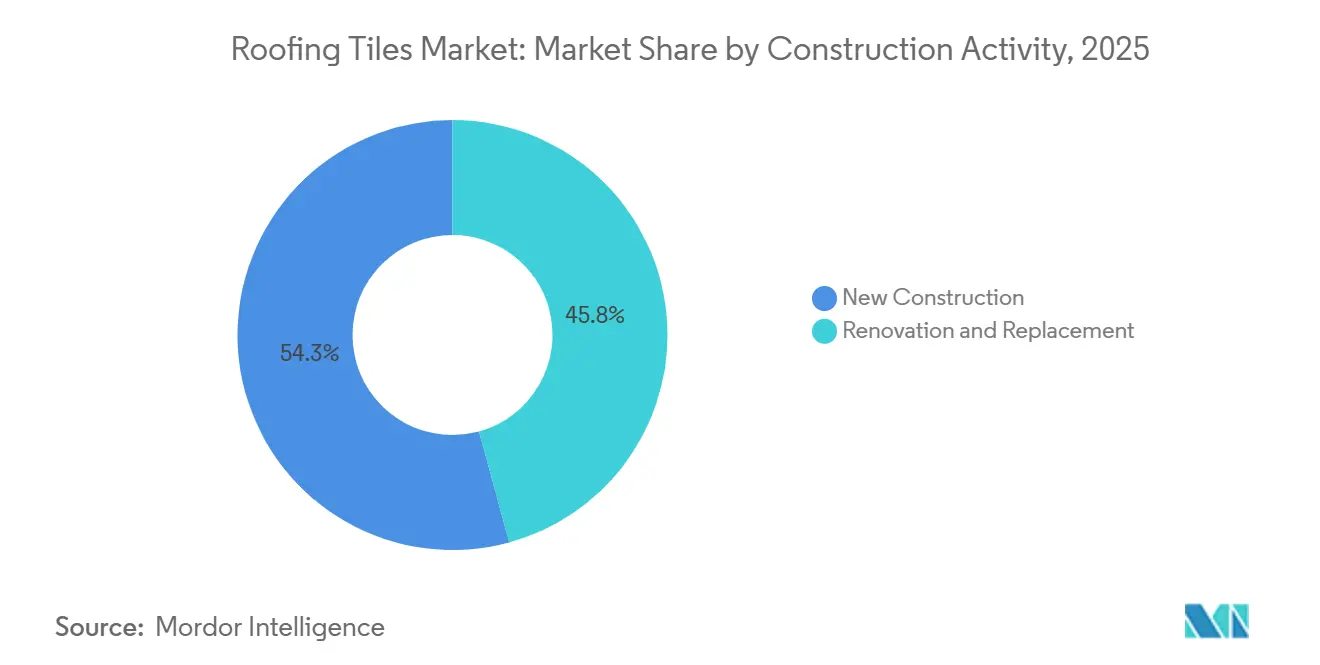
Renovation Dominates Today, New-Build Gains PaceRenovation and replacement activities delivered 45.75% of 2025 revenue because aging asphalt shingles from the 1990s are at end-of-life and insurers demand impact-rated upgrades. Reroofing now cycles every 15–18 years in high-UV regions, versus 20–25 previously, accelerating demand for tile systems with Class A fire and Class 4 impact ratings. France’s Climate & Resilience Act alone channels more than 370,000 roof refurbishments annually through 2030.
New construction captured 54.25% of the roofing tiles market size in 2025 and is expected to outpace renovation at a 6.68% CAGR through 2031 as Asia-Pacific urbanization lifts single-family starts and Middle Eastern commercial corridors adopt high-SRI tiles. Developers favor lightweight concrete profiles that cut transport emissions and meet local seismic codes, particularly in Indonesia, Vietnam, and the Philippines. U.S. suburban migration supports fresh detached-home starts, and builders in Colorado and Florida specify concrete tiles to secure insurance discounts on new dwellings.
By End-use Sector:
Residential Leads While Non-Residential DiversifiesResidential captured a 56.87% share in 2025 and is rising at a 7.05% CAGR through 2031, driven by insurer rebates, cool-roof incentives, and improving mortgage affordability in several Asia-Pacific and Middle Eastern economies. Tile demand is most pronounced in single-family detached homes where aesthetics and insurance mandates converge. Eagle Roofing Products operates four U.S. plants and eight design centers to service this segment, with a North Las Vegas hub opened in 2025.
Non-residential demand spans commercial, institutional, and infrastructure roofs where durability and low maintenance support whole-life cost targets. Holcim’s Elevate metal roofing expansion and ROCKWOOL’s new stone-wool insulation line illustrate supplier moves to deliver integrated building-envelope packages. Hospitals and schools in Europe now specify Class A tile systems with high-SRI surfaces to achieve public-procurement sustainability thresholds. Industrial parks in Mexico and ASEAN countries leverage clay and concrete tiles to meet fire regulations while lowering internal temperatures.
Geography Analysis
Europe Roofing Tiles Market
Europe sustained a 40.02% share of the roofing tiles market in 2025, upheld by EU-mandated cool-roof codes and aggressive renovation quotas. France alone mandates 370,000 annual home retrofits through 2030, and leaders such as Edilians supply clay tiles with SRI more than 80 that satisfy both energy and heritage criteria. Nordic retrofit programs prefer lightweight tiles to upgrade timber-framed dwellings without extra structural reinforcement, while Spain and Portugal export high-SRI clay tiles to the Americas and Middle East. Consolidation advanced when Wienerberger acquired Terreal for EUR 600 million in 2024, broadening distribution across Western Europe.
APAC Roofing Tiles Market
Asia-Pacific is the fastest-growing region at 7.19% CAGR through 2031 as India, Indonesia, Vietnam, and the Philippines expand housing and infrastructure pipelines. Urbanization in Indonesia is projected to hit 71% by 2030, and government programs in India underpin strong residential starts. Seismic codes in Japan and South Korea drive adoption of lightweight clay profiles that integrate photovoltaic cells. Chinese demand remains muted amid property deleveraging, but retrofit activity in coastal provinces supports high-SRI tiles that mitigate urban heat.
The Americas Roofing Tiles Market
North American demand is propelled by leading insurers in Texas, Florida, and Colorado that require impact-rated roofs. California Title 24 mandates SRI thresholds on steep-slope roofs, driving tile substitution in heat-island areas. Canada’s single-family starts rebounded in Ontario and British Columbia after rate cuts, while Mexico’s nearshoring trend fuels new commercial roofs that favor cool-roof concrete tiles. South American uptake remains concentrated in Brazil’s recovering residential sector.
Regulatory Landscape
Regulation is tightening around both product performance and disclosed environmental impacts. In the European Union, the revised Construction Products Regulation (Regulation (EU) 2024/3110) became fully applicable on 8 January 2026, strengthening requirements around Declarations of Performance and pushing manufacturers toward verified environmental information (for example, EN 15804-based metrics) to support market access for construction products, including roof tiles.
Compliance expectations are also shaping roofing-material manufacturing footprints and technology choices. In the United States, EPA air rules for roofing manufacturing remain a key compliance anchor (for example, NESHAP requirements under 40 CFR Part 63 Subpart LLLLL for asphalt roofing manufacturing), while product-level standards used by insurers and codes, such as UL 2218 impact ratings and ASTM/EN wind-uplift testing referenced in procurement and permitting, influence tile specification choices in hail, hurricane, and storm zones.
Value Chain Analysis
Roofing tiles value chains begin with mineral and binder inputs (clay, feldspar/kaolin for clay tiles, cement, sand, water, pigments such as iron oxide for concrete tiles) and move through forming, controlled drying/curing, kiln firing (for clay), coating/glazing, and packaging. Manufacturers differentiate through process control and test regimes for break strength and compressive performance, fire classification (Class A), wind resistance, and impact resistance (Class 3/4), aligning products to standards referenced by building codes and insurers.
Downstream, distribution is largely regional because tiles are heavy and freight sensitive. Scale players tend to pair multi-plant footprints with contractor networks, distributors, and design centers to maintain service levels and reduce lead times. Installation remains a specialized link in the chain, requiring code-compliant underlayment, battens, flashings, and fastening patterns; industry associations such as the Tile Roofing Industry Alliance (TRI Alliance) and the Roof Tile Association support adoption through technical manuals, installation guides, and training, which also raises barriers to entry in markets with complex local code requirements (for example, California Building Code references for roof coverings).
Competitive Landscape
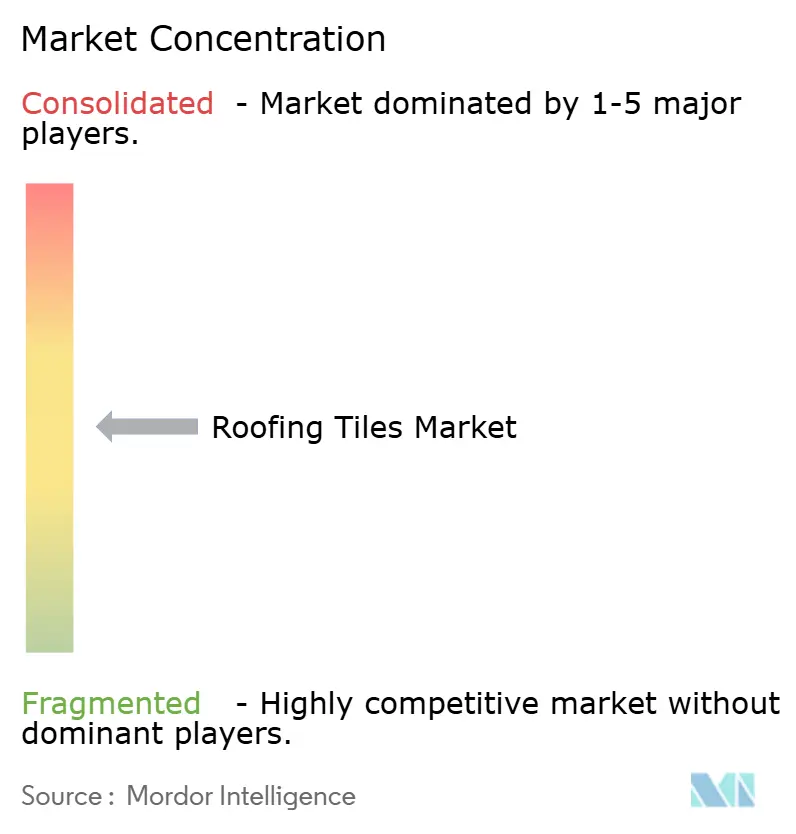
The roofing tiles industry exhibits moderate fragmentation. The combined share of Wienerberger, Westlake DaVinci Roofscapes LLC, BMI Group, Crown Roof Tiles, and Etex stood near 35% in 2025, while numerous local firms serve heritage and niche markets. Vertical integration is common: Wienerberger’s CO₂-neutral Hungary plant employs heat-pump drying that lowers gas use by 35%. BMI and Etex are channeling R&D into photovoltaic-ready tiles to capitalize on EU solar-prepared-roof mandates.
Synthetic composite disruptors such as BRAVA produce 100% recycled-plastic tiles with 50-year warranties and Class 4 impact ratings, appealing to insurers and coastal homeowners. 3D printing is reducing concrete tile weight by up to 30%, enabling single-installer handling and lowering shipping costs. Material circularity is also gaining momentum: Holcim’s Malarkey brand reuses 3,000 plastic bags per roof in its shingle backing, suggesting future tile-recycling pathways. IKO’s USD 120 million granule plant in Missouri, opening in 2026, illustrates supply-chain localization to control raw-material inputs.
The industry’s strategic focus spans kiln decarbonization, lightweight formulations, and installer-training academies. These investments aim to secure compliance with incoming carbon-border levies while capturing renovation and new-build opportunities tied to cool-roof regulations and insurance incentives.
Roofing Tiles Industry Leaders
-
Standard Industries Inc. (BMI Group)
-
Wienerberger AG
-
Etex Group
-
Westlake DaVinci Roofscapes LLC
-
Crown Roof Tiles
- *Disclaimer: Major Players sorted in no particular order
Roofing Tiles Market Companies Covered in this Report
- BRAVA
- CeDUR
- Crown Roof Tiles
- Eagle Roofing Products
- Etex Group
- Hangzhou Singer Building Materials Co., Ltd.
- IKO Industries, Inc.
- Imerys
- KPG Roofings
- LA ESCANDELLA
- LUDOWICI ROOF TILES
- MCA Clay Roof Tile
- Standard Industries Inc. (BMI Group)
- Vande Hey Raleigh
- Verea Clay Tile
- Westlake DaVinci Roofscapes LLC
- Wienerberger AG
Market Opportunities and Future Outlook
Compliance-driven transparency and decarbonization are creating openings for tile portfolios that provide verified environmental data and lower embodied carbon. With the EU Construction Products Regulation fully applicable from 8 January 2026 and requiring stronger environmental disclosure in product documentation, manufacturers that standardize EPD coverage and integrate LCA-ready data into sales channels can improve competitiveness in public procurement and renovation programs that screen materials on climate metrics.
Integration of energy and roofing is widening the design space for premium tiles and tile-adjacent roofing systems. In April 2026, TNO demonstrated a perovskite solar module on flexible foil applied to curved composite roof tiles (reported at 12.4% efficiency). In October 2025, ArcelorMittal inaugurated the Helioroof production line in France for insulated steel roofs with integrated solar cells supported by the EU Innovation Fund, reflecting continued investment in building-integrated photovoltaics. In materials, July 2026 launches such as Marley Edgemere 2.0 (using Heidelberg Materials evoZero near-zero cement) point to a path for lower-carbon concrete tiles where cement is the key emissions driver, while installer training and code-aligned product development (impact and wind-uplift performance) support adoption in insurance-sensitive reroofing markets.
Recent Industry Developments in Roofing Tiles Market
- July 2026: Marley launched Edgemere 2.0, positioned as the UKs first lower-carbon concrete roof tile made using Heidelberg Materials evoZero carbon-captured, near-zero cement. The launch links concrete tile demand to cement decarbonization pathways and creates a clearer specification option for projects screening products on embodied carbon and EPD-backed claims.
- November 2025: Hangzhou Singer Building Materials Co., Ltd. launched black and red stone-coated solar roof tiles that combine onsite power generation with weather-resistant roofing. The product move targets premium reroofing and new-build specifications that prefer building-integrated photovoltaics over rack-mounted panels, expanding the addressable market for tile-format solar.
- August 2024: KPG Roofings initiated local manufacturing of ceramic roof tiles in India. Local output reduces exposure to shipping-cost volatility and supply disruptions, supporting faster lead times and broader distribution into price-sensitive residential channels in a high-growth construction market.
Roofing Tiles Market Report Scope and Research Methodology
Market Definition and Coverage
This market covers factory-made roofing tiles used as roof coverings on buildings, measured in revenue terms across the full value of tiles sold into new build and reroofing activity.
Scope exclusions: Our sizing excludes non-tile roof coverings such as asphalt shingles, metal sheets, and roof membranes, and it does not count roof installation labor.
Segments Covered in This Report
- By Material Type
- Concrete
- Clay
- Other Types (Synthetic / Composite, Metal, etc.)
- By Construction Activity
- Renovation and Replacement
- New Construction
- By End-use Sector
- Residential
- Non-residential
- Commercial
- Infrastructure
- Industrial and Institutional
- By Geography
- Asia-Pacific
- China
- India
- Japan
- South Korea
- ASEAN Countries
- Rest of Asia-Pacific
- North America
- United States
- Canada
- Mexico
- Europe
- Germany
- United Kingdom
- France
- Italy
- NORDIC Countries
- Rest of Europe
- South America
- Brazil
- Argentina
- Rest of South America
- Middle East and Africa
- Saudi Arabia
- United Arab Emirates
- South Africa
- Egypt
- Rest of Middle East and Africa
- Asia-Pacific
Data Sources, Market Sizing, and Validation
Desk Research
Desk research was used to set the outer boundaries of demand, and then to pressure-test whether our tile volumes and pricing moved in line with construction reality. We relied on public construction and housing activity indicators, along with trade and production signals, to anchor the model before any interview inputs were applied.
Typical sources included official construction and permits statistics (for example, national statistics offices and ministries), international trade data (such as UN Comtrade), and macro building indicators from bodies such as the World Bank and OECD. For materials and standards context, we referenced sources such as International Energy Agency publications, building code and energy-efficiency updates, and peer-reviewed construction materials journals. We also reviewed company filings, investor presentations, association websites, and reputable press, and we used a paid subscription for company financials and news, plus patent screening where it helped validate product and capacity moves. These examples are illustrative only, and many other sources were also reviewed for data collection, validation, and clarification.
Primary Interviews and Surveys
Primary interviews and structured surveys were completed with a mix of tile manufacturers, distributors, roofing contractors, and building-material specifiers to reflect real buying and replacement cycles. Since this is a global market, the discussions were spread across major consuming regions to confirm assumptions on product mix, average selling price movement, and the split between new construction and renovation demand.
Distribution of primary research fieldwork respondents
| Company type | Respondent position | Region |
|---|---|---|
| Top tier: 27% | CXOs: 14% | APAC: 51% |
| Mid tier: 59% | Functional/Unit leaders: 28% | EMEA: 31% |
| Smaller Players: 14% | Managers: 58% | Americas: 18% |
Market-Sizing & Forecasting
Sizing starts with a top-down reconstruction where construction activity is translated into an addressable roof area, and then filtered through tile roof penetration and replacement cycles to reach tile demand. That demand pool is priced using observed tile price ranges by material type and region, and the results are checked against selective bottom-up approximations such as sampled supplier revenue checks and distributor channel feedback, before totals are finalized.
Key inputs used in the model included residential and non-residential construction output, building permits and starts, reroofing frequency and renovation intensity, import and export flows for tile categories, and the mix shift between clay, concrete, and other tile types. When pricing needed to be normalized, we used consistent currency conversion timing and inflation context so price progression was not overstated.
Forecasting was run using scenario analysis supported by exponential smoothing on core construction indicators, then adjusted based on what interviewees expected for renovation demand and regional build cycles. Where a bottom-up cross-check had gaps for smaller markets, the missing pieces were filled using trade data signals and peer-region ratios, followed by a final consistency review against the full regional roll-up.
Data Validation & Update Cycle
Outputs are validated by comparing the implied tile consumption and pricing against independent signals such as construction spend direction, housing starts momentum, and trade movements, and then investigating any large variance before sign-off. Outliers trigger follow-up checks, including re-contacting industry respondents when a capacity change, policy shift, or raw material shock appears large enough to move pricing or volumes.
A multi-step analyst review is applied so assumptions, formulas, and year-over-year movements stay explainable and internally consistent. Reports are refreshed annually, and material events are incorporated through interim updates, followed by a final pre-delivery pass so clients receive the most current view available at release time.
Mordor Intelligence's Roofing Tiles Market Size Compared With Other Published Estimates
It is normal to see different market-size values for roofing tiles because each publisher draws the line differently on what counts as a tile, which years are used as the base, and how pricing and replacement demand are converted into revenue.
The table shows a wide spread that mainly comes from scope and pricing logic, and then from how aggressively construction and reroofing cycles are projected. In Mordor Intelligence's model, the value is kept specific to roofing tiles sold into new construction and renovation and replacement activity, while not rolling adjacent roof covering products into the same total, which is a common reason some totals look much larger.
Benchmark comparison
| Source | Market Size | Gaps in Research Methodology |
|---|---|---|
| Mordor Intelligence | USD 13.01 B (2026) | |
| Global Consultancy A | USD 13.17 B (2025) | Uses a different base year and may blend tile pricing across application buckets (residential, industrial, and non-residential) in a way that changes the implied average selling price path versus construction activity. |
| Industry Publisher B | USD 43.01 B (2025) | Likely applies a broader product boundary and revenue treatment that can pull in wider roofing materials or installed-value assumptions, which inflates the market compared with a tiles-only manufacturer-level revenue scope. |
Taken together, the comparison points to two practical drivers, which are what is counted and how the revenue line is built from volume and price. By tying demand to construction and reroofing indicators and then checking pricing assumptions through interviews, the resulting estimate stays traceable to a clear demand pool and repeatable steps.
Key Questions Answered in the Report
How large is the roofing tiles market in 2026?
The roofing tiles market size stands at USD 13.01 billion in 2026 and is forecast to reach USD 17.19 billion by 2031.
What is the expected growth rate for roofing tiles to 2031?
The market is projected to expand at a 5.51% CAGR during the 2026-2031 period.
Which material segment is growing fastest?
Clay tiles, supported by heritage-zone acceptance and coastal demand, are expanding at a 6.74% CAGR through 2031.
Why are insurers influencing tile adoption?
Insurers in storm-prone regions impose surcharges or deny coverage for non-impact-rated roofs, steering homeowners toward Class 4-rated concrete and clay tiles.