
Market Overview
| Study Period | 2020 - 2031 |
|---|---|
| Forecast Data Period | 2026 - 2031 |
| Base Year Market Size (2025) | USD 2.46 Billion |
| Market Size (2026) | USD 2.64 Billion |
| Market Size (2031) | USD 3.79 Billion |
| Growth Rate (2026 - 2031) | 7.45 % |
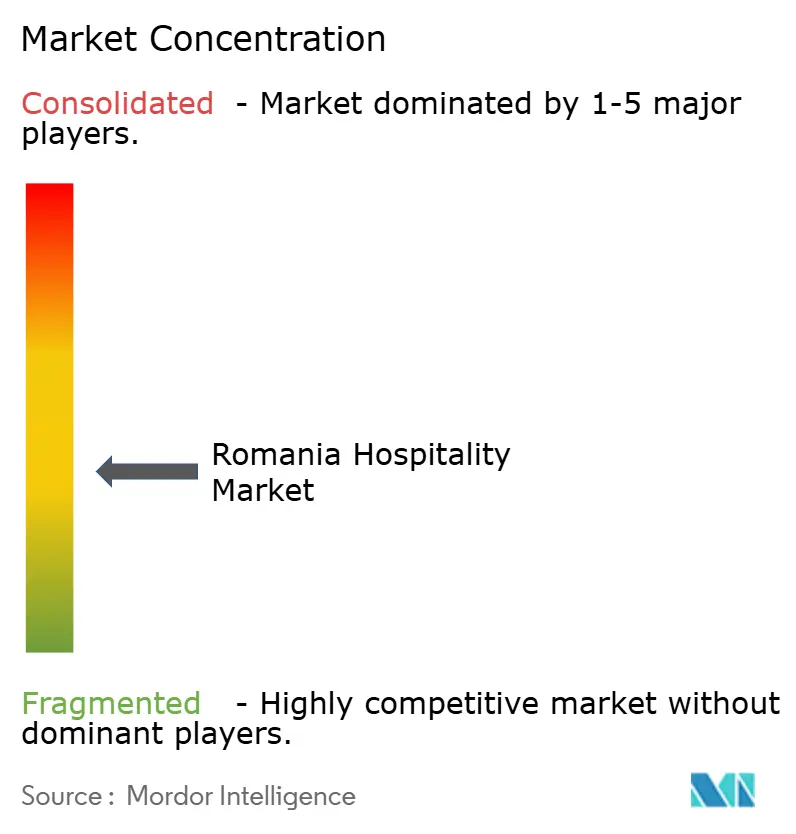
| Market Concentration | Medium |
Major Players *Disclaimer: Major Players sorted in no particular order Image © Mordor Intelligence. Reuse requires attribution under CC BY 4.0. | |
Romania Hospitality Market Analysis by Mordor Intelligence
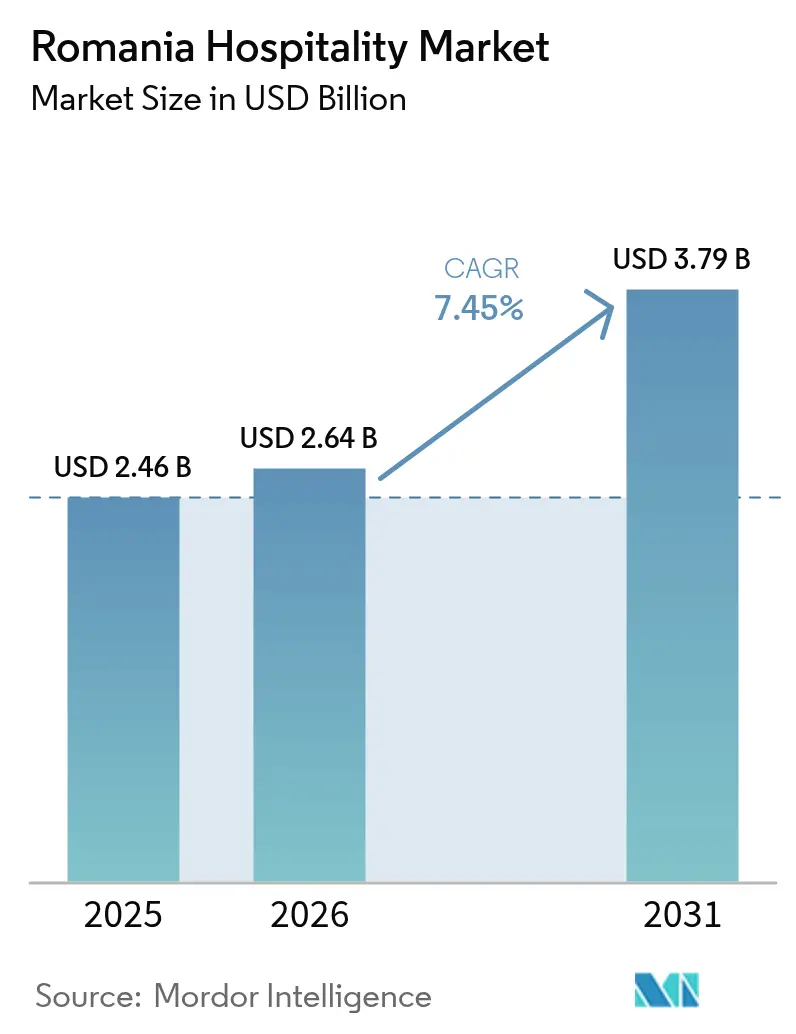
The Romania hospitality market size is expected to grow from USD 2.46 billion in 2025 to USD 2.64 billion in 2026 and is forecast to reach USD 3.79 billion by 2031 at 7.45% CAGR over 2026-2031. Schengen-driven connectivity gains power the expansion, sustained domestic leisure demand, rural tourism funding, and rapid digital adoption. International chains are deploying aggressive pipelines, while independent operators keep leveraging local touchpoints to preserve market breadth. Consumer interest in premium ski and wellness experiences, coupled with EU-financed infrastructure, widens seasonality windows and lifts average daily rates. Persistent labor shortages and legacy licensing hurdles temper growth but also accelerate automation and foreign-talent recruitment strategies, reshaping operating models across the Romania hospitality market.
Key Report Takeaways
- By type, Independent Hotels led with 66.85% Romania hospitality market share in 2025, whereas Chain Hotels are projected to expand at an 10.78% CAGR through 2031.
- By hotel category, Mid-Scale Hotels commanded 41.92% share of the Romania hospitality market size in 2025, while the Upscale & Luxury segment is set to grow at a 10.28% CAGR to 2031.
- By booking channel, Direct bookings held 50.62% of the Romania hospitality market in 2025; Online Travel Agencies record the fastest momentum at 11.62% CAGR through 2031.
- By guest origin, Domestic travelers accounted for 81.74% share of the Romania hospitality market in 2025; International arrivals are accelerating at an 11.28% CAGR.
- By region, Bucharest-Ilfov captured 36.95% Romania hospitality market share in 2025, while the North-East region is advancing at a 10.34% CAGR to 2031.
Note: Market size and forecast figures in this report are generated using Mordor Intelligence’s proprietary estimation framework, updated with the latest available data and insights as of 2026.
Romania Hospitality Market Trends and Insights
Drivers Impact Analysis*
| Driver | (~) % Impact on CAGR Forecast | Geographic Relevance | Impact Timeline |
|---|---|---|---|
| Increasing tourist arrivals rebound | +1.8% | National, with concentration in Bucharest, Constanța, Brașov | Short term (≤ 2 years) |
| Surge in domestic leisure travel post-COVID | +1.5% | National, particularly rural and secondary cities | Medium term (2-4 years) |
| Rapid OTA and digital-payments penetration | +1.2% | Urban centers, expanding to rural areas | Medium term (2-4 years) |
| EU-funded rural and agro-tourism programs | +0.9% | Rural regions, North-East, Centre, Maramureș | Long term (≥ 4 years) |
| Partial Schengen accession boosting connectivity | +1.4% | National, with immediate impact on border regions | Short term (≤ 2 years) |
| Premium ski-resort pipeline in Carpathians | +0.8% | Carpathian regions, Brașov, Maramureș | Long term (≥ 4 years) |
| Source: Mordor Intelligence | |||
Increasing Tourist Arrivals Rebound
Visitor volumes surpassed pre-COVID benchmarks, with 14.26 million arrivals in 2024, 4.5% higher year on year, as Germany, Italy, and Israel surfaced as top source markets while domestic travellers represented 83.3% of total traffic. Overnight stays reached 30.2 million, signalling longer dwell times that underpin revenue consistency across the Romania hospitality market. The rebound allows properties to diversify their international mix and hedge against demand shocks emanating from rival destinations facing geopolitical or capacity constraints.
Surge in Domestic Leisure Travel Post-COVID
Romanian residents generated 83.7% of overnight stays in 2024, fuelling regionally dispersed room demand and prompting a 200% increase in rural accommodation supply in Bucovina alone. National campaigns celebrating local gastronomy and heritage deepen loyalty and support, yield-management flexibility, anchoring baseline occupancy throughout the Romania hospitality market.
Rapid OTA and Digital-Payments Penetration
Government allocation of USD 4.1 billion under the National Recovery and Resilience Plan catalysed fibre rollout and cashless infrastructure, enabling OTAs to grow bookings 12.03% CAGR while direct digital channels employ AI concierges to lift conversion rates [1]. Indigenous platforms such as Szallas capture regional wallet preferences, highlighting the competitive imperative of payment localisation in the Romania hospitality market.
EU-Funded Rural and Agro-Tourism Programs
Common Agricultural Policy grants converted thousands of farms into guesthouses, diversifying rural income and preserving vernacular architecture; current allocations include EUR 50 million for Borșa ski infrastructure. Such projects lengthen seasonal appeal and channel traffic from overcrowded urban nodes into high-spend countryside niches of the Romania hospitality market.
Restraints Impact Analysis*
| Restraint | (~) % Impact on CAGR Forecast | Geographic Relevance | Impact Timeline |
|---|---|---|---|
| Skill shortages and wage inflation | -1.6% | National, acute in urban tourist areas | Short term (≤ 2 years) |
| Complex licensing / zoning regulations | -0.8% | Urban centers, particularly Bucharest | Medium term (2-4 years) |
| Ageing transport infrastructure outside major hubs | -0.7% | Rural and secondary regions, excluding Bucharest-Ilfov | Long term (≥ 4 years) |
| Exposure to volatile energy costs | -0.6% | National, with higher impact on energy-intensive facilities | Medium term (2-4 years) |
| Source: Mordor Intelligence | |||
Skill Shortages and Wage Inflation
Labor gaps of 20-25% nationally, peaking at 50% in prime destinations, force operators to hire South Asian workers at monthly wages of 4,500-5,000 lei (USD 950-1,050), squeezing GOP margins across the Romania hospitality market. Rising personnel expenses accelerate interest in automation and multilingual self-service solutions, but onboarding and cultural-fit costs remain pronounced.
Complex Licensing and Zoning Regulations
Although Emergency Ordinance 31/2025 sets 30-day limits for urban planning permits, overlapping sanitary, energy, and heritage requirements still create unpredictable timelines and capex overruns that deter greenfield projects in the Romania hospitality market [2]. Frequent rule changes without stakeholder input heighten perceived regulatory risk among foreign investors.
*Our forecasts treat driver/restraint impacts as directional, not additive. The impact forecasts reflect baseline growth, mix effects, and variable interactions.
Segment Analysis
By Type: Independent Hotels Hold Scale While Chains Add Pace
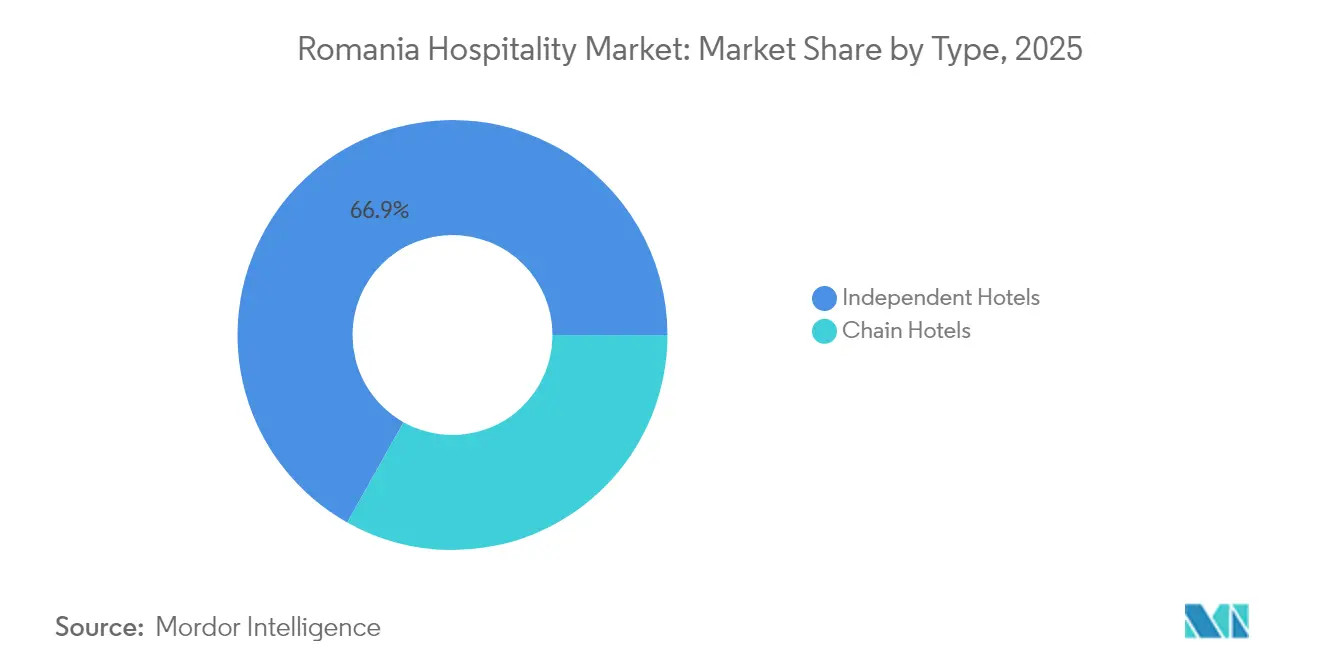
Independent Hotels commanded 66.85% of the Romania hospitality market share in 2025, reflecting the sector’s fragmented roots and guests’ appetite for local character. These operators keep costs lean and tailor experiences to regional tastes, which helps them protect margins even as wages rise. Chain Hotels, though smaller in footprint today, are adding keys at an 10.78% CAGR to 2031 on the back of loyalty-program pull and easier access to investment capital. Their expansion is most visible in Bucharest, Brașov, and along the Black Sea coast, where global brands want to lock in prime plots ahead of demand spikes from Schengen-driven tourism.
The two groups increasingly overlap in guest expectations. Independents are upgrading tech, adopting cloud PMS tools, and pursuing soft-brand affiliations to stay visible on global distribution systems. Chains, meanwhile, are integrating Romanian design cues and farm-to-table menus to sidestep a “cookie-cutter” perception. M&A chatter is growing; high-performing family hotels are becoming targets for groups that need local know-how. Long term, the market is likely to see gradual consolidation, yet a diverse ownership mix should persist and keep price points varied within the Romania hospitality market.

By Hotel Category: Mid-Scale Dominance Faces Luxury Catch-Up
Mid-Scale Hotels represented 41.92% of the Romania hospitality market in 2025, anchored by domestic corporate trips and mid-income leisure stays that favour dependable service over amenities they may not use. Steady conference demand in Bucharest and second-tier cities also underpins weekday occupancy for this band. Upscale and Luxury properties record the fastest lift at 10.28% CAGR, accelerated by projects like the EUR 70 million Kempinski Poiana Brașov and the upgraded InterContinental Athénée Palace Bucharest. Rising disposable income and a stronger outbound elite that now prefers to spend locally drive this pivot to premium.
Luxury developers emphasise larger wellness zones, rooftop dining, and branded residences that create year-round revenue. Operators also bundle cultural tours and vineyard visits to lengthen stays beyond weekend ski runs or city breaks. The shift pressures mid-scale owners to refresh rooms, add co-working lounges, and refine F&B concepts to hold share. Budget and Economy hotels stay resilient by courting price-sensitive groups and sports teams, yet they feel cost heat from higher utilities and staffing. All categories benefit when Schengen entry widens the demand funnel, but each must fine-tune value propositions to capture its slice of the Romania hospitality market.
By Booking Channel: Direct Sales Lead While OTA Momentum Builds
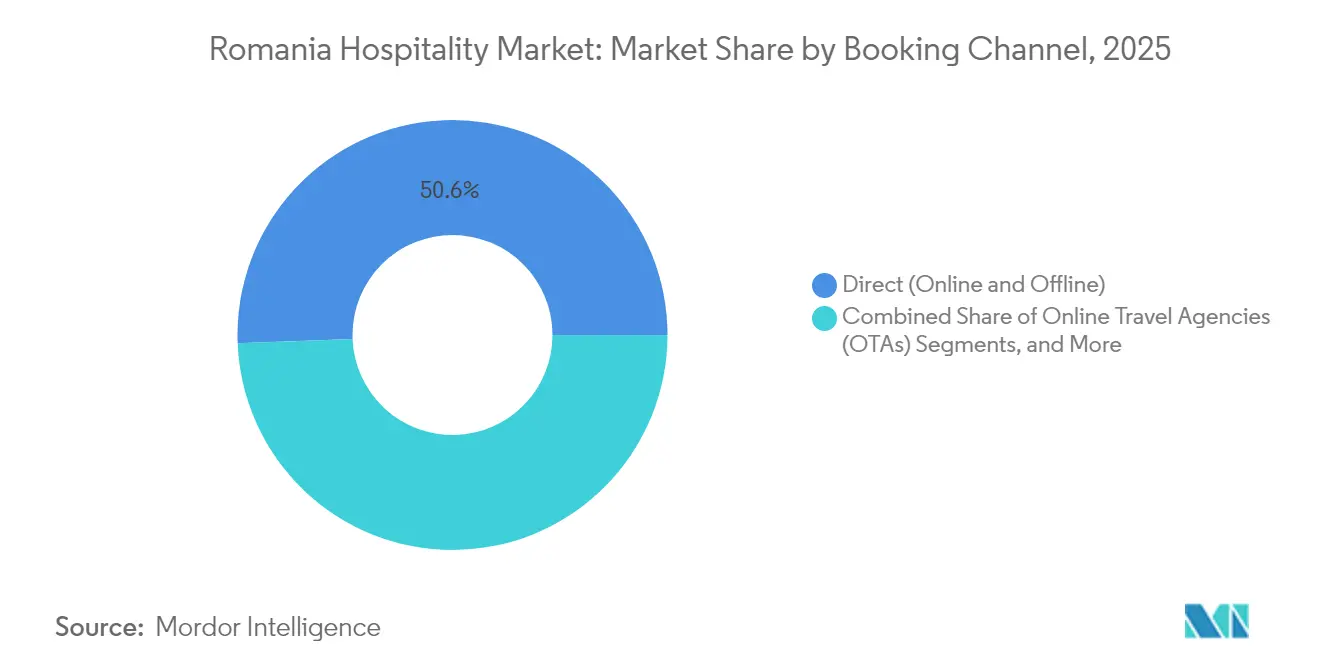
Direct channels—hotel websites, walk-ins, and call centres—retained 50.62% of bookings in 2025, as operators doubled down on member-only rates and digital concierge chat that ease pre-arrival questions. Romanian guests often favour direct contact to secure personalised extras such as late checkout or event tickets Hotels now walk a tightrope: they need OTA visibility for reach yet aim to cap commission costs. Successful properties use rate-parity software, capture email addresses at check-in, and nudge repeat guests toward proprietary apps. Local OTAs such as Szallas Group gain an edge by offering instalment payments and meal vouchers that align with Romanian payroll schemes. Global distribution systems hold steady in corporate travel, though clients increasingly request green-certified properties and dynamic packaging. As digital literacy rises across age groups, channel diversification becomes central to sustaining RevPAR in the Romania hospitality market.
By Guest Origin: Domestic Base Anchors Stability as Foreign Share Rises
Domestic travelers produced 81.74% of total stays in 2025, giving operators a dependable weekday base and softening exposure to currency shifts. Government road upgrades and “Discover Romania” media campaigns nudged city dwellers toward rural guesthouses and spa towns, spreading revenue beyond the capital. International arrivals expand at an 11.28% CAGR thanks to Schengen integration, airline route launches, and glowing coverage in TIME and CNN. Germany, Italy, and Israel supply the largest visitor pools, with North American traffic gaining traction through heritage tourism.
Hotels segment pricing calendars to reflect this mix: value bundles and flexible check-in appeal to locals, while curated wine tastings and castle tours fetch premium rates from foreign guests. Loyalty schemes roll out bilingual apps and QR-based tipping to bridge service expectations. Rural operators add card terminals and multilingual signage to court cross-border self-drive tourists. The combined surge supports year-round occupancy but raises service-quality demands, pressing brands to refine staff training and cultural-awareness modules across the Romania hospitality market.
Geography Analysis
Bucharest-Ilfov remains the country’s demand anchor, marrying corporate, MICE, and cultural itineraries. Swissôtel Bucharest and Hyatt Regency Aro Palace next lift the skyline, while labour scarcity pushes hoteliers toward migrant-worker partnerships and service automation. The North-East region surges on EU rural funds, doubling guesthouse stock and unveiling Borșa’s 25 km ski grid. Authentic heritage draws higher-spend visitors seeking vernacular immersion, yet last-mile transport still limits full potential of the Romania hospitality market. Black Sea coast assets in the South-East tap NATO air-base expansion for year-round bed-night spikes, while Carpathian enclaves in the Centre region upscale with Kempinski and Swissôtel Poiana Brașov. Western border cities benefit from cross-border tourism but need cohesive branding to increase dwell time within the Romania hospitality market.
Regulatory Landscape
Romania's hospitality regulatory framework is overseen by the Ministry of Economy, Digitalisation, Entrepreneurship and Tourism (MEDAT), through its tourism authorization and monitoring functions covering licensing, classification, and compliance. In July 2026, MEDAT updated methodological norms for issuing classification certificates and tourism licenses, including a formal definition for resort-type developments and shorter procedural timelines for completing documentation (cut to 3 months from 6 months), which affects how quickly new and refurbished properties can become fully marketable.
Investment prioritization is also guided by the tourism investments masterplan program (HG 558/2017) and the National Tourism Development Strategy 2025-2035 (approved via Government Decision 1,193/2024 and amended by GD 692/2025). These policies emphasize sustainable destination development and institutional strengthening, including operationalizing Destination Management Organizations. Separately from tourism-specific rules, hospitality operators also have to maintain basic business-registration compliance (such as declaring the point of work and relevant CAEN code) and work through multi-agency permitting and control requirements, which can still introduce timeline variability for greenfield and conversion projects.
Value Chain Analysis
Romania's hospitality value chain typically starts with real estate development and refurbishment, often financed domestically, and then moves into licensing and classification under MEDAT. Hotel operations follow, centered on staffing, utilities, and procurement across food, beverages, linens, amenities, and maintenance services. Demand generation and distribution are split between direct channels (hotel websites, call centers, and walk-ins) and intermediated channels (OTAs, GDS/wholesalers for corporate and group travel), alongside destination-level marketing led by national and local bodies and increasingly by Destination Management Organizations (36 certified DMOs as of mid-2026).
Industry associations such as FIHR, HORA, and FPTR operate across the chain as coordinating nodes, consolidating operator feedback and engaging MEDAT on fiscal and operating constraints. Bottlenecks cluster around labor availability and cost volatility in operating inputs, with national labor gaps and high turnover pressuring service consistency. Procurement and utilities have also shown sharp month-to-month volatility, pushing operators toward tighter menu engineering, vendor consolidation, and more dynamic pricing. Skills development and standardization are supported by the Comitetul Sectorial Turism, Hoteluri, Restaurante (CSTHR), but uneven compliance and perceived competitive imbalance from less-regulated short-term rentals can pull demand away from licensed hotels and complicate revenue management for traditional operators.
Competitive Landscape
Romania hospitality market displays moderate concentration that balances the brand strength of global chains with the numerical dominance of local independents. Ana Hotels, Continental Hotels, Accor, Hilton Worldwide, and Radisson Hotel Group hold leading positions, yet no single operator controls an overwhelming share, preserving space for vigorous price and service competition. Independent properties remain the majority, giving guests varied style and price options while pressuring chains to differentiate through loyalty programmes and consistent standards. Full Schengen accession has lowered access barriers, prompting both incumbents and newcomers to speed up renovation cycles and upgrade brand portfolios.
Radisson Hotel Group has committed to three high-profile openings—Radisson RED Bucharest Old Town, Radisson Blu Grand Mountain Resort Brașov, and Radisson Blu Resort & Residences Mamaia—to seize growing urban and leisure demand. Accor is advancing via management agreements with Construcții Erbașu on Swissôtel Bucharest, Novotel Living Bucharest Baneasa, and ibis Styles Oradea, sharing development risk while scaling brand presence. Ana Hotels is investing EUR 25 million to refurbish the InterContinental Athénée Palace Bucharest, reinforcing premium positioning in the capital. Technology is another differentiator: Le Boutique Hotel Moxa deployed an AI guest-communication platform that lifted direct bookings and guest-satisfaction metrics. Cross-border capital is entering as well, illustrated by Rainbow Tours’ strategic investment in tour operator Paralela 45, which expands distribution reach for domestic hotels [3].
Romania Hospitality Industry Leaders
-
Ana Hotels
-
Continental Hotels
-
Accor / Orbis
-
Hilton Worldwide
-
Radisson Hotel Group
- *Disclaimer: Major Players sorted in no particular order
Market Opportunities and Future Outlook
Destination-led development and specialized resort formats are widening demand beyond core city breaks and traditional seaside seasonality. In March 2026, work started on the EUR 44 million Semenic mountain resort project (15 km of slopes plus gondola and snowmaking), expanding the investable winter-sports footprint outside the most established Carpathian nodes. In April 2026, Prahova County Council designated Gura Vadului as Romania's first wine tourism resort, with an associated EUR 70 million investment plan across transport and accommodation infrastructure, which supports themed, higher-spend rural leisure alongside existing farm-stay and guesthouse supply.
Large-scale entertainment and mixed-use hospitality concepts also create room for accommodation, F&B, and ancillary services tied to festivals and peak-season traffic. NIBIRU in Costinesti was inaugurated on July 16, 2026 as a private investment exceeding EUR 50 million across a 1.6 million square meter area, reinforcing the viability of integrated leisure destinations on the Black Sea coast. Alongside physical development, low digitization highlighted at EnterTech 2026 points to near-term demand for affordable automation across front desk, back-office administration, and guest communications, particularly for independent hotels that rely on direct bookings and need productivity gains to offset staffing constraints.
Recent Industry Developments
- July 2026: Hilton Worldwide opened Hilton Garden Inn Brașov on July 14, 2026 with 156 rooms, developed by CS Best Hospitality and managed by Apex Alliance Hotel Management. The opening adds branded supply in a key leisure and business gateway near the Carpathians, raising the competitive bar for mid-scale and upper mid-scale operators on service consistency and distribution reach.
- June 2026: Monarc Development announced that the Radisson Blu Hotel and Residences Mamaia project entered the development phase, a roughly EUR 70 million investment planned with 234 hotel rooms and 102 branded residences. The project expands the branded resort and residences model on the Black Sea coast, supporting longer-stay demand and higher-spend mixed-use inventory.
- May 2025: Radisson Hotel Group unveiled a multi-property pipeline for Romania including Radisson RED Bucharest Old Town and Radisson Blu Grand Mountain Resort Brașov. The disclosed pipeline signaled continued international brand commitment across urban and mountain leisure corridors, increasing competitive pressure on independents to refresh their product and strengthen direct and OTA channel execution.
Research Methodology Framework and Report Scope
Market Definition and Coverage
For this study, the Romania hospitality market is defined as revenue generated from paid accommodation stays in Romania, across chain and independent properties, and captured in current USD for the base year and forecast years.
Scope exclusions: Food-only outlets, standalone nightlife, and travel transportation services are excluded unless they are bundled and billed as part of the accommodation stay.
Segmentation Overview
- By Type
- Chain Hotels
- Independent Hotels
- By Hotel Category
- Upscale and Luxury Hotels
- Mid-Scale Hotels
- Budget and Economy Hotels
- By Booking Channel
- Direct (Online and Offline)
- Online Travel Agencies (OTAs)
- GDS and Wholesalers
- By Guest Origin
- Domestic Travelers
- International Travelers
- By Region
- North East
- South East
- South Muntenia
- South West Oltenia
- West
- North West
- Centre
- Bucharest Ilfov
Data Sources, Market Sizing, and Validation
Desk Research
Desk research started with public tourism and macro datasets that explain demand, capacity, and pricing direction over time. We used sources such as Romania's National Institute of Statistics, Eurostat tourism statistics, UN Tourism datasets, the World Bank macro series, and National Bank of Romania releases to interpret arrivals, nights spent, consumer spending signals, and currency trends.
To make the numbers usable in a market model, the public series were aligned with supply-side context from operator communications, company filings (where available), investor materials, association websites, and reputable press coverage on openings, refurbishments, and brand entries. A paid subscription database was used selectively for company financials and news screening, so we could cross-check unusual jumps and confirm timing of major capacity changes. These desk sources are not exhaustive, and we reviewed additional public references for data collection, validation, and clarification.
Primary Interviews and Surveys
We interview hotel owners and operators, chain and independent property managers, booking specialists, and tourism advisors within Romania. Their input helps assess occupancy, average daily rates, booking channel mix, seasonality, new room openings, and guest origin at property and market level. We use these responses to revisit gaps in the desk data and triangulate assumptions before finalizing the analysis.
Distribution of primary research fieldwork respondents
| Company type | Respondent position |
|---|---|
| Top tier: 28% | CXOs: 15% |
| Mid tier: 47% | Functional/Unit leaders: 35% |
| Smaller Players: 25% | Managers: 50% |
Market-Sizing & Forecasting
Sizing was built using top-down and bottom-up methods, where the primary structure comes from accommodation demand pools and then gets checked against supply-side reality. On the top-down side, arrivals, nights spent, and occupancy direction from official statistics were translated into room nights, which were then paired with observed ADR movement to reconstruct revenue in USD for the base year.
To keep the totals realistic, selective bottom-up approximations were used as a cross-check, including sampled property counts by category, typical room inventory ranges, and channel checks on rate positioning in peak and shoulder months. Key inputs that were tracked and updated include room inventory changes (openings and closures), occupancy and length-of-stay shifts, ADR progression by category, domestic versus international guest mix, and booking channel mix (direct, OTAs, and intermediated channels).
Forecasting was done using scenario analysis supported by a simple multivariate regression lens, where ADR and demand are linked to travel sentiment, income and inflation conditions, and air connectivity direction. When bottom-up visibility was limited for smaller independents, gaps were handled using penetration assumptions derived from local expert feedback, then stress-tested against official nights-spent trends.
Data Validation & Update Cycle
Validation was handled through step-by-step checks so that one data series did not overly drive the outcome. We compared model outputs against independent signals such as nights spent trends, accommodation capacity additions, and the implied occupancy-ADR combination, and then we investigated outliers before internal sign-off.
If major mismatches appeared (for example, a revenue jump without a supporting change in nights spent or ADR direction), assumptions were reworked and relevant respondents were re-contacted to confirm what changed in the market. Reports are refreshed annually, with interim updates when material events occur such as policy shifts, sharp demand disruptions, or major hotel pipeline changes. Before delivery, an analyst performs a fresh pass so clients receive the latest updated view.
Mordor Intelligence's Romania Hospitality Market Size Measured Against Other Published Estimates
Published market sizes for Romania hospitality can vary even when the country focus looks identical, because what is counted as hospitality revenue is not consistent across sources. Differences also come from how demand is translated into value, especially when room nights and average daily rate are refreshed at different times.
In practice, the biggest gaps usually come from whether the estimate counts only paid accommodation revenue, or also adds adjacent visitor spend, and from how chain versus independent properties are handled when official series are incomplete. The treatment of OTA commissions in reported revenue, the way ADR is carried through seasonality, and currency conversion timing can each move the final USD value.
Benchmark comparison
| Source | Market Size | Gaps in Research Methodology |
|---|---|---|
| Mordor Intelligence | USD 2.46 B (2025) | |
| Industry Association A | USD 2.10 B (2025) | Uses a narrower accommodation set that can undercount independents and smaller regional properties, and it often relies on supply snapshots without fully adjusting for sellable inventory constraints. |
| Trade Journal B | USD 2.95 B (2025) | Often folds in broader visitor spend around the stay (like packages and some on-property services) and applies generalized ADR growth that is not always tied back to Romania seasonality patterns. |
The spread mostly traces back to whether only paid accommodation revenue is counted, and to how independents are captured when converting nights into value, with a tighter link to nights spent and category-level ADR checks in Mordor Intelligence.
Key Questions Answered in the Report
How large is the Romania hospitality market in 2026?
The Romania hospitality market is valued at USD 2.64 billion in 2026 and is projected to grow to USD 3.79 billion by 2031 at a 7.45% CAGR.
Which hotel segment is expanding fastest?
Upscale and Luxury hotels show the highest growth, advancing at a 10.28% CAGR on the back of premium ski resorts and wellness investments.
What impact does Schengen accession have on tourism?
Full Schengen membership from January 2025 lifted Q1 2025 international arrivals by 11.7%, improving accessibility and boosting investor interest.
How severe is the labour shortage in Romanian hospitality?
The sector faces a 20-25% worker deficit nationally, rising to 50% during peak seasons in tourist hotspots, driving wage inflation and recruitment of foreign staff.
Which Romanian region offers the highest growth potential?
The North-East region leads with a 10.34% CAGR through 2031, supported by EU-financed rural tourism projects and ski infrastructure upgrades.
Are Online Travel Agencies gaining share?
Yes, OTA bookings are forecast to grow at a 11.62% CAGR as improved digital infrastructure and mobile payment adoption make third-party platforms more convenient for domestic and international consumers.