Robotic Software Platforms Market Size and Share
Market Overview
| Study Period | 2020 - 2031 |
|---|---|
| Market Size (2026) | USD 7.58 Billion |
| Market Size (2031) | USD 23.07 Billion |
| Growth Rate (2026 - 2031) | 24.93% CAGR |
| Fastest Growing Market | Asia Pacific |
| Largest Market | Asia-Pacific |
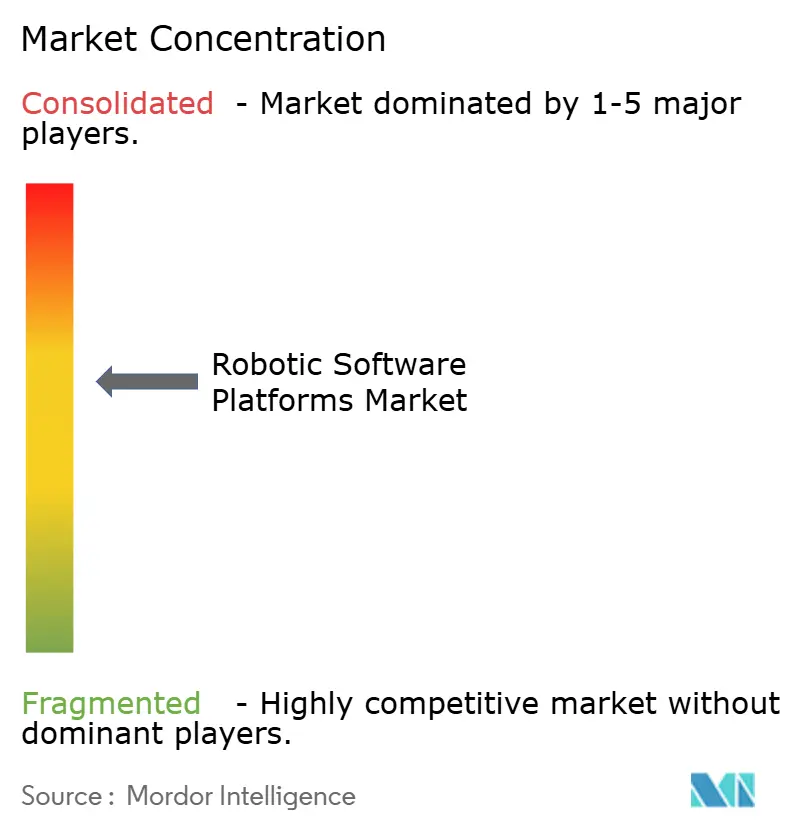
| Market Concentration | Medium |
Major Players *Disclaimer: Major Players sorted in no particular order Image © Mordor Intelligence. Reuse requires attribution under CC BY 4.0. | |
Robotic Software Platforms Market Analysis by Mordor Intelligence
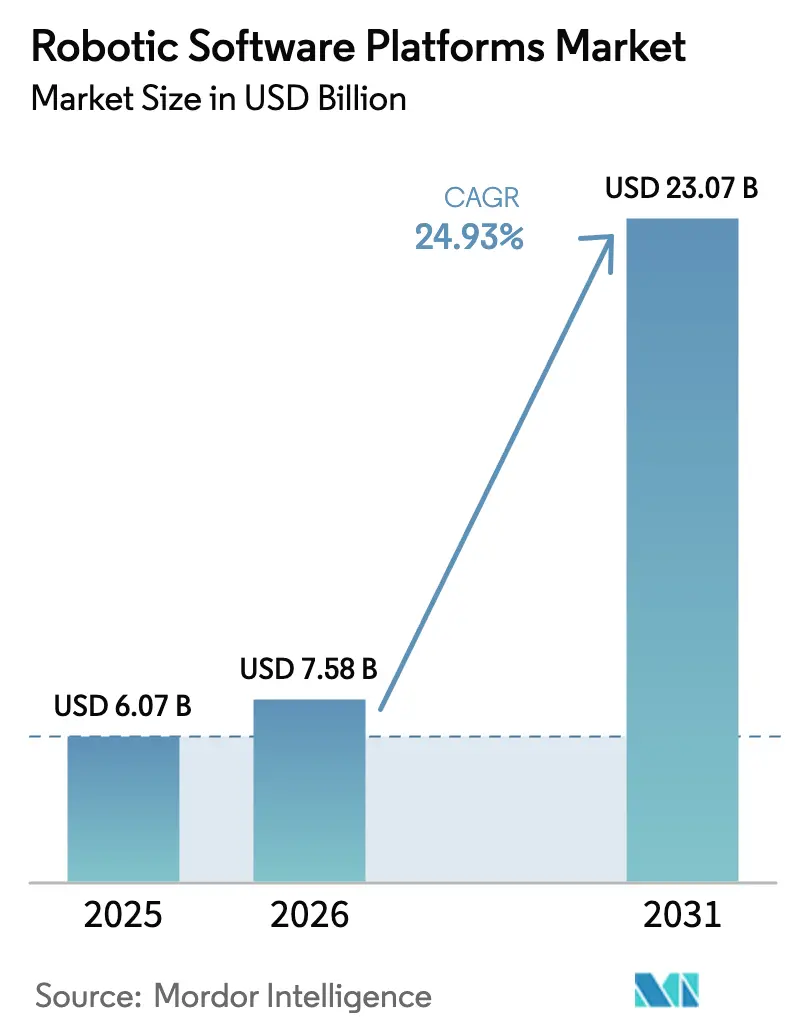
The Robotic Software Platforms Market size was valued at USD 6.07 billion in 2025 and estimated to grow from USD 7.58 billion in 2026 to reach USD 23.07 billion by 2031, at a CAGR of 24.93% during the forecast period (2026-2031).
Surging demand stems from enterprises shifting focus from hardware to intelligent code that enables adaptive automation, while generative AI compresses robot-deployment cycles from months to weeks. Industrial-edge AI brings sub-millisecond decision-making on the factory floor, supporting latency-sensitive tasks without constant cloud connectivity. Governments further accelerate uptake, with the US Advanced Manufacturing Investment Credit offering 25% relief on software that modernizes production. Yet legacy industrial protocols and rising vision-AI licensing fees inhibit seamless integration, especially in brownfield sites where equipment dating back decades remains indispensable. [1]Internal Revenue Service, “Inflation Reduction Act—Advanced Manufacturing Investment Credit,” irs.gov
Key Report Takeaways
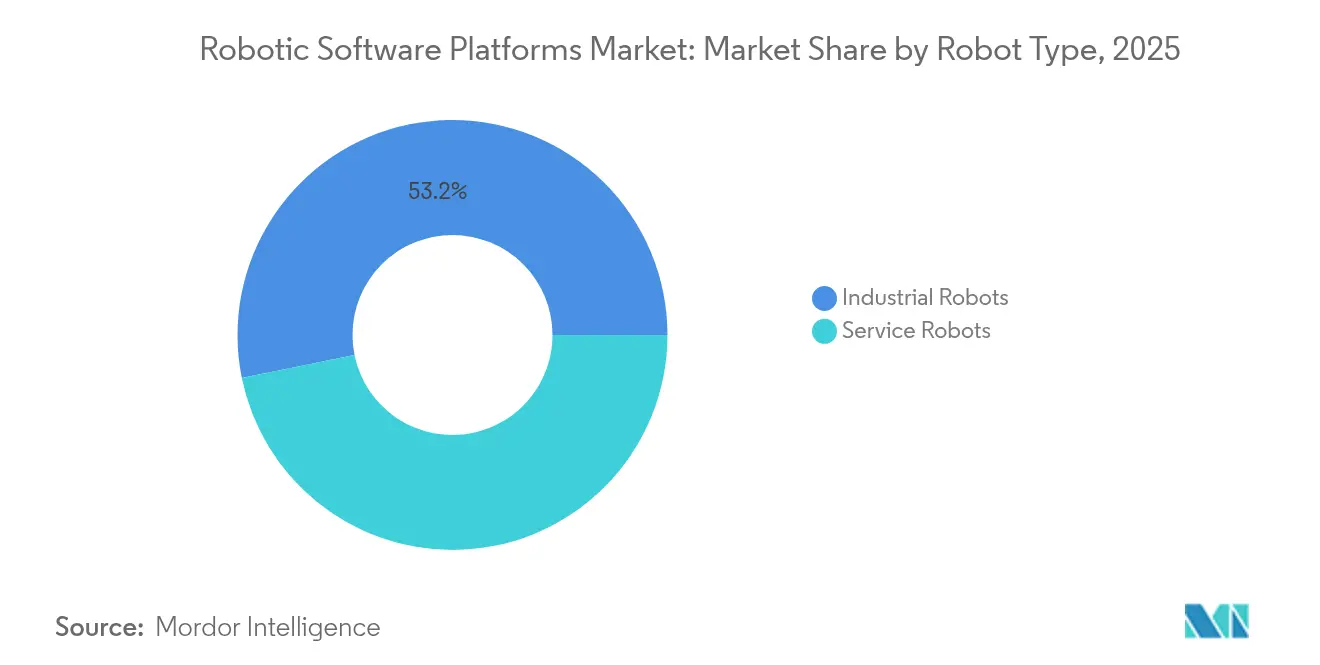
- By robot type, industrial robots commanded 53.20% of the robotic software platforms market share in 2025, while service robots are expanding at a 30.10% CAGR through 2031.
- By software type, simulation and digital-twin tools held 26.50% revenue share of the robotic software platforms market size in 2025; predictive-maintenance platforms lead growth at 31.60% CAGR to 2031.
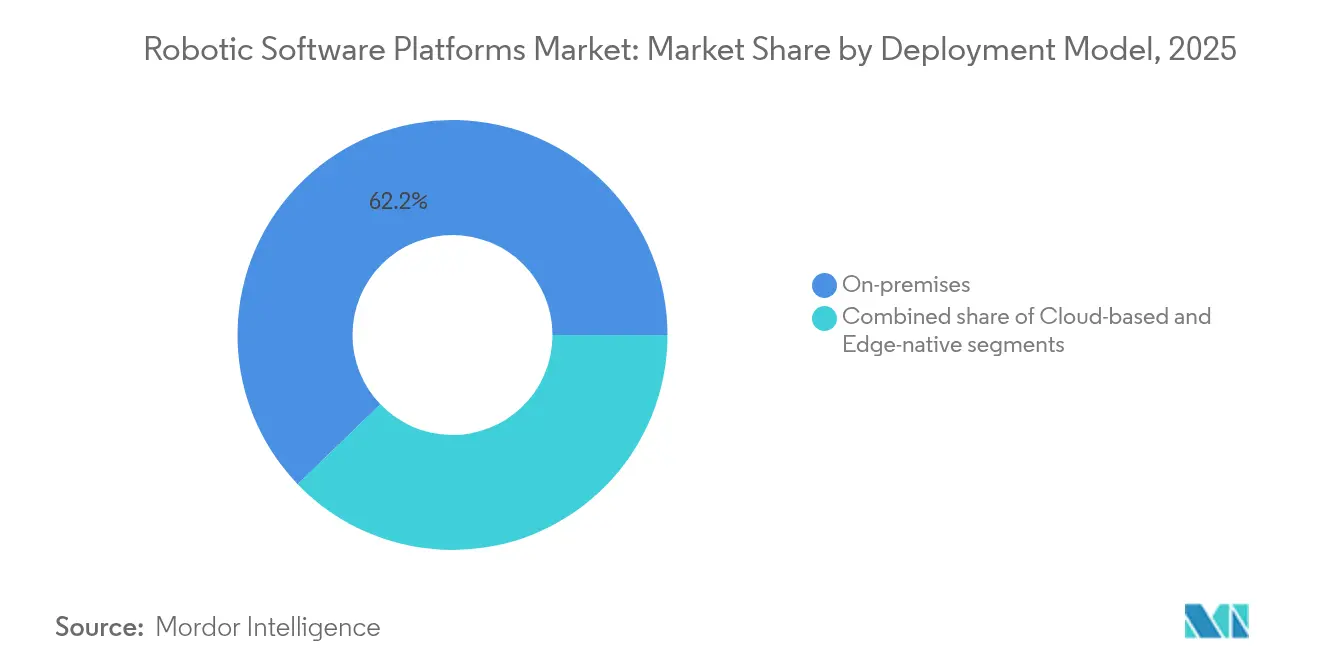
- By deployment model, on-premises installations accounted for a 62.20% share of the robotic software platforms market size in 2025, whereas cloud deployments recorded the fastest 34.10% CAGR through 2031.
- By end-user industry, automotive captured 23.60% of the robotic software platforms market share in 2025, yet healthcare applications are forecast to rise at a 28.80% CAGR to 2031.
- By geography, APAC led with 40.70% revenue share in 2025 and is projected to grow at a 30.60% CAGR to 2031.
Note: Market size and forecast figures in this report are generated using Mordor Intelligence’s proprietary estimation framework, updated with the latest available data and insights as of 2026.
Market Trends and Insights
Drivers Impact Analysis of Robotic Software Platforms Market*
| Driver | (~) % Impact on CAGR Forecast | Geographic Relevance | Impact Timeline |
|---|---|---|---|
| Accelerated low-code robot programming tools | +4.20% | Global, with early adoption in North America and EU | Short term (≤ 2 years) |
| Industrial-edge AI enabling on-device autonomy | +6.80% | APAC core, spill-over to North America | Medium term (2-4 years) |
| Collaborative-robot safety certifications harmonising globally | +3.10% | Global, led by EU regulatory framework | Medium term (2-4 years) |
| Robot-as-a-Service uptake among SMEs | +5.40% | North America and EU, expanding to APAC | Long term (≥ 4 years) |
| Government tax credits for smart-factory software | +2.90% | National, with concentration in US, Germany, China | Short term (≤ 2 years) |
| Cyber-physical security mandates for critical infrastructure robots | +3.70% | Global, with stringent requirements in North America and EU | Long term (≥ 4 years) |
| Source: Mordor Intelligence | |||
Accelerated Low-Code Robot Programming Tools
Drag-and-drop and natural-language interfaces cut robot programming time by up to 80%, as illustrated by ABB AppStudio’s 2025 launch. The democratization addresses the 2.1 million manufacturing-talent gaps projected for 2030. Mid-market manufacturers gain affordability because fewer specialist engineers are needed. Faster configuration lowers payback periods, enabling robots to handle high-mix, low-volume tasks that once lacked economic justification. Vendors embedding reusable code blocks further shrink commissioning labour. Consequently, low-code capability becomes a must-have feature when buyers shortlist robotic software platforms market offerings. [2]ABB Group, “ABB AppStudio Launch 2025,” global.abb
Industrial-Edge AI Enabling On-Device Autonomy
Shifting inference from cloud to robot improves latency, privacy, and reliability in safety-critical settings such as welding cells that require sub-10 ms reaction windows. NVIDIA’s Isaac platform adoption by Siemens and BYD Electronics reflects mainstream deployment of edge GPUs for perception and path planning. Reduced bandwidth costs help plants in regions with unstable connectivity. Edge AI also supports redundant fail-safe operation during network outages, aligning with insurance requirements for continuous production. As 5G networks mature, edge nodes gain deterministic wireless links, further broadening use cases for adaptive mobile robots inside the robotic software platforms market.
Collaborative-Robot Safety Certifications Harmonizing Globally
Convergence of ISO 3691-4 and ANSI/RIA R15.08 lets vendors design once and sell worldwide, lowering certification overhead. UL Solutions reports growing demand for functional-safety assessments targeting SIL 3 performance. Unified standards also reassure buyers that cobots can work beside staff without cages, driving deployments in food, cosmetics, and electronics assembly. Harmonization accelerates software innovation in dynamic speed and separation monitoring. Improved safety boosts worker acceptance, a soft factor that still decides project approvals in many facilities.
Robot-as-a-Service Uptake Among SMEs
Subscription models eliminate capital-budget barriers, letting SMEs pay per operating hour rather than purchase hardware outright. The RaaS market is projected to reach USD 34 billion by 2026. Brain Corp reports its fleet has covered 250 billion ft², evidencing scale-up under usage-based billing. Providers handle maintenance and software updates, relieving customers of technical complexity. Access to advanced capabilities levels the playing field between small workshops and multinationals, expanding the addressable base of the robotic software platforms market.
Restraints Impact Analysis of Robotic Software Platforms Market*
| Restraint | % Impact on CAGR Forecast | Geographic Relevance | Impact Timeline |
|---|---|---|---|
| Legacy industrial protocols slowing data interoperability | -3.80% | Global, with acute challenges in North America and EU brownfield sites | Medium term (2-4 years) |
| Scarcity of ROS2-skilled engineers | -4.60% | Global, with particular shortages in APAC and North America | Long term (≥ 4 years) |
| Escalating licence costs for vision-AI IP cores | -2.90% | Global, with higher impact on SMEs and emerging market players | Short term (≤ 2 years) |
| Pending EU AI Act liability exposure for autonomous systems | -3.20% | EU core, with spillover effects on global robotics vendors | Medium term (2-4 years) |
| Source: Mordor Intelligence | |||
Legacy Industrial Protocols Slowing Data Interoperability
Modbus, Profibus, and proprietary fieldbuses remain entrenched in decades-old equipment, impeding plug-and-play connectivity with OPC UA and other modern frameworks. Integration often needs protocol gateways that add latency, cost, and maintenance overhead. Plants juggling multiple vendor ecosystems struggle to maintain version parity across controllers. Time-Sensitive Networking promises help, yet its maturity and price keep many firms in pilot mode. Consequently, brownfield sites experience elongated project schedules and higher integration risk, slowing overall robotic software platforms market adoption.
Scarcity of ROS2-Skilled Engineers
ROS2 delivers real-time performance and enhanced security, but the talent pool remains limited. Universities only began updating curricula in 2024, creating a lag that recruiters feel today. Salaries for senior ROS2 developers exceed USD 180,000, inflating project budgets. Platform abstractions like Wind River’s VxWorks integration alleviate some complexity but cannot fully replace deep ROS2 expertise. The shortage is most pronounced in APAC where rapid robot deployment outpaces local workforce development, restraining the robotic software platforms market. [3]RoboticsTomorrow, “ROS2 Talent Shortage,” roboticstomorrow.com
*Our forecasts treat driver/restraint impacts as directional, not additive. The impact forecasts reflect baseline growth, mix effects, and variable interactions.
Robotic Software Platforms Market Segment Analysis
By Robot Type:
Service Robots Outpace Industrial SystemsIndustrial robots retained 53.20% share of the robotic software platforms market in 2025 because automotive and electronics plants run thousands of articulated arms on deterministic code. However, service robots register a 30.10% CAGR through 2031, far ahead of traditional counterparts. Hospitals expand surgical-assistant fleets, while retailers deploy inventory-scanning units to trim stock-out losses. Johns Hopkins researchers trained surgical robots to learn tasks by watching videos, illustrating how AI deepens software differentiation. Meanwhile, automotive players such as BMW pilot humanoid robots for in-plant logistics, demonstrating convergence between service and industrial paradigms.
Service-robot momentum underscores the value of adaptive perception and human-interaction algorithms versus rigid motion paths. Healthcare buyers rank system intelligence over payload capacity, tilting budgets toward platforms that update continuously via cloud pipelines. Industrial buyers respond by requesting similar capabilities like self-optimizing weld paths. The robotic software platforms market thus shifts toward unified platforms that can support both high-volume manufacturing and low-volume service environments.


By Software Type:
Predictive Maintenance AcceleratesSimulation and digital-twin packages held a 26.50% slice of the robotic software platforms market size in 2025 because they de-risk cell layouts before hardware purchase. Yet predictive-maintenance suites are achieving a 31.60% CAGR through 2031 as downtime avoidance proves a quantifiable benefit. Integrating vibration, temperature, and current sensors into AI models lets operators service robot before failure, extending mean time between repair by 15% on average.
Vendors now bundle AI-powered twins that generate synthetic data to improve fault-detection accuracy. Coupling maintenance insights with spare-parts logistics optimizes warehouse stock levels, delivering cross-functional savings. Escalating licensing fees for proprietary vision IP squeeze margins, prompting software houses to develop open-source or home-grown models. Edge-native inference further shifts value from centralized analytics toward on-device diagnosis. These dynamics reinforce predictive maintenance as the fastest-growing slice of the robotic software platforms market.
By Deployment Model:
Cloud Gains on On-Premises DominanceOn-premises solutions commanded 62.20% of the robotic software platforms market size in 2025, driven by deterministic-control requirements. However, cloud deployments grow at 34.10% CAGR through 2031 as enterprises pursue continuous feature delivery and fleet-level optimization. Vendors now offer hybrid stacks where safety-critical loops run locally, while analytics offload to elastic cloud compute.
CISA guidelines classify robot controllers as OT assets, steering critical-infrastructure operators to edge-native models for security and latency. Meanwhile, mid-tier manufacturers adopt cloud-only offerings to avoid CapEx on servers and redundant power. The net effect is a widening spectrum of deployment choices that customers tailor to process criticality, cementing hybrid frameworks as the mainstream architecture within the robotic software platforms market.
By End-User Industry:
Healthcare Leads GrowthAutomotive held 23.60% of the robotic software platforms market share in 2025, thanks to long-running applications such as welding, painting, and final assembly. Healthcare, though smaller, posts a 28.80% CAGR to 2031, buoyed by aging populations and rising demand for minimally invasive surgery. Surgeons rely on AI guidance for suture placement and tissue classification, pushing vendors to integrate vision and haptic feedback modules.
Telesurgery via 5G expands specialist access in rural regions, while hospitals implement robotic ward assistants for supply delivery. Logistics operators adopt autonomous mobile robots to handle e-commerce peaks, reflecting cross-industry spillovers. Agriculture and food processing eye wash-down compliant robots to counter labour shortages. These diverse use cases highlight how vertical specializations shape purchasing criteria, yet all share a dependency on scalable, secure, and updateable software, reinforcing growth momentum in the robotic software platforms market.
Geography Analysis
APAC Robotic Software Platforms Market
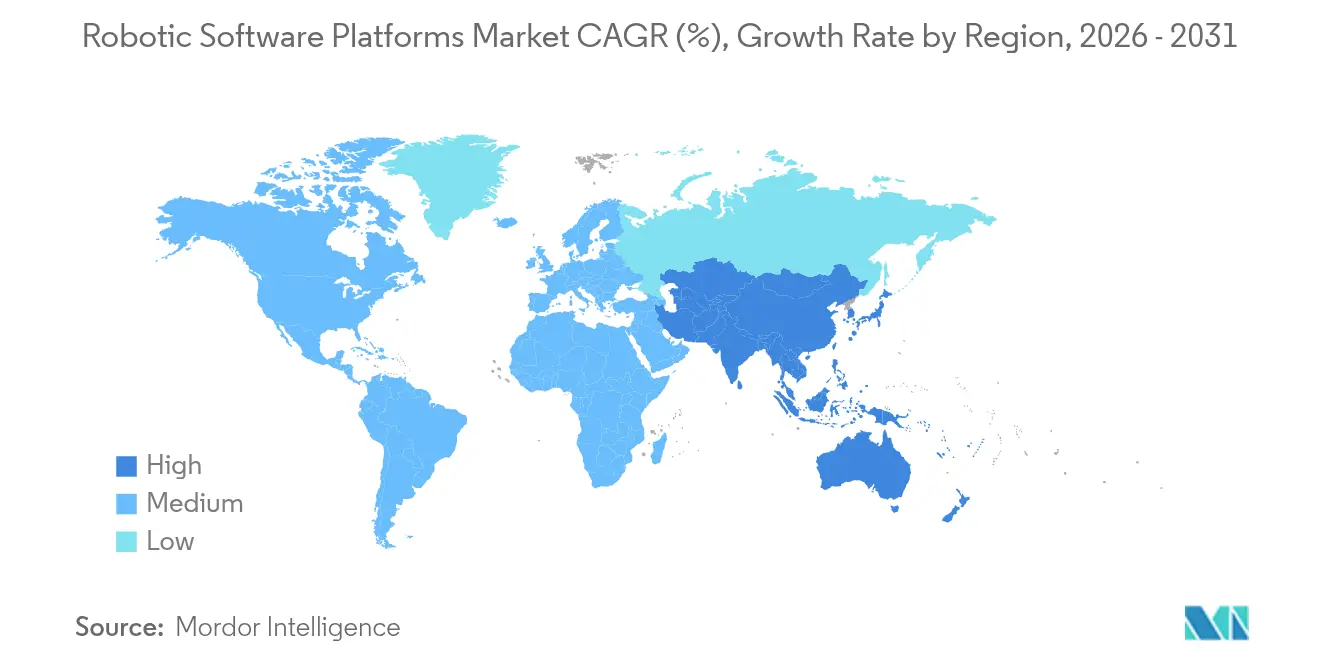
APAC generated 40.70% of global revenue in 2025 and is set to expand at a 30.60% CAGR through 2031, underscoring its manufacturing concentration. China’s USD 138 billion robotic investment pledge catalyses local supplier ecosystems, while Japan and South Korea invest in service robotic for eldercare. Local governments subsidize automation for small exporters, broadening the robotic software platforms market footprint across tier-two cities.
North America Robotic Software Platforms Market
North America benefits from generous tax credits and robust venture funding for AI-native startups. Early adoption of edge architectures supports deployments in automotive, aerospace, and fulfilment centers. Regulatory clarity on collaborative-robot safety gives integrators a stable framework to scale solutions. Canada’s warehouses deploy fleet-management software that optimizes battery utilization and aisle navigation, evidence of cross-border knowledge transfer.
EMEA and LATAM Robotic Software Platforms Market
Europe enforces the AI Act, classifying industrial robots as high-risk systems that must document data provenance and explainability. Compliance adds workload yet raises trust, which local suppliers leverage when exporting to stricter jurisdictions. Central and Eastern European plants modernize to counter labour shortages, while Scandinavian hospitals adopt rehabilitation robots. Emerging markets in Latin America, the Middle East, and Africa adopt RaaS models that bypass capital constraints, slowly diversifying regional demand streams for the robotic software platforms market.

Regulatory Landscape
International safety and compliance requirements for robotic systems increasingly shape software-platform design choices, particularly as AI-enabled autonomy extends beyond deterministic industrial use. ISO 10218-1:2025 and ISO 10218-2:2025 (published February 2025) updated safety requirements for industrial robots, applications, and robot cells, setting functional-safety expectations that flow into simulation, validation, and safety-logic tooling within robotic software platforms.
Country and regional standardization efforts further translate these requirements into procurement checklists. CSA Z434-2026 adopts the 2025 ISO 10218 standards for the Canadian market, while ISO/TC 299 continues to drive global robotics standardization across safety and autonomy-related topics. In Europe, the European Commission ICT standardisation Rolling Plan includes robotics and autonomous systems, reinforcing a structured pathway for interoperability and safety-aligned software stacks in both industrial and service deployments.
Value Chain Analysis
The value chain centers on a software control plane that spans perception and AI inference, simulation and digital twins, orchestration or fleet management, and safety validation, layered on robot controllers and edge compute. Platform vendors and ecosystem partners increasingly rely on common simulation and scene-description foundations to tighten the sim-to-real loop, with NVIDIA Isaac Sim and Omniverse frequently positioned as the digital-twin layer for application development, virtual commissioning, and validation.
Downstream, integrators and end users assemble deployments using edge and OT connectivity elements that bridge legacy plant environments and modern analytics. Multi-robot coordination and facility workflows are also aligning with open reference frameworks such as Open-RMF, while interoperability patterns cited in 2026 reference architectures commonly combine lightweight edge orchestration (for example, K3s) with telemetry and industrial integration layers (for example, MQTT 5 and OPC UA). Differentiation therefore shifts toward reusable software components, certified safety toolchains, and integration middleware that reduces brownfield friction.
Competitive Landscape
The robotic software platforms market is moderately fragmented, with no vendor covering the whole stack from perception to enterprise orchestration. ABB, KUKA, and FANUC embed tight hardware integration yet accelerate software roadmaps via acquisitions of AI startups. ABB’s 2025 plan to list its robotic unit reflects the strategic value of standalone software revenues.
NVIDIA and Samsung invested USD 35 million in Skild AI, signalling chipmakers’ commitment to build developer ecosystems that sit atop GPU hardware. KUKA enhances its Sunrise.OS with adaptive-path modules learned from cloud training, while FANUC’s ROBOGUIDE v10 adds VR-based offline programming to shorten commissioning. Universal Robots focuses on plug-and-produce APIs that align with SMEs needing rapid deployment.
Startups specializing in natural-language coding, autonomous learning, and edge-native perception secure funding by promising faster ROI. System integrators monetize middleware that bridges ROS2 with legacy PLC networks. Large integrators pursue platform consolidation to simplify sourcing for global manufacturers. Overall, supplier strategies converge on lowering time-to-value and simplifying updates, themes that will shape competitive dynamics in the robotic software platforms market through 2030.
Robotic Software Platforms Industry Leaders
ABB Ltd.
Fanuc Corporation
NVIDIA Corporation
International Business Machines Corporation (IBM)
Brain Corporation
- *Disclaimer: Major Players sorted in no particular order
Robotic Software Platforms Market Companies Covered in this Report
- ABB Ltd.
- AIBrain Inc.
- Brain Corp.
- CloudMinds Technology Inc.
- Cyberbotics Ltd.
- Energid Technologies Corp.
- Fanuc Corp.
- Furhat Robotics AB
- International Business Machines Corp.
- iRobot Corp.
- KUKA AG
- NVIDIA Corp.
- Neurala Inc.
- Realtime Robotics Inc.
- ADLINK Technology Inc.
- Robotic Systems Integration LLC

Market Opportunities and Future Outlook
A clear opportunity is in virtual commissioning and physically accurate digital twins that shorten deployment cycles and reduce integration risk in brownfield settings where legacy protocols remain dominant. In 2026, ABB and FANUC highlighted tighter integration of NVIDIA Omniverse libraries and Isaac simulation frameworks into their software stacks, indicating that simulation, validation, and digital-twin fidelity are moving into core buying criteria rather than add-on tools. That shift creates whitespace for platforms that package cell-level safety validation, PLC and OT connectivity, and repeatable digital-twin templates for high-mix manufacturing and multi-site rollouts.
Edge-native autonomy is also a near-term monetization lane as inference moves onto robot controllers for latency-sensitive tasks, which raises demand for standardized deployment, monitoring, and update pipelines across mixed fleets. NVIDIA Jetson modules positioned for controller-side inference, paired with platform-level orchestration, increases requirements for secure lifecycle management, including model versioning, audit trails, and rollback, alongside performance tooling. At the same time, safety standard refreshes, including ISO 10218-1:2025 and ISO 10218-2:2025 and CSA Z434-2026 in Canada, push vendors and users toward software platforms that embed compliance documentation, validation workflows, and functional-safety evidence generation within the development and commissioning process.
Recent Industry Developments in Robotic Software Platforms Market
- July 2026: NVIDIA announced a coalition with Japan’s robotics and manufacturing leaders, including FANUC, to build open frontier physical AI models using its Cosmos, Isaac, and Metropolis platforms. The effort expands a shared developer and model ecosystem around robot simulation, perception, and deployment tooling. It also increases the pull-through of NVIDIA-aligned software stacks into industrial robot programs.
- April 2026: Tennant Company and Brain Corp agreed to extend an exclusivity arrangement for next-generation robotic floor care under a multi-year collaboration. The companies also committed to a larger pipeline of new robotic products over a defined development window, tying hardware roadmaps more tightly to BrainOS capabilities. This reinforces verticalized software platform strategies where fleet operations and updates are standardized across deployed robots.
- March 2026: ABB announced RobotStudio HyperReality, adding NVIDIA Omniverse libraries to support higher-fidelity virtual commissioning, with availability planned for the second half of 2026. The release improves digital twin accuracy and visualization within ABB’s programming and simulation workflow. It raises competitive pressure on platform vendors to integrate sim-to-real validation features that reduce commissioning time and rework.


Robotic Software Platforms Market Report Scope and Research Methodology
Market Definition and Coverage
This market covers software platforms used to build, integrate, simulate, orchestrate, and operate robots, including core runtime, development tools, and platform-level services sold to commercial users across industries.
Scope exclusions: We exclude standalone robot hardware revenue and general enterprise software that is not robot-specific, even if it is used in automation projects.
Segments Covered in This Report
- By Robot Type
- Industrial Robots
- Service Robots
- By Software Type
- Communication Management
- Data Management and Analytics
- Predictive Maintenance
- Recognition / Vision
- Simulation and Digital Twin
- By Deployment Model
- On-premises
- Cloud-based
- Edge-native
- By End-User Industry
- Automotive
- Transportation and Logistics
- Healthcare
- Retail and E-commerce
- Manufacturing (Discrete and Process)
- Government and Defense
- ICT and Data-Centers
- Other Verticals
- By Geography
- North America
- United States
- Canada
- Europe
- Germany
- France
- United Kingdom
- Italy
- Rest of Europe
- Asia-Pacific
- China
- Japan
- India
- South Korea
- Rest of Asia-Pacific
- South America
- Brazil
- Argentina
- Rest of South America
- Middle East and Africa
- Middle East
- Saudi Arabia
- UAE
- Turkey
- Africa
- South Africa
- Nigeria
- Rest of Africa
- Middle East
- North America
Data Sources, Market Sizing, and Validation
Desk Research
Desk research was used to set the market boundaries, build a clean list of platform use cases, and create realistic input ranges before speaking to industry participants. We relied on public sources such as the International Federation of Robotics (IFR) for robot installation context, National Institute of Standards and Technology (NIST) publications for software and safety references, and ISO or IEC standards pages for robotics and functional safety terminology.
To translate activity signals into a measurable demand pool, we also reviewed sources such as US Bureau of Labor Statistics data for automation-linked workforce shifts, patent databases for robotics software filing intensity, and peer-reviewed robotics journals for adoption patterns of simulation, middleware, and autonomy stacks. Company filings, earnings call notes, investor presentations, and reputable tech press were then used to validate product scope and pricing logic, while paid subscriptions for company financials and news helped cross-check revenue mix and partnership announcements. This desk research list is illustrative, and many other public and paid sources were consulted for data collection, validation, and clarification.
Primary Interviews and Surveys
Primary work focused on confirming what buyers actually pay for at the platform layer, how licensing is packaged (subscription, support, usage-based), and how deployments differ between industrial robots and mobile or service robots. We spoke with a balanced mix of platform builders, robotics integrators, and end users across APAC, EMEA, and the Americas, and then used follow-up re-contacts to close gaps where desk research was thin, especially around attach rates and renewal behavior.
Distribution of primary research fieldwork respondents
| Company type | Respondent position | Region |
|---|---|---|
| Top tier: 30% | CXOs: 12% | APAC: 38% |
| Mid tier: 56% | Functional/Unit leaders: 39% | EMEA: 37% |
| Smaller Players: 14% | Managers: 49% | Americas: 25% |
Market-Sizing & Forecasting
Sizing starts with a top-down demand reconstruction, where robot shipments and installed base signals are translated into platform spend using platform attach rates, typical software seats per deployment, and average annual software and support fees, and then adjusted by deployment mix. The totals are corroborated through selective bottom-up checks, including sampled vendor revenue splits, channel and integrator quotes, and volume-by-ASP approximations for common platform bundles, which are then used to correct obvious undercounts or double counting.
Key inputs in the model include industrial robot installations and AMR deployment growth, the share of projects using simulation and digital twin workflows, migration pace from legacy stacks to ROS 2 and similar modular runtimes, cloud versus on-prem deployment preference, and renewal and support take rates that influence recurring revenue. Where direct revenue attribution is unclear, gaps are handled using conservative proxy ranges validated with interviews, followed by sensitivity checks on attach rates and pricing bands.
For forecasting, scenario analysis is used because platform revenue is sensitive to enterprise capex cycles and automation adoption speed, and those drivers can move differently by region and end use. Assumptions for variables such as robot deployments, software price progression, and services mix are anchored to expert consensus gathered in primary research, and then stress-tested with downside and upside cases before finalizing the base view.
Data Validation & Update Cycle
Validation happens in layers, beginning with internal consistency checks across robots shipped, estimated platform attach, and implied software spend per robot, and then compared against independent signals like company-reported software revenue share trends and large contract announcements. Outliers are flagged early, and the assumptions behind them are reviewed by a second analyst before sign-off. The final review checks whether CAGR and year-over-year steps match real adoption constraints.
Reports are refreshed annually, and interim updates are triggered when material events occur such as major regulation changes, pricing model shifts, or large-scale industry slowdowns. Before delivery, we run a fresh pass on key inputs so clients receive an updated view that reflects the latest available public information and primary feedback.
Mordor Intelligence's Robotic Software Platforms Market Estimate Compared With Other Published Estimates
Published market numbers for robotic software platforms can look far apart because firms do not always count the same software layer, and they often apply different assumptions for attach rates, renewals, and what qualifies as platform revenue. Currency timing, base year choice, and whether services are treated as core platform revenue also commonly shift the final totals.
The main gap comes from whether broader robot software and adjacent automation tools are folded into the platform total, where Mordor Intelligence counts only platform-layer revenue tied to robot development, runtime, orchestration, and related support, and keeps generic automation software outside the scope even if it is used in robotics projects. Differences also show up when some estimates assume aggressive platform penetration across all robot types, while others rely on a narrower demand pool built from installations, deployment mix, and buyer-validated renewal patterns, which tends to moderate the starting year and the slope.
Benchmark comparison
| Source | Market Size | Gaps in Research Methodology |
|---|---|---|
| Mordor Intelligence | USD 6.07 B (2025) | |
| Global Publisher A | USD 11.50 B (2024) | Uses a broader platform definition that appears to include wider robot software and adjacent automation tooling, and the base year and currency timing differ, which inflates direct comparability to a 2025 platform-layer view. |
| Industry Blog B | USD 7.92 B (2024) | Tracks a wider robot software bucket rather than isolating platform-only revenue, and it leans on headline growth assumptions with limited visibility on attach rates, renewal behavior, and deployment mix across robot types. |
The spread across the table mainly comes from what is included in the software scope and how spend-per-deployment is built up over time. When the demand pool is tied back to robot deployments, platform attach, and recurring support economics, the resulting total is easier to audit and repeat from year to year.


Key Questions Answered in the Report
What is the value of the Robotic software platforms market today and how fast is it growing?
The market stands at USD 7.58 billion in 2026 and is projected to reach USD 23.07 billion by 2031, reflecting a robust 24.93% CAGR.
Which region offers the strongest growth potential for robotic software?
APAC commands 40.70% of 2025 revenue and is forecast to expand at a 30.60% CAGR through 2031, driven by large-scale investments in China, Japan, and South Korea.
What robot category is growing fastest in software demand?
Service robots post the highest 30.10% CAGR to 2031, fueled by healthcare, retail, and hospitality applications, even though industrial robots still hold the largest installed base.
Which software segment is set to outperform others?
Predictive-maintenance platforms lead growth at a 31.60% CAGR because manufacturers prioritize uptime savings over design-phase simulation benefits.
How are deployment models shifting?
Cloud-based deployments grow at 34.10% CAGR as firms seek rapid updates and fleet-level analytics, while hybrid edge architectures handle safety-critical control on-site for latency and security.
What competitive dynamics should executives watch?
The field is moderately fragmented; incumbents like ABB, KUKA, and FANUC increasingly acquire AI-native startups, while chip leaders such as NVIDIA back software specialists to gain ecosystem influence.
Page last updated on: