
Rich Communication Services Market Size and Share
Market Overview
| Study Period | 2020 - 2031 |
|---|---|
| Market Size (2026) | USD 3.59 Billion |
| Market Size (2031) | USD 10.93 Billion |
| Growth Rate (2026 - 2031) | 24.95 % |
| Fastest Growing Market | Asia Pacific |
| Largest Market | North America |
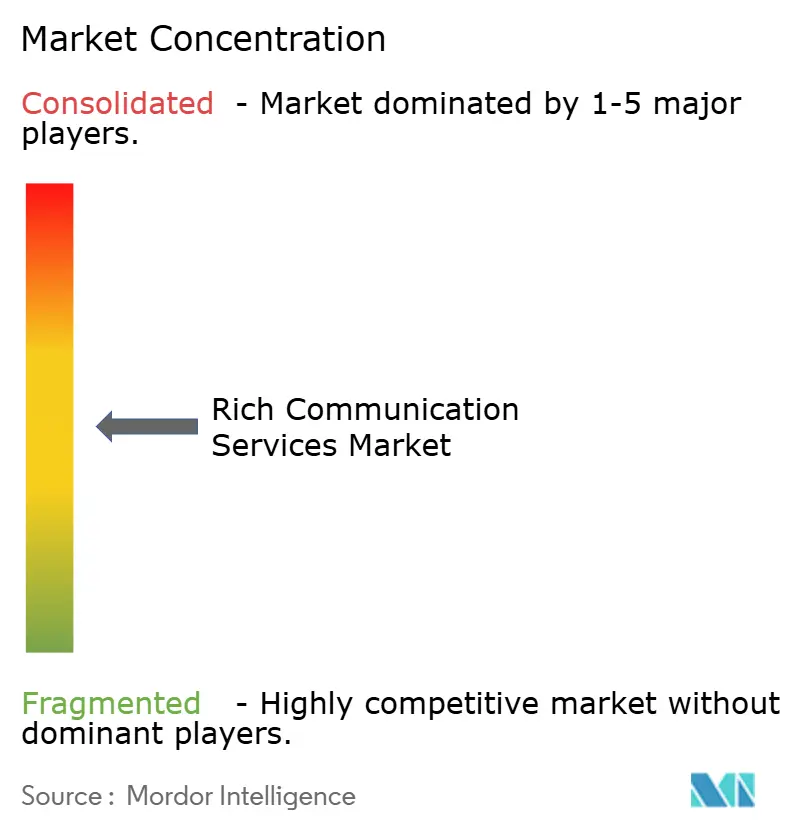
| Market Concentration | Medium |
Major Players *Disclaimer: Major Players sorted in no particular order Image © Mordor Intelligence. Reuse requires attribution under CC BY 4.0. | |
Rich Communication Services Market Analysis by Mordor Intelligence
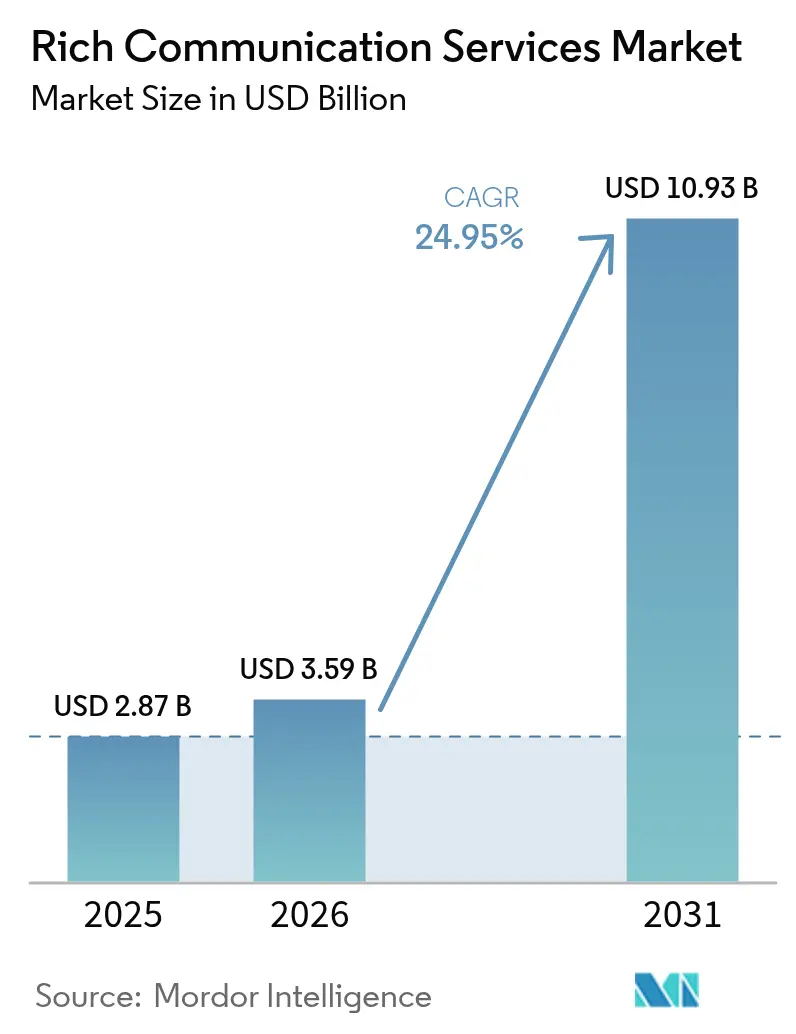
The rich communication services market size was valued at USD 2.87 billion in 2025 and estimated to grow from USD 3.59 billion in 2026 to reach USD 10.93 billion by 2031, at a CAGR of 24.95% during the forecast period (2026-2031). Growing enterprise appetite for media-rich, branded customer engagement is pushing businesses to migrate from plain SMS to interactive messaging that supports images, video, and actionable buttons. Expanded carrier support, the inclusion of RCS in iOS 18, and Google’s report of more than 1 billion U.S. RCS messages per day underscore a tipping point in mainstream adoption. Large enterprises remain the principal revenue source, yet cloud-native CPaaS platforms are lowering entry barriers for small and medium businesses. Geographic momentum is strongest in Asia-Pacific as regional operators use 5G networks to support rich media traffic, while North America holds its lead on the back of long-standing carrier interoperability. Regulatory moves toward verified sender IDs are creating additional pull for enterprises that need secure, authenticated channels for customer contact.[1]
Key Report Takeaways
- By communication type, Application-to-Person traffic led with 61.32% of rich communication services market share in 2025; Person-to-Application traffic is forecast to expand at a 30.75% CAGR to 2031.
- By deployment model, cloud solutions accounted for 72.15% of revenue in 2025, while on-premise solutions trailed but remain essential for industries with strict data-sovereignty rules.
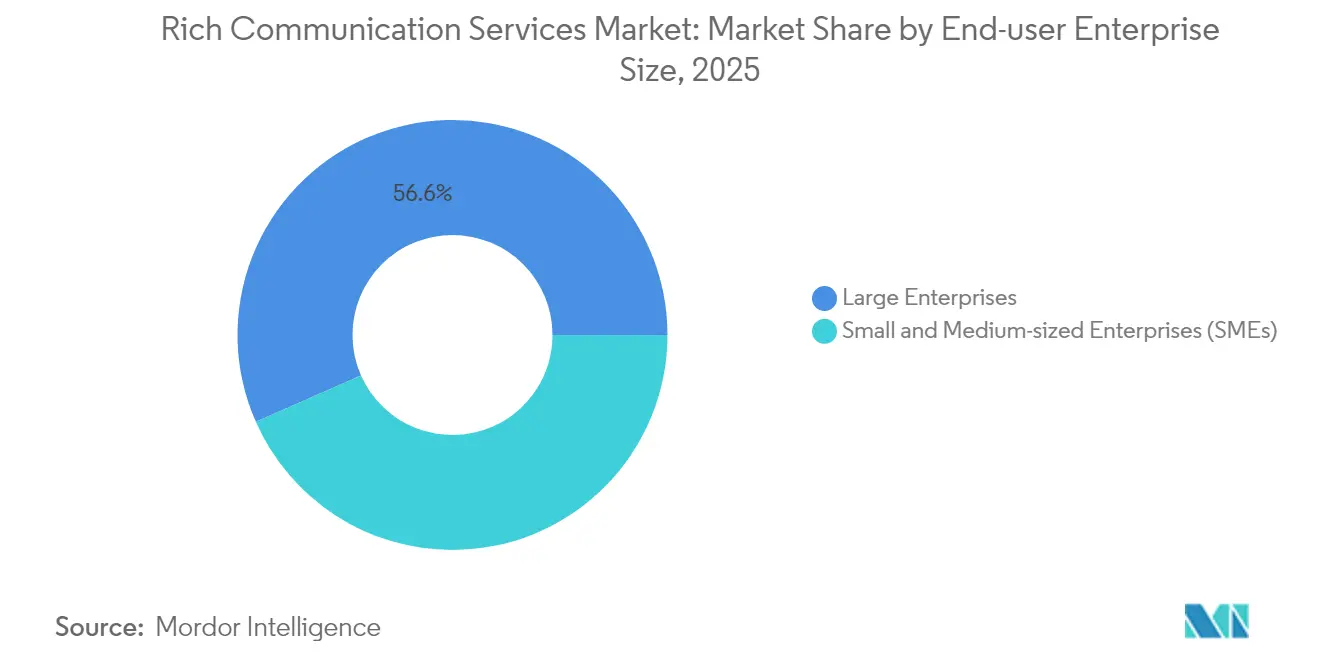
- By enterprise size, large organizations held 56.62% of 2025 revenue, whereas SMEs post the fastest 28.1% CAGR through 2031 as affordable SaaS offerings take hold.
- By end-user industry, retail and e-commerce captured 26.08% of revenue in 2025; that segment is poised for a 31.1% CAGR through 2031 on the back of conversational commerce.
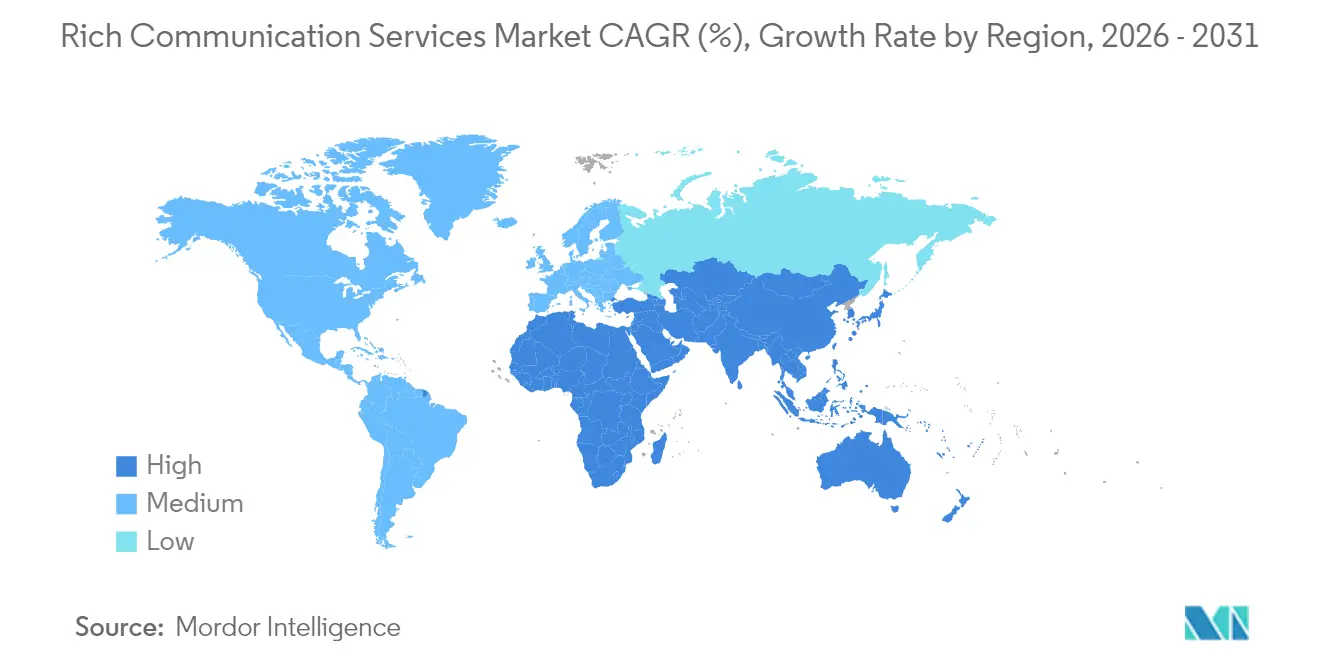
- By region, North America controlled 38.12% of revenue in 2025; Asia-Pacific is the quickest-expanding region at a 29% CAGR.
Note: Market size and forecast figures in this report are generated using Mordor Intelligence’s proprietary estimation framework, updated with the latest available data and insights as of 2026.
Market Trends and Insights
Drivers Impact Analysis of Rich Communication Services Market*
| Driver | (~) % Impact on CAGR Forecast | Geographic Relevance | Impact Timeline |
|---|---|---|---|
| Enterprise demand for A2P RCS business messaging | +6.2% | Global, strongest in North America and Europe | Medium term (2–4 years) |
| iOS-18 support and expanding Android OEM pre-installs | +5.8% | Global, accelerated in North America and Asia-Pacific | Short term (≤ 2 years) |
| 5G roll-outs boosting high-resolution rich media traffic | +4.3% | Asia-Pacific core, spill-over to North America and Europe | Long term (≥ 4 years) |
| Regulatory shift toward verified sender ID and anti-spam rules | +3.1% | Europe and North America, expanding to Asia-Pacific | Medium term (2–4 years) |
| CPaaS integration unlocking omni-channel orchestration | +2.9% | Global, enterprise-focused markets | Medium term (2–4 years) |
| Source: Mordor Intelligence | |||
Enterprise Demand for A2P RCS Business Messaging
A2P campaigns deliver markedly higher conversion and click-through rates than legacy SMS, encouraging brands in banking and retail to shift considerable spend to the channel.[2] Multi-media cards and suggested replies let marketers guide shoppers from awareness to purchase within a single threaded conversation, generating 6.2 times the ROI of basic text pushes. CPaaS vendors have responded by embedding low-code templates, compliance workflows, and real-time analytics that quantify lift against email and app-push programs. Early adopters such as global banks report 10% conversion from personalized loan-upsell chats, validating the revenue upside. As more enterprises witness the impact, A2P usage is set to underpin overall rich communication services market expansion during the forecast window.
iOS-18 Support and Expanding Android OEM Pre-installs
Apple’s decision to embed RCS in iOS 18 removes the historic interoperability gap that steered traffic to OTT apps; nearly 900 million active iPhones instantly become reachable via operator-grade rich messaging.[3] Samsung’s default adoption of Messages by Google on Galaxy devices further amplifies global reach. The unified experience eliminates pixelated images, broken group chats, and green/blue chat fragmentation that deterred consumers. Enterprises gain predictable reach across operating systems, unlocking larger addressable audiences without maintaining parallel OTT channels. This network effect is already visible in pilot campaigns that recorded 25% higher engagement after Apple rollout.
5G Roll-outs Boosting High-Resolution Rich Media Traffic
Mainstream 5G availability raises device bandwidth and lowers latency so that high-resolution video, carousel images, and interactive forms load instantly inside a message thread. Operators such as Verizon continue to earmark multi-billion-dollar budgets for 5G; that investment directly lifts the ceiling on message payload size and quality. In early 5G markets—Japan, South Korea—RCS adoption ratios are above 70%, supporting the thesis that next-gen networks lubricate rich communication uptake. As 5G coverage spreads through populous Asia-Pacific economies, elevated media capabilities will act as a demand multiplier for enterprise campaigns.
Regulatory Shift Toward Verified Sender ID and Anti-Spam Rules
Governments now consider message authentication critical to consumer trust. The FCC mandates verified sender IDs for emergency texts, while the European Union advances Digital Markets Act provisions requiring messaging interoperability.[4] RCS benefits from built-in verification and spam scoring, letting enterprises satisfy compliance without extra APIs. For consumers, visibility of a branded logo and check-mark mitigates phishing fears, reducing opt-out rates. The net effect is regulatory pull in favor of RCS over unregulated OTT channels, especially in financial services and healthcare where audit trails are compulsory.
Restraints Impact Analysis of Rich Communication Services Market*
| Restraint | (~) % Impact on CAGR Forecast | Geographic Relevance | Impact Timeline |
|---|---|---|---|
| Fragmented global operator interoperability | -4.7% | Global, most severe in emerging markets | Medium term (2–4 years) |
| Absence of full end-to-end encryption | -3.2% | Europe and North America | Short term (≤ 2 years) |
| OTT super-apps cannibalizing enterprise wallet share | -2.8% | Asia-Pacific and Latin America | Long term (≥ 4 years) |
| Unclear operator monetization models | -1.9% | Global | Medium term (2–4 years) |
| Source: Mordor Intelligence | |||
Fragmented Global Operator Interoperability
Only 57 carriers have aligned with GSMA Universal Profile 3.0, creating gaps that degrade cross-border experience. Enterprises sending campaigns into multiple regions must maintain fallback SMS or OTT channels, raising cost and operational complexity. While hubs such as Google’s Jibe and GSMA’s Interconnect projects are intended to streamline routing, uneven implementation throttles scale. Multinationals continue to lobby for consistent SLAs before migrating high-value traffic, delaying revenue realignment toward RCS.
Absence of Full End-to-End Encryption
Current RCS encryption works only for Android-to-Android traffic through Google Messages, leaving iOS and mixed-OS conversations outside the protection envelope. Financial institutions and healthcare providers subject to strict confidentiality rules remain reluctant to use RCS for sensitive payloads. Apple’s promise of encrypted RCS elevates the security baseline but may still conflict with certain government surveillance laws. Until a universally accepted encryption layer arrives, privacy concerns will cap adoption in compliance-heavy verticals.
*Our forecasts treat driver/restraint impacts as directional, not additive. The impact forecasts reflect baseline growth, mix effects, and variable interactions.
Rich Communication Services Market Segment Analysis
By Communication Type:
A2P Commands Revenue LeadershipA2P traffic delivered 61.32% of 2025 revenue, making it the backbone of the rich communication services market. Banks, retailers, and airlines use multimedia cards and quick replies to convert routine notifications into conversational touchpoints that drive incremental sales. Person-to-Application conversations, though currently smaller, are expanding 30.75% annually as AI chatbots mature and consumers grow comfortable completing transactions inside a thread. This uptick will increase the rich communication services market size for P2A flows at a double-digit clip through 2031.
Enterprises are documenting conversion jumps of 8–10 percentage points when migrating loyalty promotions from SMS to RCS. Case studies in India show a 358% traffic surge for CPaaS provider Gupshup after integrating Vertex AI chatbots. Person-to-Person usage also climbs in markets with seamless iOS–Android interconnect, though monetization is operator-driven rather than enterprise-driven. High-engagement sectors such as gaming and ticketing rely on P2A flows to manage waitlists and authentication, signaling an evolving mix within the communication-type hierarchy.


By Deployment Model:
Cloud Dominance Reflects API-First StrategiesCloud-hosted platforms generated 72.15% of 2025 revenue, mirroring broader enterprise moves to eliminate cap-ex-heavy, on-premise messaging gateways. Multinational brands favor public-cloud RCS because it dovetails with existing CRM, CDP, and marketing-automation stacks via REST APIs.
On-premise environments remain non-trivial in sectors such as defense, healthcare, and government where data-residency laws require local processing. Those deployments stand to benefit from hybrid architectures in which sensitive content is rendered behind the firewall while global reach rides public-cloud interconnects. Twilio’s public beta underscores the vendor push to abstract carrier complexity behind SDKs, letting developers spin up RCS alongside SMS, WhatsApp, and email within one dashboard.
By End-user Enterprise Size:
SMEs Accelerate UptakeLarge organizations held 56.62% of 2025 revenue, drawn by global reach, brand verification, and analytics dashboards that fit existing martech workflows. However, SMEs are set to grow 28.1% per year as SaaS providers bundle RCS into entry-level plans with drag-and-drop templates. This democratization will expand the rich communication services market share held by SMEs to roughly one-third by 2031.
Smaller retailers deploy conversational catalogs with embedded pay-now buttons, turning a single message into a storefront. Automated compliance features relieve resource-constrained teams from managing opt-outs and data-protection audits. As low-code tooling matures, onboarding times are shrinking from weeks to hours, removing yet another adoption barrier for small businesses.
By End-User Industry:
Retail and E-Commerce Lead Conversational CommerceRetail retained 26.08% revenue share in 2025 thanks to product carousels, personalized promotions, and check-out inside a chat thread, all of which cut friction in the customer journey. The segment’s 31.1% CAGR will push the rich communication services market size for retail to USD 3.79 billion by 2031. Banking and financial services are fast followers, employing RCS for two-factor authentication, portfolio updates, and interactive statements.
Healthcare providers lean on RCS for appointment reminders and medication adherence prompts, reducing no-show rates. Travel brands send dynamic boarding passes that auto-update gate changes, while media firms distribute trailers and ticket offers. Across industries, venture capital is flowing into plug-ins that connect e-commerce carts, payment gateways, and loyalty engines directly to RCS payloads, broadening monetizable use-cases.
Geography Analysis
North America Rich Communication Services Market
North America generated 38.12% of 2025 revenue, underpinned by early universal profile adoption across Verizon, ATandT, and T-Mobile. Google’s disclosure of more than 1 billion daily RCS messages in the U.S. illustrates mature consumer uptake. Regulatory clarity also helps: the FCC now recognizes RCS for emergency 911 texts, encouraging municipalities and enterprises alike to adopt authenticated channel. The region’s high ARPU lets carriers capture incremental revenue through business messaging fees.
APAC Rich Communication Services Market
Asia-Pacific is the fastest-growing geography at a 29% CAGR, stimulated by ultra-high smartphone penetration and government digitization programs. India records 50 million monthly enterprise messages on a single CPaaS platform and is projected to eclipse North America in traffic volume by 2027. Japan and South Korea exhibit plus-70% RCS user ratios, proving how 5G density correlates with rich-media adoption. Despite fragmented operator landscapes, initiatives such as the GSMA Interconnect Hub aim to streamline cross-border routing, further boosting the rich communication services market in the region.
Europe and LATAM Rich Communication Services Market
Europe posts steady expansion as data-protection regulations and Digital Markets Act interoperability rules favor verified, operator-controlled messaging over unregulated OTT apps. Deutsche Telekom’s EUR 115.8 billion 2024 revenue includes a growing slice from RCS-enabled value-added services. Conversely, the UK debate over lawful interception vis-à-vis Apple’s encrypted RCS shows that regulatory uncertainty can temporarily dampen deployment, yet enterprises continue pilot projects to gauge engagement lift. Latin America remains early-stage but is notable for outsized conversational commerce usage, especially in Brazil where tier-one carriers completed their first large-scale campaigns during 2024.
Regulatory Landscape
The regulatory environment for RCS is increasingly shaped by business messaging requirements around security and authentication, alongside standards work coordinated by industry bodies. In the United Kingdom, Ofcom intensified oversight of mobile messaging scams by consulting (October 2025) on changes to General Conditions that would place clearer duties on mobile network operators and messaging intermediaries to disrupt fraudulent traffic, and it closed this consultation in January 2026. In parallel, Ofcom also secured voluntary commitments from major UK mobile operators (BT/EE, Sky, Virgin Media O2, VodafoneThree) on A2P SMS termination pricing, effective through 2028, which affects the comparative economics of SMS versus richer verified channels.
Standards work continues to drive global alignment through the GSMA RCS Universal Profile releases, including Universal Profile 3.0 (published March 2025), Universal Profile 3.1 (released July 2025), and Universal Profile 4.0 (finalized March 2026). These updates expand common feature definitions and business verification capabilities across operator implementations, and the formal addition of Messaging Layer Security (MLS) for end-to-end encryption into the official RCS standard provides a compliance and trust anchor for regulated enterprise use cases as RCS traffic scales globally.
Value Chain Analysis
The RCS value chain begins with standards and specifications set by the GSMA (Universal Profile and related PRDs), which guide interoperable implementation across operating systems, handset OEMs, and operator networks. Mobile network operators provide the IP messaging foundation (including IMS core and RCS application components) and monetize services to enterprises either directly or via intermediaries. Interconnect and routing layers are supported by hubs and platform providers that normalize cross-operator delivery, while MaaP capabilities enable chatbots and interactive message flows that move RCS beyond basic A2P alerts.
Upstream enablement and downstream commercialization are increasingly driven by CPaaS vendors and aggregators, which package RCS Business Messaging into APIs, templates, analytics, and compliance tooling, then integrate with enterprise systems such as CRM and marketing automation. Client distribution and user reach depend on native messaging clients and OS-level defaults across Android and iOS, with common-profile conformance helping reduce fragmentation. Operational bottlenecks persist where carrier interoperability is uneven, and security and trust features, including MLS-based encryption and verified sender workflows defined in GSMA specifications and profile updates such as Universal Profile 4.0 finalized in March 2026, shape enterprise adoption, particularly in regulated verticals.
Competitive Landscape
The rich communication services market shows moderate consolidation as CPaaS leaders buy regional voice, messaging, and routing specialists to shore up global coverage. Sinch’s USD 1.14 billion purchase of Inteliquent secures direct interconnect to U.S. operators, lowering latency and cost for A2P traffic. Proximus Group’s pending takeover of Route Mobile would elevate combined revenue above EUR 2 billion by 2026, laying groundwork for a pan-European platform. Twilio counters by accelerating product velocity, rolling RCS into its omnichannel studio to defend share against newly bulked-up challengers.
Technology differentiation increasingly revolves around AI and automation. Gupshup embeds Google Vertex AI to create self-learning chat flows that surface personalized offers on the fly, reducing manual campaign design and improving statistical lift. Infobip deploys predictive audience segmentation, while Samsung files patents on augmented-reality overlays for future message formats. Providers with proprietary data models gain an edge, translating customer behavior into conversion-boosting content blocks.
Regional operators also play deal-maker: Singtel’s alliance with Sinch covers Singapore, Malaysia, and Indonesia, marrying carrier reach with CPaaS orchestration. This trend positions telcos not just as dumb pipes but as co-owners of enterprise engagement stacks. Competitive pressure is therefore shifting toward securing exclusive operator APIs, deeper wallet integrations, and advanced compliance features that answer vertical-specific needs.
Rich Communication Services Industry Leaders
-
Huawei Technologies Co. Ltd
-
Google LLC
-
AT&T Inc.
-
Verizon Communications Inc.
-
Vodafone Group plc
- *Disclaimer: Major Players sorted in no particular order
Rich Communication Services Market Companies Covered in this Report
- ATandT Inc.
- Verizon Communications Inc.
- Telefonaktiebolaget LM Ericsson
- Google LLC
- Huawei Technologies Co., Ltd.
- Samsung Electronics Co., Ltd.
- ZTE Corporation
- Mavenir Systems, Inc.
- Sinch AB
- Global Message Services AG
- Juphoon System Software Co., Ltd.
- Summit Tech
- T-Mobile USA, Inc.
- SK Telecom Co., Ltd.
- Telstra Corporation Limited
- Vodafone Group plc
- Orange S.A.
- Deutsche Telekom AG
- Twilio Inc.
- Infobip Ltd.
- Gupshup Technology India Pvt. Ltd.
- Route Mobile Limited
- MessageBird B.V.
Market Opportunities and Future Outlook
A key opportunity for RCS monetization is tied to expanding the addressable surface for rich, interactive experiences and verified business identities across major mobile OS ecosystems, supported by recent standards and security upgrades. The GSMA Universal Profile 4.0 publication in February 2026 added richer message formatting and new interaction types, including Messaging-Initiated Video Calls, which broadens the set of customer journeys that can be completed inside a thread (sales consults, service triage, and higher-touch support) without pushing users to separate apps or web flows. In parallel, GSMA RCC.16 v3.0 incorporates MLS-based end-to-end encryption for P2P RCS, and the May 2026 rollout of end-to-end encrypted RCS messaging for Android and iOS users provides a trust upgrade that can remove a blocker for enterprises that have hesitated on privacy grounds.
Whitespace also exists in improving resilience and choice in the RCS infrastructure layer, given the documented centralization of deployments on Google Jibe cloud infrastructure. That concentration gives operators, hubs, and CPaaS providers room to differentiate through multi-region routing, regional data-handling options, and compliance-ready tooling for industries that still rely on on-premise or hybrid controls. On the enterprise enablement side, continued evolution of RCS for Business interfaces, including the 2026 updates to Google RBM endpoints and tooling, supports deeper orchestration at scale, helping CPaaS platforms productize agent management, analytics, and policy enforcement for both large enterprises and fast-onboarding SMEs.
Recent Industry Developments in Rich Communication Services Market
- May 2026: Apple began a beta rollout of end-to-end encrypted RCS messaging for iPhone and Android conversations, aligning with the GSMA RCS Universal Profile. This reduces one of the most cited security gaps in mixed-OS RCS conversations and supports broader enterprise comfort with richer customer interactions on native messaging clients.
- March 2026: Twilio partnered with KPN in the Netherlands to enable RCS business messaging for enterprises, using Google-powered RCS capabilities. This expands RCS reach through a tier-one European operator channel and strengthens CPaaS-led packaging of RCS alongside other enterprise messaging routes.
- November 2024: Samsung and Google expanded their partnership to pre-install Messages by Google across Galaxy devices, reinforcing RCS as a default messaging experience on Android. Wider default client distribution improves addressability for A2P RCS campaigns and helps reduce fragmentation that previously forced brands to maintain parallel fallbacks.
Rich Communication Services Market Report Scope and Research Methodology
Market Definition and Coverage
This market captures revenues earned from rich communication services delivered over operator-supported RCS rails, where messages and calls support features like branding, media sharing, and interactive content within the native messaging experience.
Scope exclusions: OTT chat applications, pure SMS or MMS traffic, handset sales, and non-RCS push-notification tools are excluded.
Segments Covered in This Report
- By Communication Type
- A2P (Application-to-Person)
- P2P (Person-to-Person)
- P2A (Person-to-Application)
- Others
- By Deployment Model
- Cloud
- On-Premise
- By End-user Enterprise Size
- Small and Medium Enterprises (SMEs)
- Large Enterprises
- By End-User Industry
- BFSI
- Media and Entertainment
- Retail and E-commerce
- Travel and Hospitality
- Healthcare
- IT and Telecom
- Others
- By Geography
- North America
- United States
- Canada
- Mexico
- South America
- Brazil
- Argentina
- Rest of South America
- Europe
- Germany
- United Kingdom
- France
- Italy
- Russia
- Spain
- Switzerland
- Rest of Europe
- Asia-Pacific
- China
- India
- Japan
- South Korea
- Malaysia
- Singapore
- Vietnam
- Indonesia
- Rest of Asia-Pacific
- Middle East and Africa
- Middle East
- Saudi Arabia
- United Arab Emirates
- Turkey
- Rest of Middle East
- Africa
- Nigeria
- South Africa
- Rest of Africa
- Middle East
- North America
Data Sources, Market Sizing, and Validation
Desk Research
Desk work was used to build the first structure of the model and set boundaries on what counts as RCS revenue, followed by checks on adoption momentum and pricing direction. Public sources were used to anchor the market environment, including GSMA publications on RCS standards and rollout, regulator and telecom authority updates on messaging policies, ITU indicators on mobile and broadband penetration, and World Bank macro series for connectivity and spend context.
We also reviewed operator announcements and technical documentation on RCS availability, along with enterprise messaging adoption signals from association websites and business press coverage. For cross-checking company-level exposure, we referred to company filings and investor presentations where RCS, messaging, or CPaaS revenue is discussed, and we used paid database subscriptions for company financials and news discovery. Patent databases were reviewed for feature direction, and an import-export shipment-level database was used only when relevant device or network component signals were cited as supporting evidence. These desk research sources are illustrative only, and additional public and paid references were used for data collection, validation, and clarification.
Primary Interviews and Surveys
Primary interviews and surveys were used to pressure-test what portion of enterprise messaging spend is realistically shifting to RCS, and how pricing is being applied across message volumes and branded use cases. We spoke with stakeholders across the RCS value chain, including telecom operators, messaging aggregators, platform providers, and enterprise users in major regions, so assumptions on adoption timing, verified sender take-up, and monetization were not left to desk-only estimates.
Distribution of primary research fieldwork respondents
| Company type | Respondent position | Region |
|---|---|---|
| Top tier: 31% | CXOs: 15% | APAC: 40% |
| Mid tier: 54% | Functional/Unit leaders: 39% | EMEA: 37% |
| Smaller Players: 15% | Managers: 46% | Americas: 23% |
Market-Sizing & Forecasting
Sizing starts from a top-down demand pool build-up, where the mobile subscriber base, smartphone share, operator RCS readiness, and enterprise messaging activity are combined to reconstruct the addressable RCS traffic and monetizable feature usage. Once that structure is set, totals are corroborated with selective bottom-up approximations, such as sampling typical pricing per rich message session, applying it to validated volume ranges, and then adjusting totals based on what interviews indicate is actually billed versus offered as trials.
The working inputs were kept practical and repeatable, so the model relies on variables such as RCS monthly active user growth, carrier and handset support timing (including iOS and Android availability), enterprise A2P messaging intensity, verified sender adoption, and observed price bands for branded and interactive messages. Where regional data was uneven, gaps were handled by using proxy adoption curves from comparable operator markets and then scaling them using subscriber base and enterprise digital engagement indicators, before rechecking with expert feedback.
For forecasting, scenario analysis was used so base, conservative, and faster-adoption paths could be mapped to triggers such as carrier coverage expansion, verified sender enforcement, and enterprise marketing budgets. The final forecast path is selected only after the scenario outputs align with what primary respondents describe as the most likely rollout and monetization pace over the next few years.
Data Validation & Update Cycle
Model outputs are validated through triangulation across independent signals, including subscriber and smartphone indicators, rollout announcements, and implied revenue per message ranges shared in interviews. When a country or region shows a value that breaks expected adoption patterns or pricing logic, the assumptions are revisited, and targeted re-contacts are used to confirm whether there was a step change such as a major launch, policy shift, or a pricing change.
Before sign-off, results go through multi-step analyst reviews focused on variance checks across regions and consistency across time series. Reports are refreshed annually, with interim updates when material events occur, and a final pre-delivery pass is completed so clients receive the most current view available at the time of release.
Mordor Intelligence's Rich Communications Service Market Size Compared Against Other Published Estimates
Published RCS market values can look far apart because different studies count different revenue lines, use different base years, and apply different adoption curves for carrier coverage and enterprise take-up. Some estimates also fold adjacent messaging revenues into RCS, while others treat RCS more like a platform software market, which shifts the total substantially.
The benchmark table shows a wide spread mainly because scope and monetization assumptions vary, especially around whether OTT messaging is mixed in, whether SMS or MMS migration is counted as RCS revenue, and how verified sender pricing is applied. Currency conversion timing and update cadence also matter in this market, since adoption can jump quickly when major operating systems and carriers expand support, and pricing can reset after early pilots.
Benchmark comparison
| Source | Market Size | Gaps in Research Methodology |
|---|---|---|
| Mordor Intelligence | USD 2.87 B (2025) | |
| Global Research House A | USD 5.50 B (2024) | Uses an earlier base year and appears to count a broader set of RCS applications and deployment revenues, which can pull in platform and adjacent messaging items that are not always billed as RCS traffic. |
| Industry Publisher B | USD 13.67 B (2025) | Uses a wider revenue capture approach that can resemble full value chain billing at the point of sale, which can inflate totals if non-RCS messaging services or downstream resales are blended into the reported figure. |
The table points to scope and billing treatment as the main gap. In Mordor Intelligence's model, revenue is counted only when it is directly tied to GSMA-compliant RCS delivery and related enablement charges, while OTT chat and pure SMS or MMS monetization are kept outside the totals, which makes the estimate easier to trace back to adoption and pricing drivers.
Key Questions Answered in the Report
How fast is the rich communication services market expected to grow?
The market is forecast to expand at a 24.95% CAGR from USD 2.87 billion in 2025 to USD 10.93 billion by 2031.
Which segment currently contributes the most revenue?
Application-to-Person messaging delivered 61.32% of 2025 revenue, making it the single largest segment.
Why are SMEs adopting RCS so quickly?
Cloud-based CPaaS models provide low-cost APIs and pre-built templates, allowing SMEs to launch branded campaigns without heavy IT investment.
Which is the fastest growing region in Rich Communication Services Market?
Asia Pacific is estimated to grow at the highest CAGR over the forecast period (2026-2031).
What role does 5G play in RCS adoption?
5G networks support high-resolution media and low-latency interactions, enabling richer in-message experiences that increase engagement rates.