
Residential Washing Machine Market Size and Share
Market Overview
| Study Period | 2020 - 2031 |
|---|---|
| Market Size (2026) | USD 49.29 Billion |
| Market Size (2031) | USD 62.55 Billion |
| Growth Rate (2026 - 2031) | 4.89 % |
| Fastest Growing Market | Middle East and Africa |
| Largest Market | Asia Pacific |
| Market Concentration | Medium |
Major Players *Disclaimer: Major Players sorted in no particular order Image © Mordor Intelligence. Reuse requires attribution under CC BY 4.0. | |
Residential Washing Machine Market Analysis by Mordor Intelligence
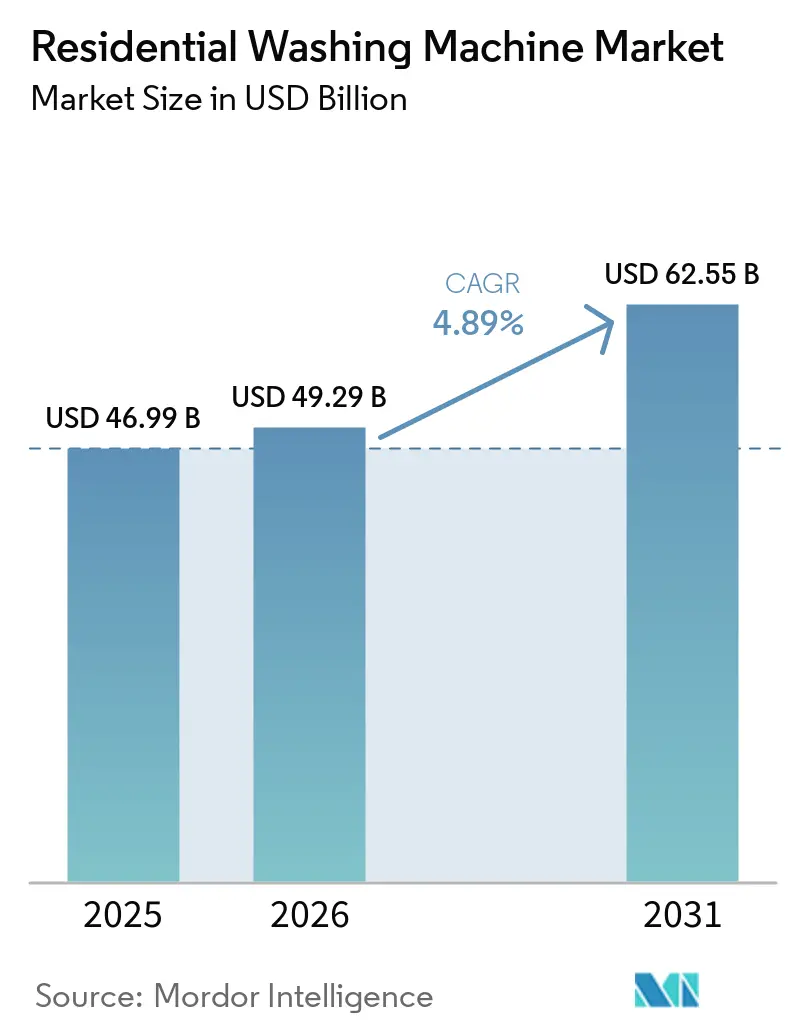
residential washing machine market size in 2026 is estimated at USD 49.29 billion, growing from 2025 value of USD 46.99 billion with 2031 projections showing USD 62.55 billion, growing at 4.89% CAGR over 2026-2031. Expansion rests on rapid urbanization, stricter energy-efficiency rules, and rising smart-home adoption. Consumers now rank artificial intelligence, IoT connectivity, and predictive maintenance ahead of basic drum size or spin speed. In response, manufacturers shorten replacement cycles with software-driven upgrades that enrich functionality well before depreciation ends. Success, therefore, hinges on blending hardware scale with software ecosystems that keep users engaged—an evolution already reshaping competitive strategy across the residential washing machine market[1]U.S. Department of Energy, “DOE Finalizes New Efficiency Standards for Residential Clothes Washers,” energy.gov.
Key Report Takeaways
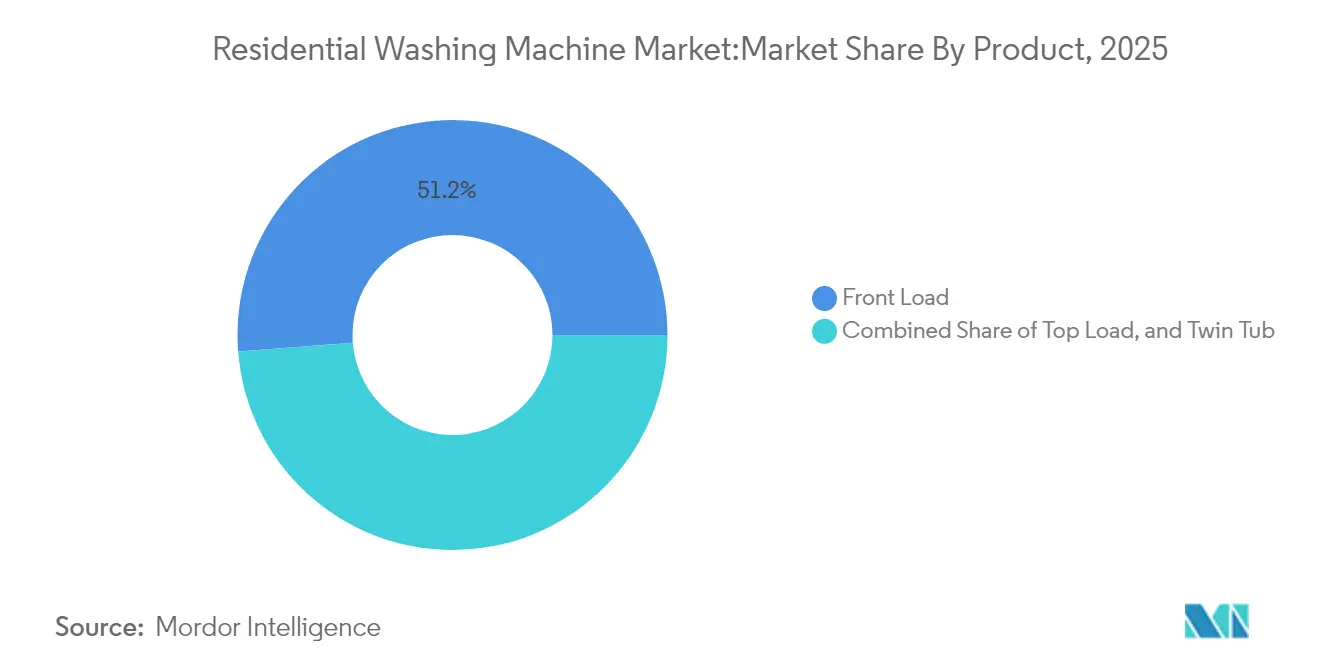
- By product type, front-load machines led with 51.23% revenue share of the residential washing machine market in 2025 and are advancing at a 5.72% CAGR through 2031.
- By technology, fully automatic units captured 72.30% of the residential washing machine market share in 2025, while smart-connected models posted the fastest 8.45% CAGR to 2031.
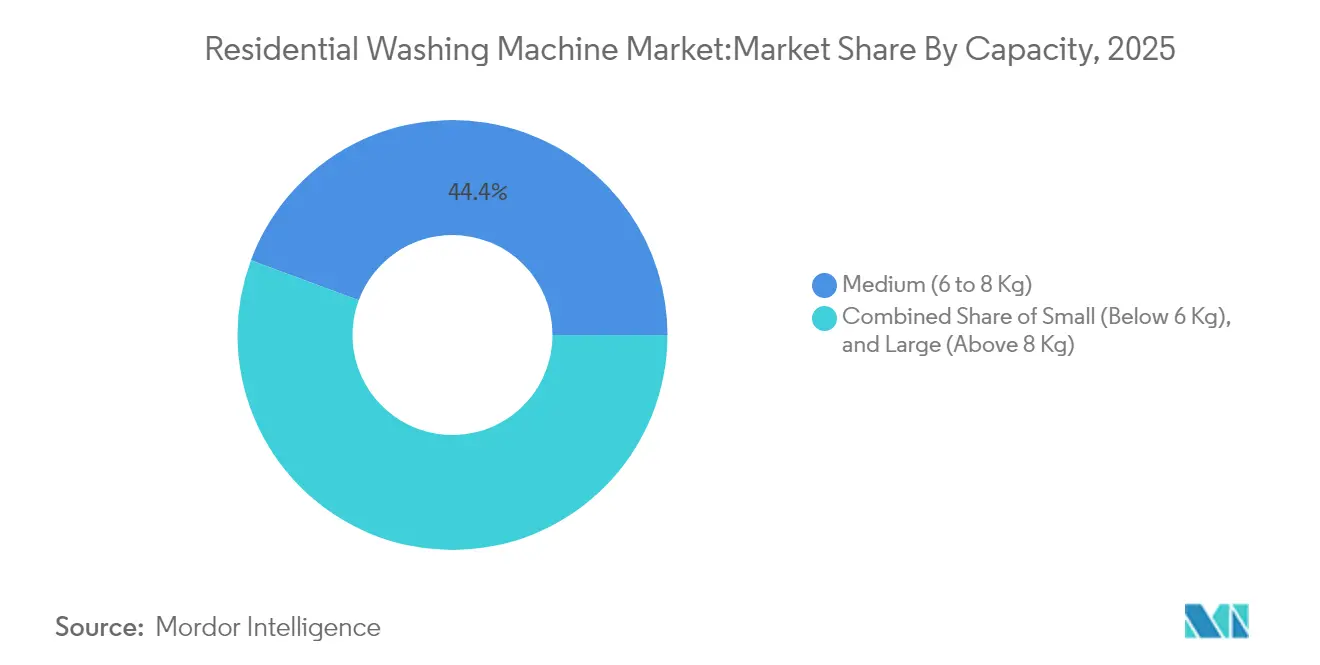
- By capacity, medium models (6–8 kg) accounted for 44.35% share of the residential washing machine market size in 2025; large-capacity units (above 8 kg) are growing fastest at a 6.18% CAGR.
- By connectivity, conventional machines still hold 77.20% share of the residential washing machine market, but smart units are expanding most rapidly.
- By region, Asia-Pacific dominated with 45.60% share of the residential washing machine market in 2025, whereas the Middle East & Africa records the strongest 6.44% CAGR to 2031.
Note: Market size and forecast figures in this report are generated using Mordor Intelligence’s proprietary estimation framework, updated with the latest available data and insights as of 2026.
Market Trends and Insights
Drivers Impact Analysis of Residential Washing Machine Market*
| Driver | % Impact on CAGR Forecast | Geographic Relevance | Impact Timeline |
|---|---|---|---|
| Urbanization-driven demand surge | +1.2% | APAC core, spill-over to MEA | Medium term (2-4 years) |
| Rising disposable income & convenience focus | +0.9% | Global, concentrated in emerging markets | Long term (≥ 4 years) |
| Energy-efficient & smart appliance preference | +1.1% | North America & EU, expanding to APAC | Short term (≤ 2 years) |
| Compact all-in-one washer–dryer adoption | +0.7% | Urban centers globally | Medium term (2-4 years) |
| Government energy-rebate replacement programs | +0.6% | North America, EU, select APAC | Short term (≤ 2 years) |
| Source: Mordor Intelligence | |||
Urbanization-Driven Demand Surge
Rapid city growth concentrates new households in high-rise apartments, where shared laundry rooms cannot scale. Chinese factories produced 79.9 million units in 2024, 16.4% higher year-over-year, while domestic sales reached 40.1 million units as first-time urban buyers entered the market [2]China Household Electrical Appliances Association, “2024 Production and Sales Data,” cheaa.org. Apartment residents pay premiums for low-noise motors, slim depths, and stackability, accelerating premiumization across the residential washing machine market. Front-load designs thrive because they fit tight spaces and enable vertical stacking with heat-pump dryers. Local governments that restrict balcony drying further boost demand for high-spin machines that shorten indoor drying time. As a result, compact but feature-rich models capture rising wallet share among new city dwellers. These trends are increasing the demand for washing machines as urban households prioritize compact and convenient laundry solutions.
Rising Disposable Income & Convenience Focus
Middle-class expansion shifts preferences from basic spin-dryers to feature-rich models with AI cycles, Wi-Fi alerts, and fabric-care analytics. Larger drums that handle weekly loads reduce time spent on chores, meeting the lifestyle expectations of dual-income households. Manufacturers, therefore, introduce tiered line-ups to capture broader consumer surplus and drive margin growth inside the residential washing machine market. World Bank data confirm sustained disposable-income growth in emerging economies, lifting demand for premium appliances that were formerly considered luxuries [3]World Bank, “MENA Economic Update 2025,” worldbank.org. Brand prestige also matters more, with consumers equating smart dashboards and brushed-steel finishes with social status. Manufacturers capture surplus through tiered line-ups that migrate successful flagship features down to mid-price ranges while keeping margins intact.
Energy-Efficient & Smart Appliance Preference
The U.S. Department of Energy’s March 2028 standard removes low-efficiency models from stores, forcing all suppliers to meet tougher performance baselines. Consumers already sensitive to utility bills now scan Eco-labels in-store or online before purchasing. Samsung’s Bespoke AI Laundry line adjusts water, spin, and detergent dosing in real time and sends energy dashboards to phones, turning efficiency into a daily engagement hook. European utilities layer time-of-use tariffs onto bills, incentivizing smart washers that auto-schedule overnight cycles for lower rates. These dynamics elevate connected models from niche gadgets to mainstream expectations inside the residential washing machine market.
Compact All-In-One Washer–Dryer Adoption
Rising real-estate prices mean less floor area per household, making single-cabinet washer-dryer combos appealing. Samsung’s 25 kg wash/13 kg dry Bespoke unit and LG’s WashCombo illustrate how heat-pump drying closes the performance gap with separate machines. Rental landlords like the plug-and-play nature of one water inlet and one 230 V socket, cutting installation costs. Users appreciate load-to-dry convenience, especially where balcony drying is banned. Advances in humidity sensors and drum insulation lower cycle times, addressing historic concerns about combo efficiency. The segment, therefore, attracts both first-time buyers and downsizers who replace two older units with a single premium appliance.
Restraints Impact Analysis of Residential Washing Machine Market*
| Restraint | % Impact on CAGR Forecast | Geographic Relevance | Impact Timeline |
|---|---|---|---|
| Supply-chain & geopolitical disruptions | -0.8% | Global, concentrated in Asia-Pacific manufacturing | Short term (≤ 2 years) |
| High energy-consumption sustainability backlash | -0.4% | EU & North America, expanding globally | Medium term (2-4 years) |
| On-demand laundry service cannibalisation | -0.3% | Urban centers in developed markets | Long term (≥ 4 years) |
| Source: Mordor Intelligence | |||
Supply-Chain & Geopolitical Disruptions
A 2024 quartz-mine shutdown in North Carolina squeezed semiconductor output, delaying smart-board deliveries that premium washers rely on [4]CNBC, “Quartz Shortage Threatens Chip Supply,” cnbc.com. Red Sea freight rerouting added two weeks to Asia-Europe transits and raised container rates, eroding appliance margins. Political tensions in the South China Sea amplify risk, as roughly one-third of machine components sail through contested waters. Manufacturers respond with multi-sourcing and buffer inventory, but the extra working capital burdens balance sheets. Persistent logistics volatility may also deter aggressive promotional campaigns if companies fear stock-outs during peak seasons.
High Energy-Consumption Sustainability Backlash
Studies show laundry still ranks among the top household energy uses even after efficiency gains. European shoppers increasingly question XXL drums and expect true cold-wash performance without detergent residue. MDPI research shows a willingness to pay premiums for recycled plastics and plant-based surfactants, yet zero tolerance for poorer stain removal. Brands must therefore balance eco-claims with transparent performance data or risk accusations of greenwashing. Negative press around high-energy dryers can spill over onto washer-dryer combos, slowing adoption in sustainability-conscious segments.
*Our forecasts treat driver/restraint impacts as directional, not additive. The impact forecasts reflect baseline growth, mix effects, and variable interactions.
Residential Washing Machine Market Segment Analysis
By Product:
Front-Load Dominance AcceleratesFront-load washers held 51.23% share of the residential washing machine market in 2025 and advanced at a 5.72% CAGR. Their gentler wash action, water savings, and stackability appeal to dense-housing residents. Samsung’s AI-enabled front loaders illustrate how premium software offsets higher prices.
Top-load designs remain popular in rural settings where lower upfront cost and quick-open lids matter, but their unit share gradually declines. Consequently, the residential washing machine market size tied to front-load units remains the largest contributor to global revenue through 2031.


By Technology:
Automation Premium PersistsFully automatic machines captured 72.30% of the residential washing machine market in 2025 and grew at a 5.12% CAGR. LG’s AI Wash adapts drum motion without user input. Remote alerts, auto-dose canisters, and voice control reinforce value perception.
Semi-automatic designs still appeal where the electricity supply is intermittent or budgets are tight. However, narrowing price gaps and growing consumer awareness of fabric protection keep funneling volume toward automatic platforms. Consequently, the residential washing machine market size linked to fully automatic units should widen its revenue gap over semi-automatic alternatives during the forecast horizon.
By Capacity:
Large-Format Growth AcceleratesMedium drums (6–8 kg) delivered 44.35% of 2025 revenue, but large units (above 8 kg) record the highest 6.18% CAGR as multigenerational households seek single-load convenience.
Bigger drums accommodate comforters and bulk linens, reducing weekly cycles and energy per kilogram. Manufacturers reinforce durability with reinforced bearings and targeted stain-removal programs. This innovation keeps the residential washing machine market share for high-capacity products on an upward trajectory despite higher price points.
By Connectivity:
Smart Integration Drives Premium GrowthConventional units still represent 77.20% of shipments, though smart models expand at 8.45% CAGR. GE Appliances’ SmartHQ app adds predictive maintenance and detergent alerts, extending interaction beyond purchase.
Smart ecosystems lock customers into cloud services and parts subscriptions, lifting lifetime value. As broadband penetration climbs, connectivity will underpin more SKUs, signifying that the residential washing machine market size linked to connected models will become an outsized contributor to profit pools even if unit share remains lower than legacy products in the medium term.
By Distribution Channel:
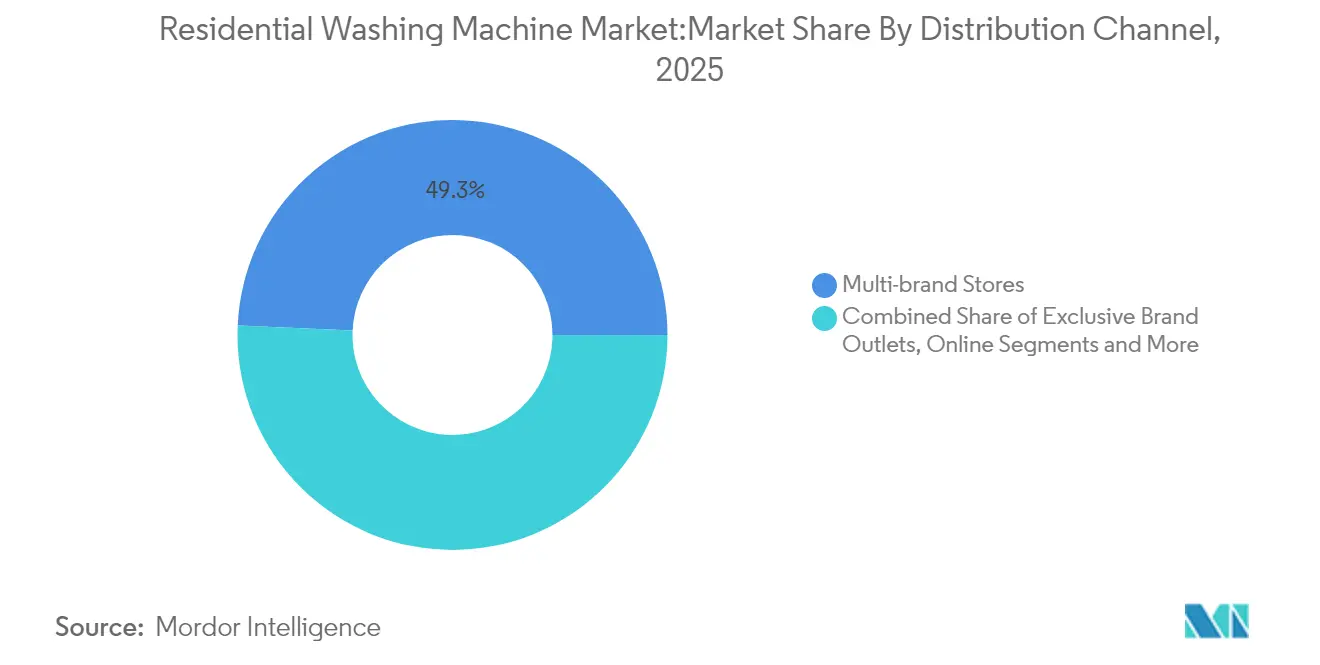
Digital Transformation AcceleratesMulti-brand stores retained a 49.30% share because shoppers prefer on-site demos for big-ticket items. Yet online sales advance at 7.32% CAGR, helped by immersive AR visuals and white-glove last-mile delivery. Exclusive brand outlets support curated experiences and warranty tie-ins.
Omnichannel strategies, therefore, shape the residential washing machine market as brands mix physical showrooms with direct-to-consumer platforms to capture incremental margin, gather usage data, and upsell accessories.
Geography Analysis
APAC Residential Washing Machine Market
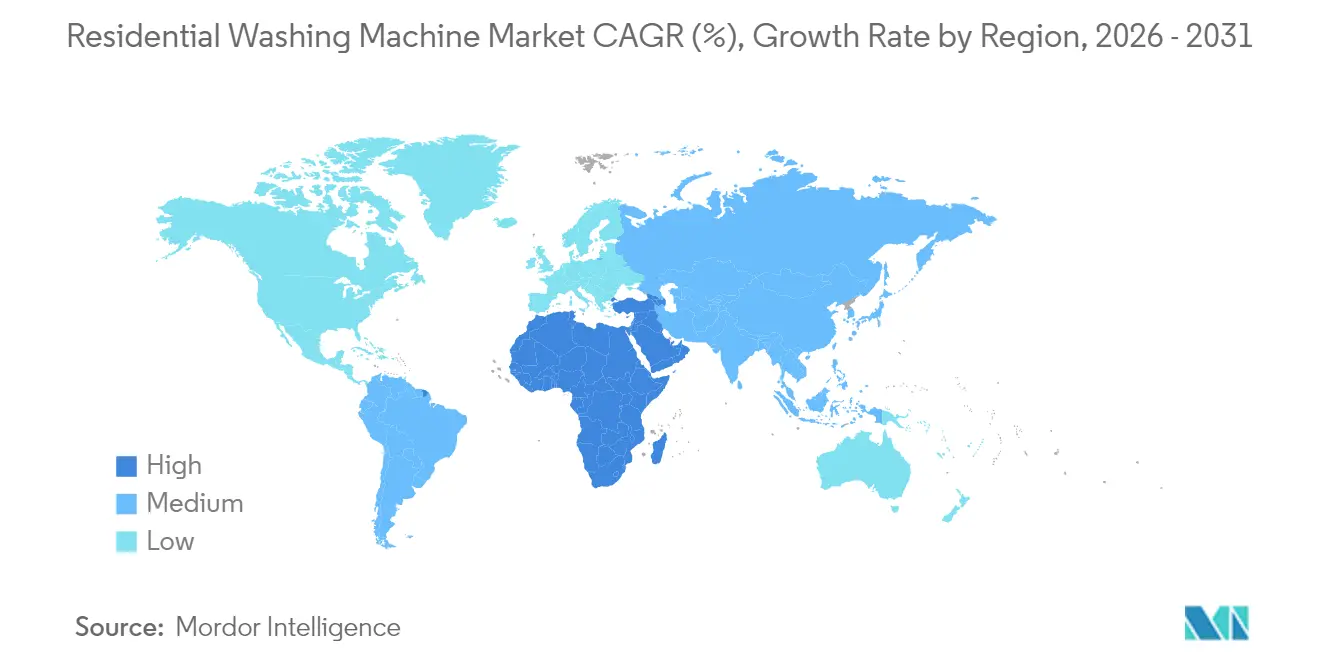
Asia-Pacific owns 45.60% of the residential washing machine market and remains the global production hub. Chinese output reached 79.958 million units in 2024 as exports rebounded to Belt and Road Initiative partners. Manufacturing density offers cost leadership but exposes producers to shipping-route volatility.
MEA Residential Washing Machine Market
The Middle East & Africa posts the highest 6.44% CAGR thanks to urbanization, infrastructure upgrades, and disposable-income growth, with regional GDP expected to rise 3.3% in 2025. Early movers that invest in localized after-sales networks lock in loyalty before competition intensifies.
North America and Europe Residential Washing Machine Market
North America and Europe remain mature but profitable, guided by tight efficiency rules that reward R&D-heavy incumbents. Consumers in these markets prioritize smart features, hygienic steam cycles, and eco-certifications, sustaining premium average selling prices.

Value Chain Analysis
The residential washing machine value chain begins with upstream inputs such as steel and plastics, motors and bearings, plus a higher-value electronics stack that includes sensors, PCBs, connectivity modules, and semiconductors used for smart features. Component availability and input-cost volatility continue to constrain OEM planning, which has pushed more localization of critical subassemblies and tighter supplier qualification, particularly for control boards and steel-intensive structures.
In the midstream, global OEMs assemble at regional hubs and increasingly rebalance production footprints closer to end markets to reduce tariff exposure and transit disruption. GE Appliances announced a USD 490 million investment in June 2025 to reshore front-load washer production to its Appliance Park in Louisville, Kentucky, reflecting a shift toward North American manufacturing for higher-feature platforms. Downstream, sales move through multi-brand retailers, exclusive brand outlets, and expanding online channels supported by installation, haul-away, and service networks. OEM and CPG partners also reinforce differentiation through detergent and auto-dose compatibility programs, including Samsung collaborations with Procter and Gamble and, later, Unilever for auto-dose oriented formulations.
Competitive Landscape
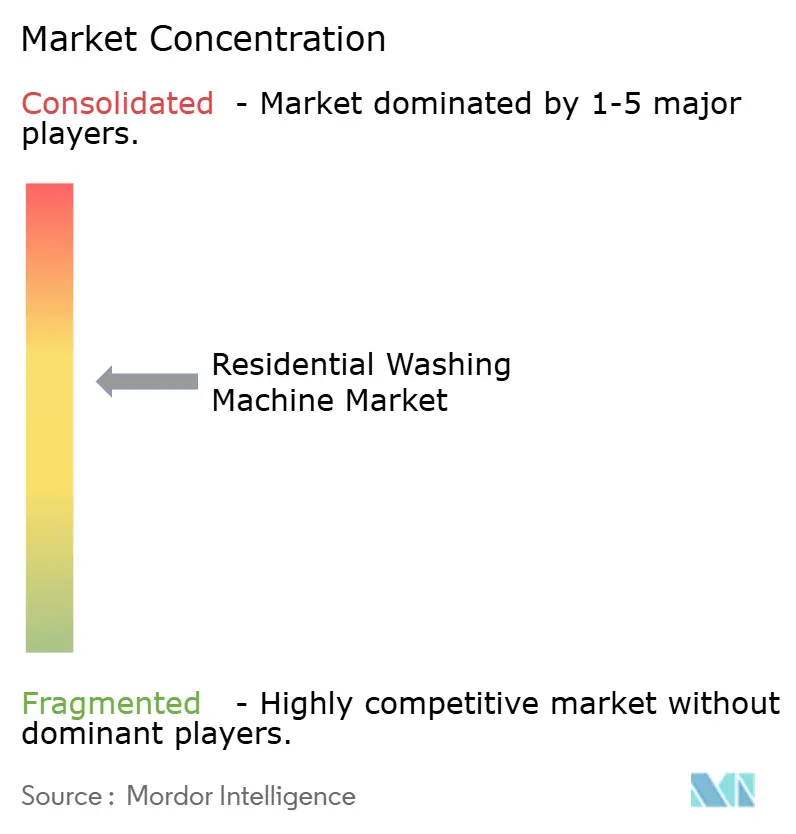
The residential washing machine market is moderately concentrated. A group of globally recognised manufacturers—Samsung, LG, Whirlpool, Electrolux, Haier, and BSH—controls more than half of worldwide shipments, yet dozens of regional and value-tier brands remain active. Scale advantages in sourcing, automation, and marketing underpin incumbents, while software ecosystems create new moats.
Samsung’s partnership with Procter & Gamble on Tide POD Cold cycles embeds detergent intelligence that rises above hardware parity. Electrolux, LG, and Whirlpool operate regional design hubs to reflect local laundry habits while sharing global platforms. Semiconductor constraints hastened partial vertical integration; Haier invests in in-house control-board production to secure supply. Cloud alliances such as LG-Microsoft supply generative-AI capabilities for service layers. Competitive focus thus shifts from price to ownership experience, fitting a moderate-concentration structure rather than a tightly monopolised one.
White-space targets include compact urban models, garment-refresh cabinets, and subscription laundry bundles. Entry barriers are rising under new energy rules, reinforcing the advantage of established players without eliminating room for niche challengers.
Residential Washing Machine Industry Leaders
LG Electronics Inc.
Whirlpool Corporation
Haier Group (incl. GE)
Samsung Electronics Co. Ltd.
BSH Home Appliances Group
- *Disclaimer: Major Players sorted in no particular order
Residential Washing Machine Market Companies Covered in this Report
- Whirlpool Corporation
- Haier Group Corp.
- LG Electronics Inc.
- Samsung Electronics Co. Ltd.
- BSH Home Appliances Group
- Panasonic Corp.
- Electrolux AB
- IFB Industries Ltd.
- Hitachi Ltd.
- Toshiba Corp.
- Midea Group
- GE Appliances
- Arçelik A.Ş.
- Hisense Co. Ltd.
- Sharp Corp.
- Godrej & Boyce
- Miele & Cie. KG
- Daewoo Electronics
- Smeg S.p.A.
- Kenmore (Transformco)
- Gree Electric Appliances Inc.
- Fisher & Paykel Appliances
- Candy Hoover Group
- Vestel White Goods
- Qingdao Hisense Electric Co. Ltd.

Market Opportunities and Future Outlook
Efficiency-led replacement and premiumization create a commercialization pathway for AI-enabled and connected washers that can substantiate lower water and energy use while improving fabric care. As compliance horizons tighten, including the US Department of Energy clothes washer standards with a March 1, 2028 compliance date, OEMs have incentives to refresh lineups and redesign platforms. This opens room for software-driven performance features such as auto-dose optimization, cold-wash capability, and time-of-use scheduling, which can be marketed with measurable utility savings. Consumables partnerships further support this opportunity, reflected in Unilever and Samsung introducing laundry products engineered for auto-dose machines.
Manufacturing and sourcing localization is also emerging as a second opportunity area, as OEM investments target components and subassemblies that affect cost, lead times, and feature availability. Whirlpool announced a USD 60 million investment in April 2026 to convert a facility in Perrysburg, Ohio, into a component and subassembly plant supporting washer and dryer production, while GE Appliances committed USD 490 million in June 2025 to build an advanced clothes washer plant in Louisville for premium lines. At the same time, localization in large emerging markets supports a wider set of price tiers and stronger service coverage, evidenced by Whirlpool disclosing a BRL 300 million investment in May 2026 to localize front-load washing machine component production in Rio Claro, Brazil (with output scheduled for September 2026), which should help enable faster model refreshes and improve after-sales parts availability.
Recent Industry Developments in Residential Washing Machine Market
- July 2026: Samsung began rolling out its new Bespoke AI Washer and Dryer lineup in select global markets, expanding capacities across multiple configurations and emphasizing AI-enhanced fabric care and connectivity. The launch strengthens Samsung's push to make AI features and app-led experiences central to product differentiation, not only premium add-ons. Broader availability also increases competitive pressure on peers to match software, sensing, and efficiency claims across mid-to-high tiers.
- April 2026: Whirlpool announced a USD 60 million investment to convert a facility in Perrysburg, Ohio, into a plant producing washer and dryer components and subassemblies, with 100 to 150 jobs planned over two years. The move supports supply assurance and lead-time control for North American laundry assembly operations while reducing exposure to cross-border disruptions. It also signals continued emphasis on domestic manufacturing capabilities for higher-feature platforms.
- July 2024: Electrolux launched a smart laundry range positioned around reducing resource use and extending textile life through connected features and optimized programs. The release reinforced the market shift toward app-enabled ownership experiences and measurable efficiency claims at the point of sale. It also raised the baseline for mainstream smart functionality among established global brands.


Residential Washing Machine Market Report Scope and Research Methodology
Market Definition and Coverage
This market covers the value of residential washing machines sold for home use, counted as annual revenue from new units shipped into household settings across major regions, and then consolidated into a global total.
Scope exclusions: We exclude commercial and industrial laundry equipment, laundromat-grade machines, and aftermarket spare parts and service revenue.
Segments Covered in This Report
- By Product
- Front Load
- With Dryers
- Without Dryers
- Top Load
- With Dryers
- Without Dryers
- Twin Tub
- Front Load
- By Technology
- Fully Automatic
- Semi-Automatic
- By Capacity
- Small (Below 6 Kg)
- Medium (6 to 8 Kg)
- Large (Above 8 Kg)
- By Connectivity
- Smart Connected
- Conventional
- By Distribution Channel
- Multi-brand Stores
- Exclusive Brand Outlets
- Online
- Other Distribution Channels
- By Geography
- North America
- Canada
- United States
- Mexico
- South America
- Brazil
- Peru
- Chile
- Argentina
- Rest of South America
- Asia Pacific
- India
- China
- Japan
- Australia
- South Korea
- South East Asia (Singapore, Malaysia, Thailand, Indonesia, Vietnam, and Philippines)
- Rest of Asia Pacific
- Europe
- United Kingdom
- Germany
- France
- Spain
- Italy
- BENELUX (Belgium, Netherlands, and Luxembourg)
- NORDICS (Denmark, Finland, Iceland, Norway, and Sweden)
- Rest of Europe
- Middle East And Africa
- United Arab of Emirates
- Saudi Arabia
- South Africa
- Nigeria
- Rest of Middle East And Africa
- North America
Data Sources, Market Sizing, and Validation
Desk Research
Desk research was used to set the fact base and keep assumptions aligned with how residential washing machines behave by geography and usage cycle. We referenced public sources such as national statistics agencies for household and housing indicators, the International Energy Agency for appliance efficiency context, and the US Department of Energy and EPA ENERGY STAR for test methods and efficiency standards that influence when consumers replace older units.
We also used customs and trade statistics from sources such as UN Comtrade to understand import dependence in key markets, along with association websites and reputable press for product-cycle trends like water-saving features and inverter motors. Company annual reports, filings, and investor presentations were reviewed to map revenue exposure and regional mix, and a paid subscription for company financials and news helped cross-check timelines and macro events. These examples are not exhaustive, and many other public sources were also reviewed for data collection, validation, and clarification.
Primary Interviews and Surveys
Primary work focused on interviews and structured questionnaires with channel participants and industry experts, including appliance brands, large-format retailers, distributors, and service ecosystem participants who observe replacement demand. For a global view, we balanced inputs across APAC, EMEA, and the Americas so regional pricing, capacity preferences, and policy effects could be compared, and then used to fine-tune model assumptions about unit velocity and ASP mix.
Distribution of primary research fieldwork respondents
| Company type | Respondent position | Region |
|---|---|---|
| Top tier: 35% | CXOs: 12% | APAC: 50% |
| Mid tier: 48% | Functional/Unit leaders: 41% | EMEA: 31% |
| Smaller Players: 17% | Managers: 47% | Americas: 19% |
Market-Sizing & Forecasting
The sizing starts with a top-down build where household stock, housing completions, and replacement cycles are translated into annual unit demand by region, which is then multiplied by region-level average selling prices and adjusted for mix changes. To keep the totals grounded, we corroborate the outputs with selective bottom-up approximations, such as sampling brand and channel price bands, checking shipment momentum implied by trade flows, and doing limited supplier and retailer cross-checks before finalizing.
Key inputs used in the model include household formation and urbanization trends, appliance penetration and replacement frequency, price tier mix shifts (entry, mid, premium), efficiency regulation timelines that pull demand forward, and regional trade intensity that affects availability and pricing. For forecasting, we used scenario analysis supported by a light multivariate regression on macro drivers like housing activity and disposable income, with expert feedback used to stress test price progression and upgrade rates. Where local unit or pricing detail is thin, gaps are handled through proxy markets with similar income and housing patterns, followed by validation calls to avoid overstating demand.
Data Validation & Update Cycle
Outputs are checked against independent signals such as housing starts direction, import and export trends for major manufacturing hubs, and observed price movements in mainstream retail. When a region shows a jump that does not match these signals, we revisit assumptions, and respondents may be re-contacted to confirm whether a promotion cycle, policy change, or supply disruption is the real driver.
Before sign-off, the model and assumptions pass through multiple analyst reviews, including variance checks versus prior editions and peer challenge on the most sensitive inputs. Reports are refreshed annually, and interim updates are made when material events occur, after which a final pre-delivery pass is completed so clients receive the latest view.
Mordor Intelligence's Residential Washing Machines Market Size Compared With Other Published Estimates
Published market sizes for residential washing machines can vary quite a bit, even when they look like they cover the same product. The spread usually comes from differences in what is counted as residential, how pricing is averaged across regions and price tiers, and how far the forecast is extended.
The main gap comes from commercial-grade and institutional washer revenue being blended into some totals, where Mordor Intelligence counts only new units intended for household dwellings and keeps laundromat and hotel demand outside the market, which shifts the starting value and the price mix used in the model.
Benchmark comparison
| Source | Market Size | Gaps in Research Methodology |
|---|---|---|
| Mordor Intelligence | USD 49.29 B (2026) | |
| Market Research Publisher A | USD 57.32 B (2024) | Uses an earlier base year and appears to apply broader household assumptions without clearly separating residential-only shipments from adjacent commercial placements, which can lift the value when ASPs are averaged. |
| Industry Research Group B | USD 46.50 B (2025) | Uses a different base year and a longer forecast horizon, and the category mapping can differ when washer-dryer related products or technology groupings are blended, which changes price mix and growth math. |
Across the three figures, the main differences trace back to scope boundaries, base year selection, and the way average prices are progressed as premium features gain share. By tying demand to housing and replacement signals and then cross-checking prices and trade intensity, the estimate remains transparent and repeatable even when data is uneven across countries.


Key Questions Answered in the Report
What is the current size of the residential washing machine market?
The residential washing machine market stands at USD 49.29 billion in 2026 and is expected to hit USD 62.55 billion by 2031.
Which product segment leads global sales?
Front-load washers lead with 51.23% revenue share in 2025 and carry the highest 5.72% CAGR through 2031.
How fast is the smart-connected washer segment growing?
Smart-connected machines grow at an 8.45% CAGR, the quickest among all connectivity categories.
Which region shows the strongest growth outlook?
The Middle East & Africa posts the fastest 6.44% CAGR thanks to urbanization and rising disposable income.
What regulatory change will most affect future demand?
The U.S. Department of Energy’s 2028 efficiency standard will phase out low-performing models and favor brands with strong R&D.
How are manufacturers using AI to differentiate products?
Leading brands embed AI algorithms that tailor cycles, provide energy dashboards, and offer predictive maintenance via connected apps, reinforcing customer loyalty and enabling premium pricing.
Page last updated on:


 Your data is secure and never sold or shared.


