
Market Overview
| Study Period | 2020 - 2031 |
|---|---|
| Forecast Data Period | 2026 - 2031 |
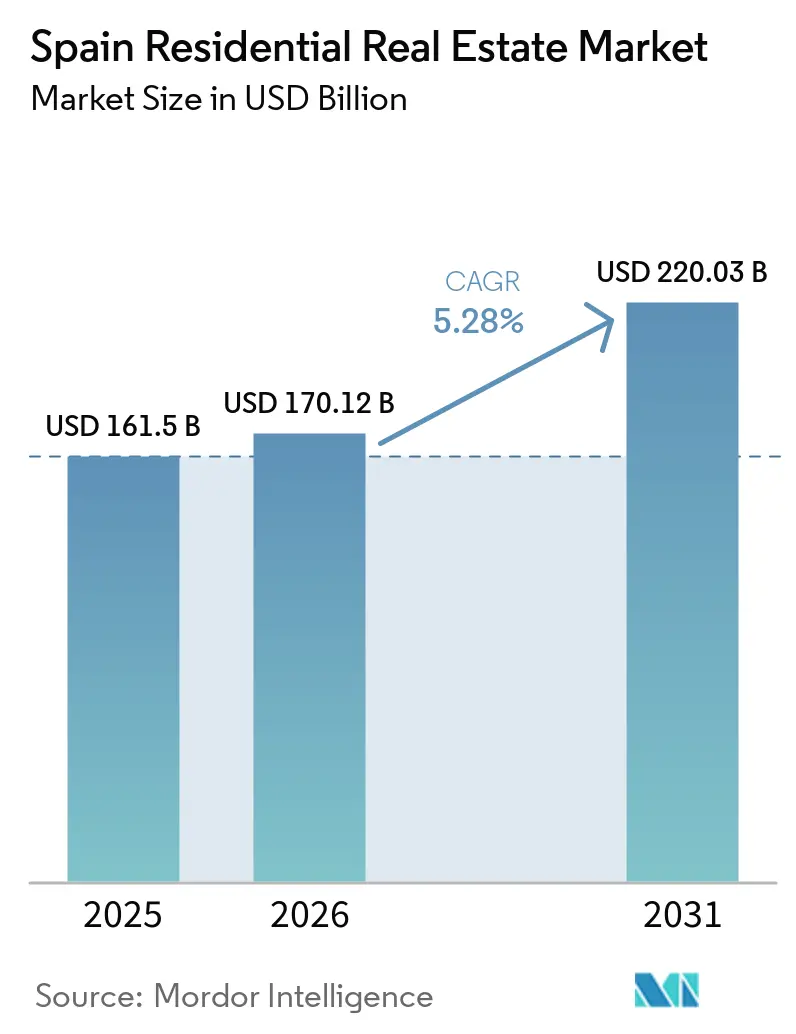
| Base Year Market Size (2025) | USD 161.5 Billion |
| Market Size (2026) | USD 170.12 Billion |
| Market Size (2031) | USD 220.03 Billion |
| Growth Rate (2026 - 2031) | 5.28 % |
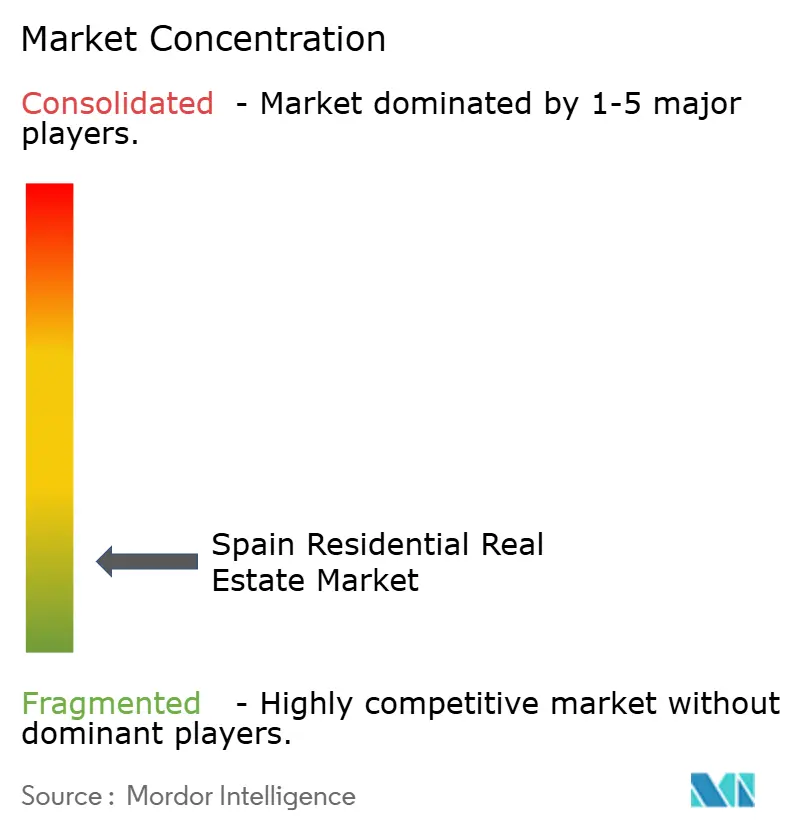
| Market Concentration | Medium |
Major Players *Disclaimer: Major Players sorted in no particular order Image © Mordor Intelligence. Reuse requires attribution under CC BY 4.0. | |
Spain Residential Real Estate Market Analysis by Mordor Intelligence
The Spain residential real estate market is valued at USD 170.12 billion in 2026 and is forecast to reach USD 220.03 billion by 2031, advancing at a 5.28% CAGR. Intensifying supply shortages, stronger foreign-buyer activity, and a wave of institutional Build-to-Rent capital continue to underpin pricing despite volatile financing costs. Madrid alone accounts for almost half of the Spain residential real estate market, yet Andalusia-Málaga & Costa del Sol posts the fastest growth as remote-working Europeans move south. Buyer demand is shifting toward energy-efficient “Clase A” dwellings after the 2021 Código Técnico update, while digital mortgage platforms lower onboarding frictions for non-resident purchasers. Tight labor markets and rising land prices impose cost pressure, but large developers consolidate land banks and pivot toward industrialized construction to accelerate delivery.[1]
Key Report Takeaways
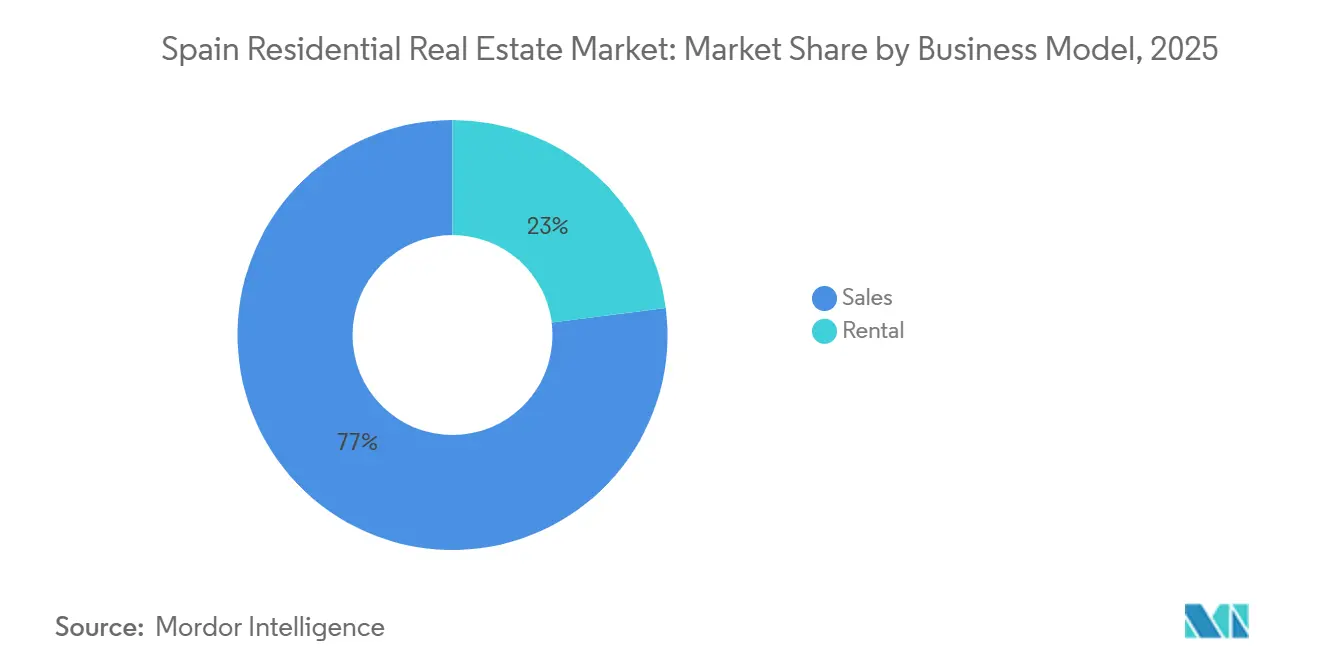
- By business model, sales retained 77% of the Spain residential real estate market share in 2025, while rental is advancing at a 5.81% CAGR through 2031.
- By property type, apartments dominated with 69% of the Spain residential real estate market size in 2025; villas are growing fastest at a 5.62% CAGR between 2026-2031.
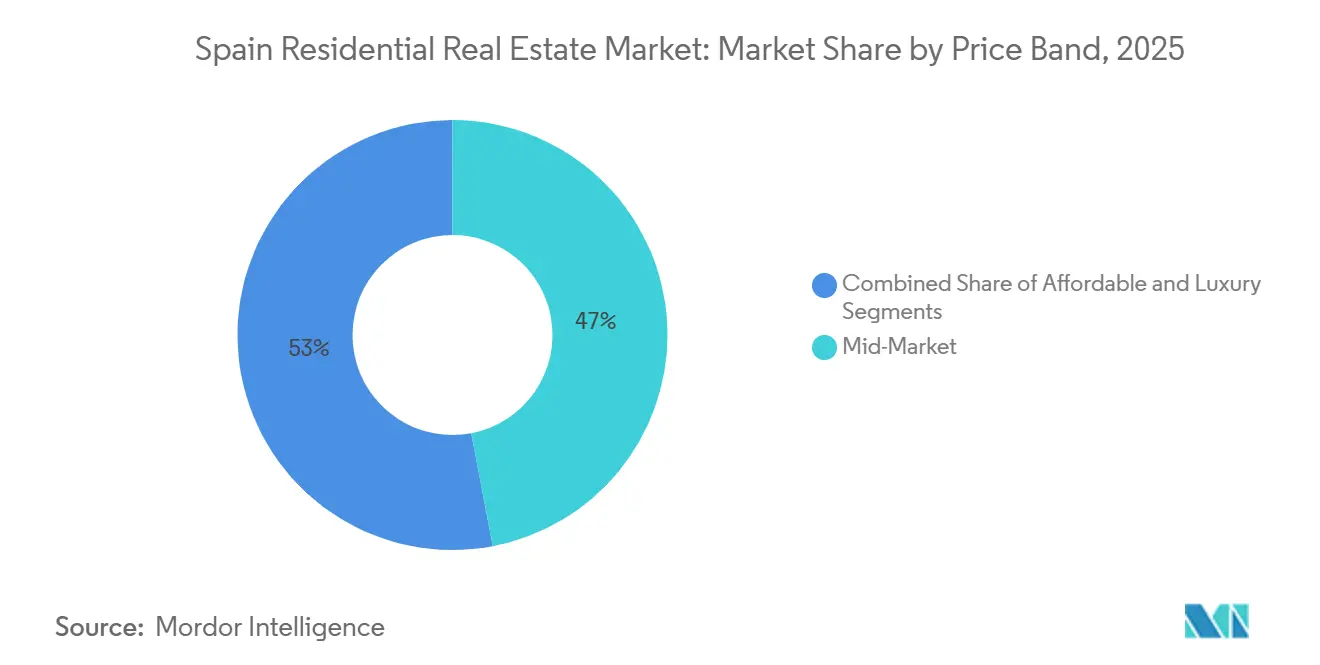
- By price band, mid-market units held 47% of transaction value in 2025; luxury is projected to expand at a 6.12% CAGR to 2031.
- By mode of sale, secondary resales accounted for 58% of the Spain residential real estate market size in 2025, and new-builds are poised to grow at a 6.44% CAGR through 2031.
- Madrid controlled 49% of the transaction value in 2025, and Andalusia–Málaga is the fastest-growing geography at a 6.28% CAGR to 2031.
Note: Market size and forecast figures in this report are generated using Mordor Intelligence’s proprietary estimation framework, updated with the latest available data and insights as of January 2026.
Spain Residential Real Estate Market Trends and Insights
Drivers Impact Analysis*
| Drivers | (~) % Impact on CAGR Forecast | Geographic Relevance | Impact Timeline |
|---|---|---|---|
| ECB-rate-linked mortgage repricing boosts pent-up demand | +1.2% | Global, strongest in Madrid, Barcelona, Valencia | Short term (≤ 2 years) |
| Institutional build-to-rent pipelines scale rapidly | +0.9% | Madrid, Barcelona, Valencia Community, Málaga | Medium term (2-4 years) |
| Tele-commute shift channels buyers to Valencia & Málaga | +0.8% | Valencia Community, Andalusia, Catalonia ex-Barcelona | Long term (≥ 4 years) |
| EU-funded energy-efficiency renovation subsidies | +0.7% | National; early gains in Catalonia, Madrid, and Andalusia | Medium term (2-4 years) |
| Digital-nomad and Golden-Visa inflows lift foreign purchases | +0.5% | Andalusia, Barcelona, Valencia coast | Short term (≤ 2 years) |
| Smart-home retrofit premiums unlock upsell revenue | +0.4% | Madrid, Barcelona, and high-end coastal developments | Long term (≥ 4 years) |
| Source: Mordor Intelligence | |||
ECB-Rate-Linked Mortgage Repricing Boosts Pent-Up Demand
The European Central Bank’s 200-basis-point deposit-rate cuts between September 2023 and June 2025 lowered average variable mortgage costs from 4.8% to 3.1%, trimming monthly payments on a typical EUR 200,000 (USD 220,000) loan by roughly EUR 180 (USD 198) and reviving affordability for sidelined households because 65% of Spanish mortgages track 12-month Euribor, the drop in that benchmark from 4.23% to 2.50% restored buying power and pushed new originations 14% higher year-on-year in Q1 2025. Reservation-to-contract conversion climbed to 68% in early 2025, indicating renewed confidence among first-time buyers. The effect is strongest in Madrid and Barcelona, where lower rates expanded the qualifying household pool by 22%. With the ECB signaling a policy-rate floor near 2.00% through 2026, borrowers are locking in financing sooner, compressing the option value of delaying purchases.[2]
Institutional Build-to-Rent Pipelines Scale Rapidly
Institutional capital commitments since January 2024 exceed EUR 765 million (USD 842 million), shifting strategy from single-asset buys to programmatic portfolio construction. Aviva Investors and Layetana’s EUR 300 million (USD 330 million) venture will deliver 928 rental units, while Barings-Salas and LandCo-Patron platforms add more than 1,900 homes across Valencia, Málaga, Madrid, and Barcelona. These vehicles professionalize management, offer CPI-linked escalations, and promise yields that diversify pension portfolios away from volatile retail or office exposure. Spain’s rental stock is 85% individually owned, so institutional operators fill a service gap with digital leasing, parcel lockers, and ISO 9001–certified maintenance, enhancing tenant retention and stabilizing cash flows. Compliance with regional energy-certificate mandates is embedded at the design stage, aligning assets with ESG capital mandates and supporting premium valuations at exit.
Tele-Commute Shift Channels Buyers to Valencia & Malaga Coast
Hybrid work allows Madrid-based professionals to relocate without sacrificing career prospects. High-speed rail now links Madrid to Málaga in 2.5 hours, and to Valencia in 1.8 hours, widening commuter belts. Detached-home transactions in Valencia climbed 10.5% in 2024, while Málaga villa sales jumped 18%, each outpacing national averages. Employers reporting sustained 2-day-per-week office attendance expect telecommute flexibility to remain a perk, reinforcing demand for coastal living with larger plots and outdoor space. These relocations reduce pressure on urban cores and distribute price growth into secondary cities, diversifying the Spain residential real estate market.
EU-Funded Energy-Efficiency Renovation Subsidies (NextGenEU)
Spain has allocated EUR 3.42 billion (USD 3.76 billion) from the EU recovery fund to retrofit 510,000 homes by 2026, reimbursing up to 40% of insulation, window, or heat-pump costs. Catalonia secured EUR 115 million (USD 127 million) and has already upgraded 18,000 units, improving average EPC ratings from E to C. Certified A or B homes command 7-12% price premiums in Madrid and Barcelona because buyers monetize expected utility savings. The subsidy requires owners to pre-finance works, favoring equity-rich households and institutional landlords over small investors. Developers leverage the grant by embedding energy features—photovoltaics, smart thermostats—into off-plan pricing, capturing the premium at sale and speeding permitting under near-zero-energy building codes.[3]
Restraints Impact Analysis*
| Restraints | (~) % Impact on CAGR Forecast | Geographic Relevance | Impact Timeline |
|---|---|---|---|
| Sharply rising Euribor raises debt-service ratios | -0.8% | National; acute in Madrid and Barcelona high-price zones | Short term (≤ 2 years) |
| Aging population slows net household formation | -0.6% | National; strongest in Castile-León, Galicia, rural Andalusia | Long term (≥ 4 years) |
| Tight coastal & heritage zoning caps new-build supply | -0.5% | Andalusia coast, Barcelona heritage districts, Balearic Islands, Valencia coast | Long term (≥ 4 years) |
| City-level caps on short-let licences curb yields | -0.4% | Barcelona, Madrid central districts, Valencia, Seville | Medium term (2-4 years) |
| Source: Mordor Intelligence | |||
Sharply Rising Euribor Raises Debt-Service Ratios
Although 12-month Euribor eased to 2.50% by mid-2024, the swing from –0.50% in 2021 still lifted median debt-service ratios from 28% to 37% of disposable income for variable-rate borrowers. Roughly 180,000 households breached the 40% prudential ceiling, forcing renegotiations that slowed 2023 originations by 22%. Lenders cut loan-to-income multiples to 3.8×, squeezing first-time buyers in cities where median prices exceed EUR 350,000 (USD 385,000). Fixed-rate uptake soared to 48% of new loans in 2024, but fixed rates remain 60–80 bps above floating, eroding purchasing power. Spain’s Mortgage Law lets borrowers switch to fixed without prepayment penalties, protecting consumers yet trimming bank net-interest margins.
Age-ing Population Slows Net New Household Formation
Spain’s median age reached 45.5 years in 2024, and over-65s will constitute 26% of residents by 2035. Annual household creation slowed from 185,000 (2015-2020 average) to 110,000 in 2024 as birth rates fell to 1.16 children per woman. Rural provinces suffer depopulation, leaving supply underutilized and price growth stagnant. Immigration partly offsets the decline in Madrid and Barcelona, yet work-permit processing caps net inflows at 60,000, half the level needed to stabilize the workforce. Developers respond by shifting to smaller one- and two-bedroom units and prioritizing infill sites near healthcare nodes, but overall demand momentum moderates, dampening the Spain residential real estate market.
*Our forecasts treat driver/restraint impacts as directional, not additive. The impact forecasts reflect baseline growth, mix effects, and variable interactions.
Segment Analysis
By Business Model: Sales Dominates, Rental Leads Growth
Sales maintained a 77% share of the Spain residential real estate market in 2025 as households continued to prioritize ownership and benefit from grandfathered mortgage-interest deductions of up to EUR 9,040 (USD 9,944) annually. Transaction velocity in Madrid averages 42 days, underscoring liquidity in the resale channel. Yet rental is the fastest-growing segment at a 5.81% CAGR through 2031 as institutional platforms add inventory and municipal caps on short-lets steer capital toward long leases. Barcelona’s removal of tourist licences has already shifted 8,500 units into the rental pool, expanding supply and stabilizing rents. Institutional operators leverage digital signing to cut vacancy downtime, and tenants pay 12–18% premiums for professional management and bundled amenities. Forward-fund structures allow developers to pre-sell entire buildings to rental funds, de-risking projects and aligning delivery with market absorption.
Rental demand concentrates among the 25-35 age cohort, which faces higher down-payment hurdles amid tighter loan-to-income ratios and rising living costs in Madrid and Barcelona. Institutional funds such as Aviva-Layetana and LandCo-Patron, together committing over EUR 1.1 billion (USD 1.21 billion), are constructing mid-market units with CPI-indexed escalators to hedge inflation. Compliance with Spain’s 2019 Urban Leases Act extends corporate leases to seven years, ensuring cash-flow visibility for investors. The Spain residential real estate market size attached to institutional rental is small today but slated for compound expansion as pension funds target housing allocations in their domestic infrastructure buckets. Sustained capital inflow and policy support underpin the segment’s above-market growth outlook.

By Property Type: Apartments Rule, Villas Accelerate
Apartments captured 69% of the Spain residential real estate market share in 2025, reflecting urban density, vertical zoning, and cost efficiencies that keep unit prices within mortgage-eligibility thresholds. Average apartment size fell from 92 m² in 2010 to 78 m² in 2024 as developers optimized layouts to maintain affordability. New-build apartments routinely achieve near-zero-energy targets, adding EUR 8,000–12,000 (USD 8,800–13,200) per unit but qualifying for 20–30% property-tax abatements. Mortgage lenders favor the segment, offering 80% loan-to-value ratios versus 70% for detached homes due to better resale liquidity. Urban regeneration corridors—Madrid’s Valdebebas, Barcelona’s 22@—provide shovel-ready sites, shortening time-to-market and feeding a steady supply.
Villas and detached houses are the fastest-growing property type with a 5.62% CAGR anticipated to 2031 as telecommute flexibility lets professionals migrate to coastal provinces. In Valencia, detached-home sales jumped 10.5% year-on-year in 2024, while Málaga registered an 18% surge, and average villa prices reached EUR 485,000 (USD 533,500). Gated communities integrate communal pools and coworking pods, replicating condominium amenities but preserving privacy. Supply, however, is capped by Coastal-Law setbacks and heritage height limits, which preserve vistas but constrain new lot creation, ensuring price stickiness. Construction costs run 30% above multi-family projects, yet buyers accept premiums for yard space and customization. As high-speed rail reduces travel times, the Spain residential real estate market will see further diffusion of demand into peri-urban and second-home corridors.
By Price Band: Mid-Market Dominates, Luxury Outperforms
Units priced EUR 150,000–400,000 (USD 165,000–440,000) represented 47% of the 2025 transaction value as dual-income households prioritize affordability and mortgage accessibility. The mid-market benefits from NextGenEU renovation grants, which add energy features and capture 7–12% resale premiums, nudging some stock toward higher price strata. Developers focus on two-bedroom apartments under 80 m² to keep gross prices within the mid-tier, ensuring steady liquidity. Mortgage lenders offer preferential rates for EPC-A upgrades, boosting borrower capacity and supporting mid-segment turnover within the Spain residential real estate market.
Luxury, defined as deals above EUR 500,000 (USD 550,000), is the fastest-expanding band at a 6.12% CAGR to 2031, buoyed by EU buyers hedging currency and tax exposure. Marbella’s Golden Mile logged 142 sales above EUR 1 million (USD 1.1 million) in 2024, up 19% year-on-year, and Ibiza villa prices range from EUR 8,000–12,000 (USD 8,800–13,200) per m². Spain’s flat 24% non-resident rental tax for EU buyers and 19% on capital gains compares favorably with France’s 45% marginal rate, encouraging capital rotation into coastal Spanish assets. AML scrutiny extends closing timelines but promotes buyer confidence and pricing transparency. Developers schedule phased launches to pace absorption and preserve scarcity, sustaining luxury premiums in the Spain residential real estate market.
By Mode of Sale: Resale Leads, New-Builds Lead Growth
Secondary-market resales accounted for 58% of the Spain residential real estate market size in 2025, leveraging a mature housing stock where 68% of units predate 2000. Resale buyers value established neighborhoods and cheaper transfer taxes; notary and registration fees average 1.2% of price compared with 1.8% for new-builds. Mortgage banks lend up to 70% LTV on resales, reflecting perceived condition risks, yet still enabling liquidity. Coastal areas with 2000s-era oversupply—Alicante, Murcia—continue to see churn as investors reposition portfolios.
Primary new-builds are expanding fastest at 6.44% CAGR through 2031, propelled by developers unlocking land acquired in the 2020 downturn and benefiting from municipal fast-track permits that cut approval time to 11 months in Madrid. Neinor Homes delivered 1,850 units in 2024 with a 72% pre-sale ratio, while AEDAS launched 2,400 units across 18 projects, signaling supply acceleration. New-build premiums of 15–25% over comparable resales are accepted because buyers value EPC-A ratings, smart-home wiring, and 10-year structural warranties mandated by Spain’s building code. Banks grant 80% LTV on EPC-A new-builds, offsetting higher sticker prices. Consequently, the Spain residential real estate market is witnessing a pivot toward modern stock as consumers prioritize efficiency and amenity value.
Geography Analysis
Madrid retained 49% of national transaction value in 2025, anchored by head-office density, 68% mortgage penetration, and average selling times of 42 days. New-build permits rose 16% year-on-year in H1 2025 after the city extended its fast-track program to projects exceeding 50 units and 15% affordable allocation, reinforcing pipeline visibility. Andalusia, led by Málaga and the Costa del Sol, posted the fastest growth at a 6.28% CAGR outlook to 2031. Year-round temperate climate, high-speed rail connectivity to Madrid in 2.5 hours, and institutional acquisitions such as Stoneweg Living’s USD 93.5 million portfolio underpin demand. Average prices in prime Marbella rose 12.8% in 2024, outstripping national 7.8% growth and cementing the region’s lead within the Spain residential real estate market.
Barcelona commands 18% of value in 2025, but its CAGR cooled to 4.10% after the city voted in June 2024 to phase out tourist lettings by 2028, redirecting investor capital to long-term rentals and nearby municipalities. Sitges, Tarragona, and Girona represent 12% of market value in 2025 with 5.40% growth as buyers seek lower prices yet proximity to Barcelona’s job base. Valencia Community, buoyed by telecommute relocations, logged 10.5% price appreciation in 2024 and attracts about 18,000 net domestic migrants annually. Property-tax abatements for EPC-A builds foster green-development clusters along the Turia River and Marina Real, intensifying supply.
The rest of Spain accounts for 15% of value in 2025 and expands at just 3.80% as depopulation dents demand in Castile-León, Galicia, and interior Andalusia. Nevertheless, Bilbao and San Sebastián sustain 4.50% growth on industrial diversification and high-end tourism. Zoning nuances shape regional pipelines: Madrid’s minimum 15% affordable inclusion fast-tracks approvals, while Barcelona’s heritage reviews extend timelines to 24 months in Eixample. Valencia’s 25% property-tax rebate for EPC-A sites accelerates planning, whereas coastal setbacks in Andalusia cap beachfront new-builds, reinforcing price resilience along prime shorelines of the Spain residential real estate market.
Regulatory Landscape
Spain's residential market is framed by Ley 12/2023 (Ley por el derecho a la vivienda), which sets the national basis for housing policy and the tools administrations use to manage affordability in officially designated tensioned market zones. In April 2026, the government approved the Plan Estatal de Vivienda 2026-2030 through Real Decreto 326/2026 (published in the BOE), establishing a EUR 7 billion program envelope administered through the Ministerio de Vivienda y Agenda Urbana.
The 2026-2030 plan directs support into (i) expanding affordable public or protected housing and (ii) rehabilitation and upgrades, with energy efficiency and accessibility embedded as eligibility conditions, including a defined share of funding for renovation. The same framework also formalizes incentives that affect developer product design and delivery strategies, including support for industrialized construction and public-private arrangements such as owners leasing homes to public administrations for affordable rental schemes.
Value Chain Analysis
The Spain residential real estate value chain runs from land sourcing and planning approvals (municipal and regional) through development and construction, brokerage and transaction services (marketing, notary, registration, financing), and into operations (property management and maintenance) across both owner-occupied and rental stock. Funding and program design increasingly influence upstream choices: the State Housing Plan 2026-2030 (EUR 7 billion) and the PERTE for housing industrialization (EUR 1.3 billion structure combining ICO loans and capital) tie public support to faster delivery, rehabilitation, and modernized building methods.
Execution bottlenecks remain concentrated in construction capacity and inputs, where labor and materials pressures have elevated build costs and slowed delivery, as reflected by a direct construction cost index at 175.86 points by end-2024 and a reported 10.6% fall in residential completions during the first 10 months of 2025. Industrialized building-system providers, for example Sismo, Viguetas Navarras, and Medgon, are becoming more visible partners for developers and contractors as subsidies introduce per-dwelling support (up to EUR 8,500) for industrialized techniques, shifting procurement toward prefabricated structural elements and modular components to compress timelines and reduce onsite labor intensity.
Competitive Landscape
The Spain residential real estate market exhibits moderate concentration as the top five developers plus two large international funds control roughly two-thirds of current new-build pipelines. Traditional homebuilders—Neinor Homes, AEDAS Homes, and Metrovacesa—compete on land-bank optionality, prefabricated construction capability, and geographic spread. Neinor’s ongoing joint bid with Apollo for AEDAS at around EUR 1.1 billion could create the country’s largest residential champion. Such consolidation promises cost synergies in procurement and marketing but raises antitrust commentary around land hoarding.
SOCIMIs like Merlin and Colonial react by pivoting into data-center, life-science, and flexible-living verticals, committing nearly EUR 4 billion through 2025 pipelines. Meanwhile, global funds—Blackstone, Greystar, and Stoneshield—expand Build-to-Rent portfolios, importing North American asset-management techniques and technology. Their scale advantages cover tenant-experience apps, dynamic pricing engines, and centralized maintenance platforms that lift net operating income.
PropTech adoption remains fragmented. Only 37.5% of construction professionals report familiarity with Lean-planning tools, opening competitive white space for modular builders and integrated platform operators. Smaller regional developers differentiate through boutique ESG-certified projects and customer-centric digital sales journeys. Overall, the Spain residential real estate industry is in a transition phase where capital-rich institutions collaborate with tech-savvy upstarts to unlock production bottlenecks and mitigate sustainability challenges.
Spain Residential Real Estate Industry Leaders
-
Neinor Homes
-
AEDAS homes
-
MetroVacesa
-
Vía Célere Desarrollos Inmobiliarios
-
Kronos Homes
- *Disclaimer: Major Players sorted in no particular order
Market Opportunities and Future Outlook
Public funding mechanisms are creating a clearer pipeline of investable, program-backed housing activity across new supply and rehabilitation. In April 2026, the State Housing Plan 2026-2030 was approved with a EUR 7 billion budget, including an allocation to expand public housing stock and a defined share for renovation, while Real Decreto 326/2026 embedded incentives for industrialized construction (aid up to EUR 8,500 per home). These instruments create whitespace for developers, contractors, and industrialized-construction suppliers that can meet program conditions and deliver at scale, particularly in strained market areas where policy attention is concentrated.
Capital and operating-model opportunities are also building around institutional rental and modernization of older stock. In February 2026, the government signaled additional public-private mobilization through the Espana Crece fund (EUR 23 billion) aimed at supporting annual homebuilding volume, and renovation activity already shows a measurable policy-linked channel, including permitted renovation budgets reported at EUR 677.2 million in Q4 2025. On the demand and distribution side, PropTech and data-led execution has moved deeper into operations, with CBRE Spain reporting a digital maturity index of 5.2/10 in 2026 and 71% of surveyed companies using generative AI for operational tasks, supporting opportunities in digital sales, tenant onboarding, compliance workflows, and portfolio-level energy performance management.
Recent Industry Developments
- April 2026: Neinor Homes reiterated its 2026-27 guidance at its Annual General Meeting, pointing to strong visibility and margin discipline. The update reinforced the companys positioning as a scaled national developer following sector consolidation, shaping competitive behavior around land selection, pricing, and delivery pace.
- January 2026: Metrovacesa reported 66% revenue growth for the first quarter of 2026 versus the prior period. The performance highlighted how large developers are prioritizing faster commercialization and delivery conversion, supporting liquidity in the new-build channel where supply constraints remain a central market theme.
- December 2025: Neinor Homes completed the acquisition of 79.2% of AEDAS Homes share capital, described by the company as the largest M&A transaction in the Spanish residential sector in a decade. The deal increased concentration in new-build pipelines and created a larger platform with greater leverage in land banking, procurement, and institutional capital partnerships.
Research Methodology Framework and Report Scope
Market Definition and Coverage
This market is defined as the annual value (in USD) of residential homes in Spain that are transacted for living purposes, covering new-build sales, existing-home resales, and long-term residential leasing across mainland Spain and the islands.
Scope exclusions: We exclude land-only transactions, timeshare-style resort products, and properties that are strictly zoned for non-residential uses, and we also do not count public housing stock held and not traded by public bodies.
Segmentation Overview
- By Property Type
- Apartments & Condominiums
- Villas & Landed Houses
- By Price Band
- Affordable
- Mid-Market
- Luxury
- By Mode of Sale
- Primary (New-Build)
- Secondary (Existing-Home Resale)
- By Key Cities
- Madrid
- Barcelona
- Catalonia (ex-Barcelona)
- Valencia Community
- Andalusia
- Rest of Spain
Data Sources, Market Sizing, and Validation
Desk Research
Desk research was used to set the facts that can be checked publicly before assumptions were added. We relied on recurring Spanish housing series and macro indicators from sources such as the National Statistics Institute (INE), the Bank of Spain, the Ministry of Transport and Sustainable Mobility (housing and building activity releases), and Eurostat, and then we cross-checked directionally with housing price and mortgage trend publications.
To ground the model, we also reviewed items such as property registry-style transaction signals, planning and completion commentary published by public bodies, listed-company filings and investor presentations, association websites, and reputable press coverage tied to housing activity. Where numbers were fragmented, we used paid subscriptions for company financials and intelligence, plus news and financials, to avoid missing large developers and to keep time series consistent. The desk sources listed here are illustrative, and many other public datasets and documents were also used for data collection, validation, and clarification.
Primary Interviews and Surveys
Primary work was used to pressure-test the demand and pricing logic when public data did not explain the full movement. We spoke with a mix of developers, brokers, property managers, lenders, and local market advisors across key demand pockets, and then we used follow-up questions to confirm how buyer mix, rental absorption, and discounting changed by location and property type.
A second layer of checks was done by comparing interview feedback against the desk model outputs so that unusual swings in volumes or prices were either supported with a clear rationale or corrected before finalizing the totals.
Distribution of primary research fieldwork respondents
| Company type | Respondent position |
|---|---|
| Top tier: 38% | CXOs: 14% |
| Mid tier: 46% | Functional/Unit leaders: 29% |
| Smaller Players: 16% | Managers: 57% |
Market-Sizing & Forecasting
Sizing starts from a top-down reconstruction of Spain residential activity, where transaction volumes and rental stock signals are paired with price and rent indicators to express the market in value terms. The model is then corroborated with selective bottom-up approximations, such as sampled price per square meter trends applied to typical unit sizes in active areas, and cross-checks using aggregated revenue signals from large residential-focused operators where disclosures allow it.
Inputs used in the model are practical and repeatable, including home sales volumes, new housing completions, mortgage origination and interest rate direction, household formation and migration signals, and residential price and rent indices. Where a variable moves differently by geography, the assumption is adjusted only after it is confirmed by interviews (for example, tighter supply in prime city zones versus softer demand in some secondary locations).
For forecasting, scenario analysis was used to keep outcomes aligned to real drivers rather than a single straight-line growth path. The forward view is anchored on a base case for sales turnover, construction delivery, and price progression, and then alternative cases test rate-sensitive affordability changes and supply release timing. Gaps in bottom-up checks are handled by using ranges for price and absorption, and the final number is set where multiple indicators point to the same direction.
Data Validation & Update Cycle
Results are validated through triangulation across independent signals, and then variance checks are run to catch mismatches, such as prices rising when transaction activity is falling faster than expected. Before sign-off, a second analyst review is done to confirm that assumptions follow the data trail and that the market definition has been applied consistently across years.
Reports are refreshed annually, and interim updates are triggered when material events shift housing activity, such as sharp rate moves, major policy changes, or sudden swings in transaction momentum. Just before delivery, we do a fresh pass on key inputs and rerun the model so clients receive the latest updated view.
Mordor Intelligence's Spain Residential Real Estate Market Size Compared Against Other Published Estimates
Published market sizes for Spain residential real estate often differ, even when they look like they describe the same thing. The gaps usually come from how each publisher treats rentals versus sales, what they count as residential value, and whether they use a single national price trend or allow for uneven local movements.
The key gap drivers here are scope and the pricing mechanics. Some estimates widen the pool by mixing in land-led development value or by treating short-stay style units and resort products as part of residential demand, and others lean on optimistic price growth without checking it against transaction turnover and mortgage affordability signals. The table also reflects timing differences, since some figures are anchored to earlier base years and then inflated forward using broad growth rates, while this model keeps the value tied to completed, transferrable dwellings and long-term leasing activity that can be tracked year to year, a choice applied by Mordor Intelligence.
Benchmark comparison
| Source | Market Size | Gaps in Research Methodology |
|---|---|---|
| Mordor Intelligence | USD 161.50 B (2025) | |
| Industry Publisher A | USD 190.50 B (2025) | Uses a broader value pool that appears to blend residential demand narratives with higher price progression assumptions across regions, which can lift the total when turnover and affordability checks are not weighted as strongly. |
| Industry Publisher B | USD 175.41 B (2025) | Runs on a wider forecast horizon and can reflect different handling of resale versus new-build weights and regional price ladders, which shifts the 2025 total when mix assumptions are not reconciled to local transaction momentum. |
Overall, the spread is explained by what gets counted as residential value and how prices are carried forward, not by a single data point. By keeping the model linked to observable turnover, completions, and rent and price indices, the final estimate stays traceable to clear steps, and it remains easier to update consistently as new housing signals come in.
Key Questions Answered in the Report
How large is the Spain residential real estate market in 2026?
The Spain residential real estate market size reached USD 170.12 billion in 2026.
What is the expected growth rate for Spanish residential property through 2031?
Market value is forecast to rise to USD 220.03 billion by 2031, delivering a 5.28% CAGR.
Which Spanish region is projected to grow fastest in housing transactions?
Andalusia-Málaga leads with a 6.28% CAGR forecast through 2031 due to climate appeal and transport links.
Why is institutional build-to-rent expanding in Spain?
Pension and insurance funds favor CPI-linked rental yields, professional management, and supportive municipal policy that redirects tourist rentals to long-term stock.
How does the end of Spain’s Golden Visa affect foreign demand?
While the Golden Visa ended in 2025, digital-nomad visas and stronger EU buyer interest continue to support luxury coastal purchases, sustaining growth in the high-end segment.