Top 5 Myanmar Residential Real Estate Companies


Marga Group
Shwe Taung Group
Yoma Strategic Holdings
Dagon Group
Eden Group
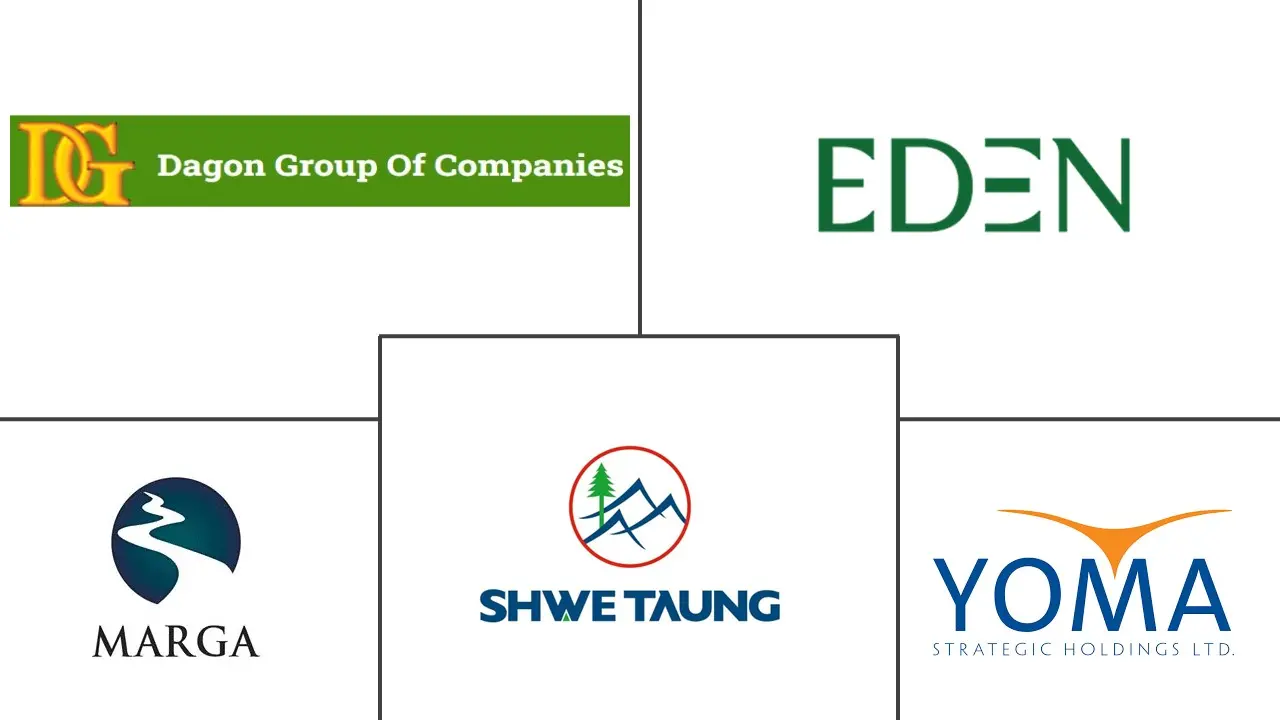
Source: Mordor Intelligence
Myanmar Residential Real Estate Companies Matrix by Mordor Intelligence
Our comprehensive proprietary performance metrics of key Myanmar Residential Real Estate players beyond traditional revenue and ranking measures
The MI Matrix can rank firms differently because it rewards what buyers feel day to day, not only financial scale. Delivery reliability, local footprint depth, and the ability to keep communities running during outages can move scores materially. Innovation signals also matter, especially when builders introduce solar, water treatment, or managed services that reduce household risk. Many executives also want quick clarity on two practical topics: how to verify condominium eligibility before paying a deposit, and how staged payment plans handle delays or partial completion. Another frequent focus is which Yangon and Mandalay corridors can sustain rentals when sales slow, since cash flow stability shapes developer behavior. This MI Matrix by Mordor Intelligence is better for supplier and competitor evaluation than revenue tables alone because it reflects operational reality, not just accounting outcomes.
MI Competitive Matrix for Myanmar Residential Real Estate
The MI Matrix benchmarks top Myanmar Residential Real Estate Companies on dual axes of Impact and Execution Scale.
Analysis of Myanmar Residential Real Estate Companies and Quadrants in the MI Competitive Matrix
Comprehensive positioning breakdown
Shwe Taung Group
Integrated building capability and long-running relationships shorten coordination cycles and drive scale. The group is a leading company in Yangon housing ecosystems and operates across real estate, construction, and infrastructure, which helps reduce single-project fragility. Policy shifts that tighten permitting or construction sequencing can raise working-capital needs, so strong internal controls act as a real moat. If mid-income affordability improves, management can re-balance toward higher-volume homes while keeping lifestyle assets supportive. The key operational risk is concentration in Yangon execution bandwidth during labor volatility and power disruptions.
Yoma Strategic Holdings
Profit recovery since FY2024 signals sustained project delivery under stress and is important for investor confidence. The company has disclosed improving performance driven by property-linked contributions and currency pressure, which suggests active management of pricing and collections. A 2025 site visit program highlighted active residential communities and ongoing project visibility, reinforcing a community-led differentiation. If regulated mortgage access expands, the business can broaden its pool of buyers beyond cash purchasers and staged payments. The most material risk remains financing cost drag when large developments face schedule variability.
Dagon Group
Execution risk rises when public updates are thin and project visibility relies on informal channels. The firm is a locally established developer that benefits from familiarity with township-level delivery, which helps when buyers prioritize practical layouts over branding. Regulatory uncertainty around land documentation and condo registration can increase buyer hesitation, so stronger proof packs would be a quick win. If construction inputs stabilize, the company could reposition toward mid-priced apartments where demand is steadier. The key weakness is limited recent disclosure, which can raise perceived counterparty risk for lenders and pre-sale buyers.
Yoma Land
Pipeline supports steady presales even when buyer sentiment swings week to week. Yoma Land is a major OEM of master-planned communities and showcased 2025 progress through project tours that highlighted solar-equipped villas and townhouse handovers within StarCity and Pun Hlaing Estate. Its differentiation is livability, since schools, utilities backups, and community services reduce perceived daily-life risk for families. If installment confidence improves, the developer can broaden uptake for mid-income formats without diluting brand standards. The critical risk is timeline dependence on large, multi-phase builds where any pause can disrupt cash conversion.
FMI Garden Development
Township style planning creates repeat buyers when services, security, and maintenance stay reliable. FMI Garden Development is a major player within Yangon's community-led housing formats, and disclosures list it alongside other residential holdings as of 31 March 2024. Strong internal governance can help manage resale ecosystems, which matters when buyers treat housing as a store of value. If infrastructure corridors improve, the model can expand with smaller clusters that need less upfront capital. The key risk is sustaining utilities and services quality at scale, since slippage quickly damages long-term buyer advocacy.


Frequently Asked Questions
What is the safest way to evaluate a housing developer in Myanmar?
Ask for proof of completed handovers, defect rectification practices, and clear title or development rights documentation. Then validate whether utilities and security operations are in place for occupied residents.
How should buyers think about presales and installment plans?
Tie payments to verified construction milestones, not calendar dates, and confirm what happens if milestones slip. Buyers should also check whether refund terms are practical to enforce.
What should I check before buying a condominium unit as a non-local buyer?
Confirm the building's eligibility and registration status for condominium transfers, then verify the unit's documentation chain. Work with legal counsel who can validate transfer steps and payment protections.
Why do rentals sometimes stay active when sales slow?
When households delay purchases, they often rent for flexibility, which supports occupancy. Developers also tend to focus on completed units and managed communities that renters perceive as lower risk.
How can a developer improve buyer trust quickly in today's conditions?
Publish standard contracts, milestone-based schedules, and a simple defect resolution promise with response times. Consistent, documented communication often matters as much as pricing.
What operational risks most often derail housing delivery?
Permitting uncertainty, utility reliability, and contractor labor volatility can compound into schedule slippage. Projects with strong site controls and resident-ready operations usually absorb shocks better.


Methodology
Research approach and analytical framework
Inputs prioritize company disclosures, listed filings, and official company channels, supplemented by credible journalism. The approach works for public and private firms by using project milestones, site signals, and documented partnerships. When direct financial splits are unavailable, scoring uses conservative proxies tied to Myanmar housing activity. Conflicting signals are triangulated and weak sources are deprioritized.
Myanmar city coverage and on-ground teams drive presales, handovers, and resident support across Yangon and secondary cities.
Buyer trust is tied to completion history, after-sales fixes, and perceived safety and service quality in housing communities.
Relative transaction pull is proxied by unit pipelines, flagship community scale, and repeat sales velocity in Myanmar housing.
Contractors, utilities backups, and maintenance capacity determine whether handovers and defect closures stay predictable.
Community features like solar, water, and managed services improve livability and reduce buyer risk in Myanmar conditions.
Housing-linked cash conversion and funding discipline matter because presales and installment timing often finance construction.