
Market Overview
| Study Period | 2020 - 2031 |
|---|---|
| Forecast Data Period | 2026 - 2031 |
| Historical Data Period | 2020 - 2024 |
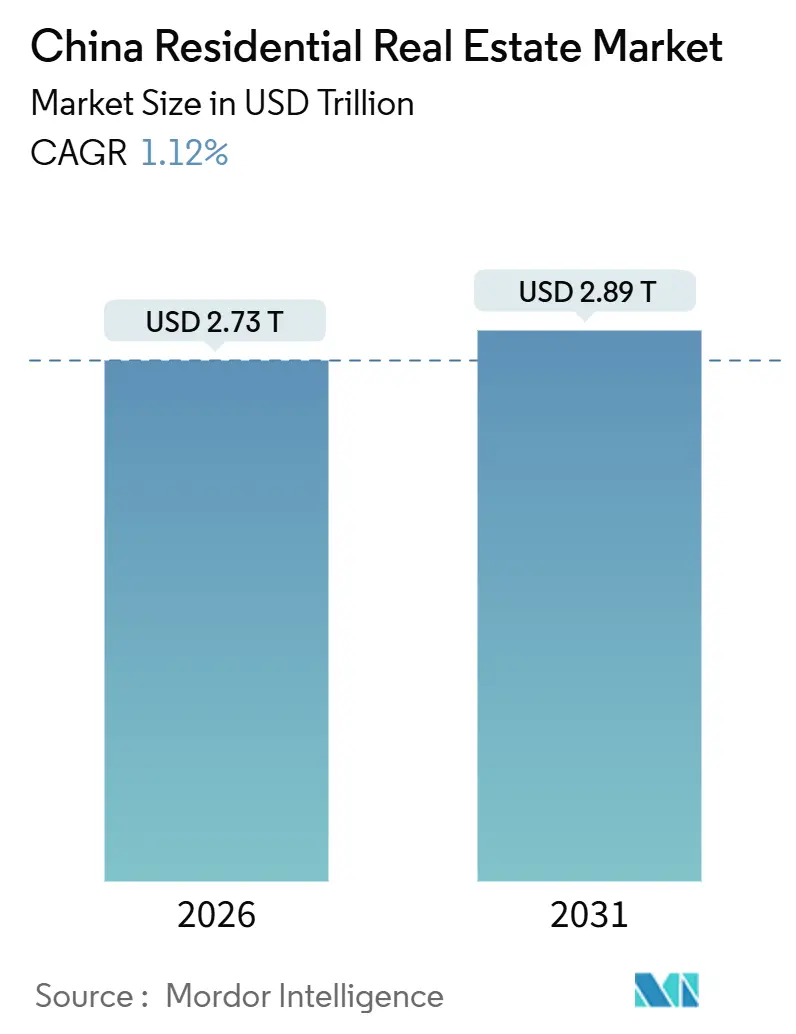
| Market Size (2026) | USD 2.73 Trillion |
| Market Size (2031) | USD 2.89 Trillion |
| Growth Rate (2026 - 2031) | 1.12 % |
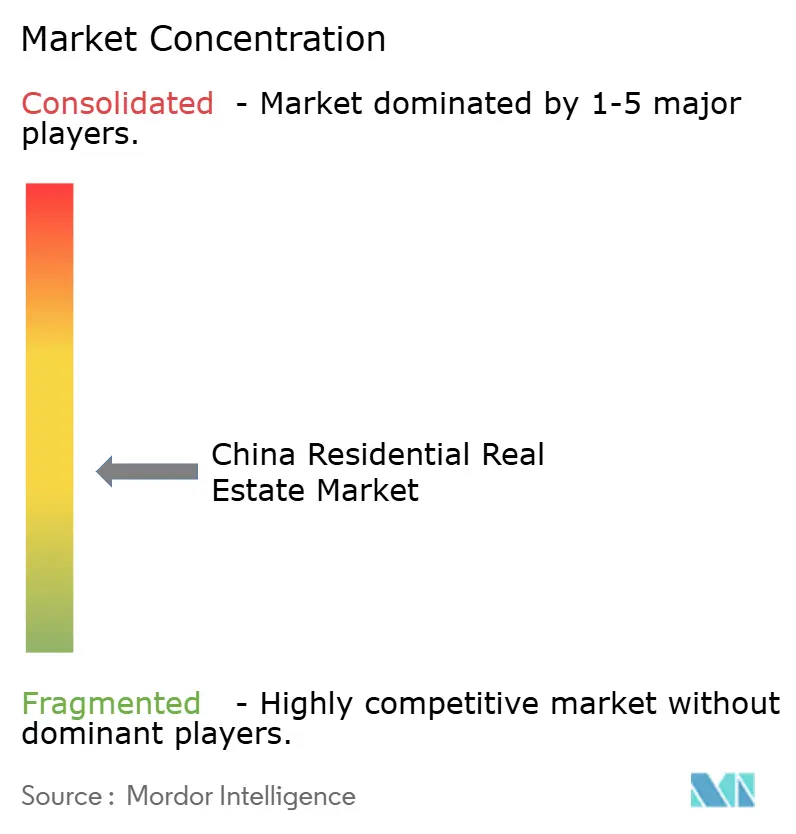
| Market Concentration | Medium |
Major Players *Disclaimer: Major Players sorted in no particular order Image © Mordor Intelligence. Reuse requires attribution under CC BY 4.0. | |
China Residential Real Estate Market Analysis by Mordor Intelligence
The China Residential Real Estate Market size is estimated at USD 2.73 trillion in 2026, and is expected to reach USD 2.89 trillion by 2031, at a CAGR of 1.12% during the forecast period (2026-2031). Subdued momentum stems from demographic headwinds, persistent developer distress, and a deliberate shift in policy from supply-side bailouts to household support. Yet the Chinese residential real estate market continues to draw selective demand in tier-one cities where limited land and deep labor pools harden price floors. Monetary easing, including the October 2024 cut that lowered the five-year Loan Prime Rate to 3.6%, has trimmed borrowing costs, but buyer confidence recovers only where project delivery risk is low[1]. Institutional landlords add fresh liquidity by acquiring distressed stock for conversion to rentals, and green-certified projects now earn carbon-credit revenue that cushions margin compression.
Key Report Takeaways
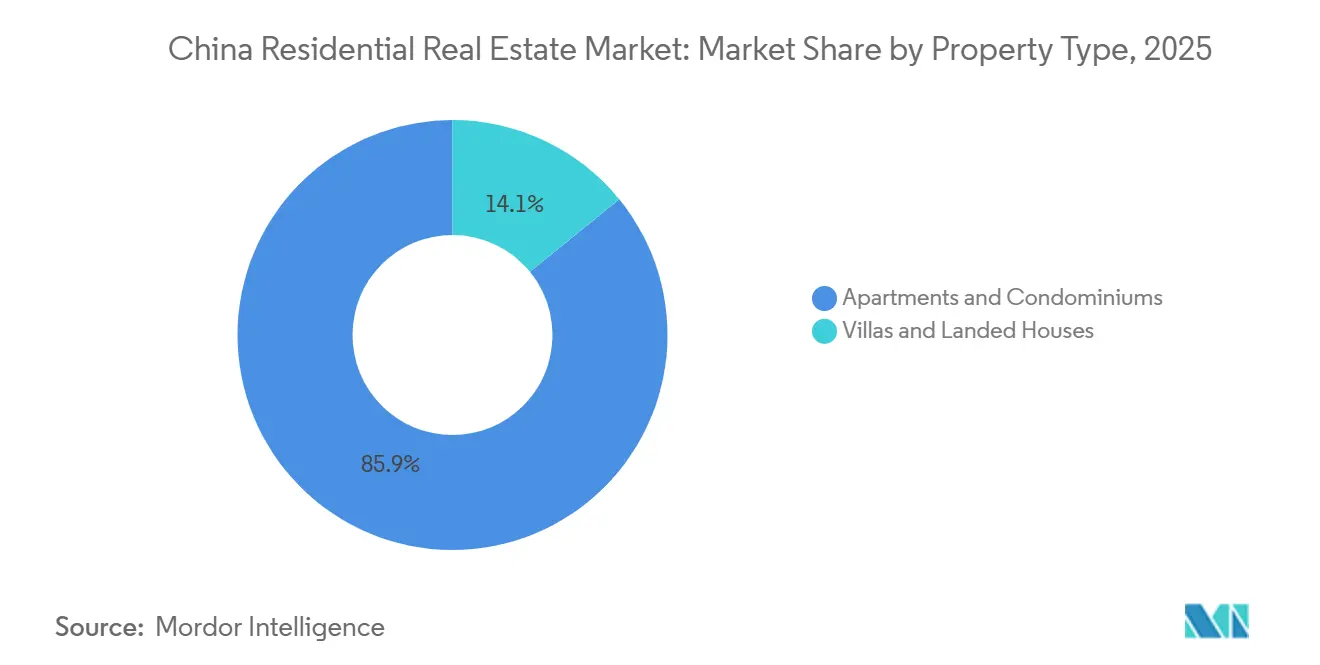
- By property type, apartments and condominiums held 85.88% of the China residential real estate market share in 2025.
- By price band, luxury homes are projected to expand at a 1.37% CAGR through 2031.
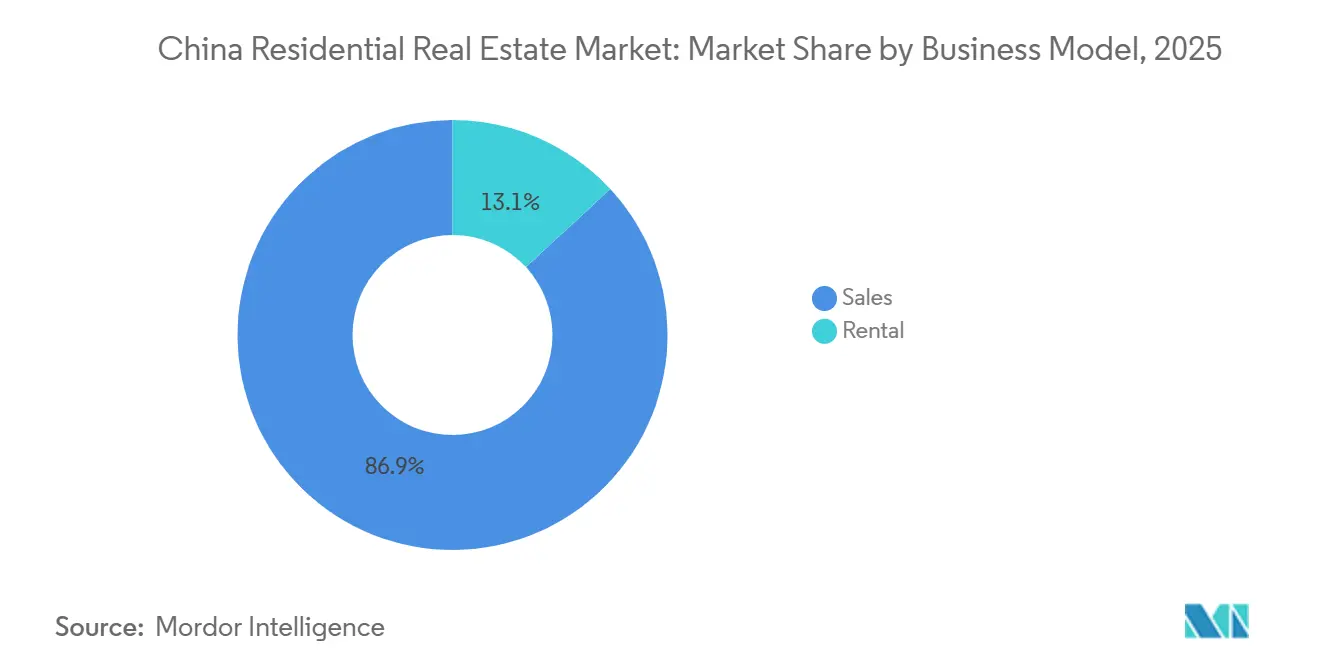
- By business model, sales transactions commanded 86.88% share of the China residential real estate market size in 2025.
- By mode of sale, secondary transactions will grow at a 1.43% CAGR between 2026 and 2031.
- By geography, Guangzhou is expected to post the fastest 1.44% CAGR through 2031.
Note: Market size and forecast figures in this report are generated using Mordor Intelligence’s proprietary estimation framework, updated with the latest available data and insights as of January 2026.
Market Trends and Insights
Drivers Impact Analysis of China Residential Real Estate Market*
| Driver | ( ~ ) % Impact on CAGR Forecast | Geographic Relevance | Impact Timeline |
|---|---|---|---|
| PBOC mortgage-rate floor easing | +0.3% | Beijing, Shanghai, Shenzhen, Guangzhou | Short term (≤ 2 years) |
| Housing Provident Fund expansion to gig-economy workers | +0.2% | National, early gains in Shenzhen, Hangzhou, Shanghai | Medium term (2-4 years) |
| Retirement-community projects with healthcare services | +0.1% | Shanghai, Beijing, Chengdu, Hangzhou | Long term (≥ 4 years) |
| AI-powered property-valuation platforms | +0.1% | Tier-one and tier-two cities | Medium term (2-4 years) |
| Cross-border e-CNY mortgage products | +0.1% | Greater Bay Area | Medium term (2-4 years) |
| Carbon-credit incentives for green-certified projects | +0.1% | Shanghai, Beijing, Shenzhen | Long term (≥ 4 years) |
| Source: Mordor Intelligence | |||
PBOC Mortgage-Rate Floor Easing Stimulates Tier-One Demand
Lower mortgage-rate floors in Beijing, Shanghai, Shenzhen, and Guangzhou reduce monthly repayments, freeing disposable income for down payments. The October 2024 60-basis-point cut alone saved about USD 21.1 billion a year for 50 million households, yet many buyers still hesitate until delivery certainty improves[2]. City officials also trimmed first-home down-payment ratios to 20%, targeting young professionals. The measure steadies, rather than revives, sales volumes. Developers with on-time completion records benefit most, while weaker peers see limited relief. Overall, the initiative shores up the China residential real estate market without reigniting speculative frenzies.
Housing Provident Fund Expansion Broadens Buyer Base
Pilot programs in Shenzhen, Hangzhou, and Shanghai now let gig-economy workers access subsidized loans at rates near 2.85%. China’s gig cohort tops 200 million, so even a 10% uptake could add 20 million future buyers. Early data show a 15% rise in new accounts in Shenzhen during Q1 2025, though many wait to convert savings into purchases. Lenders must adapt credit models to variable incomes, and developers may introduce phased payment plans. The reform enlarges the pipeline of first-time buyers, supporting the long-run depth of the Chinese residential real estate market.
Retirement-Community Projects Drive Senior-Living Pre-Sales
State Council guidelines released in 2024 promote age-friendly compounds with on-site clinics and smart health devices. Developers such as Vanke and Longfor now pre-sell units bundled with priority medical access. China’s 65+ population will exceed 300 million by 2030, and retirees with savings appreciate predictable services. Pre-sales in Shanghai’s first 10 smart elderly-care projects reached 80% of launch inventory within six months. The model delivers steadier cash flows and differentiates supply, reinforcing demand pockets in the Chinese residential real estate market.
AI-Powered Valuation Platforms Shorten Listing-to-Sale Cycles
Machine-learning engines digest transaction histories and neighborhood data to set dynamic prices, cutting listing periods in tier-two cities from nine to five months. An IMF study showed these models improved price-forecast accuracy by 12%. Computer-vision inspections further speed mortgage approvals by limiting manual appraisals. Faster turnover aids distressed developers liquidating stock, while buyers gain confidence from transparent pricing. PropTech adoption, therefore, adds incremental liquidity to the Chinese residential real estate market.
Restraints Impact Analysis of China Residential Real Estate Market*
| Restraint | ( ~ ) % Impact on CAGR Forecast | Geographic Relevance | Impact Timeline |
|---|---|---|---|
| Developer default risks | -0.4% | National, acute in tier-three and tier-four cities | Short term (≤ 2 years) |
| Real-estate-tax pilots | -0.2% | Shanghai, Chongqing, possible expansion to Beijing, Shenzhen | Medium term (2-4 years) |
| 3D-printed modular housing price pressure | -0.1% | Guangdong, Jiangsu, Zhejiang | Long term (≥ 4 years) |
| Energy-efficiency retrofit costs | -0.1% | Beijing, Shanghai, Tianjin | Medium term (2-4 years) |
| Source: Mordor Intelligence | |||
Developer Default Risks Prolong Buyer-Confidence Slump
High-profile collapses, including Evergrande’s liquidation and Country Garden’s restructuring, have shaken faith in pre-sales. Even with escrow safeguards, buyers in smaller cities face handover delays of up to 18 months. Pre-sales supply 70% of developer cash flow, so dwindling deposits starve land acquisition budgets. State-owned giants with investment-grade ratings still raise funds, accelerating consolidation. Until delivery track records improve, this drag will cap near-term growth in the Chinese residential real estate market.
Real-Estate-Tax Pilots Dampen Speculative Demand
Shanghai’s annual levy of 0.4%-0.6% on multiple-unit holdings trims rental yields and nudges investors to sell. Beijing eyes similar rules as land-sale revenue falters. Speculators, who own as much as 30% of stock in tier-one cities, may liquidate, lifting supply in secondary markets. Prices of luxury resales already eased 5% in Shanghai during H1 2025. Broader rollout would temper upside in the China residential real estate market while supporting long-run affordability.
*Our forecasts treat driver/restraint impacts as directional, not additive. The impact forecasts reflect baseline growth, mix effects, and variable interactions.
China Residential Real Estate Market Segment Analysis
By Property Type:
Apartments Retain Dominance as Villas Gain Niche TractionApartments and condominiums accounted for 85.88% of transaction value in 2025, underscoring the high-density template that Chinese planning authorities favor for land-scarce cores. Demand clusters near subway nodes, business parks, and school districts, sustaining thin vacancy even amid wider softness. Shanghai’s strict land-auction quotas kept new apartment launches below 50 plots in 2024, preserving structural tightness. The villa and landed-house niche, though only 14.12% in 2025, will grow at a 1.36% CAGR to 2031, outperforming overall China residential real estate market expansion as affluent buyers seek space and privacy. Prefabricated construction slashes on-site labor by 25%, enabling quicker villa delivery[3].
Despite elevated ticket sizes, villas align with wealthy households relocating to suburban enclaves linked by high-speed rail. Beijing approved just 12 villa projects in 2024, forcing buyers to bid aggressively for the limited supply. Energy-code upgrades push retrofit costs higher for detached homes, yet owners accept premiums for standalone PV systems and smart ventilation. Apartment developers counter by offering rooftop gardens and shared gyms to retain urban buyers. Overall, high-rise stock stays central to the China residential real estate market, while villa launches remain a profitable, capacity-constrained sub-story.

By Price Band:
Mid-Market Resilience Anchors Volume, Luxury Lifts MarginsMid-market units held 49.88% of total value in 2025, supported by first-time buyers using Housing Provident Fund loans with down payments as low as 20%. Projects near public schools and hospitals sell briskly even during downturns. Developers compete on efficient floor plans and bundled furniture packages rather than opulence, ensuring fast absorption. Luxury homes, just 12% of sales in 2025, will clock a 1.37% CAGR through 2031, ahead of the headline China residential real estate market. Cross-border e-CNY mortgages let Hong Kong residents acquire prime Shenzhen condominiums, while mainland millionaires consolidate wealth in trophy assets.
Longfor earned an AA ESG rating in 2025 and leverages that badge to price luxury units at 15% premiums. The affordable-housing slice remains a policy mandate with capped pricing; units enter lotteries within days of release but deliver thin profit margins, prompting developers to treat them as land-bank obligations. The divergence means companies often fund affordable sites with income from high-end towers. Pricing polarity will deepen as tax pilots curb speculation, shaping a barbell profile within the China residential real estate market.
By Business Model:
Sales Prevail, Yet Institutional Rentals AccelerateSales transactions held an 86.88% share in 2025, mirroring cultural bias toward ownership and developer reliance on pre-sales for funding. Still, rentals will log a 1.42% CAGR to 2031, doubling the overall China residential real estate market pace as city governments grant tax holidays to institutional landlords. China Merchants Shekou’s K11 ECOAST in Shenzhen set aside 30% of its 228,500 square meters for long leases, signaling a pivot to recurring cash flows.
Rental yields in Shanghai averaged 2.5% in 2025, below mortgage rates, deterring mom-and-pop landlords but suiting insurance funds that prize stable coupons. Younger workers in the platform economy value mobility over equity accumulation, boosting demand for branded co-living blocks with communal kitchens. Developers still favor sales in smaller cities where credit tapers ease and buyer sentiment rebounds first. Going forward, a hybrid revenue mix will underpin resilience across the China residential real estate market.
By Mode of Sale:
Secondary Market Rises on Delivery CertaintyPrimary sales supplied 67.88% of volume in 2025, yet fear of incomplete handovers nudges households toward finished units. Secondary deals are projected to advance at 1.43% CAGR to 2031, above the headline China residential real estate market, as buyers accept older layouts in exchange for immediate move-in. In first-tier cities, resale prices fell less than new-build values during H1 2025, highlighting trust premiums.
Developers experiment with “build-to-finish” pipelines, offering completed stock before collecting final payments, exemplified by China Overseas Land & Investment’s East Jianguo Road project that generated USD 5.45 billion equivalent in 2024. While this model attracts cautious buyers, it stretches balance sheets, reinforcing consolidation towards well-capitalized firms. In lower-tier cities, abundant vacant land keeps pre-sale culture alive, but secondary momentum suggests gradual diversification across the Chinese residential real estate market.
Geography Analysis
Shanghai exemplifies scarcity-driven resilience. The city issued fewer than 50 residential land parcels in 2024, down 29% year-on-year, keeping new supply tight. Its Green Building mandate forces all upcoming projects to meet two-star energy standards, raising construction costs but also enhancing resale appeal. Average household earnings that often exceed USD 30,000 place many families within mortgage qualification despite higher down-payment thresholds. Consequently, Shanghai underpins floor pricing across the China residential real estate market.
Guangzhou gains from manufacturing expansion in new-energy vehicles and consumer electronics, creating steady employment that converts into housing demand. Down-payment ratios remain 5-10 percentage points lower than those in Beijing and Shanghai, broadening access for young workers. Rail upgrades linking Guangzhou with Shenzhen trim commute times, encouraging cross-city living arrangements. This infrastructure tailwind supports the fastest city-level growth rate recorded in the China residential real estate market forecast.
Conversely, Beijing tightened second-home leverage to 50% LTV during 2025, curbing speculative layering. Hangzhou, Chengdu, and Wuhan grapple with oversized 2016-2020 land banks that now take two years to absorb at current sales tempo. Local governments run targeted voucher schemes to shrink backlog, yet developers often delay bidding at auctions until price floors stabilize. These regional contrasts confirm that recovery in the China residential real estate market will hinge on localized policy and industry capacity to match supply with realistic end-user budgets.
Regulatory Landscape
China's residential market regulatory direction in 2025-2026 focuses on stabilizing deliveries, formalizing the rental market, and shifting growth from new land expansion to stock-based urban renewal. The State Council issued the Regulation on Residential Property Leasing (Order No. 812), effective September 15, 2025, requiring local housing management departments to build leasing service and supervision platforms, implement credit evaluation systems for leasing enterprises, and coordinate data sharing with tax, public security, and financial departments.
Fiscal and administrative measures in 2026 added transaction and registration-side support. A multi-agency announcement introduced personal income tax refunds for households that sell an existing home and buy another in the same city within one year, applicable from January 1, 2026, to December 31, 2027. Separately, a May 29, 2026 notice promoted one-stop information inquiry and streamlined transfer registration for corporate-purchased real estate, tightening cross-department process integration alongside the broader 2026-2030 policy emphasis on urban renewal and a "new real estate development model" focused on upgrading existing stock.
Value Chain Analysis
China's residential real estate value chain runs from land supply and planning approvals through developer financing, design and construction delivery, sales or leasing transactions, and long-tail property management and refurbishment. Policy emphasis on urban renewal and delivery-risk mitigation is reshaping upstream inputs, with local land supply increasingly linked to inventory-clearing cycles, while project execution places greater weight on escrowed pre-sale fund supervision and completed-home sales in some local pilots. This changes the cash-conversion profile for developers and contractors.
Midstream, financing has become more structured around project-level discipline and bank involvement. On the downstream side, transaction channels are being institutionalized through formal leasing platforms and credit monitoring under the 2025 national leasing regulation. Service providers such as brokers, valuation platforms, and property managers are gaining influence as households place a higher premium on delivery certainty and transparency, and as institutional landlords acquire and convert distressed stock into rental product. In parallel, urban renewal programs, including initiatives launched in 2024 to revitalize tens of thousands of aging residential projects, are expanding the role of refurbishment contractors, building-material partners, and property management firms in lifecycle upgrades rather than greenfield build-outs.
Competitive Landscape
Consolidation advanced as the top 10 developers captured close to 40% of contracted sales in 2025. State-owned leaders, China Overseas Land & Investment, Poly Developments, and China State Construction Engineering, enjoy quasigovernmental credit lines that keep borrowing costs under 4%. China Overseas Land & Investment notched USD 43.8 billion in 2024 sales and earned an S&P upgrade to A-/Stable, evidencing balance-sheet credibility. Private peers such as Longfor and Seazen focus on turnover speed and ESG ratings to differentiate.
Strategically, SOEs absorb distressed land in tier-one markets despite slim margins, aiming to fulfill policy mandates and preserve urban influence. Private survivors retreat to tier-two cities where entry bids are lower and regulatory glare softer. Rental portfolios aimed at gig workers emerge as a shared opportunity, with Vanke pledging 50,000 long-term rental units by 2027. Senior-living projects embedded with clinics add another profit pool, particularly for developers partnering with healthcare operators. These adjacencies broaden revenue mixes across the Chinese residential real estate market.
Technology uptake separates leaders from laggards. AI valuation and prefabricated modules shave months off cycles for firms that own in-house factories, documented by a Tsinghua University yearbook that shows 30% time savings. Capital-light competitors lacking such infrastructure must outsource, eroding margin. As financing windows stay narrow, only firms with scale or niche specialization will thrive, pointing to further shake-outs in the China residential real estate market.
China Residential Real Estate Industry Leaders
-
China Vanke Co., Ltd.
-
Sunac China Holdings Limited
-
Country Garden Holdings Co., Ltd
-
China State Construction Engineering Corp. Ltd
-
China Overseas Land & Investment Ltd
- *Disclaimer: Major Players sorted in no particular order
China Residential Real Estate Market Companies Covered in this Report
- China Vanke Co., Ltd
- Country Garden Holdings Co., Ltd
- China State Construction Engineering Corp. Ltd
- China Overseas Land & Investment Ltd
- Poly Developments & Holdings Group Co., Ltd
- Greenland Holdings Corp. Ltd
- Longfor Group Holdings Ltd
- Sunac China Holdings Ltd
- Evergrande Real Estate Group Ltd
- Shimao Group Holdings Ltd
- CIFI Holdings (Group) Co., Ltd
- Greentown China Holdings Ltd
- Seazen Holdings Co., Ltd
- R&F Properties Co., Ltd
- Agile Group Holdings Ltd
- KWG Group Holdings Ltd
- Yango Group Co., Ltd
- China Jinmao Holdings Group Ltd
- China Merchants Shekou Industrial Zone Holdings Co., Ltd
Market Opportunities and Future Outlook
Urban renewal and stock-based upgrading are the clearest whitespace for developers, contractors, and service providers as policy pivots from expansion to improving existing neighborhoods and accelerating project delivery. The Urban Renewal 15th Five-Year Plan (2026-2030) frames the new model around upgrading existing stock and calls for research on revising core laws such as the Urban Real Estate Administration Law and the Construction Law, supporting a multi-year pipeline for redevelopment, retrofit, and community-level improvement works. For market participants, this expands opportunities in delivery-focused execution, renovation contracting, and value-added property management, especially where local governments package renewal projects and integrate approvals and registrations.
Rental institutionalization and transaction-facilitation tools are also creating operational and platform-led opportunities. The Regulation on Residential Property Leasing (effective September 15, 2025) requires local leasing platforms and credit evaluation systems, increasing demand for compliant institutional operators and professional property managers. On the demand side, the personal income tax refund policy for same-city home trade-ins from January 1, 2026, to December 31, 2027 creates an actionable lever for replacement chains, supporting secondary-market activity and upgrade purchases where delivery risk is lower. Developers and investors aligned with these programs, including conversions of existing inventory into affordable or long-lease rental housing, gain clearer pathways to participate in policy-backed stabilization initiatives while navigating tighter financing selectivity.
Recent Industry Developments in China Residential Real Estate Market
- July 2026: China Vanke moved to nominate a new board dominated by Shenzhen state-owned sector representatives, deepening state involvement in one of the sector's largest developers. The governance shift changes decision-making around asset disposals, project delivery prioritization, and financing access as balance-sheet repair remains central to market stabilization.
- December 2025: Sunac China's offshore debt restructuring became effective, discharging a large portion of its existing offshore obligations and resetting parts of its capital structure. The completion supported a longer runway for project-level execution and negotiations with creditors and suppliers, which directly affects delivery confidence for buyers in pre-sale-heavy cities.
- December 2024: China Merchants Shekou opened the K11 ECOAST district in Shenzhen and earmarked a material share of its residential component for rentals. The move reinforced the institutional rental channel as developers diversify away from pure sales dependence and align with city-level support for long-term leasing supply.
China Residential Real Estate Market Report Scope and Research Methodology
Market Definition and Coverage
For this study, the market is defined as the annual value of residential property activity in mainland China, covering new home sales, existing home resales, and formal residential rentals, and expressed in USD.
Scope exclusions: We exclude commercial real estate and mixed-use projects where non-residential income is the majority.
Segments Covered in This Report
- By Property Type
- Apartments & Condominiums
- Villas & Landed Houses
- By Price Band
- Affordable
- Mid-Market
- Luxury
- By Business Model
- Sales
- Rental
- By Mode of Sale
- Primary (New-Build)
- Secondary (Existing Home Resale)
- By Geography
- Shenzhen
- Beijing
- Shanghai
- Hangzhou
- Guangzhou
- Other Key Cities
Data Sources, Market Sizing, and Validation
Desk Research
Desk work was used to set the market boundaries and to build consistent time series that can be tested year by year. We primarily relied on public statistical releases and policy notes, since they help clarify what is counted as residential, what is counted as commercial, and how revisions are handled over time.
Sources typically reviewed include official releases such as the National Bureau of Statistics of China, Ministry of Housing and Urban-Rural Development announcements, land and housing transaction disclosures from major cities, and central bank or financial regulator publications for mortgage and credit conditions. Supporting context was added using listed developer filings, investor presentations, reputable press coverage, and academic or journal articles on housing demand and urbanization. In addition, paid subscriptions for company financials and news screening, and patent databases for construction and building technology signals, were used selectively for cross-checks. The sources listed here are not exhaustive, and many other public references were also consulted to collect, validate, and clarify inputs.
Primary Interviews and Surveys
Primary discussions were used to pressure-test pricing, transaction pace, and the share split between new sales, resales, and rentals, especially when city-level indicators moved differently from national totals. We spoke with a mix of developers, brokerage and property management stakeholders, lenders, and local market watchers across major demand centers and selected lower-tier cities, and then re-checked any outlier assumptions through follow-up questions.
Distribution of primary research fieldwork respondents
| Company type | Respondent position |
|---|---|
| Top tier: 33% | CXOs: 12% |
| Mid tier: 52% | Functional/Unit leaders: 32% |
| Smaller Players: 15% | Managers: 56% |
Market-Sizing & Forecasting
Market sizing was built using a blended top-down and bottom-up logic, where national and city indicators are first used to reconstruct total residential value pools and are then checked against selective roll-ups. The top-down layer was anchored on residential development investment and sales activity signals, followed by a demand pool sanity check using urban household formation and migration patterns.
Key inputs that were used as practical market fingerprints include residential development investment trends, new home sold area and sales value, existing home turnover signals in key cities, mortgage rate and credit availability direction, and observed price movements for mainstream housing types. Where some data series were not directly comparable across years, we normalized them through consistent currency timing and inflation assumptions, and any gaps were handled through conservative interpolation supported by interview feedback.
For forecasting, scenario analysis was used because policy support, financing conditions, and buyer confidence can shift quickly and do not always follow a smooth time series. The final outlook was shaped by how experts expected credit easing, inventory clearance pace, and price stabilization to play out across city tiers, and the model was adjusted when the implied value per square meter moved away from what local checks suggested.
Data Validation & Update Cycle
Outputs were validated through triangulation across at least two independent signals, such as investment and sales value, and then further sense-checked using price per square meter implications at the aggregate level. Any sharp year-to-year swings triggered an anomaly review, where assumptions were revisited and, when needed, respondents were re-contacted to confirm whether the change was structural or timing-related.
Before sign-off, the model is reviewed in steps by analysts to confirm definitions, unit conversions, and the link between inputs and totals. The report is refreshed annually, and interim updates are made when major policy moves, financing shifts, or data revisions materially change the demand outlook. Right before delivery, we run a final pass to make sure the latest available releases and market signals are reflected in the numbers.
Mordor Intelligence's China Residential Real Estate Market Size Compared Against Other Published Estimates
Published market sizes for China residential real estate often do not match, mainly because the underlying measurement concept is not always the same. Some estimates focus on annual transaction flows, while others lean toward invested or institutionally held assets, and the year and currency translation choices can further widen the spread.
The biggest gap drivers in this market usually come from whether rentals are treated as a stock value or as annual rent flow, whether resales are fully counted alongside new-home sales, and whether the estimate follows policy-driven turns with a slower refresh. On top of that, different treatments of price decline periods, and whether values are kept in constant dollars or current dollars, can change the reported level even when the direction looks similar.
Benchmark comparison
| Source | Market Size | Gaps in Research Methodology |
|---|---|---|
| Mordor Intelligence | USD 2.73 T (2026) | |
| Industry Database A | USD 0.99 T (2025) | This figure is closer to an annual activity view for a single year and does not clearly show how rentals and secondary resales are treated, which can compress the total versus a broader value pool approach. |
| Global Index Provider B | USD 0.96 T (2024) | The scope is oriented to professionally managed investment real estate, which typically excludes large portions of owner-occupied housing and informal rental stock that matter in residential living demand. |
The spread in the table mainly reflects what is being measured, and not just different math. When primary sales, secondary resales, and residential rentals are kept in one consistent USD framework and reconciled back to investment and sales signals, the result lands higher, which is the sizing choice applied by Mordor Intelligence.
Key Questions Answered in the Report
How big is the China residential real estate market in 2026?
The China residential real estate market size reached USD 2,732.68 billion in 2026, with a projected value of USD 2,889.18 billion by 2031.
Which city is expected to grow fastest through 2031?
Guangzhou is forecast to lead with a 1.44% CAGR, driven by manufacturing job creation and relatively relaxed purchase restrictions.
Why do buyers favor secondary homes now?
Completed properties eliminate delivery risk, and secondary prices fell less than new-build values in 2025, giving buyers immediate occupancy and better price stability.
What drives growth in luxury housing?
Wealth concentration and new cross-border digital-yuan mortgages for Hong Kong residents lift demand for high-end units, supporting a 1.37% CAGR through 2031.
How are developers adapting to lower sales volumes?
Firms with strong balance sheets pivot to rental housing, senior-living projects, and carbon-credit-eligible green buildings to diversify income.