
Global Renal Dialysis Equipment Market Size and Share
Market Overview
| Study Period | 2020 - 2031 |
|---|---|
| Market Size (2026) | USD 23.56 Billion |
| Market Size (2031) | USD 30.33 Billion |
| Growth Rate (2026 - 2031) | 5.18 % |
| Fastest Growing Market | Asia Pacific |
| Largest Market | North America |
| Market Concentration | Low |
Major Players *Disclaimer: Major Players sorted in no particular order Image © Mordor Intelligence. Reuse requires attribution under CC BY 4.0. | |
Global Renal Dialysis Equipment Market Analysis by Mordor Intelligence
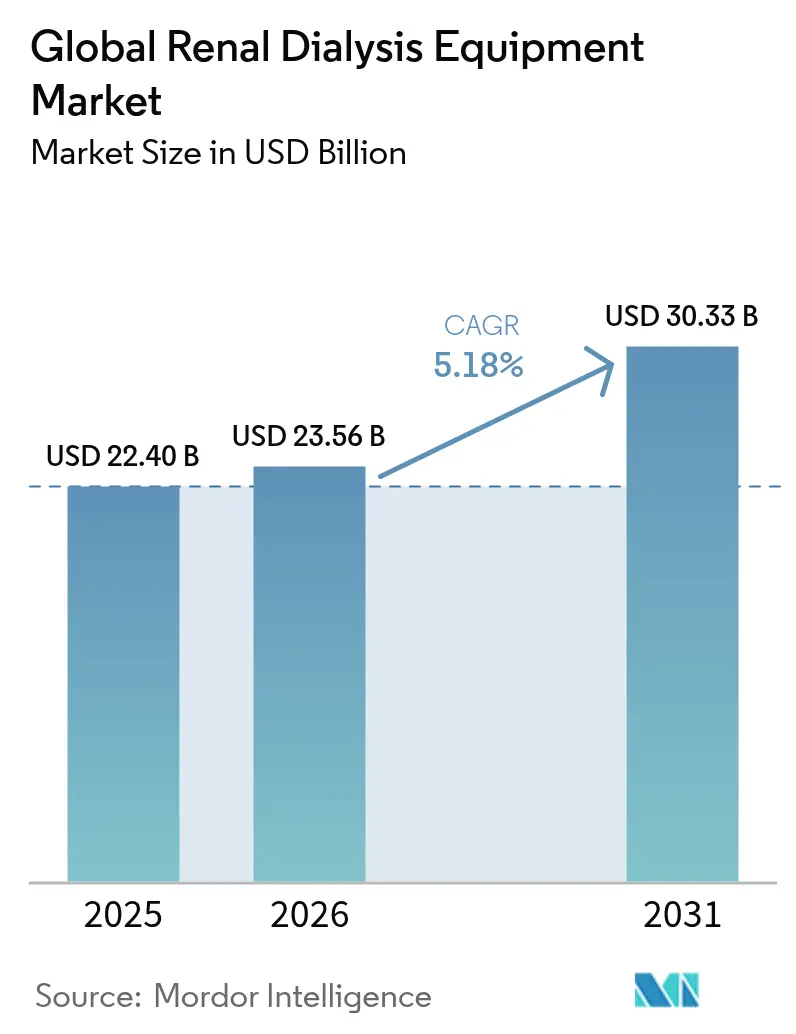
The renal dialysis equipment market size is expected to grow from USD 22.40 billion in 2025 to USD 23.56 billion in 2026 and is forecast to reach USD 30.33 billion by 2031 at 5.18% CAGR over 2026-2031. Demographic aging, rising diabetes prevalence, and chronic kidney disease (CKD) incidence are sustaining demand, while Medicare’s 2025 End-Stage Renal Disease (ESRD) payment update and similar reimbursement reforms worldwide are accelerating a shift from in-center delivery models to home-based care. Leading manufacturers are introducing compact, water-efficient machines that lower infrastructure needs, and service providers are investing in AI-enabled predictive maintenance to minimize downtime and improve clinical outcomes. Supply-chain resilience and environmental sustainability have become strategic priorities following recent raw-material shortages and tougher regulations on single-use plastics. Concurrently, capital inflows into wearable and portable sorbent-based devices point to a medium-term transition toward patient-centric, resource-light treatment paradigms.
Key Report Takeaways
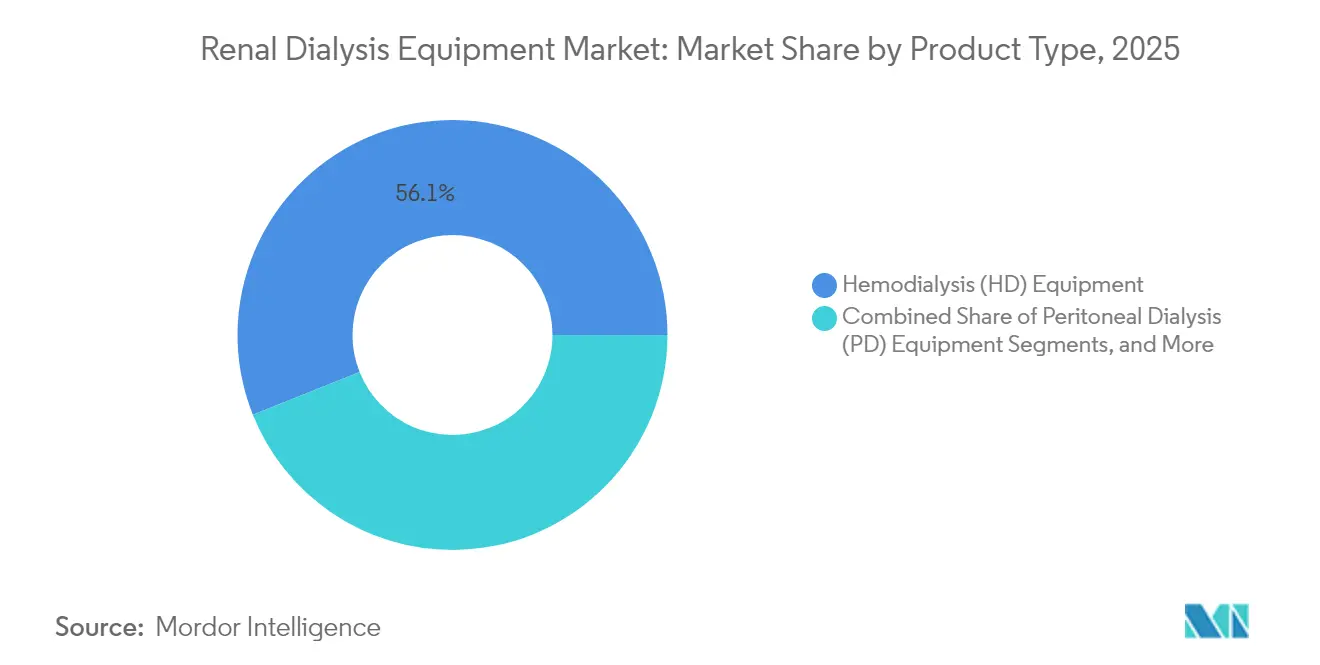
- By product type, hemodialysis equipment led with 56.05% of renal dialysis equipment market share in 2025, while peritoneal dialysis equipment is projected to rise at a 6.42% CAGR through 2031.
- By application, hemodialysis accounted for 81.65% share of the renal dialysis equipment market size in 2025; peritoneal dialysis applications are expected to grow at a 6.19% CAGR to 2031.
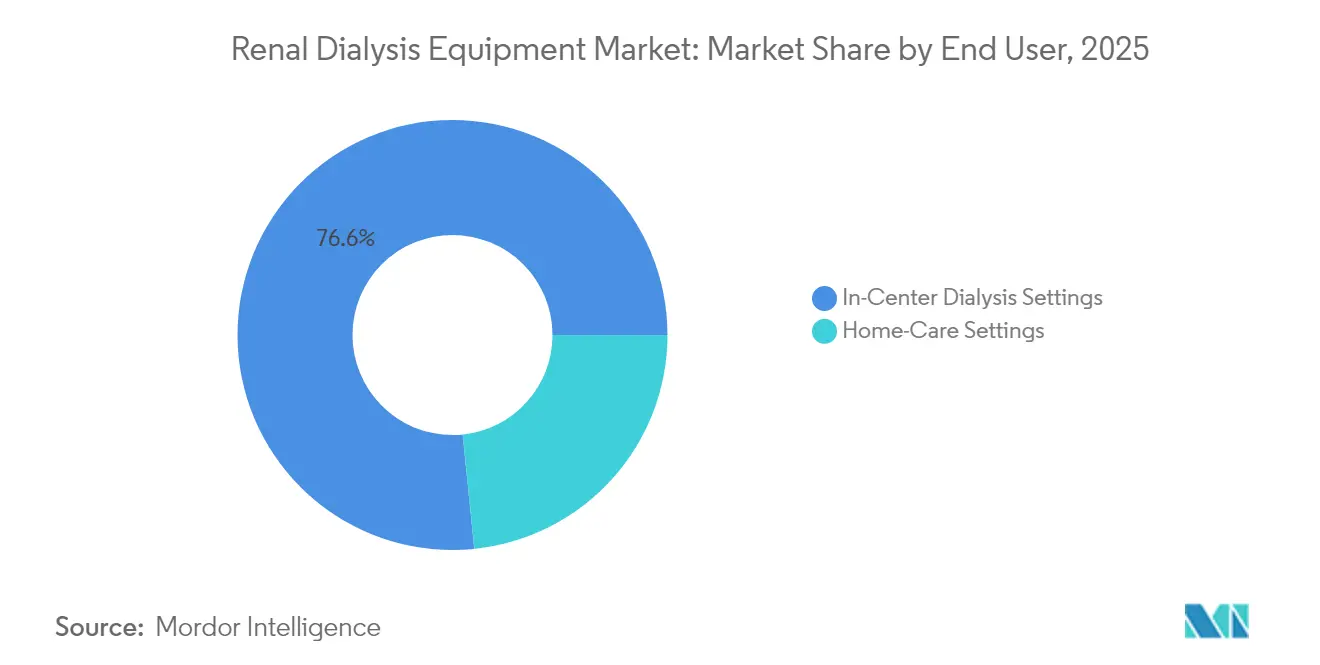
- By end user, in-center settings commanded 76.62% revenue share in 2025; the home-care segment is forecast to expand at 5.88% CAGR between 2026-2031.
- By geography, North America held 43.02% of the renal dialysis equipment market in 2025, whereas Asia-Pacific is poised to register the fastest 6.86% CAGR to 2031
Note: Market size and forecast figures in this report are generated using Mordor Intelligence’s proprietary estimation framework, updated with the latest available data and insights as of 2026.
Global Renal Dialysis Equipment Market Trends and Insights
Drivers Impact Analysis*
| Driver | (~) % Impact on CAGR Forecast | Geographic Relevance | Impact Timeline |
|---|---|---|---|
| Growing demand for peritoneal dialysis | +1.2% | Global; strongest in Asia-Pacific and Latin America | Medium term (2-4 years) |
| R&D spending for next-generation equipment | +0.8% | North America & Europe; spill-over to Asia-Pacific | Long term (≥ 4 years) |
| Increasing CKD prevalence | +1.5% | Global; highest burden in low- and middle-income regions | Long term (≥ 4 years) |
| Adoption of portable sorbent-based systems | +0.7% | North America & Europe | Medium term (2-4 years) |
| AI-enabled predictive maintenance | +0.4% | Developed markets with advanced infrastructure | Medium term (2-4 years) |
| Net-zero, water-less dialysis technologies | +0.6% | Global; priority in water-scarce regions | Long term (≥ 4 years) |
| Source: Mordor Intelligence | |||
Growing Demand for Peritoneal Dialysis
Peritoneal dialysis use is rising as clinical evidence confirms survival rates comparable to in-center hemodialysis and highlights lower infection exposure for patients treated at home. The United States Renal Data System (USRDS) reported a 70% jump in incident home-dialysis starts between 2012 and 2022, supported by Medicare’s 2025 ESRD Treatment Choices Model incentives [1]. Latin America illustrates the trend, with Mexico accounting for one-quarter of the world’s peritoneal population. Nonetheless, access gaps driven by limited surgical training and patient education persist in several regions. Clinical societies now recommend early modality education to lift adoption, and device makers are launching automated cyclers that simplify set-up and monitoring.
Growth in R&D Expenditure for New Dialysis Products
Top manufacturers have earmarked multi-year R&D budgets to upgrade dialysis platforms. Fresenius Medical Care secured FDA clearance for its 5008X system, which delivers high-volume hemodiafiltration and targets replacement of legacy machines [2]. Vantive, the newly spun-out Baxter kidney-care entity, plans USD 1 billion of investment over five years to commercialize portable and implantable technologies. Academic groups add momentum: the University of Portsmouth demonstrated predictive-maintenance algorithms that cut machine downtime by 30%, while Seoul National University is advancing nano-electrokinetic pumps for compact peritoneal units. Funding programs such as KidneyX have awarded USD 17 million since 2023, ensuring a steady pipeline of projects.
Increasing Prevalence of Chronic Kidney Disease (CKD)
CKD affected 37 million Americans in 2025, and epidemiological reviews recorded 18.99 million new global cases in 2019, reflecting a sustained burden that underpins renal dialysis equipment market growth. Diabetes and hypertension remain leading risk factors; the CDC estimates Medicare spent USD 87.2 billion on CKD in 2024, nearly 8% of its budget. Low-income countries face the sharpest rise in incidence yet lack adequate therapy capacity, creating sizable white-space opportunities for cost-optimized devices. Modeling studies forecast CKD-related deaths to top 1.81 million by 2030, ensuring demand for dialysis and transplantation outpaces supply.
Adoption of Portable Sorbent-Based Dialysis Systems
Portable systems that regenerate dialysate through sorbent cartridges dramatically reduce water consumption and infrastructure costs. Quanta Dialysis Technologies’ SC+ platform received FDA clearance for home use with flow rates equal to in-center machines while operating on standard tap water. Clinical testing shows pulsatile push-pull flows enhance solute clearance by 10-15%, and facilities benefit from faster room turnover and lower utility bills. Investor confidence surged after Quanta’s USD 245 million Series D round, enabling global scale-up and acute-care applications.
Restraints Impact Analysis*
| Restraint | (~) % Impact on CAGR Forecast | Geographic Relevance | Impact Timeline |
|---|---|---|---|
| Complications and risks during dialysis | -0.8% | Global; higher impact in developing regions | Short term (≤ 2 years) |
| Reimbursement limitations in emerging markets | -1.2% | Asia-Pacific, Latin America, Middle East & Africa | Medium term (2-4 years) |
| Volatile supply of medical-grade resins | -0.6% | Global; acute in North America & Europe | Short term (≤ 2 years) |
| Regulatory scrutiny on single-use plastics | -0.4% | Europe & North America; expanding to Asia-Pacific | Long term (≥ 4 years) |
| Source: Mordor Intelligence | |||
Complications & Risks Associated with Dialysis Procedures
Safety alerts issued by the FDA in 2024 detailed toxic-compound leaching from silicone tubing in pediatric circuits, prompting rapid redesigns and material substitutions fda.gov. Vascular-access infection remains a leading cause of hospitalization; the CMS ESRD Measures Manual showed that catheter use correlated with higher sepsis rates than arteriovenous fistulas. Peritoneal dialysis peritonitis is declining but continues to deter clinicians in settings with limited training. These complications inflate treatment costs and can delay therapy initiation, slowing overall equipment uptake.
Reimbursement Limitations in Emerging Markets
The Clinical Journal of the American Society of Nephrology found that 90% of surveyed governments reimburse maintenance dialysis but that payment rates track closely with national GDP, leaving substantial gaps in Asia-Pacific and parts of Africa. Registry data reveal renal replacement therapy prevalence closely mirrors gross national income, confirming financial access as the primary hurdle. Because the highest CKD growth occurs where reimbursement is weakest, manufacturers must tailor lower-cost models, localize production, and partner with charities to unlock demand.
*Our forecasts treat driver/restraint impacts as directional, not additive. The impact forecasts reflect baseline growth, mix effects, and variable interactions.
Segment Analysis
By Product Type: Hemodialysis Platforms Remain Dominant While Peritoneal Equipment Gains Momentum
Hemodialysis machines, water-treatment systems, and ancillary disposables accounted for 56.05% of renal dialysis equipment market share in 2025 underpinned by decades of installed infrastructure and clinician familiarity. The 5008X high-volume hemodiafiltration unit is expected to refresh fleets across major U.S. providers, signaling sustained investment in conventional platforms. In contrast, peritoneal dialysis cyclers are forecast to post a 6.42% CAGR, buoyed by payer incentives and advances in user-friendly interfaces. Automated cyclers equipped with remote telemetry are expanding uptake among elderly and rural patients, and new biocompatible solutions are reducing peritonitis rates. Concentrates and solutions also benefit from CMS policy changes that bring oral phosphate binders into the bundled payment, enlarging adjunct revenue streams.
Peritoneal equipment momentum is strongest in Mexico, China, and the United States, where transitional care units guide candidates through modality selection. Supply-chain tightness for plastic bloodlines and cartridges spotlighted the need for multi-source procurement strategies, yet manufacturers with vertically integrated resin capacity are navigating disruptions better than peers. Sustainability targets are accelerating a shift to recyclable cartridges, and research consortia are trialing plant-based polymers for dialyzer housings. As home uptake rises, after-sales service and 24-hour technical support emerge as key competitive differentiators.

By Application: Conventional Hemodialysis Leads but Home-Based Modalities Accelerate
Conventional in-center hemodialysis retained 81.65% of the renal dialysis equipment market size in 2025, reflecting worldwide standardization of thrice-weekly regimens. AI-driven sensors within modern machines now adjust ultrafiltration in real time, lowering hypotension events and aligning with quality metrics. Short-daily and nocturnal variants are growing from a small base, supported by outcome data indicating superior fluid management and patient-reported quality of life.
Peritoneal dialysis applications, although smaller, are set to expand at 6.19% CAGR. Continuous ambulatory peritoneal dialysis (CAPD) dominates Latin American practice, whereas automated peritoneal dialysis (APD) gains traction in developed economies. The 2024 USRDS report showed that 45.6% of U.S. clinics still lack home-dialysis certification, offering a large conversion pool once training barriers are removed. Emerging telehealth platforms allow nephrologists to review real-time data and intervene proactively, raising confidence in home care.
By End User: Facility-Based Care Prevails as Home-Care Growth Outpaces
In-center facilities captured 76.62% revenue in 2025, supported by economies of scale and immediate clinical oversight. Fresenius Medical Care and DaVita, through vertical integration, standardize protocols and consolidate procurement, reinforcing their purchasing power. Hospital-based units treat higher-acuity patients and maintain larger proportions of peritoneal cases due to surgical resources.
Home-care settings, though nascent, are predicted to grow 5.88% annually. The Medicare home-dialysis payment adjustment and FDA clearance of machines that run on tap water lower entry hurdles. Transitional training programs report conversion rates above 40%, indicating patient willingness when education is structured. Remote monitoring platforms feeding into electronic health records facilitate regulatory compliance and early adverse-event detection.
Geography Analysis
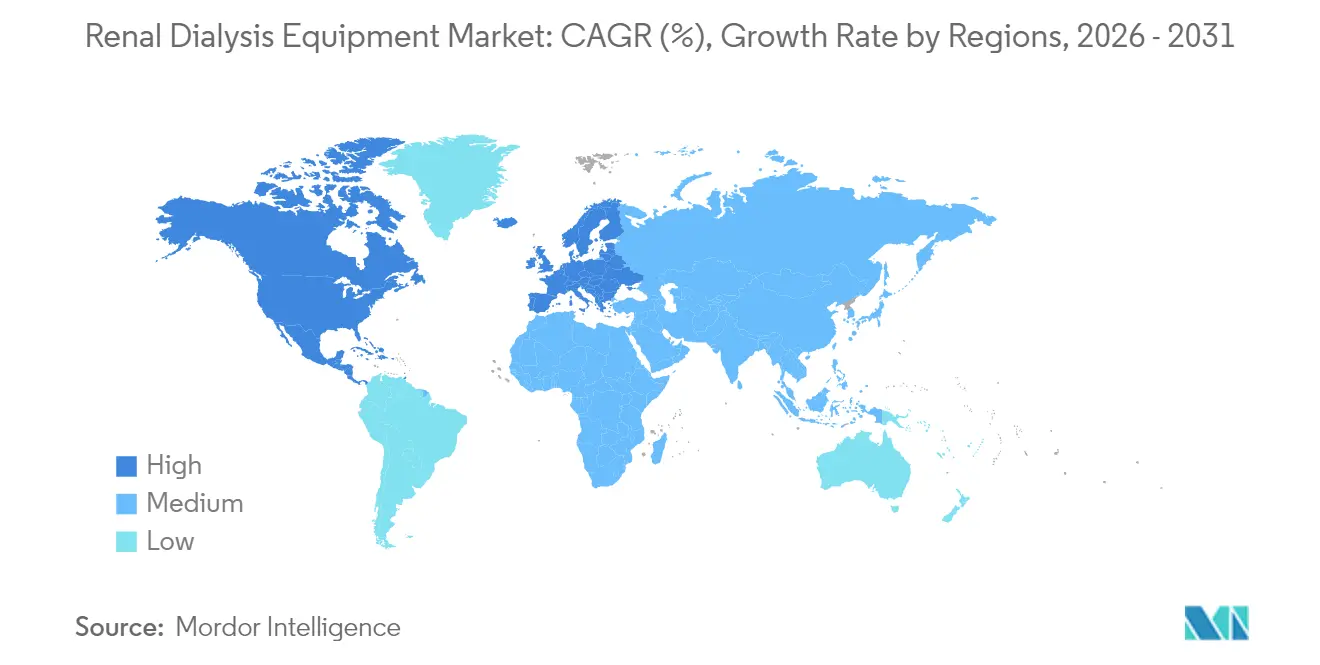
North America retained 43.02% of the renal dialysis equipment market in 2025 thanks to robust reimbursement, extensive clinic networks, and rapid device approvals. Medicare spent USD 75 billion on CKD beneficiaries in 2024, and CMS raised the ESRD base rate to USD 273.82 in 2025, directly boosting provider capital budgets . Canada’s single-payer model guarantees nationwide dialysis coverage, while Mexico leads peritoneal usage globally due to sustained policy backing. Although Hurricane-related disruptions to a key North Carolina dialyzer plant exposed supply‐chain concentration, FDA emergency-use authorizations enabled alternative sourcing, prompting manufacturers to diversify footprints.
Europe constitutes the second-largest region, characterized by strict environmental directives that favor low-water, low-waste systems. National health services in Germany, France, and the United Kingdom fund universal access, and the European Renal Association promotes cross-border clinical guidelines to harmonize quality standards. Italy’s nephrology society published a ten-step green framework in 2024, encouraging dialyzer reprocessing and renewable-energy adoption within clinics. Regulatory updates aligning ISO 23500 water-purity limits with AAMI guidelines are pushing vendors to upgrade filtration modules across the installed base.
Asia-Pacific is the fastest-growing territory at a projected 6.86% CAGR. Japan records the world’s highest ESRD prevalence and maintains sophisticated reimbursement for thrice-weekly in-center hemodialysis. China and India face a 66% access gap, representing the largest latent demand pool. Government-led insurance expansions, private-equity investment in dialysis chains, and public-private partnerships for rural outreach are narrowing disparities. Australia and South Korea showcase near-universal coverage and are early adopters of tele-monitored home systems. Multinationals are increasingly establishing localized assembly plants to meet price-sensitive segments and qualify for procurement tenders.
Regulatory Landscape
Renal dialysis equipment is regulated as a medical device in major markets. In the United States, hemodialysis systems are treated as Class II devices under 21 CFR 876.5820, with the FDA premarket notification (510(k)) pathway and general device controls forming the core approval route. A key compliance milestone is the FDA Quality Management System Regulation (QMSR), which incorporates ISO 13485:2016 by reference and takes effect February 2, 2026, increasing the emphasis on harmonized quality documentation and audit readiness for global manufacturers supplying the US.
Safety and performance expectations are also tightening through standards updates and procurement specifications. In Europe and other IEC-aligned jurisdictions, BS EN IEC 60601-2-16:2025 updates particular requirements for the basic safety and essential performance of haemodialysis, haemodiafiltration, and haemofiltration equipment, which affects design controls and verification for new platforms and upgrades to installed fleets. Trade and fiscal policy adds another variable for market access. In mid-2026, US discussions around potential medical-device tariffs under Section 232 investigations prompted formal input from stakeholder groups such as the American Hospital Association. Separately, Bangladesh considered removal of a 7.5% advance tax on imported kidney dialysis equipment in May 2026, a lever on affordability in an import-reliant market.
Value Chain Analysis
The renal dialysis equipment value chain spans: (1) upstream specialty materials and components, including hollow-fiber membranes (commonly polysulfone/polyethersulfone), medical-grade plastics, metals, sensors and electronics, and water-treatment filtration media; (2) device and consumable manufacturing, covering hemodialysis machines, dialyzers, bloodlines and tubing sets, water treatment systems, and dialysate concentrates and solutions; and (3) downstream distribution and service through hospital procurement, dialysis provider networks, and home-therapy channels that bundle installation, training, and maintenance. Standards that are used across the chain, such as IEC 60601-2-16 for equipment safety and performance and ISO 23500-1 for dialysis fluid preparation, shape supplier qualification, incoming inspection, and final release testing, while large dialysis organizations and group purchasing create specification and pricing pressure at the buying end.
Operational resilience has become a defining feature of the chain given recurring constraints in high-volume consumables and packaging logistics. In 2025, disruptions tied to hemodialysis bloodline availability underscored dependence on constrained labor and supplier capacity. In 2026, Malaysia reporting pointed to emerging shortages of dialysers and hemodialysis components amid shipping delays and reliance on imported raw materials, including plastics and dialysate-related inputs. These dynamics tend to favor manufacturers with diversified resin and component sourcing, tighter control of membrane production, and the ability to hold buffer inventory for bulky items such as large concentrate containers, while still meeting cold-chain and shelf-life requirements for sensitive fluids and sterilized disposables.
Competitive Landscape
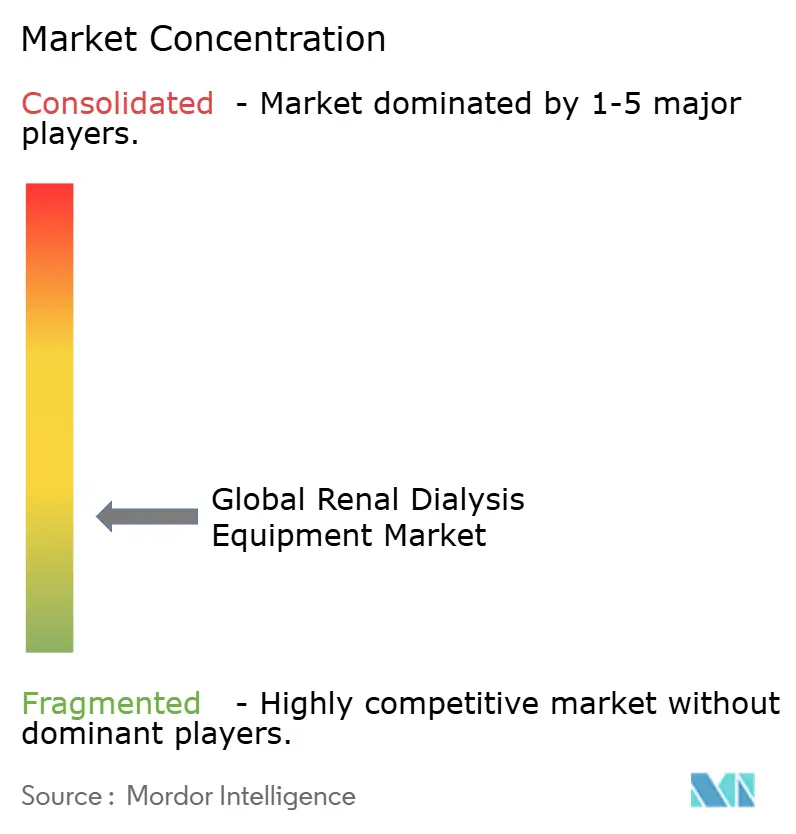
The renal dialysis equipment market is highly concentrated. Fresenius Medical Care and DaVita collectively treat 69% of U.S. patients at 65% of facilities, and Fresenius supplies a significant share of machines to its own sites, reinforcing vertical control. Fresenius’s acquisition of NxStage strengthened its home-hemodialysis roster, while DaVita leverages analytics to optimize capacity utilization. Baxter completed a USD 3.8 billion carve-out of its kidney-care arm, Vantive, allocating USD 1 billion to accelerate wearable and implantable technologies, a move that could reshape competitive dynamics by 2028.
Emerging challengers center on portability and user simplicity. Outset Medical’s Tablo integrates water purification and supports acute and chronic settings, enabling hospitals to deploy dialysis beyond dedicated units. Quanta’s SC+ delivers clinic-grade performance in a trolley-size footprint and has accumulated more than 1 million treatment hours worldwide. Device makers are also courting sustainability: Nipro introduced dialyzers with reduced-carbon membranes, and B. Braun is piloting recyclable cartridge programs that aim to cut plastic waste by 40% per treatment.
Strategic alliances are proliferating. Fresenius partnered with Nvidia in 2025 to embed AI workflows that detect coagulation anomalies before alarms trigger, while Baxter signed a memorandum with Tencent to integrate tele-monitoring into its automated peritoneal cyclers for the Chinese market. Suppliers are pairing equipment with cloud analytics, consumable subscriptions, and patient-education apps to lock in long-term revenue and differentiate beyond hardware specifications.
Global Renal Dialysis Equipment Industry Leaders
-
Fresenius Kabi AG
-
Baxter International, Inc.
-
Nikkiso Co, Ltd.
-
Nipro Corporation
-
B. Braun Melsungen AG
- *Disclaimer: Major Players sorted in no particular order
Market Opportunities and Future Outlook
Home-based therapy enablement is a recurring whitespace, supported by the expansion of connected-care infrastructure and cleared device upgrades that reduce on-site complexity. In June 2026, Fresenius Medical Care launched kinexus as a unified digital platform spanning home hemodialysis and peritoneal dialysis, strengthening remote monitoring and prescription management capabilities that providers need to scale home programs while maintaining oversight and documentation. On the device side, multiple FDA clearances in 2026, including Outset Medicals Tablo Hemodialysis System (January 2026) and Fresenius NxStage System One with NxView (May 2026), reinforce the product pipeline aimed at simplified operation, data capture, and alignment with home workflows.
A second opportunity is modernization of in-center fleets toward higher efficiency and advanced modalities, especially high-volume hemodiafiltration (HDF) platforms and associated consumables. Fresenius Medical Care disclosed that its 5008X CAREsystem rollout in the United States reached roughly 100 clinics, with more than 100,000 treatments performed by Q1 2026, which points to active provider investment in upgraded systems and the associated recurring demand for validated disposables and water-quality assurance. At the same time, supply disruptions in key components and consumables during 2025-2026 indicate a commercial opening for suppliers that can localize assembly, dual-source resins and tubing inputs, and provide managed logistics and service contracts to reduce downtime risks for clinics and home patients.
Recent Industry Developments
- June 2026: Fresenius Medical Care launched kinexus, a unified digital platform supporting home hemodialysis and peritoneal dialysis with tools for remote therapy monitoring and prescription management. The launch strengthens Fresenius positioning in connected-care workflows and adds a software layer that can deepen long-term equipment and consumable relationships with providers running home programs.
- January 2026: Nikkiso introduced the DBB-06 PRO hemodialysis machine and a dedicated bloodline set for the US market. The introduction emphasizes automation and assist functionality, aligning product differentiation with staffing constraints in clinics and the demand for safer, more standardized setups.
- August 2024: Baxter signed a definitive agreement to divest its Kidney Care segment (later rebranded as Vantive) to The Carlyle Group for USD 3.8 billion. The transaction reshaped competitive resource allocation in kidney care by separating a major dialysis portfolio into a more focused platform with greater flexibility for targeted investment in next-generation therapies and commercialization.
Research Methodology Framework and Report Scope
Market Definition and Coverage
This market covers equipment and related disposables used to perform renal dialysis, including hemodialysis and peritoneal dialysis, measured as revenue at the first sale from manufacturers. The focus is on products directly used in the dialysis process for chronic and acute kidney failure.
Scope exclusions: Dialysis service revenue, procedure fees, rental income, dialysis chairs, and general hospital equipment are excluded.
Segmentation Overview
- By Product Type
- Hemodialysis (HD) Equipment
- Dialysis Machines
- Dialyzers
- Bloodlines & Tubing Sets
- Water Treatment Systems
- Peritoneal Dialysis (PD) Equipment
- Automated PD Cyclers
- Portable PD Devices
- Concentrates & Solutions
- Other Accessories
- Hemodialysis (HD) Equipment
- By Application
- Hemodialysis
- Conventional HD
- Short-Daily HD
- Nocturnal HD
- Peritoneal Dialysis
- CAPD
- APD
- Hemodialysis
- By End User
- In-Center Dialysis Settings
- Home-Care Settings
- By Geography
- North America
- United States
- Canada
- Mexico
- Europe
- Germany
- United Kingdom
- France
- Italy
- Spain
- Rest of Europe
- Asia-Pacific
- China
- Japan
- India
- Australia
- South Korea
- Rest of Asia-Pacific
- Middle East & Africa
- GCC
- South Africa
- Rest of Middle East & Africa
- South America
- Brazil
- Argentina
- Rest of South America
- North America
Data Sources, Market Sizing, and Validation
Desk Research
Desk work starts with building a clean fact base on kidney disease burden and dialysis utilization, since demand tracks treated patients and the modality split. Public sources such as the US CDC, the WHO, and the World Bank help frame patient pools, demographics, and health system context, which we then match to dialysis penetration patterns.
We also review regulatory and clinical reference material, along with trade flows and product signals, to keep the equipment scope consistent across regions. Useful inputs typically include sources such as the US FDA device databases, USRDS publications, OECD health statistics, and peer-reviewed nephrology journals, followed by company annual reports, investor presentations, and credible press coverage on capacity expansions and home dialysis adoption. Where needed, a paid subscription covering company financials and a paid patent database are used to confirm product families and revenue splits. These are illustrative examples only, and many other public sources were also used for data collection, validation, and clarification.
Primary Interviews and Surveys
Primary work was used to pressure test treated patient assumptions, modality shifts (in-center versus home), and average pricing trends for machines and key disposables. We spoke with a mix of manufacturers, distributors, dialysis clinic operators, hospital procurement staff, and nephrology-focused clinicians across APAC, EMEA, and the Americas, then reconciled the input back to the model so weak assumptions could be corrected.
Distribution of primary research fieldwork respondents
| Company type | Respondent position | Region |
|---|---|---|
| Top tier: 36% | CXOs: 15% | APAC: 44% |
| Mid tier: 45% | Functional/Unit leaders: 28% | EMEA: 36% |
| Smaller Players: 19% | Managers: 57% | Americas: 20% |
Market-Sizing & Forecasting
Sizing is built using a top-down demand pool that reconstructs equipment and disposable needs from dialysis prevalence, treated ESRD and AKI patient counts, and modality mix by geography. After patient and treatment volumes are established, equipment demand is translated using practical usage indicators such as sessions per patient, replacement cycles for hemodialysis machines, peritoneal cycler adoption, and typical consumption rates for dialyzers, bloodlines, and fluid cartridges.
To keep outputs realistic, we corroborate totals with selective bottom-up checks, such as rolling up a sample of supplier revenues, validating channel patterns in key countries, and checking implied ASP times volume ranges for large product groups. Forecasting is run using scenario analysis supported by a light multivariate regression view, where the main drivers are diabetes and hypertension prevalence trends, aging population growth, dialysis center capacity additions, home dialysis policy support, and price movement linked to procurement and reimbursement. When direct data is thin for smaller countries, gaps are handled by benchmarking to similar health system archetypes, then adjusting using local treatment access and import dependence signals.
Data Validation & Update Cycle
Validation is done through several checks so the final number does not hinge on one assumption. We compare model outputs with independent signals like dialysis patient counts, reported clinic capacity, equipment installation trends, and import or manufacturing cues where applicable, then investigate unusual variances before sign off.
If an input creates an abnormal jump, the assumptions are reviewed, and follow-up outreach is triggered to recheck pricing, utilization, or replacement rates. Reports are refreshed annually, and material events like reimbursement changes or major supply shifts are incorporated through interim updates when needed. Before delivery, a final pass is completed so the model and narrative reflect the most recent data available.
Mordor Intelligence's Renal Dialysis Equipment Market Size Measured Against Other Published Estimates
Published market sizes for renal dialysis equipment often vary, even when the topic sounds identical, because each study sets its own product boundaries, valuation point, and timing for currency and inflation handling. Differences also show up when one estimate leans on patient-based demand math, while another leans more on reported revenues and broad category mapping.
Dialysis service revenue is a common source of confusion, and it sits outside Mordor Intelligence's scope even though it is frequently bundled into wider renal care spending figures. Gaps can also come from whether CRRT is counted, whether water treatment and bloodline-related components are included, and how home dialysis adoption changes unit demand versus in-center treatment. Finally, refresh cadence matters because new device launches, price pressure, and reimbursement updates can move near-term totals quickly.
Benchmark comparison
| Source | Market Size | Gaps in Research Methodology |
|---|---|---|
| Mordor Intelligence | USD 23.56 B (2026) | |
| Global Consultancy A | USD 21.23 B (2024) | Uses an earlier base year and a different forecast window, which can understate the impact of recent home dialysis growth and equipment refresh cycles when compared with a 2026 anchored view. |
| Industry Publisher B | USD 17.80 B (2022) | Anchored to an older historical year and can blend solutions and accessories more broadly, which shifts what is counted as equipment revenue and changes the timing of pricing assumptions. |
The comparison shows that timing and scope alignment drive most of the spread, more than any single modeling formula. By tying the total back to treated patient volumes, modality mix, and repeatable consumption and replacement assumptions, the estimate stays traceable to real dialysis activity and can be updated in a consistent way.
Key Questions Answered in the Report
How big is the Global Renal Dialysis Equipment Market?
The Global Renal Dialysis Equipment Market size is expected to reach USD 23.56 billion in 2026 and grow at a CAGR of 5.18% to reach USD 30.33 billion by 2031.
What is the current Global Renal Dialysis Equipment Market size?
In 2026, the Global Renal Dialysis Equipment Market size is expected to reach USD 23.56 billion.
Who are the key players in Global Renal Dialysis Equipment Market?
Fresenius Kabi AG, Baxter International, Inc., Nikkiso Co, Ltd., Nipro Corporation and B. Braun Melsungen AG are the major companies operating in the Global Renal Dialysis Equipment Market.
Which is the fastest growing region in Global Renal Dialysis Equipment Market?
Asia Pacific is estimated to grow at the highest CAGR over the forecast period (2026-2031).
Which region has the biggest share in Global Renal Dialysis Equipment Market?
In 2025, the North America accounts for the largest market share in Global Renal Dialysis Equipment Market.
What years does this Global Renal Dialysis Equipment Market cover, and what was the market size in 2025?
In 2025, the Global Renal Dialysis Equipment Market size was estimated at USD 23.56 billion. The report covers the Global Renal Dialysis Equipment Market historical market size for years: 2019, 2020, 2021, 2022, 2023 and 2024. The report also forecasts the Global Renal Dialysis Equipment Market size for years: 2026, 2027, 2028, 2029, 2030 and 2031.