Ransomware Protection Market Size and Share
Market Overview
| Study Period | 2020 - 2031 |
|---|---|
| Market Size (2026) | USD 30.04 Billion |
| Market Size (2031) | USD 63.56 Billion |
| Growth Rate (2026 - 2031) | 16.18% CAGR |
| Fastest Growing Market | Asia Pacific |
| Largest Market | North America |
| Market Concentration | Medium |
Major Players *Disclaimer: Major Players sorted in no particular order Image © Mordor Intelligence. Reuse requires attribution under CC BY 4.0. | |
Ransomware Protection Market Analysis by Mordor Intelligence
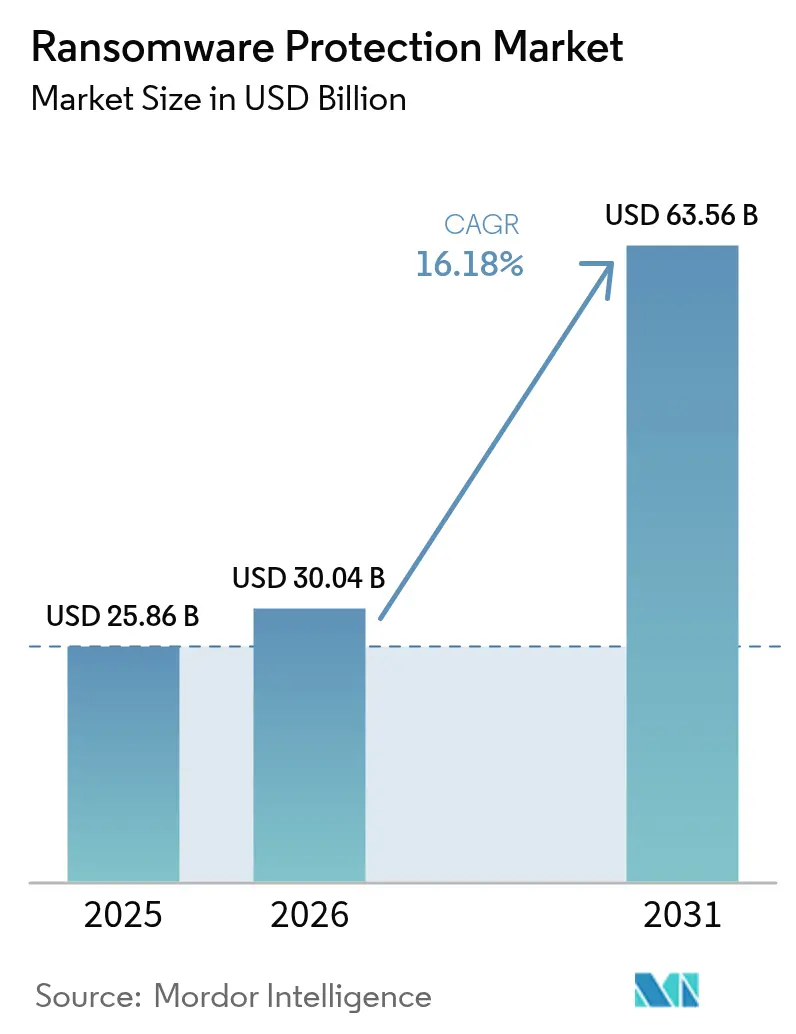
The ransomware protection market size was valued at USD 25.86 billion in 2025 and estimated to grow from USD 30.04 billion in 2026 to reach USD 63.56 billion by 2031, at a CAGR of 16.18% during the forecast period (2026-2031). Expanding ransomware-as-a-service ecosystems, the rise of triple-extortion threats, and a widening operational-technology attack surface keep spending momentum strong. Enterprises now emphasize integrated prevention, detection, and rapid recovery so they can maintain business continuity even when encryption succeeds. Cloud workload exposure, tightening global disclosure laws, and higher cyber-insurance thresholds are shifting budgets toward zero-trust controls, immutable backups, and behavioral analytics. Vendor consolidation intensifies because end users favor unified platforms that blend endpoint, identity, cloud, and backup capabilities with managed detection and response services.
Key Report Takeaways
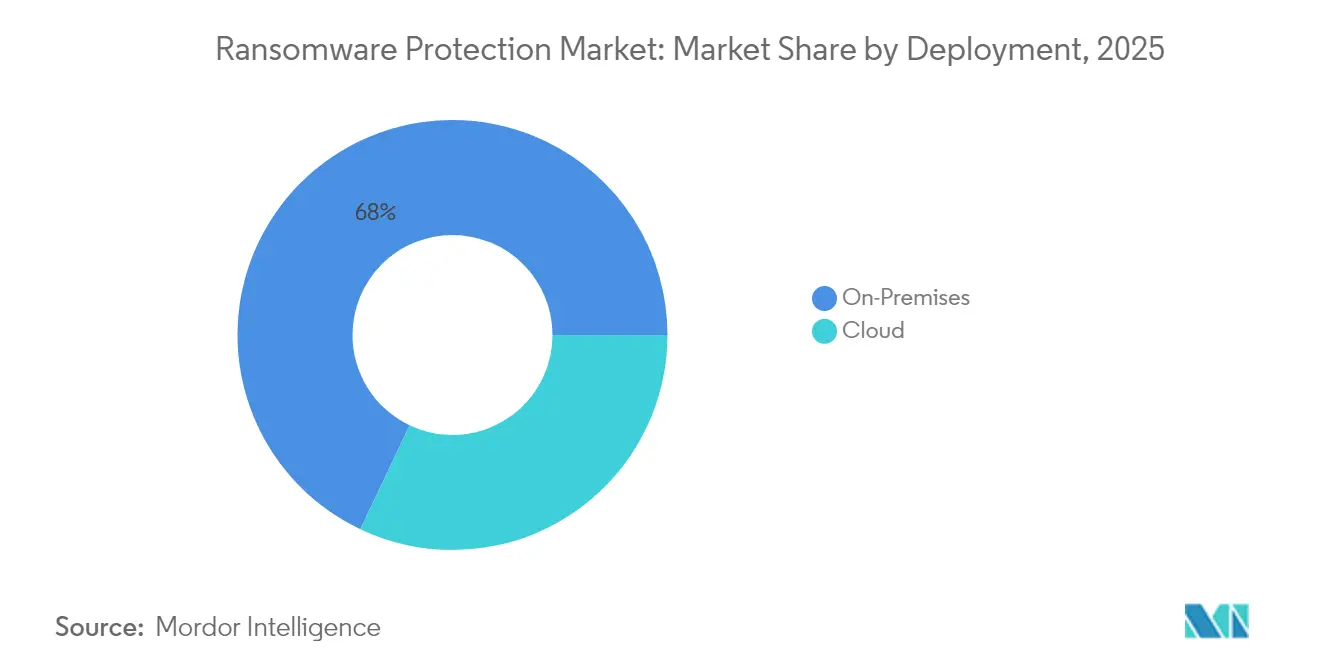
- By deployment, on-premises retained 67.95% of the ransomware protection market share in 2025 while cloud solutions are expanding at an 17.55% CAGR through 2031.
- By application, endpoint protection led with 43.65% revenue share in 2025; backup and recovery is forecast to advance at a 16.7% CAGR to 2031.
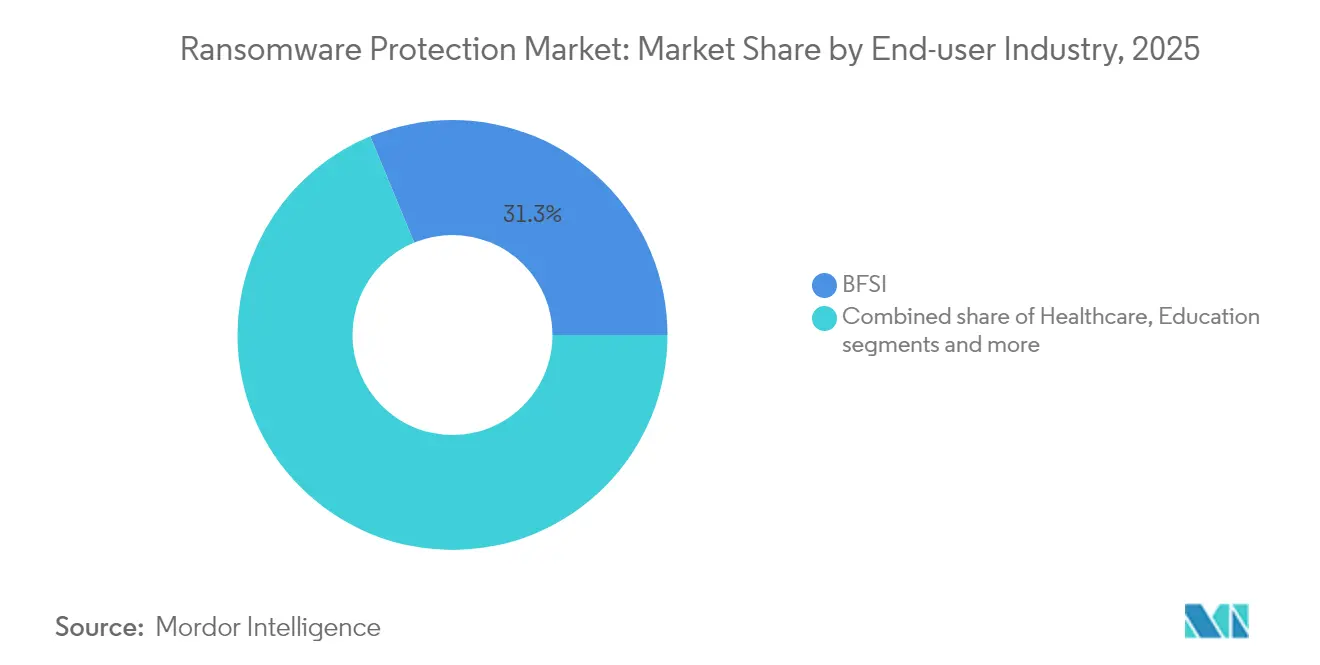
- By end-user industry, banking, financial services, and insurance captured 31.25% of the ransomware protection market share in 2025, whereas healthcare is progressing at a 16.75% CAGR through 2031.
- By organisation size, large enterprises commanded 71.60% of 2025 revenues while small and medium enterprises record the highest projected CAGR at 17.35% to 2031.
- By geography, North America led with 35.90% revenue share in 2025; Asia-Pacific is set to grow at a 16.95% CAGR to 2031.
Note: Market size and forecast figures in this report are generated using Mordor Intelligence’s proprietary estimation framework, updated with the latest available data and insights as of 2026.
Global Ransomware Protection Market Trends and Insights
Drivers Impact Analysis*
| Driver | (~) % Impact on CAGR Forecast | Geographic Relevance | Impact Timeline |
|---|---|---|---|
| Escalating phishing and targeted breaches | +2.8% | Global, with concentration in North America & Europe | Short term (≤ 2 years) |
| Ransomware-as-a-Service (RaaS) boom | +3.2% | Global, particularly APAC and emerging markets | Medium term (2-4 years) |
| Cloud/SaaS migration enlarging attack surface | +2.1% | North America & EU leading, APAC following | Medium term (2-4 years) |
| Cyber-insurance mandates for advanced controls | +1.9% | North America & EU regulatory frameworks | Short term (≤ 2 years) |
| Zero-trust and micro-segmentation adoption | +2.4% | Global enterprise adoption, government-led initiatives | Long term (≥ 4 years) |
| Rise of data-exfiltration and triple-extortion tactics | +2.7% | Global, with higher impact in regulated industries | Short term (≤ 2 years) |
| Source: Mordor Intelligence | |||
Escalating Phishing and Targeted Breaches
Generative-AI voice cloning turns conventional phishing into persuasive “vishing,” increasing credential compromise rates in 2025. Microsoft’s Phishing Triage Agent in Defender XDR now auto-labels suspicious messages, allowing security teams to shorten response cycles while boosting accuracy[1]Tom Burt, “Defender XDR Adds AI-Powered Phishing Triage,” microsoft.com. Financial institutions say 56% of recent breaches originated from unpatched VPN flaws, pushing them to deploy user-entity behavior analytics that flag anomalous session activity. Heightened focus on social-engineering countermeasures fuels demand for continuous email, endpoint, and identity monitoring that work in concert rather than in silos.
Ransomware-as-a-Service Boom
More than half of active malware kits sold on underground forums are ransomware variants, and RaaS operators typically collect a 10%–40% cut of every extortion payment. Low technical barriers enable affiliates to attack industrial firms, driving an 87% surge in OT-focused incidents. Enterprises increasingly subscribe to threat-intelligence feeds that pinpoint emerging affiliate groups and pre-release indicators of compromise, allowing them to update detection rules before weaponization.
Cloud and SaaS Migration Enlarging Attack Surface
Workload migration drives a 75% rise in cloud intrusions year over year. The shared-responsibility model leaves identity and key management in customer hands, yet many teams lack skills to enforce least-privilege policies across multicloud estates. Cloud-native application protection platforms combine posture management, runtime protection, and container scanning to give security operations a single control plane. Fortinet’s planned integration of AI anomaly detection into its CNAPP suite reflects market appetite for automated drift-analysis that pinpoints misconfigurations before attackers do.
Cyber-Insurance Mandates for Advanced Controls
Underwriters now demand evidence of multi-factor authentication, network segmentation, and immutable backups before binding ransomware cover. Eighty-three percent of organizations purchase cyber policies, and average extortion payments rose from USD 335,000 to USD 6.5 million within two years, pushing carriers to tighten technical prerequisites. Vendors respond by bundling warranty programs—Bitdefender offers up to USD 1 million breach compensation—to help customers satisfy insurer questionnaires.
Restraints Impact Analysis*
| Restraint | (~) % Impact on CAGR Forecast | Geographic Relevance | Impact Timeline |
|---|---|---|---|
| Free basic endpoint tools depress spend | -1.8% | Global, particularly price-sensitive SMB segments | Short term (≤ 2 years) |
| Law-enforcement wins cutting ransom payments | -1.2% | Global, with stronger impact in jurisdictions with active enforcement | Medium term (2-4 years) |
| Cyber-talent shortage for complex roll-outs | -2.1% | Global, acute in North America & Europe | Long term (≥ 4 years) |
| High total cost of full-stack XDR for SMBs | -1.6% | Global SMB market, particularly in emerging economies | Medium term (2-4 years) |
| Source: Mordor Intelligence | |||
Free Basic Endpoint Tools Depress Spend
Integrated protections inside Windows and major browser platforms deliver baseline anti-malware at no added cost. While these tools curb commoditized ransomware strains, they rarely offer behavioral analytics, deception, or automated rollback. Some SMB owners, misjudging their exposure, delay paid upgrades, eroding prospective revenue for specialist vendors. Commercial suppliers therefore highlight advanced response functions, supply-chain telemetry, and insurance-eligibility reports to justify premium tiers.
Law-Enforcement Wins Cutting Ransom Payments
Global takedowns have dismantled several ransomware infrastructures and helped recover funds, potentially undermining criminal ROI and tempering panic-driven procurement. The United States, United Kingdom, and Australia now share ransom-payment disclosures with financial-crime units, letting investigators trace laundering paths[2]CISA, “Joint Cybersecurity Advisory: Play Ransomware,” cisa.gov. Yet attackers adapt quickly, switching to data-wiper or harassment tactics that cause business disruption without large payments, ensuring ongoing need for resilient defenses.
*Our forecasts treat driver/restraint impacts as directional, not additive. The impact forecasts reflect baseline growth, mix effects, and variable interactions.
Segment Analysis
By Deployment: Cloud Momentum Grows Alongside Control-Centric On-Premises Environments
In 2025, on-premises implementations accounted for 67.95% of revenue, underlining compliance and data-sovereignty demands among heavily regulated enterprises. Nevertheless, cloud subscriptions are sprinting forward at an 17.55% CAGR through 2031. The ransomware protection market size for cloud-delivered offerings is projected to rise sharply as buyers embrace elastic analytics and simplified updates. Hybrid designs are now standard, pairing local sensors with SaaS-based correlation engines so teams keep telemetry on-site while leveraging off-premises scale.
Automated snapshot orchestration shortens mean time to recover. Commvault’s Cloud Rewind now restores full tenant environments in minutes, rallying interest from organizations that previously hesitated due to recovery uncertainty. Continuous posture monitoring, integrated key management, and policy-as-code pipelines further attract development teams that favor DevSecOps alignment over hardware refresh cycles.


By Application: Backup and Recovery Outpace a Maturing Endpoint Core
Endpoint protection delivered 43.65% of 2025 revenue and remains the first purchase in any ransomware defence stack. Still, backup and recovery are on track for a 16.7% CAGR, the highest among application groups. Immutable and air-gapped repositories now act as a last-line assurance when prevention layers fail. ExaGrid’s non-network-facing tier and delayed delete feature exemplify designs that stop attackers from tampering with restore points.
Email and web-gateway modules evolve via secure access service edge architectures that route traffic through cloud inspection nodes, lowering latency for distributed workforces. Network segmentation features also move into these platforms, blurring lines between categories while strengthening containment. As buyers push toward platform consolidation, vendors bundle previously discrete modules into unified licences, a pattern reinforcing the ransomware protection market momentum.
By End-User Industry: Regulation Drives Healthcare Investment Beyond Financial Sector Leadership
The banking, financial services, and insurance segment led with 31.25% revenue share in 2025, reflecting entrenched regulatory scrutiny and high asset attractiveness. Healthcare follows with the fastest 16.75% CAGR, propelled by stricter HIPAA Security Rule amendments that require multi-factor authentication and encryption for electronic protected health information. The ransomware protection market size for healthcare entities is set to expand swiftly as providers modernize legacy systems and roll out zero-trust networks inside clinical environments.
Manufacturers contend with converged IT-OT infrastructures; 68% of industrial ransomware incidents in early 2025 hit production facilities, prompting investments in asset-visibility platforms. Education institutions, despite budget constraints, accelerated security spending after a 70% spike in attacks during the prior academic year. Across verticals, insurers and auditors now ask for proof of immutable backups and tabletop recovery drills as part of annual policy renewals.
By Organisation Size: SME Adoption Rises as Managed Services Close Capability Gaps
Large enterprises held 71.60% revenue share in 2025 thanks to sizable security staffs and multi-layer architectures. Yet small and medium enterprises are growing at 17.35% CAGR, underpinning democratization of enterprise-grade controls. Cloud-native protection suites with per-endpoint subscriptions remove capital barriers and embed best-practice policies out of the box.
Security-focused managed service providers (MSPs) play a pivotal role, bundling monitoring, patching, and incident response so customers sidestep talent shortages. Partnerships such as Guardz and SentinelOne integrate AI-powered detection with simplified dashboards, letting MSPs deploy across dozens of tenants efficiently. As ransomware groups increasingly target businesses under 1,000 employees, SMEs perceive cyber spending as a direct business-continuity cost rather than discretionary IT outlay, reinforcing ransomware protection market expansion.
Geography Analysis
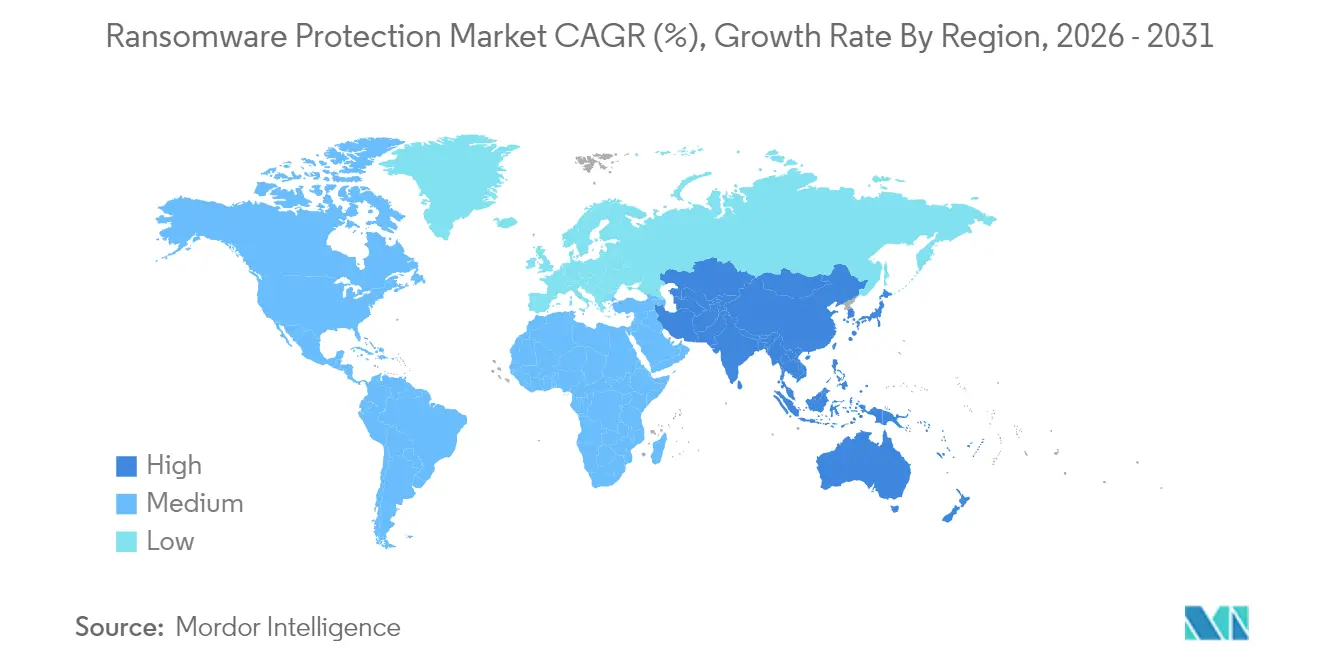
North America led with 35.90% revenue share in 2025, anchored by mature compliance regimes in finance and healthcare plus sizeable enterprise budgets. Federal initiatives such as mandatory incident reporting for critical infrastructure further elevate baseline security expectations. The ransomware protection market size for United States-based organizations will continue to climb as insurance underwriters harden coverage terms.
Asia-Pacific posts the fastest 16.95% CAGR to 2031. New laws in Australia require ransom-payment disclosures, and Southeast Asia recorded more than 135,000 ransomware cases in 2024, spotlighting regional exposure. Many APAC governments launch subsidy programs that help mid-market firms adopt zero-trust controls, accelerating uptake beyond multinational headquarters.
Europe benefits from the NIS2 directive, which covers up to 150,000 essential entities and sets fines at EUR 10 million for non-compliance. The ransomware protection market share for EU-based SMEs is expected to rise as they implement mandatory risk assessments and supply-chain monitoring. Meanwhile, the Middle East and Africa foresee security outlays exceeding USD 3 billion in 2025 as enterprises invest in generative-AI analytics and breach-response retainers. Latin America grapples with a ransomware involvement rate notably higher than the global average, driving new regulation in Brazil that forces disclosure within three days, thereby enlarging regional opportunity for managed security providers.

Regulatory Landscape
Ransomware-specific compliance requirements are tightening around payment reporting and incident notification, which raises the weight of documentation, auditability, and recovery readiness in procurement. Australia enacted the Cyber Security Act 2024, requiring entities above an AUD 3 million annual turnover threshold to report ransomware or cyber extortion payments within 72 hours of payment. This reinforces demand for controls that can evidence MFA usage, segmentation, and immutable backup posture during post-incident reviews.
In the European Union, NIS2 expands mandatory cybersecurity risk management measures across a broader set of essential and important entities. Commission Implementing Regulation (EU) 2024/2690 (October 2024) specifies technical requirements and criteria for significant incident reporting, including ransomware, and ENISA published technical implementation guidance in June 2025 to support NIS2 implementation. In the United States, NIST IR 8374 Revision 1 (June 2026) updates ransomware risk management guidance as a Cybersecurity Framework (CSF) 2.0 community profile, giving enterprises and regulated operators a clearer mapping between ransomware playbooks and governance, protect, detect, respond, and recover functions.
Value Chain Analysis
The ransomware protection value chain covers upstream telemetry and control-plane enablers (endpoint agents, identity providers, email security, network sensors, SIEM/XDR data pipelines, and cloud logging), core analytics and response layers (behavioral detection, threat intel enrichment, SOAR playbooks, deception, and rapid isolation), and downstream resilience components (immutable backup repositories, DR orchestration, incident recovery tooling, and managed detection and response services). Customer buying centers increasingly bundle endpoint, identity, email, and backup into fewer platforms, while MSPs and MDR providers remain key channels for SMEs that lack in-house cyber talent.
Supply chain exposure has also become a key propagation route, shaping vendor expectations across the chain, from secure software development and package provenance to third-party risk and procurement due diligence. The Cloud Security Alliance documented a 2026 cascade in which TeamPCP compromised security and AI tooling packages used in CI/CD pipelines, harvesting credentials from privileged environments, reinforcing that scanners and SDKs can become high-value targets. In May 2026, reporting around a Nitrogen ransomware incident involving Foxconn North American facilities described large-scale data exfiltration affecting multiple downstream brand partners, highlighting how attackers can amplify leverage through contract manufacturers and service providers. These cases increase the emphasis on secrets management, least privilege, supplier attestations, and recovery testing during vendor selection and renewal.
Competitive Landscape
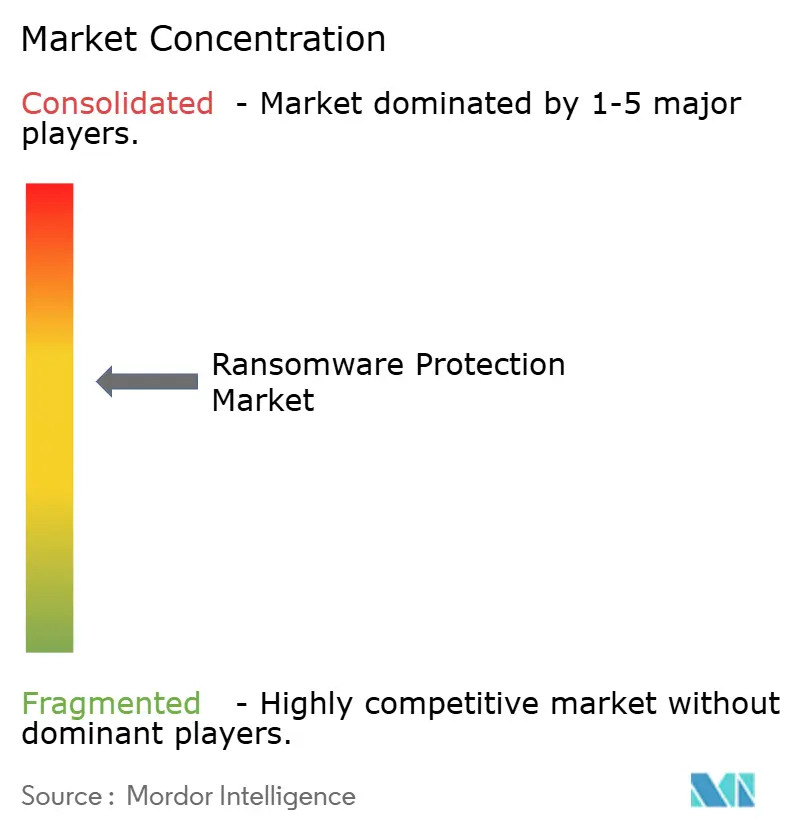
The vendor arena remains moderately fragmented yet tilts toward platform consolidation. Sophos’ USD 859 million purchase of Secureworks adds managed detection and response depth to its endpoint base, strengthening integrated incident-response pipelines. CyberArk’s USD 1.54 billion acquisition of Venafi marries machine identity management with human privilege controls, tackling credential abuse in multicloud environments.
AI-first specialists gain traction by focusing exclusively on ransomware defeat. Halcyon reached a USD 1 billion valuation through real-time behavior blocking and exfiltration prevention. Established players counter by infusing machine-learning analytics into backup and identity modules, thereby offering “detect-protect-recover” loops from a single console. Cloud alliances surge: CrowdStrike and Google Cloud expanded their partnership to embed managed detection into hyperscale logging, shortening investigation cycles for joint customers.
Success metrics move away from raw malware block rates toward measurable downtime reduction. Vendors that can demonstrate sub-hour recovery via orchestrated snapshot rollback enjoy premium pricing leverage, steering procurement teams toward outcome-based evaluations rather than feature checklists.
Ransomware Protection Industry Leaders
McAfee, LLC
AO Kaspersky Lab
Bitdefender
FireEye, Inc.
Microsoft
- *Disclaimer: Major Players sorted in no particular order

Market Opportunities and Future Outlook
Buyer demand is shifting from point defenses toward auditable ransomware risk management aligned with published government guidance, creating whitespace for solutions that translate controls into evidence, readiness scoring, and repeatable response. NIST IR 8374 Rev. 1 (finalized in June 2026) provides a CSF 2.0-aligned ransomware community profile, supporting vendors that map product controls to governance and recover outcomes, including immutable backup verification, segmentation validation, and recovery drill reporting. CISA and FBI advisories, including the July 2025 advisory on Interlock and the June 2025 update on Play ransomware, keep baseline practices in view such as network segmentation, multi-factor authentication, and offline backups, which sustains demand for integrated packages that reduce deployment complexity across endpoint, identity, email, and backup.
Opportunities also cluster around AI-assisted defense workflows and automation that reduce mean time to detect and recover, particularly for cloud and hybrid estates where telemetry is spread across environments. In March 2026, the White House released President Trump’s Cyber Strategy for America, calling out zero-trust architecture and AI-powered cybersecurity as priorities to mitigate ransomware and related threats, which supports enterprise interest in automated triage, behavioral analytics, and orchestration that can contain lateral movement while preserving business continuity. Separately, supply chain attacks and multi-party extortion events continue to raise demand for credential hygiene, CI/CD protection, and vendor risk programs that connect software supply chain security with ransomware containment and recovery, extending the addressable scope beyond traditional endpoints into development tooling and embedded or operational environments.
Recent Industry Developments
- July 2026: NIST published NIST IR 8374 Revision 1, updating its Ransomware Risk Management guidance as a Cybersecurity Framework (CSF) 2.0 community profile. The update gives organizations a more prescriptive control mapping for govern-protect-detect-respond-recover activities, helping standardize vendor evaluations and internal assurance reporting.
- April 2026: Bitdefender launched GravityZone Extended Email Security for businesses and MSPs, integrating email protection with endpoint security to disrupt phishing-led ransomware delivery and business email compromise. The release supports platform consolidation trends by extending anti-ransomware coverage into a high-frequency initial access vector without requiring separate tooling.
- October 2024: The European Commission adopted Implementing Regulation (EU) 2024/2690, specifying technical requirements and criteria for significant incident reporting under the NIS2 framework, including ransomware-related incidents. The measure increased the operational importance of incident classification, evidence retention, and response process maturity for in-scope entities and their critical suppliers.


Research Methodology Framework and Report Scope
Market Definition and Coverage
This market covers revenues from tools and services that help organizations prevent ransomware entry, detect suspicious activity, contain spread, and restore data and operations after encryption events, across common enterprise environments.
Scope exclusions: We exclude generic antivirus products that do not have dedicated anti-ransomware capability and standalone incident-response retainer fees.
Segmentation Overview
- By Deployment
- On-Premises
- Cloud
- By Application
- Endpoint Protection
- Email Protection
- Network / Web Security
- Backup and Recovery / DR
- By End-user Industry
- BFSI
- Healthcare
- Government and Public Sector
- IT and Telecom
- Manufacturing and Industrial
- Education
- By Organisation Size
- Large Enterprises
- Small and Medium Enterprises (SMEs)
- By Geography
- North America
- United States
- Canada
- Mexico
- Europe
- Germany
- United Kingdom
- France
- Italy
- Spain
- Russia
- Rest of Europe
- Asia-Pacific
- China
- Japan
- India
- South Korea
- Australia and New Zealand
- Rest of Asia-Pacific
- South America
- Brazil
- Argentina
- Rest of South America
- Middle East and Africa
- Middle East
- Saudi Arabia
- United Arab Emirates
- Turkey
- Rest of Middle East
- Africa
- South Africa
- Nigeria
- Rest of Africa
- Middle East
- North America
Data Sources, Market Sizing, and Validation
Desk Research
Desk work started by mapping the threat and exposure footprint, then connecting it to observable spending signals for ransomware readiness. Sources used for this include public cybersecurity advisories and reporting such as CISA alerts, FBI IC3 complaint statistics, NIST guidance, and ENISA threat landscape publications, plus OECD digital indicators where relevant.
We also reviewed vendor public disclosures, including annual reports and investor presentations, procurement notices, and reputable press coverage of major incidents, alongside technical papers in peer-reviewed security journals. To avoid missing smaller revenue streams, we used paid subscriptions for company financial intelligence, patent coverage, and curated news, which helped reconcile business line items and product positioning. This list is not exhaustive, and many other public documents were also checked for data collection, validation, and clarification.
Primary Interviews and Surveys
Primary inputs were gathered through interviews and surveys with security buyers, IT leaders, and delivery-side experts who work on endpoint protection, backup and recovery, email security, MDR, and incident response planning. These discussions were used to confirm adoption timing, typical contract structures, attach rates for managed services, and practical pricing movement. We then used that input to pressure-test the desk assumptions across APAC, EMEA, and the Americas.
Distribution of primary research fieldwork respondents
| Company type | Respondent position | Region |
|---|---|---|
| Top tier: 33% | CXOs: 15% | APAC: 43% |
| Mid tier: 48% | Functional/Unit leaders: 26% | EMEA: 33% |
| Smaller Players: 19% | Managers: 59% | Americas: 24% |
Market-Sizing & Forecasting
Sizing was built using a top-down demand pool. First, we estimated the addressable base of organizations by region, then applied ransomware protection adoption and spend intensity patterns that fit observed cyber-incident exposure and security budget behavior. The initial output was then checked with selective bottom-up approximations, such as sampling typical annual contract values for key tool categories and multiplying by adoption ranges, followed by channel and services attach-rate checks to adjust totals.
Inputs that mattered most included reported ransomware incident frequency and disruption severity, backup and recovery modernization rates (including immutable storage features), endpoint and email security refresh cycles, the share of workloads shifting to cloud, and the portion of deployments using managed security services for 24x7 monitoring. Forecasting was run using scenario analysis, supported by a light multivariate regression on leading indicators such as security spend growth, breach disclosure trends, and cloud adoption. We then refined the scenarios based on expert feedback on how prevention and recovery capabilities are being packaged into platform contracts. Where bottom-up checks were weaker for smaller regions or niche use cases, we used ranges and normalized back to the demand pool so totals stayed realistic.
Data Validation & Update Cycle
Validation was done in layers, starting with consistency checks across regions and customer cohorts. We then compared model outputs against independent signals such as incident reporting trends, security budget direction, and managed services mix. Outliers were flagged, assumptions were revisited, and follow-up calls were triggered when pricing, adoption, or scope interpretations did not align across respondents.
Each dataset and calculation step was reviewed by another analyst before final sign-off. The last pass was completed close to delivery to capture recent material events that can shift demand. Reports are refreshed annually, and interim updates are added when major regulatory, threat, or technology changes materially affect the market trajectory.
Mordor Intelligence's Ransomware Protection Market Estimate Compared With Other Published Estimates
Published market sizes for ransomware protection often do not match because the category sits close to adjacent security areas, and each study draws its inclusion line differently. Differences also come from the reference year chosen, how services are treated, and whether pricing is modeled as a flat uplift or tied to measurable contract and adoption shifts.
Some external estimates fold in broad cybersecurity spend buckets that can include general antivirus, wider endpoint security, or incident-response services booked as separate retainers. In Mordor Intelligence's model, revenues are counted only when the product or service is purpose-built for ransomware prevention, detection, containment, or recovery, while generic antivirus and standalone retainer fees are kept out. This tends to narrow the total in mixed-scope comparisons.
Benchmark comparison
| Source | Market Size | Gaps in Research Methodology |
|---|---|---|
| Mordor Intelligence | USD 30.04 B (2026) | |
| Global Research Publisher A | USD 27.23 B (2024) | Uses an earlier base year and a broader component mix that can group general security controls alongside ransomware-focused capabilities, which changes the starting value before forecasting. |
| Industry Research Publisher B | USD 22.22 B (2024) | Relies on a different demand base and regional weighting across 30+ countries, and it may treat managed services and recovery-related revenue differently, which shifts the 2024 total. |
The spread in values is mainly explained by year selection and how closely the definition is tied to ransomware-specific prevention and recovery use cases. By keeping the build-up anchored to observable adoption, pricing, and managed services attach rates, the estimate remains traceable to clear inputs that can be rechecked and updated as the threat environment changes.


Key Questions Answered in the Report
What is the current size and growth rate of the ransomware protection market?
The market is valued at USD 30.04 billion in 2026 and is set to reach USD 63.56 billion by 2031, reflecting a 16.18% CAGR.
Which deployment model is expanding the quickest?
Cloud-based ransomware protection shows the fastest trajectory with an 17.55% CAGR through 2031, even though on-premises still holds the larger revenue share.
Why are backup and recovery solutions seeing stronger budget allocation?
Backup and recovery tools are growing at a 16.7% CAGR because immutable and air-gapped storage offers the last line of defense when prevention layers fail.
Which industry vertical is projected to increase spending the most?
Healthcare is forecast to rise at a 16.75% CAGR, spurred by stricter HIPAA Security Rule revisions that mandate multi-factor authentication and encryption.
How do new regulations influence market demand?
Measures such as the EU’s NIS2 directive and Australia’s ransom-payment reporting law compel thousands of organizations to adopt zero-trust controls, driving fresh demand for comprehensive protection platforms.
What strategies help vendors stay competitive in this market?
Leading providers differentiate through platform consolidation, AI-driven detection, and rapid recovery capabilities, often supported by acquisitions and strategic cloud alliances.
Page last updated on: