
Market Overview
| Study Period | 2021 - 2031 |
|---|---|
| Forecast Data Period | 2026 - 2031 |
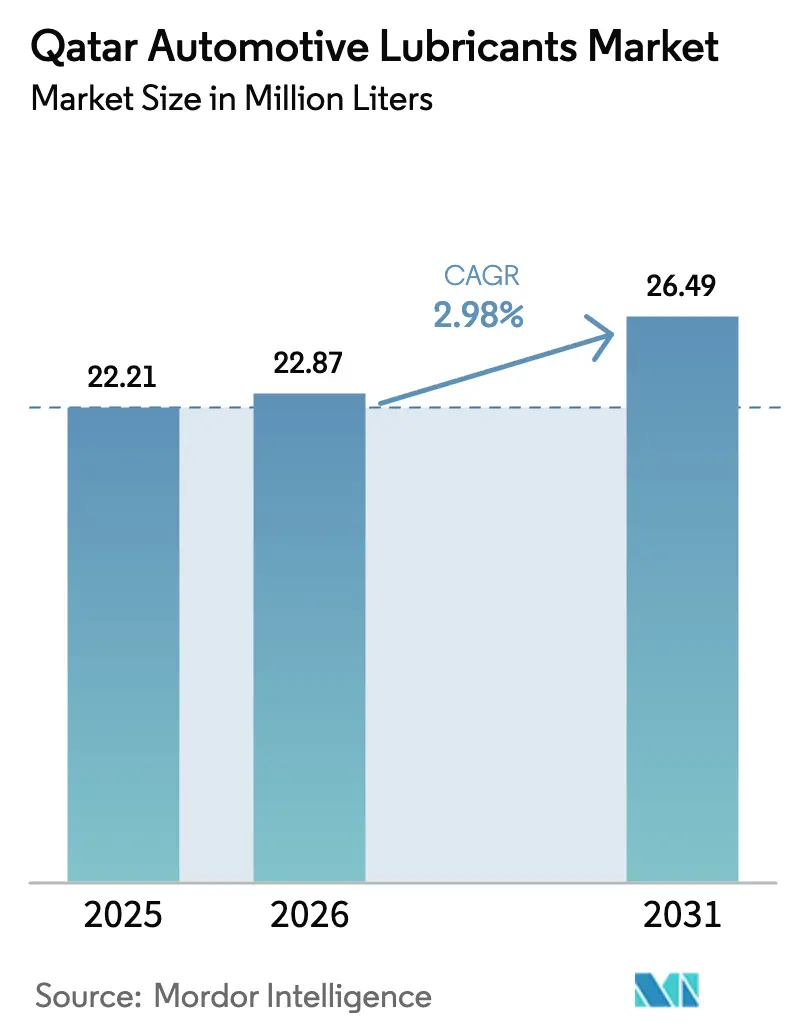
| Base Year Market Size (2025) | 22.21 Million liters |
| Market Volume (2026) | 22.87 Million liters |
| Market Volume (2031) | 26.49 Million liters |
| Growth Rate (2026 - 2031) | 2.98 % |
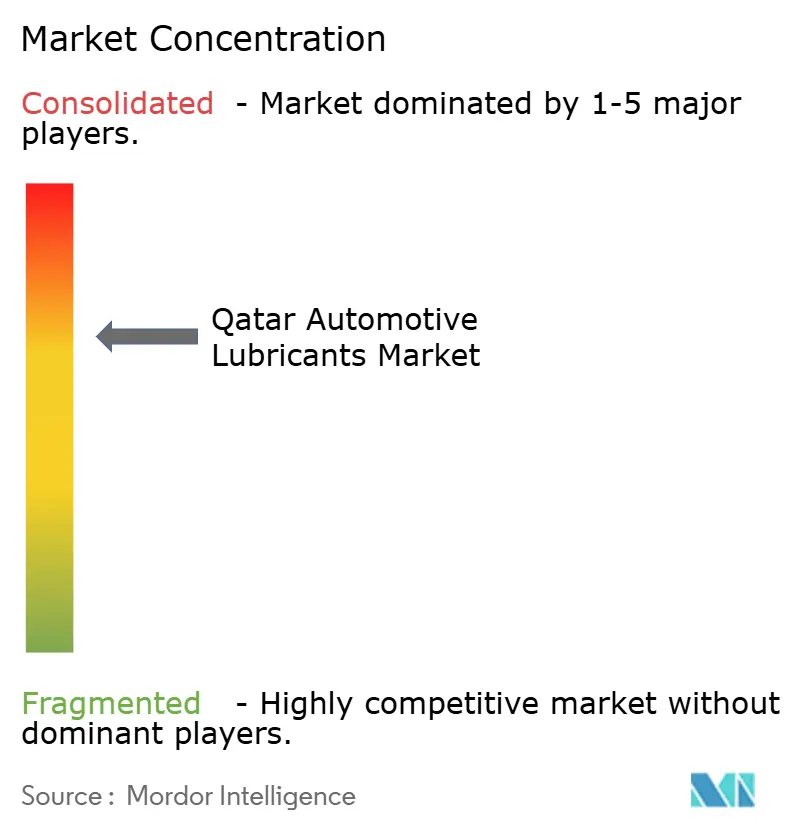
| Market Concentration | Medium |
Major Players *Disclaimer: Major Players sorted in no particular order Image © Mordor Intelligence. Reuse requires attribution under CC BY 4.0. | |
Qatar Automotive Lubricants Market Analysis by Mordor Intelligence
The Qatar Automotive Lubricants Market size is expected to grow from 22.21 Million liters in 2025 to 22.87 Million liters in 2026 and is forecast to reach 26.49 Million liters by 2031 at 2.98% CAGR over 2026-2031. Robust new-vehicle registrations in 2024, a premiumization shift toward fully synthetic grades, and a domestic supply of gas-to-liquids (GTL) base oil from Pearl GTL keep volumes expanding even as longer drain intervals curb per-vehicle consumption. Automatic transmission adoption, extreme-heat operating conditions, and public-bus electrification targets are reshaping product-mix priorities for suppliers seeking higher-margin niches. Construction, logistics, and oil-and-gas projects continue to enlarge the commercial-vehicle fleet, sustaining heavy-duty demand despite cyclical construction spending. Meanwhile, additive import dependence, predictive-maintenance tools, and the gradual rise of e-fluids serve as structural brakes on bulk-volume growth, forcing market participants to pivot toward solution-based offerings.
Key Report Takeaways
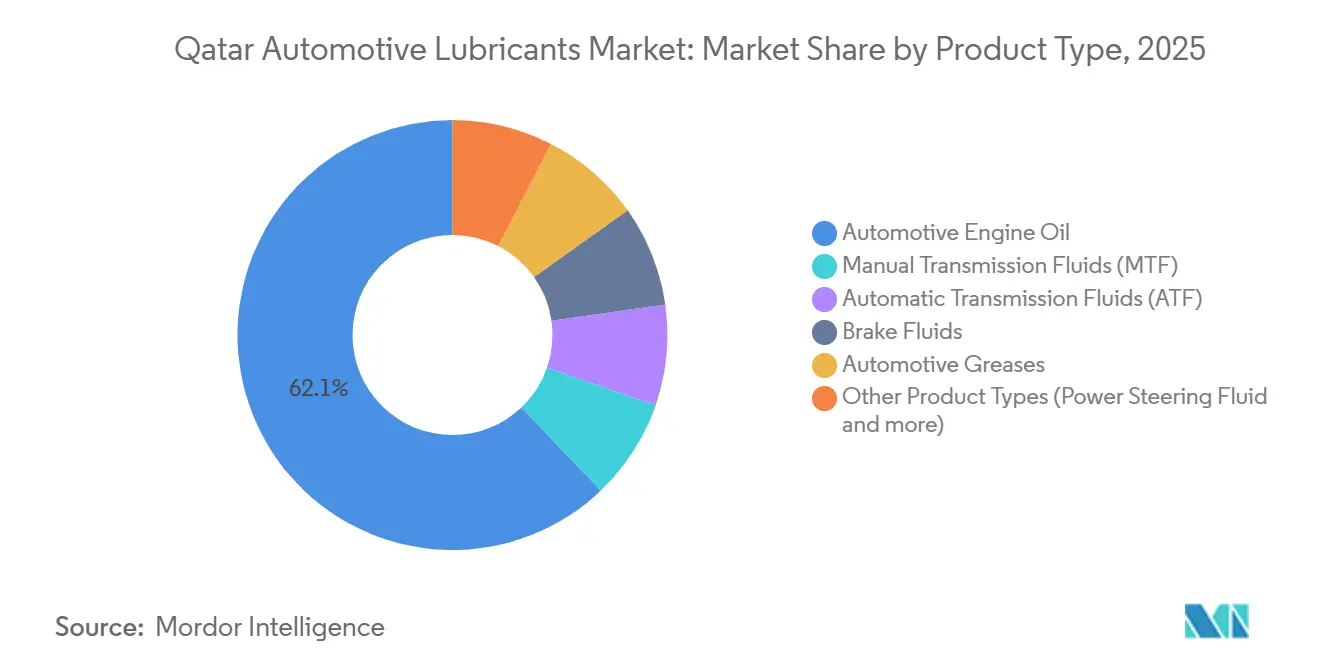
- By product type, engine oil led with 62.12% share of the Qatar automotive lubricants market in 2025, while automatic transmission fluids are forecast to grow at a 3.34% CAGR through 2031.
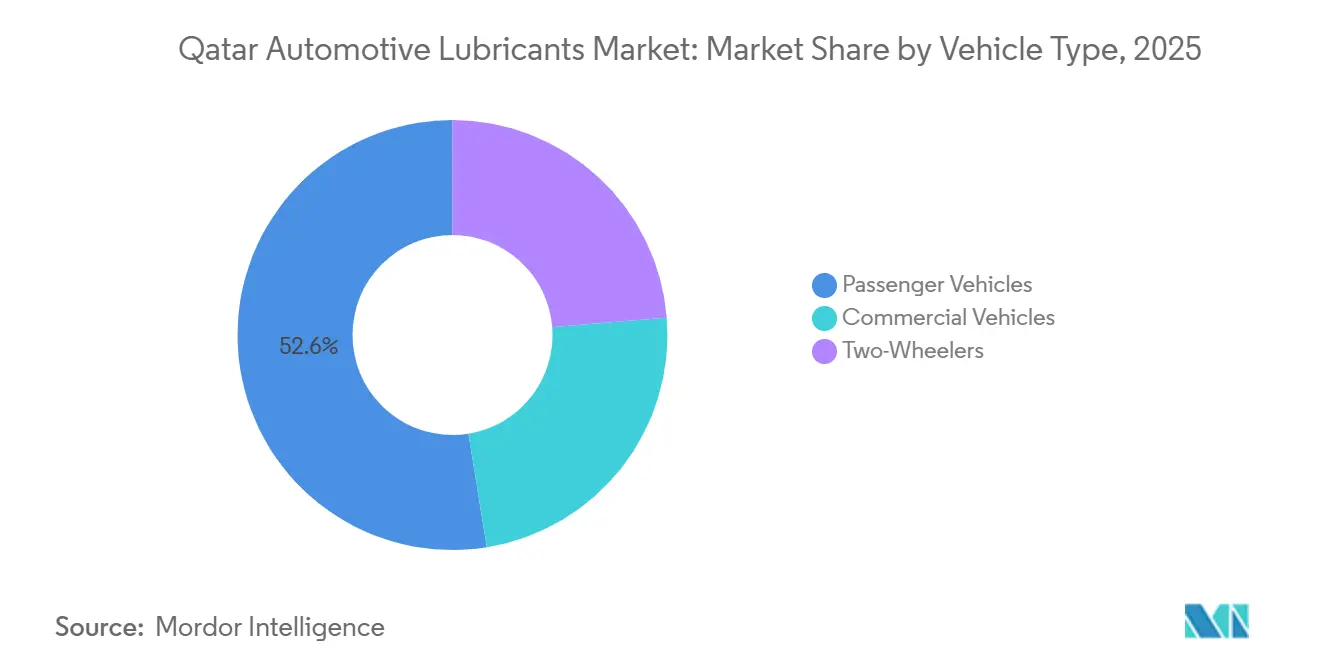
- By vehicle type, passenger cars held 52.55% of the Qatar automotive lubricants market share in 2025, while two-wheelers are advancing at a 3.56% CAGR to 2031.
Note: Market size and forecast figures in this report are generated using Mordor Intelligence’s proprietary estimation framework, updated with the latest available data and insights as of January 2026.
Qatar Automotive Lubricants Market Trends and Insights
Drivers Impact Analysis*
| Driver | (~) % Impact on CAGR Forecast | Geographic Relevance | Impact Timeline |
|---|---|---|---|
| Expansion of passenger-car parc post-FIFA 2022 and infrastructure boom | +0.8% | National, concentrated in Doha, Al Khor, Lusail, Ras Laffan | Medium term (2-4 years) |
| Construction and logistics projects fuelling commercial-fleet lubricant demand | +0.7% | National, with industrial zones in Central/Northern Qatar and Al Shaheen oil & gas expansion in South | Medium term (2-4 years) |
| Heat-resistant synthetic-oil adoption in extreme climate | +0.5% | National, heightened in coastal and industrial areas experiencing >45°C peaks | Long term (≥ 4 years) |
| GTL base-oil availability from Pearl plant lowering input costs | +0.4% | National production, regional export spillover to GCC | Long term (≥ 4 years) |
| EV-specific e-fluid niches emerging from Qatar e-mobility targets | +0.2% | National, early adoption in public transport (buses), gradual private-vehicle penetration | Long term (≥ 4 years) |
| Source: Mordor Intelligence | |||
Heat-Resistant Synthetic-Oil Adoption in Extreme Climate
Qatar logs 107 days annually above 40°C, creating thermal stress that degrades conventional lubricants and accelerates oxidation. Fleet owners increasingly select fully synthetic 0W-20 and 5W-30 grades that sustain viscosity at elevated temperatures, boosting low-viscosity penetration by 15% year on year. Shell’s GTL-derived PurePlus base oils and TotalEnergies’ Quartz series address this need with higher viscosity indices and low volatility, allowing drain extensions without engine-wear penalties. Government adaptation plans that emphasize infrastructure resilience add urgency to premium-grade adoption, and distributors position long-life synthetics as a total-cost-of-ownership play for private and fleet users. The widespread shift raises average revenue per liter, yet it simultaneously reduces total liters sold per vehicle. Suppliers therefore combine product upgrades with value-added services such as oil-analysis programs to protect margins.
Expansion of Passenger-Car Parc Post-FIFA 2022 and Infrastructure Boom
Vehicle registrations in the first eight months of 2024 reached 62,163 units, up 13.7% from the same period in 2023, with private cars making up more than 70% of the total. Stadiums, highways, and urban-connectivity projects completed for the FIFA World Cup keep mobility demand elevated, especially in Doha and Lusail. Rising GDP per capita and an expanding population drive luxury-vehicle sales, which now represent about one-third of new registrations and require OEM-approved synthetic lubricants. The Ministry of Transport’s Freight Master Plan also encourages larger commercial fleets, linking ground freight with air and sea modes through 2050. Seasonal registration spikes in May and August provide predictable retail peaks that service centers can use to optimize inventory and promotions.
Construction and Logistics Projects Fuelling Commercial-Fleet Demand
Hamad Port expansions, airport-cargo growth, and North Field LNG developments pushed the logistics market from USD 9.5 billion in 2024 toward a projected USD 13.49 billion by 2030, advancing at a 6.01% CAGR. Industrial-vehicle counts rose 45% over the previous three years, and construction-equipment registrations increased 28% between 2022 and 2023, sustaining heavy-duty lubricant demand. Caltex’s multi-year supply agreement with UrbaCon Trading & Contracting highlights the importance of fleet contracts, while public tenders from Qatar Primary Materials Company illustrate ongoing lubricant procurement for large earth-moving assets. The national development strategy targets 4% annual non-hydrocarbon GDP growth, ensuring a pipeline of infrastructure and logistics projects that anchor commercial-vehicle lubricant volumes.
GTL Base-Oil Availability from Pearl Plant Lowering Input Costs
Shell’s Pearl GTL complex produces about 30,000 barrels per day of Group III base oil that displays 99.5% purity and a high viscosity index, enabling ultra-low-viscosity formulations such as 0W-16. Woqod blends the locally marketed OTO range with this feedstock, offering premium quality at competitive prices through a broad retail network. A 20-year naphtha-supply contract signed in 2024 ensures long-term feedstock security for downstream petrochemicals and lubricants, reinforcing Qatar’s regional export advantage. Stable domestic supply lowers transport costs and buffers local blenders against global freight volatility, supporting price competitiveness and higher gross margins.
Restraints Impact Analysis*
| Restraint | (~) % Impact on CAGR Forecast | Geographic Relevance | Impact Timeline |
|---|---|---|---|
| Extended drain intervals curbing per-vehicle oil volumes | -0.6% | National, accelerated in luxury and fleet segments adopting synthetic oils | Medium term (2-4 years) |
| High additive import dependence driving price volatility | -0.3% | National, affecting all blenders and distributors | Short term (≤ 2 years) |
| Predictive-maintenance digital tools cutting over-lubrication | -0.2% | National, concentrated in commercial fleets and logistics operators | Medium term (2-4 years) |
| Source: Mordor Intelligence | |||
Extended Drain Intervals Curbing Per-Vehicle Oil Volumes
Synthetic lubricants meeting GF-6 and API SP standards now support 7,500- to 10,000-mile oil-change intervals, shrinking per-vehicle consumption by up to 60%. Luxury-vehicle owners adopt these products fastest, encouraged by OEM service packages that emphasize fewer visits and lower lifetime maintenance costs. Shell and TotalEnergies both promote long-life ranges that comply with Euro 5 emission controls, yet longer intervals reduce overall volume growth even as average selling prices rise. Blenders respond with premium add-on services, oil analysis, warranty extensions, and fleet contracts, to preserve revenue streams. The net effect is slower liter growth despite healthy revenue yields per unit of lubricant sold.
High Additive Import Dependence Driving Price Volatility
More than 85% of lubricant additives consumed in Qatar come from overseas suppliers, exposing blenders to freight spikes and currency swings. Domestic refinery throughput of 337,000 barrels per day in 2024 meets fuel needs but does not generate significant additive intermediates. QALCO must therefore hedge supply contracts and build safety stocks to avoid shortages, passing extra costs through to distributors during tight markets. Headline consumer inflation moderated to 2.5% in late 2023, yet petrochemical input costs remain volatile, especially as freight rates fluctuate. Suppliers with local GTL feedstock and flexible blending recipes hold a cost advantage in this environment.
*Our forecasts treat driver/restraint impacts as directional, not additive. The impact forecasts reflect baseline growth, mix effects, and variable interactions.
Segment Analysis
By Product Type: Engine Oil Dominance Meets ATF Acceleration
Automotive engine oil accounted for 62.12% of the Qatar automotive lubricants market in 2025, supported by strong passenger-car uptake of 0W-20 and 5W-30 synthetics and commercial-fleet reliance on 15W-40 multigrades[1]. Automatic transmission fluids are forecast to grow at 3.34% per year, outpacing the broader market as automatic transmissions become standard in new light-duty and even heavy-duty vehicles. Caltex, Shell, and TotalEnergies have tailored multi-vehicle ATF formulations that meet OEM specifications across stepped automatics, CVTs, and dual-clutch systems, capturing higher margins per liter thanks to specialized additive packages.
Growth in ATF demand reflects driver-comfort priorities and fleet-management economics. Luxury-car imports, a sizable share of new registrations, arrive almost exclusively with automatic gearboxes that require advanced low-viscosity, anti-shudder fluids. In parallel, logistics firms favor automatic trucks to reduce driver fatigue and improve fuel efficiency, further tilting volumes toward ATF. While brake fluid and manual-transmission fluid remain stable niches, suppliers continue to expand coolant and grease lines to capture ancillary workshop spend, especially as extended drain intervals compress engine-oil turnover.

By Vehicle Type: Passenger Cars Lead, Two-Wheelers Sprint
Passenger cars held 52.55% of the Qatar automotive lubricants market share in 2025, buoyed by an ownership density of 627 cars per 1,000 residents in Doha and adjacent industrial zones. Despite extended drain intervals, volume growth remains intact as total registrations climb and luxury-car owners opt for premium synthetics blended with GTL base oils. The Qatar automotive lubricants market size attributable to private-car servicing is forecast to rise modestly through 2031, though per-vehicle liters consumed will trend lower. Two-wheelers are projected to grow at 3.56% CAGR, the fastest of all vehicle classes, as last-mile delivery services and cost-conscious expatriate commuters select motorcycles and scooters[2].
Commercial-vehicle lubricants also benefit from construction and logistics activity, but rising digital-maintenance adoption will temper per-asset consumption. Heavy-duty engine-oil suppliers highlight formulations that manage soot and maintain total base number (TBN) under Euro 5 diesel regulations. Meanwhile, motorcycle-oil brands such as FUCHS Silkolene tailor 4-stroke and 2-stroke lines to the hot local climate, and distributors encourage bulk purchase programs for delivery-fleet operators that conduct high-frequency oil changes. Ministry-led smart-mobility initiatives could further accelerate two-wheeler adoption by easing congestion in urban corridors, extending the segment’s above-average growth run.
Geography Analysis
Doha, Al Khor, Lusail, and Ras Laffan together host more than 65% of industrial licenses and vehicle ownership, making them the epicenter of lubricant demand. The post-FIFA infrastructure legacy concentrated highways, metro extensions, and service centers in these urban hubs, producing heightened lubricant sales throughout 2024 and 2025. Southern districts anchored by the Al Shaheen oil-and-gas field now rank as the fastest-growing corridor, spurred by industrial-vehicle additions linked to LNG expansion and energy-sector developments. Ras Laffan’s Pearl GTL plant provides a local base-oil stream, giving Qatar a rare cost advantage over regional neighbors that rely on imports.
Regulatory alignment with Gulf Cooperation Council standards simplifies cross-border trade; Euro 5 diesel limits and the GSO 1785-2:2023 standard require ACEA oil sequences, effectively lifting the performance bar and squeezing lower-tier imports. Invest Qatar offers logistics incentives covering up to 40% of qualified capital spending for projects exceeding QAR 25 million, positioning Qatar as a re-export platform for premium lubricants destined for other GCC markets. The TASMU Smart Qatar initiative seeks to halve import costs and raise logistics’ GDP contribution to 10%, which would further reduce distribution expenses for lubricant enterprises. A 20-year naphtha-supply accord between QatarEnergy and Shell deepens downstream integration, supporting local availability of petrochemical intermediates essential for lubricant blending.
Regulatory Landscape
Automotive lubricants supplied in Qatar operate under a combined framework of domestic consumer-protection enforcement and Gulf-aligned product performance standards. The Ministry of Commerce and Industry (MOCI) conducts market inspections targeting authenticity and correct labeling of motor oils, reflecting enforcement against spurious or misrepresented products under Qatar consumer-protection requirements (including Law No. 8 of 2008).
On the technical side, Qatar aligns with GCC Standardization Organization (GSO) standards for lubricants. Updates such as GSO 1785-1:2024 provide a basis for performance classification of internal-combustion-engine lubricating oils, tightening minimum performance expectations for imported and locally blended products. Environmental handling obligations for chemicals, including storage and transport controls, sit under the Environment Protection Law (Law No. 30 of 2002) and related requirements, while industrial operators in QatarEnergy Industrial Cities also adhere to site HSE standards. In-country laboratory testing commonly references ASTM, API, ISO, and GSO methods to verify conformity.
Value Chain Analysis
The Qatar automotive lubricants value chain begins with feedstocks and intermediates drawn from the domestic hydrocarbon and petrochemical system, anchored by Ras Laffan and Mesaieed, and supplemented by imported performance additives that are critical for meeting modern engine-oil and ATF specifications. Domestic downstream participants include Qatar Fuel Additives Company (QAFAC), a QatarEnergy and Industries Qatar joint venture producing methanol and MTBE as part of the wider chemicals ecosystem supporting industrial development priorities.
Blending, packaging, and storage are concentrated around industrial zones such as Mesaieed Industrial City, where local companies (for example, Qatar Lubricants Company, QALCO) support supply continuity into automotive channels. Distribution to end users relies on national retail and workshop networks and authorized dealers, supported by established distributors such as Jaidah Group for international lubricant brands. The Qatar National Manufacturing Strategy 2024-2030 reinforces the role of chemicals and petrochemicals in diversification, supporting investment logic for higher value-added local blending and packaging, while specialized additive sourcing remains a key sensitivity in the chain.
Competitive Landscape
The Qatar Automotive Lubricants market is moderately consolidated, with ExxonMobil and FUCHS competing with homegrown QALCO and regional supplier ENOC. Shell leverages Pearl GTL’s output to co-brand the OTO range with Woqod, distributing through a nationwide service-station network. TotalEnergies extended an exclusive supply pact with Q-Auto, covering Audi, Volkswagen, and Skoda service centers until 2028, locking in premium-grade volumes for the luxury segment. Suppliers are now vying to bundle telematics, predictive analytics, and e-fluid portfolios as differentiators, anticipating rising EV penetration.
Qatar Automotive Lubricants Industry Leaders
-
ExxonMobil Corporation
-
Qatar Lubricants Company (QALCO)
-
TotalEnergies
-
Shell plc
-
BP p.l.c.
- *Disclaimer: Major Players sorted in no particular order
Market Opportunities and Future Outlook
Localization of blending, packaging, and selected downstream chemical inputs tied to Mesaieed appears as a practical route to closer integration for lubricant players already operating around the peninsula. In July 2026, the Ministry of Commerce and Industry and QatarEnergy signed Terms of Reference to develop a new medium industries area in Mesaieed Industrial City and to establish a governance framework for evaluating and allocating hydrocarbon-derived resources to qualifying industrial investments. This structure gives downstream manufacturers, including lubricant operators, a clearer basis to pursue projects that depend on reliable access to hydrocarbon-derived feedstocks and industrial land.
Where product demand is shifting, opportunities are concentrated in premium synthetics and specialty fluids aligned with Qatar operating conditions and changing powertrains. That includes low-viscosity engine oils, multi-vehicle automatic transmission fluids, and early-stage e-fluids linked to electrification in public transport. Pearl GTL-derived base oils underpin local capability for higher-performance formulations, while programs such as Tawteen (in the energy supply chain) add another pathway for lubricant suppliers to align with localization and procurement requirements beyond retail channels. At the same time, the market offers room for services-led offerings, including oil analysis, condition monitoring, and fleet programs, which target extended drain intervals and predictive maintenance adoption without depending on incremental liters for growth.
Recent Industry Developments
- July 2026: The Ministry of Commerce and Industry and QatarEnergy signed Terms of Reference to cooperate on evaluating and allocating hydrocarbon-derived resources to qualifying industrial investment opportunities and to develop a new medium industries area in Mesaieed Industrial City. The agreement formalizes a governance pathway that can influence downstream chemicals and lubricant-adjacent investments around Mesaieed, where blending and packaging footprints already exist.
- November 2025: TotalEnergies Marketing Qatar renewed its exclusive lubricants supply partnership with Q-Auto until 2028, continuing the use of TotalEnergies Quartz products across Q-Auto after-sales service operations for Audi, Volkswagen, and Skoda in Qatar. The multi-year exclusivity strengthens channel control in premium dealer workshops and secures visibility for OEM-aligned synthetic grades.
- February 2024: Qatol partnered with Q-Tire to combine Q-Tire's tire-service network with Qatol's automotive lubricants portfolio, covering products such as heavy-duty engine oils, transmission fluids, and brake fluids. The collaboration expands point-of-service access for lubricant sales and supports cross-selling through a broader automotive maintenance footprint in Qatar.
Research Methodology Framework and Report Scope
Market Definition and Coverage
For this report, the market covers finished automotive lubricants consumed within Qatar for on-road vehicles, measured at the point of local consumption in the aftermarket and OEM-fill where applicable, and expressed in value terms for sizing and forecasting.
Scope exclusions: Industrial lubricants, marine lubricants, process oils, and neat fuel additives are excluded from this market definition.
Segmentation Overview
- By Product Type
- Automotive Engine Oil
- 0W-XX
- 5W-XX
- 10W-XX
- 15W-XX
- Monogrades
- Other Grades
- Manual Transmission Fluids (MTF)
- Automatic Transmission Fluids (ATF)
- Brake Fluids
- Automotive Greases
- Other Product Types (Power Steering Fluid etc.)
- Automotive Engine Oil
- By Vehicle Type
- Passenger Vehicles
- Commercial Vehicles
- Two-Wheelers
Data Sources, Market Sizing, and Validation
Desk Research
Desk research was used to frame Qatar specific demand signals and to anchor a clean demand pool before any modeling started. We reviewed public vehicle and mobility indicators and linked them to lubricant use patterns that align with hot climate duty cycles and typical service intervals.
Sources referenced included public datasets and publications such as Qatar Planning and Statistics Authority releases, customs and trade statistics from UN Comtrade, and OPEC and IEA oil and refinery context notes where relevant. We also used technical standards and guidance from SAE and API, plus peer reviewed papers on lubricant drain intervals and viscosity behavior. These were complemented with company filings, investor presentations, reputed press, and an import and export shipment level database to sanity check product movement and mix. The sources listed here are illustrative, and additional public documents and datasets were also used to collect, validate, and clarify inputs.
Primary Interviews and Surveys
Primary work was used to convert the desk view into practical Qatar market assumptions, especially where public data is limited around product mix and drain intervals. We spoke with supply chain and channel stakeholders (importers, distributors, workshops, fleet maintenance teams, and lubricant specifiers) to validate volumes by vehicle category, viscosity grade shifts, and the split between mineral and synthetic.
Coverage was kept Qatar-wide. Interview feedback was used to cross-check service patterns for passenger vehicles and commercial fleets, then a final pass aligned assumptions with what is currently being sold and serviced.
Distribution of primary research fieldwork respondents
| Company type | Respondent position |
|---|---|
| Top tier: 30% | CXOs: 16% |
| Mid tier: 52% | Functional/Unit leaders: 26% |
| Smaller Players: 18% | Managers: 58% |
Market-Sizing & Forecasting
Sizing started with a top-down build where the in-use vehicle parc and annual mileage expectations were translated into oil change events, and then multiplied by typical sump sizes and service fill volumes to reconstruct total lubricant consumption in Qatar. To keep the numbers realistic, the model was adjusted using product mix checks, including the passenger versus commercial split, the share of synthetic and semi-synthetic, and the gradual increase in automatic transmission fluid and grease usage in newer platforms.
Selective bottom-up checks were then used to confirm totals, including sampled channel volume discussions, importer and distributor throughput ranges, and a simple ASP-by-category approach for value conversion. Key inputs that mattered most included vehicle parc growth, average drains per year by vehicle type, viscosity grade movement in hot conditions, workshop share versus dealership servicing, and import timing that can shift apparent consumption across years.
Forecasting used scenario analysis supported by short time-series smoothing on the core demand drivers, and then expert inputs were applied to reflect likely shifts in drains, synthetic penetration, and fleet utilization. Where bottom-up visibility was limited, gaps were handled by applying conservative ranges and then rebalancing totals so that category sums stayed consistent with the reconstructed demand pool.
Data Validation & Update Cycle
Outputs were validated through checks that look for overstatement or undercounting, such as comparing implied liters per vehicle against service interval norms and reconciling category totals with channel feedback. When a variance appeared, we rechecked the underlying inputs, revisited interview notes, and recalculated the model before internal sign-off.
A second analyst review was used to test assumptions independently, followed by a final consistency pass so the sizing logic stays traceable year to year. Reports are refreshed annually, and interim updates are made when material events occur, such as major changes in vehicle parc, lubricant specifications, or import patterns. Before delivery, an analyst runs a fresh update sweep so clients receive the most current view available.
Mordor Intelligence's Qatar Automotive Lubricants Market Market Size Versus Other Published Estimates
Published estimates for Qatar automotive lubricants can differ widely because sources do not always measure the same coverage, and they also mix volume and value in different ways. The spread typically comes from scope edges, how demand is linked to the vehicle parc, and how prices are converted and updated over time.
Marine and industrial lubricants are kept outside Mordor Intelligence's scope here, which tends to narrow the total versus figures that bundle all lubricants sold in the country. Other gaps often come from using aggressive synthetic price progression, counting trade flows as consumption without adjusting for timing, or applying regional averages for drain intervals that do not match Qatar service behavior.
Benchmark comparison
| Source | Market Size | Gaps in Research Methodology |
|---|---|---|
| Mordor Intelligence | USD 0.06 B (2026) | |
| Industry Data Publisher A | USD 0.33 B (2026) | Likely reported as a broad lubricants value pool with unclear currency basis and category boundaries, and the published extract does not clearly separate automotive demand from adjacent lubricant uses. |
| Sector Research Outlet B | USD 0.19 B (2026) | Revenue figure is for passenger vehicle lubricants only, so coverage differs by vehicle set, and the higher value per liter can also reflect a different price basket and channel weighting. |
The table shows that most variance can be explained by what is included, and by how the value conversion is handled when only partial volume or revenue is visible. Our approach keeps the market traceable to vehicle parc, drains, and product mix, and then uses channel checks to keep the final number grounded and repeatable.
Key Questions Answered in the Report
How large is the Qatar automotive lubricants market in 2026?
The Qatar automotive lubricants market size is 22.87 million liters in 2026, on its way to 26.49 million liters by 2031.
What CAGR is forecast for automotive lubricants demand in Qatar?
Volume demand is projected to rise at a 2.98% CAGR between 2026 and 2031.
Which product type holds the largest share of lubricant volumes?
Engine oil leads with 62.12% of total volume in 2025.
Which segment is growing fastest in Qatar’s lubricant market?
Automatic transmission fluids are expanding at 3.34% CAGR through 2031.
How will electrification influence lubricant demand?
Public-bus electrification and rising EV sales will lower engine-oil volumes but create new demand for dedicated e-fluids such as battery-cooling liquids.