
Push To Talk Market Size and Share
Market Overview
| Study Period | 2020 - 2031 |
|---|---|
| Market Size (2026) | USD 47.45 Billion |
| Market Size (2031) | USD 77.53 Billion |
| Growth Rate (2026 - 2031) | 10.32 % |
| Fastest Growing Market | Asia-Pacific |
| Largest Market | North America |
| Market Concentration | Medium |
Major Players *Disclaimer: Major Players sorted in no particular order Image © Mordor Intelligence. Reuse requires attribution under CC BY 4.0. | |
Push To Talk Market Analysis by Mordor Intelligence
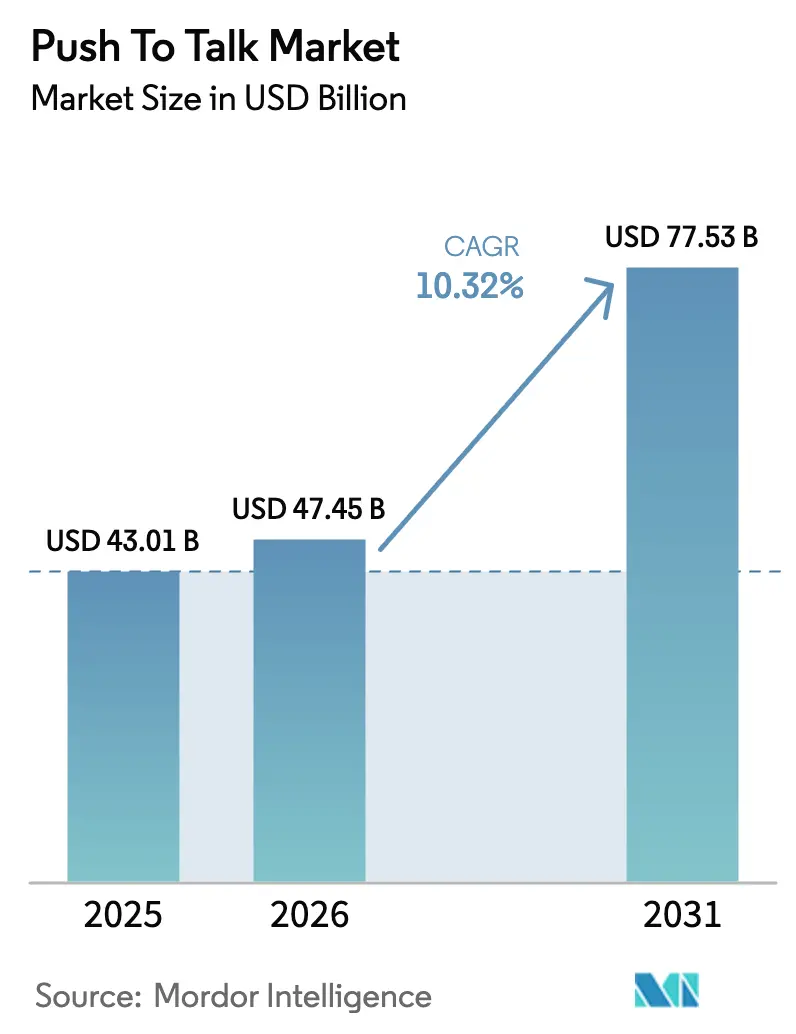
The Push To Talk Market size was valued at USD 43.01 billion in 2025 and estimated to grow from USD 47.45 billion in 2026 to reach USD 77.53 billion by 2031, at a CAGR of 10.32% during the forecast period (2026-2031).
The Push to Talk market is valued at USD 43.01 billion in 2025 and is on course to reach USD 70.82 billion by 2030, translating to a compound annual growth rate of 10.49%. Sustained demand for instant voice services in public safety, oil and gas, utilities, and logistics environments continues to pull investments toward broadband-based solutions that complement or replace Land Mobile Radio (LMR). The widening availability of carrier-integrated Mission Critical Push to Talk (MCPTT) on 5G networks, the integration of artificial intelligence in dispatch centers, and the proliferation of rugged smart devices are reinforcing the commercial case for next-generation services. At the same time, operators have to navigate fragmented spectrum allocation, semiconductor shortages, and heightened cyber-risk, factors that collectively shape procurement choices and deployment timelines. Competitive pressure is rising as traditional radio vendors, telecom infrastructure suppliers, and cloud-native software companies jostle for a larger position in the Push to Talk market.[1]
Key Report Takeaways
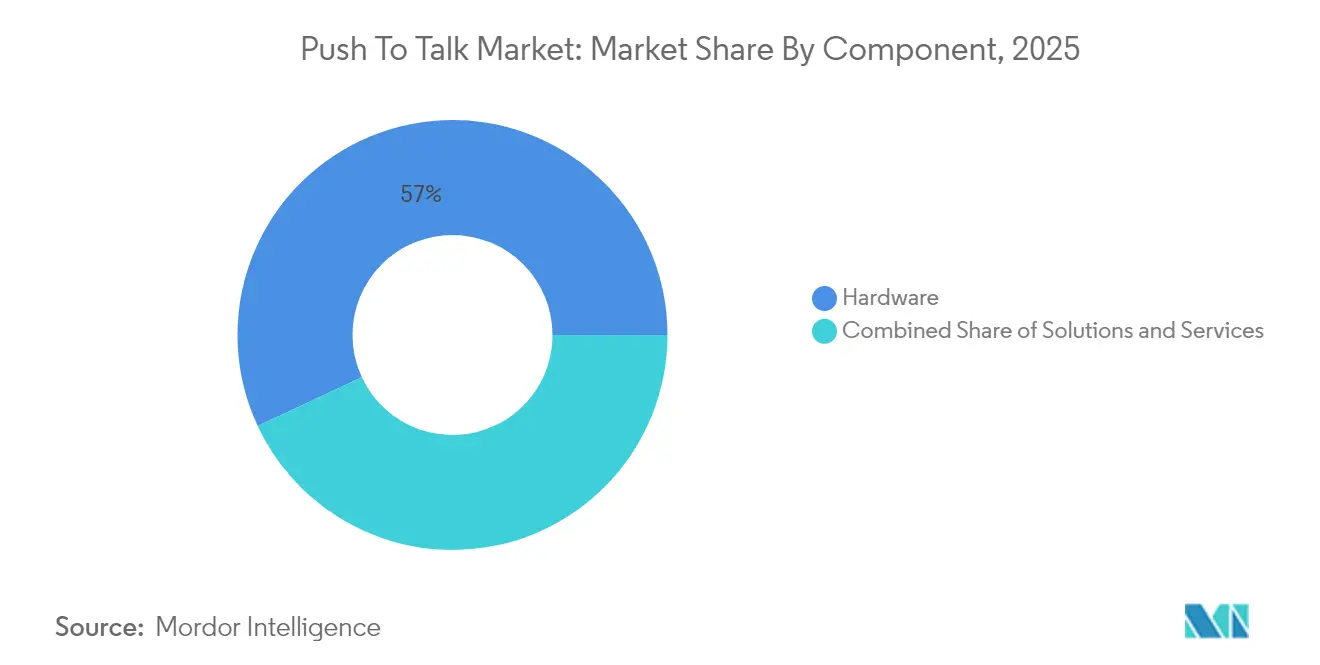
- By component, hardware led with 56.95% revenue share in 2025, while services are projected to grow at a 12.18% CAGR through 2031.
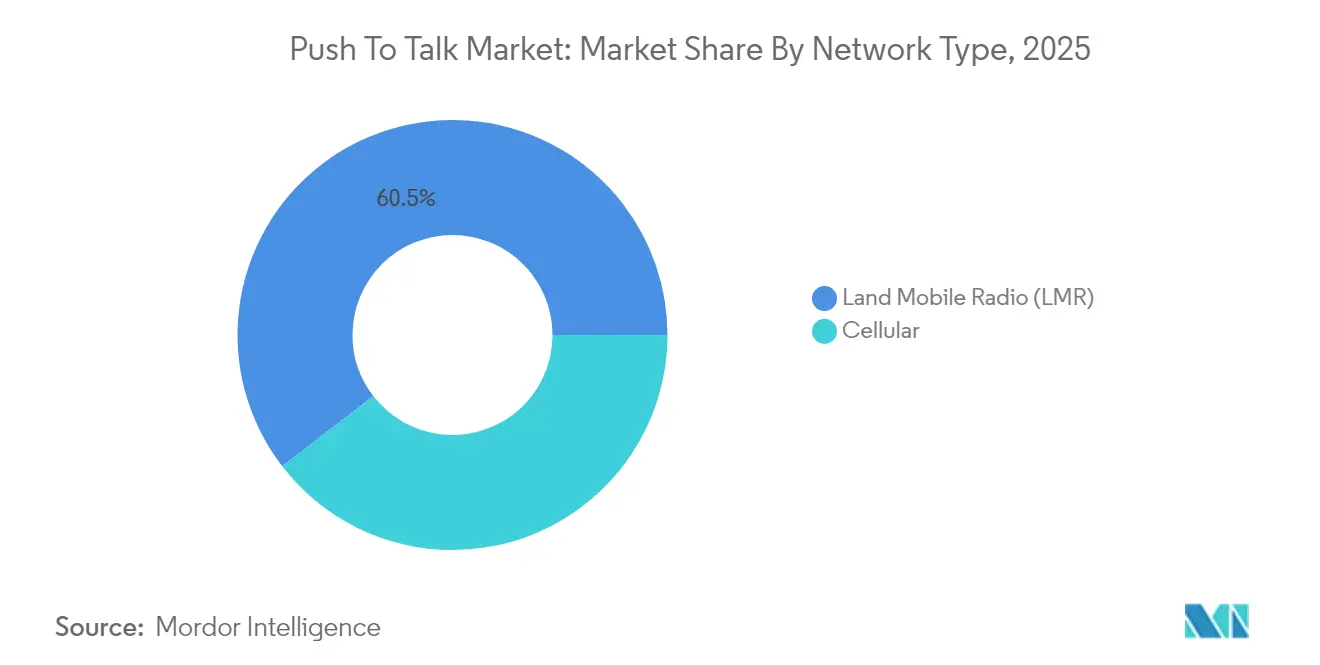
- By network type, Land Mobile Radio retained 60.45% of Push-to-Talk market share in 2025; 5G cellular networks are advancing at a 15.18% CAGR to 2031.
- By vertical, public safety accounted for 45.95% of the Push-to-Talk market size in 2025, whereas oil and gas and utilities are expected to expand at a 13.22% CAGR through 2031.
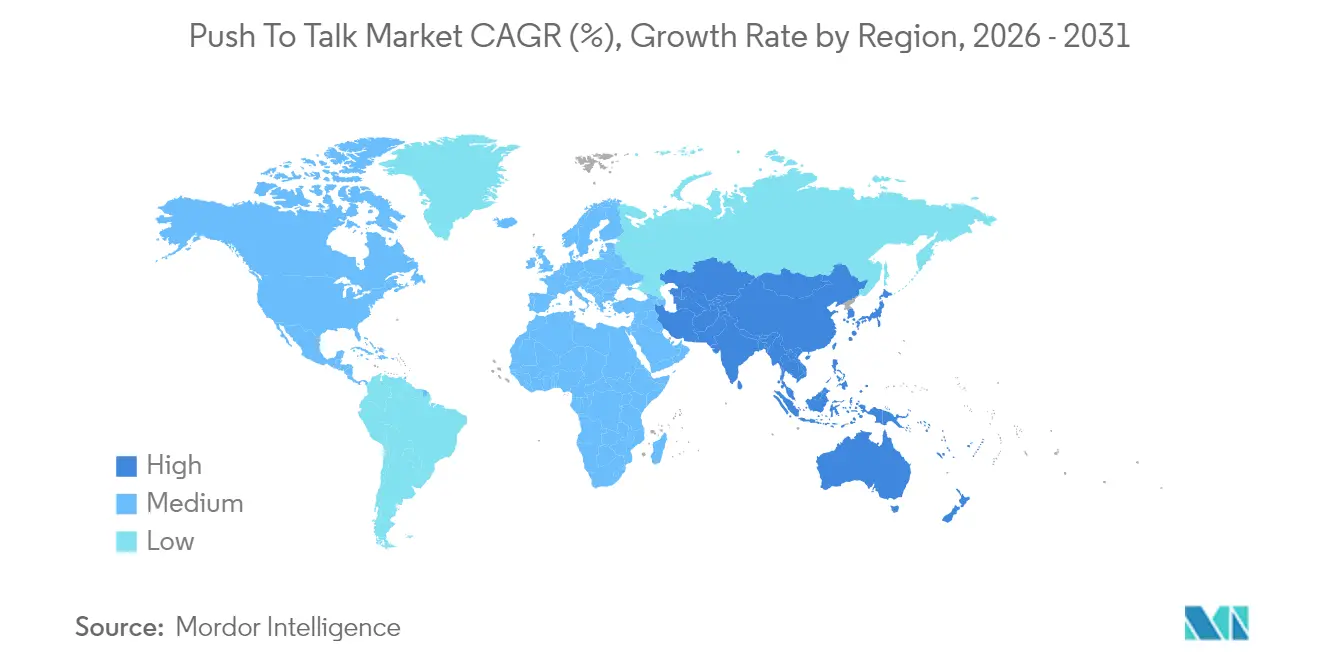
- By geography, North America held 36.35% revenue share in 2025, while Asia-Pacific is forecast to post the fastest regional growth at an 11.12% CAGR to 2031.
Note: Market size and forecast figures in this report are generated using Mordor Intelligence’s proprietary estimation framework, updated with the latest available data and insights as of 2026.
Market Trends and Insights
Drivers Impact Analysis of Push To Talk Market*
| Driver | (~) % Impact on CAGR Forecast | Geographic Relevance | Impact Timeline |
|---|---|---|---|
| Migration from legacy LMR to LTE/5G PoC solutions | +2.8% | Global; North America and Europe lead | Medium term (2-4 years) |
| Growing mission-critical communications demand in public safety | +2.1% | Global; strongest in developed markets | Long term (≥ 4 years) |
| Proliferation of rugged smart devices with integrated PTT | +1.9% | Asia Pacific core; spill-over to MEA and Latin America | Short term (≤ 2 years) |
| AI-driven dispatch analytics and situational awareness | +1.4% | North America and Europe first; APAC next | Medium term (2-4 years) |
| Carrier-integrated MCPTT standards (3GPP Release 18+) | +1.2% | Global; deployment paced by carriers | Long term (≥ 4 years) |
| Industrial private-5G campus networks | +0.8% | Industrial hubs in Germany, Japan, South Korea, China | Medium term (2-4 years) |
| Source: Mordor Intelligence | |||
Migration from Legacy LMR to LTE/5G PoC Solutions
Analog and early digital LMR systems are approaching end-of-life, and agencies are turning to broadband Push to Talk over Cellular (PoC) to address voice, video, and data in one service. The United Kingdom’s Emergency Services Network provides a prominent illustration of how public safety organizations are prioritizing broadband capability while preserving mission-critical availability standards. In North America, FirstNet allows agencies to phase out P25 equipment gradually without jeopardizing coverage. Private 5G networks inside factories and offshore platforms remove the line-of-sight constraints that previously complicated LMR roll-outs. Together, these use cases continue to accelerate the Push to Talk market shift toward cellular architectures.[2]
Growing Mission-Critical Communications Demand in Public Safety
Police, fire, and emergency medical teams have moved beyond voice-only communication. Today’s frontline personnel expect broadband Push to Talk services that seamlessly stream body-worn camera feeds, drone footage, and sensor data back to command centers. NATO field exercises in 2025 validated how 5G can maintain secure communications across multiple agencies operating jointly, highlighting the need for interoperable, low-latency services. Despite tight municipal budgets, federal grants motivate system upgrades that bring predictive analytics and location awareness into routine operations. These requirements ensure that public safety will remain the anchor vertical within the Push to Talk market.[3]
Proliferation of Rugged Smart Devices with Integrated PTT
Rugged Android handsets now combine Push to Talk buttons, high-resolution cameras, and barcode scanners, displacing single-purpose radios for many industrial and logistics users. Cost inflation tied to chipset shortages has pushed device makers to emphasize value-added software subscriptions to preserve margins. Leasing and device-as-a-service offerings reduce customer capital outlay and shorten refresh cycles, expanding the addressable base. As enterprises evaluate total cost of ownership, device convergence is driving additional momentum into the Push to Talk market.
AI-Driven Dispatch Analytics and Situational Awareness
Artificial intelligence engines incorporated into dispatch consoles automatically analyze voice traffic, background noise, and caller sentiment. They sequence incidents based on severity and available resources, shaving critical seconds off deployment times. Real-time language translation promotes cross-border cooperation, while transcription services preserve evidentiary records without human intervention. Early adopters cite measurable reductions in false alarms and overtime costs, reinforcing the growth potential for AI-enhanced Push to Talk market solutions.
Restraints Impact Analysis of Push To Talk Market*
| Restraint | (~) % Impact on CAGR Forecast | Geographic Relevance | Impact Timeline |
|---|---|---|---|
| Fragmented spectrum allocation and regulatory delays | −1.8% | Global; severity varies by region | Long term (≥ 4 years) |
| Security vulnerabilities in PoC over public networks | −1.3% | Global; heightened for defense and utilities | Medium term (2-4 years) |
| Interoperability gaps between LMR and broadband PTT platforms | −0.9% | North America and Europe | Medium term (2-4 years) |
| Budgetary capital-expenditure constraints in public sector agencies | −0.7% | Developing markets mainly | Short term (≤ 2 years) |
| Source: Mordor Intelligence | |||
Fragmented Spectrum Allocation and Regulatory Delays
Conflicting national priorities complicate the hunt for harmonized mission-critical spectrum. In the United States, protracted debates around 4.9 GHz sidelink usage have slowed statewide deployments. Europe’s reliance on 380–470 MHz TETRA channels poses integration challenges with 700 MHz broadband allocations. Certification cycles can stretch past two years, deterring smaller vendors from entering new territories and delaying revenue realization for the Push to Talk market.[4]
Security Vulnerabilities in PoC over Public Networks
Cellular Push to Talk traffic traverses shared infrastructure, increasing exposure to denial-of-service and eavesdropping threats. Operators report that 76% of attempted breaches now target signaling planes to disrupt priority services. End-to-end encryption is improving, yet multi-agency interoperability often forces temporary downgrades in cipher strength. These vulnerabilities make risk-averse buyers reluctant to abandon closed LMR networks, slowing certain Push to Talk market conversions.
*Our forecasts treat driver/restraint impacts as directional, not additive. The impact forecasts reflect baseline growth, mix effects, and variable interactions.
Push To Talk Market Segment Analysis
By Component:
Services Extend MonetizationHardware still generated USD 24.5 billion in 2025, representing the largest single slice of the Push to Talk market. Strong demand for intrinsically safe radios in petrochemical sites and for rugged smartphones in construction has kept device revenues steady. Nevertheless, managed service contracts that wrap device management, cybersecurity, and 24/7 network monitoring are outpacing unit sales growth. Service providers now bundle predictive maintenance and analytics dashboards, which elevate switching costs and lengthen customer lifecycles. The evolution aligns with enterprise procurement teams that favor operational expenditure over lump-sum capital purchases.
The services category, growing at 12.18% annually, increasingly includes regulatory advisory, grant-writing assistance, and user-training subscriptions. Software vendors monetize artificial-intelligence modules on a per-seat basis, delivering customizable incident-command features without fresh hardware purchases. As a result, the Push to Talk market size for services is projected to exceed USD 35.7 billion by 2031, indicating a substantial shift in revenue mix away from physical equipment. Deployment complexity, particularly in hybrid LMR-cellular environments, guarantees a multi-year runway for professional services revenue.

By Network Type:
Cellular Transformation AcceleratesLMR retained a commanding foothold with 60.45% Push to Talk market share in 2025, showing that proven reliability still matters to mission-critical users. However, 5G deployments are expanding at a 15.18% CAGR on the back of network slicing and enhanced mobile broadband. Multi-operator core networks, pioneered in the European public safety community, allow first responders to roam across carriers without manual intervention, directly challenging LMR’s historical advantage in coverage continuity.
Private industrial 5G has unlocked new pockets of demand. Automotive assembly lines use sub-20-millisecond latency channels to synchronize autonomous guided vehicles, with real-time voice overlays for maintenance alerts. Hybrid architectures are the norm: agencies keep LMR for fallback while shifting day-to-day traffic to broadband. Over the forecast horizon, the Push to Talk market size for cellular solutions is set to eclipse USD 40.6 billion, driven by cap-and-grow migration strategies.
By Vertical:
Industrial Uptake Gains PacePublic safety dominated revenue with USD 19.8 billion in 2025, reflecting federal mandates for interoperable voice platforms and continuing FirstNet expansion. Police command centers integrate body-worn video feeds and geofencing, which pushes users toward broadband. Fire and emergency medical services rely on biometric tracking to protect personnel in hazardous zones, a feature absent in legacy radios.
The oil and gas and utilities vertical is projected to post the quickest gains, with 13.22% annual growth as operators roll out private 5G in refineries and transmission corridors. Cellular Push to Talk supports direct-transfer-trip schemes that halt equipment instantly if communication links fail, satisfying stringent safety regulations. Transportation and manufacturing segments follow similar logic, merging plant controls with real-time voice. By 2030, industrial users are expected to contribute more than one-third of incremental Push to Talk market revenue.
Geography Analysis
North America Push To Talk Market
North America generated the largest regional revenue in 2024, underpinned by extended FirstNet coverage, federal grant incentives, and a sizable installed base of P25 networks needing upgrades. Canada’s public safety agencies prioritize interoperability across vast territories, while Mexico’s maquiladora factories seek unified communication channels to support lean workflows.
Europe Push To Talk Market
Europe’s modernization programs focus on seamless roaming across borders. Pilot projects in Scandinavia demonstrate cross-carrier MCPTT hand-offs that preserve push-to-talk sessions during high-speed rail travel. Regulatory clarity on 700 MHz narrowband spectrum has accelerated tender activity, though supply-chain constraints occasionally disrupt device deliveries.
APAC Push To Talk Market
Asia Pacific, the fastest-growing region at 11.12%, benefits from large-scale 5G roll-outs and industrial automation drives in China, Japan, and India. Local vendors supply purpose-built terminals at lower price points, encouraging small- and mid-size enterprises to adopt broadband Push to Talk. Australia and New Zealand remain niche markets that emphasize mining safety applications, yet their stringent equipment standards create attractive margins for premium device makers.
MEA Push To Talk Market
The Middle East and Africa trail on absolute revenue yet show momentum in verticals such as energy and smart city public safety. Gulf Cooperation Council members invest in network slicing to support megaproject security, while South Africa leans on broadband PTT to monitor deep-level mine operations. As coverage gaps close, cellular-first deployments may let new entrants bypass legacy LMR entirely, broadening the Push to Talk market addressable base.
Regulatory Landscape
Push-to-talk deployments are governed by spectrum policy, critical-infrastructure cybersecurity obligations, and mission-critical service standards that shape interoperability requirements. In the United States, the Federal Communications Commission (FCC) has ongoing proceedings around the 4.9 GHz band that affect broadband sidelink and adjacent public-safety use cases, while public-safety broadband programs such as FirstNet influence procurement toward cellular MCPTT alongside legacy P25.
On the standards front, 3GPP mission critical services (MCX, including MCPTT, MCVideo, and MCData) and ETSI technical specifications provide the baseline for carrier-integrated services and multi-vendor certification activity, including ETSI MCX Plugtests. In Europe, the EU NIS2 Directive transposition and enforcement across 2025-2026 tighten incident reporting and security governance for essential entities, including telecommunications providers, which raises compliance expectations for operators and solution vendors carrying mission-critical voice over public networks.
Competitive Landscape
Competition centers on who can deliver mission-critical latency and reliability while keeping total cost-of-ownership low. Incumbent LMR suppliers protect their franchises through large patent portfolios and decades-long relationships with government agencies. Telecom infrastructure giants partner with carriers to layer MCPTT directly onto 5G cores, providing nationwide reach without dedicated repeaters. Cloud-native entrants differentiate through AI-powered dispatch analytics and subscription pricing.
Consolidation has intensified: several regional two-way radio distributors merged in 2024 to build scale in managed services, and a handful of software vendors acquired smaller AI start-ups to embed real-time transcription inside mobile apps. Meanwhile, chipset shortages forced device makers to prioritize high-margin rugged handsets, indirectly squeezing budget buyers. The drive toward open APIs has also widened the playing field— integrators can mix and match radios, smartphones, and dispatch consoles from multiple brands without forfeiting support contracts.
Strategic moves underline vertical specialization. One radio vendor partnered with a turbine manufacturer to certify explosion-proof handsets for floating LNG terminals. A telecom operator bundled cloud-hosted MCPTT together with 5G smart-meter connectivity for European utilities, locking in multi-decade contracts. Another supplier launched a device-as-a-service offer that rolls hardware, software, and 24-hour replacement into a single monthly fee. Such tactics underscore a broader migration from hardware margins to recurring revenue inside the Push to Talk market.
Push To Talk Industry Leaders
-
Qualcomm Technologies, Incorporation
-
Nokia
-
Samsung Electronics
-
Ericsson
-
Verizon Communications
- *Disclaimer: Major Players sorted in no particular order

Push To Talk Market Companies Covered in this Report
- Motorola Solutions
- AT&T (FirstNet)
- Verizon Communications
- Hytera Communications
- Tait Communications
- Iridium Communications
- Telstra
- Qualcomm Technologies
- Zebra Technologies
- Samsung Electronics
- Airbus Defence and Space
- Cisco Systems
- Nokia
- Ericsson
- L3Harris Technologies
- Sonim Technologies
- Sepura
- ESChat
- RugGear
- Siyata Mobile
Market Opportunities and Future Outlook
A clear whitespace remains in standards-based interworking between broadband MCX and legacy Land Mobile Radio (LMR) fleets, where agencies and critical-infrastructure operators need phased migration rather than rip-and-replace. 3GPP Release 19 mission critical specifications, delivered through ETSI technical documents, broaden the technical foundation for MCPTT and MCPTX capabilities and support richer service bundles combining voice with mission critical data (MCData) and mission critical video (MCVideo). This creates an opening for vendors and integrators to productize gateways, dispatch integration, identity and key management, and policy-driven prioritization across hybrid LMR and LTE/5G environments.
Beyond public safety, commercial adoption is also an opportunity aligned to the mission critical service requirements framework. 3GPP service requirements (for example, TS 22.179) explicitly consider sectors such as utilities and railways. As utilities and industrial operators roll out private 5G campus networks and carriers expand MCX enablement across cores and IMS stacks, suppliers that bundle rugged endpoints, managed services, and security controls aligned to critical-infrastructure obligations (including NIS2-driven practices in Europe) have a clearer path to scale deployments across multi-site operations where voice, video, and workflow data must be coordinated in real time.
Recent Industry Developments in Push To Talk Market
- June 2026: Qualcomm Technologies, HMD Secure, StreamWIDE collaborated to deploy NR Sidelink powered device-to-device communications incorporating push-to-talk, messaging, and file sharing for first responders operating off-network. The collaboration links push-to-talk with NR Sidelink, improving latency and reliability and extending off-network deployment scenarios.
- June 2026: Qualcomm Technologies, HMD Secure, and StreamWIDE collaborated to deploy NR Sidelink powered device-to-device (D2D) communications, incorporating push-to-talk, messaging, and file sharing for first responders operating off-network. The action expands the reach of off-network PTT solutions and supports resilience in emergency response.
- May 2026: Nokia Federal Solutions & Lockheed Martin announced a modular, open-architecture 5G solution for U.S. and allied defense forces, using commercial 5G technologies for mission-critical connectivity. The open architecture MCPTT is designed to enable interoperability across defense networks and support faster deployment of critical communications in public safety and defense environments.
Push To Talk Market Report Scope and Research Methodology
Market Definition and Coverage
For this methodology, the push-to-talk market covers hardware, software, and services that enable instant, group voice communication with a press-to-speak workflow across cellular and land mobile radio networks. It is used by public safety, government, defense, and commercial users.
Scope exclusions: We exclude generic voice calling and consumer messaging apps that do not offer purpose-built push-to-talk features for coordinated work or mission use.
Segments Covered in This Report
- By Component (Value)
- Hardware
- PTT Radios
- Rugged / Ultra-rugged Smart Devices
- Gateways and Repeaters
- Audio Accessories
- Solutions
- PoC Software (MCPTT, PoC, iPTT)
- Dispatch and Command-Centre Consoles
- Application-Integration Middleware
- Services
- Professional Services
- Managed Services
- Training and Support
- Hardware
- By Network Type (Value)
- Land Mobile Radio (LMR)
- Analog LMR
- Digital LMR (DMR, TETRA, P25, dPMR, NXDN)
- Cellular
- 3G
- 4G / LTE
- 5G
- Land Mobile Radio (LMR)
- By Vertical (Value)
- Public Safety
- Police
- Fire and Rescue
- Emergency Medical Services
- Government and Defense
- Commercial
- Transportation and Logistics
- Manufacturing
- Construction
- Oil and Gas and Utilities
- Hospitality and Retail
- Public Safety
- By Geography (Value)
- North America
- United States
- Canada
- Mexico
- South America
- Brazil
- Argentina
- Rest of South America
- Europe
- Germany
- United Kingdom
- France
- Russia
- Rest of Europe
- Asia Pacific
- China
- Japan
- South Korea
- India
- Australia and New Zealand
- Rest of Asia Pacific
- Middle East and Africa
- Middle East
- Saudi Arabia
- United Arab Emirates
- Turkey
- Rest of Middle East
- Africa
- South Africa
- Nigeria
- Rest of Africa
- Middle East
- North America
Data Sources, Market Sizing, and Validation
Desk Research
Desk research starts by mapping the demand pool and the enabling network environment, then aligning it with what suppliers usually monetize, devices, platforms, and service bundles. We use public sources such as the Federal Communications Commission (FCC) for spectrum and radio ecosystem context, the National Institute of Standards and Technology (NIST) for cybersecurity guidance signals, and standards bodies such as ETSI and 3GPP for mission-critical communications roadmaps.
To avoid building the model on just one lens, we also reference industry and government publications such as the National Telecommunications and Information Administration (NTIA) and the International Telecommunication Union (ITU), plus public financial filings, investor presentations, and credible press releases that indicate contract wins and deployments. Where useful, paid database subscriptions are used for company financial intelligence, patent lookups, and shipment-level trade signals, which helps cross-check trend direction without forcing the model into an overly granular build. The sources mentioned above are illustrative and not exhaustive, and additional public documents and datasets were also used for data collection, validation, and clarification.
Primary Interviews and Surveys
Primary work focuses on how push-to-talk is actually bought and used, which helps us pin down pricing logic and adoption curves by vertical and by region. We speak with telecom and radio ecosystem participants, solution delivery teams, and enterprise and public safety buyers across major geographies, so assumptions on migration to broadband PTT, device replacement cycles, and service attach rates can be checked and adjusted.
Distribution of primary research fieldwork respondents
| Company type | Respondent position | Region |
|---|---|---|
| Top tier: 33% | CXOs: 16% | APAC: 48% |
| Mid tier: 45% | Functional/Unit leaders: 34% | EMEA: 31% |
| Smaller Players: 22% | Managers: 50% | Americas: 21% |
Market-Sizing & Forecasting
Our sizing starts with a top-down reconstruction of addressable spending by linking industry communication needs to network readiness, then applying adoption and pricing assumptions to push-to-talk capable hardware, software, and services. We also corroborate selectively with bottom-up approximations, such as sampled ASP x volume checks for rugged devices, platform and service pricing bands gathered from channel conversations, and sanity checks against supplier revenue exposure where it can be reasonably isolated.
Key model inputs include the pace of broadband push-to-talk adoption versus land mobile radio usage, the share of deployments that require mission-critical features, average number of active users per organization in target verticals, subscription versus perpetual mix for software, and service attach rates for support and integration. Geography is handled through region-level weighting because procurement patterns and network coverage differ, and gaps are treated through controlled assumptions that are only retained when validated by multiple interview themes.
Forecasting uses scenario analysis supported by trend lines from the demand indicators above, then is tuned using expert views on 4G and 5G rollout timing, public safety modernization cycles, and expected pricing progression for bundled services. When signals conflict, the model is kept conservative on adoption speed, and aggressive assumptions are not carried forward unless they are backed by repeated buyer-side confirmation.
Data Validation & Update Cycle
Validation is done through triangulation between the model output, independent market signals, and what interviewees report as real-world buying behavior. Outliers are flagged early, and the assumptions behind them are re-checked, followed by a second analyst review that focuses on scope alignment, unit consistency, and currency and inflation handling.
If a material variance is found, re-contact is triggered with relevant respondents so the input can be corrected before sign-off. Reports are refreshed annually, and interim updates are made when major events change spending patterns or deployment plans. Before delivery, an analyst performs a fresh pass so clients receive the latest updated view.
Mordor Intelligence's Push to Talk Market Sizing Compared With Other Published Estimates
Published market sizes for push-to-talk can differ even when the titles sound similar, because the counted revenue boundary is not always the same and the forecasting posture can be more or less aggressive. Differences usually come from what is included as push-to-talk revenue, how land mobile radio and cellular services are treated, and how quickly the model assumes migration to broadband-based deployments.
By checking cellular versus land mobile radio deployment mix, refreshing service attach and device replacement-cycle assumptions, and then validating with procurement and rollout interviews, Mordor Intelligence keeps the total tied to push-to-talk monetization across hardware, software, and services, rather than counting broader enterprise voice communication spend.
Benchmark comparison
| Source | Market Size | Gaps in Research Methodology |
|---|---|---|
| Mordor Intelligence | USD 43.01 B (2025) | |
| Global Market Compendium A | USD 29.60 B (2025) | This estimate is often narrower in what it counts as revenue, leaning toward cellular service and platform spend, which can leave out device-led deployments and integration services that are paid for in public safety and industrial environments. |
| Industry Briefing B | USD 23.74 B (2024) | This estimate uses an earlier base year and typically applies longer-horizon growth curves with fewer near-term checks on public sector budgets and enterprise rollout timing, which can shift totals when refresh cadence and currency conversion timing differ. |
The spread across sources is mainly explained by scope boundaries, base year timing, and how quickly network migration and service bundling are assumed to happen. With clear inclusion rules and repeatable checks on adoption, pricing, and attach rates, the methodology produces a balanced market view that can be updated consistently as new deployment signals appear.
Key Questions Answered in the Report
What is the projected size of the Push to Talk market in 2031?
The Push to Talk market is expected to reach USD 77.53 billion by 2031 on a CAGR of 10.32%.
Which component segment is growing the fastest?
Services, comprising integration, managed support, and training, are advancing at a 12.18% CAGR through 2031.
Why are public safety agencies moving toward broadband Push to Talk?
They need low-latency voice along with real-time video, location tracking, and analytics that traditional LMR cannot deliver.
How does 5G benefit Push to Talk applications?
5G provides network slicing and sub-20-millisecond latency, matching mission-critical voice standards while adding high-bandwidth data.
What regions show the highest growth potential?
Asia Pacific leads with an 11.12% CAGR because of large-scale 5G deployments and industrial digitalization programs.
Are LMR systems becoming obsolete?
Not immediately; many users run hybrid deployments that leverage existing LMR for fallback and broadband for enhanced data features.