
Prophylactic HIV Drugs Market Size and Share
Market Overview
| Study Period | 2020 - 2031 |
|---|---|
| Market Size (2026) | USD 34.75 Billion |
| Market Size (2031) | USD 42.23 Billion |
| Growth Rate (2026 - 2031) | 3.96 % |
| Fastest Growing Market | Asia-Pacific |
| Largest Market | North America |
| Market Concentration | Medium |
Major Players *Disclaimer: Major Players sorted in no particular order Image © Mordor Intelligence. Reuse requires attribution under CC BY 4.0. | |
Prophylactic HIV Drugs Market Analysis by Mordor Intelligence
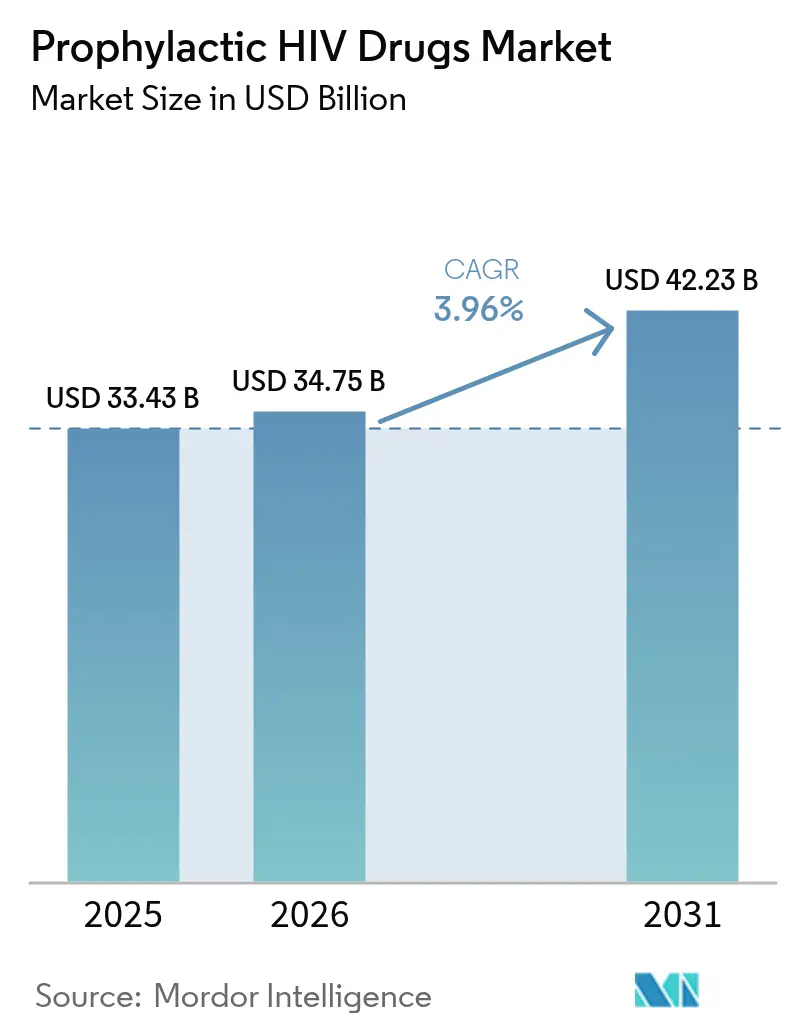
The prophylactic HIV drugs market size was valued at USD 33.43 billion in 2025 and estimated to grow from USD 34.75 billion in 2026 to reach USD 42.23 billion by 2031, at a CAGR of 3.96% during the forecast period (2026-2031). Growing demand for long acting injectables, rising policy support, and widening digital distribution networks are reshaping the competitive field, while cost pressures tied to generic entry temper margins in mature economies. Innovation momentum remains high: FDA clearance of twice-yearly lenacapavir in June 2025 validates capsid inhibition as a breakthrough prevention class and anchors the fastest-growing dosage-form segment at 7.56% CAGR. North America preserves scale advantages through insurance reimbursement and clinical infrastructure, but Asia-Pacific posts the sharpest volume gains as governments embed PrEP into national AIDS plans and expand telehealth coverage. Across the prophylactic HIV drugs market, differentiation now hinges on dosing convenience, manufacturing partnerships, and value-based pricing models that reconcile R&D returns with equitable access.
Key Report Takeaways
- By drug, Tenofovir Alafenamide led with 54.78% prophylactic HIV drugs market share in 2025, whereas lenacapavir is forecast to achieve the highest CAGR at 6.35% through 2031.
- By dosage form, oral tablets controlled 65.02% of the prophylactic HIV drugs market size in 2025, while long-acting injectables expand at a 7.31% CAGR between 2026 and 2031.
- By distribution channel, hospital pharmacies retained 55.21% revenue share in 2025; online pharmacies and tele-PrEP platforms record the fastest growth at 7.55% CAGR to 2031.
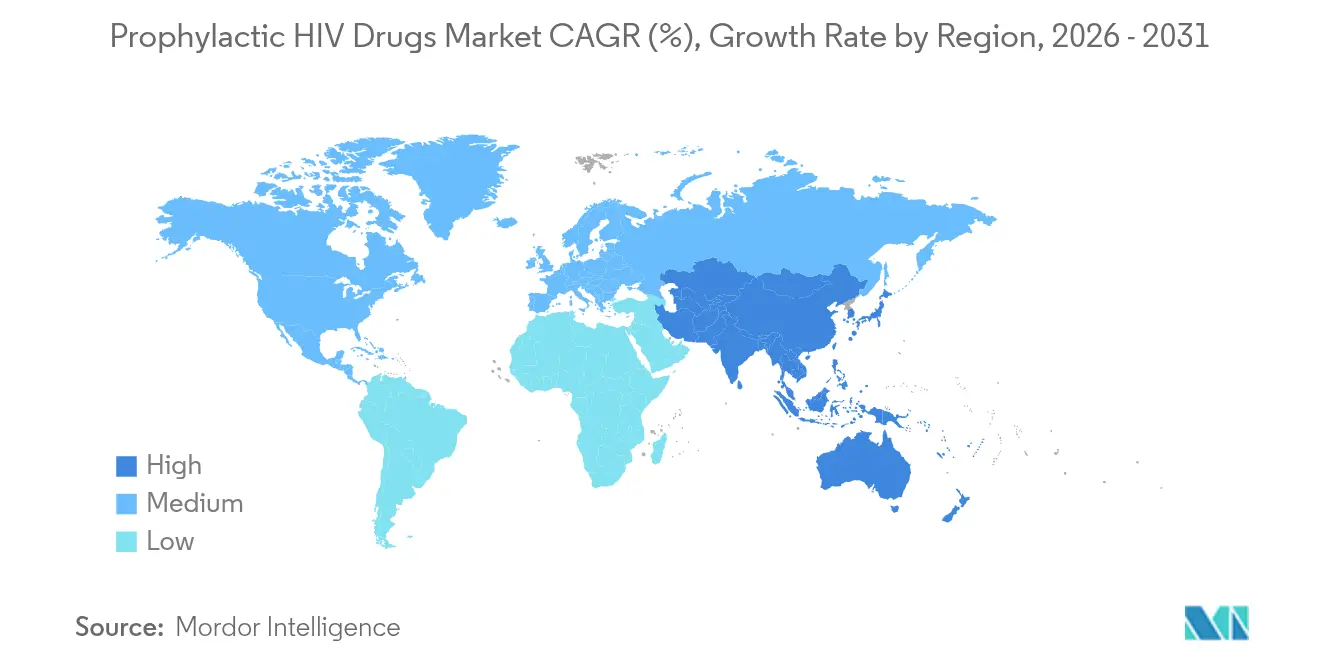
- By geography, North America held 41.02% of 2025 revenue and Asia-Pacific registers the highest projected CAGR at 5.28% through 2031.
Note: Market size and forecast figures in this report are generated using Mordor Intelligence’s proprietary estimation framework, updated with the latest available data and insights as of 2026.
Market Trends and Insights
Drivers Impact Analysis of Prophylactic HIV Drugs Market*
| Driver | % Impact on CAGR Forecast | Geographic Relevance | Impact Timeline |
|---|---|---|---|
| Rising global HIV incidence and prevalence | +1.2% | Sub-Saharan Africa, Asia-Pacific, Latin America | Long term (≥ 4 years) |
| Expanding government and donor funding for prevention programs | +0.8% | PEPFAR-supported regions; Global Fund priority countries | Medium term (2-4 years) |
| Increasing generic drug availability and affordability | +0.7% | Low- and middle-income countries; emerging markets | Medium term (2-4 years) |
| Ongoing innovation in antiretroviral drug-delivery technologies | +0.6% | North America and Europe (early adoption); global rollout as approvals widen | Short term (≤ 2 years) |
| Evolving digital health channels enabling remote PrEP access | +0.5% | North America, Europe, urban hubs in Asia-Pacific | Short term (≤ 2 years) |
| Integration of PrEP within sexual and reproductive health services | +0.4% | Europe and Latin America (accelerated implementation); global family-planning programs | Medium term (2-4 years) |
| Source: Mordor Intelligence | |||
Rising Global HIV Incidence and Prevalence
Roughly 1.3 million new HIV infections were reported worldwide in 2024, with adolescents and young adults accounting for a growing proportion of cases. The epidemiological urgency sustains baseline demand for prophylactic strategies and amplifies uptake of the prophylactic HIV drugs market across high-burden geographies. PURPOSE-1 and PURPOSE-2 trials documented 100% prevention efficacy for twice-yearly lenacapavir among cisgender women, eliminating adherence gaps that limited daily-pill effectiveness[1]. Public-health agencies increasingly recommend capsid inhibitors for high-risk cohorts, signaling an evidence-driven shift in clinical guidelines. Rising drug-resistant HIV strains further heighten interest in mechanisms outside reverse transcriptase inhibition, reinforcing diversification within the prophylactic HIV drugs market. Collectively, disease-burden dynamics and resistance concerns underpin a structural growth floor for preventive pharmacotherapy.
Expanding Government and Donor Funding for Prevention Programs
Donor agencies are pivoting toward prevention as the fiscally prudent way to cut HIV incidence, with the Global Fund’s 2025 procurement of African-manufactured first-line regimens marking a watershed for regional supply chains[2]. PEPFAR’s pledge to source 2 million locally produced treatments by 2030 illustrates how industrial-policy goals now overlap with public-health objectives. Such commitments enlarge the prophylactic HIV drugs market by guaranteeing predictable volumes and lowering last-mile costs. At the same time, program funding is tied to political cycles, injecting volatility into multiyear revenue forecasts. Manufacturers that master low-cost GMP production and navigate donor tender processes secure a durable competitive edge under the new access paradigm.
Increasing Generic Drug Availability and Affordability
Voluntary-licensing deals accelerate generic penetration while strategically sheltering premium margins in high-income markets. Gilead’s license for lenacapavir across 120 countries slashes cost of goods to USD 40-100 per patient per year versus the USD 42,250 branded price in the United States. As generic firms ramp volume, innovators face margin compression yet gain reputational benefits and extended lifecycle revenue through royalties. Middle-income nations left outside licensing envelopes, including Brazil and Mexico, intensify advocacy for broader access, signaling potential policy pressure that could reshape pricing corridors in the prophylactic HIV drugs market. The resulting price gradients reinforce tiered-market dynamics that reward efficient scale production and targeted portfolio management.
Ongoing Innovation in Antiretroviral Drug-Delivery Technologies
Pipeline assets such as Merck’s once-monthly oral MK-8527 and ViiV’s four-monthly N6LS antibody highlight a diverse wave of long-acting modalities moving through late-stage trials. Patient-preference studies show sustained willingness to switch from daily pills to injectable or monthly oral options, citing convenience and reduced stigma. Combination of extended-release pharmacology with digital adherence monitoring allows clinicians to tailor prophylaxis schedules, enhancing real-world effectiveness. Early adoption in North America and Europe drives premium pricing, while technology-transfer initiatives shorten lag-times before launch in emerging markets. Continuous innovation thus injects additional growth momentum into the prophylactic HIV drugs market and differentiates leaders via intellectual-property depth.
Restraints Impact Analysis of Prophylactic HIV Drugs Market*
| Restraints Impact Analysis | (~) % Impact on CAGR Forecast | Geographic Relevance | Impact Timeline |
|---|---|---|---|
| High cost of novel long-acting formulations | -0.9% | Global; greatest effect in middle-income countries | Short term (≤ 2 years) |
| Persisting socioeconomic access disparities | -0.6% | Sub-Saharan Africa, Latin America, rural Asia-Pacific | Long term (≥ 4 years) |
| Regulatory and reimbursement uncertainties across markets | -0.5% | Emerging markets and countries with fragmented insurance systems | Medium term (2-4 years) |
| Stigma and misinformation limiting PrEP uptake | -0.4% | High-burden regions worldwide, particularly among marginalized populations | Long term (≥ 4 years) |
| Source: Mordor Intelligence | |||
High Cost of Novel Long-Acting Formulations
Annual U.S. list pricing of USD 42,250 for lenacapavir stands a thousand-fold above estimated manufacturing costs, limiting payer acceptance despite clinical superiority. Insurers impose prior authorization and step therapy, delaying uptake of long-acting options in favor of cheaper generics. Middle-income markets caught between patent protection and absence of tiered pricing face the steepest affordability hurdles, curbing near-term penetration of the prophylactic HIV drugs market. To mitigate resistance, companies are exploring subscription-style agreements and value-based contracts, yet these models remain nascent and unevenly applied.
Persisting Socioeconomic Access Disparities in High-Burden Regions
Cold-chain requirements and skilled-provider administration constrain distribution of injectables in rural clinics, while stigma deters marginalized groups from engaging with public health systems[3]. Internet connectivity gaps hinder tele-PrEP rollout, dampening the digital-channel upside in low-resource settings. Such structural inequities create a floor beneath which technology alone cannot lift prophylaxis coverage, capping total-addressable share in the prophylactic HIV drugs market. Multisectoral interventions encompassing infrastructure, education, and legal reform are needed to resolve these systemic obstacles.
*Our forecasts treat driver/restraint impacts as directional, not additive. The impact forecasts reflect baseline growth, mix effects, and variable interactions.
Prophylactic HIV Drugs Market Segment Analysis
By Drug:
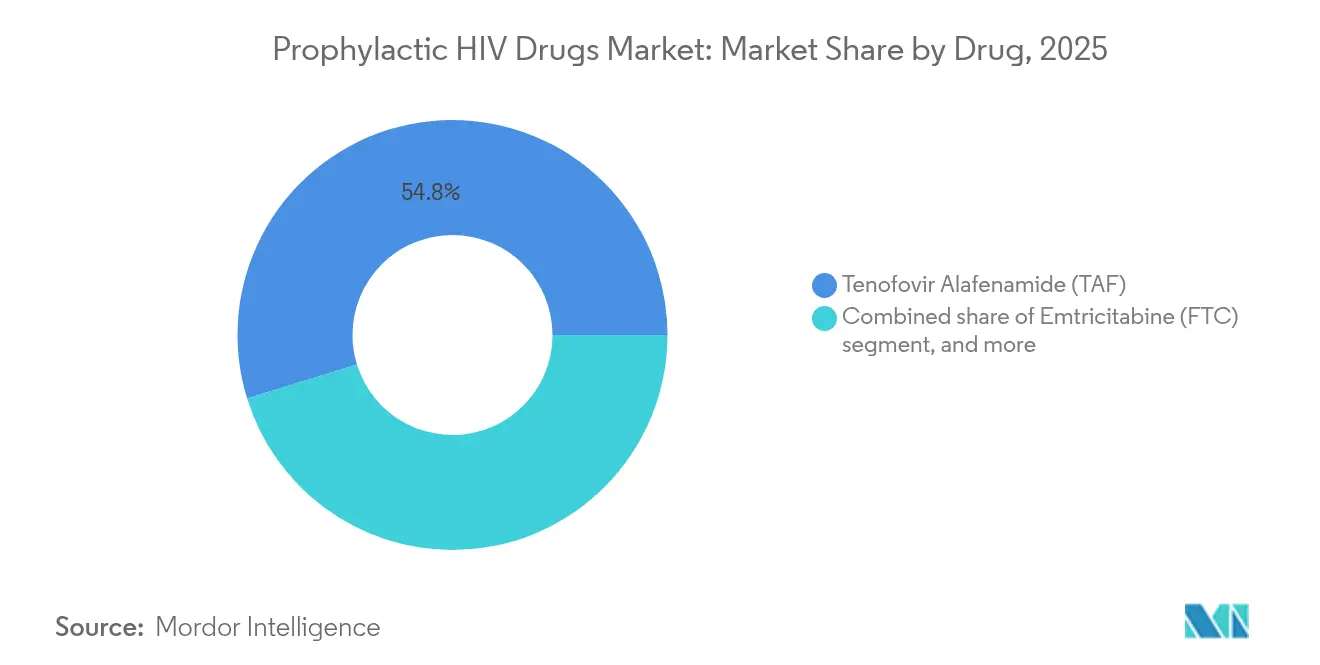
Lenacapavir’s Capsid Inhibition Reshapes Competitive HierarchyTenofovir Alafenamide controlled 54.78% of the prophylactic HIV drugs market share in 2025, reflecting its renal- and bone-sparing safety profile and wide familiarity among prescribers. However, lenacapavir unlocks a differentiated capsid-inhibition pathway that secures a 6.35% CAGR, displacing incumbents in high-adherence-risk populations and expanding the overall prophylactic HIV drugs market size by capturing patients previously unwilling or unable to manage daily pills. Emtricitabine remains a staple backbone in combination regimens, while cabotegravir long-acting sustains niche demand despite supply bottlenecks.
Competitive dynamics increasingly hinge on mechanism-of-action diversification to counter resistance evolution, positioning lenacapavir as the vanguard of next-generation prophylaxis within the prophylactic HIV drugs industry. As generic licensing unlocks volume in 120 countries, innovators must rely on lifecycle management and novel co-formulations to defend share in premium tiers.

By Dosage Form:
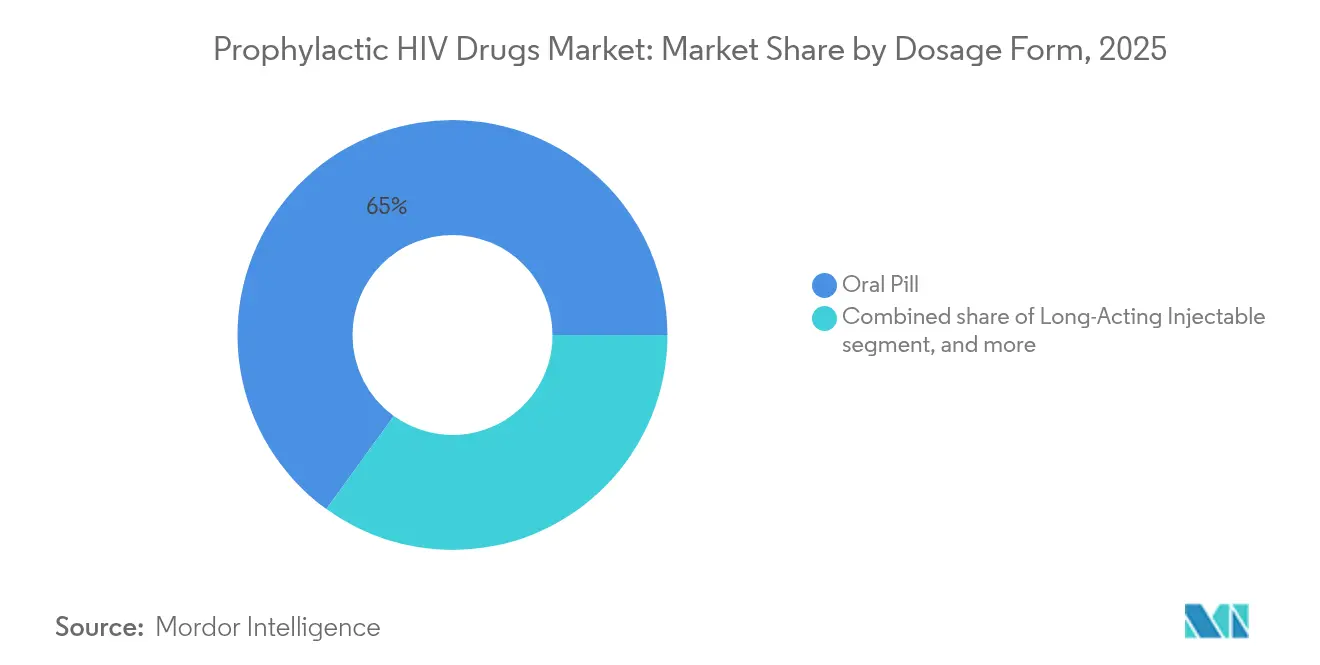
Injectables Record Fastest UptakeOral tablets still accounted for 65.02% revenue in 2025, buoyed by entrenched procurement channels and lower unit costs. Yet injectables outpace all formats at 7.31% CAGR through 2031, helping enlarge the prophylactic HIV drugs market as twice-yearly dosing removes daily-adherence friction. Post-marketing studies show preference swings toward injectables among adolescents and cisgender women citing discretion and convenience.
Pipeline work on sub-dermal implants and microbicide rings signals a broader dosage-form diversification that supports personalized prevention. This heterogeneity shields the prophylactic HIV drugs market from single-technology shocks and distributes growth across varying patient needs and healthcare settings.
By Distribution Channel:
Digital Platforms Scale RapidlyHospital pharmacies held 55.21% share in 2025 owing to mandatory baseline testing and monitoring requirements, anchoring traditional revenue streams for the prophylactic HIV drugs market. The pandemic-era telemedicine surge catalyzed online pharmacies and tele-PrEP services, which now expand at a 7.55% CAGR by offering remote prescribing, doorstep delivery, and app-based adherence reminders.
Retail pharmacies capture incremental volume because walk-in service lowers stigma, while community clinics leverage culturally tailored outreach to reach marginalized groups. Despite bandwidth gaps in some countries, digital platforms are projected to unlock significant incremental prophylactic HIV drugs market size by reducing travel time and provider shortages in underserved regions.
Geography Analysis
North America Prophylactic HIV Drugs Market
North America represented 41.02% of 2025 revenue for the prophylactic HIV drugs market, underpinned by broad insurance coverage, early regulatory approvals, and mature clinical trial ecosystems. United States payers increasingly adopt value-based reimbursement for long-acting injectables, while Canada’s single-payer system standardizes PrEP benefits nationally. Mexico leverages trade ties to accelerate technology transfer, enabling cross-border manufacturing partnerships that widen supply resilience.
APAC Prophylactic HIV Drugs Market
Asia-Pacific posts the highest forecast CAGR at 5.28% and is projected to outpace global growth through 2031 as governments in Vietnam, Thailand, and India merge HIV prevention into universal-health-coverage agendas. Rapid smartphone penetration backs telehealth delivery, although rural cold-chain gaps still constrain injectable scale-up. Regulatory harmonization across ASEAN could streamline approval timelines, expanding the prophylactic HIV drugs market size in populous economies.
Europe Prophylactic HIV Drugs Market
Europe shows mature yet uneven penetration; 38 of 52 countries had national PrEP guidelines by 2024, but recipient data reveal concentration among men who have sex with men at 98%, highlighting unmet needs in women and migrants. Germany’s insurance model has achieved 33% coverage of indicated users and targets 81% by 2030, illustrating how reimbursement stability lifts adoption. Divergent eligibility criteria across member states, however, continue to fragment the prophylactic HIV drugs market landscape within the region.
Regulatory Landscape
The regulatory environment for HIV prevention has broadened to include ultra-long-acting options alongside established daily oral PrEP. In June 2025, the US Food and Drug Administration (FDA) approved lenacapavir (Yeztugo) as a twice-yearly injectable HIV-1 capsid inhibitor for PrEP in adults and adolescents weighing at least 35 kg, creating a labeled prevention class beyond reverse transcriptase and integrase inhibition.
Global policy alignment strengthened in July 2025 when the World Health Organization (WHO) recommended injectable lenacapavir for HIV prevention within combination prevention approaches. WHO also introduced a pilot abridged prequalification procedure in 2025 to expedite procurement suitability for products already approved by Stringent Regulatory Authorities, with lenacapavir cited as the first product prequalified under this pathway. In the United States, coverage rules under the Affordable Care Act require most private plans and state Medicaid programs to cover recommended HIV preventive services, including PrEP, without cost-sharing, while CDC programming and funding instruments have been used to support progress toward national PrEP coverage goals.
Competitive Landscape
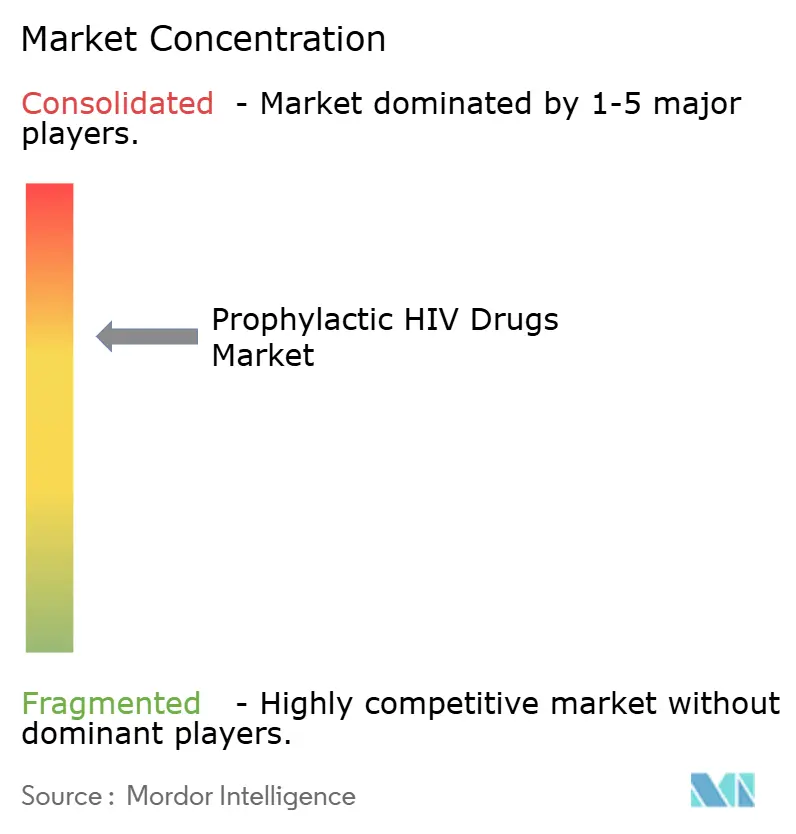
The prophylactic HIV drugs market remains moderately consolidated: Gilead Sciences and ViiV Healthcare dominate innovation pipelines and maintain extensive manufacturing footprints. Gilead leverages integrated R&D and voluntary licensing to balance access with revenue preservation, while ViiV’s focused HIV franchise accelerates cycle times on long-acting formulations. Patent portfolios form formidable entry barriers, yet strategic licensing opens room for regional manufacturers like Emcure, Cipla, and Aurobindo to build share on cost-leadership in price-sensitive territories.
Competitive positioning now centers on dosing flexibility, cold-chain efficiency, and companion digital tools rather than molecular uniqueness alone. Multinationals forge contract-manufacturing deals to defray capital expenses and localize supply, exemplified by Emcure’s 2024 royalty-free license for lenacapavir covering 120 countries. Generic challengers pursue tender-driven volume in sub-Saharan Africa, but still rely on innovators for active-ingredient supply in early ramp-up phases.
Anticipated patent expiries post-2031 could spark steeper price erosion, prompting innovators to invest in next-wave assets like broadly neutralizing antibodies and ultra-long implants. Stakeholders that align portfolio depth with equitable-pricing frameworks are positioned to retain relevance as the prophylactic HIV drugs industry evolves toward value-based and access-driven paradigms.
Prophylactic HIV Drugs Industry Leaders
-
Merck & Co., Inc.
-
Cipla Inc
-
Bristol-Myers Squibb Company
-
Johnson & Johnson
-
Viatris Inc.
- *Disclaimer: Major Players sorted in no particular order
Prophylactic HIV Drugs Market Companies Covered in this Report
- Gilead Sciences
- ViiV Healthcare (GSK Plc)
- Johnson & Johnson
- Merck
- Abbvie
- Bristol-Myers Squibb
- Roche
- Boehringer Ingelheim Intl. GmbH
- Pfizer
- Cipla
- Viatris
- Teva Pharmaceutical Industries
- Sun Pharmaceuticals Industries
- Aurobindo Pharma Ltd.
- Hetero Labs Ltd.
- Lupin
- Macleods Pharmaceuticals Ltd.
- Apotex
- Glenmark Pharmaceuticals
- Dr. Reddy’s Laboratories
Market Opportunities and Future Outlook
A key opportunity is converting PrEP-intent but adherence-challenged users from daily oral regimens to long-acting modalities, especially where stigma, travel time, or clinic access reduces persistence on pills. The policy stack has also become more enabling for scale-up, as WHO guidance in July 2025 recommended injectable lenacapavir and supported the use of rapid diagnostic tests to streamline PrEP initiation, aligning with delivery models beyond specialist centers into community-based settings.
Early rollout provides evidence of where incremental volume can be built through funded programs and localized delivery infrastructure. A Clinton Health Access Initiative flash update reported that, as of April 2026, eight African countries (Eswatini, Lesotho, Kenya, Mozambique, Nigeria, Uganda, Zambia, and Zimbabwe) had introduced lenacapavir for PrEP, and more than 11,000 individuals had initiated the regimen across these countries. Competitive opportunity also continues in differentiated dosing and routes, such as once-monthly oral prevention candidates and longer-interval antibodies under development, alongside distribution models that combine tele-PrEP, online dispensing, and clinic administration to reduce friction from mandatory testing and follow-up.
Recent Industry Developments in Prophylactic HIV Drugs Market
- April 2026: The US FDA approved Merck's IDVYNSO (doravirine and islatravir), a once-daily two-drug single-tablet regimen for virologically suppressed adults with HIV-1, with pharmacy availability following in May 2026. Although this is a treatment label, it strengthens Merck's HIV franchise and supports continued investment into prevention programs and pipeline assets that compete for the same prescriber attention and payer budgets.
- July 2025: Merck initiated Phase 3 trials (EXPrESSIVE-10 and EXPrESSIVE-11) for MK-8527, an investigational once-monthly oral HIV prevention pill for PrEP, including a 4,390-participant study across 16 countries. Advancing a monthly oral option expands the modality mix beyond injectables and daily tablets, increasing competitive pressure on adherence and convenience as core differentiators.
- October 2024: Emcure Pharmaceuticals secured a royalty-free license from Gilead for lenacapavir across 120 countries. The agreement broadened the manufacturing and supply base for ultra-long-acting PrEP in lower-income markets and reinforced tender-driven access strategies alongside originator commercialization in high-income countries.
Prophylactic HIV Drugs Market Report Scope and Research Methodology
Market Definition and Coverage
For this study, the market covers the revenues generated from drug therapies used to prevent HIV infection, including preventive regimens used before or after potential exposure, across major healthcare delivery settings.
Scope exclusions: HIV diagnostics, testing kits, vaccines in development, and treatment-only HIV regimens used for diagnosed patients are not counted in this market sizing.
Segments Covered in This Report
- By Drug
- Tenofovir Disoproxil Fumarate (TDF)
- Tenofovir Alafenamide (TAF)
- Emtricitabine (FTC)
- Cabotegravir Long-Acting (Apretude)
- Lenacapavir (Yeztugo/Sunlenca)
- Other Drugs
- By Dosage Form
- Oral Pill
- Long-Acting Injectable
- Sub-Dermal Implant (Pipeline)
- Topical Microbicide (Gel/Film)
- Vaginal Ring
- By Distribution Channel
- Hospital Pharmacies
- Retail Pharmacies
- Online Pharmacies & Tele-PrEP Platforms
- Community-Based Clinics & NGOs
- Geography
- North America
- United States
- Canada
- Mexico
- Europe
- Germany
- United Kingdom
- France
- Italy
- Spain
- Rest of Europe
- Asia-Pacific
- China
- Japan
- India
- Australia
- South Korea
- Rest of Asia-Pacific
- Middle East & Africa
- GCC
- South Africa
- Rest of Middle East & Africa
- South America
- Brazil
- Argentina
- Rest of South America
- North America
Data Sources, Market Sizing, and Validation
Desk Research
Desk work starts by mapping the preventive HIV demand pool and the care pathways, then linking that to what is actually procured and dispensed in practice. We leaned on public health and surveillance sources such as UNAIDS publications, World Health Organization guidance, US CDC updates, and national health ministry dashboards to track uptake trends and policy timelines.
To shape pricing and access assumptions, we also reviewed sources such as Global Fund procurement information, PEPFAR program materials, and peer reviewed literature that reports adherence, persistence, and discontinuation patterns by regimen. Company filings, earnings decks, and credible media coverage were used to confirm major product transitions and geography rollouts, and a paid subscription for company financials and intelligence was used selectively to normalize reported revenues. These are illustrative sources only, and many other public references were used for data collection, cross-checks, and clarifying assumptions.
Primary Interviews and Surveys
Primary work was used to pressure test what desk sources cannot fully explain, including how prevention programs convert eligible populations into active users and how long acting options affect persistence. We spoke with a mix of clinicians, public health program stakeholders, payers, distributors, and industry-facing experts across APAC, EMEA, and the Americas, so regional differences in access and reimbursement could be reflected in the final model.
Distribution of primary research fieldwork respondents
| Company type | Respondent position | Region |
|---|---|---|
| Top tier: 26% | CXOs: 21% | APAC: 37% |
| Mid tier: 53% | Functional/Unit leaders: 35% | EMEA: 37% |
| Smaller Players: 21% | Managers: 44% | Americas: 26% |
Market-Sizing & Forecasting
Sizing was built using a top-down approach where prevention eligible populations and program coverage are translated into treated or protected cohorts, then converted into annual demand using regimen level utilization. Our model uses practical inputs such as PrEP and PEP uptake rates, average time on therapy (persistence), refill or visit frequency by channel, regimen mix shifts between oral tablets and long acting injectables, and country level reimbursement or program funding signals.
Those outputs are then corroborated with selective bottom-up checks, such as sampled price per patient month multiplied by estimated active users, and channel checks across hospital, retail, and online pharmacy pathways to verify direction and magnitude. Where country level data is thin, we fill gaps using region peers with similar policy and access profiles, then adjust using expert feedback so outliers do not distort totals.
For forecasting, scenario analysis is applied around key inflection points, including guideline updates, expansion of prevention programs, and expected switching from daily oral regimens to longer acting options. Assumptions are kept visible so year to year changes can be traced back to clear drivers, rather than a single blended growth rate.
Data Validation & Update Cycle
Outputs are checked against independent signals, including prevention program enrollment trends, reported prescribing patterns, and public procurement direction, then reviewed for unusual jumps in volume, price, or mix. When the model shows a sharp variance, we re-check the underlying assumptions, revisit the desk sources, and re-contact relevant experts to confirm whether the change is temporary or structural.
Before sign-off, a second analyst reviews the logic, inputs, and math, followed by a final edit pass focused on consistency across regions and years. Reports are refreshed annually, and interim updates are made when material events occur, such as major label expansions, policy changes, or meaningful pricing moves, followed by a final pre-delivery check so clients receive the most current view.
Mordor Intelligence's Prophylactic Hiv Drugs Market Estimate Compared With Other Published Estimates
It is common to see different published market sizes for prophylactic HIV drugs because teams draw the boundary differently and they also choose different base years. Results can also move when assumptions are made on regimen mix, persistence, and how public program volumes are translated into revenue.
The biggest gaps usually come from scope and timing choices, including whether maternal prophylaxis and broader prevention-related antiretroviral use are included, and how quickly long acting injectable uptake is assumed to scale. Currency conversion timing and price erosion logic also matter, since a small change in average annual cost per user can shift the total by billions at a global level.
Benchmark comparison
| Source | Market Size | Gaps in Research Methodology |
|---|---|---|
| Mordor Intelligence | USD 34.75 B (2026) | |
| Global Consultancy A | USD 36.80 B (2026) | Uses a broader prevention scope that explicitly includes maternal prophylaxis and combination prophylactic regimens, which can lift the modeled patient pool and raise the revenue total in the same year. |
| Regional Consultancy B | USD 34.75 B (2024) | Anchors the estimate to an earlier base year and mixes in adjacent categories such as treatment oriented ART and immunomodulators, which changes what is counted as prophylaxis and makes year to year comparisons less direct. |
PrEP uptake signals, public procurement direction, and persistence assumptions are the checks that tie Mordor Intelligence's 2026 estimate to an observable prevention demand pool, and that is why the spread in the table is mostly explained by scope breadth and base-year timing. When users read the numbers with those two points in mind, the estimates become easier to reconcile and more repeatable to update.
Key Questions Answered in the Report
What is the current size of the prophylactic HIV drugs market?
The prophylactic HIV drugs market size is valued at USD 34.75 billion in 2026 and is forecast to reach USD 42.23 billion by 2031.
Which drug segment is expanding the fastest?
Lenacapavir leads growth with a 6.35% CAGR due to its twice-yearly injectable schedule and novel capsid-inhibition mechanism.
How quickly are long-acting injectables growing?
Long-acting injectable formulations post a 7.31% CAGR between 2026 and 2031, making them the fastest-growing dosage form.
Which region is projected to see the highest growth rate?
Asia-Pacific shows the highest regional CAGR at 5.28% thanks to government-led PrEP expansion and digital-health adoption.
What are the main barriers to wider PrEP adoption?
High pricing of novel long-acting products and systemic access disparities in rural and marginalized populations remain key obstacles.
How concentrated is the competitive landscape?
The market scores 7 on a 10-point concentration scale because the five largest suppliers hold about 70% of global revenue yet face rising generic competition.