
Japan Private Banking Market Size and Share
Market Overview
| Study Period | 2020 - 2031 |
|---|---|
| Forecast Data Period | 2026 - 2031 |
| Base Year Market Size (2025) | USD 7.96 Billion |
| Market Size (2026) | USD 8.78 Billion |
| Market Size (2031) | USD 14.3 Billion |
| Growth Rate (2026 - 2031) | 10.26 % |
| Market Concentration | Medium |
Major Players *Disclaimer: Major Players sorted in no particular order Image © Mordor Intelligence. Reuse requires attribution under CC BY 4.0. | |
Japan Private Banking Market Analysis by Mordor Intelligence
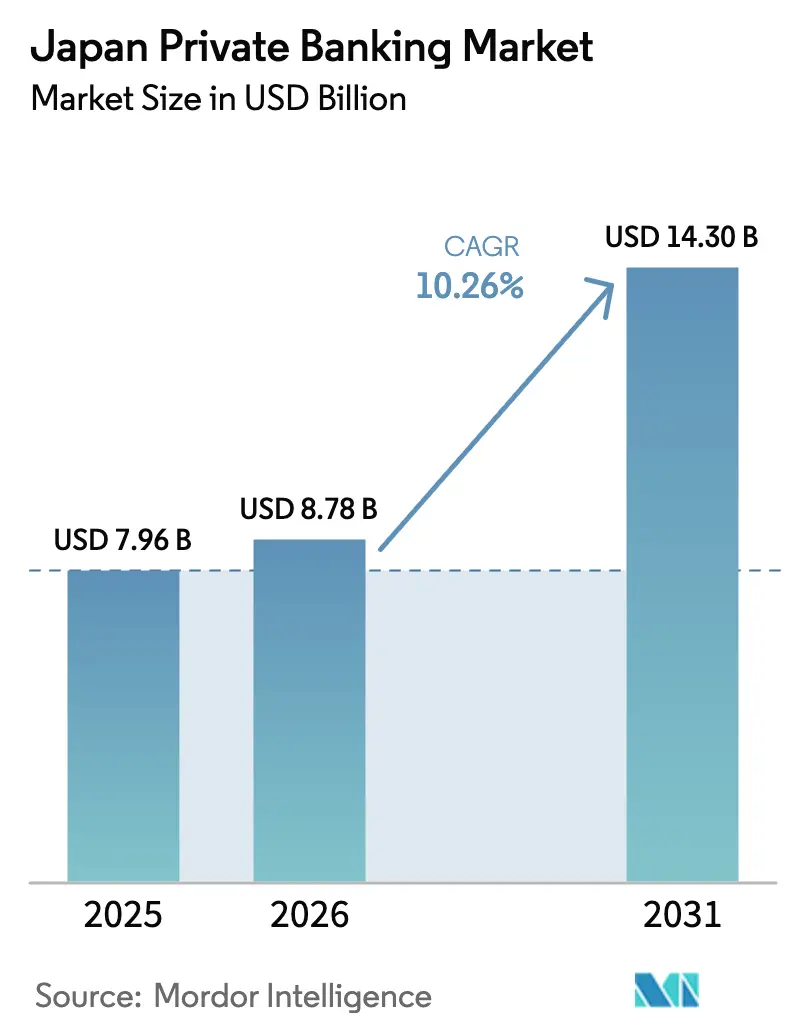
The Japan private banking market size is expected to grow from USD 7.96 billion in 2025 to USD 8.78 billion in 2026 and is forecast to reach USD 14.3 billion by 2031 at 10.26% CAGR over 2026-2031. This expansion is fueled by the country’s unprecedented inter-generational wealth transfer, incremental deregulation of fiduciary services, intensifying digital innovation, and rising equity valuations that swell investable assets. Scale advantages held by the largest domestic trust banks, rising demand for holistic succession solutions, and the rapid emergence of API-enabled advisory platforms are amplifying competitive intensity. Simultaneously, foreign houses are enlarging on-shore desks to serve ultra-high-net-worth (UHNW) clients who seek cross-border diversification, while domestic banks deepen fee-based revenue streams to offset margin pressure. Structural opportunities remain concentrated in wealth succession, discretionary mandates, and digital advisory tools that broaden access to specialist products.
Key Report Takeaways
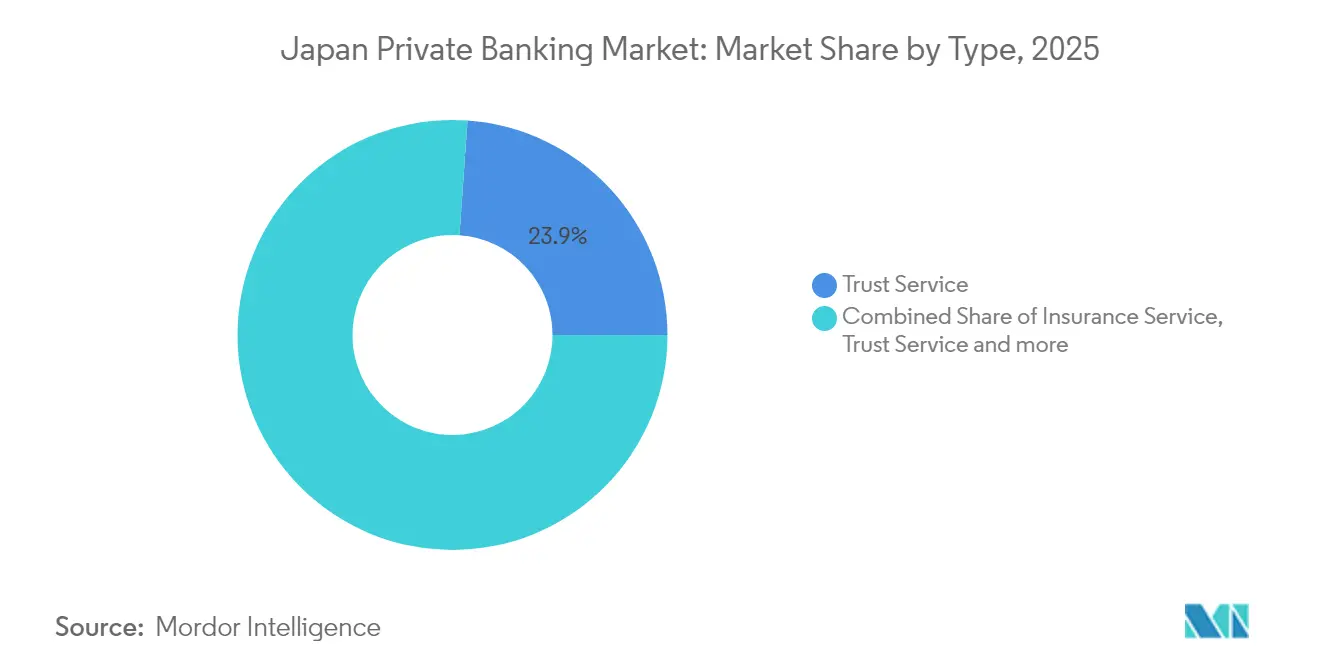
- By type, trust service held a 23.89% of the Japan private banking market share in 2025, while real estate consulting is forecast to advance at an 8.22% CAGR through 2031.
- By application, the personal segment controlled 30.45% of the Japan private banking market share in 2025 and is progressing at a 5.75% CAGR to 2031.
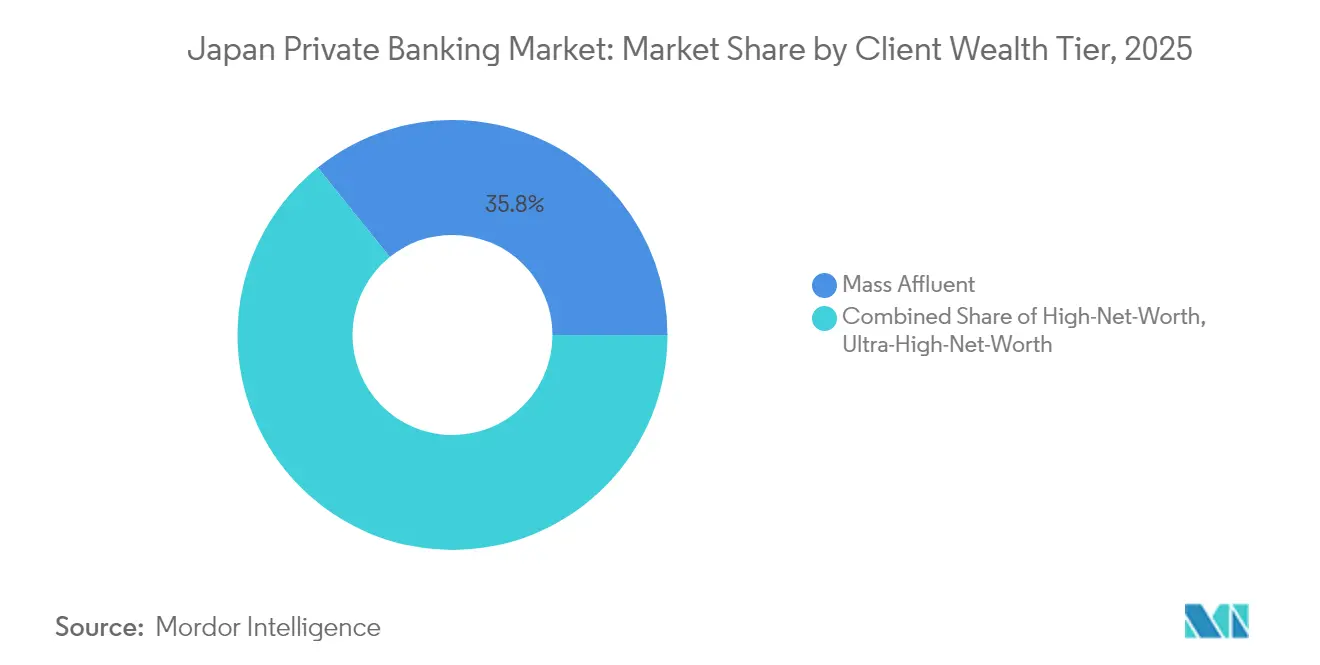
- By client wealth tier, mass affluent clients represented 35.78% of the Japan private banking market share in 2025, whereas high-net-worth clients are set to expand at a 6.95% CAGR.
- By geography, Kansai commanded 25.35% of the Japan private banking market share in 2025; Kanto is poised for a 6.05% CAGR over the outlook period.
Note: Market size and forecast figures in this report are generated using Mordor Intelligence’s proprietary estimation framework, updated with the latest available data and insights as of 2026.
Japan Private Banking Market Trends and Insights
Drivers Impact Analysis*
| Driver | (~) % Impact on CAGR Forecast | Geographic Relevance | Impact Timeline |
|---|---|---|---|
| Aging population driving inter-generational wealth transfer | +3.2% | National, concentrated in Kanto and Kansai | Long term (≥ 4 years) |
| Deregulation of fiduciary services under Japan's Stewardship Code | +2.1% | National, early adoption in Tokyo metropolitan | Medium term (2-4 years) |
| Digital transformation of wealth platforms (APIs, robo-advisory) | +1.8% | National, urban centers leading | Short term (≤ 2 years) |
| Rising stock-market valuation spurring affluent asset growth | +1.4% | National, Kanto region primary beneficiary | Medium term (2-4 years) |
| Corporate-governance reforms triggering executive liquidity events | +1.0% | National, Tokyo Stock Exchange listed companies | Medium term (2-4 years) |
| Tokyo metropolitan real-estate tokenization enabling new PB products | +0.8% | Kanto region, spillover to major urban centers | Long term (≥ 4 years) |
| Source: Mordor Intelligence | |||
Aging Population Wealth Transfer
Japan's demographic transition is creating the world's largest intergenerational wealth transfer event, with USD 2.21 trillion (Yen330 trillion) in assets expected to change hands by 2030 as baby boomers pass wealth to younger generations. This transfer represents approximately 60% of Japan's GDP and is concentrated among households with investable assets exceeding USD 670,000 (Yen100 million), creating a natural client base for private banking services. The complexity of Japan's inheritance tax system, which imposes rates up to 55% on estates exceeding USD 4.02 million (Yen600 million), is driving demand for sophisticated tax planning and trust structures. Recent legislative changes extending the inheritance tax clawback period from 3 to 7 years for overseas residents further amplifies the need for professional wealth structuring services. Cultural shifts are equally significant, with Nomura Research Institute data showing that 64.6% of business heirs have no intention of taking over family enterprises, necessitating alternative succession strategies through private banking channels.
Deregulation of Fiduciary Services Under Japan's Stewardship Code
The Financial Services Agency's 2024 amendments to Japan's Stewardship Code are dismantling traditional barriers between asset management and advisory services, enabling private banks to offer more integrated wealth solutions. These reforms allow institutions to provide discretionary investment management alongside traditional banking services, creating new revenue streams and improving client outcomes through holistic portfolio management[1]Source: Financial Services Agency, “Japan’s Stewardship Code and Fiduciary Services Reform,” fsa.go.jp. The deregulation particularly benefits trust banks like Sumitomo Mitsui Trust, which can now leverage their fiduciary expertise across broader client segments without regulatory constraints. Early adoption metrics show discretionary mandate growth of 23% year-over-year among major private banks in 2024, with average fee compression of 15 basis points as competition intensifies. This regulatory evolution aligns Japan with global best practices in wealth management while maintaining robust investor protection standards through enhanced disclosure requirements.
Digital Transformation of Wealth Platforms (APIs, Robo-Advisory)
Technology adoption in Japan's private banking sector accelerated dramatically following MUFG's USD 660 million acquisition of WealthNavi in 2024, validating the robo-advisory model for affluent Japanese investors. WealthNavi's flagship ROBOPRO Fund reached USD 670 million (Yen100 billion) in assets under management within 18 months of launch, delivering 39% returns and demonstrating strong client acceptance of algorithm-driven investment strategies[2]Source: WealthNavi, “ROBOPRO Fund Surpasses Yen100 Billion in AUM,” wealthnavi.com. This success is spurring broader digital transformation initiatives across the industry, with traditional institutions investing heavily in API-enabled platforms that integrate banking, investment, and advisory services. SBI Shinsei Bank's partnership with DeCurret and Partior to offer tokenized deposits represents another frontier, enabling real-time settlement and cross-border wealth transfers through blockchain infrastructure. The digital evolution is particularly resonating with younger affluent clients, who represent 34% of new private banking relationships in 2024 compared to 18% in 2020, according to internal metrics from major institutions.
Rising Stock-Market Valuation Spurring Affluent Asset Growth
Japan's equity markets reached multi-decade highs in 2024, with the Nikkei 225 surpassing 40,000 points and creating substantial wealth effects among affluent investors. This rally increased investable assets among high-net-worth individuals by an estimated 28% year-over-year, expanding the addressable market for private banking services. Corporate governance reforms mandating improved shareholder returns are sustaining this trend, with Tokyo Stock Exchange companies increasing dividend payouts by 15% annually since 2022. The wealth creation is particularly concentrated among executives and entrepreneurs holding equity stakes in listed companies, driving demand for liquidity management and tax-efficient monetization strategies. Private banks are responding with specialized equity collar products and structured derivatives that allow clients to hedge concentrated positions while maintaining upside participation, generating fee income of 75-125 basis points annually on structured exposure.
Restraints Impact Analysis*
| Restraint | (~) % Impact on CAGR Forecast | Geographic Relevance | Impact Timeline |
|---|---|---|---|
| Persistently low interest-rate environment compressing NIMs | -1.9% | National, affecting all deposit-taking institutions | Long term (≥ 4 years) |
| Stricter Basel III capital requirements limiting risk appetite | -1.2% | National, major banks primarily affected | Medium term (2-4 years) |
| Intensifying competition from foreign private banks | -0.8% | Kanto and Kansai regions, UHNW segment focus | Short term (≤ 2 years) |
| Cultural hesitancy among SMEs to outsource succession planning | -0.6% | National, rural and traditional industries | Long term (≥ 4 years) |
| Source: Mordor Intelligence | |||
Low Interest-Rate Environment
The Bank of Japan’s March 2024 policy lift to 0.1% concluded an era of negative rates, yet margins remain historically compressed[3]Source: Bank of Japan, “Statement on Monetary Policy,” boj.or.jp. This environment particularly challenges smaller regional private banks that lack scale in advisory services, with average NIMs declining to 0.85% in 2024 from 1.2% in 2019 across the sector. The constraint is driving strategic pivots toward wealth management fees, with leading institutions targeting fee income ratios of 35-40% by 2030 compared to the current 25% average. Regulatory compliance factors under the Financial Instruments and Exchange Act require enhanced disclosure of fee structures, creating transparency that benefits clients but pressures institutional margins during the transition period.
Basel III Capital Requirements
Enhanced Basel III capital requirements, fully implemented in Japan by 2024, are constraining private banks' ability to extend credit facilities and structured products to wealthy clients. The Total Loss-Absorbing Capacity (TLAC) framework requires systemically important banks to maintain capital ratios of 18% or higher, reducing available capital for discretionary lending activities. This regulatory pressure particularly affects credit-intensive private banking products such as securities-backed lending and real estate financing, where risk-weighted asset calculations limit portfolio growth. Major institutions are responding by partnering with non-bank lenders and insurance companies to provide credit solutions while maintaining regulatory compliance, though these arrangements typically reduce fee capture by 25-35% compared to direct lending.
*Our forecasts treat driver/restraint impacts as directional, not additive. The impact forecasts reflect baseline growth, mix effects, and variable interactions.
Segment Analysis
By Type: Trust Services Sustain Leadership Amid Real-Estate Innovation
Trust Service held 23.89% of the Japan private banking market in 2025, underpinned by the nation’s complex inheritance taxes and a legal culture that favors trust structures for asset continuity. Integration of portfolio management with trust administration has improved relationship depth and share-of-wallet among multi-generational families. Real Estate Consulting, while accounting for a smaller base, is projected to register the fastest 8.22% CAGR as tokenization of metropolitan properties and REIT-linked offerings democratize access to prime assets. The Japan private banking market size for real-estate-focused mandates is accelerating as blockchain platforms open fractional ownership opportunities to mass affluent investors. Insurance Service, backed by bancassurance tie-ups, commands 17.62% revenue through capital-protected wrappers popular among risk-averse seniors. Tax Consulting expands at 8.05% CAGR, driven by cross-border financial complexity as affluent households diversify overseas portfolios.
Digitalization permeates each service line. API bridges now feed trust-account data into portfolio dashboards, giving clients a single view of assets. High-volume advisory processes are automated, releasing capacity for bankers to focus on complex structures. The regulatory backdrop remains supportive: the Financial Services Agency streamlines trust-bank licensing, while property-token guidelines released in 2024 clarify custodial responsibilities. As a result, the Japan private banking market continues to migrate from transactional product silos toward holistic, digitally enabled service bundles.


By Application: Personal Mandates Preserve Dominance
Personal mandates represented 30.45% of Japan private banking market share in 2025, manifesting Japan’s relationship-centric culture in which families prefer bespoke advisory over institutional pooling. Growth at 5.75% CAGR is driven by rising demand for family office-like services portfolio aggregation, philanthropy planning, and next-generation financial education. Enterprise mandates, while smaller at roughly 7.85% share, post a quicker 6.05% CAGR as listed companies outsource executive compensation management and employee stock ownership program (ESOP) administration. Digital account-opening reforms enacted in 2024 simplify enterprise onboarding, fostering new corporate-linked wealth flows. Meanwhile, hybrid models emerge employee-ownership platforms that facilitate leveraged buyouts allow departing founders to exit while employees accumulate wealth, widening the advisory remit.
Customization remains the competitive battleground in personal mandates. Banks deploy AI-assisted goals-based planning to translate life events education, retirement, philanthropy into portfolio glide paths. For the enterprise segment, regulatory filings such as insider-trading reports and tax withholding obligations create compliance complexity that private banks monetize through specialized administrative services. Ultimately, the Japan private banking industry converges around integrated offerings that bridge personal and corporate wealth, blurring historic segmentation lines yet preserving individualized service.
By Client Wealth Tier: Mass Affluent Scale Meets High-Net-Worth Velocity
Mass Affluent households accounted for 35.78% of the Japan private banking market in 2025. Standardized discretionary portfolios and robo-advisory tools keep servicing costs low, enabling scalability and stable recurring revenue. Conversely, High-Net-Worth clients expand at a faster 6.95% CAGR as equity-market liquidity events and business successions swell their investable assets. The Japan private banking market size for UHNW services remains smaller but revenue-rich, driven by complex private-equity access, co-investment opportunities, and bespoke credit. Compliance frameworks under the Anti-Money-Laundering Act mandate enhanced due diligence for UHNW accounts, reinforcing the need for robust KYC systems that large providers already possess.
Banks adopt tier-differentiated engagement: digital-first workflows serve mass affluent segments, while dedicated relationship managers handle top-tier clients whose multidimensional needs span philanthropy, art finance, and global estate planning. Cross-selling deepens life policies backed by trust wrappers protect overseas property, and securities-backed loans finance tax liabilities without liquidating assets. Overall, wealth-tier segmentation evolves toward experience levels rather than asset thresholds, with digital literacy now a key stratifier.
Geography Analysis
Kansai maintained a 25.35% share of the Japan private banking market in 2025, anchored by longstanding conglomerates and affluent manufacturing dynasties in Osaka and Kobe. Trust-bank branches historically embedded in keiretsu supply chains continue to channel corporate founder wealth into private-banking divisions. Growth, however, is shifting eastward. Kanto is expected to secure a 6.05% CAGR through 2031 on the back of Tokyo’s status as Asia’s second-largest financial hub and its concentration of technology IPOs. Unicorn founder liquidity events and stock-option exercises translate into incremental private-bank relationships, especially among younger clients who favor API-enabled advisory models.
Chubu, supported by Nagoya’s automotive ecosystem, contributes steady 13.85% revenue, with exporters turning to hedging and offshore diversification amid currency volatility. Northern regions Hokkaido & Tohoku benefit from digital onboarding that eliminates branch dependency; remote clients can now execute sophisticated trust deeds via e-signatures validated under the 2024 Digital Procedures Act. Chugoku & Shikoku retain niche high-margin agribusiness succession mandates, yet market depth is thin. Kyushu & Okinawa posts the fastest 7.72% CAGR thanks to government incentives for semiconductor fabs around Kumamoto and Fukuoka’s startup scene that spawns new wealth. Regional banks collaborate with megabanks to white-label private-bank platforms, marrying local relationship capital with product scale.
Regulatory Landscape
Japan's private banking activity sits under the Financial Services Agency (FSA), with on-the-ground supervision and inspections carried out through Local Finance Bureaus, and securities-related conduct overseen through the Securities and Exchange Surveillance Commission framework. Core rules that shape product design and distribution span the Banking Act, the Financial Instruments and Exchange Act (FIEA) for investment and advisory services, and the Trust Business Act for custody and estate structures, making regulatory alignment a key differentiator for trust banks and broker-bank hybrids.
Recent rule-setting has tightened operational requirements while expanding how services can be delivered. The FSA's Guidelines for Anti-Money Laundering and Combating the Financing of Terrorism were updated in March 2026, strengthening risk-based controls that are relevant for UHNW onboarding, cross-border diversification, and complex trust arrangements. Self-regulatory bodies also influence market practices, including the Japanese Bankers Association and the Japan Investment Management Association, formed in April 2026 via consolidation of legacy associations. This coordination affects product governance and distribution partnerships across institutions.
Value Chain Analysis
Japan's private banking value chain starts with client acquisition and relationship management, then moves into advisory and portfolio construction delivered through bank, trust-bank, and securities-broker platforms. It then covers execution, custody, reporting, and ongoing servicing. Trust banking capabilities, including estate planning, inheritance structuring, fiduciary administration, and custody, remain central inputs, while securities brokerage and asset management supply liquid products, alternatives access, and discretionary mandates that support recurring fee income.
Partnership-led operating models are a defining feature of how capabilities are assembled. The Morgan Stanley and MUFG alliance structure supports a combined securities and wealth platform, and Sumitomo Mitsui Trust Group's partnership with UBS through UBS SuMi TRUST Wealth Management combines global product access with domestic trust infrastructure. On the operations layer, reforms effective May 2025 enabled investment management firms to outsource middle- and back-office processes to approved service providers, shifting more processing, data operations, and post-trade workflows toward specialized vendors and increasing the share of the end-to-end service cost base tied to integration, controls, and oversight.
Competitive Landscape
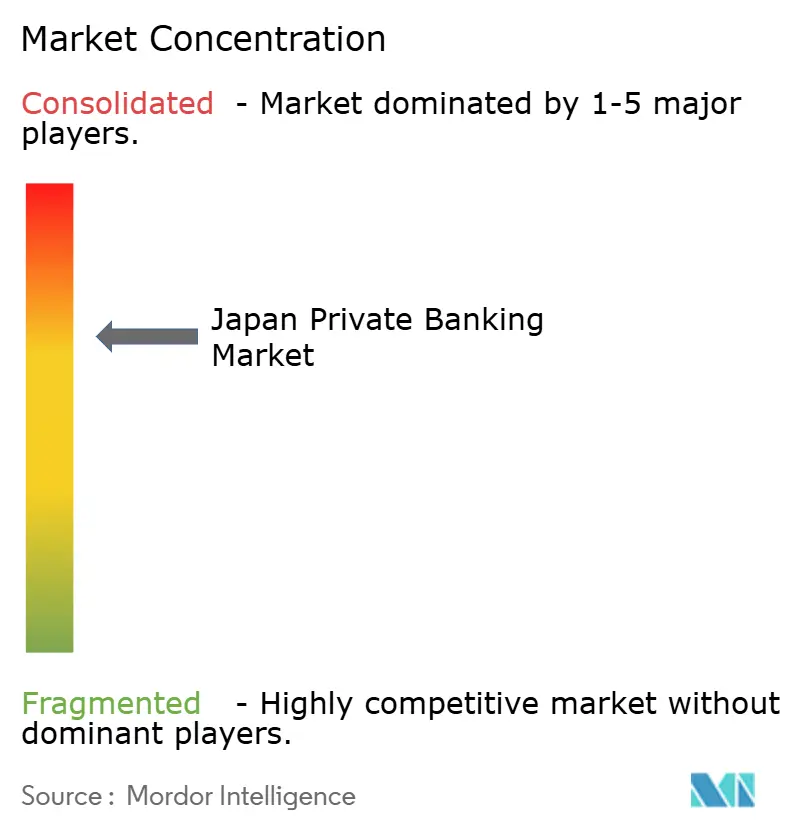
The Japan private banking market is characterized by an oligopolistic structure, with the top five firms dominating overall revenues. Mitsubishi UFJ Morgan Stanley Private Banking holds the leading position, benefiting from its dual-brand strategy that combines international product access with strong domestic deposit funding. Sumitomo Mitsui Trust comes next, capitalizing on its extensive trust operations and long-standing reputation for fiduciary expertise. Mizuho Private Wealth follows with a comprehensive service model that integrates investment banking and wealth management. Beneath these megabanks, regional firms like Nomura and Daiwa are crafting multi-family office models, while international banks such as UBS, HSBC, and Credit Suisse expand their Tokyo operations to serve ultra-wealthy clients seeking global diversification.
Strategic differentiation in Japan’s private banking landscape increasingly hinges on digital innovation and intergenerational wealth planning. MUFG’s acquisition of WealthNavi represents a deliberate choice to accelerate digital capabilities through acquisition rather than internal development. Sumitomo Mitsui Trust is piloting AI-powered tools to simulate estate tax scenarios, deepening relationships with clients across generations. UBS, meanwhile, takes advantage of its global open-architecture platform to distribute alternative investments not easily accessible through domestic providers. Domestic institutions are also expanding ESG-focused portfolios and philanthropic advisory services to align with the values of younger heirs, aiming to retain family wealth across generations.
While foreign banks continue to grow their presence, competition remains focused on the ultra-high-net-worth segment, where cross-border needs are more pronounced. In the broader mass affluent space, cultural familiarity and language fluency still give local banks a competitive edge. However, the rise of open-banking APIs is beginning to break down traditional distribution channels, empowering fintech platforms to compete on pricing transparency and accessibility. Over the coming years, operational scale, regulatory readiness, and data-driven client engagement will separate leaders from laggards. Firms that fail to evolve risk declining profit margins and eventual client attrition in an increasingly competitive landscape.
Japan Private Banking Industry Leaders
Mitsubishi UFJ Morgan Stanley PB
Sumitomo Mitsui Trust Bank
Mizuho Private Wealth Management
Nomura Holdings
Daiwa Securities Group
- *Disclaimer: Major Players sorted in no particular order

Market Opportunities and Future Outlook
Succession, trust structuring, and tax-aware planning are the highest-complexity areas where differentiated private banks can deepen wallet share, supported by Japan's large intergenerational wealth transfer and the continued predominance of trust services in client solutions (23.89% share in 2025). There are also product and advisory opportunities tied to investment-led household asset migration. With the expansion of NISA and iDeCo reforms, more retail and affluent savings are moving toward managed investments, which increases demand for model portfolios, discretionary mandates, and consolidated reporting that integrates banking, brokerage, and trust accounts.
Operational and platform changes create additional room for partnerships and modular models. The May 2025 FIEA amendment allowing delegation of middle- and back-office operations to approved middle-office service providers enables private banks and affiliated managers to scale open-architecture offerings with more modular operating models. This supports faster onboarding of external strategies and alternatives distribution. Japan's push to build an asset management hub provides clearer engagement channels for private banks and foreign houses serving UHNW clients, including the FSA-linked Program to Support Emerging Asset Managers, which held 87 events in October 2025, and the planned Japan Weeks 2026 (2-30 October 2026), both of which increase manager-access density and broaden cross-border collaboration for Japan-based wealth platforms.
Recent Industry Developments
- June 2026: Mitsubishi UFJ Morgan Stanley Securities targets to increase retail wealth assets under management by 10 trillion yen. The initiative accelerates competition in Japan’s private banking space and shifts emphasis to discretionary wealth management.
- March 2026: Mizuho Trust and Banking forms a capital and business alliance with TRI Investment Management, acquiring a 14% equity stake. The collaboration strengthens offshore real estate access for private banking clients and broadens cross-border product suite.
- June 2025: Sumitomo Mitsui Financial Group and SBI Holdings plan to launch a joint venture for wealth management, targeting 10 trillion yen AUM within five years. The venture creates a large-scale private banking platform to scale assets under management and compete with domestic megabanks.


Research Methodology Framework and Report Scope
Market Definition and Coverage
For this report, the market is defined as the annual revenue earned from private banking services delivered to high net worth and ultra high net worth clients in Japan, across advisory, investment management, and related wealth solutions that are typically fee-based.
Scope exclusions: This sizing excludes retail mass-market banking, pure corporate banking services, and revenues from non-client-facing treasury or proprietary trading activities.
Segmentation Overview
- By Type
- Asset Management Service
- Insurance Service
- Trust Service
- Tax Consulting
- Real Estate Consulting
- By Application
- Personal
- Enterprise
- By Client Wealth Tier
- Mass Affluent
- High-Net-Worth
- Ultra-High-Net-Worth
- By Region
- Kanto
- Kansai
- Chubu
- Hokkaido & Tohoku
- Chugoku & Shikoku
- Kyushu & Okinawa
Data Sources, Market Sizing, and Validation
Desk Research
Desk research set the base structure of the model and helped us anchor the client pool and macro assumptions. We referred to public statistics and supervisory publications such as the Bank of Japan, Japan Financial Services Agency (FSA), OECD financial indicators, and IMF datasets to understand rates, savings patterns, and market conditions that influence fee pools.
We also used sources such as Japan Securities Dealers Association releases, exchange and fund statistics, and selected peer reviewed finance research to sense-check product penetration and investor behavior. Company annual reports, investor presentations, and earnings transcripts were used to map service mix and fee logic, while approved paid subscriptions supported company financials, patent coverage for digital advisory tools, and relevant news and filings to confirm event timing. The desk sources named above are illustrative, and they are not exhaustive since we reviewed additional public documents and datasets for collection, cross-checking, and clarification.
Primary Interviews and Surveys
Primary work was used to validate what drives private banking revenue in Japan, including typical fee schedules, discretionary versus advisory mix, and how product demand shifts with market volatility. We spoke with relationship leaders, product specialists, and operations or compliance stakeholders, and the discussion covered major financial hubs and regional client coverage to cross-check desk assumptions and close gaps.
Those inputs were then used to confirm the implied revenue per client and to align the model with current pricing and service delivery practices.
Distribution of primary research fieldwork respondents
| Company type | Respondent position |
|---|---|
| Top tier: 37% | CXOs: 12% |
| Mid tier: 48% | Functional/Unit leaders: 38% |
| Smaller Players: 15% | Managers: 50% |
Market-Sizing & Forecasting
Sizing started with a top-down build where the Japan demand pool was reconstructed using investable wealth signals and service penetration, then translated into revenue using typical fee rates and product mix. To keep the numbers grounded, the outputs were corroborated with selective bottom-up approximations, such as sampled revenue-to-AUM yields from public disclosures, channel checks on client onboarding volumes, and sanity checks on implied revenue per relationship manager.
Key inputs that shaped the model included the count and growth of HNWI and UHNW client pools, investable assets trends, discretionary mandate adoption, fee rate ranges by service type, and product mix shifts between cash, funds, structured products, and alternatives. When a direct input was not available, a proxy was used (for example, mapping public fund flows and equity market moves into a reasonable AUM change factor), followed by validation through interviews.
Forecasting was done using scenario analysis supported by variable-level expectations collected from primary experts, and then adjusted for known triggers such as interest rate path shifts, risk appetite changes, and regulatory guidance affecting suitability and advisory practices. The final forecast was reviewed to ensure year-to-year movements matched observable market signals rather than smooth math alone.
Data Validation & Update Cycle
Validation was handled through repeated variance checks across independent signals, where modeled revenues were compared with implied fee yields, reported wealth business trends, and macro indicators that typically move investable assets in Japan. Outliers were investigated, assumptions were revisited, and specific gaps were taken back to respondents when the model and market signals did not align.
Before sign-off, the work went through multi-step internal reviews so calculations, units, and year mapping were consistent across the model. Reports are refreshed annually, and interim updates are triggered when material events occur, such as major regulatory changes or sharp market moves that can shift AUM and fee realization. A final pre-delivery pass is completed to ensure the latest data points are reflected in the published view.
Mordor Intelligence's Japan Private Banking Market Sizing Compared With Other Published Estimates
Published market sizes for private banking in Japan often differ because the underlying revenue logic is not the same across studies, and the timing of currency conversion and market data cutoffs can shift the result even when growth direction is similar. Differences also come from whether estimates are tied to realized fee revenue versus being inferred from AUM with broad fee assumptions.
When refresh cadence is slower, fee rate changes and product mix shifts can be missed for a full cycle, which can move the market value away from what clients and advisors report in the current year. By re-checking yen to USD conversion timing around the base year and reconciling fee yield bands to recent disclosures and interview feedback, Mordor Intelligence keeps the sizing aligned to current pricing and service mix that drive actual private banking revenues in Japan.
Benchmark comparison
| Source | Market Size | Gaps in Research Methodology |
|---|---|---|
| Mordor Intelligence | USD 7.96 B (2025) | |
| Industry Research Publisher A | USD 30.20 B (2025) | Likely treats the market as AUM-linked opportunity size or a broader wealth management revenue pool, and then applies a generalized fee rate, which can overstate private-banking-only revenues in Japan. |
| Specialist Research Publisher B | USD 29.00 B (2024) | May include adjacent services such as mass affluent wealth and brokerage revenues, and can also rely on older price and service mix assumptions that are not re-tested against current year advisory and discretionary mandate realities. |
The table indicates that scope and the revenue translation method are the main reasons the published values spread out. Our model stays closer to fee revenue that can be traced to client servicing activity, and it is checked against yield and mix signals so the estimate is repeatable and easier to audit year over year.


Key Questions Answered in the Report
How large is Japan’s private banking market in 2026?
The Japan private banking market size stands at USD 8.78 billion in 2026 and is forecast to grow at 10.26% CAGR to USD 14.3 billion by 2031.
Which service type currently leads private banking revenue?
Trust Service leads with 23.89% share in 2025, sustained by demand for inheritance and fiduciary structures.
Which client wealth tier is expanding fastest?
High-Net-Worth clients show the highest growth, projected at a 6.95% CAGR through 2031 as equity liquidity events rise.
Which region is expected to deliver the strongest growth?
The Kanto region is projected to record a 6.05% CAGR thanks to Tokyo’s tech-driven wealth creation and financial-services density.
How are banks countering low interest margins?
Institutions pivot toward fee-based income discretionary mandates, real-estate advisory, and digital asset services to offset compressed net interest margins.
What digital trends are shaping private banking in Japan?
API-enabled aggregation, robo-advisory portfolios, and tokenized deposits are redefining client experience and broadening access to sophisticated products.
Page last updated on:


 Your data is secure and never sold or shared.


