
Precision-Guided Munition Market Size and Share
Market Overview
| Study Period | 2019 - 2031 |
|---|---|
| Market Size (2026) | USD 39.60 Billion |
| Market Size (2031) | USD 52.48 Billion |
| Growth Rate (2026 - 2031) | 5.79 % |
| Fastest Growing Market | Asia-Pacific |
| Largest Market | North America |
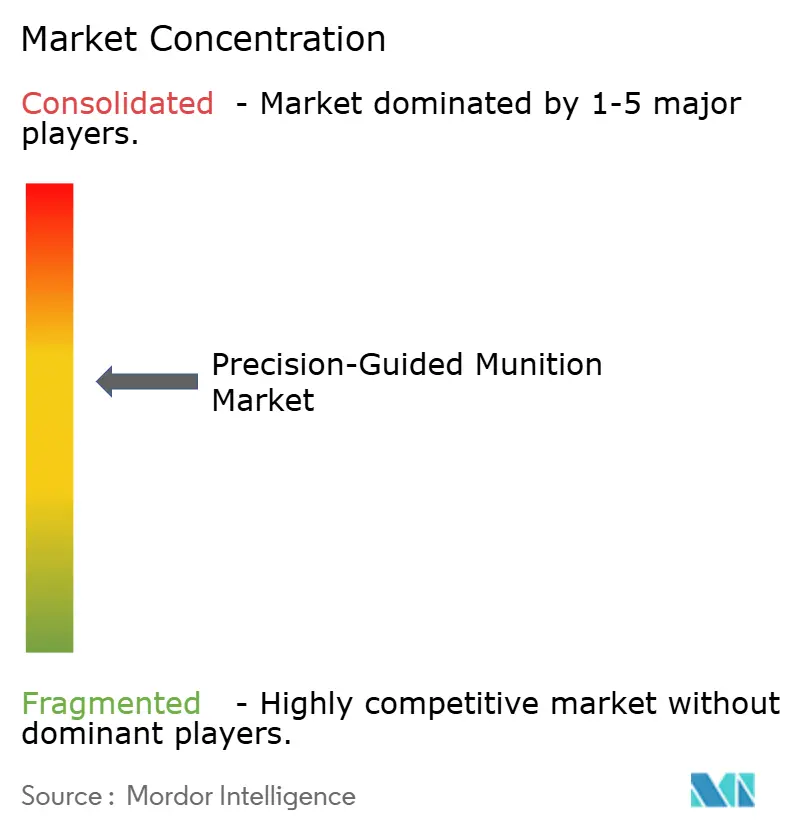
| Market Concentration | Medium |
Major Players *Disclaimer: Major Players sorted in no particular order Image © Mordor Intelligence. Reuse requires attribution under CC BY 4.0. | |
Precision-Guided Munition Market Analysis by Mordor Intelligence
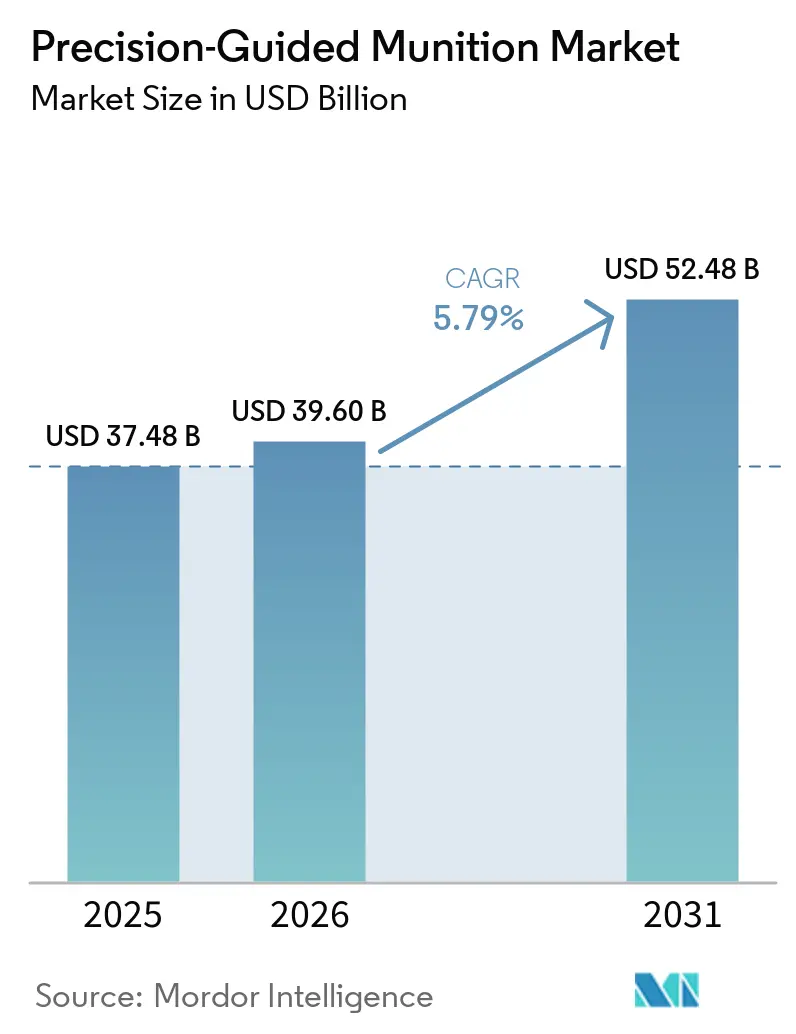
The precision-guided munition market size was valued at USD 37.48 billion in 2025 and is forecast to grow from USD 39.60 billion in 2026 to reach USD 52.48 billion in 2031, registering a 5.79% CAGR during the forecast period (2026-2031). Defense ministries prioritize stand-off strike capabilities to counter anti-access/area-denial (A2/AD) networks, stimulate domestic production, and cut collateral damage in asymmetric conflicts. Multi-year procurement contracts, such as the US Army’s USD 4.94 billion Precision Strike Missile award, underpin a robust order pipeline. Miniaturization opens up new deployment options for unmanned aerial vehicles (UAVs), while modular, open-systems architectures shorten upgrade cycles and reduce life-cycle costs. Industrial capacity constraints and semiconductor shortages continue to be a brake on output, but investments in digital manufacturing and predictive analytics are gradually easing these bottlenecks.
Key Report Takeaways
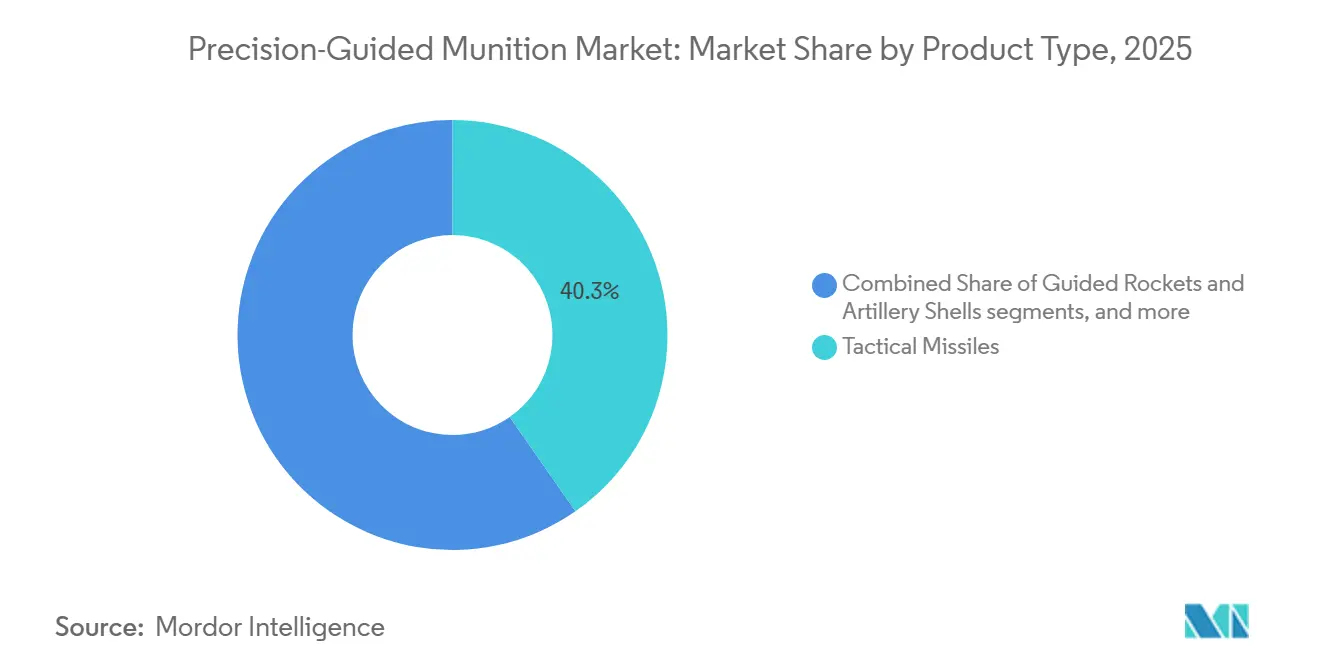
- By product type, tactical missiles led the precision-guided munition market, accounting for 40.31% of the market share in 2025. In contrast, loitering munitions are projected to expand at a 7.56% CAGR through 2031.
- By launch platform, airborne systems accounted for 42.87% of the precision-guided munition market in 2025, maintaining their leadership position due to integrations with fighter and bomber aircraft. Unmanned systems are forecast to grow at a 9.50% CAGR through 2031, as smaller UAV classes receive precision payloads.
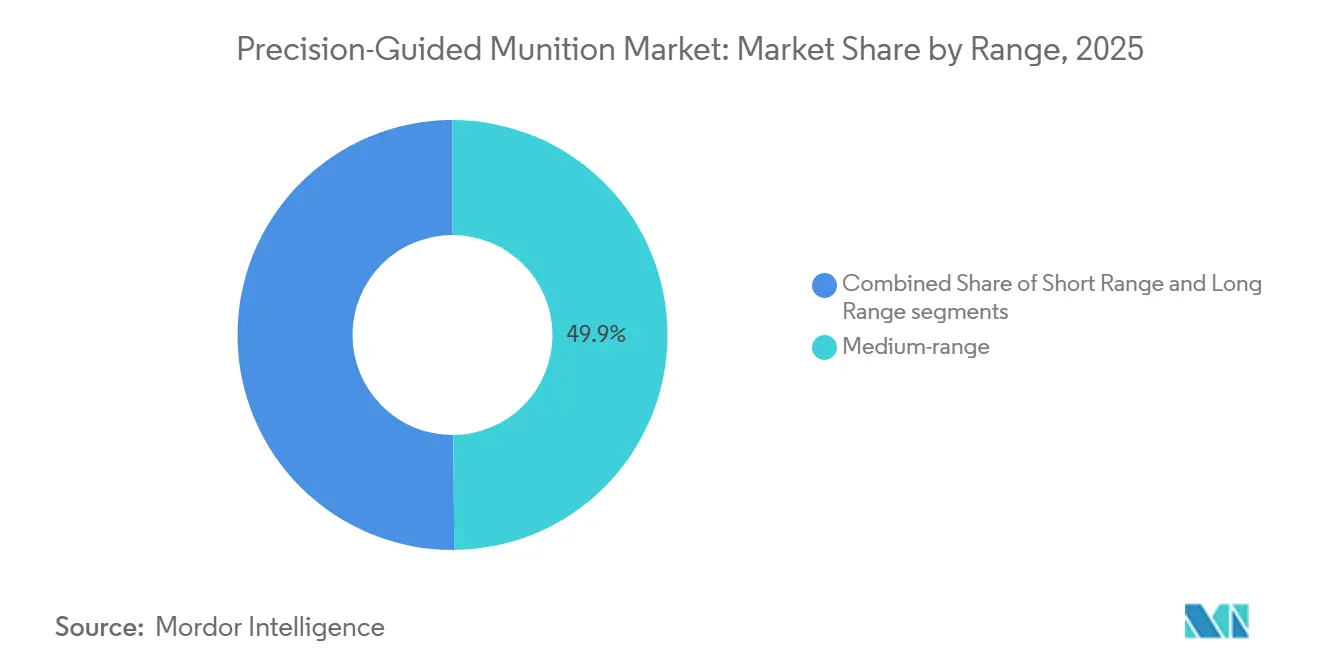
- By range, medium-range weapons (50 to 300 km) captured 49.87% revenue in 2025, topping the range category, while long-range weapons (greater than 300 km) are forecast to grow at an 8.43% CAGR through 2031.
- By speed, supersonic systems held a 43.27% share in 2025, the largest within the speed segmentation, while hypersonic systems are forecast to record a 10.29% CAGR, the fastest across all speed classes.
- By sub-system, guidance and navigation units delivered 38.31% of 2025 revenue, topping sub-system contributions, while target-acquisition modules are forecast to grow at a 6.21% CAGR through 2031 as artificial intelligence (AI) enhances seeker performance.
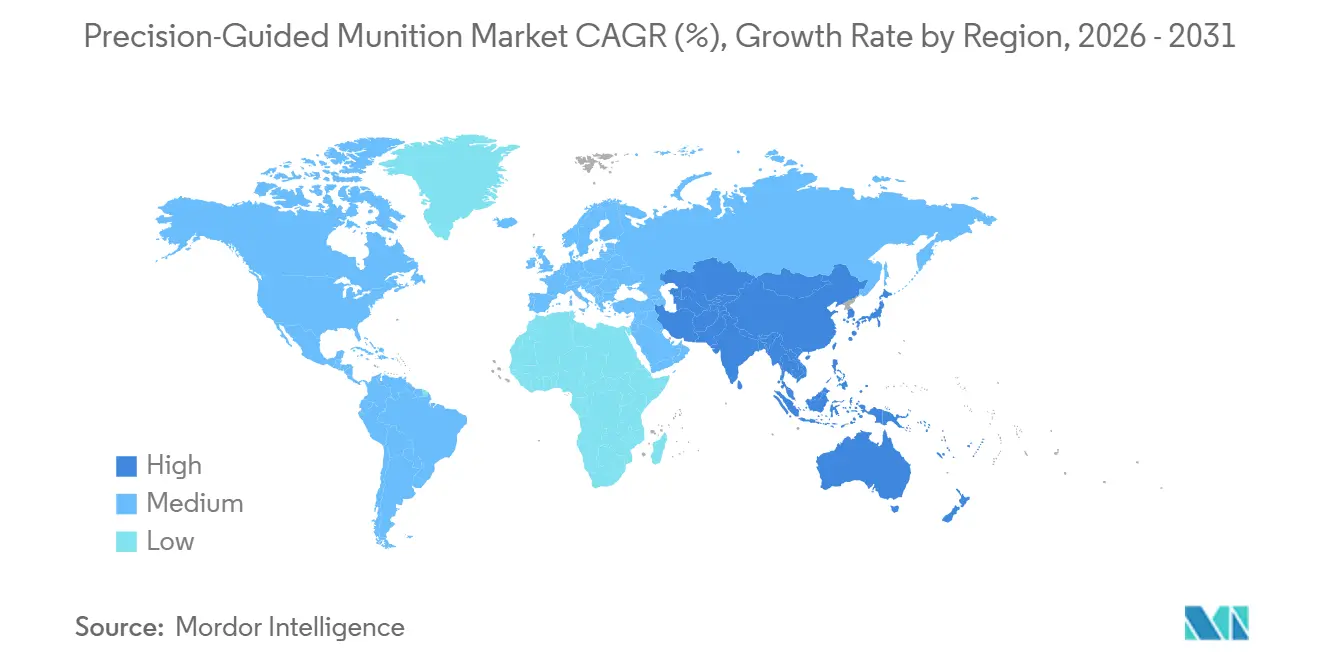
- By geography, North America accounted for 39.92% of revenue in 2025, remaining the largest regional buyer, while Asia-Pacific is forecast to grow at a 6.82% CAGR through 2031, thanks to rapid force modernization programs.
Note: Market size and forecast figures in this report are generated using Mordor Intelligence’s proprietary estimation framework, updated with the latest available data and insights as of January 2026.
Market Trends and Insights
Drivers Impact Analysis of Precision-Guided Munition Market*
| Driver | (~) % Impact on CAGR Forecast | Geographic Relevance | Impact Timeline |
|---|---|---|---|
| DoD modernization programs in US and allies | + 1.80% | North America and Europe; spill-over to AUKUS partners | Long term (≥ 4 years) |
| Growing demand for stand-off weapons in contested A2/AD zones | + 1.50% | Asia-Pacific core; Middle East spill-over | Medium term (2-4 years) |
| Rising asymmetric warfare and need for surgical strikes | + 1.20% | Global; early adoption in Ukraine, Middle East, Asia-Pacific | Medium term (2-4 years) |
| Miniaturization enabling deployment on UAVs and loitering munitions | + 0.90% | Global | Short term (≤ 2 years) |
| AI-enabled target recognition improving hit-to-kill probability | + 0.70% | North America, Europe, advanced Asia-Pacific markets | Medium term (2-4 years) |
| Emergence of low-cost glide kits for legacy bombs | + 0.60% | Global, especially emerging defense buyers | Short term (≤ 2 years) |
| Source: Mordor Intelligence | |||
Rising Asymmetric Warfare and Demand for Surgical Strikes
Precision weapons with sub-10 m circular error probabilities allow commanders to neutralize high-value targets hidden in urban terrain while limiting collateral damage. Ukraine’s battlefield experience has underscored the operational pay-off, forcing major powers and smaller states alike to stockpile comparable capabilities.[1] The heightened lethality of non-state actors equipped with accurate rockets pushes regional militaries to invest in offensive precision assets and layered missile defenses. As a result, procurement budgets increasingly favor guided over unguided rounds, compressing the logistical footprint of sustained operations. The trend is expected to strengthen as urbanization and media scrutiny amplify the strategic cost of civilian casualties. Continued integration of dual-mode seekers ensures reliability when GPS is jammed, further widening the capability gap versus legacy ordnance.
DoD and Allied Modernization Programs
The US Army’s Precision Strike Missile, the Navy’s SM-6 multi-mission round, and allied programs, such as Germany’s Taurus Neo, collectively represent the most significant investment in guided munitions since the Cold War. Modular open-systems standards enhance upgrade agility, enabling electronics refreshes without scrapping airframes or launchers. Interoperability initiatives under NATO Standardization Agreements create bulk-buy economies and reduce per-unit prices for consortium members. However, congressional testimony highlights limitations in the industrial base, compelling primes to adopt digital twins and additive manufacturing to increase throughput.[2] Parallel investments by Japan and Australia in domestic lines improve supply security and diversify the vendor pool. These synchronized roadmaps provide a stable, multi-year demand horizon that cushions suppliers against cyclical budget swings.
Growing Demand for Stand-Off Weapons in Contested A2/AD Zones
Anti-ship ballistic missiles, long-range surface-to-air systems, and over-the-horizon radars fielded by peer competitors force strike platforms to launch from beyond 400 km. Weapons such as the Joint Air-to-Surface Standoff Missile-Extended Range provide crews with the necessary reach while maintaining precision, a capability highly valued by Japan, Australia, and the Philippines.[3] Satellite-based sensors now cue land-attack missiles in near real time, improving time-on-target performance. Regional air forces are upgrading tanker fleets to extend loiter windows for long-range shooters, further elevating demand for standoff ordnance. Procurement transparency laws in several Asia-Pacific democracies are accelerating competitive tenders and lowering barriers for non-traditional suppliers to gain a foothold. Over the forecast period, long-range weapons are expected to steadily capture budget share from medium-range incumbents.
Miniaturization Enabling UAV and Loitering Deployments
New micro-electromechanical (MEMS) inertial units, compact power modules, and lightweight composite casings allow precision effects in warheads weighing under 10 lbs. Small UAVs equipped with multi-drop racks now deliver pinpoint strikes at a fraction of the cost of legacy sorties. European armed forces are fast-tracking loitering systems as a direct result of the Russia-Ukraine conflict; domestic suppliers benefit from less onerous airworthiness certification rules, as the platforms are classified as munitions rather than aircraft. Multi-mode guidance, combining GNSS, inertial, and optical seekers, mitigates the risk of jamming, thereby increasing mission assurance in electromagnetically contested airspace. Looking ahead, swarming software should increase the volume of simultaneous strikes without a proportionate increase in operator workload. The cost-effectiveness of loitering systems makes them attractive to major powers and budget-constrained buyers.
Restraints Impact Analysis of Precision-Guided Munition Market*
| Restraint | (~) % Impact on CAGR Forecast | Geographic Relevance | Impact Timeline |
|---|---|---|---|
| Counter-UAS and EW systems degrading GPS guidance | −1.1% | Global; concentrated in contested theaters | Medium term (2-4 years) |
| Export-control regimes (ITAR, MTCR) limiting addressable market | −0.8% | Global; strongest effect on US-allied trade | Long term (≥ 4 years) |
| Semiconductor supply-chain fragility impacting guidance units | −0.7% | Global; acute for advanced guidance-electronics producers | Short term (≤ 2 years) |
| Escalating unit costs versus unguided ordnance | −0.6% | Global; budget-constrained militaries most affected | Medium term (2-4 years) |
| Source: Mordor Intelligence | |||
Export-Control Regimes (ITAR, MTCR) Limiting Addressable Market
International Traffic in Arms Regulations impose registration fees, compliance programs, and hefty civil penalties that deter small exporters and slow multinational sales campaigns.[4] The Missile Technology Control Regime (MTCR) thresholds block transfers of systems capable of delivering payloads of 500 kg or more beyond 300 km, thereby directly affecting strategic-range precision munitions. Several European governments are responding by developing sovereign development roadmaps to reduce reliance on US export approvals. While category transfers from ITAR to Commerce rules have eased small-arms exports, precision-guided categories remain tightly controlled because of their strategic implications. Lengthy licensing lead times complicate just-in-time production schedules, often forcing primes to build speculative batches in advance, tying up working capital.
Counter-UAS and Electronic-Warfare Systems Degrading GPS Guidance
Adversaries increasingly field jammers and spoofers that target civilian L1 and military M-code GPS bands, compelling missile designers to embed redundant guidance modes. Cross-linked inertial sensors, terrain-following algorithms, and imaging infrared seekers mitigate, but do not eliminate, denial risks. The democratization of low-cost electronic warfare (EW) kits means that even non-state actors can erode the precision edge previously monopolized by great-power militaries. Counter-UAS laser and microwave systems also challenge small loitering munitions, raising survivability thresholds. Upgrading entire inventories with hardened receivers involves substantial retrofit budgets, which can delay adoption in fiscally constrained forces. Over the medium term, guidance-agnostic kill chains integrating multiple sensor modalities will be required to sustain accuracy in electromagnetic gray zones.
*Our forecasts treat driver/restraint impacts as directional, not additive. The impact forecasts reflect baseline growth, mix effects, and variable interactions.
Precision-Guided Munition Market Segment Analysis
By Product Type:
Loitering Systems Drive InnovationTactical missiles generated 40.31% of 2025 revenue, underpinning the most significant slice of the precision-guided munition market share. Their entrenched position stems from mature supply chains and established operator training pipelines across more than 50 nations. Yet the cost-per-kill advantage of loitering systems is reshaping budget allocations, allowing commanders to hover above targets until identification is confirmed. Guided bombs benefit from retrofit kits that upgrade legacy stocks, while hypersonic missiles, although smaller in volume, siphon away R&D funding due to their strategic deterrence value.
Loitering munitions are forecast to grow at a 7.56% CAGR, the fastest rate in the precision-guided munitions market, as European and Middle Eastern customers adopt Ukrainian concepts of operation. Their unit cost undercuts cruise missiles by an order of magnitude, widening their applicability from high-value to time-sensitive targets. Therefore, the precision-guided munition market size for loitering munitions is expected to rise significantly from its low base in 2025. Proprietary data links highlight the expansion of domestic production in Germany and Türkiye, improving supply resilience. Suppliers are focusing on multi-drop dispensers and auto-swarm logic to cement competitive differentiation.

By Launch Platform:
Unmanned Systems Transform DeploymentAirborne launchers, such as fighters, bombers, and rotary platforms, accounted for 42.87% of revenue in 2025, bolstered by fleets of F-35, Rafale, and Su-30 aircraft that carry precision racks as standard equipment. Continuous software drops under open-mission-system standards enable rapid weapons integration without costly avionics upgrades. However, growing operator reluctance to risk pilots in high-end fights is shifting attention toward unmanned combat aerial vehicles (UCAVs).
Unmanned launchers, such as fixed-wing MALE UAVs and rotary mini-drones, will record a 9.50% CAGR, the steepest among platforms, as shrinking guidance modules make sub-25 kg class drones viable shooters. Containerized ground-control stations and improved SATCOM links enable expeditionary deployment with minimal logistical footprint. Modularity enables rapid role transitions from surveillance to strike, reinforcing the case for high-tempo operations in contested airspace.
By Sub-System:
Target Acquisition Drives GrowthGuidance, navigation, and control electronics accounted for 38.31% of 2025 revenue, underscoring their indispensability in achieving hit-to-kill performance; the unit value of advanced seekers maintains healthy margins despite stiff competition. Hybrid GNSS-inertial solutions dominate, but emerging optically aided systems are gaining traction for GPS-denied scenarios. Propulsion subsystems follow, with dual-pulse rocket motors supporting extended-range rockets. Semiconductor scarcity has complicated supply chains, pushing primes to dual-source ASICs and GaN power components.
Target-acquisition modules are projected to clock a 6.21% CAGR, the fastest among subsystems, as artificial intelligence (AI) boosts real-time object recognition rates. Indigenous sensor fabrication by major European primes reduces reliance on imports and shields programs from export-control shocks. Therefore, the precision-guided munition market share for target acquisition subsystems is expected to rise incrementally through 2031. Simultaneous improvements in onboard processing speed and thermal management lower detection-to-firing timelines and enhance engagement envelopes.
By Range:
Long-Range Capabilities AccelerateMedium-range (50 to 300 km) weapons captured 49.87% of the 2025 turnover, balancing cost and coverage for most battlefield and coastal defense missions. Their popularity rests on compatibility with existing launchers and doctrine, ensuring brisk demand from replacement and recapitalization cycles.
Long-range systems (greater than 300 km) are projected to expand at an 8.43% CAGR, spurred by the imperative to engage high-value nodes without entering adversary air-defense umbrellas. It is propelled by contract awards for surface-launched cruise missiles and extended-range rockets. European joint projects aim to field systems exceeding 1,000 km by the early 2030s, signaling persistent momentum.
By Speed:
Hypersonic Systems Lead InnovationSupersonic rounds retained 43.27% market share in 2025, capitalizing on decades of platform integration and export precedents. Their mature production lines deliver predictable costs, a trait sought by budget-sensitive ministries. However, their strategic value is gradually diluted by advanced air defenses capable of intercepting Mach 3 targets.
Hypersonic weapons are projected to grow at a 10.29% CAGR, the fastest in the precision-guided munition market, despite unit prices exceeding USD 10 million and unresolved thermal-protection challenges. Successful live-fire tests show potential to pierce tier-1 integrated air-defense shields, triggering parallel spending on counter-hypersonic interceptors. Certification hurdles and material scarcity prolong development cycles, but the strategic deterrence benefits keep programs well funded across the US, China, and Russia.
Geography Analysis
North America Precision-Guided Munition Market
North America generated 39.92% of 2025 revenue, anchored by consistent US funding for long-range precision fire and multi-million-round sustainment packages. Canada invests in niche research grants on guidance algorithms, while Foreign Military Sales (FMS) cases to allies sustain production volumes between domestic lots. Upgrade contracts within NATO partially offset export-control laws, which cap expansion to non-aligned buyers but block orders to them.
APAC Precision-Guided Munition Market
Asia-Pacific is on course for the fastest 6.82% CAGR as territorial disputes and gray-zone coercion spur demand for credible strike options.[5] Australia's Guided Weapons and Explosive Ordnance Enterprise, India's "Make in India" offsets, and Japan's carrier aviation upgrades collectively buoy regional expenditure. The Philippines' USD 875 million modernization outlay includes anti-ship precision missiles, broadening the customer base beyond the usual top spenders. China's opaque, state-funded programs indirectly fuel Southeast Asian procurement as neighbors seek deterrent parity.
EMEA Precision-Guided Munition Market
Europe balances capability shortfalls exposed by the war in Ukraine with sovereign production drives. Germany’s EUR 2.10 billion (USD 2.46 billion) Taurus Neo and France’s Foudre MLRS exemplify the pivot from reliance on imports to local manufacturing. NATO’s push for 2% of GDP in defense spending provides a tailwind that should keep the regional CAGR at 5.60% through 2031. In the Middle East and Africa, threat perceptions from precision-armed non-state actors accelerate offensive and defensive buys, although fiscal headroom varies widely with hydrocarbon revenues.
Competitive Landscape
The top five vendors, including Lockheed Martin Corporation, RTX Corporation, Northrop Grumman Corporation, BAE Systems plc, and The Boeing Company, collectively accounted for a significant share of 2025 revenue, indicating a moderately concentrated field. Incumbents leverage decades of classified know-how, captive sustainment streams, and proprietary software toolchains to secure follow-on awards. Vertical mergers, such as primes acquiring RF-component suppliers, aim to shield programs from semiconductor shortages.
Emerging challengers include Türkiye’s ASELSAN and Roketsan, which combine government backing with competitive labor costs to undercut Western peers in export tenders. The consortium model, seen in European Next Generation Effectors, pools R&D risk and accelerates technology transition. As illustrated by Godspeed Capital’s USD 675 million defense fund, private equity inflows signal a growing investor appetite for niche guidance and propulsion shops.
Strategic moves are centered on capacity expansions and digitalization. Lockheed Martin opened a new Alabama assembly line for the Precision Strike Missile, adding 50,000 ft² of automated machining space. MBDA implemented augmented-reality work instructions that cut build times by 25%. Northrop Grumman’s Glide Phase Interceptor win positions the firm as an early mover in counter-hypersonics, a domain viewed as the next multi-billion-dollar frontier.
Precision-Guided Munition Industry Leaders
-
Lockheed Martin Corporation
-
RTX Corporation
-
The Boeing Compnay
-
Northrop Grumman Corporation
-
BAE Systems plc
- *Disclaimer: Major Players sorted in no particular order
Precision-Guided Munition Market Companies Covered in this Report
- Lockheed Martin Corporation
- RTX Corporation
- The Boeing Company
- Northrop Grumman Corporation
- BAE Systems plc
- Thales Group
- MBDA
- Saab AB
- Israel Aerospace Industries Ltd.
- Rafael Advanced Defense Systems Ltd.
- L3Harris Technologies, Inc.
- Kongsberg Defence & Aerospace (Kongsberg Gruppen ASA)
- Elbit Systems Ltd.
- General Dynamics Corporation
- Hanwha Corporation
- Bharat Dynamics Limited
- Mitsubishi Heavy Industries, Ltd.
- Diehl Stiftung & Co. KG
- Leonardo S.p.A.
- ASELSAN A.Ş.
Recent Industry Developments in Precision-Guided Munition Market
- August 2026: AeroVironment, Inc. received a USD 51 million delivery order from the United States Army for additional Switchblade® 600 Block 2 loitering munition systems. The order also includes Switchblade 600 Block 1 systems to support an FMS to a key US ally.
- April 2025: Lockheed Martin secured a USD 4.94 billion production contract for the Precision Strike Missile, ensuring multiyear manufacturing visibility.
- March 2025: Lockheed Martin secured a USD 4.94 billion production contract for the Precision Strike Missile, ensuring multiyear manufacturing visibility.
- March 2025: Lockheed Martin secured a USD 4.94 billion production contract for the Precision Strike Missile, ensuring multiyear manufacturing visibility.
- March 2025: ASELSAN unveiled the GÖZDE guidance kit that converts Mk-82 bombs into dual-mode precision rounds.
Global Precision-Guided Munition Market Report Scope
Precision-guided munitions (PGMs), commonly known as “smart weapons,” are advanced military systems equipped with integrated guidance and control systems that actively direct them toward designated targets. Unlike unguided “dumb” bombs, which rely solely on ballistic trajectories, PGMs use technologies such as GPS, inertial navigation systems (INS), laser guidance, and radar to improve accuracy, enhance strike efficiency, and minimize collateral damage.
The precision-guided munition market is segmented by product type, launch platform, subsystem, range, speed, and geography. By product type, the market is segmented into tactical missiles, guided rockets and artillery shells, guided bombs, loitering munitions, interceptor missiles, torpedoes, and hypersonic missiles. By launch platform, the market is segmented into airborne, land-based, naval, and unmanned systems. By range, the market is segmented into short-range, medium-range, and long-range. By speed, the market is segmented into subsonic, supersonic, and hypersonic. The report also covers market sizes and forecasts for the precision-guided munition market in major countries across the regions. For each segment, the market size is provided in terms of value (USD).
| Tactical Missiles |
| Guided Rockets and Artillery Shells |
| Guided Bombs (PGMs/Smart Bombs) |
| Loitering Munitions |
| Interceptor Missiles |
| Torpedoes |
| Hypersonic Missiles |
| Airborne |
| Land-based |
| Naval |
| Unmanned Systems |
| Guided and Navigation Systems |
| Target Acquisition Systems |
| Propulsion Systems |
| Warheads |
| Power Supply Systems |
| Short-Range (Less than 50 km) |
| Medium-Range (50 to 300 km) |
| Long-Range (Greater than 300 km) |
| Subsonic |
| Supersonic |
| Hypersonic |
| North America | United States | |
| Canada | ||
| Mexico | ||
| Europe | United Kingdom | |
| France | ||
| Germany | ||
| Italy | ||
| Russia | ||
| Rest of Europe | ||
| Asia-Pacific | China | |
| India | ||
| Japan | ||
| South Korea | ||
| Australia | ||
| Rest of Asia-Pacific | ||
| South America | Brazil | |
| Rest of South America | ||
| Middle East and Africa | Middle East | Saudi Arabia |
| Israel | ||
| United Arab Emirates | ||
| Rest of Middle East | ||
| Africa | South Africa | |
| Rest of Africa | ||
| By Product Type | Tactical Missiles | ||
| Guided Rockets and Artillery Shells | |||
| Guided Bombs (PGMs/Smart Bombs) | |||
| Loitering Munitions | |||
| Interceptor Missiles | |||
| Torpedoes | |||
| Hypersonic Missiles | |||
| By Launch Platform | Airborne | ||
| Land-based | |||
| Naval | |||
| Unmanned Systems | |||
| By Subsystem | Guided and Navigation Systems | ||
| Target Acquisition Systems | |||
| Propulsion Systems | |||
| Warheads | |||
| Power Supply Systems | |||
| By Range | Short-Range (Less than 50 km) | ||
| Medium-Range (50 to 300 km) | |||
| Long-Range (Greater than 300 km) | |||
| By Speed | Subsonic | ||
| Supersonic | |||
| Hypersonic | |||
| By Geography | North America | United States | |
| Canada | |||
| Mexico | |||
| Europe | United Kingdom | ||
| France | |||
| Germany | |||
| Italy | |||
| Russia | |||
| Rest of Europe | |||
| Asia-Pacific | China | ||
| India | |||
| Japan | |||
| South Korea | |||
| Australia | |||
| Rest of Asia-Pacific | |||
| South America | Brazil | ||
| Rest of South America | |||
| Middle East and Africa | Middle East | Saudi Arabia | |
| Israel | |||
| United Arab Emirates | |||
| Rest of Middle East | |||
| Africa | South Africa | ||
| Rest of Africa | |||
Key Questions Answered in the Report
How large is the precision-guided munition market in 2025?
The precision-guided munition market size was valued at USD 37.48 billion in 2025 and is forecast to grow from USD 39.60 billion in 2026 to reach USD 52.48 billion in 2031, registering a 5.79% CAGR during the forecast period (2026-2031).
Which product segment grows fastest through 2031?
Loitering munitions are expected to advance at a 7.56% CAGR, outpacing all other products.
Which region records the quickest growth?
Asia-Pacific leads with a 6.82% CAGR owing to territorial tensions and modernization drives.
What are the main restraints on market expansion?
Strict export-control regimes and EW systems that degrade GPS guidance exert the greatest drag.
Who are the top vendors?
Lockheed Martin Corporation, RTX Corporation, Northrop Grumman Corporation, BAE Systems plc, and The Boieng Company collectively command about 55% of 2025 revenue.
Why are hypersonic weapons attracting investment?
Their ability to penetrate advanced air defenses at speeds above Mach 5 drives both offensive procurement and counter-hypersonic R&D.