
Power Transformer Cooling Systems Market Size and Share
Market Overview
| Study Period | 2021 - 2031 |
|---|---|
| Market Size (2026) | USD 1.36 Billion |
| Market Size (2031) | USD 2.11 Billion |
| Growth Rate (2026 - 2031) | 9.19 % |
| Fastest Growing Market | Asia-Pacific |
| Largest Market | Asia-Pacific |
| Market Concentration | Medium |
Major Players *Disclaimer: Major Players sorted in no particular order Image © Mordor Intelligence. Reuse requires attribution under CC BY 4.0. | |
Power Transformer Cooling Systems Market Analysis by Mordor Intelligence
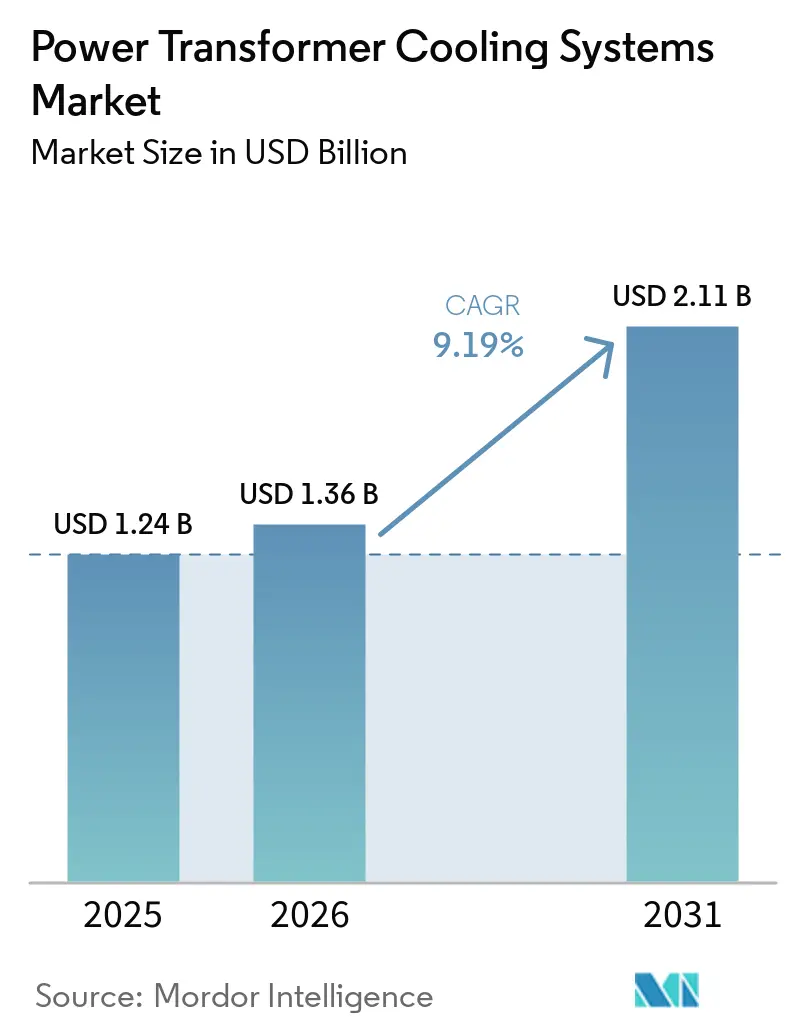
The Power Transformer Cooling Systems Market size is projected to expand from USD 1.24 billion in 2025 and USD 1.36 billion in 2026 to USD 2.11 billion by 2031, at a CAGR of 9.19% during 2026–2031. Long delivery schedules for large transformers are shifting spending toward upgrades that increase the usable capacity and life of equipment already in service. Cooling has therefore become a capital investment issue rather than only a routine maintenance item. Utilities, power producers, and large electricity users are seeking systems that manage sustained loading, frequent temperature changes, and limited space around transformer installations. Suppliers can benefit from both new transformer projects and retrofit work, particularly where an active cooling upgrade can avoid a longer replacement cycle. The power transformer cooling systems market also faces material cost pressure, digital security requirements, and technical qualification work when newer equipment must connect with older transformer interfaces.
Key Report Takeaways
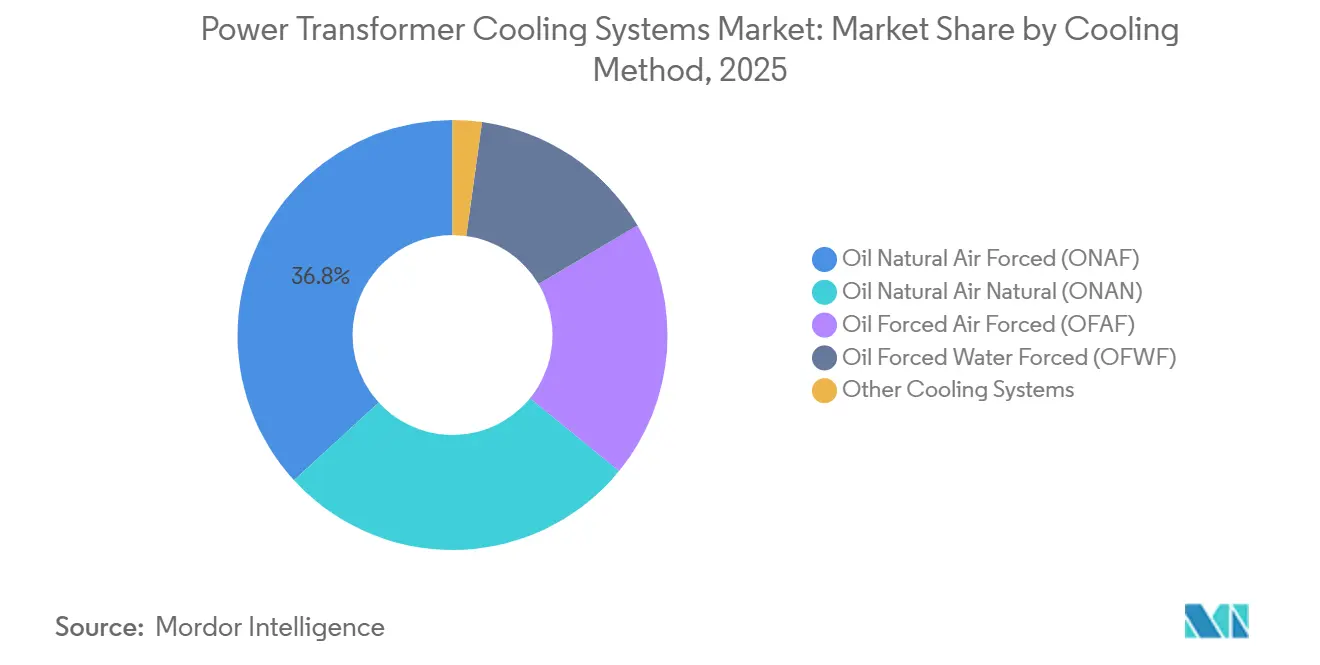
- By cooling method, ONAF held 36.8% of the power transformer cooling systems market share in 2025, while OFAF is forecast to grow at a 9.8% CAGR through 2031.
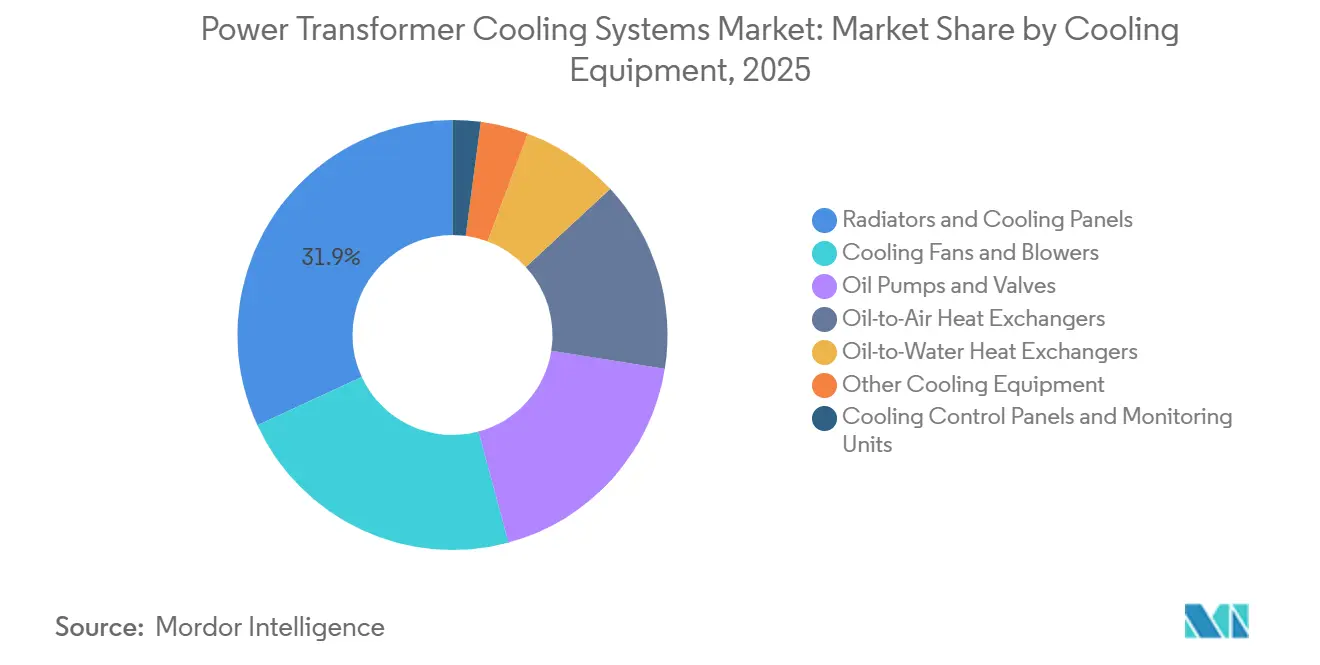
- By cooling equipment, radiators and cooling panels held 31.9% of the power transformer cooling systems market share in 2025, while cooling control panels and monitoring units are forecast to grow at a 10.4% CAGR through 2031.
- By end user, utilities held 57.4% of the power transformer cooling systems market share in 2025, while renewable energy operators are forecast to grow at a 10.9% CAGR through 2031.
- By geography, Asia-Pacific held 43.6% of the power transformer cooling systems market share in 2025 and is forecast to grow at an 11.3% CAGR through 2031.
Note: Market size and forecast figures in this report are generated using Mordor Intelligence’s proprietary estimation framework, updated with the latest available data and insights as of January 2026.
Market Trends and Insights
Drivers Impact Analysis of Power Transformer Cooling Systems Market*
| Driver | (~) % Impact on CAGR Forecast | Geographic Relevance | Impact Timeline |
|---|---|---|---|
| Grid Modernization and Aging Transformer Replacement | +2.80% | Global; most severe in North America and Europe | Short term (≤ 2 years) |
| Renewable Energy Integration and Higher Thermal Cycling | +1.90% | Global; APAC, Europe, and the Americas lead | Long term (≥ 4 years) |
| Hyperscale Data Center and Electrification Load Growth | +2.10% | North America and APAC core, spill-over to Europe | Medium term (2–4 years) |
| Industrial and Mining Electrification in Emerging Economies | +0.90% | APAC, South America, MEA | Long term (≥ 4 years) |
| Legacy Cooler Drawing Digitization and Retrofit Compatibility | +0.70% | Global | Medium term (2–4 years) |
| Modular Cooling Upgrades for Transformer Uprating | +0.60% | North America and Europe | Medium term (2–4 years) |
| Source: Mordor Intelligence | |||
Grid Modernization and Aging Transformer Replacement
Grid operators face rising demand while large new transformers remain difficult to secure within short project schedules. FirstEnergy announced a USD 36 billion capital plan for 2026 through 2030, including more than USD 19 billion for transmission infrastructure[1]. Large power transformers averaged 128 weeks for delivery by mid-2025, and generator step-up units averaged 144 weeks. These lead times make ONAF-to-OFAF conversion kits, replacement radiator banks, and updated control panels practical capacity measures for equipment already operating on the grid. Digitized legacy cooler drawings and compatible retrofit designs can reduce the engineering effort needed to match old equipment interfaces. Modular cooling upgrades also allow utilities to uprate selected transformers while replacement equipment remains on order.
Renewable Energy Integration and Higher Thermal Cycling
Wind and solar generation expose transformers to repeated top-oil and winding hot-spot temperature changes during rapid output ramps. These operating patterns create more cumulative thermal fatigue than conventional generation profiles. Harmonic currents from grid-tied inverters can increase stray and eddy-current losses and create localized hot spots beyond models based on steady operating conditions. The power transformer cooling systems market benefits when generator step-up transformers need OFAF cooling rather than ONAF configurations. Renewable generation patterns were associated with transformer failure rates in research that examined location and operating timing, especially in areas with east-west photovoltaic installations[2]. This need also supports monitoring systems that activate cooling equipment in response to observed thermal conditions.
Hyperscale Data Center and Electrification Load Growth
Data center expansion is concentrating large electricity loads at a smaller number of connection points. U.S. data center power demand was 31 GW in 2025, is estimated at 41 GW in 2026, and is projected to reach 66 GW in 2027. Individual hyperscale campuses can require 100 MW to 500 MW of capacity, placing transformers under continuous high-load duty cycles. Such operating conditions can exceed the usable thermal range of an ONAF system across ambient temperatures. The power transformer cooling systems market gains from this need for higher heat rejection within compact transformer designs. The same load growth also makes reliable cooling controls important because prolonged high loading can require earlier fan, pump, and alarm activation.
Industrial and Mining Electrification in Emerging Economies
Industrial and mining electrification is creating demand for more capable cooling systems in high-temperature and remote operating environments. India plans USD 30 billion of grid investment to support 500 GW of non-fossil generation capacity by 2030, with transformers representing 15% to 20% of equipment procurement budgets in the supplied research. Deep mines, furnaces, and traction applications commonly operate at sustained loads where interruptions carry major operating consequences. OFAF and OFWF configurations can be specified from the beginning, where facilities require continuous service and higher thermal capacity. Oil-to-water heat exchanger upgrades can also be used in industrial and traction transformer applications. The power transformer cooling systems market has an aftermarket opportunity where existing sites need these upgrades after the original transformer installation.
Restraints Impact Analysis of Power Transformer Cooling Systems Market*
| Restraint | (~) % Impact on CAGR Forecast | Geographic Relevance | Impact Timeline |
|---|---|---|---|
| CRGO Steel, Copper, Aluminum and Component Lead-Time Volatility | -1.40% | Global; most severe in North America and India | Short term (≤ 2 years) |
| High Installed Cost and Skilled-Service Requirements | -0.80% | Emerging markets in APAC, South America, MEA | Long term (≥ 4 years) |
| Legacy Cooler Interface Fragmentation and Qualification Burden | -0.50% | Global | Medium term (2–4 years) |
| Cybersecurity and Interoperability Risk in Connected Controls | -0.40% | North America and Europe | Long term (≥ 4 years) |
| Source: Mordor Intelligence | |||
CRGO Steel, Copper, Aluminum and Component Lead-Time Volatility
Material price changes can reduce cooling system margins and increase the cost of projects for end users. The supplied research states that copper and aluminum together account for more than 60% of power transformer manufacturing costs. It also reports that CRGO silicon steel prices increased from USD 1,700 per ton to USD 2,300 per ton between 2020 and 2025, while power transformer prices rose 77% over that period. These pressures shorten quotation validity periods for suppliers of radiators, pumps, fans, and other cooling equipment. Long-term contracts may therefore include escalation clauses that pass changes in input costs into project pricing. Domestic content conditions for federally funded U.S. projects can further limit sourcing choices for CRGO steel and copper inputs.
High Installed Cost and Skilled-Service Requirements
OFAF and OFWF systems cost more than simpler cooling arrangements and need continued service support. Oil pumps and forced-air fans add moving components that require lubrication, filter replacement, and inspection by trained personnel. Operators with limited maintenance capacity or unreliable spare-part supply can instead select ONAN systems, even when higher thermal performance would be useful. Cooling controls also require IEC 61850-compatible integration and regular firmware security updates. Older transformer interfaces can require extensive engineering verification before a replacement cooler or control package is accepted. Networked controls also increase cybersecurity and interoperability requirements, especially for utilities in North America and Europe.
*Our forecasts treat driver/restraint impacts as directional, not additive. The impact forecasts reflect baseline growth, mix effects, and variable interactions.
Power Transformer Cooling Systems Market Segment Analysis
By Cooling Method:
OFAF Growth Reflects Shifting Thermal DemandsONAF held 36.8% of the power transformer cooling systems market share in 2025 because it serves the medium-load range where fan cooling provides sufficient heat removal. Its installed base includes bulk distribution substations, industrial service transformers, and commercial grid equipment across regions. The arrangement uses forced-air fans while avoiding the cost and maintenance needs of active oil circulation. ONAN systems continue to serve lower-load and rural applications because they do not require ancillary power for fans or pumps. Their passive design also has low maintenance requirements. OFWF serves a smaller application group that includes traction, pumped-storage hydro, and industrial furnace transformers. Water availability allows OFWF systems to achieve high heat rejection with a smaller site footprint.
OFAF is projected to expand at a 9.8% CAGR from 2026 through 2031, the fastest rate among cooling methods in the supplied research. The power transformer cooling systems market size for OFAF is supported by offshore wind generator step-up units and data center connections that operate under sustained thermal loads. Large compact transformers can lack enough room for the radiator surface area that an ONAF configuration would require. A technical review found that OFAF and oil-directed air-forced systems are increasingly specified for transformers above 40 MVA to 60 MVA under high or variable loads. Active oil pumping improves thermal performance compared with passive oil circulation. IEC 60076-1 and the wider IEC 60076 series govern cooling classifications and factory thermal testing for new and upgraded units.

By Cooling Equipment:
Smart Monitoring Outpaces Passive ComponentsRadiators and cooling panels accounted for 31.9% of the power transformer cooling systems market share in 2025. They remain the main oil-to-air heat dissipation interface in ONAN and ONAF systems. Other designs within existing transformer tank footprints cannot easily replace corrugated radiator banks. Cooling fans and blowers support field upgrades from ONAN to ONAF. Oil pumps and valves provide the mechanical function required in OFAF and OFWF systems. Oil-to-air and oil-to-water heat exchangers address different thermal requirements, with oil-to-water designs suited to compact applications near concentrated loads.
Cooling control panels and monitoring units are projected to grow at a 10.4% CAGR from 2026 through 2031. This part of the power transformer cooling systems market is supported by IEC 61850 digital substation requirements, predictive maintenance programs, and connected condition monitoring. Multi-sensor frameworks can combine temperature, dissolved gas, and winding mechanical data using Modbus/TCP and OPC-UA protocols. These data support dynamic transformer rating and allow cooling equipment to respond before temperatures exceed operating limits. Siemens Energy’s acquisition of Camlin Group in June 2026 extended its capabilities in sensor-based transformer monitoring and analytics. Integrating cooling analytics into service contracts can create recurring revenue beyond equipment sales.
By End User:
Utilities Lead, Renewable Operators Set the PaceUtilities held 57.4% of the power transformer cooling systems market share in 2025 because they operate large transformer fleets and receive grid modernization support. Near-term utility demand is mainly related to replacement and retrofit needs. New transformer lead times encourage utilities to increase the capacity of installed assets rather than wait for new deliveries. Independent power producers are another demand group and often specify OFAF systems and advanced monitoring for baseload generation. Commercial infrastructure and data center operators are becoming more important users. Their requirements can exceed standard utility specifications where loading is high and continuous.
Renewable energy operators are projected to grow at a 10.9% CAGR from 2026 through 2031, the fastest end-user rate in the supplied research. The power transformer cooling systems market serves this group, where legacy thermal assumptions do not match cycling from inverter-based generation. Neoen appointed Camlin Energy as its global high-voltage transformer monitoring partner for assets in Europe, Australia, and Latin America[3]. The program uses continuous dissolved gas, partial discharge, and on-load tap changer monitoring. Rail and traction operators also need technically demanding solutions as electrified networks expand in Europe and Asia. Industrial and mining operators in emerging economies remain an underdeveloped aftermarket group for active cooling upgrades.
Geography Analysis
APAC Power Transformer Cooling Systems Market
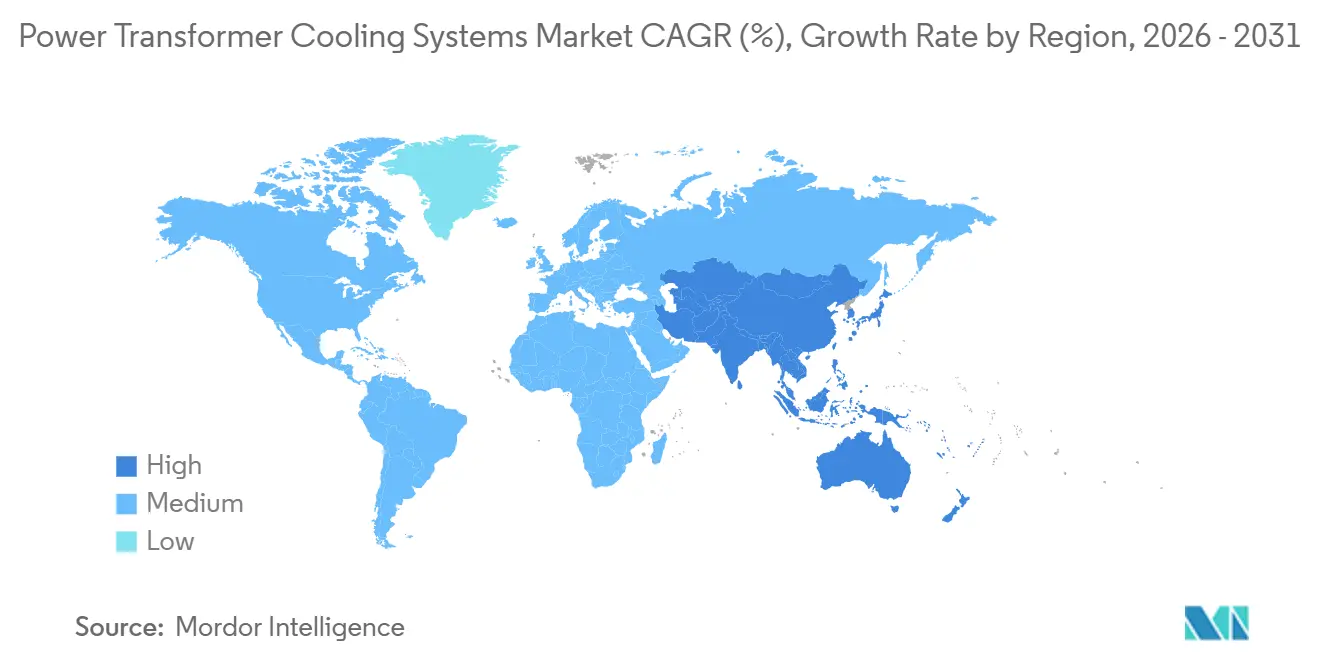
Asia-Pacific accounted for 43.6% of the power transformer cooling systems market share in 2025 and is forecast to grow at an 11.3% CAGR through 2031. China’s 1,000 kV AC and ±800 kV DC ultra-high-voltage backbone investments support demand for OFAF and OFWF systems used in high-MVA transformers. India’s Revamped Distribution Sector Scheme is a USD 34.76 billion program that supports transformer procurement and cooling upgrades across transmission and distribution. Japan’s energy efficiency standards for transformers became effective in 2026 and target an 11.4% improvement across 24 transformer categories. These requirements support the replacement of less efficient cooling configurations. Indonesia, Vietnam, and Thailand are expanding grid capacity, which supports both new installation and retrofit demand.
North America and Europe Power Transformer Cooling Systems Market
North America and Europe form the next-largest regional cluster in the supplied research, with demand shaped by transformer supply constraints. Hitachi Energy announced more than USD 1 billion of U.S. manufacturing investment in September 2025, including USD 457 million for a large power transformer facility near South Boston. The power transformer cooling systems market in these regions also benefits from equipment replacement and cooling retrofits during supply shortages. Hitachi Energy signed an agreement worth up to USD 700 million with E.ON in July 2025 for German grid infrastructure delivery. Stadtwerke Karlsruhe began a five-year program in 2025 to invest more than EUR 36 million, or USD 39 million, in high-voltage infrastructure and replace 9 end-of-life transformers across 4 substations. Offshore wind additions in the North Sea and Baltic also support demand for marine-grade OFAF and OFWF systems in generator step-up transformers above 100 MVA.
South America and MEA Power Transformer Cooling Systems Market
South America and the Middle East and Africa have smaller combined shares but remain important expansion areas through 2031. WEG announced BRL 543 million, or USD 99 million, of investment in transformer capacity in Brazil, including capacity for voltage classes up to 230 kV. The Betim expansion was expected to add 10% of production capacity by mid-2026. WEG also supplied three single-phase 500 MVA transformers at 525 kV for Brazil’s Assis Substation. Saudi Arabia’s Vision 2030 grid program, data center development in the UAE, and North African solar projects support new transformer demand. Sub-Saharan Africa offers longer-term potential as electrification and industrial investment increase.
Competitive Landscape
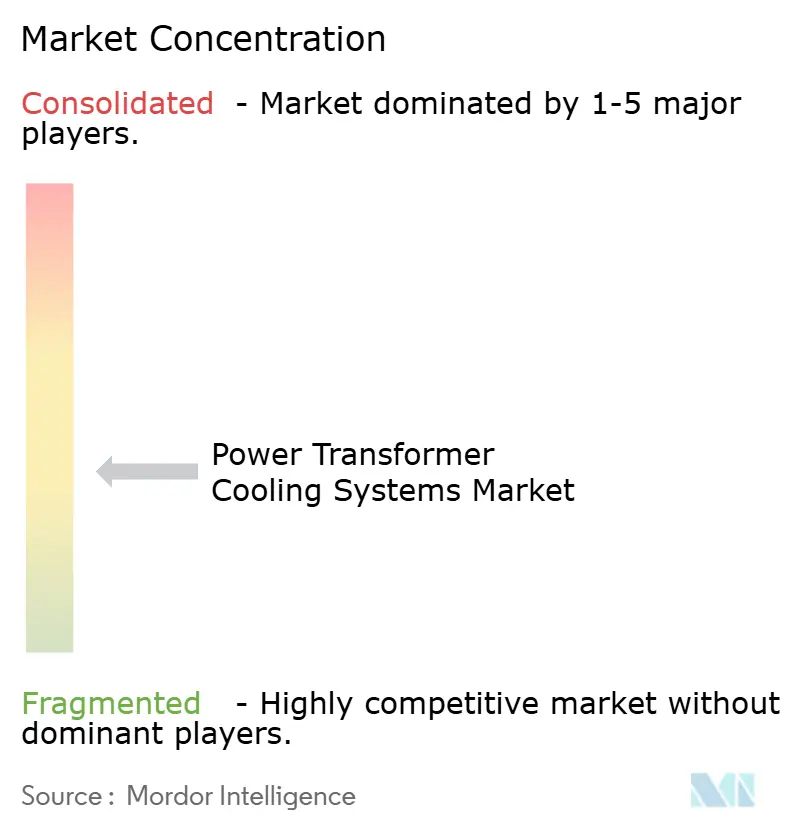
The power transformer cooling systems market has moderate concentration among integrated original equipment manufacturers and a more fragmented specialist component base. Hitachi Energy Ltd., Siemens Energy AG, and ABB Ltd. supply integrated cooling systems for large power transformers. Their capabilities span transformer design, cooling configuration, testing, and field service. Application-specific designs limit direct replacement because radiator dimensions, fan arrays, oil pump ratings, transformer MVA class, voltage, and site conditions must match. These requirements create switching costs for users with installed equipment. Suppliers also face CRGO steel and copper price changes, connected-control cybersecurity exposure, and qualification work for legacy interfaces.
Siemens Energy announced its intention to acquire Camlin Group in June 2026, subject to regulatory approval, to add sensor-based transformer monitoring and analytics capabilities. The move adds real-time cooling management and grid analytics to its transformer digitalization offer. Hitachi Energy increased U.S. manufacturing investment in 2025 to support the supply of critical grid infrastructure[4]. The company also reported cooling-related patent activity covering fluid discharge devices and oil-to-air heat exchanger designs for large power transformers in 2025 and 2026. These steps pair production capacity with continued design work. The power transformer cooling systems market therefore includes competition in equipment supply, monitoring, service, and project execution.
Kelvion Holding GmbH, Alfa Laval AB, and SPX Technologies compete as thermal equipment suppliers on heat exchanger performance, material options, and service reach. Apollo Funds agreed to acquire a majority stake in Kelvion in August 2025, giving the business capital support for data center and power grid cooling expansion. SPX Technologies raised its 2026 data center cooling revenue outlook to USD 430 million while retaining transformer heat exchanger lines for utilities in the supplied research. WEG in South America and BHEL in India benefit from domestic content preferences and established utility relationships. No combined market share for the leading companies was provided in the supplied material. The leading original equipment manufacturers are prominent, but specialist suppliers remain important across the component base.
Power Transformer Cooling Systems Industry Leaders
-
Hitachi Energy Ltd.
-
Siemens Energy AG
-
GE Vernova Inc.
-
ABB Ltd.
-
Kelvion Holding GmbH
- *Disclaimer: Major Players sorted in no particular order
Power Transformer Cooling Systems Market Companies Covered in this Report
- ABB Ltd.
- Alfa Laval AB
- Bharat Heavy Electricals Limited
- CG Power and Industrial Solutions Limited
- GE Vernova Inc.
- Hitachi Energy Ltd.
- Hyosung Heavy Industries Corporation
- Kelvion Holding GmbH
- Luvata Söderköping AB
- M&I Materials Limited
- Modine Manufacturing Company
- Radiator Manufacturing Company
- Siemens Energy AG
- SPX Technologies, Inc.
- Sterling Thermal Technology
- Tada Electric Co., Ltd.
- Thermofin GmbH
- Toshiba Energy Systems & Solutions Corporation
- Trantech Radiator Products, Inc.
- United Heat Exchanger
- WEG S.A.
Recent Industry Developments in Power Transformer Cooling Systems Market
- July 2026: GE Vernova expanded its Charleroi, Pennsylvania, manufacturing facility for high-voltage grid infrastructure as part of a USD 138 million site investment, targeting shorter lead times for critical grid components. The project is part of GE Vernova’s broader USD 1.3 billion U.S. manufacturing commitment for 2025-2028.
- June 2026: Hitachi Energy India announced an investment of INR 2,000 crore, or USD 235 million, to establish a new Large Power Transformer factory in Karjan, Vadodara, Gujarat. The LEED-certified facility is scheduled for completion in FY28 and targets high-voltage transmission, HVDC, and AI data center applications. It will create more than 1,000 direct and indirect jobs.
- June 2026: Siemens Energy announced its intention to acquire Camlin Group, a Northern Irish specialist in sensor-based transformer monitoring and analytics software. The acquisition is expected to close before the end of 2026, subject to regulatory approval, and extends Siemens Energy’s transformer digitalization capabilities into real-time cooling management and grid analytics.
- September 2025: Hitachi Energy announced more than USD 1 billion of U.S. manufacturing investment, including USD 457 million for a new large power transformer facility near South Boston, to address the U.S. transformer supply shortage.
Global Power Transformer Cooling Systems Market Report Scope
Power transformer cooling systems are integrated thermal management systems designed to dissipate heat generated in a power transformer during operation. They maintain the temperature of windings, core, and insulating medium within permissible limits. These systems use natural or forced circulation of insulating oil, air, water, or combinations thereof to transfer heat away from the transformer. This preserves insulation integrity, improves efficiency, extends equipment life, and ensures safe and reliable operation under varying load conditions.
The Global Power Transformer Cooling Systems Market is segmented by cooling method, cooling equipment, end user, and geography. By cooling method, the market is segmented into Oil Natural Air Natural (ONAN), Oil Natural Air Forced (ONAF), Oil Forced Air Forced (OFAF), Oil Forced Water Forced (OFWF), and other cooling methods. By cooling equipment, the market is segmented into radiators, cooling fans, oil pumps, heat exchangers, control panels, and other cooling equipment. By end user, the market is segmented into utilities, independent power producers (IPPs), industrial and mining, data centers, renewable energy, rail, and other end users. The report also covers the market size and forecasts for the global power transformer cooling systems market across 26 countries in key regions. For each segment, the market sizing and forecasts have been provided on the basis of value (USD).
| Oil Natural Air Natural (ONAN) |
| Oil Natural Air Forced (ONAF) |
| Oil Forced Air Forced (OFAF) |
| Oil Forced Water Forced (OFWF) |
| Other Cooling Systems |
| Radiators and Cooling Panels |
| Cooling Fans and Blowers |
| Oil Pumps and Valves |
| Oil-to-Air Heat Exchangers |
| Oil-to-Water Heat Exchangers |
| Cooling Control Panels and Monitoring Units |
| Other Cooling Equipment |
| Utilities |
| Independent Power Producers |
| Industrial and Mining |
| Commercial Infrastructure and Data Centers |
| Renewable Energy Operators |
| Rail and Traction Operators |
| Other End Users |
| North America | United States |
| Canada | |
| Mexico | |
| Europe | Germany |
| France | |
| Italy | |
| Spain | |
| United Kingdom | |
| Poland | |
| Russia | |
| Rest of Europe | |
| Asia-Pacific | China |
| India | |
| Japan | |
| South Korea | |
| Australia | |
| Indonesia | |
| Vietnam | |
| Thailand | |
| Rest of Asia-Pacific | |
| South America | Brazil |
| Argentina | |
| Chile | |
| Rest of South America | |
| Middle East and Africa | Saudi Arabia |
| United Arab Emirates | |
| Egypt | |
| South Africa | |
| Morocco | |
| Rest of Middle East and Africa |
| By Cooling Method | Oil Natural Air Natural (ONAN) | |
| Oil Natural Air Forced (ONAF) | ||
| Oil Forced Air Forced (OFAF) | ||
| Oil Forced Water Forced (OFWF) | ||
| Other Cooling Systems | ||
| By Cooling Equipment | Radiators and Cooling Panels | |
| Cooling Fans and Blowers | ||
| Oil Pumps and Valves | ||
| Oil-to-Air Heat Exchangers | ||
| Oil-to-Water Heat Exchangers | ||
| Cooling Control Panels and Monitoring Units | ||
| Other Cooling Equipment | ||
| By End User | Utilities | |
| Independent Power Producers | ||
| Industrial and Mining | ||
| Commercial Infrastructure and Data Centers | ||
| Renewable Energy Operators | ||
| Rail and Traction Operators | ||
| Other End Users | ||
| By Geography | North America | United States |
| Canada | ||
| Mexico | ||
| Europe | Germany | |
| France | ||
| Italy | ||
| Spain | ||
| United Kingdom | ||
| Poland | ||
| Russia | ||
| Rest of Europe | ||
| Asia-Pacific | China | |
| India | ||
| Japan | ||
| South Korea | ||
| Australia | ||
| Indonesia | ||
| Vietnam | ||
| Thailand | ||
| Rest of Asia-Pacific | ||
| South America | Brazil | |
| Argentina | ||
| Chile | ||
| Rest of South America | ||
| Middle East and Africa | Saudi Arabia | |
| United Arab Emirates | ||
| Egypt | ||
| South Africa | ||
| Morocco | ||
| Rest of Middle East and Africa | ||
Key Questions Answered in the Report
What is the projected value of the power transformer cooling systems market by 2031?
The power transformer cooling systems market is projected to reach USD 2.11 billion by 2031, rising from USD 1.36 billion in 2026 at a 9.19% CAGR.
Which cooling method is growing fastest for power transformers?
OFAF is the fastest-growing cooling method, with a projected 9.8% CAGR through 2031, supported by high and variable loading conditions.
Why are utilities upgrading transformer cooling equipment?
Long delivery times for new transformers are encouraging utilities to install radiator banks, active cooling kits, and updated controls on in-service assets.
Which equipment type is expanding fastest?
Cooling control panels and monitoring units are forecast to grow at a 10.4% CAGR through 2031 as users adopt connected thermal monitoring.
Which end user is expected to grow most quickly?
Renewable energy operators are forecast to grow at a 10.9% CAGR through 2031 because variable generation increases thermal cycling in transformer equipment.
Which region leads demand for transformer cooling systems?
Asia-Pacific held 43.6% share in 2025 and is forecast to grow at an 11.3% CAGR through 2031.