
Powder Coatings Market Size and Share
Market Overview
| Study Period | 2021 - 2031 |
|---|---|
| Market Size (2026) | USD 13.59 Billion |
| Market Size (2031) | USD 17.94 Billion |
| Growth Rate (2026 - 2031) | 5.71 % |
| Fastest Growing Market | Asia Pacific |
| Largest Market | Asia Pacific |
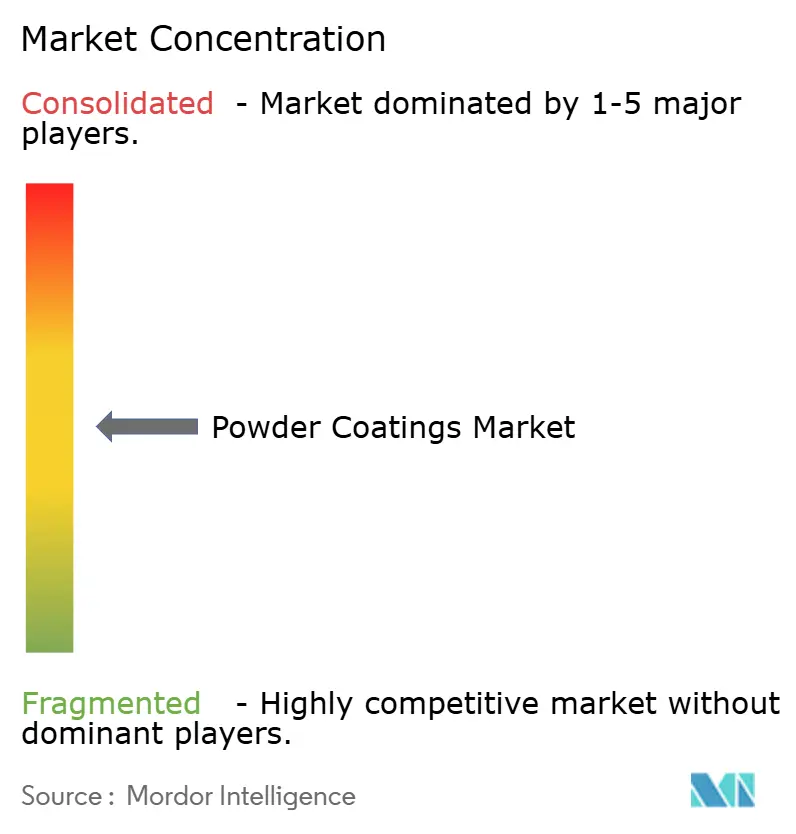
| Market Concentration | Medium |
Major Players *Disclaimer: Major Players sorted in no particular order Image © Mordor Intelligence. Reuse requires attribution under CC BY 4.0. | |
Powder Coatings Market Analysis by Mordor Intelligence
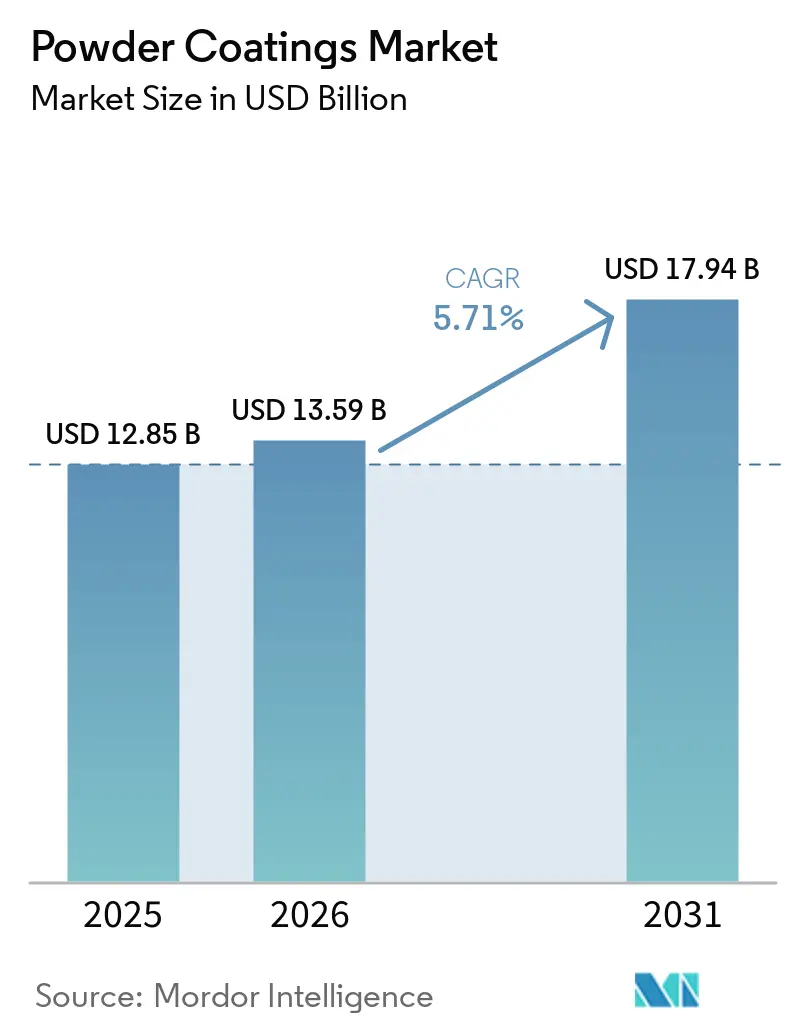
The Powder Coatings Market size is projected to expand from USD 12.85 billion in 2025 and USD 13.59 billion in 2026 to USD 17.94 billion by 2031, registering a CAGR of 5.71% between 2026 to 2031. Momentum stems from regulatory tailwinds that narrow the cost gap with liquid finishes, robust appliance output in Southeast Asia, and expanded use of medium-density fiberboard (MDF) enabled by low-temperature chemistries. Polyester formulations remain the workhorse for exterior durability, while thermoplastic grades are carving niches where recyclability is paramount. Capacity additions in Vietnam, China, and the United States illustrate an industry pivot toward regional hubs that shorten lead times and reduce embedded emissions. Feedstock inflation and thin-film application hurdles temper growth but have not derailed capital spending on new automated spray lines.
Key Report Takeaways
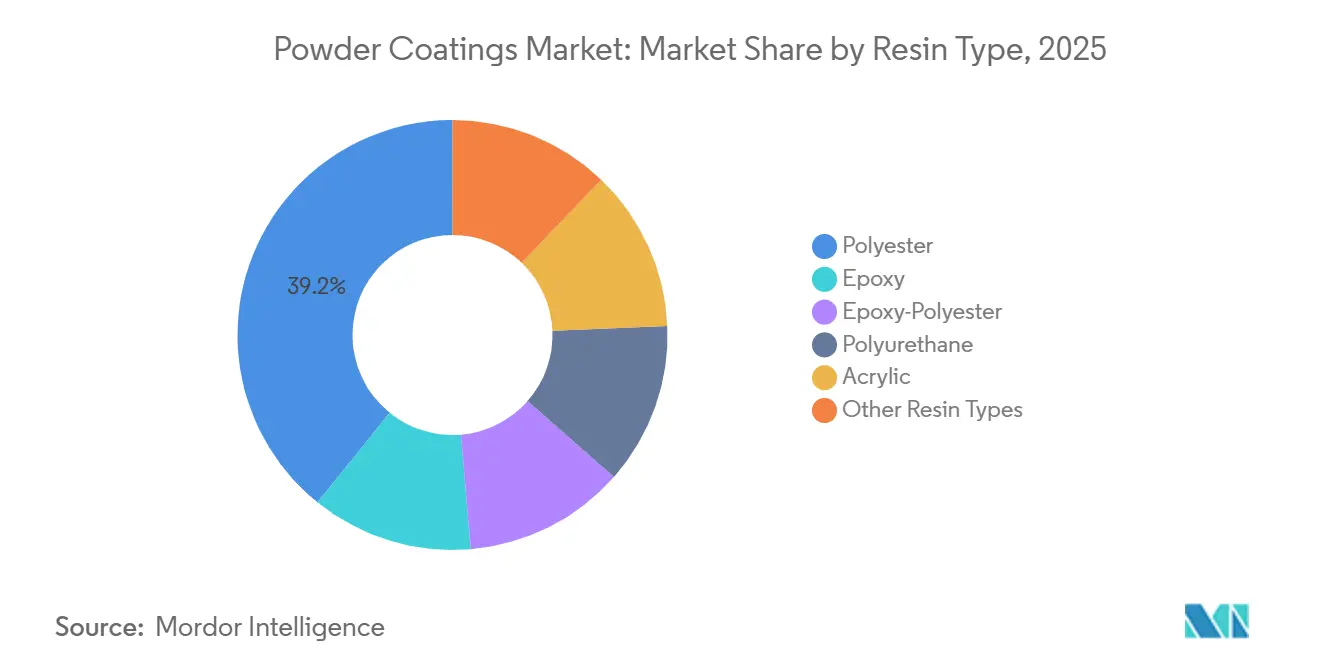
- By resin type, polyester led with 39.18% of powder coatings market share in 2025 and is forecast to expand at a 6.29% CAGR to 2031.
- By coating type, thermoset chemistries captured 91.05% revenue in 2025, while thermoplastic grades are advancing at a 6.17% CAGR through 2031.
- By end-use industry, the industrial segment held 44.46% of demand in 2025 and is progressing at the fastest 6.42% CAGR to 2031.
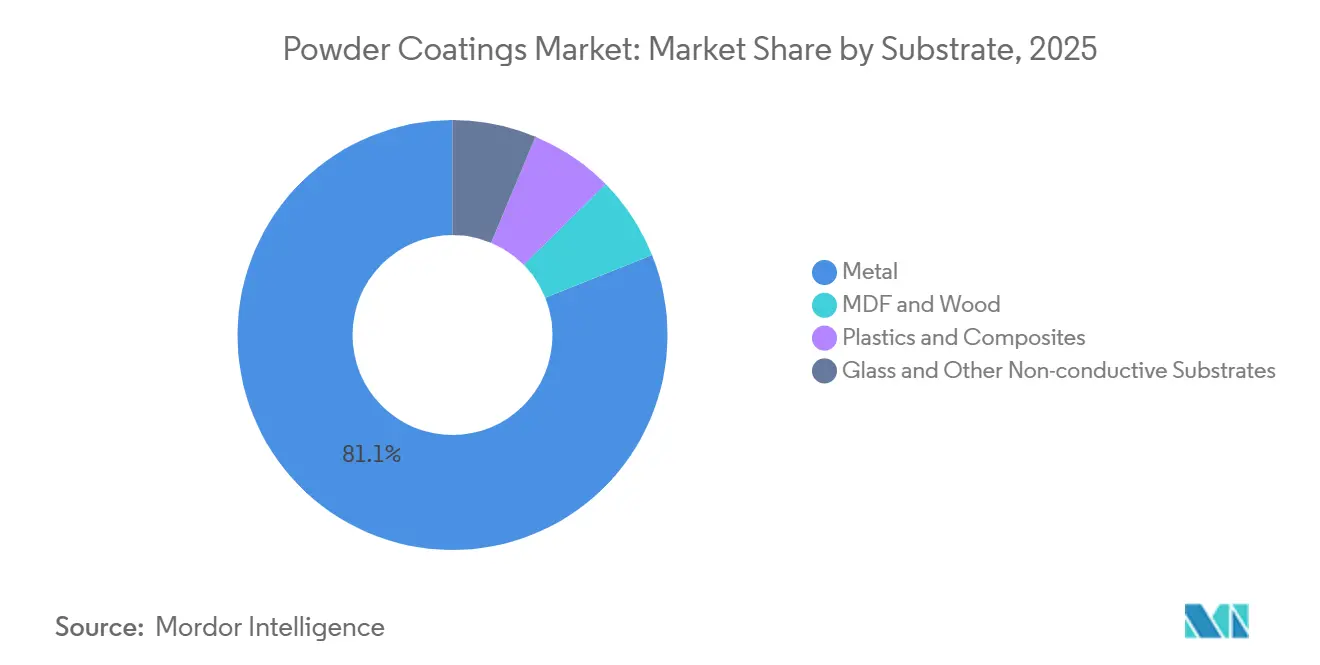
- By substrate, metal accounted for 81.08% volume in 2025, whereas MDF and wood are pacing ahead at a 6.16% CAGR to 2031.
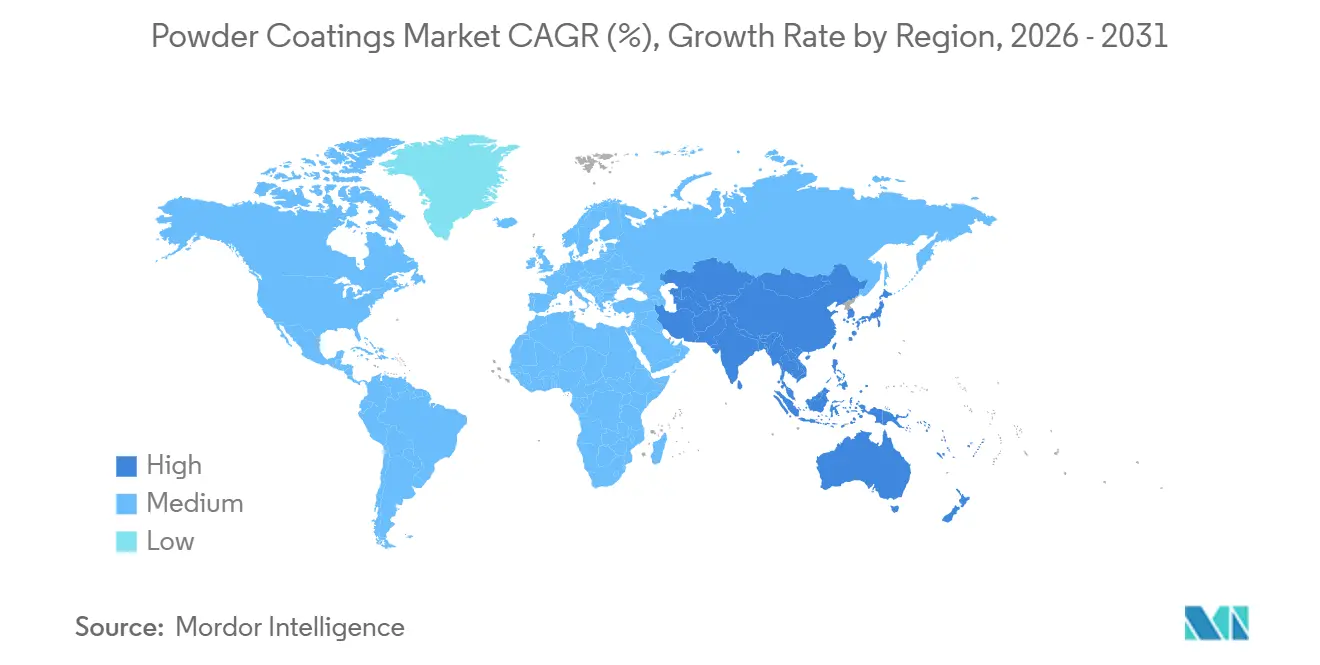
- By geography, Asia-Pacific dominated with a 55.65% share in 2025 and is tracking a 5.91% CAGR over the outlook period.
Note: Market size and forecast figures in this report are generated using Mordor Intelligence’s proprietary estimation framework, updated with the latest available data and insights as of January 2026.
Market Trends and Insights
Drivers Impact Analysis of Powder Coatings Market*
| Drivers | (~) % Impact on CAGR Forecast | Geographic Relevance | Impact Timeline |
|---|---|---|---|
| Stringent VOC and carbon-pricing rules accelerating solvent-free finishes | +1.4% | Europe, North America, China | Medium term (2-4 years) |
| Low-temperature chemistries unlocking MDF and heat-sensitive substrates | +0.9% | Global, with early adoption in Europe and North America | Long term (≥ 4 years) |
| ASEAN appliance build-out fuelled by FDI | +1.2% | ASEAN core (Vietnam, Thailand, Indonesia), spill-over to India | Short term (≤ 2 years) |
| Re-shoring of auto OEM lines | +0.8% | North America, Europe | Medium term (2-4 years) |
| GCC giga-projects spurring architectural aluminium demand | +0.6% | Middle East (Saudi Arabia, UAE), spill-over to North Africa | Short term (≤ 2 years) |
| Source: Mordor Intelligence | |||
Stringent VOC And Carbon-Pricing Rules Accelerating Solvent-Free Finishes
Regulations are increasingly favoring powder lines over liquid booths, leading to a reduced total cost of ownership. In December 2024, the U.S. EPA set a VOC content cap at 350 g/L. This move has forced converters to evaluate the cost of abatement hardware against the option of installing powder booths. Meanwhile, in Europe, the Carbon Border Adjustment Mechanism, set to take effect in January 2026, will apply the EU-ETS carbon price to imported metal goods. This has led exporters in Turkey and India to pivot towards powder solutions to sidestep tariffs. In China, provincial subsidies in Jiangsu and Guangdong are covering a portion of powder equipment costs. This initiative aligns with China's 10% VOC-reduction goal under its 14th Five-Year Plan. Thanks to these concerted efforts, the payback period for mid-scale powder installations has been significantly reduced. Additionally, OEMs are adopting solvent-free finishes, bolstering their corporate net-zero commitments and driving the uptake of powder coatings in the furniture, appliance, and transportation industries.
Low-Temperature Chemistries Unlocking MDF And Heat-Sensitive Substrates
Breakthrough formulations now cure at temperatures between 110 °C and 130 °C, enabling their application as low temperature powder coating on engineered wood and select plastics without causing substrate distortion. BASF’s Ultradur High Speed polyester achieves full cross-linking at 130 °C, adhering to ISO 2409 standards on MDF without the need for primers[1]. Similarly, Axalta’s AquaEC system performs on polypropylene bumpers at 110 °C, successfully passing ASTM D3359 tape tests[2]. Furniture manufacturers are quick to adapt: IKEA utilized the low-bake powder on its cabinet frames, highlighting energy savings and resolving grain-raising challenges typical of water-borne liquids. While resin costs are higher than standard polyesters, the significant energy and labor savings make a strong case for the technology's long-term growth in decorative panels, office furniture, and automotive interiors.
ASEAN Appliance Build-Out Fueled By FDI
In 2024-2025, Vietnam and Thailand attracted significant investment in the appliance and electronics sector. This surge has birthed a dedicated market for powder coatings, specifically tailored for refrigerator and washing-machine cabinets. Notably, expansions by industry giants Samsung, LG, and Haier have driven this growth. These companies stand to gain a finishing-cost advantage from powder coatings, especially when factoring in waste handling and solvent recovery. In Indonesia, the push for energy efficiency is underscored by the mandatory SNI 8000 labeling. This regulation has heightened the appeal of powder coatings, as their uniform thin films significantly boost thermal insulation in refrigerator liners. While regional capacity is striving to keep pace, challenges remain. PPG's new plant in Binh Duong, inaugurated in April 2025, is grappling with lead times during peak seasons.
Re-Shoring Of Auto OEM Lines
North American and European automakers are increasingly localizing their electric vehicle (EV) platforms, with powder technology playing a pivotal role in their revamped paint shops. General Motors, as part of a significant investment announced in August 2024, is retooling three U.S. plants to incorporate powder-coated battery enclosures and subframes. Ford's Oakville site, which commenced EV production in late 2025, adopted a two-coat powder sequence. This innovation replaces the traditional water-intensive e-coat dip, contributing to water conservation efforts. Across the Atlantic, Volkswagen has transitioned a substantial portion of its Emden underbody processing to powder. This move not only aligns with the tightened VOC limits set by the Industrial Emissions Directive but also underscores the industry's commitment to sustainability. The adoption of shorter cure cycles and reduced bake temperatures further emphasizes powder's integral role in modernizing automotive paint lines, aligning with broader lean manufacturing objectives.
Restraints Impact Analysis of Powder Coatings Market*
| Restraints | (~) % Impact on CAGR Forecast | Geographic Relevance | Impact Timeline |
|---|---|---|---|
| Thin-film (less than 25 µm) application limits | -0.7% | Global, most acute in automotive Class-A surfaces | Medium term (2-4 years) |
| UV-cure powders still geometry-restricted | -0.5% | Global, particularly complex automotive and industrial parts | Long term (≥ 4 years) |
| Polyester/epoxy feedstock price volatility | -1.1% | Global, with highest impact in Asia-Pacific | Short term (≤ 2 years) |
| Source: Mordor Intelligence | |||
Thin-Film Application Limits Below 25 Microns
Particle size constraints hinder the production of uniform films, preventing the use of powder in premium exterior auto panels and shells of consumer electronics. Powders face challenges with fluidization and electrostatic charge, leading to higher reject rates in automotive audits compared to their liquid counterparts. Sherwin-Williams' resin upgrade in 2025 pushed the viable build down but still falls short of the targets set by automakers. Until advancements are made in thin-film deposition, liquid topcoats will continue to dominate Class-A surfaces, limiting powder's application in categories where appearance is paramount.
UV-Cure Powders Still Geometry-Restricted
While rapid-cure UV powders boost throughput, they struggle with shadowed recesses where light fails to uniformly activate photoinitiators. IGP's technology is primarily adopted for flat or gently curved components, like interior trims and shelving. However, complex automotive frames, heat sinks, and lattice structures are still incompatible, capping volume potential for the next decade.
*Our forecasts treat driver/restraint impacts as directional, not additive. The impact forecasts reflect baseline growth, mix effects, and variable interactions.
Powder Coatings Market Segment Analysis
By Resin Type:
Polyester Dominance Anchored By Outdoor DurabilityPolyester powders generated 39.18% of the powder coatings market size for resins in 2025 and are enjoying a 6.29% CAGR through 2031, well ahead of epoxies and acrylics. Notably, polyester-TGIC systems consistently achieve AAMA 2605 weatherability standards, enduring a decade of Florida's sun without significant chalking.
Architectural aluminum extrusions, agricultural equipment, and outdoor furniture, all demanding high UV stability at competitive prices, drive the strongest demand. While epoxies are valued for their corrosion protection, their use is largely limited to appliance interiors and underbody auto parts due to their tendency to discolor in sunlight. Hybrid epoxy-polyesters serve as a middle ground for indoor metal furniture and HVAC cabinets, where a balanced performance is adequate. Niche polyurethanes, catering to oil-and-gas pipelines, offer abrasion resistance that commands a price premium. Acrylic powders, while maintaining gloss for decorative wheels, can be complemented by polishing powder in surface-finishing applications but face cost constraints. With the rise of offshore wind and solar farms, dual-layer epoxy primers topped with polyester systems, compliant with ISO 12944 C5-M, are increasingly favored in challenging marine environments.

By Coating Type:
Thermoset Platforms Lock In Share Through Cross-Link DensityThermoset grades dominated revenue at 91.05% in 2025, and although their growth trails thermoplastics, the absolute volume advantage will persist. Superior solvent and abrasion resistance from irreversible covalent bonding suits chassis, battery trays, and white-goods casings that must survive detergent and salt exposure. The powder coatings market size for thermoplastic grades is smaller but rising at a 6.17% CAGR as electronics and automotive interiors pursue recyclability targets outlined in the EU Circular Economy Action Plan.
BASF's Relest trials demonstrate that polyolefin thermoplastics can be reground and reapplied. However, these thermoplastics lag in hardness and chemical durability, limiting their applications to low-stress scenarios. The move by BASF and Covestro to expand their portfolios into bio-based polyesters hints at a future where performance meets sustainability. This shift could lead to a significant market share change, especially once cost parity is realized.
By End-Use Industry:
Industrial Segment Captures Fastest Growth Through DiversificationIndustrial machinery absorbed 44.46% of demand in 2025, and its 6.42% CAGR through 2031 outstrips other verticals as powder migrates into construction equipment, material-handling systems, and agricultural implements. Caterpillar and John Deere conversions to single-coat epoxy systems illustrate durability gains that cut warranty claims and field failures.
Architecture follows closely, led by high-rise façades in the Middle East and refurbishment projects in Europe seeking AAMA-compliant finishes. Automotive adoption is accelerating in EV underbodies and battery housings, but exterior panels still mainly use liquids. Appliance and furniture producers continue to push powder to meet zero-VOC mandates and reduce curing energy. Diversification across these sectors insulates suppliers from cyclical swings in any one market.
By Substrate:
Metal Dominance Continues As MDF Gains MomentumMetal remained the workhorse with 81.08% volume in 2025, underpinned by the conductive nature of steel and aluminum that eases electrostatic deposition. The powder coatings market share for MDF and wood is, however, rising quickly on a 6.16% CAGR path enabled by chemistries that cure at or below 120 °C. Tiger Coatings’ low-bake polyester now provides Class 1 furniture surfaces per EN 12720 without primer, removing steps and emissions compared with solvent stains.
Plastics and composites remain experimental, constrained by the need for conductive primers or flame treatment, yet OEM initiatives in circular design may accelerate trials. Glass and other non-conductive substrates are negligible, limited to decorative partitions and specialty lighting where powder offers unique textures.
Geography Analysis
APAC Powder Coatings Market
Asia-Pacific commanded 55.65% of the powder coatings market revenue in 2025 and is tracking a 5.91% CAGR to 2031. Vietnamese appliance exports necessitated a significant annual draw of powder for white-goods casings. Thailand's automotive production relied on powder for underbodies, enabling OEMs to comply with Phase 4 emissions standards. In a bid to achieve higher market penetration in furniture and appliances by 2025, China is backing its target with subsidies for powder equipment in Jiangsu and Guangdong. Meanwhile, India's ambition to increase vehicle production is driving an expansion of domestic powder capacity, particularly near Pune and Chennai.
North America Powder Coatings Market
North America is reaping the rewards of re-shored EV lines and the stipulations of USMCA origin rules. GM, Ford, and Stellantis invested heavily in their U.S. and Canadian facilities, with a focus on using powder for battery enclosures and frames. Mexico's adoption of powder coatings increased significantly, while Canadian extruders utilized powder for curtain walls, ensuring compliance with AAMA 2605 standards.
Europe Powder Coatings Market
The Industrial Emissions Directive heavily influences Europe's powder coatings market and mandates promoting a circular economy. To align with CAFE targets, German automakers turned to powder coatings for battery trays. French builders, adhering to the RE2020 low-carbon regulations, used powder on a majority of their aluminum frames. The UK's Environmental Act 2021 is pushing appliance manufacturers towards zero-VOC coatings. In Italy, furniture producers in Lombardy achieved a significant milestone, reducing solvent use through a shift towards powder coatings.
MEA and South America Powder Coatings Market
Though smaller in scale, South America and the Middle East-Africa regions are witnessing rapid growth in the powder coatings market. Brazil boosted powder usage in commercial vehicles, spurred by tax incentives promoting low-emission manufacturing. Thanks to Saudi Arabia's ambitious giga-projects, imports surged significantly. In the UAE, green-building codes mandated the use of powder coatings on a majority of curtain walls. South Africa's auto plants, primarily focused on exports, are transitioning to powder coatings to meet Euro 6-equivalent standards.
Mordor Intelligence provides coverage of the powder coatings market across other key regional markets, including North America and Europe, each with their regulatory frameworks and demand patterns.
Value Chain Analysis
Powder coatings value creation starts upstream with petrochemical-derived monomers and additives used to produce epoxy, polyester, acrylic, and polyurethane resins, along with pigments, fillers, and curing agents. Formulators compound and manufacture powders by weighing and premixing, melt extrusion (typically around 90-120 C), cooling and chipping, micronizing to about 30-80 microns, sieving, and packaging. Quality control typically emphasizes particle-size distribution, flow, and cure response, while feedstock volatility in polyester and epoxy chains remains a cost risk. Low-temperature and specialty chemistries also raise the bar for raw-material qualification.
Downstream, powders are distributed through regional networks to OEM coaters and custom coat shops that run automated spray lines, reclaim systems, and curing ovens. Application equipment suppliers and system integrators influence line performance and transfer efficiency, which affects conversion costs and throughput. Logistics and inventory planning is increasingly tied to lead-time reduction for custom colors and to just-in-time supply into appliance, automotive, architectural aluminum, furniture, and general industrial lines, consistent with the shift toward regional hubs in Asia-Pacific and North America. Process and energy innovations are also working their way into the value chain, including the March 2026 PPG, IPG Photonics, and Whirlpool pilot in Strongsville, Ohio that integrates laser-based curing into finishing operations to cut energy use and improve throughput economics.
Competitive Landscape
The powder coatings market is moderately fragmented. Akzo Nobel's acquisition of Huarun's powder division has expanded its reach into China's appliance and furniture sector. PPG's plant in Vietnam, strategically located alongside OEM clusters, has successfully reduced custom-color lead times. In a bid to stand out, specialty players are turning to innovative technologies: IGP's UV-cure powders now boast a rapid cure time for flat parts. Meanwhile, Sherwin-Williams has clinched a patent for conductive primers, allowing powder application on polypropylene bumpers. This breakthrough could pave the way for significant new applications.
Powder Coatings Industry Leaders
-
Akzo Nobel N.V.
-
PPG Industries, Inc.
-
The Sherwin-Williams Company
-
Axalta Coating Systems, LLC
-
Jotun
- *Disclaimer: Major Players sorted in no particular order
Powder Coatings Market Companies Covered in this Report
- Advanced Powder Coatings
- Akzo Nobel N.V.
- Asian Paints PPG Pvt. Ltd.
- Axalta Coating Systems, LLC
- BASF
- Berger Paints India
- Cardinal
- Hempel A/S
- IFS Coatings
- IGP Pulvertechnik AG
- Jotun
- Kansai Paint Co.,Ltd.
- NATIONAL PAINTS FACTORIES CO. LTD.
- Nippon Paint Holdings Co., Ltd.
- PPG Industries, Inc.
- RPM International Inc. (TCI Powder Coatings)
- SAK Coat
- ST POWDER COATINGS S.P.A.
- Teknos Group
- The Sherwin-Williams Company
- TIGER Coatings GmbH & Co. KG
Market Opportunities and Future Outlook
Low-temperature cure systems (about 110-130 C) create incremental demand beyond metal by making it feasible to coat MDF and other heat-sensitive substrates in furniture and interior components. This aligns with OEM efforts to reduce solvents and compress process steps, and it supports specific commercial use cases already visible in the market, including BASF low-bake polyester performance on MDF (aligned to ISO 2409 adhesion practices) and adoption in furniture production. In practice, this provides a pathway for powder to replace liquid coatings where energy and emissions constraints are most acute.
A second opportunity centers on sustainability-driven product differentiation, with a shift from marketing claims to verifiable documentation and lower-carbon formulations. Sherwin-Williams publishing an Environmental Product Declaration for POWDURA ECO TGIC-Free (November 2025) and AkzoNobel introducing bio-attributed resins within its Interpon D architectural powder collection at European sites (March 2026) show how suppliers are using EPDs and mass-balance inputs to meet procurement requirements in architecture and industrial supply chains. On the process side, technologies that reduce cure energy and bake steps support line conversions and retrofits, reinforced by the March 2026 PPG, IPG Photonics, and Whirlpool pilot for laser-based powder curing and Sherwin-Williams Industrial launching OneCure in June 2026 to combine primer and topcoat into a single bake cycle. These changes target cost, footprint, and productivity constraints that typically slow powder adoption.
Recent Industry Developments in Powder Coatings Market
- June 2026: Sherwin-Williams Industrial launched the OneCure powder coating system, a dust-on-dust approach that applies primer and topcoat and cures them in a single bake cycle. The platform targets shorter cycle times and lower oven energy while freeing up line footprint for high-mix industrial coaters. By reducing the number of thermal steps, it also addresses a common barrier to switching from liquid systems on throughput-constrained lines.
- March 2026: PPG partnered with IPG Photonics and Whirlpool to accelerate commercialization of laser-based powder curing, installing a pilot finishing line in Strongsville, Ohio. The pilot centers on the PhotoniCURE laser curing system to reduce finishing energy consumption and operating cost versus conventional ovens. The collaboration brings an appliance OEM into process innovation, which can speed qualification and broaden adoption if production metrics translate to other high-volume coat lines.
- March 2024: AkzoNobel announced an investment of over EUR 28 million to upgrade and expand powder coatings capacity at four North American sites, Reading, PA; Warsaw, IN; Nashville, TN; and Monterrey, Mexico. The multi-site program strengthens regional supply resilience and service levels for automotive, architecture, and general industrial demand. It also supports shorter lead times for local OEM clusters, aligning with the broader shift toward regional manufacturing hubs.
Powder Coatings Market Report Scope and Research Methodology
Market Definition and Coverage
This market covers powder coating materials sold as dry powder that are applied (most often by electrostatic spray) and then cured to form a protective and decorative finish on the target surface.
Scope exclusions: It excludes liquid paints, application equipment, and service-only revenues such as contract or toll coating.
Segments Covered in This Report
- By Resin Type
- Epoxy
- Polyester
- Epoxy-Polyester
- Polyurethane
- Acrylic
- Other Resin Types (Polyvinyl Chloride, Polyolefins)
- By Coating Type
- Thermoset Powder Coatings
- Thermoplastic Powder Coatings
- By End-use Industry
- Architecture and Decorative
- Automotive
- Industrial
- Others (Furniture, Appliances, etc.)
- By Substrate
- Metal
- MDF and Wood
- Plastics and Composites
- Glass and Other Non-conductive Substrates
- By Geography
- Asia-Pacific
- China
- India
- Japan
- South Korea
- Rest of Asia-Pacific
- North America
- United States
- Canada
- Mexico
- Europe
- Germany
- France
- United Kingdom
- Italy
- Rest of Europe
- South America
- Brazil
- Argentina
- Rest of South America
- Middle-East and Africa
- Saudi Arabia
- South Africa
- Rest of Middle-East and Africa
- Asia-Pacific
Data Sources, Market Sizing, and Validation
Desk Research
We start by building a demand map for powder coatings by end use, then we gather public data that can anchor the model. Common inputs include trade and tariff records for coating-related materials, industrial production indicators, and construction and automotive output series that signal coating demand.
For this market, we refer to public sources such as the US Census Bureau, US Bureau of Labor Statistics, Eurostat, UN Comtrade, and technical publications from groups such as the American Coatings Association, along with peer-reviewed journals on coating chemistries and curing behavior. Company annual reports, investor presentations, and credible press are used to cross-check capacity additions, pricing commentary, and regional demand shifts. Where helpful, a paid subscription for company financials, patents, and shipment-level trade detail is used to close gaps. These desk sources are illustrative only, and other references are used throughout data collection, validation, and clarification.
Primary Interviews and Surveys
Next, we validate what desk research cannot reliably explain, mainly the mix shift across end uses, price movement, and utilization patterns at plants and applicators. The interviews and surveys capture inputs from raw material participants, powder producers, formulators, distributors, and large coating users across APAC, EMEA, and the Americas, which helps pressure-test assumptions and align the model with real buying and specification behavior.
Distribution of primary research fieldwork respondents
| Company type | Respondent position | Region |
|---|---|---|
| Top tier: 35% | CXOs: 13% | APAC: 43% |
| Mid tier: 51% | Functional/Unit leaders: 35% | EMEA: 32% |
| Smaller Players: 14% | Managers: 52% | Americas: 25% |
Market-Sizing & Forecasting
Sizing is built using a top-down demand reconstruction where end-use output is translated into coating consumption through penetration rates and typical coating usage per unit area, then converted into value using regional pricing. To keep the numbers grounded, the results are corroborated with selective bottom-up checks, such as sampling supplier revenues where available, channel conversations on volumes, and a simple volume times average selling price sanity check by major end-use groups.
Key inputs used in the model include industrial production and durable goods output, automotive and appliance build trends, construction activity tied to architectural metal components, trade flows for coating-related materials, and observable shifts in resin mix and low-temperature curing adoption (important for MDF and heat-sensitive substrates). Forecasts use scenario analysis supported by expert views on end-use growth, capacity additions, and price pass-through, and we smooth short-term noise using recent historical run rates so the curve stays explainable. When bottom-up reference points are missing for a country or end use, we fill gaps using proxy penetration levels from similar markets and then re-check those proxies with interviews until the implied volumes align.
Data Validation & Update Cycle
Triangulation is done by comparing model outputs against independent signals like end-use production trends, trade direction, and the price movement discussed by market participants. Outliers are flagged, assumptions are revisited, and cross-checks are repeated at the country and regional level before sign-off, followed by an internal review pass to confirm the math, logic, and scope consistency.
Reports are refreshed annually. Interim updates are triggered when material events occur, such as major capacity ramps, sharp feedstock moves, or demand shocks in automotive, appliances, or construction. Before delivery, we run a fresh validation sweep so clients receive an updated view that still ties back to the same repeatable steps.
Mordor Intelligence's Powder Coatings Market Size Measured Against Other Published Estimates
Published market sizes for powder coatings often vary because the included revenue streams, end-use boundaries, and year labeling differ across publishers. Variations also show up when pricing assumptions are carried forward in different ways, or when older capacity and demand signals are not re-validated.
Liquid coatings and wet paint revenues sit outside Mordor Intelligence's scope, which is one common reason some published totals land higher even when the same end-use industries are referenced. In addition, gaps can come from whether a source blends in application services, how it handles regional currency timing, and whether demand is built from end-use output checks versus a broad chemicals spend approach.
Benchmark comparison
| Source | Market Size | Gaps in Research Methodology |
|---|---|---|
| Mordor Intelligence | USD 13.59 B (2026) | |
| Global Consultancy A | USD 15.17 B (2024) | Uses an earlier base year and can reflect a wider coating spend view, where pricing and mix are not re-validated against recent end-use output shifts and regional utilization changes. |
| Industry Publisher B | USD 11.50 B (2025) | Leans on a narrower value capture that can under-count higher-spec industrial powder demand, and the implied pricing appears more conservative across major end uses. |
The spread in the table mostly comes from what is counted as in-scope revenue, plus how pricing and mix are carried between years. By tying demand to end-use output signals and then re-checking pricing and penetration with interviews, the final number stays transparent and easier to reproduce in future updates.
Key Questions Answered in the Report
What is the projected value of the powder coatings market by 2031?
The market is forecast to reach USD 17.94 billion by 2031, expanding at a 5.71% CAGR from USD 13.59 billion in 2026.
Which resin holds the largest share in powder formulations?
Polyester commanded a 39.18% share in 2025 thanks to its outdoor durability and cost efficiency.
Why are low-temperature powders important for MDF furniture?
Chemistries that cure at 110 °C–130 °C allow powder to coat MDF without charring, cutting energy use, and eliminating solvent emissions.
How are automotive OEMs using powder coatings in electric vehicles?
Re-shored EV lines apply powder on battery enclosures, subframes, and underbodies to meet zero-VOC targets and streamline paint-shop water use.
What is limiting powder adoption on premium car exterior panels?
Achieving uniform films below 25 µm remains challenging, leading to surface defects that keep liquids dominant on Class-A panels.
Which region represents the fastest-growing opportunity through 2031?
Asia-Pacific maintains the lead, driven by appliance manufacturing in Vietnam and Thailand and sustained automotive production growth in China and India.