
Postal Automation System Market Size and Share
Market Overview
| Study Period | 2020 - 2031 |
|---|---|
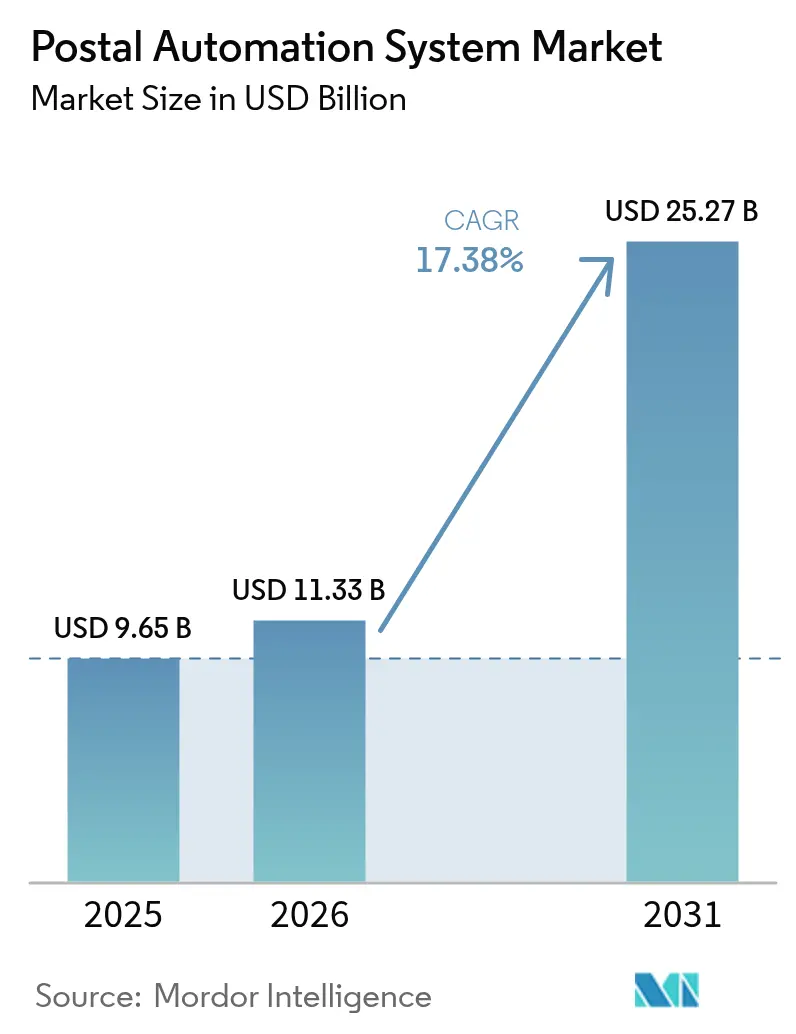
| Market Size (2026) | USD 11.33 Billion |
| Market Size (2031) | USD 25.27 Billion |
| Growth Rate (2026 - 2031) | 17.38 % |
| Fastest Growing Market | Asia Pacific |
| Largest Market | North America |
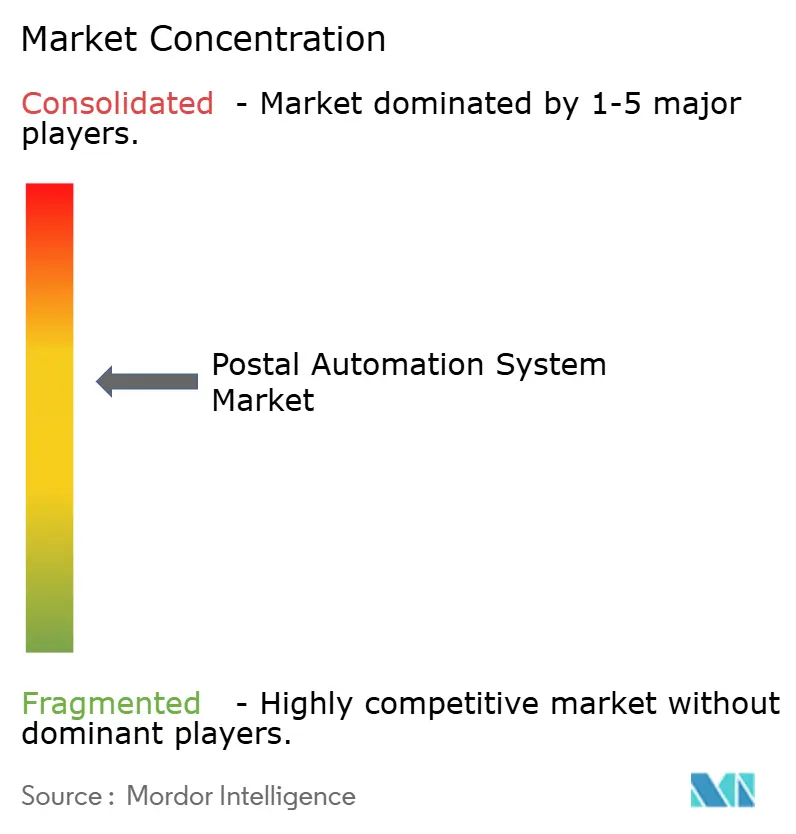
| Market Concentration | Medium |
Major Players *Disclaimer: Major Players sorted in no particular order Image © Mordor Intelligence. Reuse requires attribution under CC BY 4.0. | |
Postal Automation System Market Analysis by Mordor Intelligence
Postal automation system systems market size in 2026 is estimated at USD 11.33 billion, growing from 2025 value of USD 9.65 billion with 2031 projections showing USD 25.27 billion, growing at 17.38% CAGR over 2026-2031. Growth reflects rising cross-border e-commerce demand, postal modernization programs and sustained labor cost pressures that make automation economically attractive. North America and Europe account for the largest installed base because of sizeable public-sector investments and energy-efficiency regulations that favor next-generation equipment. Asia-Pacific is the fastest-growing region as China Post, Cainiao and Japan Post accelerate rural and urban automation projects, shortening delivery times and lowering manual labor costs. Hardware continues to dominate purchases, yet demand is shifting toward service contracts and robotics-as-a-service models that transfer performance risk to suppliers. Competitive intensity is moderate, with Vanderlande’s purchase of Siemens Logistics and BlueCrest’s acquisition of Fluence Automation redefining scale advantages in integrated hardware-software offerings.
Key Report Takeaways
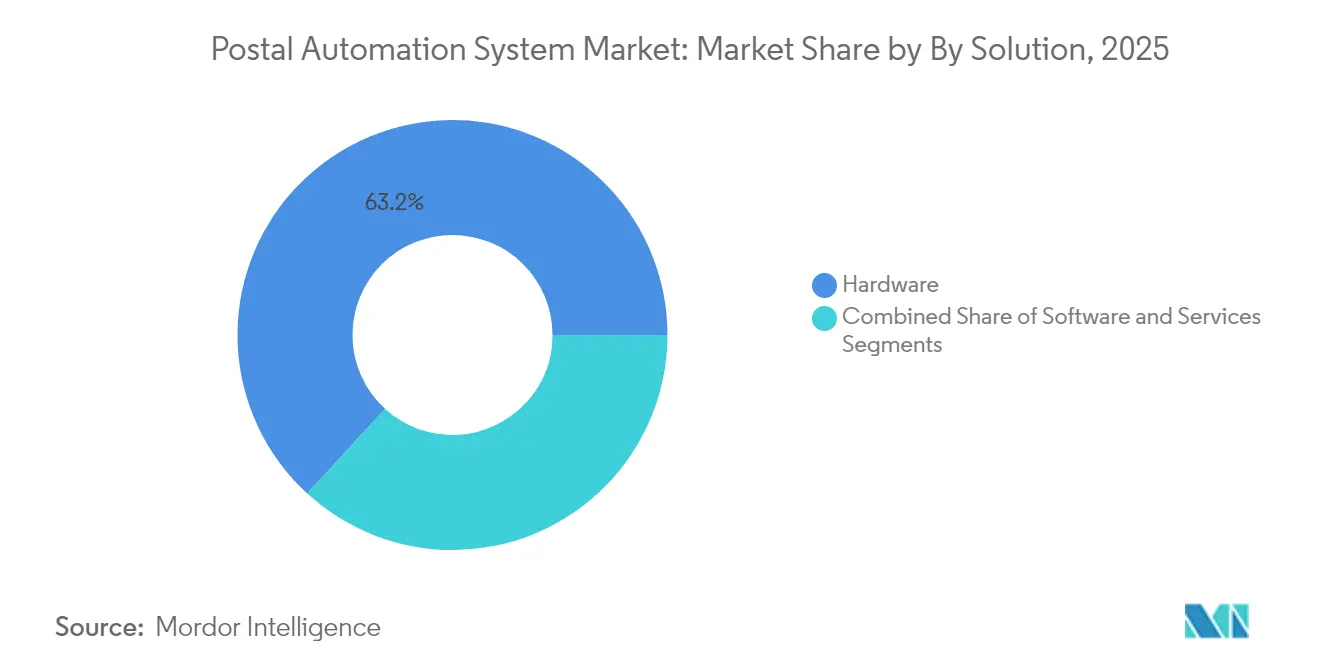
- By solution, hardware held 63.20% of the mail sorting systems market share in 2025, while the services segment is projected to expand at a 20.25% CAGR through 2031.
- By technology, parcel sorters led with 41.30% revenue share in 2025; automated guided vehicles and robotics record the highest projected CAGR at 23.2% through 2031.
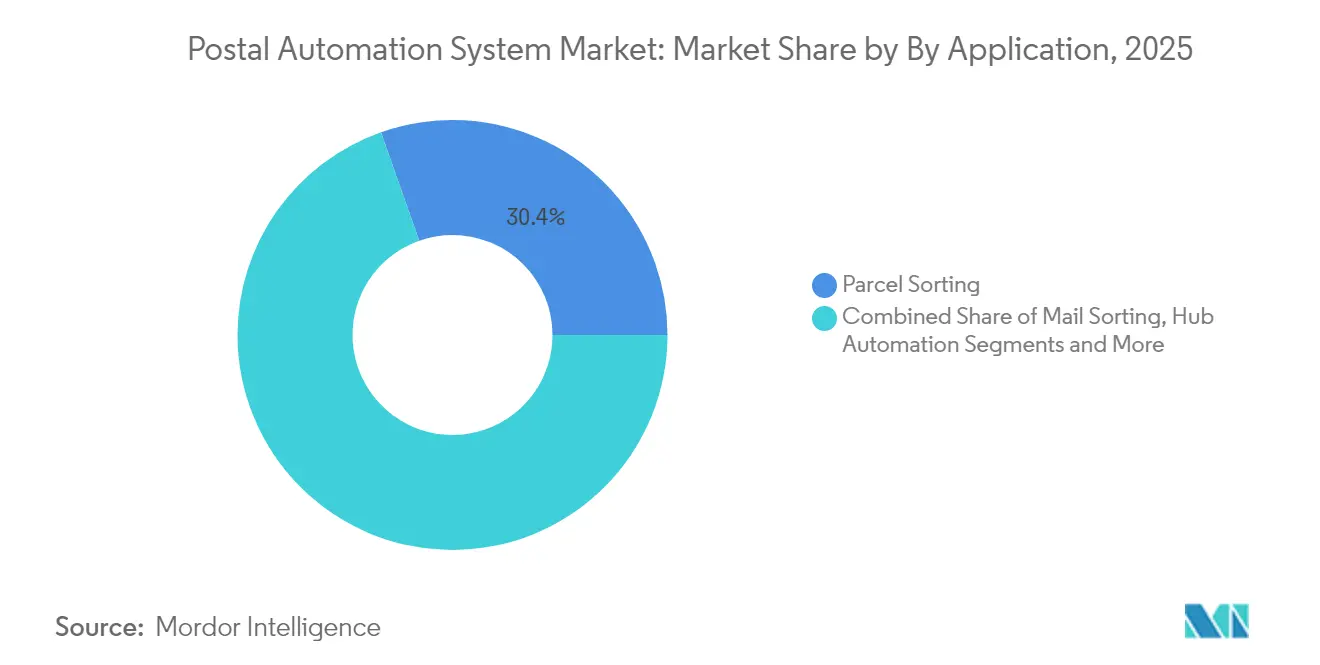
- By application, parcel sorting accounted for 30.40% of the mail sorting systems market size in 2025, while last-mile hub automation is advancing at a 25.45% CAGR to 2031.
- By end user, national postal operators captured 41.10% of the mail sorting systems market share in 2025; e-commerce fulfillment centers are expanding at a 22.6% CAGR through 2031.
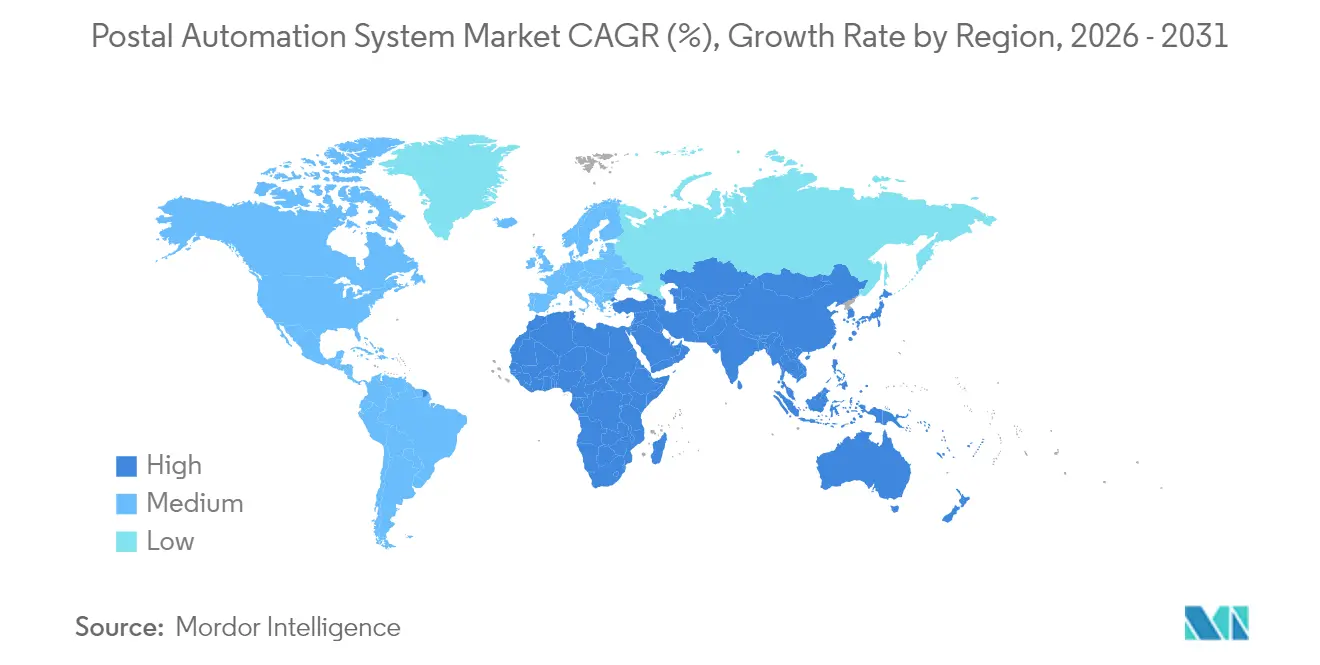
- By geography, North America is the largest regional market, while Asia-Pacific posts the fastest CAGR on the back of large-scale projects in China and Japan.
Note: Market size and forecast figures in this report are generated using Mordor Intelligence’s proprietary estimation framework, updated with the latest available data and insights as of 2026.
Market Trends and Insights
Drivers Impact Analysis of Postal Automation System Market*
| DRIVER | (~) % IMPACT ON CAGR FORECAST | GEOGRAPHIC RELEVANCE | IMPACT TIMELINE |
|---|---|---|---|
| Surge in cross-border e-commerce parcel volumes in Asia driving high-throughput parcel sorters | +3.2% | APAC core, spill-over to North America & EU | Medium term (2-4 years) |
| USPS "Delivering for America" modernization spurring automation upgrades in North America | +2.8% | North America, with technology transfer to global markets | Short term (≤ 2 years) |
| EU Green Deal demand for energy-efficient systems boosting replacement sales | +2.1% | Europe, with regulatory influence on global standards | Medium term (2-4 years) |
| Labor shortages & wage inflation accelerating robotic singulation adoption in CEP hubs | +4.3% | Global, with acute impact in developed markets | Short term (≤ 2 years) |
| Real-time track-and-trace mandates triggering RFID-enabled sorting adoption in Japan & South Korea | +1.7% | APAC core, with expansion to developed markets | Medium term (2-4 years) |
| Urban micro-fulfillment expansion increasing demand for compact modular sorters in Middle East | +1.4% | Middle East & North Africa, urban centers globally | Long term (≥ 4 years) |
| Source: Mordor Intelligence | |||
Surge in Cross-Border E-Commerce Parcel Volumes Driving High-Throughput Sorters
E-commerce parcels crossing borders continue to climb, with US parcel volumes reaching 21.7 billion in 2023 even as revenue per piece declined, underscoring the need for efficient high-throughput automation. Amazon Logistics overtook UPS on volume, proving that speed-optimized sorting networks confer a market edge. China Post and Cainiao lowered rural labor costs by deploying vision-guided systems that read waybills automatically, narrowing the urban-rural service gap. Operators now focus on processing density rather than cost per piece, since automation enables higher volumes without proportional staffing increases.[1]
USPS “Delivering for America” Modernization Spurring Automation Upgrades
USPS committed USD 40 billion to revamp its network, expanding daily package capacity to 60 million items and aligning mail and parcel flows for improved reliability. Zebra Technologies printers, a new remote forwarding system, and the USPS Ship migration reinforce the digital layer underpinning physical automation. Suppliers leverage USPS specifications to scale similar solutions globally, creating a technology spill-over that accelerates adoption in other regions.[2]
Labor Shortages Accelerating Robotic Singulation Adoption
Worker scarcity drove USD 55 billion in automation investment since 2021, with logistics leading the uptake. UPS will shutter 200 sort centers yet invest USD 9 billion in automation to save USD 3 billion annually by 2028. VTPost’s 160 LiBiao robots now handle 6,000 parcels hourly with negligible error, redeploying staff to higher-value tasks and reducing operating costs.
EU Green Deal Demand for Energy-Efficient Systems
Regulation 2024/1781 sets ecodesign rules for industrial products, making durability and recyclability mandatory. The Net Zero Industry Act aims for 40% manufacturing capacity in net-zero tech by 2030, encouraging public buyers to select systems with lower power use. DHL targets cutting logistics-related greenhouse gases below 29 million tons by 2030, reinforcing market demand for high-efficiency drives and low-noise solutions.
Restraints Impact Analysis of Postal Automation System Market*
| RESTRAINTS | (~) % IMPACT ON CAGR FORECAST | GEOGRAPHIC RELEVANCE | IMPACT TIMELINE |
|---|---|---|---|
| Legacy IT integration complexity within postal infrastructures in Africa & LatAm | -2.1% | Africa & Latin America, with spillover to emerging markets | Long term (≥ 4 years) |
| Capital-intensive investments with >7-year ROI deterring small CEP operators | -1.8% | Global, with acute impact on emerging market operators | Medium term (2-4 years) |
| Import tariffs on automation equipment in Brazil & India elevating TCO | -1.3% | Brazil & India, with regional trade bloc implications | Short term (≤ 2 years) |
| Declining letter-mail volumes limiting spending on letter-sorting technology in Europe | -1.5% | Europe, with secondary impact on developed markets | Medium term (2-4 years) |
| Source: Mordor Intelligence | |||
Legacy IT Integration Complexity Limiting Emerging Market Adoption
Developing posts often run on ageing platforms that cannot easily connect to modern sorters, extending project timelines and raising costs. The IMF highlights similar challenges in payment rails that mirror logistics bottlenecks, stressing a need for basic digital infrastructure before advanced automation can scale.
Capital-Intensive Investments Deterring Small CEP Operators
KION projects the mobile automation market at EUR 20 billion by 2027, a figure that underscores the hefty capital outlay required for competitiveness. Kardex posted a 24.3% revenue rise to EUR 702.9 million in 2023, yet order delays reveal customer hesitancy when payback exceeds seven years.
*Our forecasts treat driver/restraint impacts as directional, not additive. The impact forecasts reflect baseline growth, mix effects, and variable interactions.
Postal Automation System Market Segment Analysis
By Solution:
Services Accelerate Despite Hardware DominanceThe mail sorting systems market size attributed to hardware reached USD 6.1 billion in 2025, reflecting capital-intensive conveyor, sensor and OCR investments. Services produced a smaller revenue base but are projected to grow at a 20.25% CAGR to 2031 as operators favor managed outcomes over outright equipment ownership. Software licenses bridge the two, enabling live performance dashboards, route optimization and predictive maintenance that extend asset life.
Adoption of outcome-based contracts shifts risk to vendors, with Quadient and BlueCrest guaranteeing throughput levels and uptime. These arrangements allow even mid-tier operators to access sophisticated capabilities without upfront capital, broadening the addressable base for the mail sorting systems market. Hardware spending will remain sizeable, yet revenue mix analysis shows services closing the gap by 2031 as subscription and pay-per-sort models scale.

By Technology:
AGV and Robotics Disrupt Traditional SortingParcel sorters commanded 41.30% of the mail sorting systems market share in 2025 on the strength of long-established cross-belt and tilt-tray designs. Growth momentum, however, lies with automated guided vehicles and collaborative robots that post a 23.2% CAGR through 2031. Robotics removes fixed-track constraints, letting operators re-configure hubs quickly to manage seasonal peaks.
La Poste’s data show mail contributing only 15.8% of revenue in 2024, down from 52% in 2010, signaling a structural shift away from letter-centric machinery toward parcel-centric robotics. Culler-facer-canceller units retain a niche in high-volume philatelic segments, but hybrid sites integrating AGVs, vision systems and coding modules deliver superior flexibility. Vendors now bundle fleet-management software with mobile robots, improving ROI for operators constrained by real estate limits in urban hubs.
By Application:
Last-Mile Automation Drives GrowthParcel sorting still generated 30.40% of revenue in 2025, yet last-mile hub automation will contribute the largest absolute growth as it scales at 25.45% CAGR. Fulfillment centers located closer to consumers opt for compact modular sorters that handle polybags, flats and small parcels in one stream, reducing the need for multiple downstream processes.
Japan Post’s digital address initiative enhances field-level accuracy, cutting mis-sorts and enabling smoother handoffs between automated central facilities and last-mile depots. Traditional mail sorting persists in government and financial services where physical delivery remains mandatory, yet operators integrate OCR and label-printing modules into single-pass processes to maximize floor space. Address printing systems now link directly with customer data to create audit trails, aligning with stricter compliance demands.
By End User:
E-Commerce Fulfillment Centers AccelerateNational postal operators captured 41.10% of revenue in 2025, benefitting from universal service mandates and expansive networks that make large-scale automation cost-effective. However, e-commerce fulfillment centers are projected to expand revenue at a 22.6% CAGR through 2031 as platforms such as Amazon and Alibaba vertically integrate logistics to control customer experience.
Singapore Post provides a case study in transformation: logistics now accounts for 70% of revenue, up from 38% five years earlier, driven by 4PL platform expansion. Courier and parcel specialists occupy a middle space, pressured by postal incumbents’ scale and e-commerce players’ integrated models. Government agencies and financial institutions continue to demand bespoke solutions with advanced security features, supporting a premium niche for suppliers.
Geography Analysis
North America Postal Automation System Market
North America leads global revenue owing to the USPS “Delivering for America” program that injects USD 40 billion into facility upgrades and boosts daily capacity to 60 million packages. Canada follows a similar trajectory, adopting robotics to mitigate labor shortages in large urban hubs such as Toronto and Vancouver. Stable regulatory regimes and predictable parcel flows shorten payback periods, reinforcing vendor preference for early product rollouts in the region.
Europe Postal Automation System Market
Europe contributes robust growth underpinned by the Net Zero Industry Act, which prioritizes energy-efficient equipment and accelerates replacement cycles. Germany’s updated postal law gives Deutsche Post flexibility to optimize routes, while DHL holds 63% mail and 40% parcel market shares, creating economies of scale for nationwide automation. The United Kingdom’s approval of the DHL eCommerce–Evri merger forms a combined network processing more than 1 billion parcels annually, anchoring further automation investments.
APAC Postal Automation System Market
Asia-Pacific records the fastest CAGR, propelled by China Post and Cainiao’s automation deployments and Japan’s proposed 500-kilometer automated conveyor network to counter driver shortages. South Korea leverages advanced telecom infrastructure to roll out RFID-enabled sortation, while India wrestles with equipment tariffs that raise project costs. Australia’s dispersed population boosts interest in robotics that can flexibly scale capacity across long distances.
LATAM Postal Automation System Market
Latin America delivers uneven performance. Mexico benefits from USMCA proximity, attracting cross-border parcel flows that justify automation in northern hubs. Brazil’s compliance program supports e-commerce growth, yet tariffs on imported automation remain a drag on total cost of ownership. Argentina’s economic volatility prolongs investment decision cycles, limiting market penetration for high-end solutions.
MEA Postal Automation System Market
The Middle East and Africa remain nascent but promising. Gulf states invest in urban micro-fulfillment facilities that demand compact modular systems, while Africa faces legacy IT hurdles that slow deployments. International aid programs targeting postal infrastructure modernization could unlock future demand, especially as smartphone-led commerce expands across major urban corridors.
Regulatory Landscape
Postal automation investment is increasingly tied to data, customs, and pricing-rule compliance, alongside throughput targets. Cross-border parcel handling is influenced by Universal Postal Union (UPU) standards for electronic data exchange, including Electronic Advance Data (EAD) messaging used for customs and security risk assessment. The UPU Standards Board maintains baseline technical standards for barcodes, messaging, and interoperability that automation vendors and postal operators use.
In North America, domestic-mail rules and rate governance are changing operational requirements for sortation and data capture. The US Postal Regulatory Commission adopted a January 2026 rule that restricts Market Dominant rate adjustments to once per fiscal year through 2030, while USPS implemented July 2026 Domestic Mail Manual changes that simplify certain presort and rate structures, including a shift from ADC/AADC categories toward 3-Digit rate constructs and nomenclature updates. In Canada, 2026 Canada Gazette instruments amended processes to give Canada Post additional latitude on stamp-rate setting without prior Governor in Council approval, reinforcing the need for flexible pricing, product classification, and reporting capabilities that support postal automation and the underlying IT layers.
Value Chain Analysis
The postal automation system value chain starts with core components (conveyance, sensors, imaging/OCR, label printing, drives, and controls) and expands into software (vision and address interpretation, routing logic, fleet management for AGVs and AMRs, and analytics) and services (integration, uptime guarantees, lifecycle maintenance, and outcome-based contracts). Hardware OEMs and intralogistics suppliers deliver parcel and mixed-mail sortation platforms, while specialist providers add modules such as virtual keying and image enhancement, increasingly packaged into integrated stacks deployed at processing centers, delivery hubs, and e-commerce fulfillment sites.
Downstream, systems integrators and operators manage deployment and network-wide standardization, with public procurement and framework contracting shaping vendor selection and rollout cadence. USPS contracting illustrates this channel from design and manufacturing to installation and testing, including a 2025 award to Intralox for Parallel Induction Linear Sorter (PILS) deployments. In Europe, supplier ecosystems and alliances are forming to offer bundled solutions and financing support, such as the French Postal Suppliers Alliance (FPSA), founded in 2024 to consolidate postal and e-commerce supply-chain capabilities, while vendors like BOWE GROUP position integrated IoT-enabled automation portfolios to support operational visibility and maintenance across distributed sites.
Competitive Landscape
Competition in the mail sorting systems market remains moderate. Vanderlande’s USD 325 million acquisition of Siemens Logistics strengthens its postal and baggage-handling portfolio, creating synergies in conveyor technology and control software. Traditional OEMs such as Toshiba Infrastructure Systems, NEC and Pitney Bowes still command significant installed bases but face pressure from robotics specialists and software-first entrants.
Strategic shifts favor vertical integration and service-led revenue. BlueCrest’s 2025 purchase of Fluence Automation expands its ability to provide turnkey solutions from hardware through lifecycle optimization. Dematic and Beumer Group launch energy-efficient drive systems and cloud analytics platforms to comply with EU ecodesign rules and to differentiate on sustainability.
Emerging disruptors focus on robotics. LiBiao’s autonomous mobile sorters replace fixed cross-belt lines, offering scalability for operators facing real estate constraints. KION opened an Antwerp center of excellence to co-develop customer-specific robotic modules that integrate seamlessly with SAP and other WMS platforms. Software innovation—AI-enabled vision, predictive maintenance and digital twins—has become as critical as mechanical throughput, narrowing differentiation windows for legacy hardware players.
Postal Automation System Industry Leaders
-
Siemens Logistics GmbH
-
Toshiba Infrastructure Systems & Solutions Corp.
-
NEC Corporation
-
Vanderlande Industries B.V.
-
Pitney Bowes Inc.
- *Disclaimer: Major Players sorted in no particular order
Postal Automation System Market Companies Covered in this Report
- Siemens Logistics GmbH
- Toshiba Infrastructure Systems and Solutions Corp.
- NEC Corporation
- Pitney Bowes Inc.
- Vanderlande Industries B.V.
- Beumer Group GmbH and Co. KG
- Solystic SAS
- Fives Group
- Bowe Systec GmbH
- Interroll Holding AG
- BlueCrest Inc.
- Opex Corporation
- EuroSort Systems
- Honeywell Intelligrated
- Dematic (Kion Group)
- KUKA AG
- Zhejiang Libiao Robotics
- Fluence Automation LLC
- Leonardo S.p.A.
- Engineering Production and Installation (EPI)
Market Opportunities and Future Outlook
Modernization programs and facility build-outs are creating near-term whitespace for modular parcel automation, software integration, and managed service delivery, especially where operators are restructuring networks and standardizing equipment fleets. USPS activity provides a clear anchor: a March 2026 notification referenced deployment or installation of additional automated equipment during FY 2026, including SIPS+, SDUS/SDUS+, PILS, AFCS 200, and PARS-TR/CARS systems, while July 2026 activations added eight new Sorting and Delivery Centers (S&DCs) effective July 11, 2026. Together, equipment deployment and node activation increase demand for scalable controls, data capture, and installation and testing services across multiple processing and delivery points.
Opportunities also show up in Asia-Pacific as operators fund step-change capacity upgrades and look for compact, high-throughput systems for parcels and mixed mail. In Singapore, SingPost unveiled a S$30 million automated sortation facility at its Regional eCommerce Logistics Hub in Tampines in June 2026, lifting small and medium parcel processing capacity from 100,000 to 300,000 parcels per day. These projects support demand for high-accuracy imaging/OCR, robotics for singulation and induction, and lifecycle service contracts that maintain throughput while reducing labor dependence, consistent with the market shift toward services and outcome-based models described in the report context.
Recent Industry Developments in Postal Automation System Market
- April 2026: Vanderlande completed its acquisition of Siemens Logistics in the United States, following earlier completion in EMEA. The transaction consolidates a larger installed base across parcel and logistics automation and strengthens the ability to deliver integrated hardware and control software under a single global organization.
- December 2025: Toshiba signed a letter of intent with Qazpost JSC to collaborate on improving warehouse efficiency using autonomous mobile robots, building on a prior demonstration. The move broadens Toshiba's AMR-led automation footprint in Central Asia and supports wider adoption of mobile automation in postal and parcel operations.
- April 2024: USPS published updated operational guidance for mail preparation and acceptance through its official publications, reinforcing standardized requirements that interact with automated sorting and verification processes. Clearer operational rules support investments in data capture, barcode compliance, and workflow automation that reduce exceptions at induction and processing stages.
Postal Automation System Market Report Scope and Research Methodology
Market Definition and Coverage
This market is defined as the revenue generated from postal automation systems used to automate mail and parcel handling in postal and courier environments, including the equipment and the related software and support needed for day to day operations.
Scope exclusions: We exclude last mile delivery assets, general warehouse automation used outside postal hubs, and purely manual services that do not involve automation systems.
Segments Covered in This Report
- By Solution
- Hardware
- Software
- Services
- By Technology
- Culler-Facer-Canceller (CFC) Systems
- Letter Sorters
- Flat Mail Sorters
- Parcel Sorters
- Mixed-Mail Sorters
- Coding and Printing/OCR Systems
- Automated Guided Vehicles and Robotics
- Others
- By Application
- Parcel Sorting
- Mail Sorting
- Address Printing and Labelling
- Data Capture and OCR
- Last-Mile Delivery
- Hub Automation
- By End User
- National Postal Operators
- Courier, Express and Parcel (CEP) Companies
- E-commerce Fulfilment Centers
- Government Agencies and Others
- By Geography
- North America
- United States
- Canada
- Mexico
- Europe
- United Kingdom
- Germany
- France
- Italy
- Rest of Europe
- Asia-Pacific
- China
- Japan
- India
- South Korea
- Rest of Asia
- Middle East
- Israel
- Saudi Arabia
- United Arab Emirates
- Turkey
- Rest of Middle East
- Africa
- South Africa
- Egypt
- Rest of Africa
- South America
- Brazil
- Argentina
- Rest of South America
- North America
Data Sources, Market Sizing, and Validation
Desk Research
Desk work started with building a clean view of demand drivers and capacity signals for mail and parcel networks, because these explain why automation budgets rise or pause. We leaned on public sources such as the Universal Postal Union datasets, World Bank indicators, OECD statistics, and national postal regulator publications that describe mail volumes, parcel growth, and service level targets. Trade and shipment context was also checked using customs and trade statistics from sources such as UN Comtrade, which helped us sanity check where equipment demand is likely to be concentrated.
To connect demand signals to dollars, we reviewed public company filings, investor presentations, and press releases that discuss sorting upgrades, modernization programs, and large hub expansions. We also used paid subscriptions for company financials and intelligence, and for patent databases, mainly to track product refresh cycles and where automation features are moving, for example imaging and recognition improvements. The desk sources listed here are not exhaustive, and we used additional public references to collect, validate, and clarify the final assumptions.
Primary Interviews and Surveys
Primary work focused on interviews and short surveys with postal operators, integrators, component suppliers, and service teams that support installation and maintenance. We used these discussions to confirm adoption timing, typical upgrade cycles, and how spending splits between hardware, software, and service contracts across major regions. When desk checks shifted any assumptions, we re-contacted a few respondents to align on the updated view of how deployments translate into revenue.
Distribution of primary research fieldwork respondents
| Company type | Respondent position | Region |
|---|---|---|
| Top tier: 34% | CXOs: 12% | APAC: 43% |
| Mid tier: 49% | Functional/Unit leaders: 35% | EMEA: 33% |
| Smaller Players: 17% | Managers: 53% | Americas: 24% |
Market-Sizing & Forecasting
Our sizing logic starts with a top-down build where mail and parcel throughput, sorting center footprints, and modernization activity are used to reconstruct the reachable automation spend by region. Once that demand pool is shaped, we corroborate totals using selective bottom-up approximations, such as sampled average selling prices for key system types multiplied by observed shipment volumes, plus a light roll up of supplier revenues where disclosures are clear.
In the model, a few practical inputs do most of the work. These include parcel volume growth from e-commerce, the share of items processed through automated hubs versus manual sites, replacement and upgrade cycles for sorters and scanners, average system price progression by technology generation, and the pace of new hub buildouts. Where a country has limited disclosure, gaps are handled through proxy indicators such as trade signals for automation equipment, peer country automation density, and interview based adoption ranges. For forecasting, we used scenario analysis supported by expert input, because automation budgets can swing based on labor availability, service level mandates, and capex timing that does not follow a smooth line.
Data Validation & Update Cycle
Results are checked through multiple passes so the final numbers do not rely on a single assumption. We compare outputs against independent signals like parcel growth trends, announced facility upgrades, and disclosed capex intensity, and then review outliers to understand if they reflect true step changes or data issues. Before sign-off, the model and key assumptions go through an internal analyst review, and any large variance triggers follow up questions to respondents for confirmation.
The report is refreshed each year, and interim updates are done when material events occur, such as major postal modernization programs, policy shifts, or large project awards. Right before delivery, we complete a final freshness pass so clients receive the most current view available at that time.
Mordor Intelligence's Postal Automation System Market Estimate Compared With Other Published Estimates
Published market sizes for postal automation systems can look far apart even when everyone is discussing similar equipment, because the scope and the way revenues are counted are not the same. Differences usually come from whether services are included, whether adjacent logistics automation is folded in, which year is treated as the base, and how currency timing is handled.
Some sources group postal automation together with a wider parcel and logistics automation spend and also add broad service revenues like data management and analytics. In contrast, Mordor Intelligence limits the number to postal automation system deployments and their directly attached software and service work, so the demand pool stays tied to mail and parcel processing inside postal and courier networks.
Benchmark comparison
| Source | Market Size | Gaps in Research Methodology |
|---|---|---|
| Mordor Intelligence | USD 11.33 B (2026) | |
| Global Consultancy A | USD 0.90 B (2024) | Uses an earlier base year and a narrower revenue capture that is often closer to core equipment categories, which can understate service attached revenues and later cycle upgrade waves. |
| Industry Publisher B | USD 3.91 B (2024) | Broader definition that adds multiple service lines and factory gate valuations across a wider automation ecosystem, which can pull in spending that is not strictly tied to postal hub automation systems. |
The spread in the table mainly comes from what each estimate counts as in-scope revenue and how the base year is set. When the inputs are anchored to throughput growth, upgrade cycles, and system pricing, the resulting number becomes easier to trace, and it remains repeatable even when only partial public data is available.
Key Questions Answered in the Report
What is the current size of the mail sorting systems market?
The market generated USD 11.33 billion in revenue in 2026 and is on track to reach USD 25.27 billion by 2031.
Which region is expanding fastest in mail sorting automation?
Asia-Pacific posts the highest CAGR as China, Japan and South Korea scale large-format projects to handle rising e-commerce volumes.
Why are services growing faster than hardware?
Operators prefer managed automation contracts that shift performance risk to vendors, accelerating service revenue at a 20.25% CAGR even as hardware remains essential.
How do labor shortages influence technology choices?
Worker scarcity increases demand for robotic singulation and AGV systems that sustain throughput without adding headcount, boosting robotics growth at 23.2% CAGR.
What role do sustainability regulations play in equipment selection?
EU ecodesign rules and the Net Zero Industry Act encourage buyers to replace older sorters with energy-efficient models, creating a strong replacement market in Europe.
Who are the leading vendors in the mail sorting systems market?
Key players include Vanderlande, Pitney Bowes, Toshiba Infrastructure Systems, NEC, BlueCrest, Dematic and LiBiao, each focusing on integrated hardware-software solutions and outcome-based services.