
Market Overview
| Study Period | 2020 - 2031 |
|---|---|
| Forecast Data Period | 2026 - 2031 |
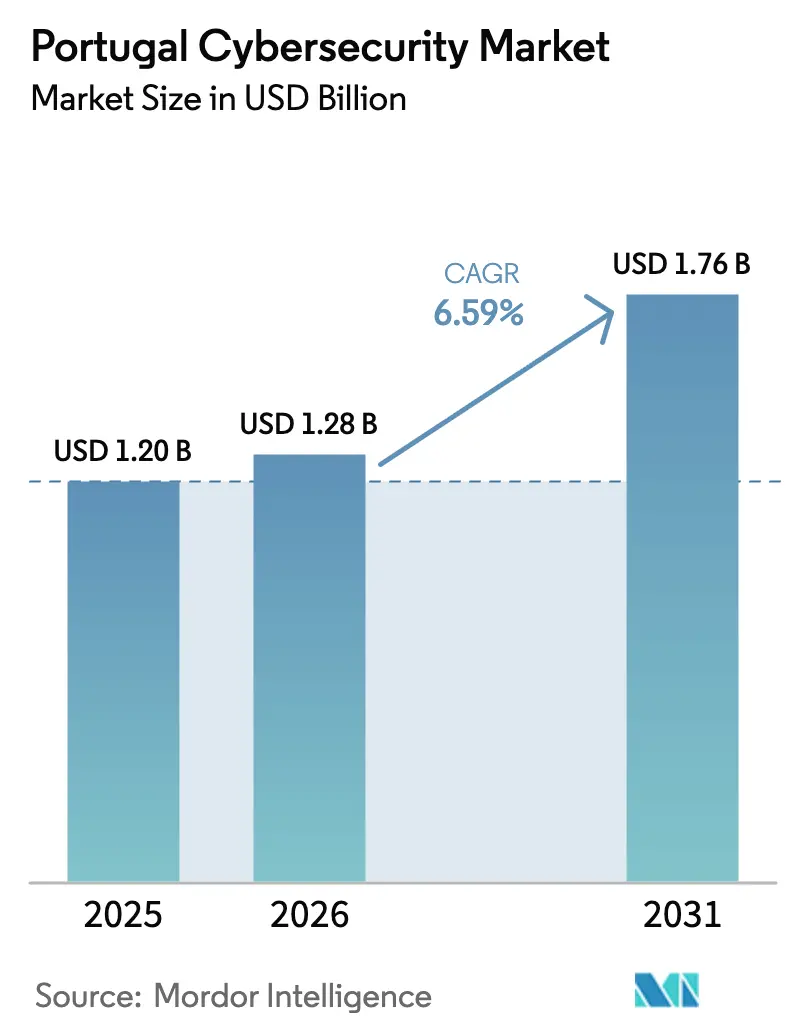
| Base Year Market Size (2025) | USD 1.20 Billion |
| Market Size (2026) | USD 1.28 Billion |
| Market Size (2031) | USD 1.76 Billion |
| Growth Rate (2026 - 2031) | 6.59 % |
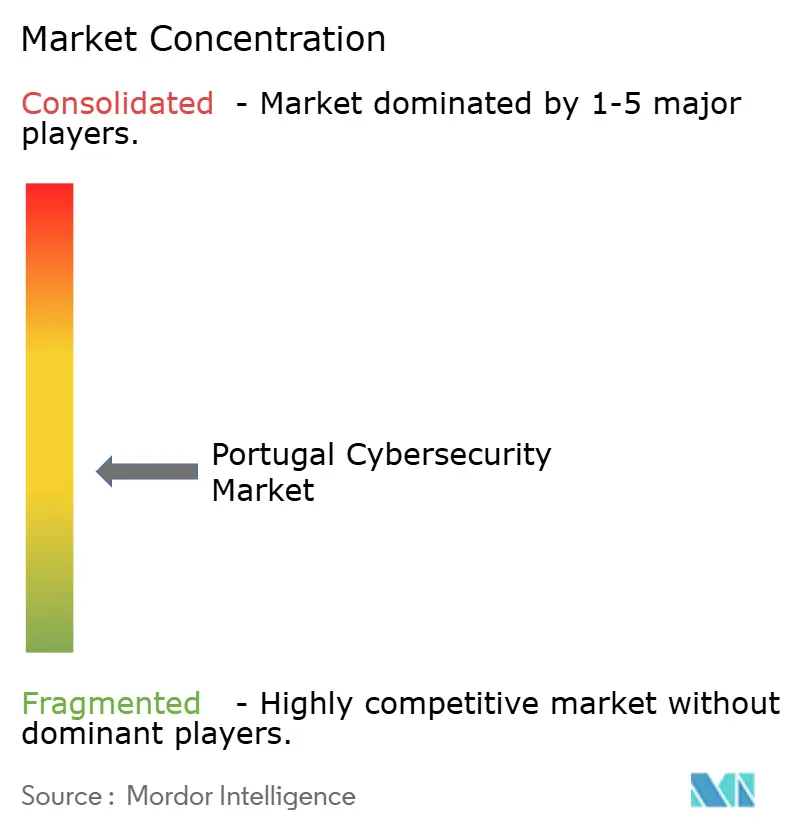
| Market Concentration | Medium |
Major Players *Disclaimer: Major Players sorted in no particular order Image © Mordor Intelligence. Reuse requires attribution under CC BY 4.0. | |
Portugal Cybersecurity Market Analysis by Mordor Intelligence
Portugal cybersecurity market size in 2026 is estimated at USD 1.28 billion, growing from 2025 value of USD 1.20 billion with 2031 projections showing USD 1.76 billion, growing at 6.59% CAGR over 2026-2031. Rising investment is anchored in the country’s role as a Southern-European data gateway and in strict implementation of the EU’s NIS2 Directive and the Digital Operational Resilience Act (DORA)[1]. Continuous growth also stems from public-sector digital-transition funds, a heightened critical-infrastructure threat profile and aggressive cloud adoption. New hyperscale data-center campuses along the Sines-Lisboa-Porto corridor embed zero-trust baselines in supplier contracts, pushing enterprises toward identity-centric security controls. Large programmable grants aimed at small and mid-size companies require auditable cyber safeguards, creating fresh pockets of demand. Talent shortages and fragmented public procurement temper momentum yet they also redirect spending toward managed services and automation, thereby sustaining the upward trajectory of the Portugal cybersecurity market.
Key Report Takeaways
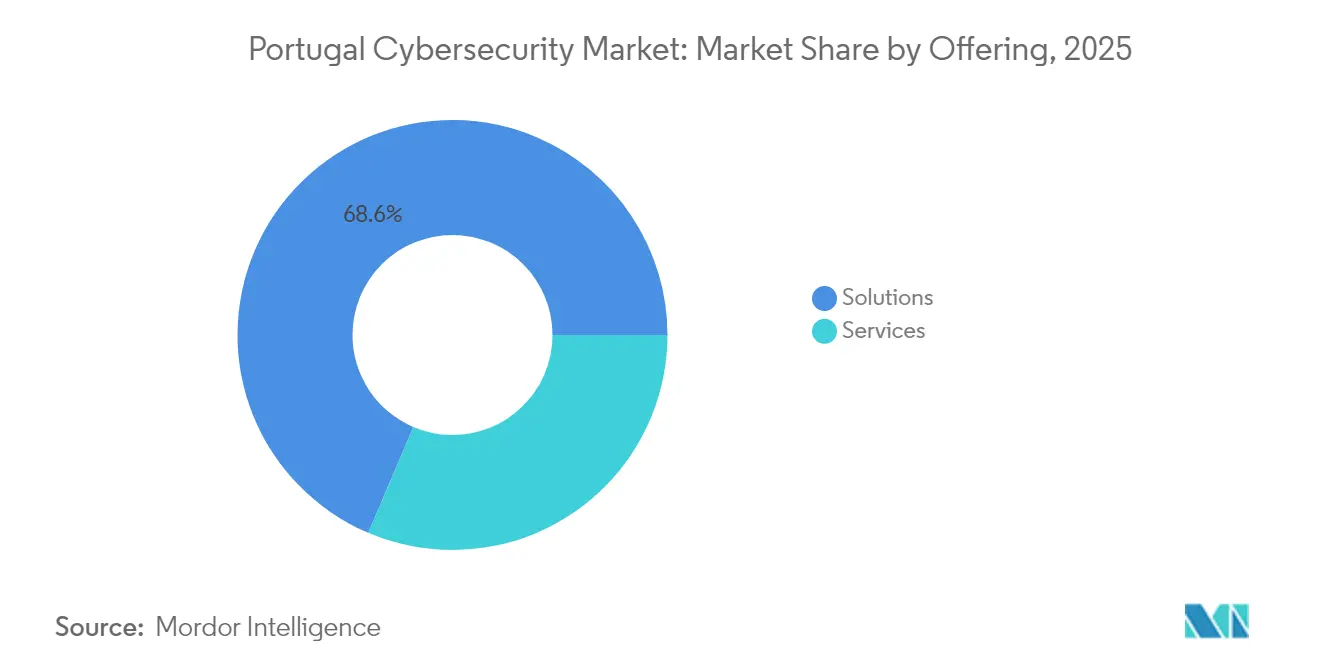
- By offering, solutions captured 68.60% Portugal cybersecurity market share in 2025; services are projected to grow fastest at an 8.05% CAGR through 2031.
- By deployment mode, on-premise represented 70.55% of the Portugal cybersecurity market size in 2025, while cloud deployments are forecast to climb at an 8.24% CAGR through 2031.
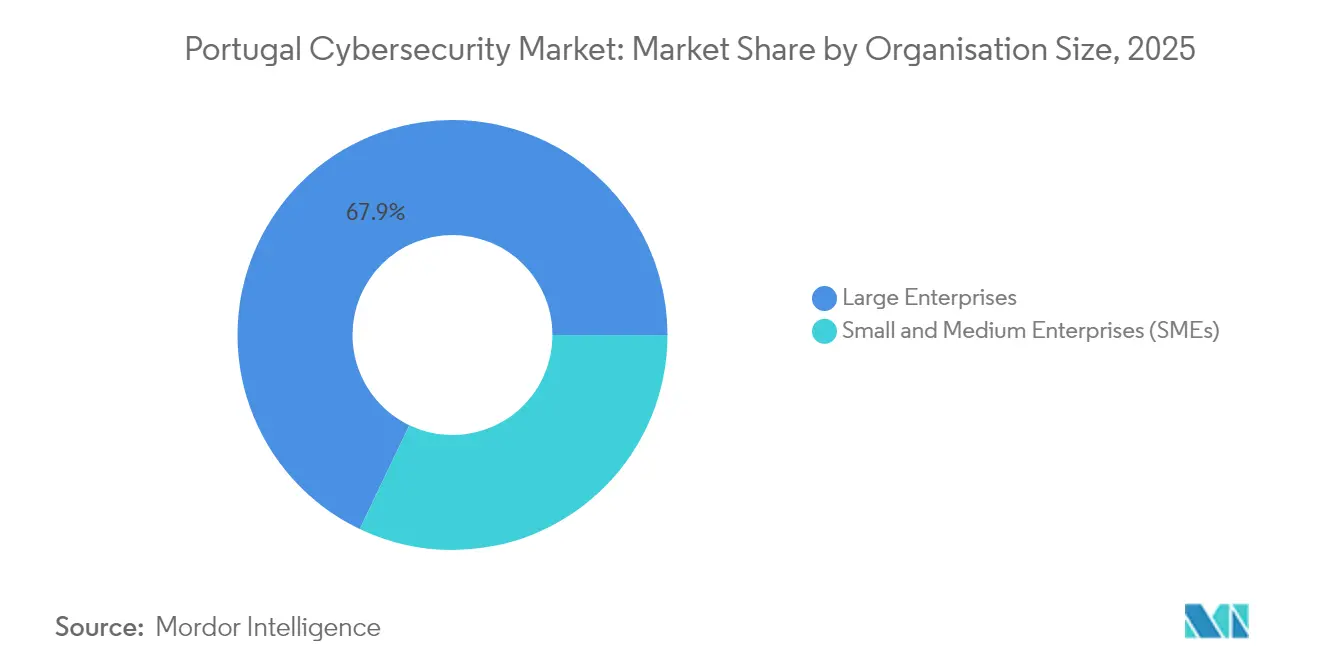
- By organisation size, large enterprises held 67.90% revenue in 2025; SMEs are expected to advance at a 7.63% CAGR by 2031.
- By end user, IT and telecom led with 22.50% revenue share in 2025; BFSI is projected to post the quickest growth at a 6.66% CAGR to 2031.
Note: Market size and forecast figures in this report are generated using Mordor Intelligence’s proprietary estimation framework, updated with the latest available data and insights as of 2026.
Market Trends and Insights
Drivers Impact Analysis of Portugal Cybersecurity Market*
| Driver | (~) % Impact on CAGR Forecast | Geographic Relevance | Impact Timeline |
|---|---|---|---|
| EU NIS2 compliance deadlines boosting spend | +1.8% | Global, with early gains in Norte, Centro, Lisboa | Medium term (2-4 years) |
| Remote-work and cloud adoption exposing attack-surface | +1.5% | National, concentrated in Lisboa and Porto tech hubs | Short term (≤ 2 years) |
| Spike in public-sector and banking cyber incidents | +1.2% | National, with spillover to critical infrastructure operators | Short term (≤ 2 years) |
| Hyperscale data-center build-outs requiring zero-trust architectures | +1.0% | Regional, concentrated in Sines, Lisboa, Porto corridors | Long term (≥ 4 years) |
| Portugal Tech II VC fund accelerating local cyber start-ups | +0.8% | National, with concentration in Lisboa, Porto, Coimbra | Medium term (2-4 years) |
| SME digitalization grants with mandatory cybersecurity outlays | +0.4% | National, with stronger uptake in Centro and Norte regions | Medium term (2-4 years) |
| Source: Mordor Intelligence | |||
EU NIS2 compliance deadlines boosting spend
Portugal is finalising the transposition of NIS2. Organisations now face compressed windows to map assets, perform risk assessments and report incidents. The National Cybersecurity Centre (CNCS) recommends integrated approaches instead of point solutions, raising demand for platform architectures that merge vulnerability management, threat intelligence and automated reporting.
Remote-work and cloud adoption expanding attack surface
More than 80 000 tech professionals work in Portugal; a remote-first culture widens perimeters far beyond corporate offices. Enterprises therefore move to zero-trust network access and strong identity controls, replacing VPN-centric approaches that struggled during pandemic shifts.
Spike in public-sector and banking cyber incidents
High-profile disruptions in the Iberian power grid and repeated phishing campaigns against national ministries raised awareness of cross-sector cyber dependencies. Banco de Portugal has issued circulars compelling financial institutions to formalise ICT-risk frameworks aligned with DORA, accelerating procurements of security-information-and-event-management (SIEM) upgrades and managed detection services.
Hyperscale data-center build-outs requiring zero-trust architectures
More than EUR 12 billion in confirmed data-center investment flows into Portugal, with projects such as the Start Campus complex specifying micro-segmented networks and post-quantum encryption for all suppliers. These requirements ripple through subcontractors and local managed-service providers, lifting total addressable demand in the Portugal cybersecurity market.
Restraints Impact Analysis of Portugal Cybersecurity Market*
| Restraint | (~) % Impact on CAGR Forecast | Geographic Relevance | Impact Timeline |
|---|---|---|---|
| Acute cyber-talent shortage inflating salary costs | -1.2% | National, most severe in Lisboa and Porto tech hubs | Short term (≤ 2 years) |
| Legacy IT penetration and tight SME budgets | -0.8% | National, concentrated in traditional manufacturing regions | Medium term (2-4 years) |
| Fragmented public procurement restricting deal sizes | -0.6% | National, with spillover effects across all regions | Medium term (2-4 years) |
| In-house IT culture slowing MSSP uptake | -0.4% | National, strongest in large enterprises and government | Long term (≥ 4 years) |
| Source: Mordor Intelligence | |||
Acute cyber-talent shortage inflating salary costs
The ENISA “Cybersecurity Skills Shortage” report shows 65% of Portuguese entities struggling to fill defensive roles; salaries for senior architects now top EUR 100 000, more than double average IT wages[2]. Companies substitute with managed detection-and-response subscriptions and AI-driven monitoring, injecting momentum into the services segment of the Portugal cybersecurity market.
Legacy IT penetration and tight SME budgets
OECD surveys reveal 18% of Portuguese SMEs still deploy no dedicated security controls, while 44% rely only on basic antivirus software. Up-front hardware costs and limited in-house skills slow adoption, though EU-funded grant programmes increasingly condition payouts on verified cyber safeguards.
*Our forecasts treat driver/restraint impacts as directional, not additive. The impact forecasts reflect baseline growth, mix effects, and variable interactions.
Portugal Cybersecurity Market Segment Analysis
By Offering:
Services gain momentum as compliance complexity risesSolutions accounted for 68.60% of Portugal cybersecurity market revenue in 2025. Integrated firewall, endpoint and identity platforms remain baseline purchases for regulated industries. Yet services outpace all other categories at an 8.05% CAGR as organisations seek external expertise to interpret NIS2, DORA and CNCS guidance. National service providers bundle incident-response retainers with 24 × 7 SOC staffing that many midsize firms cannot afford internally. Almost two-thirds of large buyers now require contracts to guarantee mean-time-to-detect below 15 minutes, a metric rarely achievable without specialised personnel.

By Deployment Mode:
Cloud chips away at on-premise leadershipOn-premise still held 70.55% Portugal cybersecurity market share in 2025, reflecting data-sovereignty sensitivities in energy and public administration. Cloud deployments, however, rise 8.24% annually, powered by EUR 2.46 billion in government digital-transition funds that showcase secure sovereign clouds for document management. Hybrid models now dominate new tenders: sensitive databases stay on dedicated hardware, while e-mail gateways and sandboxed analysis shift to SaaS.
By Organisation Size:
SMEs accelerate under grant-linked mandatesLarge enterprises commanded 67.90% of expenditure in 2025, driven by layered compliance obligations. Still, SMEs are on course for 7.63% CAGR because Portugal 2030 financing ties at least EUR 200 000 of every approved digital-transformation project to provable cybersecurity measures. Unified-threat-management appliances and subscription-based endpoint suites lower entry barriers, helping lift the Portugal cybersecurity market size attributable to small firms.
By End User:
BFSI races ahead on regulatory urgencyIT and telecom providers led spending with 22.50% revenue in 2025. BFSI is projected to accelerate the fastest at 6.66% CAGR through 2031. DORA requires banks to catalogue critical ICT functions, test under severe-but-plausible scenarios and report major cyber incidents within strict timelines. Portuguese lenders therefore expand governance-risk-and-compliance suites and automated third-party monitoring, feeding fresh orders into the Portugal cybersecurity market.
Geography Analysis
The Norte region generated 36.72% of 2025 revenue. A dense manufacturing base around Porto and Braga prioritises industrial-control-system monitoring and secure remote maintenance to comply with IEC 62443 guidelines. Universities of Minho and Porto produce applied-research graduates who staff regional managed-service centres.
Centro is forecast to grow fastest at 7.05% CAGR. The Cybersecurity Competence Center – Central Region opened in Coimbra and runs joint research labs and certification facilities, lowering barriers for local SMEs to meet NIS2 benchmarks. Leiria hosts additive-manufacturing firms adopting secure digital-twins that rely on embedded encryption.
Lisboa and Tagus Valley remain the nation’s digital nucleus. Web Summit and three hyperscale cloud regions concentrate talent and venture funding, fuelling advanced use cases such as automated secure-software pipelines. Start Campus in Sines adds 495 MW of green-powered server capacity with a strict zero-trust blueprint, enforcing minimum-security requirements on every subcontractor and thus enlarging the Portugal cybersecurity market.
Algarve, Alentejo and the islands of Azores and Madeira adopt cybersecurity to protect smart-tourism platforms and micro-grid controllers that underpin renewable-energy self-sufficiency. These smaller territories leverage EU structural funds to co-finance vulnerability assessments and cyber-awareness training.
Regulatory Landscape
Portugal's cybersecurity compliance baseline is anchored in the national cyberspace security framework set out by Law No. 46/2018, later complemented (including by Decree-Law No. 65/2021). In 2025, Decree-Law No. 125/2025 updated the legal framework to transpose the EU NIS2 Directive into Portuguese law, expanding the set of covered entities and strengthening duties around risk management and incident notification.
The National Cybersecurity Centre (CNCS) serves as the National Cybersecurity Authority, with responsibilities that include supervision, regulatory guidance, and sanctioning. It also coordinates national cooperation mechanisms such as the Rede Nacional de CSIRT. In parallel, EU-wide operational-resilience requirements for financial services (DORA) reinforce governance, testing, and third-party ICT-risk controls, with Portuguese financial oversight linked to Banco de Portugal and European supervisory bodies within the broader EU framework.
Value Chain Analysis
Demand is shaped by regulated buyers, including public administration, critical infrastructure operators, and BFSI organizations aligning ICT-risk programs with NIS2 and DORA obligations. Upstream, the supply base includes global cybersecurity platform vendors covering network security, endpoint, identity, and cloud security, alongside hyperscale and sovereign cloud providers, and local distributors and channel partners that package licensing with integration and support.
System integrators, MSSPs, and SOC operators operate midstream by translating CNCS guidance into controls, implementing monitoring and incident-response playbooks, and supporting reporting workflows. In the public sector, the Agency for Technological Reform of the State (ARTE) drives standardization through the Common ICT Architecture, which then influences procurement specifications for cloud migration, security baselines, and shared services. Downstream, incident-response coordination is reinforced by the Rede Nacional de CSIRT, while associations such as AP2SI and Alianca para a Ciberseguranca support capability building, networking, and the diffusion of practices that feed talent pipelines and vendor shortlists.
Competitive Landscape
The Portugal cybersecurity market is moderately fragmented. Global equipment suppliers—Cisco, Fortinet, Palo Alto Networks and Microsoft—deliver core platforms for firewalls, secure-access service edge and workload protection. National integrators such as Noesis and S21sec localise compliance playbooks, wrap managed detection services around leading platforms and translate EU legislation for Portuguese boards.
Innovation flourishes in niche segments. Ethiack commercialises continuous penetration testing with human-in-the-loop validation, serving over 50 domestic clients including the national airport operator. Probely, created in Porto and acquired by Snyk, exports automated web-vulnerability scanning built on machine-learning heuristics, demonstrating Portugal’s capacity to develop globally applicable security IP.
Foreign strategic buyers increase their presence to secure NIS2-related contracts. The scarcity of experienced SOC analysts raises acquisition multiples for mature service providers, while AI-rich start-ups attract venture capital for autonomous threat-detection engines. Together these dynamics enlarge the Portugal cybersecurity market while nudging it toward gradual consolidation.
Portugal Cybersecurity Industry Leaders
-
IBM Corporation
-
Dell Technologies Inc.
-
Fortinet Inc.
-
AVG Technologies
-
Cisco Systems Inc.
- *Disclaimer: Major Players sorted in no particular order
Portugal Cybersecurity Market Companies Covered in this Report
- IBM Corporation
- Cisco Systems Inc.
- Fortinet Inc.
- Check Point Software Technologies Ltd.
- Palo Alto Networks Inc.
- Dell Technologies Inc.
- Intel Security (McAfee LLC)
- F5 Inc.
- Trellix (FireEye + McAfee Enterprise)
- Fujitsu Ltd.
- AVG Technologies (avast)
- S21sec Cybersecurity Services
- Noesis Portugal S.A.
- SIBS Forward Payment Solutions
- Claranet Portugal
- VisionWare S.A.
- Euronext Technologies Portugal
- Energias de Portugal (EDP) Cybersecurity Center
- Secutronic Ingeniería S.L.
- WatchGuard Technologies
- CrowdStrike Inc.
Market Opportunities and Future Outlook
A key opportunity is compliance operationalization for NIS2-scoped entities that must convert legal requirements into repeatable processes, including asset discovery, continuous risk assessment, and auditable incident reporting. The rollout of the MyCiber platform and its associated national reference framework is increasing demand for tooling and managed services that reduce reporting friction (ticketing, evidence capture, and SIEM/SOAR integration), helping organizations show control effectiveness. CNCS's coordination role and the Rede Nacional de CSIRT also create room for interoperable incident-handling services that standardize playbooks across sectors.
Cloud governance and data-sovereignty controls provide another growth lane. The National Sovereign Cloud Plan (PNNS), approved under Resolution of the Council of Ministers No. 102/2026, promotes sovereign hosting, encryption, and data-governance requirements across public and adjacent ecosystems. The 2026-2027 Digital Strategy Action Plan, backed by EUR 1 billion across the National Digital Strategy, National AI Agenda, and the Pact for Digital Skills, supports modernization programs where security requirements are embedded in funding and architecture choices. NCC-PT support for participation in European cybersecurity funding and consortia also encourages local vendors and integrators to productize services such as assessment and certification readiness, and to deliver cross-border projects without relying only on bespoke implementations.
Recent Industry Developments in Portugal Cybersecurity Market
- June 2026: Government of Portugal - Publication of Regulation No. 756/2026 establishing rules for the MyCiber electronic platform, incident reporting, and the National Cybersecurity Reference Framework. The regulation creates a unified governance layer for cyber risk management and incident response, driving clearer compliance expectations for critical infrastructure and providers. It also reinforces the country's approach to standardized incident reporting and reference architectures across the public sector.
- June 2026: Government of Portugal - Official launch of the MyCiber platform; entities have 60 business days to register and complete self-identification. The launch expands the national digital security fabric and improves visibility into asset risk and threat exposure across agencies. It supports more coordinated defense through standardized identity proofing and data sharing across government and critical services.
- June 2026: IBM - Joined the OpenAI Daybreak Cyber Partner Program to deploy frontier AI for enterprise security. The collaboration brings advanced AI capabilities to enhance threat detection and response, accelerating security operations for enterprises. It strengthens the market by introducing advanced AI-driven security tooling and accelerates adoption among Portuguese firms.
Portugal Cybersecurity Market Report Scope and Research Methodology
Market Definition and Coverage
For this methodology, the Portugal cybersecurity market is the revenue generated inside Portugal from technologies and services that prevent, detect, respond to, and recover from cyber threats across IT and operational environments.
Scope exclusions: We exclude general IT hardware refresh, non-security consulting, and telecom connectivity spend when it is not bundled and priced as a security offering.
Segments Covered in This Report
- By Offering
- Solutions
- Application Security
- Cloud Security
- Data Security
- Identity and Access Management
- Infrastructure Protection
- Other Solutions
- Services
- Professional Services
- Managed Services
- Solutions
- By Deployment Mode
- On-premise
- Cloud
- By Organization Size
- Large Enterprises
- Small and Medium Enterprises (SMEs)
- By End User
- BFSI
- Healthcare
- IT and Telecom
- Industrial and Defense
- Retail
- Energy and Utilities
- Manufacturing
- Other End-Users
Data Sources, Market Sizing, and Validation
Desk Research
Desk research starts by mapping Portugal-level digital activity and risk signals that correlate with security spending. Those signals are then translated into market inputs that can be tracked consistently over time. We used public sources such as the European Union Agency for Cybersecurity (ENISA), Eurostat, OECD ICT indicators, the Banco de Portugal for macro context, and Diario da Republica for regulation and compliance timelines.
We also reviewed vendor annual reports, public procurement portals, industry association updates, and reputable press to understand budget cycles and buying triggers. When needed, paid subscriptions were used selectively for company financials and market intelligence, as well as patent databases to sense product direction and emerging security themes. This source list is illustrative only, and additional references were used for data collection, cross-checking, and clarification.
Primary Interviews and Surveys
Primary work was used to confirm what buyers in Portugal are purchasing, how deals are priced, and which controls are being prioritized due to compliance and threat patterns. We spoke with cybersecurity service providers, solution specialists, distributors, and end users across regulated and non-regulated sectors, so assumptions from desk research could be checked and then adjusted.
Distribution of primary research fieldwork respondents
| Company type | Respondent position |
|---|---|
| Top tier: 27% | CXOs: 18% |
| Mid tier: 54% | Functional/Unit leaders: 29% |
| Smaller Players: 19% | Managers: 53% |
Market-Sizing & Forecasting
The model begins with a top-down demand pool built from Portugal IT spend direction, cloud adoption, and regulatory exposure, then allocated into cybersecurity using observed security budget ratios and control priorities. Once that structure is set, totals are corroborated using selective bottom-up approximations, including sampled deal sizes for managed security, solution license ranges, and channel checks on shipment and renewal intensity.
Inputs used in the sizing include the share of workloads moving to cloud, the prevalence of ransomware and phishing incidents reported by public bodies, compliance deadlines that trigger mandatory controls, the mix shift toward managed detection and response, and the cadence of public sector tenders. Forecasting is done using scenario analysis supported by expert views on how fast compliance programs convert into paid deployments, followed by smoothing to avoid artificial spikes. When supplier data is missing, gaps are bridged using comparable contract structures and validated price bands before being folded back into the final totals.
Data Validation & Update Cycle
Outputs are checked against independent signals such as budget guidance from large buyers, tender activity, and changes in cloud and remote access security adoption that can be observed over time. Any large variance is reviewed, assumptions are re-tested, and follow-up calls are triggered when the change is material or cannot be explained by a clear market event.
A multi-step analyst review is applied before sign-off, so outliers are either corrected or documented with the reason. Reports are refreshed annually, and interim updates are done when major regulatory, threat, or macro shifts change near-term spend patterns. Before delivery, a final pass is completed so the model reflects the most recent information available.
Mordor Intelligence's Portugal Cybersecurity Market Size Compared Against Other Published Estimates
Published market values for cybersecurity in Portugal can look far apart because boundaries are not always consistent, and the underlying inputs are not always visible. Differences usually come from what is counted as cybersecurity, whether services are included with solutions, and how the forecast years are handled.
Evidence such as public-sector security tenders, cloud security uptake, and interview-validated price bands helps keep Mordor Intelligence aligned to actual spend on solutions plus services inside Portugal, instead of narrower solution-only tallies or broader IT risk totals.
Benchmark comparison
| Source | Market Size | Gaps in Research Methodology |
|---|---|---|
| Mordor Intelligence | USD 1.20 B (2025) | |
| Trade Journal A | USD 0.27 B (2024) | Typically reflects stated spending on cybersecurity solutions for one year, with limited visibility into services attach rates, multi-year contracts, and renewals that lift the full market value. |
| Industry Blog B | USD 3.26 B (2025) | Often blends wider IT and digital risk spend into cybersecurity, and may apply aggressive budget-share assumptions without reconciling to deal-size realities and Portugal-level procurement signals. |
The comparison shows that scope choices drive most of the gap, especially around whether security services and multi-year managed contracts are fully counted. By anchoring the model to observable demand signals and then testing totals through grounded price and volume checks, the resulting market size stays transparent and repeatable.
Key Questions Answered in the Report
How big is the Portugal cybersecurity market today?
It stands at USD 1.28 billion in 2026 and is projected to reach USD 1.76 billion by 2031, reflecting a 6.59% CAGR.
Which segment is growing the fastest?
Professional and managed services rise at an 8.05% CAGR as firms outsource expertise to meet NIS2 and DORA obligations.
Why are SMEs increasing cybersecurity spending?
Portugal 2030 grants make cybersecurity investment a funding prerequisite, pushing smaller firms to adopt unified-threat-management and cloud-based protection suites.
What regulation most influences spending in Portuguese banks?
The Digital Operational Resilience Act obliges banks to test resilience and report incidents, driving significant upgrades in monitoring and incident-response tooling.
Which geographic area is forecast to grow fastest?
The Centro region leads with a projected 7.05% CAGR, supported by a new cybersecurity competence centre and fresh foreign investment.
How do hyperscale data-center projects affect the market?
They impose strict zero-trust and post-quantum standards on suppliers, expanding opportunities for identity-centric and cloud-workload security solutions across industries.