
Market Overview
| Study Period | 2020 - 2031 |
|---|---|
| Forecast Data Period | 2026 - 2031 |
| Base Year Market Size (2025) | 2.02 Million tonnes |
| Market Volume (2026) | 2.08 Million tonnes |
| Market Volume (2031) | 2.41 Million tonnes |
| Growth Rate (2026 - 2031) | 2.95 % |
| Market Concentration | Medium |
Major Players *Disclaimer: Major Players sorted in no particular order Image © Mordor Intelligence. Reuse requires attribution under CC BY 4.0. | |
Portugal Container Glass Market Analysis by Mordor Intelligence
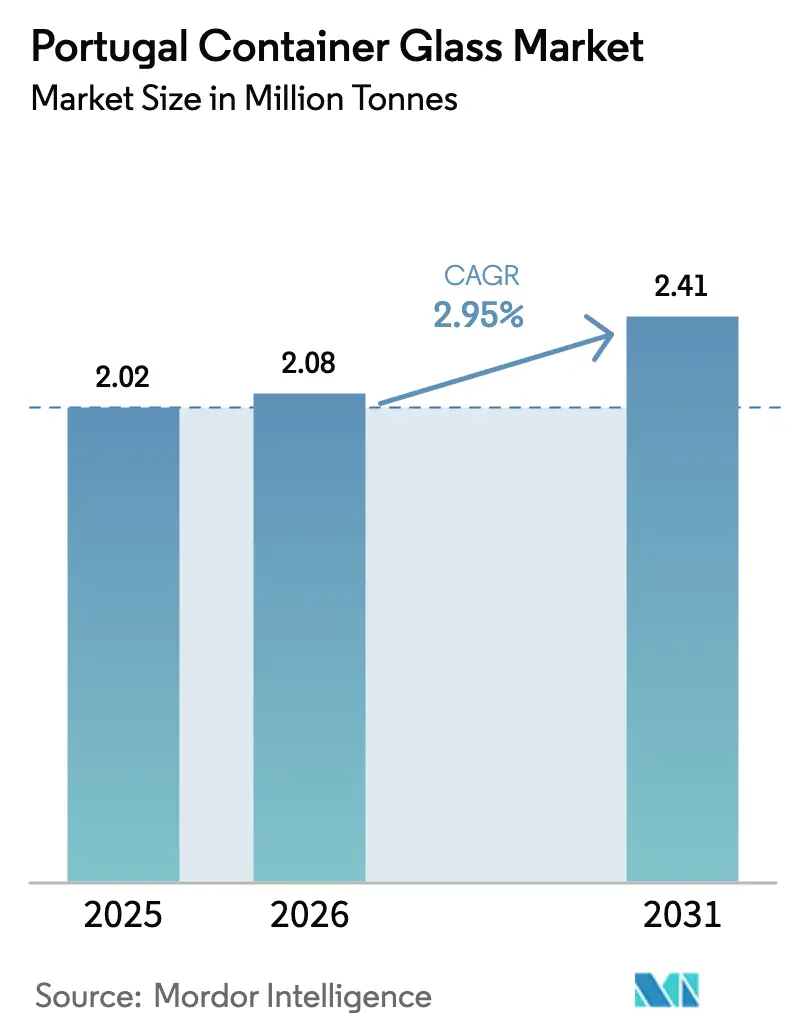
Portugal Container Glass Market size in 2026 is estimated at 2.08 million tonnes, growing from 2025 value of 2.02 million tonnes with 2031 projections showing 2.41 million tonnes, growing at 2.95% CAGR over 2026-2031. Demand continues to shift toward premium beverages, growing pharmaceutical exports, and sustainability mandates that are elevating recycled-content requirements. Manufacturers are consolidating production lines to increase furnace efficiency, while customers intensify their preference for endlessly recyclable packages that align with European circular economy targets. Power prices remain the most volatile cost element, motivating rapid investment in onsite renewables and lightweighting technologies. At the same time, a resilient export orientation protects revenues against fluctuations in consumption from any single country and allows producers to smooth capacity utilization throughout the year.[1]
Key Report Takeaways
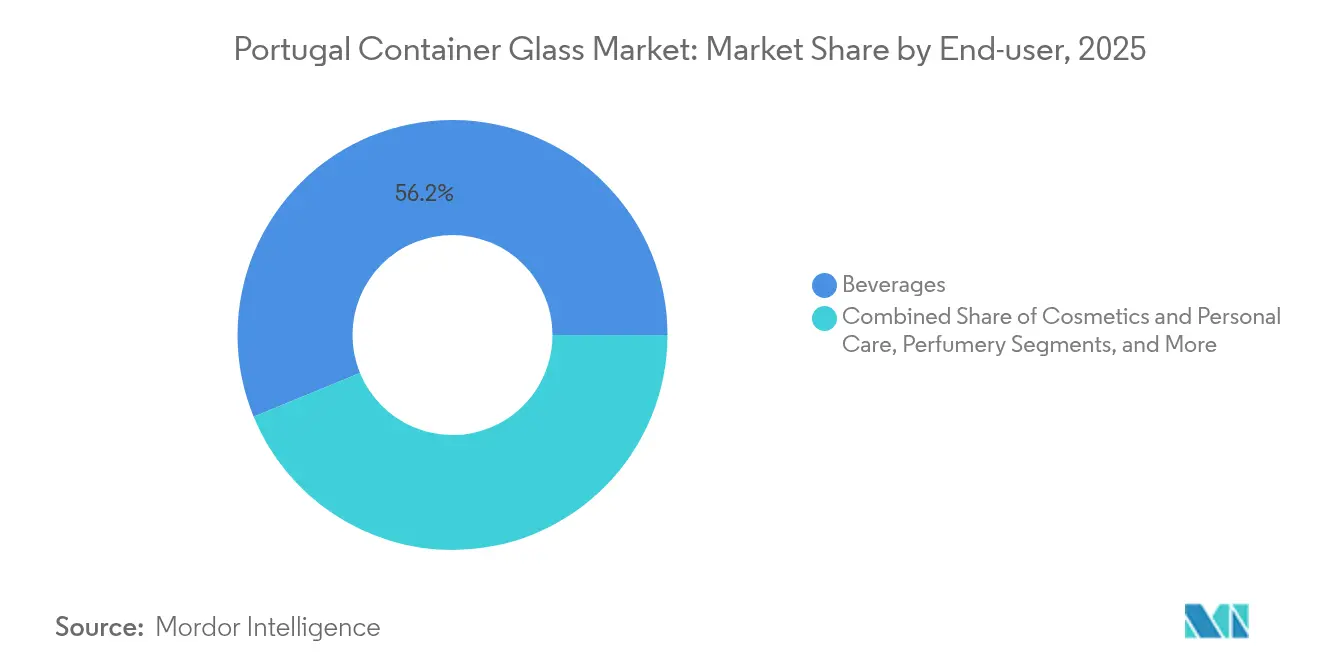
- By end-user, beverages captured 56.20% of the Portugal container glass market share in 2025.
- By color, the Portugal container glass market size for the amber segment is projected to grow at a 4.82% CAGR between 2026-2031.
Note: Market size and forecast figures in this report are generated using Mordor Intelligence’s proprietary estimation framework, updated with the latest available data and insights as of 2026.
Portugal Container Glass Market Trends and Insights
Drivers Impact Analysis*
| Driver | (~) % Impact on CAGR Forecast | Geographic Relevance | Impact Timeline |
|---|---|---|---|
| Growing consumer preference for recyclable glass packaging | +0.8% | Portugal and Iberian Peninsula | Medium term (2-4 years) |
| Premiumisation of beverages increases glass packaging demand | +0.7% | Wine and craft-beverage regions | Short term (≤ 2 years) |
| Regulatory push toward circular economy and recycling | +0.6% | National within EU framework | Long term (≥ 4 years) |
| Expansion of food and beverage manufacturing volumes | +0.5% | Domestic with export influence | Medium term (2-4 years) |
| Pharmaceutical and cosmetics sectors require glass containers | +0.4% | European pharma corridor | Long term (≥ 4 years) |
| Technology upgrades enable lighter, lower-carbon glass | +0.3% | Marinha Grande cluster | Long term (≥ 4 years) |
| Source: Mordor Intelligence | |||
Growing Consumer Preference for Recyclable Glass Packaging
Recyclability dominates shopper decision criteria as collection efficiency across the European Union now exceeds 80% and Portugal extends bottle-bank networks to every major municipality. The result is a noticeable shift among retailers toward specifying cullet-rich bottles for their store brands. Brand owners capitalize on this consumer sentiment, reinforcing glass attributes of infinite recyclability and chemical inertness. Larger volumes of color-sorted cullet flow back to furnaces, trimming energy use per kilogram melted and lowering Scope 1 emissions. These advantages strengthen the Portugal container glass market position against single-use plastics, which face escalating regulatory fees tied to extended producer responsibility frameworks.
Premiumisation of Beverages Increases Glass Packaging Demand
Portugal’s wine export values advanced 4.5% in 2024, even after a weather-challenged harvest, confirming customer willingness to pay for premium presentation.[2] Craft breweries expand capacity, and flagship brands such as Super Bock deploy glass to underscore artisanal identity. Superior oxygen and carbon dioxide barriers in glass deliver the shelf-life performance premium labels require, and the packaging’s tactile appeal reinforces the perceived value of the product. These factors sustain high per-unit margins that offset the costs of furnace modernization, thereby anchoring investment flows in the Portuguese container glass market.
Regulatory Push Toward Circular Economy and Recycling
The Packaging and Packaging Waste Regulation (EU 2024/1040) fixes minimum recycled-content thresholds for glass containers sold inside the bloc. Portugal’s decision to exclude glass from its 2026 deposit-return launch gives the material a competitive edge, as plastics and metals will incur additional handling fees. Mandatory cullet quotas reshape procurement, compelling producers to forge supply contracts with sorting facilities. Compliance favors scale players who already operate color-separation lines, tightening barriers to entry and supporting price discipline across the Portugal container glass market.
Expansion of Food and Beverage Manufacturing Volumes
Food processing remains one of Portugal’s fastest-growing industrial pillars, importing USD 293 million of U.S. agricultural inputs in 2023.[3] Rising output of olive oil, jam and gourmet condiments requires packaging that safeguards organoleptic properties and signals premium origin. Glass answers both needs with chemical inertness and visual clarity, while its rigidity withstands long-haul exports to the Americas and Asia. Steady throughput from the food sector balances seasonal swings in wine bottling, stabilizing furnace utilization rates and sustaining workforce employment.
Restraints Impact Analysis*
| Restraint | (~) % Impact on CAGR Forecast | Geographic Relevance | Impact Timeline |
|---|---|---|---|
| High energy intensity increases production costs | -0.9% | Portugal within EU energy context | Short term (≤ 2 years) |
| Fragility raises logistics costs and breakage risk | -0.4% | Export supply chains | Medium term (2-4 years) |
| Competition from cheaper plastic and metal packaging | -0.3% | Global alternatives pressure | Medium term (2-4 years) |
| Volatile raw-material and transport cost pressures | -0.2% | European supply hubs | Short term (≤ 2 years) |
| Source: Mordor Intelligence | |||
High Energy Intensity Increases Production Costs
Melting furnaces operate above 1,500 °C and consume energy at rates up to four times higher than competing packaging substrates. Portugal’s industrial power tariffs spiked in 2024 and forced producers to absorb cost surges that reached 20% of finished-container expenses. The Electrointensive Consumer Statute now offers rebates worth as much as 75% of regulated grid surcharges for manufacturers that source renewables, yet eligibility hinges on capital-intensive metering upgrades. Smaller firms lacking liquidity struggle to qualify, which accelerates consolidation inside the Portugal container glass market.
Fragility Raises Logistics Costs and Breakage Risk
Glass brittleness necessitates heavier outer cartons and careful palletization, elevating freight costs by 10-15% over plastic equivalents on identical lanes. Exporters shipping to North America absorb higher marine insurance premiums, and e-commerce fulfillment introduces multiple touchpoints where breakage probability multiplies. These hidden expenses pressure margins, especially for lower-value food products where packaging already represents a large proportion of cost of goods sold. Consequently, some volume migrates to lightweight plastics for single-serve SKUs, moderating the growth trajectory of the Portugal container glass market.
*Our forecasts treat driver/restraint impacts as directional, not additive. The impact forecasts reflect baseline growth, mix effects, and variable interactions.
Segment Analysis
By End-User: Beverages Sustain Leadership while Personal Care Accelerates
The beverages segment captured 56.20% of the Portuguese container glass market size in 2025, reflecting the nation’s well-established wine tradition and expanding craft beer culture. Bottle formats remain dominant, and wineries prioritize glass for its stability in product aging and export-ready aesthetics. Continuous premiumisation maintains a high average unit value, enabling producers to absorb furnace efficiency upgrades without eroding their margins. Parallel momentum stems from the spirits subsegment, where aged aguardentes deploy heavyweight flint bottles to signal authenticity and heritage.
Cosmetics and personal care are forecast to post a 4.45% CAGR through 2031, the fastest across all end-uses. Portuguese contract manufacturers scale up dermocosmetic and natural-ingredient lines that command premium price points in European pharmacies. Glass jars and vials align with consumer safety perceptions, as they are free of potential endocrine disruptors linked to certain plastics. The Portugal container glass market thus broadens its customer mix, reducing dependence on seasonal beverage cycles and capturing higher-margin specialty demand.

By Color: Flint Dominates as Amber Gains Momentum
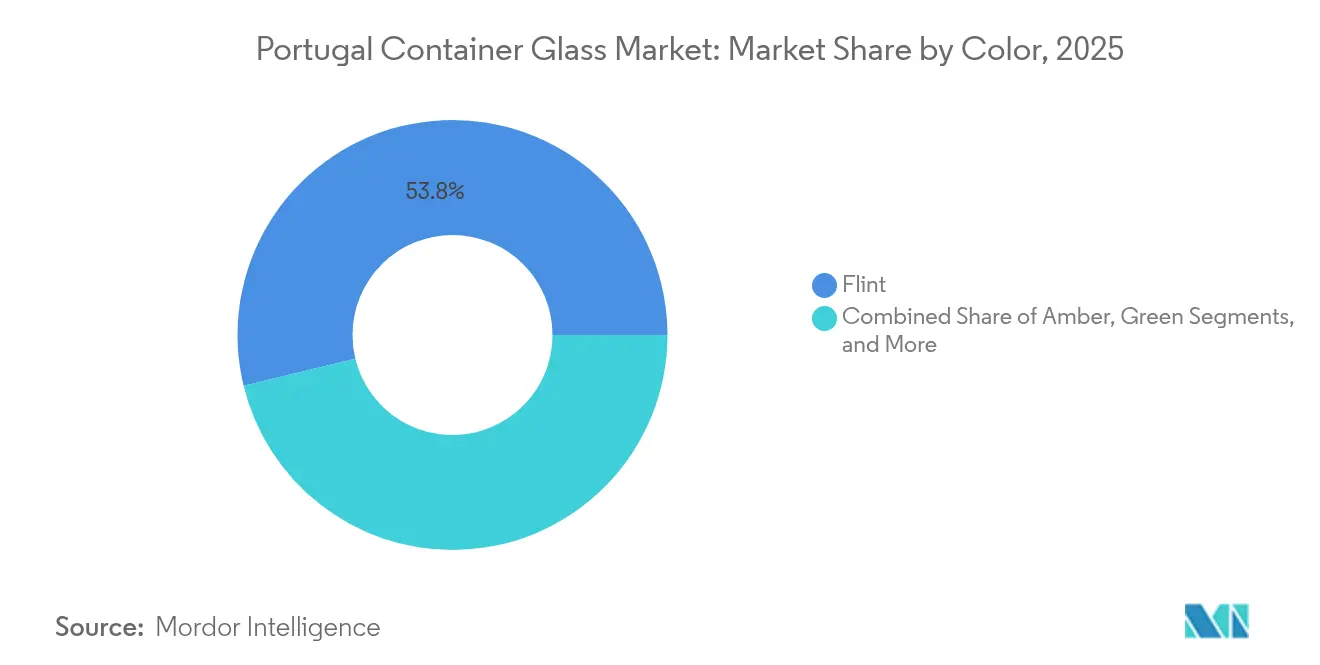
Flint held 53.80% of the Portuguese container glass market share in 2025, driven by premium beverage bottling and pharmaceutical applications that require visual inspection of fill levels and clarity. Producers leverage Flint’s neutrality to showcase label design and maximize shelf appeal, which is critical in export-oriented wine channels. Advanced furnace refinements cut iron impurities, yielding higher brilliance that meets luxury-brand specifications.
Amber leads in growth with a 4.82% CAGR outlook thanks to increased craft-beer output and heightened pharmaceutical adoption that depends on UV shielding. Breweries prefer amber to safeguard hop-derived volatiles, while drug manufacturers comply with photostability guidelines for light-sensitive formulations. This diversification stabilizes furnace color campaigns and supports batch-size optimization. Green glass retains a steady share in traditional wine bottling, whereas specialty colors cater to niche perfumery SKUs at attractive unit margins.
Geography Analysis
Portugal’s container glass production is geographically concentrated in the historic Marinha Grande cluster, where centuries-old know-how and an experienced labor pool lower onboarding time for furnace technicians. Proximity to silica sand quarries reduces inbound logistics and helps contain raw material costs, especially as fuel surcharges increase maritime freight tariffs. The region also benefits from a supportive municipal administration that streamlines environmental permitting, accelerating rebuild schedules for end-of-life furnaces.
Northern Portugal anchors secondary capacity around Porto and Avintes, enabling cross-border shipments to Spain within a single day’s truck transit. This locale supplies beverage clients located along the Douro Valley and Galicia, aligning glass-blowing capacities with winery bottling peaks during post-harvest months. Coastal port access enables producers to load rail-linked intermodal containers destined for the Americas, thereby diversifying revenue streams and mitigating macroeconomic fluctuations in domestic consumption.
Central and southern areas lack significant melting furnaces yet constitute essential demand clusters. Pharmaceutical and cosmetics fillers cluster near Lisbon, leveraging air-cargo links for time-sensitive exports. Although these areas import bottles from the north, localized decoration and sterilization services flourish, adding value and reducing empty-glass haul-back. This intra-country flow underlines how the Portugal container glass market functions as an integrated network rather than siloed regional operations.
Regulatory Landscape
Portugal's container glass sector operates within EU packaging and climate rules that govern recycled-content and circularity. The Packaging and Packaging Waste Regulation (EU 2024/1040) fixes minimum recycled-content thresholds for glass containers, while the European Emissions Trading System (CELE) places carbon and energy-management pressures on furnace operators.
Industry bodies and programs link policy to implementation, with AIVE (Associacao dos Industriais de Vidro de Embalagem) representing manufacturers in regulatory engagement. Close the Glass Loop also works to coordinate collection and cullet quality, while the Recovery and Resilience Plan (PRR) channels funding for industrial efficiency and decarbonization projects that support modernization and compliance.
Value Chain Analysis
The Portugal container glass value chain starts with batch raw materials and cullet, then melts and forms at Verallia Portugal, Vidrala, and BA Glass furnace operators across Vila Nova de Gaia, Avintes, Figueira da Foz, Marinha Grande, and Amadora. Vidro+ through Smart Waste Portugal connects industry, government, and knowledge partners to improve collection, sorting, and cullet quality, which supports higher recycled-content procurement by furnaces.
Downstream, brand owners, wineries, breweries, and food processors set format and color requirements, while logistics providers run a distribution network that accounts for glass fragility. Recycling and circular-supply loops are coordinated through Vidro+ and related initiatives, reinforcing collaboration and procurement flows that underpin modernization investments.
Competitive Landscape
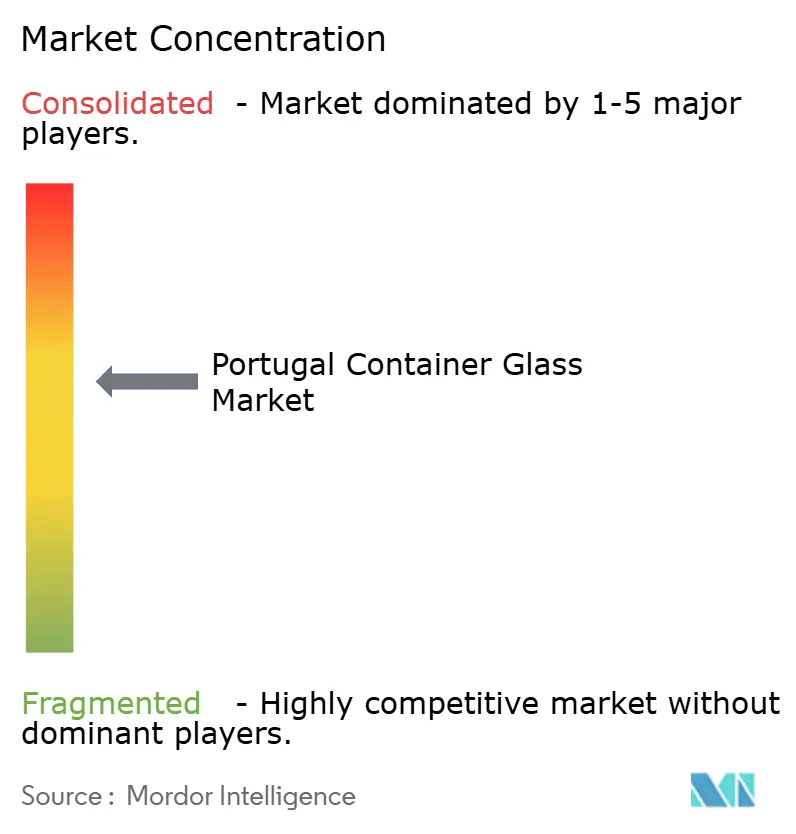
The market exhibits moderate concentration, with Verallia, Vidrala, and BA Glass operating Portugal’s three multi-furnace plants. Each leverages shared R&D platforms from its wider European network to lift energy efficiency and accelerate lightweighting rollouts. Verallia’s Figueira da Foz site is integrated into a 32-plant continental footprint that secures cullet supply and balances color campaigns across borders. Vidrala’s Santos Barosa plant introduced the 260 g wine bottle, reducing glass mass by 25% relative to standard 350 g formats while preserving stacking strength, a milestone that differentiates its offer to premium wineries. BA Glass invests in hybrid electric-oxygen burners and installs photovoltaic panels sized to supply 20% of its base-load demand, aligning with eligibility criteria for Portugal’s Electrointensive Consumer Statute.
Strategic moves often involve mergers to achieve geographic diversification. Vidrala’s acquisition of Vidraporto in Brazil injects double-digit growth exposure to South America, while BA Glass’ stake in Mexico’s Vidrio Formas grants entry to the North American Free-Trade corridor. Such deals provide foreign-exchange revenue that hedges against fluctuations in euro-denominated energy prices. Beyond scale, technological alliances play a pivotal role. Major players join supplier consortia to accelerate hydrogen-ready furnace trials, anticipating the impact of carbon pricing beyond 2030. Niche opportunities persist for mid-sized specialists in pharmaceutical tubing and low-volume perfumery flacons, but qualification barriers and capital intensity limit rapid entry by challengers.
Customer relationships form the final pillar of competitive advantage. Long-term contracts with Portugal’s major wine co-operatives lock in baseline demand, while integrated decoration capabilities foster stickiness by reducing lead times. Consequently, bargaining power tilts toward the three incumbents, underpinned by their ability to guarantee security of supply during furnace overhauls or geopolitical trade disruptions.
Portugal Container Glass Industry Leaders
-
Mercado do Vidro
-
BA Vidro S.A
-
Verallia Packaging
-
Vidrala S.A
-
Deposito da Marinha Grande
- *Disclaimer: Major Players sorted in no particular order
Market Opportunities and Future Outlook
The market opportunities concentrate on circularity and decarbonization. The industry has set a target to reach 90 percent glass collection and recycling by 2030, aligning investment themes with BA Glass's 25 million euro sustainable commercial paper programme with Bankinter Portugal in July 2026, Verallia Portugal's 20 million euro Fontela investment funded by the Recovery and Resilience Plan (PRR), and the RODIV2050 decarbonization roadmap.
Demand signals from beverages and pharmaceuticals support premium packaging conversions, particularly for high-clarity and safety-focused glass formats. Alongside the regulatory push toward the circular economy, modernization programs in the Marinha Grande cluster create a practical path to improve capacity utilization and secure supply across the Portuguese market.
Recent Industry Developments
- May 2026: Verallia Portugal announces a 20 million Euro investment in Fontela, Figueira da Foz glass bottle/jar factory funded by PRR to modernize furnaces and energy systems. The upgrade enhances energy efficiency and production resilience; supports premium beverage packaging demand and circular economy goals.
- April 2026: BA Glass B.V. acquires 41% stake in Société Tunisienne de Verreries (Sotuver). The acquisition expands its footprint into North Africa and strengthens the Mediterranean hub strategy for supply security.
- April 2025: BW Gestão de Investimentos voluntary tender offer for Verallia shares valued around EUR 2.47 billion. The bid highlights consolidation pressure among regional packaging glass players and could shift market leadership outcomes.
Research Methodology Framework and Report Scope
Market Definition and Coverage
This market covers container glass produced and supplied in Portugal for packaging uses such as bottles and jars, and it is sized on a volume basis in tons for the study period.
Scope exclusions: This sizing does not count flat glass, fiberglass, tableware, or laboratory glassware that are not used as packaging containers.
Segmentation Overview
- By End-user
- Beverages
- Alcoholic
- Beer
- Wine
- Spirits
- Other Alcoholic Beverages (Cider and Other Fermented Drinks)
- Non-Alcoholic
- Juices
- Carbonated Drinks (CSDs)
- Dairy Product Based Drinks
- Other Non-Alcoholic Beverages
- Alcoholic
- Food (Jam, Jelly, Marmalades, Honey, Sausages and Condiments, Oil, Pickles)
- Cosmetics and Personal Care
- Pharmaceuticals (excluding Vials and Ampoules)
- Perfumery
- Beverages
- By Color
- Green
- Amber
- Flint
- Other Colors
Data Sources, Market Sizing, and Validation
Desk Research
Desk research was used to set the Portugal context and to anchor the model with stable reference series that can be checked over time. We mainly rely on official and public sources such as Statistics Portugal (INE) for industrial output indicators, Eurostat for manufacturing and trade series, UN Comtrade for customs-linked flows, and the European Commission for packaging and waste policy direction.
To link container glass demand with end markets, we reviewed sources such as FEVE (glass recycling and cullet trends), APA (Portuguese Environment Agency) packaging waste reporting, and public updates from relevant beverage and food associations where available. Company filings, press releases, and investor presentations were also reviewed to understand plant footprint changes and furnace rebuild timing. In a few cases, a paid subscription for company financials and an import-export shipment-level database were used to cross-check high-impact assumptions. The sources listed here are illustrative, and additional public datasets and documents were also referred to during data collection, validation, and clarification.
Primary Interviews and Surveys
Primary work focused on aligning the model to what is actually sold in Portugal and how pricing and mix have been moving. We spoke with manufacturers, distributors, recyclers, and large packaging buyers across beverages, food, and pharma to confirm capacity and utilization assumptions, cullet availability, and product mix, and then applied those inputs consistently in the sizing.
Distribution of primary research fieldwork respondents
| Company type | Respondent position |
|---|---|
| Top tier: 27% | CXOs: 13% |
| Mid tier: 55% | Functional/Unit leaders: 31% |
| Smaller Players: 18% | Managers: 56% |
Market-Sizing & Forecasting
The core sizing starts with a top-down, Portugal-specific volume build where production and trade indicators are used to reconstruct the container glass supply that remains available for domestic use, and it is then aligned to realistic end-market absorption. To keep the output grounded, the totals are corroborated with selective bottom-up checks, including sampled throughput by furnace lines, channel checks for major container types, and volume by typical container weights for a few large beverage formats.
Key inputs used in the model include installed furnace capacity and rebuild schedules, utilization ranges through the year, cullet availability and recycled-content direction, glass lightweighting rates, and demand shifts across beverage, food, and pharma packaging. For forecasting, scenario analysis is used to translate these drivers into forward volumes, especially where energy costs and policy timing can change the slope of growth. When bottom-up visibility was incomplete for smaller formats, we filled gaps using conservative mix shares validated in interviews, then reconciled the outcomes back to the country-level volume totals.
Data Validation & Update Cycle
Outputs were checked against independent signals such as trade movements, reported recycling momentum, and known capacity events so that the growth path stays believable for Portugal. Where the model produced sharp jumps, assumptions were re-tested, interview notes were revisited, and follow-up clarification was triggered before sign-off.
Before publication, the work is reviewed in steps so calculation logic, units, and conversion choices stay consistent across years. Reports are refreshed annually, and interim updates are made when a material event changes demand, supply, or pricing direction. Right before delivery, an analyst runs a final freshness pass so the latest public indicators and confirmed developments are reflected.
Mordor Intelligence's Portugal Container Glass Market Size Compared With Other Published Estimates
Published market sizes for Portugal container glass often do not line up because the measurement unit, the time stamp of pricing, and the boundary of what is counted can all shift from one study to another. Even when the same country is covered, differences in how imports are treated, how cullet-related mix changes are reflected, and how recent capacity changes are incorporated can move the total.
In practice, the biggest gaps usually come from refresh cadence and currency timing, followed by how average selling price logic is applied when product mix is changing. When quarterly cost shocks or furnace rebuilds are not re-validated, a full-year number can be pushed up or down mechanically, and the model can drift away from observed utilization and trade signals. That is why the annual refresh and variance checks are kept tight here, which is a key way Mordor Intelligence separates short-term pricing swings from the underlying volume pattern.
Benchmark comparison
| Source | Market Size | Gaps in Research Methodology |
|---|---|---|
| Mordor Intelligence | USD 2.02 M (2025) | |
| Industry Association A | USD 1.85 M (2025) | Uses a narrower reporting perimeter that emphasizes domestically produced shipments and does not fully adjust for net trade, which can understate total availability in years with higher import flows. |
| Trade Journal B | USD 2.30 M (2026) | Applies a single average price progression to the full market without separating mix shifts from energy-driven pricing, and it appears to assume smoother capacity utilization than what plant cycles typically allow. |
The comparison indicates that most of the spread comes from timing and boundary choices, not from radically different demand views. By keeping units consistent, anchoring the model to observable Portugal-level supply and demand signals, and then pressure-testing assumptions with targeted checks, the final estimate stays traceable and repeatable year to year.
Key Questions Answered in the Report
What volume does the Portugal container glass market reach in 2026?
The Portugal container glass market size is 2.08 million tonnes in 2026.
Which end-use category drives the highest demand for Portuguese glass containers?
Beverages account for 56.20% of total demand, led by wine and expanding craft-beer output.
Which color segment is growing fastest through 2031?
Amber glass is forecast to advance at a 4.82% CAGR owing to craft-beer and pharmaceutical uptake.
How is the government addressing high industrial energy costs?
Portugal’s Electrointensive Consumer Statute offers rebates covering up to 75% of regulated grid surcharges for qualifying glass producers.
What major sustainability trend shapes purchasing decisions?
Rising consumer preference for infinitely recyclable packaging is steering brands toward glass over single-use plastics.
Who are the key manufacturers operating furnaces in Portugal?
Verallia, Vidrala and BA Glass run the country’s three primary container-glass plants.