
Polyurethane Foam Market Size and Share
Market Overview
| Study Period | 2021 - 2031 |
|---|---|
| Market Volume (2026) | 15.88 Million tons |
| Market Volume (2031) | 19.61 Million tons |
| Growth Rate (2026 - 2031) | 4.31 % |
| Fastest Growing Market | Asia Pacific |
| Largest Market | Asia Pacific |
| Market Concentration | Medium |
Major Players *Disclaimer: Major Players sorted in no particular order Image © Mordor Intelligence. Reuse requires attribution under CC BY 4.0. | |
Polyurethane Foam Market Analysis by Mordor Intelligence
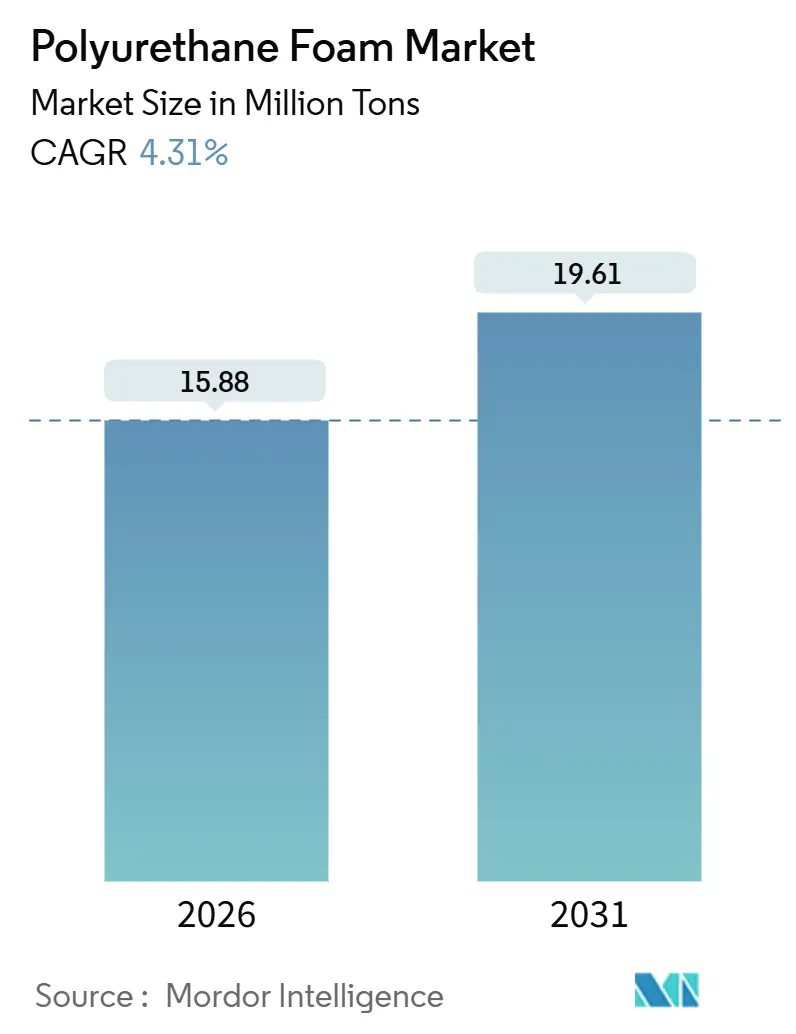
The Polyurethane Foam Market size is estimated at 15.88 million tons in 2026, and is expected to reach 19.61 million tons by 2031, at a CAGR of 4.31% during the forecast period (2026-2031). Growth is migrating from green-field capacity additions toward retrofit demand generated by tougher energy-efficiency codes, rising electric-vehicle (EV) production, and the rapid build-out of global cold-chain logistics. Momentum in specialty formats such as spray, integral-skin, and viscoelastic foams is accelerating as builders look for materials that deliver high R-values in tight spaces, while automotive original-equipment manufacturers (OEMs) specify bespoke battery-pack enclosures that combine thermal management with lightweighting. Regulatory initiatives—Europe’s Energy Performance of Buildings Directive, China’s GB 50189-2024 standard, and the United States’ 2024 International Energy Conservation Code—are lifting baseline consumption, whereas price volatility in methylene diphenyl diisocyanate (MDI) and toluene diisocyanate (TDI) feeds continues to pressure converters’ margins. Integrated suppliers with captive isocyanate capacity and early-stage bio-based polyol platforms are widening the competitive gap as customers seek verified decarbonization pathways and secure raw-material availability.
Key Report Takeaways
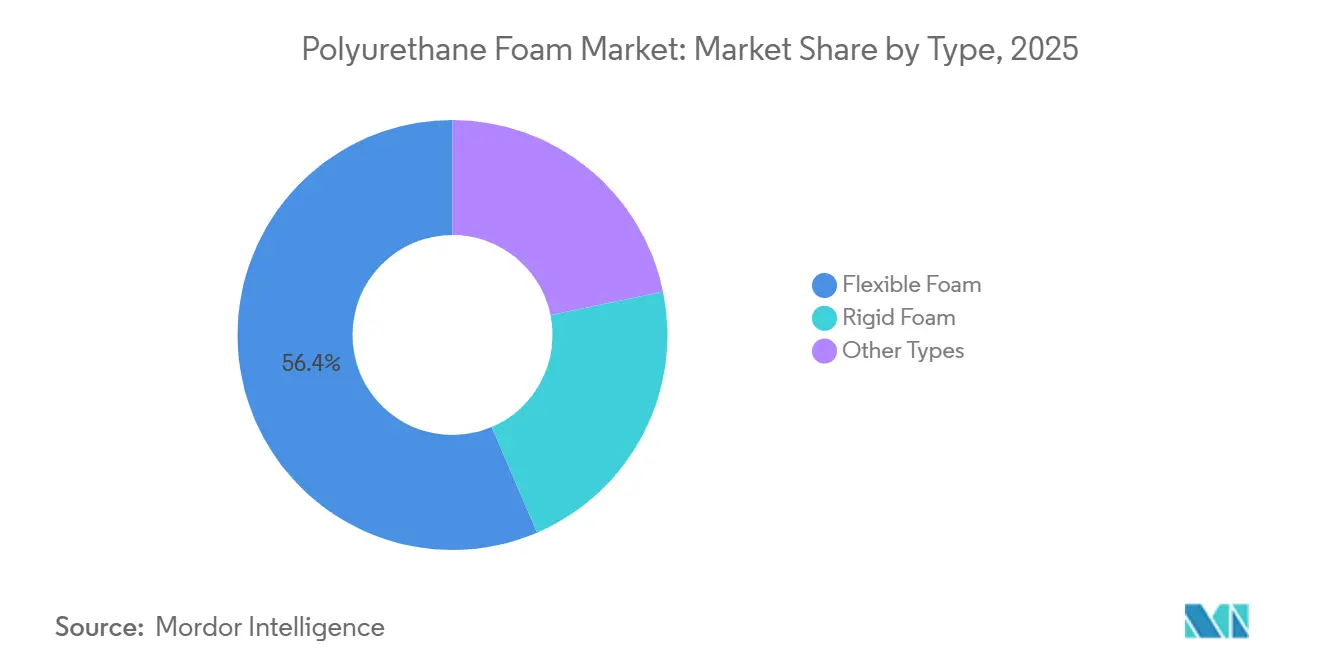
- By type, flexible foam led with 56.44% of polyurethane foam market share in 2025, while other formats are forecast to post the fastest 6.49% CAGR through 2031.
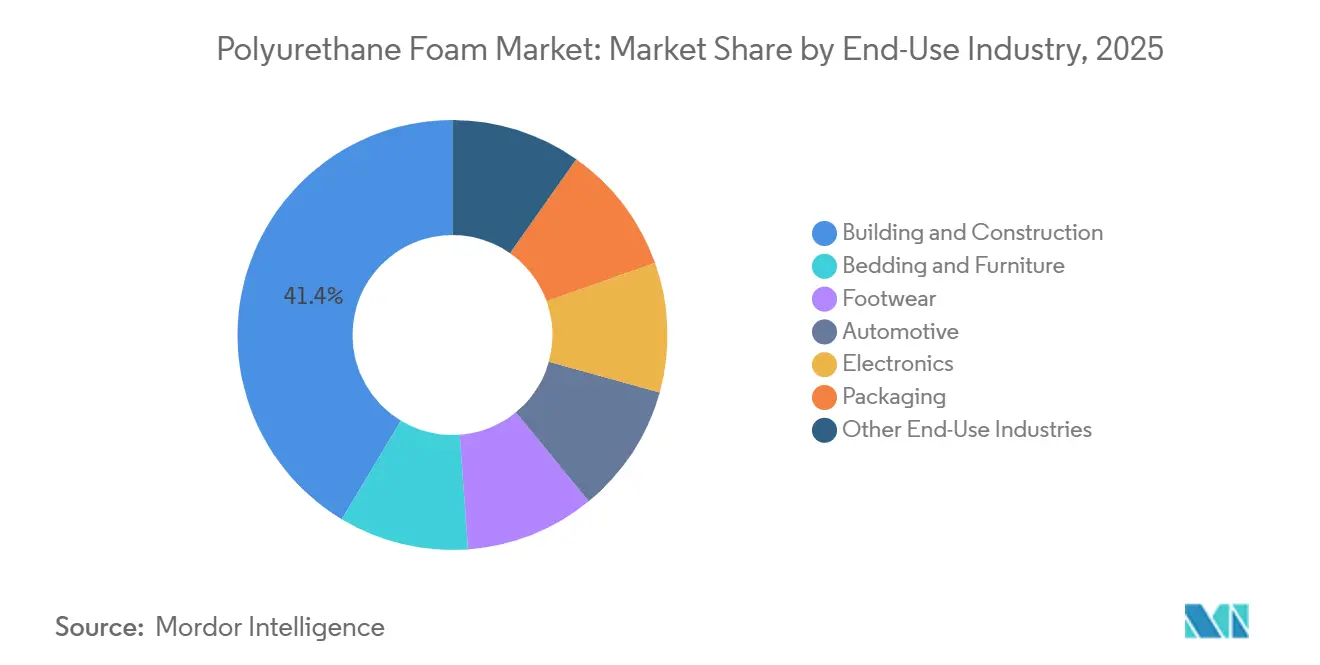
- By end-use, building and construction absorbed 41.39% of volume in 2025, but packaging is advancing at a market-leading 7.26% CAGR through 2031.
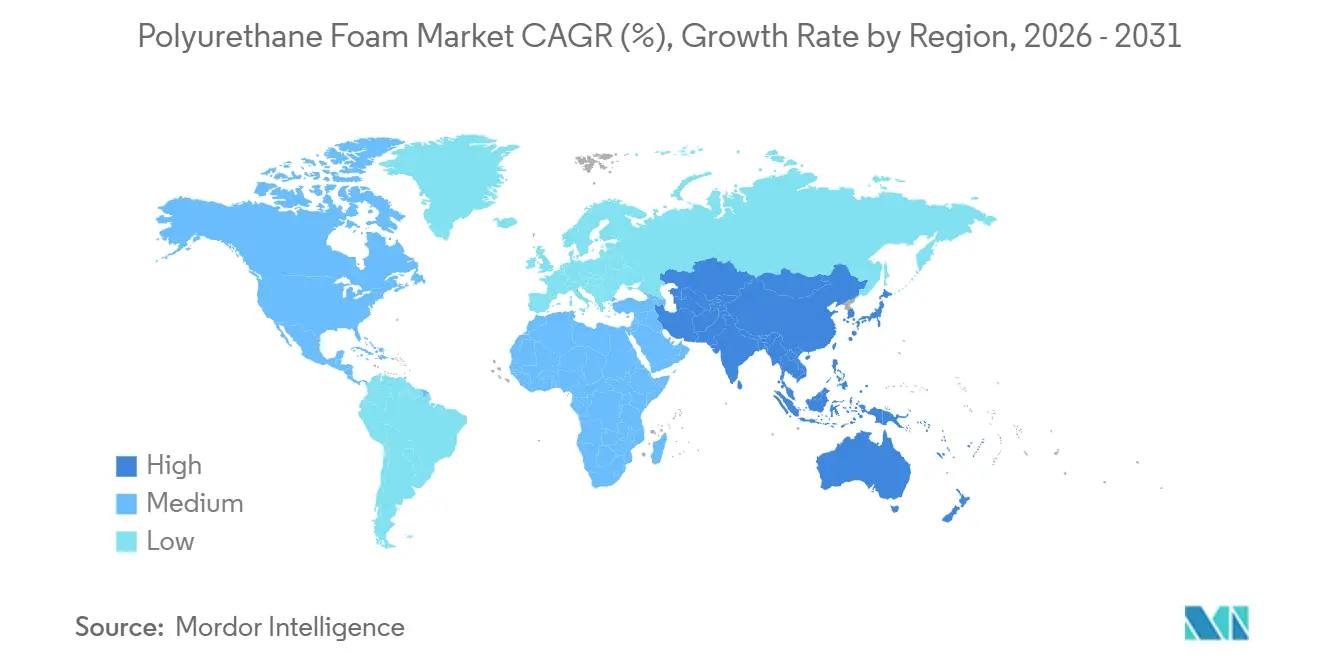
- By geography, Asia-Pacific accounted for 49.58% of global polyurethane foam market consumption in 2025; the region is projected to expand at a 6.36% CAGR to 2031, the strongest regional trajectory.
Note: Market size and forecast figures in this report are generated using Mordor Intelligence’s proprietary estimation framework, updated with the latest available data and insights as of January 2026.
Market Trends and Insights
Drivers Impact Analysis of Polyurethane Foam Market*
| Drivers | (~) % Impact on CAGR Forecast | Geographic Relevance | Impact Timeline |
|---|---|---|---|
| Energy-efficient building insulation demand | +1.2% | Global, strongest in Asia-Pacific and Europe | Medium term (2-4 years) |
| Automotive lightweighting and comfort applications | +0.9% | Asia-Pacific core plus North America | Medium term (2-4 years) |
| Furniture and mattress production upsurge | +0.7% | Asia-Pacific, spillover Latin America | Short term (≤ 2 years) |
| Cold-chain and refrigeration capacity expansion | +0.8% | Global, fastest in Asia-Pacific and MEA | Long term (≥ 4 years) |
| EV battery thermal-management foams | +0.5% | Asia-Pacific, North America, Europe | Long term (≥ 4 years) |
| Source: Mordor Intelligence | |||
Energy-Efficient Building Insulation Demand
Governments are tightening thermal-performance requirements, adding 1.2 percentage points to the baseline CAGR in the polyurethane foam market. In 2024, the European Union revised its Energy Performance of Buildings Directive, mandating member states to annually renovate public buildings. This move is guiding specifiers to favor spray polyurethane foam, which offers insulation and achieves air-sealing in a single application. In the United States, eighteen states adopted the 2024 International Energy Conservation Code, raising prescriptive wall insulation from R-13 to R-20 in colder climate zones, a change that places continuous rigid foam sheathing at the forefront of compliance. China's GB 50189-2024 has raised heating-energy limits. This move has pushed developers in northern provinces to shift from expanded polystyrene to closed-cell polyurethane panels[1]. Additionally, spray foam is capturing a larger share in retrofit projects. Its advantage lies in the ability to apply it without removing exterior cladding, reducing installation time. These combined policies ensure a clear demand trajectory over the coming years, especially for existing buildings where energy savings offer appealing payback periods.
Automotive Lightweighting and Comfort Applications
Automotive regulators are mandating higher fuel economy and extended EV range, contributing 0.9 percentage points to to the polyurethane foam market growth. In response to the U.S. Corporate Average Fuel Economy standard aiming for a fleet average of 58 miles per gallon equivalent by 2027, automakers are shifting from traditional padding to low-density flexible polyurethane. This change reduces seat weight without compromising ergonomics. An SAE study found that optimized foam formulations in door panels and headliners can reduce cabin noise at highway speeds, boosting passenger comfort in the quiet cabins of electric vehicles. In China, where new-energy-vehicle sales have grown significantly, local suppliers are collaborating on rigid foams for battery-module gap-filling. These foams are more effective than aerogels at inhibiting thermal-runaway propagation. With benefits in both mass reduction and safety, polyurethane's role in vehicle bills of materials is expanding, leading to increased content per vehicle in both premium and mass-market segments.
Furniture and Mattress Production Upsurge
Higher disposable incomes in Asia-Pacific deliver a 0.7 percentage-point uplift to the polyurethane foam market, most visible in India and Southeast Asia. In 2025, India's organized furniture market saw significant growth. Memory-foam mattresses gained a notable share of the bedding segment, as consumers shifted preferences from coir and cotton. In late 2025, Sheela Foam launched a flexible-foam line in Uttarakhand. The move targets tier-2 cities, where brand penetration is on the rise. Meanwhile, in China, a shift towards online furniture sales is streamlining delivery times. Manufacturers are now using vacuum-compressed foam packaging, reducing shipping volume significantly. This innovation not only supports direct-to-consumer models but also lowers the total landed cost. As a result, there's a broader market for premium foam products, especially in price-sensitive demographics.
Cold-Chain and Refrigeration Capacity Expansion
The rise of temperature-controlled logistics adds 0.8 percentage points to growth, in the polyurethane foam market driven by vaccines, fresh food, and e-commerce grocery. Saudi Arabia's Public Investment Fund allocated resources for a large-scale cold-storage space, targeting completion by 2028. The fund emphasized the use of rigid polyurethane panels with enhanced thermal conductivity to bolster moisture resistance. In 2025, India provided subsidies through its Pradhan Mantri Kisan Sampada Yojana, aiming to expedite the construction of refrigerated warehouses. India showed a preference for prefabricated polyurethane sandwich panels, which can be installed significantly faster compared to traditional site-poured concrete. The pharmaceutical sector is also driving this momentum; Pfizer's 2024 expansion of its mRNA vaccine network necessitated ultra-low-temperature freezer insulation. This specific requirement was exclusively fulfilled using rigid polyurethane in conjunction with vacuum-insulated panels. Given the persistent demand for robust cold chains, the appetite for high-performance foam systems is set to remain strong.
Restraints Impact Analysis of Polyurethane Foam Market*
| Restraints | (~) % Impact on CAGR Forecast | Geographic Relevance | Impact Timeline |
|---|---|---|---|
| Stricter isocyanate health and environmental rules | -0.6% | Global, with Europe and North America most stringent | Short term (≤ 2 years) |
| Volatility in MDI/TDI feedstock prices | -0.4% | Global, with Europe and North America most exposed | Short term (≤ 2 years) |
| Mycelium/algae bio-foams replacing PU in premium packaging | -0.2% | North America and Europe niche segments | Medium term (2-4 years) |
| Source: Mordor Intelligence | |||
Stricter Isocyanate Health and Environmental Rules
Widening regulatory scrutiny on diisocyanate exposure is trimming 0.6 percentage points from polyurethane foam market growth. Under the 2024 Significant New Use Rule by the U.S. Environmental Protection Agency, spray-foam teams must don supplied-air respirators and utilize real-time monitoring. This mandate escalates annual compliance expenses for each team, hindering adoption in budget-conscious retrofits. Meanwhile, Europe's REACH update has tightened the occupational exposure limit for TDI. This change mandates converters to invest in closed-loop mixing systems. In 2025, California's Proposition 65 was updated to include MDI. This addition requires retailers to label products with warnings if they contain more than 0.1% MDI[2]. As a result, furniture manufacturers are increasingly leaning towards water-blown formulations, albeit at a cost premium. While there's progress in non-isocyanate polyurethane chemistries, their widespread commercial adoption is still projected to be at least five years away, primarily due to existing cost and performance disparities.
Volatility in MDI/TDI Feedstock Prices
Sharp swings in diisocyanate pricing have compressed converter margins and curtailed long-term contracts. In Europe, MDI spot prices surged due to outages at BASF’s Ludwigshafen and Covestro’s Dormagen complexes. However, prices later retreated, buoyed by a surge in Chinese exports. Meanwhile, U.S. Gulf-Coast TDI quotations oscillated, influenced by force majeure events and anti-dumping duties. In response to these market fluctuations, converters have extended their feedstock holdings as a defensive strategy. This approach locks up working capital and trims their return on invested capital. Integrated suppliers, boasting captive MDI/TDI capacity, are seizing market share by offering fixed-price agreements and expedited order cycles.
*Our forecasts treat driver/restraint impacts as directional, not additive. The impact forecasts reflect baseline growth, mix effects, and variable interactions.
Polyurethane Foam Market Segment Analysis
By Type:
Specialty Formats Outpace Commodity FlexibleFlexible foam retained 56.44% of the polyurethane foam market share in 2025, anchored by furniture, bedding, and automotive seating applications. However, commodity blocks face margin squeeze from low-cost imports, persuading North American and European converters to shift toward high-resilience and viscoelastic lines that command 30% price premiums. Other formats—spray, integral-skin, and memory foams—are projected to grow at 6.49% CAGR, nearly double the broader market. Spray foam benefits from its ability to air-seal irregular cavities, driving residential retrofit adoption under utility rebate programs in the United States. Integral-skin foams in steering wheels and armrests are gaining favor as EV interiors prioritize tactile quality, while memory foams are migrating from premium mattresses to athletic footwear and medical cushions.
High-growth niches are gaining market share within the polyurethane foam industry by offering performance attributes that alternative materials struggle to match. The U.S. spray-foam segment expanded, spurred by the Inflation Reduction Act's rebate for air-sealing enhancements. Automotive OEMs harnessed integral-skin technology to minimize vibration transmission in EV cabins, now devoid of engine noise. This shift was bolstered by an SAE study highlighting noise reduction. Memory foams, previously limited to sleep products, gained a foothold in running shoes, thanks to Nike's introduction of a dual-density midsole that adapts to the gait cycle. These successes across diverse industries indicate that specialty polyurethane foams are poised to secure a significant portion of future innovation investments and profit margins.

By End-Use Industry:
Packaging Surges on Cold-Chain LogisticsBuilding and construction absorbed 41.39% of volume in 2025, underpinned by mandatory insulation upgrades across Asia-Pacific, Europe, and North America. Yet packaging is the fastest-rising end-use at a 7.26% CAGR, propelled by e-commerce grocery and temperature-sensitive pharmaceuticals. By 2027, Amazon aims to ship half of its fresh groceries using reusable polyurethane-lined totes. This decision comes after recognizing that closed-cell foam can maintain temperatures between 2 °C and 8 °C for up to 48 hours, eliminating the need for gel packs. Pfizer transitioned from polystyrene to polyurethane shippers, achieving a reduction in packaging weight and a boost in pallet density. This shift underscores the potential for significant savings in air-freight costs.
The automotive sector, spurred by the rise of electric vehicles (EVs) and an increased foam content per vehicle, stands as the second-fastest-growing segment in the PU foam market. New-energy vehicles benefit from polyurethane used for seating, acoustic dampening, and battery insulation, contrasting with traditional internal-combustion models. a, the bedding and furniture sectors in the Asia-Pacific region are on a steady growth trajectory, fueled by rising incomes and a trend towards premiumization. Footwear, electronics, and other niche applications collectively represent a significant portion of the demand. Notably, the footwear segment is witnessing a surge in innovation, with brands pursuing enhanced energy returns and reduced carbon footprints through the integration of bio-attributed polyols.
Geography Analysis
APAC Polyurethane Foam Market
Asia-Pacific dominated global consumption with a 49.58% share in 2025 and is on course to grow 6.36% annually to 2031, the highest regional pace. In 2024, China upgraded its GB 50189 standard, boosting wall insulation R-values in heating zones. This change prompted a shift from expanded polystyrene to rigid polyurethane in both commercial and residential projects. India's organized furniture market experienced significant growth in 2025. This uptick coincided with Sheela Foam's capacity expansion, aimed at meeting the rising demand for memory-foam mattresses in tier-2 cities. Japan and South Korea, despite their market maturity, are capitalizing on innovations in electronics and EV batteries. A notable instance is LG Energy Solution's qualification of phase-change-enhanced polyurethane for the E-GMP platform, underscoring the region's technological advancements. In Southeast Asia, investments in cold-chain warehousing, especially in Vietnam and Indonesia, are bolstered by government incentives targeting a reduction in post-harvest food loss.
North America Polyurethane Foam Market
North America accounted for a significant market share in 2025 and registered steady growth in the US polyurethane foam market. Spray-foam retrofits and EV battery enclosures largely drove the momentum. A significant contributor to this growth was the U.S. Inflation Reduction Act’s Home Energy Rebates, which spurred an increase in spray-foam installations in 2025. Homeowners capitalized on these rebates to mitigate installation expenses. Meanwhile, Canada’s National Building Code 2025 is steering builders towards rigid foam sheathing by mandating continuous insulation across all climate zones. In 2025, Mexico, with a strong vehicle production base, is witnessing a trend where U.S. OEMs are integrating higher polyurethane content. This move aligns with their strategy to near-shore EV assembly, ensuring compliance with regional-content requirements.
EMEA and South America Polyurethane Foam Market
Europe is navigating a steady growth trajectory in the polyurethane foam industry. The region grapples with stringent isocyanate regulations while aggressively pursuing retrofit targets. The Energy Performance of Buildings Directive mandates an annual renovation rate for public buildings. This directive leans towards high-efficiency spray foam, even with the challenge of elevated labor compliance costs. South America and the Middle East and Africa (MEA), collectively representing a notable portion of global demand, are experiencing robust growth. In Brazil, municipalities are incentivizing LEED-certified buildings with property-tax rebates, leading to a heightened adoption of polyurethane insulation. In Saudi Arabia, a substantial investment in cold storage is driving demand for rigid panels. Concurrently, in South Africa, the addition of new solar capacity in 2025 is spurring the use of polyurethane-insulated transport for exporting perishables.
Value Chain Analysis
The polyurethane foam value chain starts with upstream aromatics and olefins (benzene, toluene, propylene), which move into intermediates such as aniline and propylene oxide. These then feed isocyanates (MDI, TDI) and polyols. Major integrated producers, including BASF, Dow, Covestro, and Wanhua, run multi-step assets that connect these inputs through to isocyanate and polyol production. This structure helps manage raw-material variability and supports supply assurance for foam system houses and converters.
In the midstream, formulators and system houses blend polyols, catalysts, surfactants, blowing agents, and flame retardants to create tailored systems for flexible, rigid, and spray foams. They then supply converters producing slabstock, molded foams, and panels. Distribution is routed through chemical distributors and direct contracts to large end users across building products, automotive, appliances, and packaging, while end-use outcomes depend on installation quality and contractor capability, especially for spray foam where compliance is closely tied to performance. Bottlenecks typically cluster around MDI/TDI availability and logistics. Integrated-supplier debottlenecking and capacity additions are used to stabilize supply to converters, and industry guidance from groups such as the American Chemistry Council (Center for the Polyurethanes Industry) and EUROPUR supports safer handling and standardization across downstream activities.
Competitive Landscape
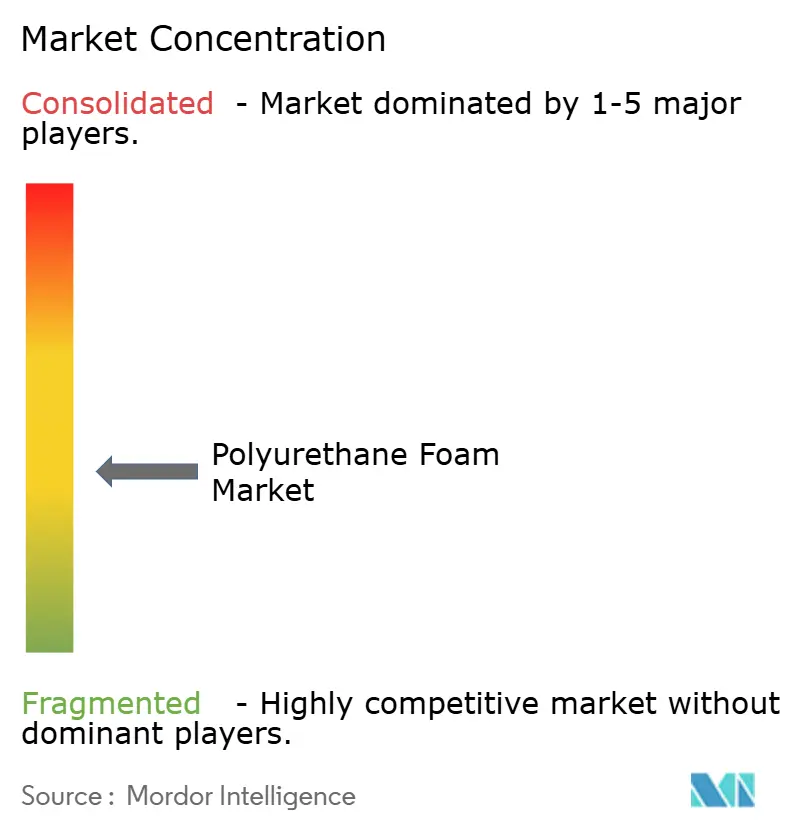
The PU foam market is moderately fragmented. Covestro’s Cardyon platform, commercialized in 2024, embeds up to 20% captured CO₂ into polyols and has earned purchase orders from European automotive OEMs looking to trim Scope 3 emissions without compromising crashworthiness. BASF followed in 2025 with Lupranat Bio, a tall-oil fatty-acid-based MDI targeting furniture and mattress customers pressured by retailer carbon-footprint pledges. Startups are exploiting white-space in EV battery and cold-chain packaging where incumbents have limited domain expertise. As sustainability metrics and real-time quality control gain importance, players with integrated feedstock positions, verified low-carbon technologies, and advanced manufacturing analytics are poised to consolidate share.
Polyurethane Foam Industry Leaders
-
Covestro AG
-
BASF SE
-
Dow
-
Huntsman International LLC
-
Wanhua Chemical Group Co., Ltd.
- *Disclaimer: Major Players sorted in no particular order
Polyurethane Foam Market Companies Covered in this Report
- Arkema
- BASF SE
- Carpenter Co.
- Covestro AG
- Dow
- Eurofoam S.r.l.
- Foam Partner Group
- Foamcraft Inc.
- FXI
- Huntsman International LLC
- INOAC Corporation
- Rogers Corporation
- Saint-Gobain
- Sekisui Chemical Co., Ltd.
- Sheela Foam Ltd.
- UFP Technologies Inc.
Market Opportunities and Future Outlook
White-space is emerging in lower-carbon and circular polyurethane foam inputs as downstream buyers shift toward verified pathways rather than general sustainability claims. Covestro commercialized Cardyon CO2-based polyols in 2024 for automotive OEM demand, and BASF followed in 2025 with Lupranat Bio (tall-oil-fatty-acid-based MDI) aimed at furniture and mattress customers influenced by retailer carbon-footprint pledges. Together, these launches give converters a basis to differentiate through certified product carbon footprint documentation, mass-balance feedstocks, and recycled polyol blends, particularly in flexible foam and other specialty formats where formulation know-how and compliance support carry more weight.
Opportunities also extend to supply security and specification-driven demand in insulation, cold-chain, and EV-adjacent applications. Energy-efficiency enforcement, including EU Energy Performance of Buildings Directive revisions in 2024, the United States 2024 International Energy Conservation Code adoption across multiple states, and China GB 50189-2024, supports retrofit-led demand for spray and rigid insulation systems. Cold-chain build-outs are pulling rigid panel volumes through programs such as India subsidies under Pradhan Mantri Kisan Sampada Yojana. Upstream capacity actions in Asia are reshaping procurement strategies, with Covestro completing a TDI debottleneck at its Shanghai site in January 2026 (20% capacity uplift, from 310,000 to 370,000 metric tons) and announcing in June 2026 an investment program that includes a new 660-kiloton-per-year MDI train at the same integrated Shanghai site. Wanhua Chemical also moved a polyether polyol expansion in Yantai into public consultation in May 2026. These changes support longer-term contracting, dual sourcing, and stronger localized system-house capabilities in growth regions, while increasing the commercial value of low-GWP blowing-agent transitions where regulations such as EU F-Gas and EPA SNAP restrict traditional HFC options.
Recent Industry Developments in Polyurethane Foam Market
- June 2026: Covestro announced a strategic investment program that includes a new 660-kiloton-per-year MDI production train at its Integrated Site Shanghai and a feasibility study for a similarly scaled plant in the United Arab Emirates. The move indicates an emphasis on securing long-run isocyanate supply at integrated hubs, supporting polyurethane foam converters that depend on stable MDI availability for insulation, appliance, and industrial applications.
- October 2025: BASF confirmed progress on a major MDI capacity expansion project in the United States. The project is aimed at strengthening supply security for the polyurethane value chain and supports longer-term contracting while reducing vulnerability to regional outages that can disrupt foam system houses and downstream converters.
- August 2024: UFP Technologies acquired AQF Medical to expand its position in medical-grade polyurethane foam applications. The acquisition strengthens converting capabilities for specialized, regulated end uses where material performance and traceability requirements are higher than in commodity foam markets.
Polyurethane Foam Market Report Scope and Research Methodology
Market Definition and Coverage
For this report, the polyurethane foam market includes freshly manufactured polyurethane foams that are sold into trade channels, captured as production leaving the producer or converter and measured in metric tons across major end uses.
Scope exclusions: We exclude rebonded scrap foams, polyurea elastomers, and in-plant cavity-filled systems that do not enter open commercial trade.
Segments Covered in This Report
- By Type
- Flexible Foam
- Rigid Foam
- Other Types (Spray Foam, Integral Skin Foam, Memory Foam)
- By End-Use Industry
- Building and Construction
- Bedding and Furniture
- Footwear
- Automotive
- Electronics
- Packaging
- Other End-Use Industries (Medical Devices, Textiles and Apparel, Aerospace)
- By Geography
- Asia-Pacific
- China
- India
- Japan
- South Korea
- Rest of Asia-Pacific
- North America
- United States
- Canada
- Mexico
- Europe
- Germany
- United Kingdom
- France
- Italy
- Rest of Europe
- South America
- Brazil
- Argentina
- Rest of South America
- Middle-East and Africa
- Saudi Arabia
- South Africa
- Rest of Middle-East and Africa
- Asia-Pacific
Data Sources, Market Sizing, and Validation
Desk Research
Desk research was used to set the market boundary, map the value chain, and gather anchor data for demand signals that can be checked country by country. We leaned on public sources such as national statistical offices for industrial output series, UN Comtrade for trade flows of relevant chemical and foam-related headings, and energy and building indicators from sources such as the IEA and the World Bank that help explain insulation demand.
To keep assumptions practical, we also referenced materials and construction bodies such as ISO and ASTM for standards context, plus peer-reviewed polymer and materials journals for density, yield, and formulation ranges that influence tonnage conversion. Company annual reports, investor presentations, and press coverage were used to understand capacity changes and regional operating footprints, and a paid subscription for company financials and intelligence was used selectively to normalize disclosures and track major plant announcements. The sources listed here are illustrative and not exhaustive, and other public materials were also consulted to collect data, validate assumptions, and close information gaps.
Primary Interviews and Surveys
Primary work focused on validating how much foam is actually placed into end markets, and what shifts the mix between flexible, rigid, and spray grades in different regions. We spoke with stakeholders across the chain, including foam producers and converters, distributors, and downstream buyers in construction, bedding and furniture, and automotive, to confirm utilization swings, typical densities, and practical substitution limits.
Distribution of primary research fieldwork respondents
| Company type | Respondent position | Region |
|---|---|---|
| Top tier: 25% | CXOs: 15% | APAC: 40% |
| Mid tier: 57% | Functional/Unit leaders: 34% | EMEA: 33% |
| Smaller Players: 18% | Managers: 51% | Americas: 27% |
Market-Sizing & Forecasting
Market sizing was built using a top-down and bottom-up combination, where production and trade indicators are used to reconstruct apparent foam availability by geography, followed by allocation to end uses using penetration and intensity factors. In parallel, we corroborated totals with selective bottom-up checks such as sampled capacity by site, utilization ranges discussed in interviews, and typical density and yield logic to sanity-check the tonnage implied by end-use demand.
Key inputs that shaped the model included construction activity signals (insulation and building activity proxies), bedding and furniture output trends, automotive production volumes, and the relative pull from packaging and appliances where foam usage is tied to manufacturing cycles. We also tracked raw material pricing direction (MDI and TDI) as a practical indicator for formulation shifts and down-gauging that can change tons shipped even when unit demand is stable. When country-level gaps appeared, they were handled through regional benchmarking using similar end-use structures and then corrected through interview feedback and trade flow consistency checks.
For forecasting, scenario analysis was used to translate macro demand drivers into volume growth paths, and then adjusted using primary feedback on capacity additions, conversion constraints, and expected application mix shifts. Forecast outputs were reviewed for realism against historical volatility patterns and against known investment cycles in insulation and durable goods production.
Data Validation & Update Cycle
Validation is done through repeated cross-checks so that one data series does not drive the outcome by itself. We compare modeled totals against independent signals such as capacity announcements, utilization commentary gathered in interviews, and trade movements that should directionally match demand changes, and then outliers are investigated before values are finalized.
A second analyst review is used to test key assumptions such as density ranges, end-use allocation ratios, and any unusual country trends that could be a data artifact. The report is refreshed annually, and interim updates are considered when material events occur such as major plant shutdowns, new capacity starts, or sharp raw material price swings. Before delivery, a final update pass is completed so clients receive the latest updated view.
Mordor Intelligence's Polyurethane Foam Market Size Measured Against Other Published Estimates
Published market figures for polyurethane foam often do not match because authors use different units, different points in the value chain, and different rules for what is counted as foam sold into the market. Some estimates also mix foam with adjacent polyurethane categories, which can make the headline number look larger even when end-use demand signals are similar.
Capacity utilization disclosures, trade-flow directionality, and end-use output indicators are the checks that keep Mordor Intelligence aligned to freshly manufactured foam volumes entering trade channels, which is why value-based rollups or broader polyurethane scopes can land on a different figure. Gaps usually come from including CASE products or elastomers, counting in-plant foaming that never enters open trade, or applying a price-per-ton assumption that is not refreshed with current MDI and TDI dynamics and regional mix.
Benchmark comparison
| Source | Market Size | Gaps in Research Methodology |
|---|---|---|
| Mordor Intelligence | USD 15.88 M (2026) | |
| Trade Journal A | USD 70.55 B (2024) | Uses a revenue definition and likely blends foam sales with broader polyurethane materials and mixed end-use pricing, which shifts the total away from a pure foam tonnage view at the producer or converter exit stage. |
| Industry Brief B | USD 75.66 B (2024) | Reports a value number with limited visibility on included foam forms and conversion stage, and the pricing basis can differ materially by region and mix, creating a different total versus volume-led sizing. |
The table shows that most of the spread is explained by unit choice and the included product boundary, not by disagreement that foam demand is growing across construction and consumer durables. By keeping the model traceable to tons placed into trade and then checking those volumes against capacity, trade, and end-use signals, our estimate stays easier to reproduce and interpret across regions and time.
Key Questions Answered in the Report
How large is the polyurethane foam market in 2026?
The polyurethane foam market size is 15.88 million tons in 2026, with a forecast to reach 19.61 million tons by 2031, registering a CAGR of 4.31%.
Which region is growing fastest for polyurethane foam demand?
Asia-Pacific is the fastest-growing region, expected to register a 6.36% CAGR through 2031 on the back of stricter building-energy codes and an expanding cold-chain network.
Which end-use is expected to add the most new volume?
Packaging, especially for cold-chain and e-commerce grocery, is projected to grow at a 7.26% CAGR, the highest among all end-uses.
What is the main regulatory headwind facing polyurethane foam producers?
Tightening isocyanate exposure limits in Europe and North America are increasing compliance costs and slowing spray-foam adoption.
How are leading companies improving their sustainability credentials?
Integrated suppliers such as Covestro and BASF have commercialized bio-based polyols and MDI grades that embed captured CO₂ or tall-oil derivatives, reducing product carbon footprints without sacrificing performance.