
Polyethylene Market Size and Share
Market Overview
| Study Period | 2021 - 2031 |
|---|---|
| Market Size (2026) | USD 168.36 Billion |
| Market Size (2031) | USD 208.41 Billion |
| Growth Rate (2026 - 2031) | 4.36 % |
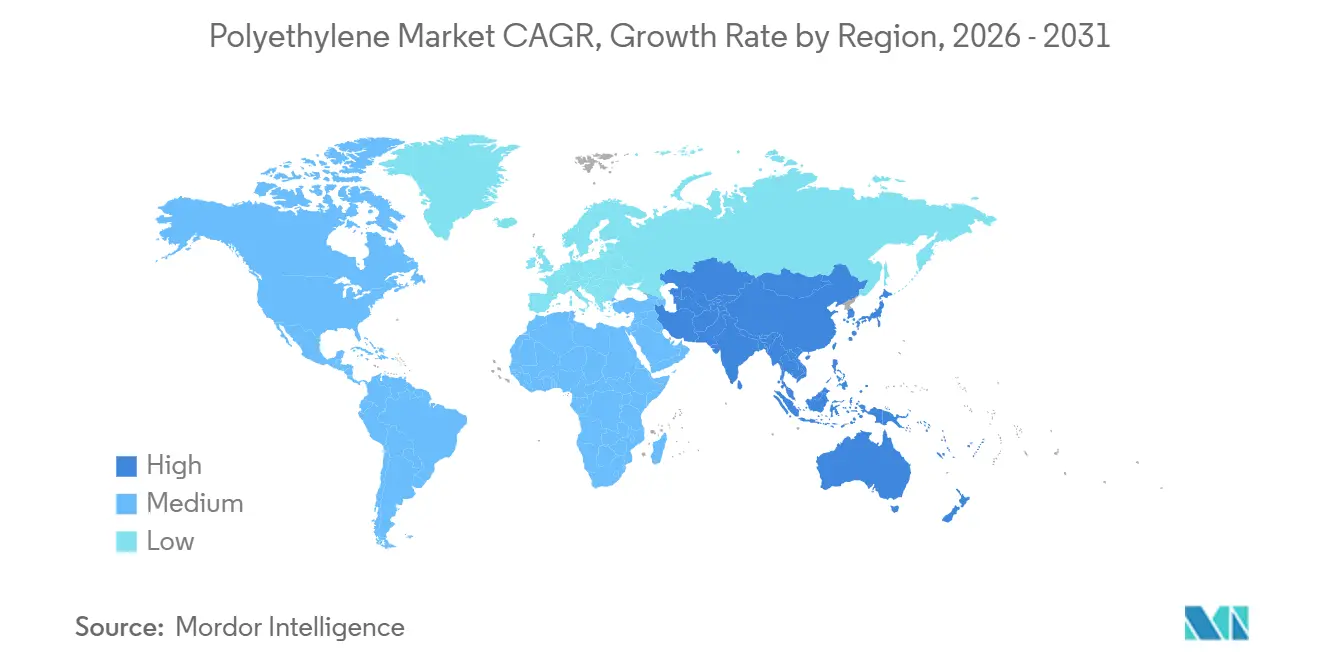
| Fastest Growing Market | Asia-Pacific |
| Largest Market | Asia-Pacific |
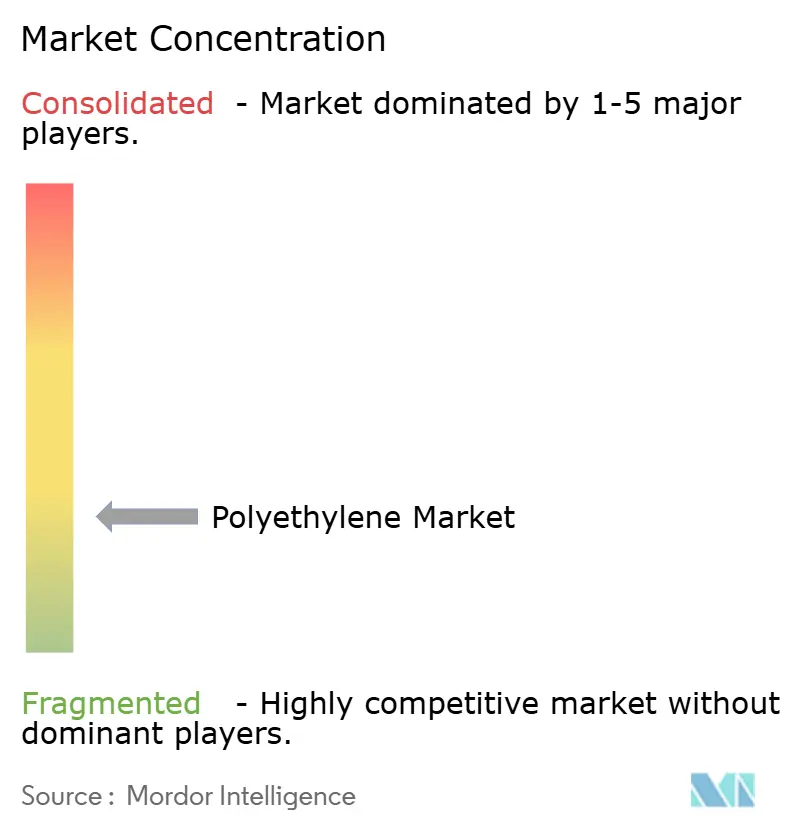
| Market Concentration | Low |
Major Players *Disclaimer: Major Players sorted in no particular order Image © Mordor Intelligence. Reuse requires attribution under CC BY 4.0. | |
Polyethylene Market Analysis by Mordor Intelligence
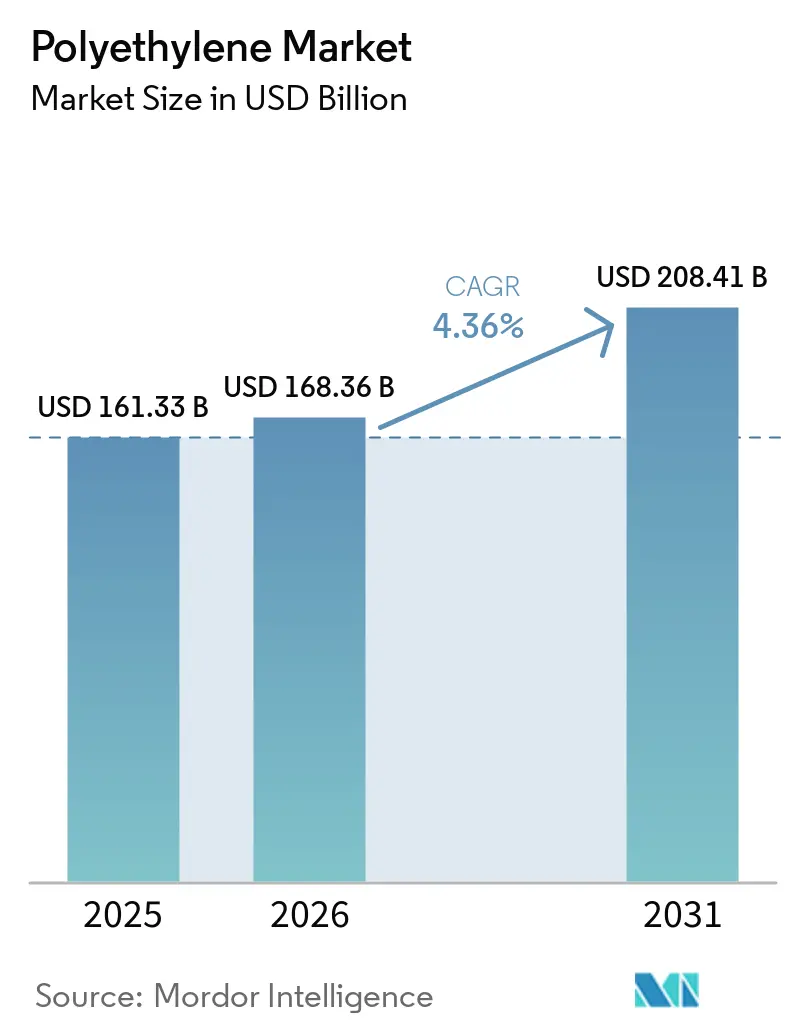
The Polyethylene Market was valued at USD 161.33 billion in 2025 and is estimated to grow from USD 168.36 billion in 2026 to reach USD 208.41 billion by 2031, at a CAGR of 4.36% during the forecast period (2026–2031). Demand remains broad because the resin is used in packaging, pipe infrastructure, consumer goods, and construction applications. Its cost position against metals and glass continues to support converter demand, especially where lightweight packaging or corrosion resistance is important. Capacity additions in China are increasing supply and pressuring prices, while infrastructure projects support demand through a longer investment cycle. Recycled-content requirements are increasing demand for recycled polyethylene grades, even as restrictions on some single-use formats limit virgin resin demand. Producers that can combine conventional grades, recycled material, and specialized pipe grades are better placed to serve changing customer requirements in the polyethylene market.
Key Report Takeaways
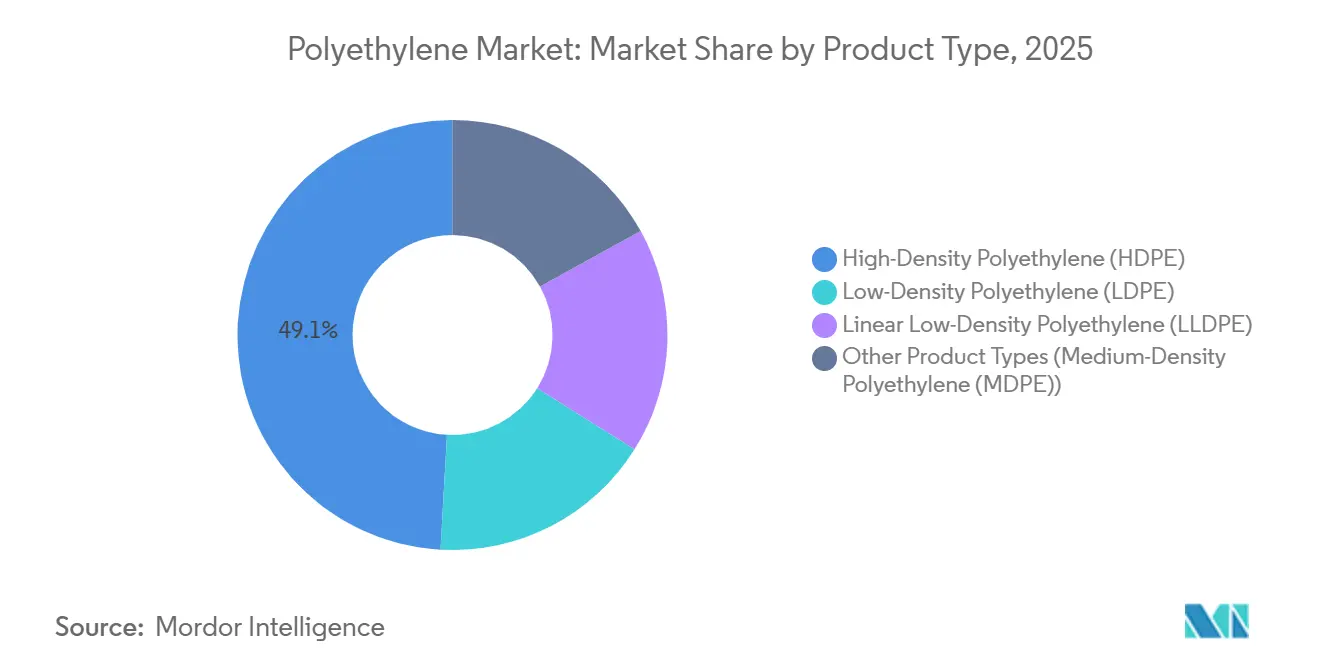
- By product type, High-Density Polyethylene (HDPE) held 49.12% of the polyethylene market share in 2025, while Linear Low-Density Polyethylene (LLDPE) is projected to advance at a 4.74% CAGR through 2031.
- By form, sheets and films held 38.81% of the polyethylene market share in 2025 and are projected to advance at a 4.89% CAGR through 2031.
- By manufacturing process, extrusion held 49.53% of the polyethylene market share in 2025 and is projected to advance at a 4.64% CAGR through 2031.
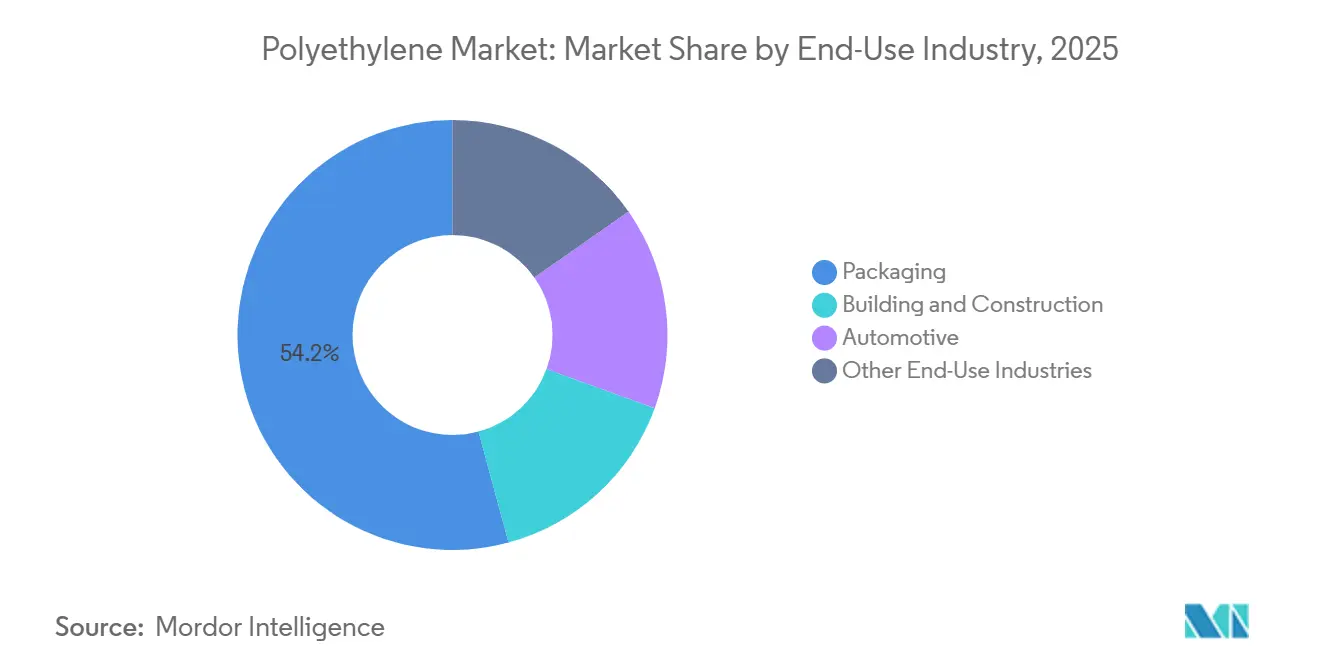
- By end-use industry, packaging held 54.20% of the polyethylene market share in 2025, while building and construction is projected to advance at a 5.23% CAGR through 2031.
- By geography, Asia-Pacific held 47.67% of the polyethylene market share in 2025 and is projected to advance at a 5.06% CAGR through 2031.
Note: Market size and forecast figures in this report are generated using Mordor Intelligence’s proprietary estimation framework, updated with the latest available data and insights as of January 2026.
Global Polyethylene Market Trends and Insights
Drivers Impact Analysis*
| Driver | (~) % Impact on CAGR Forecast | Geographic Relevance | Impact Timeline |
|---|---|---|---|
| Packaging Demand from Food, Beverage, and E-Commerce Channels | +1.5% | Global, with accelerated gains in India, Southeast Asia, and North America | Short term (≤ 2 years) |
| Water, Gas, and Irrigation Infrastructure Expansion | +1.1% | Asia-Pacific, North America, Africa, and Middle East | Medium term (2–4 years) |
| Lightweighting and Performance Requirements Across End-Use Industries | +0.8% | Global, strongest in North America, Europe, and Northeast Asia | Medium term (2–4 years) |
| Circular Polyethylene and Recycled-Content Mandates | +0.6% | EU core, spill-over to North America and APAC | Medium term (2–4 years) |
| Hydrogen-Ready Gas Networks Requiring PE-100-RC Pipes | +0.3% | EU, North America, Australia, with emerging demand in GCC | Long term (≥ 4 years) |
| Pellet-Loss Compliance and Resin Traceability Investments | +0.2% | EU and North America with international adoption | Short to medium term (1–3 years) |
| Source: Mordor Intelligence | |||
Packaging Demand from Food, Beverage, and E-Commerce Channels
Packaging captured 54.20% of polyethylene end-use demand in 2025, and food, beverage, and e-commerce uses continue to support resin consumption. In India, the expansion of quick-commerce services is increasing demand for flexible packaging, especially linear low-density polyethylene (LLDPE) used in stretch films and mailer bags. Emerging-market e-commerce supply chains favor thin, durable LLDPE films over traditional low-density polyethylene (LDPE) films. This shift supports metallocene-grade LLDPE because it allows film producers to reduce thickness while maintaining seal strength and puncture resistance. Polyethylene packaging for food and beverages is expected to grow with flexible packaging, while mono-material films are gaining attention from brands seeking recyclable designs. Suppliers of higher-performance LLDPE grades can therefore capture value in the polyethylene market beyond standard resin volumes, particularly when their materials let converters use thinner substrates without failing seal-strength or puncture-resistance tests. This makes the polyethylene market more favorable to differentiated film grades than to undifferentiated resin alone.
Water, Gas, and Irrigation Infrastructure Expansion
High-density polyethylene (HDPE) pipe demand is supported by replacement programs in North America, water grid projects in Africa and South Asia, and wastewater upgrades in Southeast Asia. The American Water Works Association updated its HDPE pipe standard in 2025 to add fitting requirements and clarify lead-free applications. The update reinforced HDPE as a material covered by American National Standards Institute and American Water Works Association standards for service, distribution, and transmission piping from 0.75 to 65 inches. African demand has also expanded across water, sewage, mining, agriculture, and fire-retardant pipe applications. Irrigation modernization in water-stressed agricultural economies creates a continuing investment channel that is less dependent on short-term gross domestic product cycles. The 70-mile rural water pipeline in South Dakota and the 27-mile Vita H2O Project in Colorado illustrate the range of projects supporting infrastructure-grade HDPE demand, from rural water supply to projects that modernize service networks.
Circular Polyethylene and Recycled-Content Mandates
Recycled-content regulation is moving from voluntary commitments to binding obligations, which require producers to develop mechanical and chemical recycling capacity. Regulation (EU) 2025/40 entered into force on February 11, 2025, and applies from August 12, 2026[1]European Commission, “Packaging Waste: Packaging and Packaging Waste Regulation 2025/40,” European Commission, environment.ec.europa.eu. It requires packaging placed on the European Union market to meet recycled-content thresholds by 2030, including 10% for non-polyethylene terephthalate contact-sensitive plastics and 35% for other plastic packaging. A joint 2025 study by the Independent Chemical Information Service and the China Petroleum and Chemical Industry Federation projected demand of 5.4 million metric tons per year of recycled polyethylene, polypropylene, and polyethylene terephthalate in the European Union by 2030. NOVA Chemicals commissioned its Connersville, Indiana, mechanical recycling facility in 2025, targeting full annual capacity above 100 million pounds of recycled LLDPE by 2026, and commercialized two recycled polyethylene grades in February 2026.
Hydrogen-Ready Gas Networks Requiring PE-100-RC Pipes
Hydrogen-blended and 100%-hydrogen gas networks are creating demand for PE-100-RC, a crack-resistant polyethylene pipe grade. EN 1555-1:2025 includes an informative annex on the chemical resistance and permeation properties of polyethylene systems used with hydrogen and hydrogen-natural gas blends. The standard supports the use of PE-100-RC in hydrogen-compatible gas distribution systems. In April 2026, the U.S. Pipeline and Hazardous Materials Safety Administration issued a direct final rule that incorporated ASTM International D2513-2024 for polyethylene gas pressure pipe. The PE100+ Association completed a 2025 round robin test for certification of PE-100-RC materials using a new environmentally compliant test surfactant. Producers of these compounds can seek premium pricing compared with standard HDPE pipe grades, making this specification-driven demand a higher-value portion of the broader infrastructure opportunity in the polyethylene market.
Restraints Impact Analysis*
| Restraint | (~) % Impact on CAGR Forecast | Geographic Relevance | Impact Timeline |
|---|---|---|---|
| Crude Oil and Ethylene Feedstock Price Volatility | -0.9% | Global, most acute for naphtha-dependent European and Northeast Asian producers | Short to medium term (1–3 years) |
| Single-Use Plastic Restrictions and Sustainable Material Substitution | -0.6% | EU (August 2026 onset), UK, Canada, with regulatory influence spreading to ASEAN | Medium term (2–4 years) |
| Food-Contact and Medical-Grade Recycled Resin Qualification Constraints | -0.3% | North America and EU | Medium to long term (3–5 years) |
| Fragmented Mass-Balance Certification and Chain-of-Custody Standards | -0.2% | Global | Long term (≥ 4 years) |
| Source: Mordor Intelligence | |||
Crude Oil and Ethylene Feedstock Price Volatility
Feedstock volatility continues to compress polyethylene margins outside the U.S. ethane-cracking corridor. Naphtha-dependent producers in Europe and Northeast Asia remain exposed to crude oil movements that they cannot fully pass on to converters in an oversupplied environment. LyondellBasell reported a USD 738 million net loss in 2025, compared with USD 1.367 billion net income in 2024, as margins declined across North American and European operations. Margin pressure accelerated rationalization decisions, and ethylene capacity at Dow, SABIC, and LyondellBasell sites in Europe declined by a combined 1.9 million metric tons per year by the end of 2025. Some Singapore-based operators had negative naphtha and ethylene margins in late 2025, which limited the scope for further resin-price reductions. Producers with ethane import terminals, gas-based cracking, or access to low-cost Middle Eastern ethylene have a stronger position, although feedstock exposure remains a near- and medium-term constraint.
Single-Use Plastic Restrictions and Sustainable Material Substitution
Single-use plastic regulations are reducing the addressable demand for some polyethylene films and bags in regulated markets. Regulation (EU) 2025/40 bans several single-use packaging categories from January 2030, while the United Kingdom's plastic wet wipes ban took effect in December 2025[2]UK Government, “Plastic Wet Wipes Ban,” GOV.UK, gov.uk. These rules are prompting brand owners to reformulate packaging and direct spending toward paper, bioplastics, and reusable structures. Polyethylene can nevertheless gain share in compliant formats, particularly recyclable mono-material films that replace multilayer laminates containing aluminum or non-polyethylene polymers. LLDPE and HDPE can benefit where converters need recyclable formats with strength and barrier performance. The resulting product mix favors higher-performance grades rather than evenly supporting all resin types, because the formats that remain compliant must still meet the performance requirements of food service and consumer packaging.
*Our forecasts treat driver/restraint impacts as directional, not additive. The impact forecasts reflect baseline growth, mix effects, and variable interactions.
Segment Analysis
By Product Type: HDPE Dominates, While LLDPE Leads Growth
HDPE held 49.12% of the polyethylene market share in 2025, supported by demand for blow-molded bottles, gas distribution pipe, potable water pipe, corrugated pipe, protective industrial films, and geomembrane liners. The material is widely specified for municipal water systems in North America and Oceania because it resists corrosion and can be joined through fusion, creating monolithic joints that differ from conventional mechanical connections. Its broad use across containers, pipes, construction, and environmental containment provides a substantial demand base across high-volume processing chains. LDPE retained a role in low-temperature packaging, extrusion coatings, and film-blending uses where its processing characteristics remain useful, even as converters assess opportunities to use LLDPE in films that need more strength at the same gauge. Converters are increasingly replacing LDPE with LLDPE in stretch and agricultural films because greater tensile strength can reduce resin use at an equivalent gauge without sacrificing the required film performance.
LLDPE is projected to advance at a 4.74% CAGR through 2031, the fastest rate among product types. Its growth is supported by a shift from rigid to flexible packaging, stronger e-commerce demand for stretch film in emerging markets, and metallocene catalyst technology. This technology allows producers to tailor molecular architecture for specific film applications and to supply films with the required seal strength and puncture resistance, which is particularly relevant for e-commerce packaging, food wraps, and downgauged flexible structures. Mono-material LLDPE films can replace multilayer laminates while maintaining seal strength and moisture-barrier performance, aligning with extended producer responsibility frameworks that are influencing procurement in Europe and North America. NOVA Chemicals launched 9 SURPASS, SCLAIR, and NOVAPOL grades with a non-fluorinated polymer processing aid in September 2025, adding a regulatory-compliance element to performance-based competition.


By Form: Sheets and Films Drive Both Share and Growth
Sheets and films held 38.81% of the polyethylene market share in 2025 and are projected to advance at a 4.89% CAGR through 2031. This combination reflects the depth of demand from packaging, agriculture, and construction rather than a narrow application base. E-commerce supports demand for stretch films, mailer bags, protective wrapping, and other flexible packaging formats that need thin, durable materials. Agricultural film also supports demand because LLDPE greenhouse and silage films provide ultraviolet stability and multi-season durability in protected cultivation, where growers depend on consistent material performance across repeated exposure cycles. Pellets remained the principal commercial delivery form for virgin resin used in injection-molding and blow-molding operations, even while film applications drove the faster growth of sheets and films.
Powder form polyethylene serves rotational molding, wire and cable coatings, and hot-melt adhesives. Its fine particle size supports consistent heat transfer and fusion in processing systems that do not use pellets. Other forms, including granules, pipes, and tubes, are finished industrial products tied to infrastructure purchasing cycles rather than raw converter feedstock. Dow introduced INNATE TF 220 precision packaging resin in 2025 for biaxially oriented polyethylene (BOPE) films. BOPE films can improve stiffness, transparency, and recyclability compared with conventional oriented films used in flexible packaging. These product developments concentrate material innovation in the sheets and films category, where brands also need packaging structures that can meet recyclability requirements.
By Manufacturing Process: Extrusion Leads Across Both Dimensions
Extrusion held 49.53% of the polyethylene market share in 2025 and is projected to advance at a 4.64% CAGR through 2031. The process is central to continuous film blowing, pipe extrusion, and sheet production. It offers high throughput for thin-gauge film applications where converters must control material use and output. Its compatibility with monolayer and multilayer co-extrusion die configurations supports the sheets and films form segment. The same demand supporting films and pipe is supporting extrusion growth, including demand for recyclable mono-material film structures, continuous production of pipe for water and gas networks, and sheet production for construction uses.
Blow molding supplies HDPE bottles and containers used in personal care, industrial chemicals, and food packaging. Investments in China and India are directed toward demand from domestic branded goods markets and their expanding packaging supply chains. Injection molding supports polyethylene closures, crates, fittings, and short-run technical parts, although polypropylene limits its growth in rigid containers. Rotational molding, compression molding, and thermoforming serve storage tanks and specialized components in chemical-processing settings. The Golden Triangle Polymers project in Orange, Texas, is deploying 2 HDPE units with 1,000 kilotons per year of capacity each for export markets where blow-molded and injection-molded HDPE demand is growing. The project indicates that product design for individual processing routes is central to producer investment decisions, since HDPE grades must meet the requirements of bottle, container, pipe, and other converter applications in export markets.
By End-Use Industry: Packaging Anchors Demand, Building and Construction Accelerates
Packaging held 54.20% of the polyethylene market share in 2025, reflecting use in films, bags, and blow-molded containers. Food and beverage, consumer goods, e-commerce logistics, and industrial supply chains all rely on these products for transport, protection, and product presentation. The segment benefits from polyethylene's low unit cost, broad processing capability, and food-contact approvals in major markets. Competing materials rarely provide the same combination at comparable total cost or across the same range of flexible and rigid formats, which limits substitution risk where high-volume converter operations require established materials and processing equipment. Automotive use is growing through HDPE fuel tanks, interior panels, and under-hood cable coverings, although battery-electric platforms remove fuel tanks as a consumption category.
The building and construction industry is projected to advance at a 5.23% CAGR through 2031, supported by HDPE pipe, geomembranes, house wrap, and insulation membranes. Water and gas infrastructure spending is increasing demand for pipe, while landfill and water-containment projects support geomembranes. India's national pipeline-grid expansion is also supporting HDPE pipe demand for gas distribution. Other end-use industries include electrical and electronics, consumer goods, healthcare, agriculture, and industrial manufacturing. These uses include flexible films, agricultural mulch, irrigation drip tape, specialized medical-grade HDPE for device components, and medical packaging, which together provide demand outside the principal packaging and construction applications.
Geography Analysis
Asia-Pacific held 47.67% of the polyethylene market share in 2025 and is projected to advance at a 5.06% CAGR through 2031. Regional capacity rationalization in Japan and South Korea can affect supply conditions through the forecast period. The region combines the largest production base with the strongest consumption growth. India and the Association of Southeast Asian Nations (ASEAN) countries are also expanding through e-commerce, food-packaging modernization, and infrastructure investment. Japan is in a third petrochemical rationalization cycle, targeting the removal of 2.4 million metric tons of ethylene capacity by 2028. South Korea requested restructuring and competitiveness plans from 10 major petrochemical companies in August 2025, targeting 3.7 million metric tons of capacity reduction.
North America benefits from ethane-based cracking on the U.S. Gulf Coast. Demand comes from packaging, infrastructure pipes, and automotive uses. Dow's Poly-7 line in Freeport, Texas, has started up with 590,000 metric tons per year of HDPE or LLDPE capacity. Golden Triangle Polymers in Orange, Texas, is scheduled for completion in the second half of 2026 with 2 HDPE units totaling 2 million metric tons per year. Mexico is an emerging demand center after Braskem opened a USD 580 million ethane import terminal in 2025, improving feedstock logistics at the Braskem Idesa plant in Veracruz.
South America, and the Middle East and Africa are growing parts of the polyethylene market. Brazil's packaged food demand, meat-export packaging needs, and a preliminary antidumping duty of USD 199.04 per metric ton on U.S. polyethylene imports are affecting domestic resin pricing. Argentina and other South American countries are supported by agricultural film and consumer-goods packaging demand. Gulf Cooperation Council producers retain a cost advantage from gas-based feedstocks, supporting capacity investment despite global oversupply. In Sub-Saharan Africa, urbanization and water infrastructure gaps support HDPE pipe procurement in Nigeria and South Africa.

Competitive Landscape
The polyethylene market is highly fragmented, with the top five players including Exxon Mobil Corporation, LyondellBasell Industries Holdings N.V., China Petrochemical Corporation, SABIC, and Dow. Producers with advantaged ethane or gas feedstocks are investing in capacity and export-oriented HDPE production. Naphtha-dependent producers in Europe and Northeast Asia are rationalizing older capacity and focusing on specialty grades and circular polyethylene. This difference in feedstock access is shaping investment choices and the competitive position of regional producers, with capacity growth centered in cost-advantaged regions and portfolio changes more common in locations exposed to higher naphtha costs.
LyondellBasell divested its European olefins and polyolefins assets to Aequita, forming Velogy in Rotterdam in 2026. Aequita also agreed to integrate SABIC's European petrochemicals business into the Velogy platform. The transaction reflects the repositioning of assets in a region facing weaker margins, sustained margin compression, lower operating rates, and the need to address an older production base. SABIC's USD 6.4 billion Fujian Petrochemical Complex in China is on track for a fourth-quarter 2026 startup, showing continued investment in growth-market capacity. The project is built around a 1.8 million metric tons per year mixed-feed cracker and includes polyethylene, polypropylene, polycarbonate, and ethylene glycol units.
Recycled polyethylene is becoming an important point of differentiation for NOVA Chemicals, Dow, Reliance Industries, TotalEnergies, and SABIC. Dow acquired a stake in Xycle, a Rotterdam chemical recycler with planned capacity of 21,000 metric tons per year that is expected to be fully operational in the fourth quarter of 2026. NOVA Chemicals obtained U.S. Food and Drug Administration no-objection letters for two recycled polyethylene grades in 2024 and plans to expand into food-contact recycled LLDPE in 2026. Food-contact-approved recycled LLDPE remains scarce, creating an opening for suppliers with quality-controlled material and a route to regulatory approval for demanding packaging or medical-related applications. Mass-balance certification and chain-of-custody requirements under ISO 14044 and International Sustainability and Carbon Certification (ISCC) PLUS favor companies with established compliance capabilities, as those companies can manage documentation and traceability more readily than smaller independent converters.
Polyethylene Industry Leaders
Exxon Mobil Corporation
LyondellBasell Industries Holdings N.V.
China Petrochemical Corporation
SABIC
Dow
- *Disclaimer: Major Players sorted in no particular order

Recent Industry Developments
- February 2026: NOVA Chemicals launched SYNDIGO rPE-IN3 and rPE-IN4 for commercial availability. These two 100% post-consumer recycled linear low-density polyethylene grades are produced at its Connersville, Indiana facility, which has a target annual production capacity of over 100 million pounds.
- February 2026: South Korean refiner S-Oil signed a 5-year polyethylene supply contract worth KRW 5.5 trillion (USD 3.9 billion) with SABIC. The contract secured a global sales channel for polyethylene output from S-Oil's Shaheen Project, South Korea's largest petrochemical plant.


Global Polyethylene Market Report Scope
Polyethylene is a versatile thermoplastic polymer widely used for its excellent chemical resistance, durability, flexibility, and ease of processing. It is one of the most widely consumed plastics and is used across packaging, construction, automotive, healthcare, agriculture, and numerous industrial applications.
The Polyethylene Market is segmented by product type, form, manufacturing process, end-use industry, and geography. By product type, the market is segmented into high-density polyethylene (HDPE), low-density polyethylene (LDPE), linear low-density polyethylene (LLDPE), and other product types (including medium-density polyethylene (MDPE)). By form, the market is segmented into sheets and films, pellets, powder, and other forms (including granules, pipes, and tubes). By manufacturing process, the market is segmented into extrusion, blow molding, injection molding, and other manufacturing processes (including rotational molding, compression molding, and thermoforming). By end-use industry, the market is segmented into packaging, building and construction, automotive, and other end-use industries (including electrical and electronics, consumer goods, healthcare, agriculture, and industrial manufacturing). The report also covers the market size and forecasts for polyethylene in 19 countries across major regions. For each segment, the market sizing and forecasts have been done on the basis of value (USD).
| High-Density Polyethylene (HDPE) |
| Low-Density Polyethylene (LDPE) |
| Linear Low-Density Polyethylene (LLDPE) |
| Other Product Types (Medium-Density Polyethylene (MDPE)) |
| Sheets and Films |
| Pellets |
| Powder |
| Other Forms (Granules, Pipes and Tubes) |
| Extrusion |
| Blow Molding |
| Injection Molding |
| Other Manufacturing Processes (Rotational Molding, Compression Molding, Thermoforming) |
| Packaging |
| Building and Construction |
| Automotive |
| Other End-Use Industries (Electrical and Electronics, Consumer Goods, Healthcare, Agriculture, Industrial Manufacturing) |
| Asia-Pacific | China |
| India | |
| Japan | |
| South Korea | |
| ASEAN Countries | |
| Rest of Asia-Pacific | |
| North America | United States |
| Canada | |
| Mexico | |
| Europe | Germany |
| United Kingdom | |
| France | |
| Italy | |
| Spain | |
| NORDIC Countries | |
| Russia | |
| Rest of Europe | |
| South America | Brazil |
| Argentina | |
| Rest of South America | |
| Middle East and Africa | Saudi Arabia |
| South Africa | |
| Egypt | |
| Nigeria | |
| Rest of Middle East and Africa |
| By Product Type | High-Density Polyethylene (HDPE) | |
| Low-Density Polyethylene (LDPE) | ||
| Linear Low-Density Polyethylene (LLDPE) | ||
| Other Product Types (Medium-Density Polyethylene (MDPE)) | ||
| By Form | Sheets and Films | |
| Pellets | ||
| Powder | ||
| Other Forms (Granules, Pipes and Tubes) | ||
| By Manufacturing Process | Extrusion | |
| Blow Molding | ||
| Injection Molding | ||
| Other Manufacturing Processes (Rotational Molding, Compression Molding, Thermoforming) | ||
| By End-Use Industry | Packaging | |
| Building and Construction | ||
| Automotive | ||
| Other End-Use Industries (Electrical and Electronics, Consumer Goods, Healthcare, Agriculture, Industrial Manufacturing) | ||
| By Geography | Asia-Pacific | China |
| India | ||
| Japan | ||
| South Korea | ||
| ASEAN Countries | ||
| Rest of Asia-Pacific | ||
| North America | United States | |
| Canada | ||
| Mexico | ||
| Europe | Germany | |
| United Kingdom | ||
| France | ||
| Italy | ||
| Spain | ||
| NORDIC Countries | ||
| Russia | ||
| Rest of Europe | ||
| South America | Brazil | |
| Argentina | ||
| Rest of South America | ||
| Middle East and Africa | Saudi Arabia | |
| South Africa | ||
| Egypt | ||
| Nigeria | ||
| Rest of Middle East and Africa | ||


Key Questions Answered in the Report
What is the size of the polyethylene market?
The polyethylene market stands at USD 168.36 billion in 2026 and is projected to reach USD 208.41 billion by 2031.
Which region is expected to grow fastest through 2031?
Asia-Pacific is projected to advance at a 5.06% CAGR through 2031.
Which polyethylene product type is expected to grow fastest through 2031?
Linear Low-Density Polyethylene (LLDPE) is projected to advance at a 4.74% CAGR through 2031, supported by flexible packaging and e-commerce film demand.
Which end-use industry led the market demand in 2025?
Packaging held 54.20% of demand in 2025, supported by films, bags, and blow-molded containers.
Page last updated on:


 Your data is secure and never sold or shared.


