
Polyester Hot Melt Adhesives Market Size and Share
Market Overview
| Study Period | 2020 - 2031 |
|---|---|
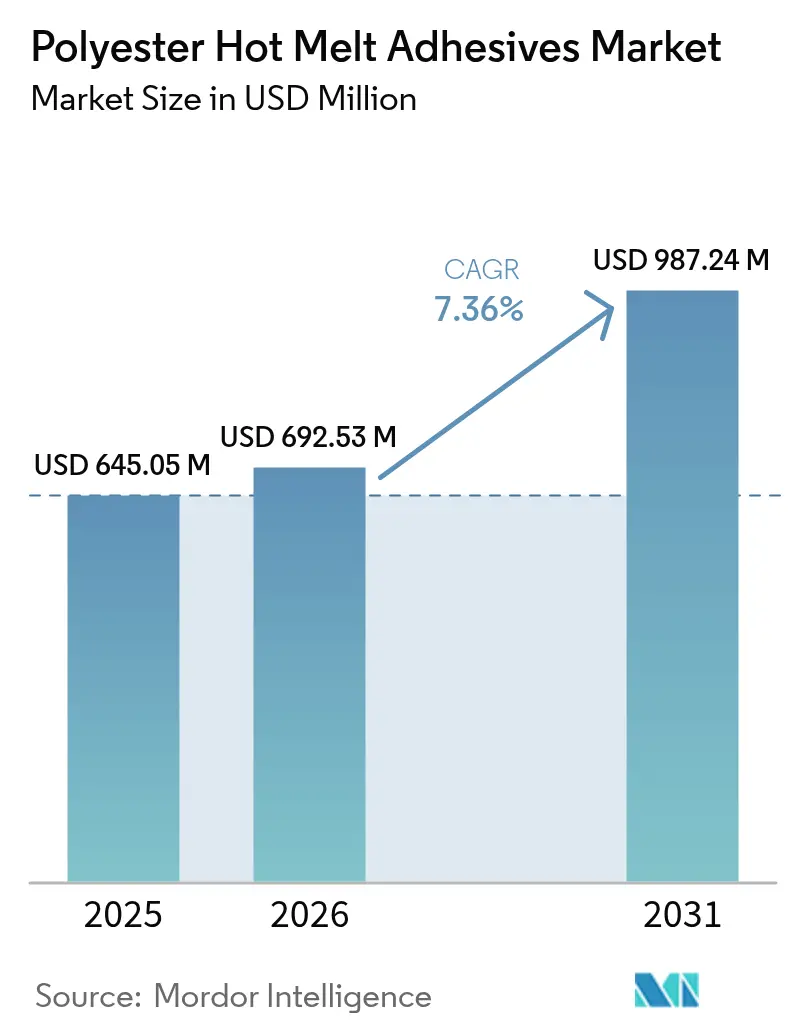
| Market Size (2026) | USD 692.53 Million |
| Market Size (2031) | USD 987.24 Million |
| Growth Rate (2026 - 2031) | 7.36 % |
| Fastest Growing Market | Asia Pacific |
| Largest Market | Asia Pacific |
| Market Concentration | Medium |
Major Players *Disclaimer: Major Players sorted in no particular order Image © Mordor Intelligence. Reuse requires attribution under CC BY 4.0. | |
Polyester Hot Melt Adhesives Market Analysis by Mordor Intelligence
The Polyester Hot Melt Adhesives Market size is expected to grow from USD 645.05 million in 2025 to USD 692.53 million in 2026 and is forecast to reach USD 987.24 million by 2031 at 7.36% CAGR over 2026-2031. Growth reflects the global transition from solvent-based systems to thermoplastic solutions that avoid volatile organic compounds, comply with tightening regulations, and deliver high bonding strength across automotive, electronics, packaging, textile, and medical uses. Regulatory pressure—most notably the European Union’s restriction on diisocyanates—continues to accelerate uptake of polyester formulations that combine structural performance with low emissions. Demand is further underpinned by lightweight vehicle programs, miniaturised consumer electronics, and rapid advances in smart-textile and medical disposables that all require adhesives capable of bonding dissimilar substrates, surviving thermal cycling, and meeting biocompatibility rules. Feedstock volatility and emerging bio-based alternatives add cost and competitive complexity, yet sustained capacity investments by leading suppliers in Asia Pacific secure raw material access, shorten delivery times, and foster application-specific innovation. Together, these forces keep the polyester hot melt adhesives market on a long-term, mid-single-digit growth trajectory despite cyclical raw-material cost swings.
Key Report Takeaways
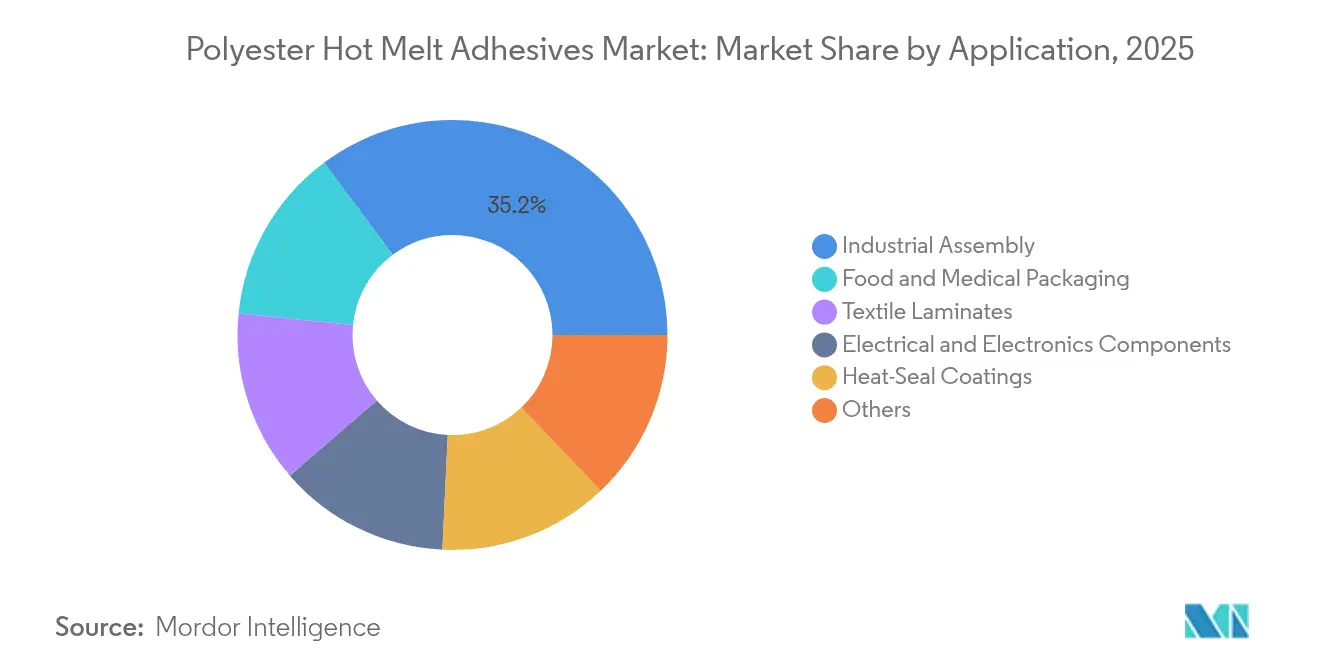
- By application, Industrial assembly led with 35.20% of the polyester hot melt adhesives market share in 2025; food and medical packaging is projected to expand at an 8.24% CAGR to 2031.
- By resin chemistry, Aromatic polyester captured 46.00% share of the polyester hot melt adhesives market size in 2025; bio-based polyester is forecast to grow at an 8.22% CAGR between 2026-2031.
- By form, Pellets and granules accounted for 48.10% share of the polyester hot melt adhesives market size in 2025, while powder and microspheres record the fastest projected CAGR at 8.18% through 2031.
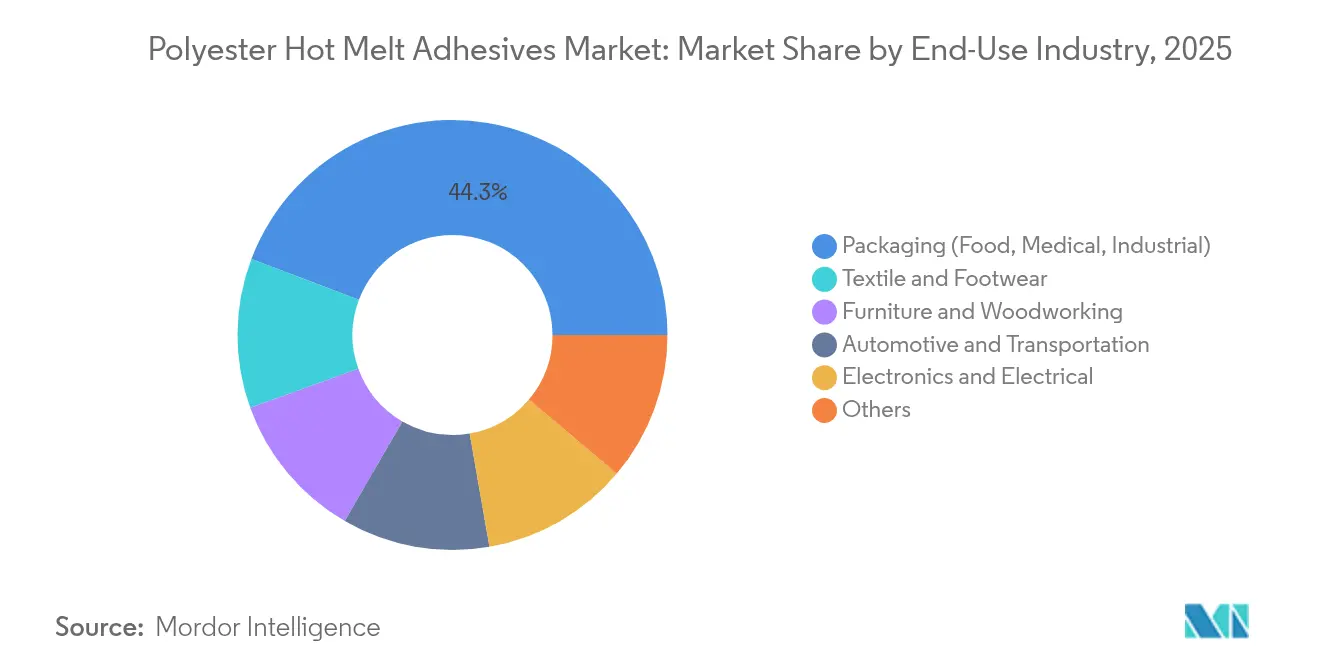
- By end-use industry, Packaging commanded 44.25% share of the polyester hot melt adhesives market size in 2025; textile and footwear is the fastest-growing end-use, rising at an 8.01% CAGR to 2031.
- By geography, Asia Pacific held 39.60% revenue share of the polyester hot melt adhesives market in 2025 and is advancing at an 8.12% CAGR through 2031.
Note: Market size and forecast figures in this report are generated using Mordor Intelligence’s proprietary estimation framework, updated with the latest available data and insights as of 2026.
Market Trends and Insights
Drivers Impact Analysis of Polyester Hot Melt Adhesives Market*
| Driver | (~) % Impact on CAGR Forecast | Geographic Relevance | Impact Timeline |
|---|---|---|---|
| Rising demand for solvent-free packaging adhesives | +1.80% | Global, with concentration in North America & EU | Medium term (2-4 years) |
| Lightweight automotive bonding requirements | +2.10% | APAC core, spill-over to North America | Long term (≥ 4 years) |
| Growth in miniaturised electronic components | +1.50% | APAC dominance, expanding to global markets | Short term (≤ 2 years) |
| Wearable smart-textile bonding emergence | +1.20% | North America & EU early adoption, APAC manufacturing | Medium term (2-4 years) |
| Medical-grade low-temperature film adhesives | +0.90% | Global, with regulatory leadership in EU & North America | Long term (≥ 4 years) |
| Source: Mordor Intelligence | |||
Rising Demand for Solvent-Free Packaging Adhesives
Packaging producers are eliminating solvent emissions and cutting energy use by shifting from solvent-borne laminating products to 100% solids polyester hot melts. Henkel, Dow, and Kraton recently cut the carbon footprint of the TECHNOMELT range by 25% by introducing bio-based tackifiers without sacrificing food-contact safety[1]. Tightening EU VOC limits further accelerates this switch, while converters benefit from quicker line speeds and the elimination of costly solvent-recovery equipment. Polyester formulations also improve adhesion to metallised films and enhance moisture resistance, making them attractive for premium barrier packaging.
Lightweight Automotive Bonding Requirements
Vehicle makers pursuing weight reduction and electrification rely on polyester hot melts to join aluminium, carbon fibre, and advanced steels that cannot be riveted or welded cost-effectively. These thermoplastic adhesives withstand wide temperature swings, damp vibration, and allow easier component disassembly for end-of-life recycling. Increasing power-electronics density in electric vehicles heightens under-hood thermal stress; polyester chemistries tailored for 150 °C service safely insulate battery modules while maintaining mechanical integrity.
Growth in Miniaturised Electronic Components
High-density circuit boards and flip-chip packaging demand adhesives that survive multiple reflow cycles yet provide electrical insulation. Polyester hot melts deliver precise dot placement, rapid green strength, and reworkability superior to traditional epoxies. Wearable and IoT devices need flexible bonding of films, antennas, and sensors; modified polyester grades accommodate repeated bending and low-temperature assembly, supporting high-volume Asian electronics production.
Wearable Smart-Textile Bonding Emergence
Integrating conductive yarns and flexible sensors into fabrics calls for adhesives compatible with ultrasonic welding and low-bulk lamination. Polyester hot melts bond electronics into garments while retaining drape and wash durability[2]. Footwear brands deploy them to embed force and temperature sensors in performance shoes, opening a fast-rising niche that rewards suppliers offering soft-handle, durable adhesive films.
Restraints Impact Analysis of Polyester Hot Melt Adhesives Market*
| Restraint | (~) % Impact on CAGR Forecast | Geographic Relevance | Impact Timeline |
|---|---|---|---|
| Availiablity Of subsitutes | -1.40% | Global, with higher impact in price-sensitive markets | Short term (≤ 2 years) |
| Volatile petrochemical diacid & glycol prices | -2.20% | Global, with acute impact in Asia Pacific manufacturing | Medium term (2-4 years) |
| High Raw Material & Production Costs | -1.80% | Global, with concentration in high-cost manufacturing regions | Long term (≥ 4 years) |
| Source: Mordor Intelligence | |||
Availability of Substitutes
Lignin-based hot melts, reactive polyurethane systems, and advanced cyanoacrylates match or exceed polyester performance in certain uses and attract buyers seeking lower cost or higher green content[3]. As these alternatives scale, they cap pricing power for polyester suppliers and can divert new projects when technical differences are minimal.
Volatile Petrochemical Diacid & Glycol Prices
Terephthalic acid and ethylene glycol price swings create margin pressure and budgeting uncertainty. Energy-market shocks, geopolitical events, or unplanned shutdowns ripple quickly through polyester value chains. Producers hedge with forward contracts, inventory buffers, and bio-feedstock experiments, yet sustained volatility remains a structural headwind.
*Our forecasts treat driver/restraint impacts as directional, not additive. The impact forecasts reflect baseline growth, mix effects, and variable interactions.
Polyester Hot Melt Adhesives Market Segment Analysis
By Application:
Industrial Assembly Drives Market LeadershipIndustrial assembly remains the largest slice of the polyester hot melt adhesives market, holding 35.20% share in 2025 and topping the USD polyester hot melt adhesives market size rankings. Automotive bonding dominates this segment, where the adhesive’s ability to unite multi-material structures and survive life-cycle temperature extremes is critical. Vehicle electrification raises peak under-hood temperatures, further reinforcing the need for thermally resilient polyester hot melts. Other industrial uses include appliance, furniture, and filter assembly, each benefiting from fast set times and clean processing.
Food and medical packaging is the fastest-growing application, advancing at an 8.24% CAGR through 2031. Brand owners favour solvent-free, low-odour adhesives that meet stringent migration limits while reducing line energy demand. Peelable heat-seal coatings for retort pouches and lidding films illustrate the crossover between industrial assembly and packaging functions. Electronics packaging and heat-seal coatings add diversity, while textile laminates offer an emerging arena where flexible adhesion, breathability, and wash resistance converge.

By Resin Chemistry:
Aromatic Polyester Dominance Faces Bio-Based ChallengeAromatic polyester commands 46.00% of 2025 revenues, prized for high glass-transition temperature, cohesive strength, and resistance to automotive and electronic operating conditions. The polyester hot melt adhesives market share advantage stems from decades of optimisation, ready availability of raw materials, and broad formulation know-how.
Bio-based and partially bio-based polyester, however, is the fastest-growing chemistry at 8.22% CAGR. Suppliers leverage plant-derived diacids, recycled PET, and CO₂-based intermediates to cut carbon footprint without losing mechanical performance. Customers in consumer goods and medical devices value the sustainability story, and legislative pressure on petrochemical dependence will narrow legacy cost advantages. Aliphatic polyester serves niche biodegradable or compostable end-uses, while copolyester chemistries fine-tune crystallinity and melt viscosity for tailored substrate wet-out or reworkability. Continuous R&D keeps the polyester hot melt adhesives market dynamic as performance and sustainability benchmarks rise in tandem.
By Form:
Pellets Maintain Processing AdvantagesPellets and granules deliver 48.10% of 2025 sales, driven by automated feeders that ensure consistent melt flow in high-speed packaging and automotive lines. Bulk pellet logistics cut handling loss and facilitate precise dosing, safeguarding quality in lean manufacturing environments.
Powder and microspheres post the highest growth at 8.18% CAGR. Electronics miniaturisation demands exact adhesive placement at the micron scale, prompting the adoption of screen-printable polyester powders and laser-activatable microbeads. Films and webs serve roll-to-roll textile lamination and large-area composite fabrication, while blocks, slabs, and sticks remain relevant for maintenance, repair, and craft applications where manual application still predominates. The diversified product mix lets converters choose the optimal delivery vehicle for their specific process constraints.
By End-Use Industry:
Packaging Leadership Faces Textile DisruptionPackaging remains the largest end use with 44.25% revenue in 2025, reflecting global food, beverage, and medical handling needs. Solvent-free polyester hot melts deliver hermetic seals for barrier films, suit cold-chain logistics, and support high-speed case and carton sealing. The shift to monomaterial flexible structures for easier recycling accentuates polyester’s role because its polarity matches many polyolefin and PET substrates.
Textile and footwear, at an 8.01% CAGR, is the fastest-growing segment as apparel brands integrate sensors, LEDs, and heating elements into garments. Polyester hot melts bond electronics into fabric with soft handfeel and wash durability, giving the sector a new functional dimension. Automotive, electronics, furniture, woodworking, and construction collectively diversify demand and buffer macro-sector volatility, ensuring volume stability for suppliers.
Geography Analysis
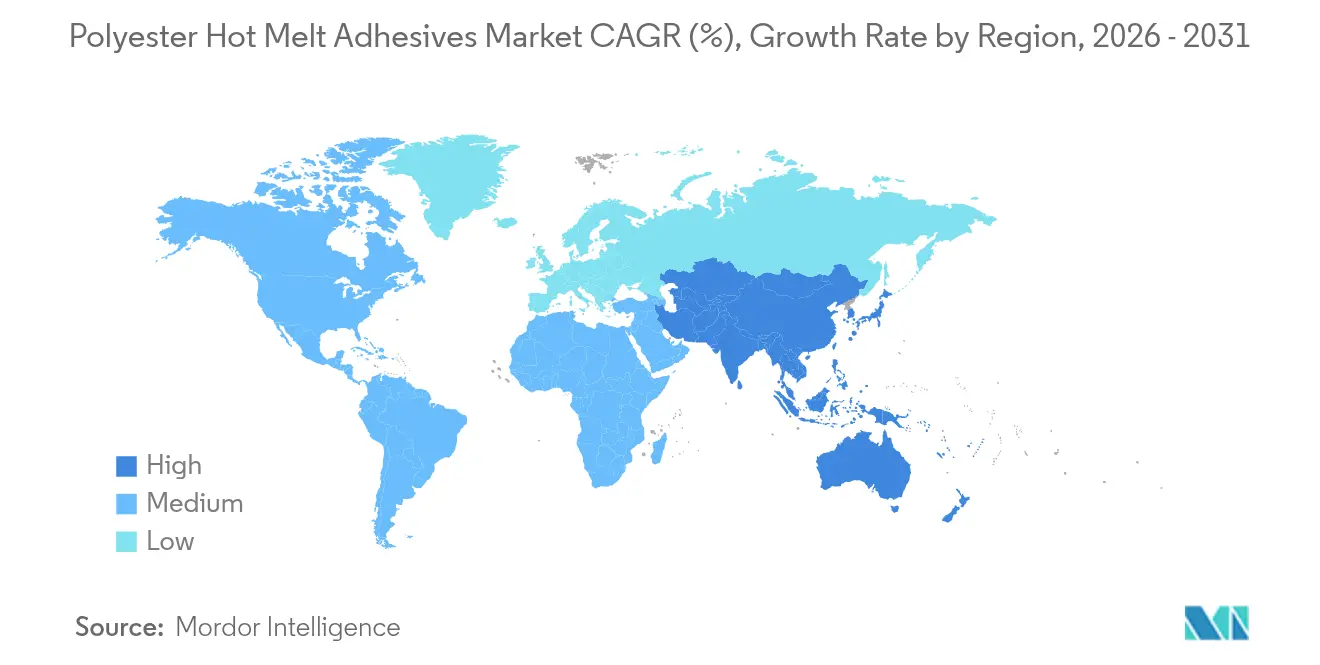
APAC Polyester Hot Melt Adhesives Market
Asia Pacific held 39.60% of global sales in 2025 and is on track for an 8.12% CAGR to 2031. China’s electric-vehicle buildout, India’s smartphone assembly hubs, and Japan’s high-precision electronics plants all consume large volumes of polyester hot melts. Regional authorities promote investment in advanced materials, encouraging Henkel and Sika to add local capacity, which shortens delivery cycles and integrates technical support into customers’ product-development workflows. Consolidated net sales at Pidilite Industries reached INR 12,337 crore (USD 1.48 billion) in 2025, underscoring the region’s maturing demand base.
North America and Europe Polyester Hot Melt Adhesives Market
North America remains an innovation powerhouse, driving stringent automotive lightweighting targets and pioneering bio-based chemistries. EU regulations steer materials away from diisocyanates and high-VOCs, making polyester hot melts a go-to solution. Both regions collaborate with academia and start-ups to scale CO₂-derived monomers, showcasing leadership in circular-economy adhesives.
MEA and South America Polyester Hot Melt Adhesives Market
South America, the Middle East, and Africa register smaller volumes but represent untapped potential. Infrastructure expansion and growing packaged-food sectors support wider adoption. As regional converters modernise equipment and embrace solvent-free lines, polyester hot melt suppliers win green-field projects that lock in multi-year contract volumes and strengthen global network resilience.
Value Chain Analysis
The value chain starts with petrochemical and increasingly circular or bio-based feedstocks, where dicarboxylic acids (notably terephthalic, isophthalic, and adipic acids) and diols (such as ethylene glycol, 1,4-butanediol, and 1,6-hexanediol) form the core input slate. These monomers move into polyester resin synthesis (esterification followed by polycondensation), typically using metal catalysts and stabilizer packages, before downstream formulation into application-specific hot melts.
Formulated products are converted into market-ready forms (pellets/granules, films/webs, and powders/microspheres) and distributed via direct OEM supply and specialty chemical distributors to packaging converters, automotive and electronics assemblers, and textile or footwear laminators. Performance qualification and application engineering are key downstream value-add steps, since line-speed targets, thermal-cycling durability, wash resistance, and food-contact or medical compliance often determine formulation and customer lock-in. Feedstock price volatility and the need for consistent molecular-weight control remain recurring bottlenecks. Research published in September 2025 on catalyst-free, bio-based polyester hot melt systems using FDCA points to ongoing upstream-to-midstream innovation to reduce reliance on petroleum-derived terephthalic acid while maintaining processing and bond-performance requirements.
Competitive Landscape
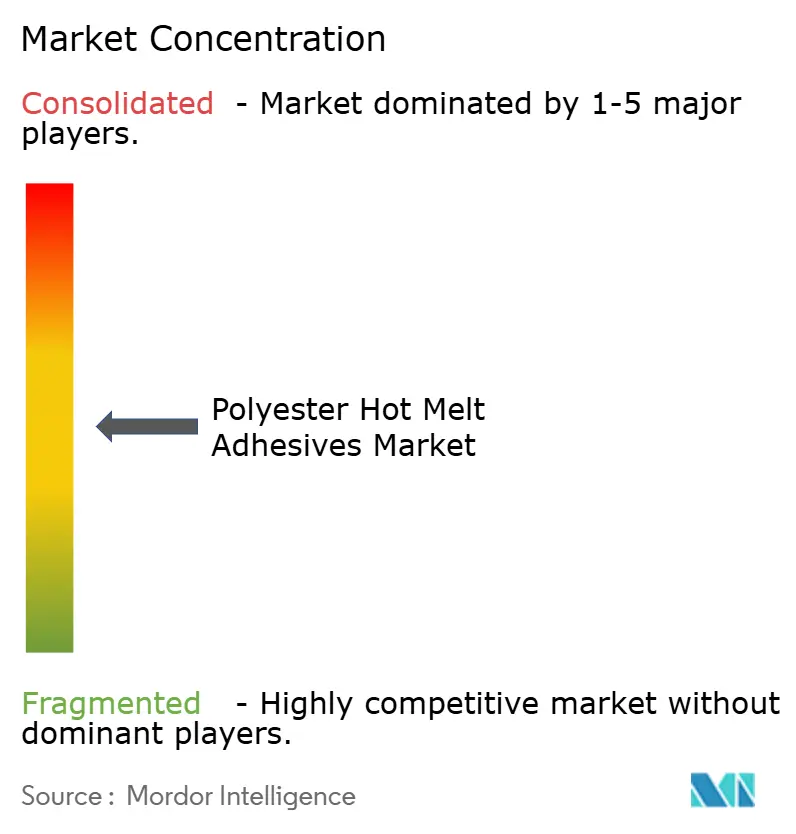
The polyester hot melt adhesives market is moderately fragmented. Henkel, H.B. Fuller, 3M, Bostik-Arkema, and Dow (through specialty joint ventures and technology partnerships) head the global roster. Their competitive edge rests on wide product portfolios, backward integration into polymer synthesis, and technical-service teams that embed with OEMs during design-in cycles.
Recent portfolio realignment illustrates strategic focus: Dow divested its flexible-laminating adhesives assets to Arkema for USD 150 million in December 2024, sharpening its emphasis on higher-margin specialty segments while bolstering Arkema’s reach in sustainable hot melts. Henkel partnered with Celanese to pioneer CO₂-based polyester, signalling that decarbonisation can coexist with performance leadership. Bostik earmarked USD 27 million for 2025 to expand high-molecular-weight polyester at its Massachusetts plant, reinforcing its heat-activated adhesive franchise for footwear and automotive interiors.
Regional specialists thrive by tailoring grades to local substrates and regulatory nuances. Price competition is limited because automotive, medical, and electronics qualification cycles can exceed 18 months, rewarding incumbents with proven track records. R&D centres increasingly concentrate on bio-feedstock substitution, reactive extrusion for faster melt-index control, and AI-driven formulation screening, indicating that intellectual property and application engineering—not scale alone—determine long-run market share shifts.
Polyester Hot Melt Adhesives Industry Leaders
-
3M
-
Arkema (Bostik)
-
Dow
-
H.B. Fuller Company
-
Henkel AG & Co. KGaA
- *Disclaimer: Major Players sorted in no particular order
Polyester Hot Melt Adhesives Market Companies Covered in this Report
- 3M
- Arkema (Bostik)
- Avery Dennison Corporation
- Beardow Adams Ltd.
- Bühnen GmbH & Co. KG
- Cattie Adhesives
- Dow
- Dymax Corporation
- Evonik Industries AG
- H.B. Fuller Company
- HellermannTyton
- Henkel AG & Co. KGaA
- Jowat SE
- Nihon Matai Co., Ltd.
- Sika AG
- Spiderbond Adhesives Co., Ltd.
- Toagosei Co., Ltd.
Market Opportunities and Future Outlook
Whitespace is expanding where customers are actively redesigning packages and assemblies around solvent-free processing, recyclability, and lower-emission chemistries. Packaging remains a primary arena for reformulation work, including copolyester hot melts positioned to be compatible with PET recycling streams and to replace incumbent polyolefin-based adhesive approaches in select structures. At the same time, automotive and electronics programs continue to pull for higher-temperature, durability-focused polyester hot melts that support multi-material joining and reworkable insulation bonding, while textile and footwear applications reward suppliers that can offer low-bulk, wash-durable adhesive films and webs for smart-textile integration.
On the supply side, recent investments and plant upgrades show where suppliers are building capability to serve these needs. Bostik (Arkema) announced a USD 27 million investment in May 2025 to expand high-molecular-weight polyester production at its Middleton, Massachusetts site, aimed at improving output and supporting specialty heat-activated platforms used across durable goods. Henkel has also disclosed adhesives manufacturing investments (for example, an approximately EUR 20 million expansion and modernization of its Bopfingen, Germany facility announced in October 2024) that include advanced hot melt formulations using sustainable alternative raw materials, indicating continued commercialization focus beyond lab-scale innovation. R&D evidence points to opportunities in catalyst-free polycondensation routes and bio-based monomers (such as FDCA and succinic-acid-based systems) that lower petrochemical exposure while enabling tunable melt behavior for demanding bonding windows.
Recent Industry Developments in Polyester Hot Melt Adhesives Market
- April 2026: Shenzhen Tunsing Plastic Products Co., Ltd. released the DS001TS copolyester hot melt adhesive film for industrial uses spanning textiles, automotive, and electronics. The release points to continued productization of copolyester film formats that simplify lamination and bonding in performance-critical assemblies where low-VOC processing and durability are required.
- May 2025: Bostik (Arkema) announced a USD 27 million investment to expand high-molecular-weight polyester resin production at its Middleton, Massachusetts facility. By increasing reactor capacity and improving production throughput, the project strengthens supply reliability for specialty heat-activated polyester hot melt platforms used in footwear, automotive interiors, and other durable-goods applications.
- April 2024: Henkel Adhesive Technologies, Kraton, and Dow collaborated to reduce the carbon footprint of Henkel’s TECHNOMELT SUPRA 100 and TECHNOMELT SUPRA 106M end-of-line packaging products in North America. The work highlights active reformulation pathways that keep packaging hot melts aligned with decarbonization requirements without sacrificing processing performance or compliance needs.
Polyester Hot Melt Adhesives Market Report Scope and Research Methodology
Market Definition and Coverage
This market covers polyester-based hot melt adhesive products sold for bonding and lamination, where the material is supplied as a solid and applied by heating and then setting on cooling. Our sizing reflects the value of these adhesives across common industrial and end-use consumption.
Scope exclusions: The market excludes non-polyester hot melts (such as EVA, polyolefin, TPU, and SBC systems) and excludes dispensing equipment, applicators, and installation services.
Segments Covered in This Report
- By Application
- Industrial Assembly
- Automotive
- Others
- Food and Medical Packaging
- Electrical and Electronics Components
- Heat-Seal Coatings
- Textile Laminates
- Others
- Industrial Assembly
- By Resin Chemistry
- Aromatic Polyester
- Aliphatic Polyester
- Copolyester
- Bio-based/Partially Bio-based Polyester
- By Form
- Pellets/Granules
- Blocks/Slabs
- Sticks
- Film/Web
- Powder/Microspheres
- By End-use Industry
- Packaging (Food, Medical, Industrial)
- Automotive and Transportation
- Electronics and Electrical
- Textile and Footwear
- Furniture and Woodworking
- Others
- By Geography
- Asia-Pacific
- China
- India
- Japan
- South Korea
- Rest of Asia-Pacific
- North America
- United States
- Canada
- Mexico
- Europe
- Germany
- United Kingdom
- Italy
- France
- Rest of Europe
- South America
- Brazil
- Argentina
- Rest of South America
- Middle East and Africa
- Saudi Arabia
- South Africa
- Rest of Middle East and Africa
- Asia-Pacific
Data Sources, Market Sizing, and Validation
Desk Research
To anchor the model, we first pulled public indicators that explain how polyester hot melt adhesives are used and where demand is expanding. Directional checks relied on trade and production statistics from agencies such as the US International Trade Commission and UN Comtrade, plus broader manufacturing signals from the Federal Reserve and the World Bank.
We then added industry context from non-paywalled technical and regulatory references, such as publications on hot melt and polymer processing in peer-reviewed journals, and regulatory documentation from agencies such as the US EPA and the European Chemicals Agency. For company-level context, we reviewed annual reports, investor presentations, and press releases to understand capacity additions, product positioning, and end-market exposure. Where needed, we also used subscription databases to cross-check company financials, patent activity, and import-export shipment patterns. This desk list is illustrative, and multiple other sources were used for data collection, validation, and clarification.
Primary Interviews and Surveys
Primary inputs were collected through structured expert conversations and short surveys across the value chain, covering raw material stakeholders, adhesive formulators, converters, and end-use procurement teams. We used these discussions to validate pricing ranges, typical formulation shifts (aromatic versus aliphatic and copolyester), form-factor demand (pellets, blocks, films, and powders), and realistic adoption levels in packaging, textiles, electronics, and transportation across major regions.
Distribution of primary research fieldwork respondents
| Company type | Respondent position | Region |
|---|---|---|
| Top tier: 36% | CXOs: 17% | APAC: 48% |
| Mid tier: 42% | Functional/Unit leaders: 32% | EMEA: 34% |
| Smaller Players: 22% | Managers: 51% | Americas: 18% |
Market-Sizing & Forecasting
Sizing starts with a top-down demand pool build that links polyester hot melt adhesive consumption to end-use activity where hot melts are routinely specified, then assigns polyester share based on application fit and material switching patterns. To keep the totals realistic, we corroborated the result with selective bottom-up approximations, such as sampled price per kg ranges by form, indicative consumption per end-use line, and supplier-side sanity checks shared during interviews.
A few inputs materially move the model, including packaging throughput growth (especially food and medical packs), textiles and footwear production shifts, electronics assembly output, and automotive and transportation build rates. These are then adjusted for hot melt penetration and polyester resin chemistry selection. We also tracked practical pricing drivers such as polyester feedstock movements and regional mix, since small value changes can shift a value-based market even when volume is broadly stable. For forecasting, scenario analysis was applied around adoption pace and price progression, and then narrowed using the range that most experts said is achievable under current regulatory and performance needs.
When bottom-up checks leave gaps, which often happens in smaller regions or niche uses, we fill them using proxy demand indicators and then re-test the outputs against interview feedback before finalizing the year values.
Data Validation & Update Cycle
Before sign-off, outputs are triangulated across multiple independent signals, including end-use activity trends, resin and adhesive pricing direction, and supplier commentary that explains share shifts. If a region or application moves outside expected ranges, the assumption is reviewed, and we re-check the driver inputs and re-contact selected experts when the variance remains unexplained.
The model is reviewed in steps by analysts so that arithmetic checks, unit consistency checks, and year-to-year continuity checks are completed before the final narrative is aligned. Reports are refreshed annually, and interim updates are done when there are material events that can shift pricing or demand. Right before delivery, a final pass is completed so clients receive the most current view available at that time.
Mordor Intelligence's Polyester Hot Melt Adhesives Market Sizing Compared With Other Published Estimates
Published market sizes for polyester hot melt adhesives can look far apart because different publishers set different scope lines, and they also handle pricing and conversion assumptions in different ways. We see the biggest swings when studies mix resin chemistries, count adjacent adhesive technologies, or use older pricing snapshots while still presenting the number as a current-year estimate.
The main gap comes from whether non-polyester hot melts are included in totals. In Mordor Intelligence's build, polyester hot melt adhesives are counted only when the resin chemistry is polyester (including copolyester and partially bio-based polyester), and the value reflects adhesive sales rather than application equipment. Differences also come from how each estimate treats form factors like films and powders, how quickly price assumptions are refreshed when feedstock moves, and whether regional demand weights are tied back to end-use output signals.
Benchmark comparison
| Source | Market Size | Gaps in Research Methodology |
|---|---|---|
| Mordor Intelligence | USD 692.53 M (2026) | |
| Regional Consultancy A | USD 477.58 M (2024) | The estimate uses an earlier base year and can understate value when later-year price progression and mix shifts toward higher-value forms are not carried through consistently. |
| Industry Publisher B | USD 391.92 M (2022) | The number reflects an older demand environment and can differ if regional weights and application penetration are not updated to match recent packaging and electronics output trends. |
The spread in published values is mainly explained by year selection and how tightly the polyester-only scope is applied in practice, followed by how pricing is refreshed and validated. By keeping the scope tied to polyester chemistries and checking the totals against end-use activity and interview-backed price ranges, the final number stays traceable to clear drivers and repeatable steps.
Key Questions Answered in the Report
What is the current size of the polyester hot melt adhesives market?
The market stands at USD 692.53 million in 2026 and is forecast to hit USD 987.24 million by 2031.
Which application dominates demand for polyester hot melt adhesives?
Industrial assembly, led by automotive bonding, holds 35.20% of revenue in 2025.
Why are polyester hot melts preferred over solvent-based laminating adhesives in packaging?
They eliminate VOC emissions, cut line energy use, and meet stricter food-contact regulations while delivering strong heat-seal performance.
Which region shows the fastest growth?
Asia Pacific leads with an 8.12% CAGR thanks to electric-vehicle production, electronics assembly, and ongoing capacity investments.
How are suppliers addressing feedstock price volatility?
Strategies include forward-buy contracts, regional sourcing diversification, and development of bio-based or CO₂-derived monomers that lower dependence on petrochemical inputs.