
Market Overview
| Study Period | 2020 - 2031 |
|---|---|
| Forecast Data Period | 2026 - 2031 |
| Base Year Market Size (2025) | USD 11.64 Billion |
| Market Size (2026) | USD 12.25 Billion |
| Market Size (2031) | USD 15.78 Billion |
| Growth Rate (2026 - 2031) | 5.20% CAGR |
| Market Concentration | Low |
Major Players *Disclaimer: Major Players sorted in no particular order Image © Mordor Intelligence. Reuse requires attribution under CC BY 4.0. | |
Poland Home Furniture Market Analysis by Mordor Intelligence
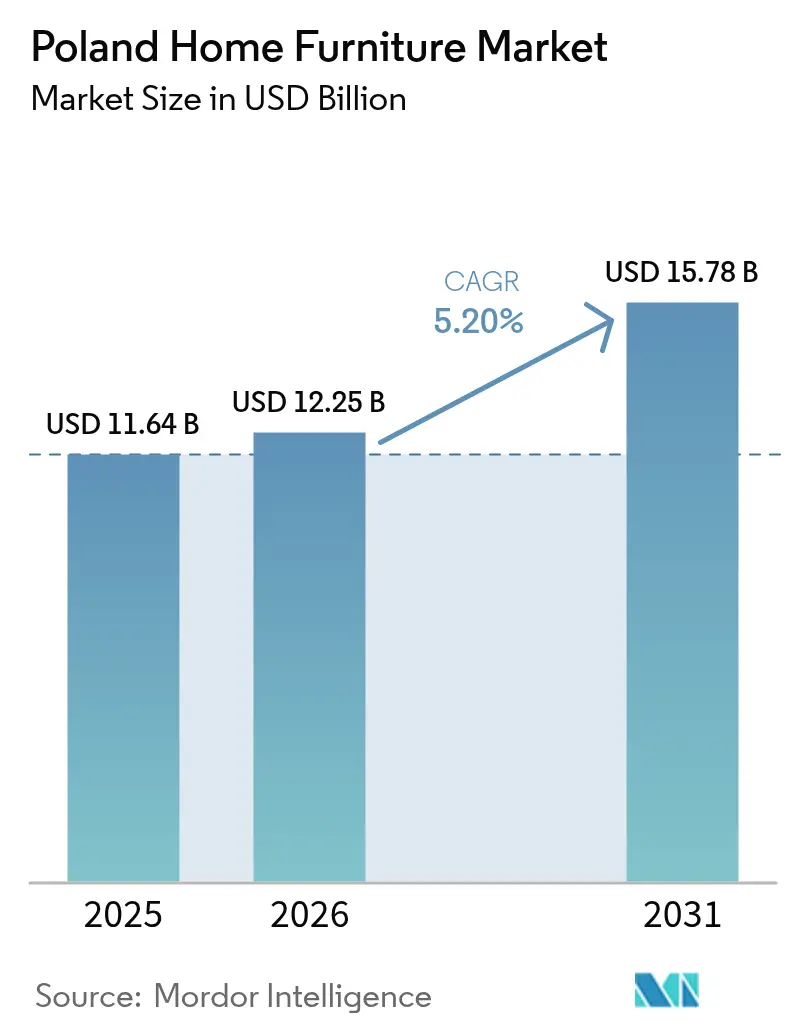
Poland home furniture market size in 2026 is estimated at USD 12.25 billion, growing from 2025 value of USD 11.64 billion with 2031 projections showing USD 15.78 billion, growing at 5.2% CAGR over 2026-2031. Rising first-time home purchases under the Bezpieczny Kredyt 2% scheme, persistent remote-work patterns, and a clear consumer tilt toward space-saving modular pieces sustain the growth momentum[1]Bezpieczny Kredyt 2% Factsheet, gov.pl. Manufacturers are broadening material portfolios with recyclable polymers to complement Poland’s long-standing woodworking heritage, while e-commerce penetration lifts direct-to-consumer sales, trimming retail mark-ups. Re-shoring by export-oriented producers is enlarging premium domestic offerings, and Masovian’s economic weight ensures a robust demand backbone even amid inflationary pressures. Supply-chain recalibration—especially on timber—remains the chief cost variable, yet high FSC certification rates help firms command price premiums in sustainability-minded urban demographics.
Key Report Takeaways
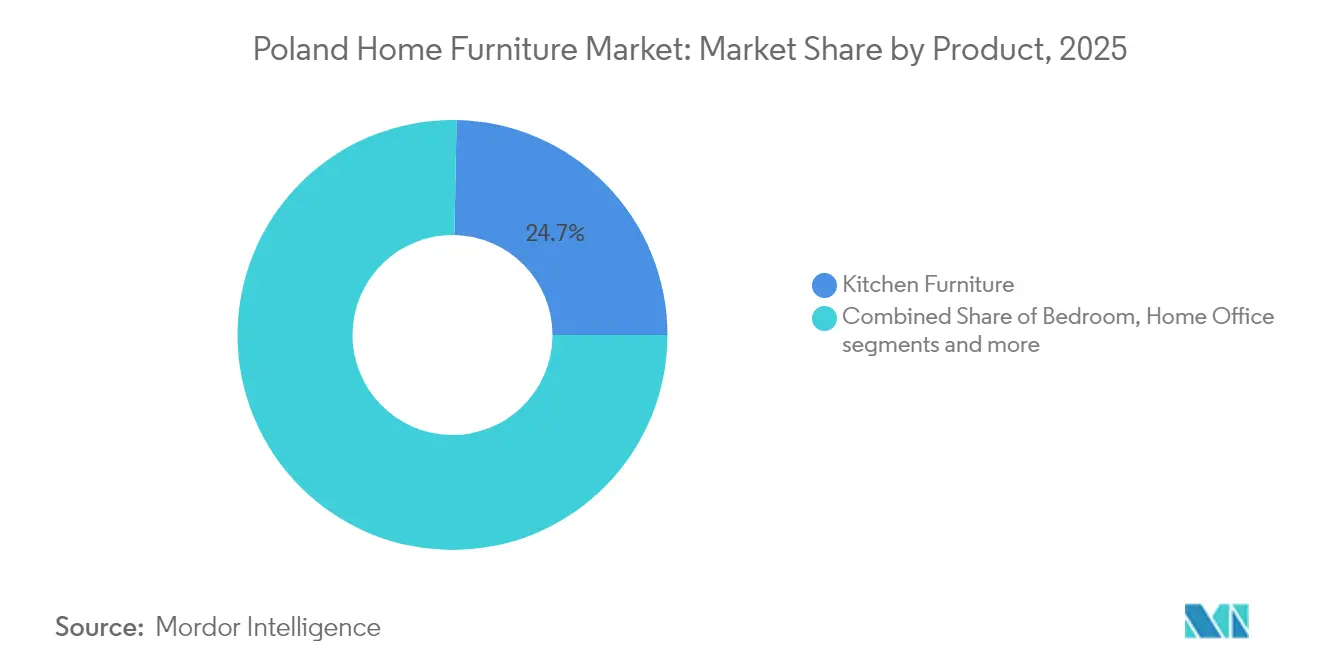
- By product, kitchen furniture led with 24.70% revenue share in 2025; home office furniture is projected to expand at a 5.75% CAGR to 2031.
- By material, wood held 44.35% of the Poland home furniture market share in 2025, while plastic & polymer is advancing at a 5.15% CAGR through 2031.
- By price range, mid-range captured 54.20% of the Poland home furniture market size in 2025; the premium tier is poised to grow at 5.65% CAGR through 2031.
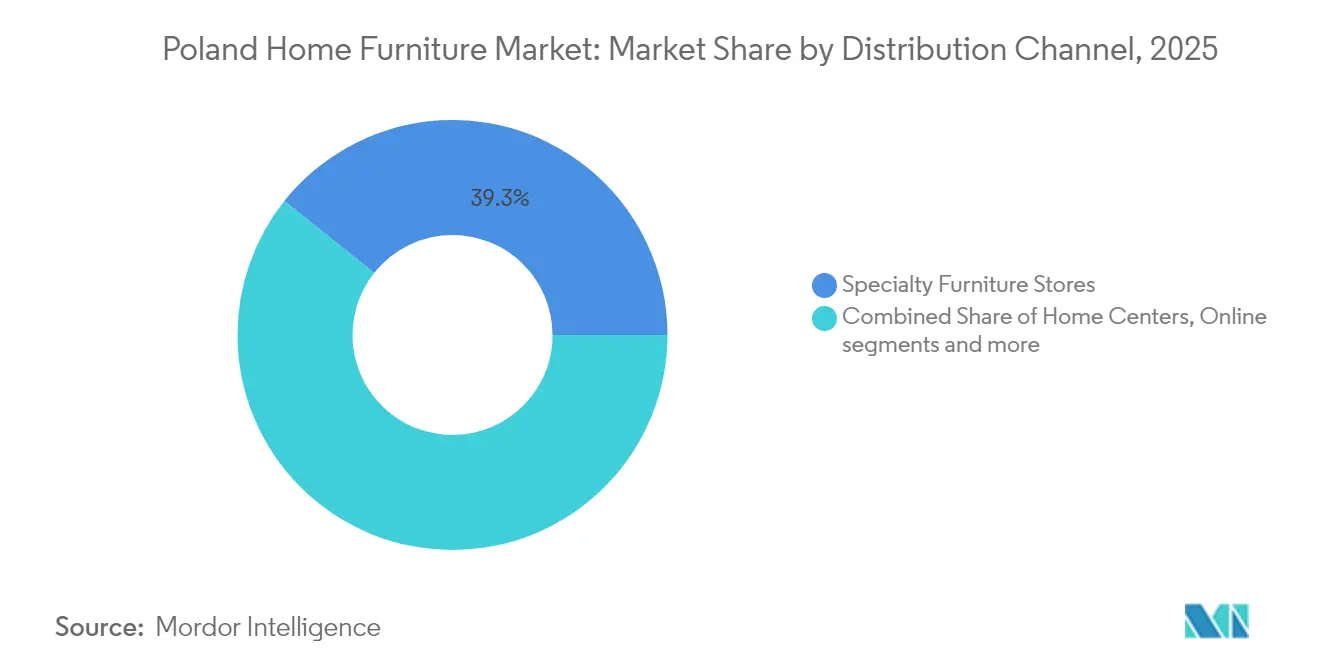
- By distribution channel, specialty stores controlled 39.30% revenue in 2025; online retail is rising at a 6.35% CAGR to 2031.
- By geography, Masovian (Mazowieckie) accounted for 19.85% share of the Poland home furniture market in 2025, while Lesser Poland (Małopolskie) is the fastest-growing region at a 5.85% CAGR.
Note: Market size and forecast figures in this report are generated using Mordor Intelligence’s proprietary estimation framework, updated with the latest available data and insights as of 2026.
Poland Home Furniture Market Trends and Insights
Drivers Impact Analysis*
| Driver | (~) % Impact on CAGR Forecast | Geographic Relevance | Impact Timeline |
|---|---|---|---|
| Re-Urbanization Fueling Small-Space Furniture Demand | +1.2% | National, concentrated in Warsaw, Kraków, Wrocław | Medium term (2–4 years) |
| Government “Mieszkanie Plus” Housing Program Boosting First-Time Furniture Purchases | +0.8% | National, higher impact in metropolitan areas | Short term (≤ 2 years) |
| Rise of Domestic E-Commerce Platforms Increasing Direct-to-Consumer Sales | +0.6% | National, with urban concentration | Medium term (2–4 years) |
| Export-Oriented Polish Producers Re-Shoring Capacity to Serve Domestic Premium Segment | +0.4% | Masovian, Wielkopolskie, Śląskie regions | Long term (≥ 4 years) |
| Growing Popularity of Sustainable FSC-Certified Wood Furniture Among Millennials | +0.3% | National, with urban millennial concentration | Long term (≥ 4 years) |
| Source: Mordor Intelligence | |||
Re-Urbanization Fueling Small-Space Furniture Demand
Urban migration intensifies in Poland even as housing supply tightens, with 28% of adults still sharing homes with family and apartment completion cycles lengthening from 21 to 26.5 months. Average unit size is 90.8 m², nudging producers toward transformable sofas, fold-down desks, and storage-rich ottomans that permit multifunctional use in limited floorplates[2]“Housing Completions and Permit Statistics 2025,” stat.gov.pl. Warsaw tenants now devote 43% of wages to rent, prompting compact furnishing choices, while border cities absorbing Ukrainian refugees favor quick-assembly, budget-oriented lines[3]“Urban Rental Affordability in Poland,” infor.pl. Manufacturers pairing modular design with rapid delivery gain share as customers equate adaptability with value. Marketing that highlights dual-purpose utility resonates strongly with tech-savvy millennials and Gen Z households.
Government “Mieszkanie Plus” Housing Program Boosting First-Time Furniture Purchases
Ongoing government mortgage subsidies, an entrenched hybrid-work culture and a growing roster of premium domestic collections keep demand momentum intact even while raw-material inflation nudges production costs. The Bezpieczny Kredyt 2% plan cuts early mortgage outflows from PLN 5,400 to PLN 2,800, channeling freed funds straight into furnishing budgets. Loan ceilings of PLN 600,000 for families spark comprehensive room fit-outs, lifting demand peaks in kitchen, bedroom, and living zones. January 2025 housing completions rose 3.8% to 15,500 units, predominantly targeting subsidy beneficiaries. Retailers leverage the 10-year subsidy window to craft instalment bundles keyed to mortgage cycles. Retailers clustered near new-build complexes can expect a predictable revenue stream, as each subsidized buyer is projected to make significant expenditures on initial furniture purchases.
Rise of Domestic E-Commerce Platforms Increasing Direct-to-Consumer Sales
AI-driven configurators and AR visualization lift online average order values by 30% while slashing return rates for color or size mismatches[4]Furniture World, “Intiaro Visualization Boosts Sales,” furnitureworld.com . TikTok commerce helps brands court younger consumers through shoppable short videos, building brand equity without heavy store investments. Cross-border digital storefronts enable Polish makers to pilot Scandinavian demand before pursuing physical distribution. Omnichannel models merge showroom touchpoints with online convenience, allowing specialty chains to protect their 40% store share while scaling national reach.
Export-Oriented Polish Producers Re-Shoring Capacity to Serve Domestic Premium Segment
A decrease in export revenue spurring factories to tilt output toward affluent Polish buyers and avoid freight volatility. Premium lines fetch higher margins, offsetting volume decline and currency swings. Masovia’s dense high-income cluster provides a ready customer base, while Wielkopolskie workshops leverage proximity to automated plants and just-in-time systems for custom orders. The strategic pivot compresses lead times, supports personalized finishes, and upgrades perceived quality. Domestic brands thus challenge imported design houses on craftsmanship and sustainability, cementing the long-view trajectory of the Poland home furniture market.
Restraints Impact Analysis*
| Restraint | (~) % Impact on CAGR Forecast | Geographic Relevance | Impact Timeline |
|---|---|---|---|
| Surging Raw Material Prices Driven by Belarus/Russia Supply Disruptions | –1.1% | National, with a higher impact on wood-dependent manufacturers | Short term (≤ 2 years) |
| Lengthy Building Permit Cycles Delaying New-Build Furnishing Demand | –0.7% | National, with regional variations in bureaucratic efficiency | Medium term (2–4 years) |
| Fragmented Last-Mile Logistics Raising Return Costs for Online Retailers | –0.4% | National, with rural areas most affected | Medium term (2–4 years) |
| Source: Mordor Intelligence | |||
Surging Raw Material Prices Driven by Belarus/Russia Supply Disruptions
EU sanctions curtailed Belarusian timber inflows, and suspect imports from Kazakhstan ballooned from EUR 14 million to EUR 68 million, destabilizing price benchmarks [5]“Kazakh Timber Routes Raise Sanction Alerts,” occrp.org. Smaller factories face a choice between absorbing losses or slowing production, both of which curb market momentum. Consumer push-back is already visible in delayed replacement cycles, softening near-term domestic demand. Import-substitution from Baltic, Slovak, and Ukrainian suppliers is underway, yet limited capacity and higher freight mean relief will be gradual. Raw-material volatility, therefore, remains the most immediate cost headwind for the Poland home furniture market through at least 2026.
Lengthy Building Permit Cycles Delaying New-Build Furnishing Demand
Construction timelines now stretch beyond 26 months, frustrating production planning for made-to-order cabinetry. Permit issuances plummeted 23.6% year-on-year in April 2025, while starts fell 5.5%, pushing furniture demand further into the future. Consumers often postpone bespoke orders until permit clarity emerges, diluting pipeline visibility for suppliers. Though easing digitization may shorten approvals mid-term, the drag will shave close to 0.7 percentage points from forecast growth until 2027.
*Our forecasts treat driver/restraint impacts as directional, not additive. The impact forecasts reflect baseline growth, mix effects, and variable interactions.
Segment Analysis
By Product: Kitchen Primacy and Home-Office Upswing
Kitchen furniture remains the anchor, holding 24.70% of the Poland home furniture market in 2025, thanks to the central role of cooking areas in compact homes. High remodel frequency guarantees baseline volumes, while smart storage solutions curb clutter. In parallel, home-office furniture records a 5.75% CAGR through 2031 as hybrid work cements. Living room and dining assortments widen with sectional sofas and extendable tables that morph into work surfaces. Bathroom upgrades gain pace, spurred by larger bathrooms in new apartments. Outdoor lines, once seasonal, now ride balcony-usage gains, favoring weatherproof composites. The unifying motif is modularity, allowing Polish households to extract utility from every square meter.
Kitchen’s 24.70% share should moderate gradually as other categories accelerate, yet its absolute value rises in tandem with real-estate completions. Vendors winning in the Poland home furniture market now push quick-ship flat-packs to match mortgage-driven move-in timelines. Tier-two producers leverage digital configurators to bundle cabinetry with appliances, raising basket sizes. Home-office makers integrate ergonomic norms and power-management features to justify premium tags. With rental churn high in Warsaw, pieces that dismantle and reassemble without toolkits earn loyalty and drive repeat sales cycles.


By Material: Wood Heritage, Polymer Innovation
Wood captures 44.35% revenue and underpins Poland home furniture market size leadership, owing to rich forestry assets and 861 FSC-certified firms fsc.org. Consumers view oak and ash finishes as quality markers, especially in Masovian premium dwellings. Yet plastic & polymer lines expand at 5.15% CAGR on the back of lightweight, modular frames ideal for elevator-constrained flats. Metals complement both categories, delivering slim industrial aesthetics for home-office desks. Composite innovations allow disassembly for recycling, aligning with EU circularity mandates.
Wooden producers invest in lean manufacturing to curb waste, raising yield amid raw-material price ascent. Polymer pioneers emphasize recyclability, countering perceptions of lower durability. As hybrid materials blur boundaries, product passports listing carbon footprints become common. Suppliers able to marry wood veneers with polymer cores for weight saving without sacrificing tactile warmth broaden appeal in the Poland home furniture industry.
By Price Range: Mid-Range Backbone, Premium Climb
Mid-range retains 54.20% share, giving the Poland home furniture market a stable revenue base that balances value and longevity. Shoppers in this tier accept mass customization, leading to predictable manufacturing runs. Premium sales, on a 5.65% CAGR track, reflect rising urban disposable incomes and a shift toward viewing furniture as multi-decade assets. Export-focused brands redirect domestic capacity, introducing globally recognized designers to local showrooms.
Mid-range resilience cushions economic shocks; manufacturers negotiate economies of scale to absorb lumber and energy hikes. Premium margins, though smaller in volume, provide useful buffers against input volatility. Economy lines stay relevant for student rentals and border-region demand but face profitability pressure. Differentiation now pivots on warranty length, sustainable sourcing proof, and digital visualization support that shortens purchase cycles.
By Distribution Channel: Specialty Store Authority, Digital Surge
Specialty furniture chains keep a 39.30% share by pairing tactile showrooms with interior-design counsel, reinforcing high-involvement purchase trust. Online outlets grow 6.35% annually, broadening the Poland home furniture market across rural zones via doorstep delivery. Home centers such as IKEA and Agata exploit economies of scale, while hypermarkets capture opportunistic buys. Omnichannel readiness is decisive; consumers browsing on phones expect stock visibility before in-person confirmation.
Specialty retailers integrate click-and-collect to preserve in-store traffic. Logistics partnerships mature as carriers adopt lift-gate trucks and room-of-choice delivery to lower damage claims. Returns management remains a pain point, but algorithmic fit prediction is mitigating mismatch risk.
Geography Analysis
Masovian voivodeship controls 19.85% of the Poland home furniture market, anchored by Warsaw’s premium customer base. High housing density and corporate HQ clusters sustain year-round demand while R&D institutions seed design innovation. Regional infrastructure grants producers fast access to national highways, compressing last-mile costs.
Lesser Poland (Małopolskie) is moving fastest, with a 5.85% CAGR forecast through 2031 as Kraków’s tourism boom lifts property prices and prompts more frequent furniture upgrades. International firms opening regional hubs are bringing in young professionals who prefer clean lines and modular builds. Greater Poland (Wielkopolskie) remains a manufacturing stronghold; plants around Poznań feed Western Europe through well-developed highways and VOX’s new pan-European distribution centre.
Lower Silesia (Dolnośląskie) leans on its industrial roots and cross-border links to Germany and the Czech Republic. Consumers outside the big hubs tend to favour classic wood finishes, while urban shoppers prefer minimalist, space-saving sets, giving producers room to tailor regional assortments. The spread of demand beyond Warsaw reduces market risk and supports steadier national growth as multiple local centres gain scale.
Regulatory Landscape
Poland’s home furniture market operates under the Act on General Product Safety, aligned with EU product-safety rules and overseen by the Office of Competition and Consumer Protection (UOKiK) through market surveillance and Trade Inspection (Inspekcja Handlowa). The requirements focus on placing safe products on the market, maintaining technical documentation, and demonstrating conformity with relevant PN-EN standards as applicable, with enforcement covering both offline retail and online commerce.
Regulatory attention increasingly ties to digital selling and supply-chain transparency. The EU General Product Safety Regulation (GPSR) expands responsibilities for online platforms to monitor and remove unsafe offers, while wood-traceability obligations linked to the EU Deforestation Regulation (EUDR) are a near-term compliance focus for wood-heavy portfolios. In May 2026, the Ministry of Development and Technology chaired the second meeting of the Council for the Wood and Furniture Industry, reflecting ongoing state-industry coordination on raw material stability and competitiveness. In June 2026, the Polish Chamber of Commerce of Furniture Manufacturers appealed for practical EUDR implementation training.
Value Chain Analysis
The value chain starts with upstream raw materials, led by timber supply (including State Forests as a key domestic source), as well as panels, finishes, hardware, adhesives, and packaging, then moves into manufacturing dominated by SMEs alongside larger players. Production covers cabinetry, upholstery, and assembly, supported by service entities such as joinery and upholstery workshops and equipment suppliers. Sector coordination and capability building are supported by associations including the Polish Chamber of Commerce of Furniture Manufacturers (OIGPM) and DROMA (woodworking machinery and tools).
Downstream, distribution flows through home centers and large-format chains (for example IKEA and other DIY and furniture retailers such as Castorama and Leroy Merlin), specialty furniture stores, and an online channel that is expanding with heavier reliance on third-party logistics and last-mile handling for bulky items. Timber availability and pricing volatility, high energy and transport costs, and margin pressure from imports are recurring bottlenecks across the chain. These constraints have also surfaced in sector-level financial stress, including overdue liabilities reported for woodworking and furniture industries (PLN 352 million, as reported in June 2026). Manufacturers have responded with operational consolidation and efficiency moves, such as Forte S.A. concentrating cabinet furniture production in Suwałki and Ostrów Mazowiecka.
Competitive Landscape
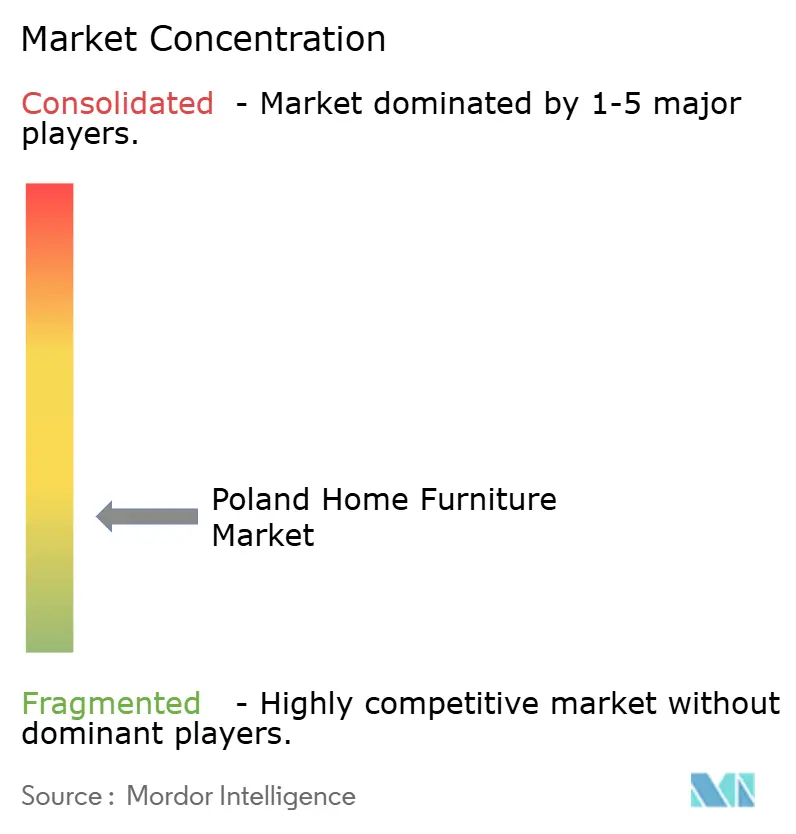
The Poland home furniture market remains fragmented. Dozens of regional mills and boutique upholsterers compete on design niches, making consolidation difficult. Market entry barriers stay low in specialty segments such as youth furniture, encouraging innovation but limiting pricing power.
Technology investment defines emerging leaders. Vendors adopting CNC routers and automated edge-banding shorten lead times and support mass customization. Retailers integrating 3D visualization tools from partners like Intiaro report reduced return rates and higher customer satisfaction. Sustainability remains a branding weapon; firms flaunting FSC tags justify 15–20% premiums. Geographic clusters near Poznań and Wrocław forge supplier networks that share prototypes rapidly and co-market abroad.
E-commerce newcomers leverage influencer channels to scale nationally without large store footprints. Established chains counter by adding design-consult subscription services that build annuity revenue. Partnerships with fintechs for split-payment financing further widen consumer reach. Competitive intensity is expected to persist as no single player breaches a 25% share threshold, aligning the Poland home furniture industry with mid-range concentration norms.
Poland Home Furniture Industry Leaders
IKEA
Black Red White SA
VOX Furniture (Poland Sales Arm)
Fabryki Mebli “Forte” SA
Szynaka-Meble Sp. z o.o.
- *Disclaimer: Major Players sorted in no particular order

Market Opportunities and Future Outlook
Compliance-driven traceability and verifiable sourcing create a tangible opportunity for suppliers and retailers that can scale wood origin documentation and product safety documentation. Industry bodies have pointed to execution gaps, including the June 2026 call from the Polish Chamber of Commerce of Furniture Manufacturers for practical EUDR training. This is driving demand for structured supplier onboarding, chain-of-custody documentation, and audit-ready workflows. Firms with strong FSC adoption can use certification and documentation to defend access to export-linked value chains and also support domestic premium positioning.
Factory digitalization and automation also offer a concrete path for addressing labor constraints and cost control, supported by activity such as the July 2026 tender by Przedsiebiorstwo Wielobranzowe Mobilis Marcin Matusiak for digital modernization and automation of furniture production via new CNC equipment. On the demand side, persistent hybrid work and small-space living continue to support modular, space-saving ranges and online-led discovery. That creates opportunities for configurable product assortments and omnichannel fulfillment approaches that reduce returns and damage risk in last-mile delivery.
Recent Industry Developments
- March 2026: IKEA Retail Polska published FY2025 updates highlighting Poland as a leading market in Ingka Group’s sustainability transformation and reporting local sales of over PLN 6.2 billion, up 3% year on year. The disclosure underscores continued investment emphasis in the Polish retail footprint and reinforces the role of sustainability-linked operations in brand differentiation. It also supports omnichannel execution as online contribution becomes a larger share of sales.
- November 2025: Black Red White S.A. announced a restructuring plan supported by owner and bank financing extended to March 31, 2027, alongside a target to lift EBITDA by PLN 100 million by end-2026 versus 2025. The plan indicates balance-sheet stabilization and operational refocusing at one of Poland’s prominent home-furniture players, with implications for pricing, assortment breadth, and channel strategy. It also frames BRW’s ability to fund capability upgrades and marketplace expansion while managing cost pressures.
- April 2024: Ingka Group released IKEA’s FY2024 reporting and sustainability disclosures for Poland, reiterating the company’s operational focus on lowering environmental footprint across retail activities. The emphasis on decarbonization and circularity strengthens consumer-facing sustainability claims in a market where FSC and traceability are increasingly used to justify premiums. It also raises the competitive bar for domestic brands selling through large-format and online channels.


Research Methodology Framework and Report Scope
Market Definition and Coverage
For this study, the market covers the annual retail value (point of sale, including VAT) of new movable home furniture purchased for residential use across Poland, and it is expressed in USD for easy comparison over time.
Scope exclusions: We exclude built-in onsite joinery, fitted wardrobes, mattresses, decor accessories, appliances, and non-residential or contract furnishings.
Segmentation Overview
- By Product
- Living Room and Dining Room Furniture
- Bedroom Furniture
- Kitchen Furniture
- Home Office Furniture
- Bathroom Furniture
- Outdoor Furniture
- Other Furniture
- By Material
- Wood
- Metal
- Plastic & Polymer
- Others
- By Price Range
- Economy
- Mid-Range
- Premium
- By Distribution Channel
- Home Centers (for e.g., IKEA, Black Red White, Agata, etc.)
- Specialty Furniture Stores (including exclusive brand outlets)
- Online
- Other Distribution Channels (hypermarkets, supermarkets, teleshopping, warehouse clubs, departmental stores, etc.)
- By Geography
- Masovian (Mazowieckie)
- Silesian (Śląskie)
- Greater Poland (Wielkopolskie)
- Lower Silesian (Dolnośląskie)
- Lesser Poland (Małopolskie)
- Rest of Poland
Data Sources, Market Sizing, and Validation
Desk Research
Desk research started by mapping what should be counted as home furniture retail value in Poland, and then aligning it with public statistical series and trade flows. We reviewed official and non-paywalled sources such as Statistics Poland (GUS) for household spending and retail indicators, Eurostat for harmonized consumption categories, and National Bank of Poland releases for macro context and inflation signals that influence furniture tickets.
To cross-check supply and pricing direction, we also used sources such as UN Comtrade for furniture trade data, the European Commission trade and product safety documentation for market boundary clarity, and industry association publications that describe category movements and demand sentiment. Company annual reports, investor presentations, and reputable press were used to sense-check channel shifts and product mix changes. Select paid subscriptions were used only for company financials and intelligence, patent lookups, and shipment-level trade checks where public series were too aggregated. These examples are not exhaustive, and many other public and proprietary sources were also used to collect data, validate assumptions, and clarify open questions.
Primary Interviews and Surveys
Primary interviews and surveys were used to confirm what is actually sold as home furniture in Poland, how VAT-inclusive retail prices are moving, and how online versus offline channel shares are evolving. We spoke with a balanced mix of manufacturers, importers, distributors, and retailers, and then re-checked key assumptions with logistics and category specialists to close gaps where public reporting was not granular enough.
Distribution of primary research fieldwork respondents
| Company type | Respondent position | Region |
|---|---|---|
| Top tier: 32% | CXOs: 14% | APAC: 51% |
| Mid tier: 49% | Functional/Unit leaders: 33% | EMEA: 30% |
| Smaller Players: 19% | Managers: 53% | Americas: 19% |
Market-Sizing & Forecasting
Sizing was built mainly using a top-down path where household consumption and retail signals are reconstructed into a furniture-only demand pool for Poland, and then converted into USD with consistent timing. Once the demand pool was formed, selective bottom-up checks were run using sampled price points times observed volume proxies, and through roll-ups of a limited set of supplier and channel indicators to adjust obvious under or over-counting.
The model uses practical inputs that can be tracked every year, such as household final consumption trends, furniture retail turnover direction, housing completions and renovation activity as demand triggers, import and export movements for finished furniture categories, and average selling price movement by major furniture groups (capturing both mix shifts and inflation). Because furniture prices can swing due to wood and logistics costs, we treated ASP progression as a separate step rather than a simple CPI uplift. Forecasts were developed with scenario analysis, where macro paths and housing activity are translated into demand growth, and then validated with expert consensus on channel mix and promotional intensity. When bottom-up checks had missing company coverage, we filled gaps using category-level averages and distribution-channel share ranges that were confirmed in interviews.
Data Validation & Update Cycle
Validation was done by comparing model outputs against independent signals, including retail direction, trade balances for relevant furniture categories, and the implied per-household spend level. Outliers were flagged when growth rates or implied ASPs diverged too far from observed inflation and category commentary, and then assumptions were revisited before sign-off.
Each report is reviewed in multiple steps, starting with internal checks on definitions and math, followed by a second analyst review of key drivers and sensitivities, and then a final pass for consistency across the time series. We refresh the model annually, and interim updates are triggered when material events occur, including tax changes, sharp currency swings, or sudden shifts in housing activity. Before delivery, the latest public releases are re-checked so the reported view reflects the most recent signals.
Mordor Intelligence's Poland Home Furniture Market Size Measured Against Other Published Estimates
Published market values for Poland home furniture can vary widely because the boundaries are not always the same, and pricing treatment can differ even when the category label looks similar. Differences usually come from what is counted as furniture, whether values are retail or factory-gate, and how currency conversion is handled across inflationary years.
A major driver is whether kitchen and bathroom units, fitted joinery, or mattresses get mixed into the same total, which can push estimates up or down without an obvious clue in the headline. Another frequent issue is refresh cadence, since using older exchange-rate timing or an un-updated ASP step can distort USD market values when the zloty moves, and the VAT-inclusive retail definition is not always followed.
Benchmark comparison
| Source | Market Size | Gaps in Research Methodology |
|---|---|---|
| Mordor Intelligence | USD 11.64 B (2025) | |
| Trade Journal A | USD 6.48 B (2025) | Uses a narrower retail-only panel and typically excludes kitchen and bathroom units, and then applies a single price index uplift that can understate ASP mix changes in higher-ticket categories. |
| Industry Association B | USD 14.20 B (2025) | Blends factory-gate production value with retail turnover indicators, which can double count through the chain, and it is often refreshed less frequently for USD conversion timing during currency volatility. |
The spread in the table mostly comes from scope and timing, not from a disagreement that furniture demand exists. By keeping the USD conversion anchored to a consistent year-average approach, re-checking VAT-inclusive retail pricing, and re-validating ASP movement during annual refresh cycles, the estimate stays traceable, a discipline applied by Mordor Intelligence.


Key Questions Answered in the Report
What is the current value of the Poland home furniture market?
The Poland home furniture market is valued at USD 12.25 billion in 2026.
How fast will the market grow through 2031?
Market revenue is projected to expand at a 5.2% CAGR, reaching USD 15.78 billion by 2031.
Which product segment generates the highest revenue?
Kitchen furniture leads with 24.70% revenue share, driven by frequent remodels and essential status in new homes.
Why is home-office furniture gaining traction?
Persistent hybrid work models fuel a 5.75% CAGR for the segment as consumers seek ergonomic, space-saving office setups.
Which region is growing the fastest?
Lesser Poland (Małopolskie) posts the highest growth at a 5.85% CAGR, helped by rising urbanization, tech-driven development, and increasing disposable incomes.
How are online channels affecting sales?
Online retail is climbing at 6.35% CAGR, aided by augmented-reality visualization tools that reduce purchase uncertainty and returns.
Page last updated on:


