
Pneumatic Conveying Systems Market Size and Share
Market Overview
| Study Period | 2021 - 2031 |
|---|---|
| Market Size (2026) | USD 37.03 Billion |
| Market Size (2031) | USD 47.53 Billion |
| Growth Rate (2026 - 2031) | 5.11 % |
| Fastest Growing Market | Asia Pacific |
| Largest Market | North America |
| Market Concentration | Medium |
Major Players *Disclaimer: Major Players sorted in no particular order Image © Mordor Intelligence. Reuse requires attribution under CC BY 4.0. | |
Pneumatic Conveying Systems Market Analysis by Mordor Intelligence
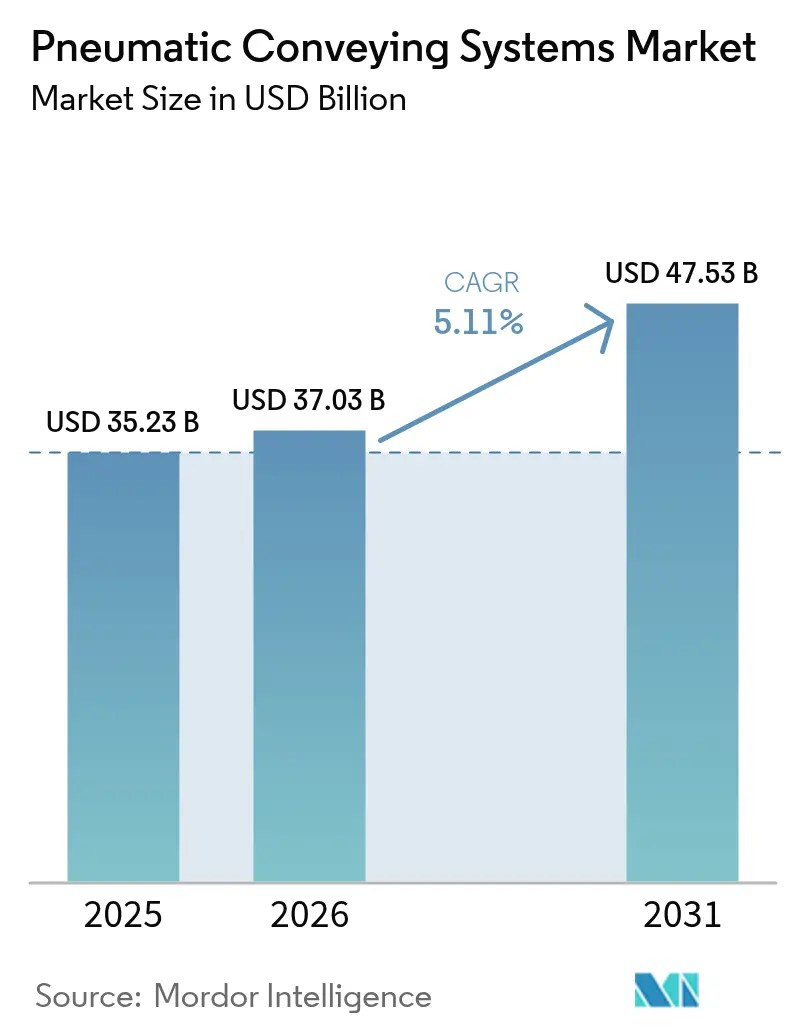
The Pneumatic Conveying Systems market size is expected to grow from USD 35.23 billion in 2025 to USD 37.03 billion in 2026 and is forecast to reach USD 47.53 billion by 2031 at 5.11% CAGR over 2026-2031.
Rising investments in industrial automation, growing emphasis on contamination-free bulk handling, and steady retrofits in mature manufacturing plants sustain near-term demand. Rapid battery gigafactory construction, particularly in the Asia-Pacific region, introduces a new high-growth application stream. Adoption is further reinforced by artificial-intelligence-driven airflow optimisation that cuts operating costs, helping users offset rising electricity prices. Meanwhile, competition intensifies as leading vendors accelerate acquisitions to expand their regional reach and broaden their technology offerings.
Key Report Takeaways
- By conveying phase, dilute phase systems held 56.62% of the pneumatic conveying systems market share in 2025, while dense phase is projected to expand at a 6.74% CAGR through 2031.
- By operating principle, positive-pressure systems commanded a 62.88% share of the pneumatic conveying systems market size in 2025, whereas vacuum conveying systems recorded the fastest growth at a 7.01% CAGR from 2026 to 2031.
- By end-user industry, the food and beverage sector led with a 30.35% revenue share in 2025; battery manufacturing is forecast to grow at a 8.85% CAGR through 2031.
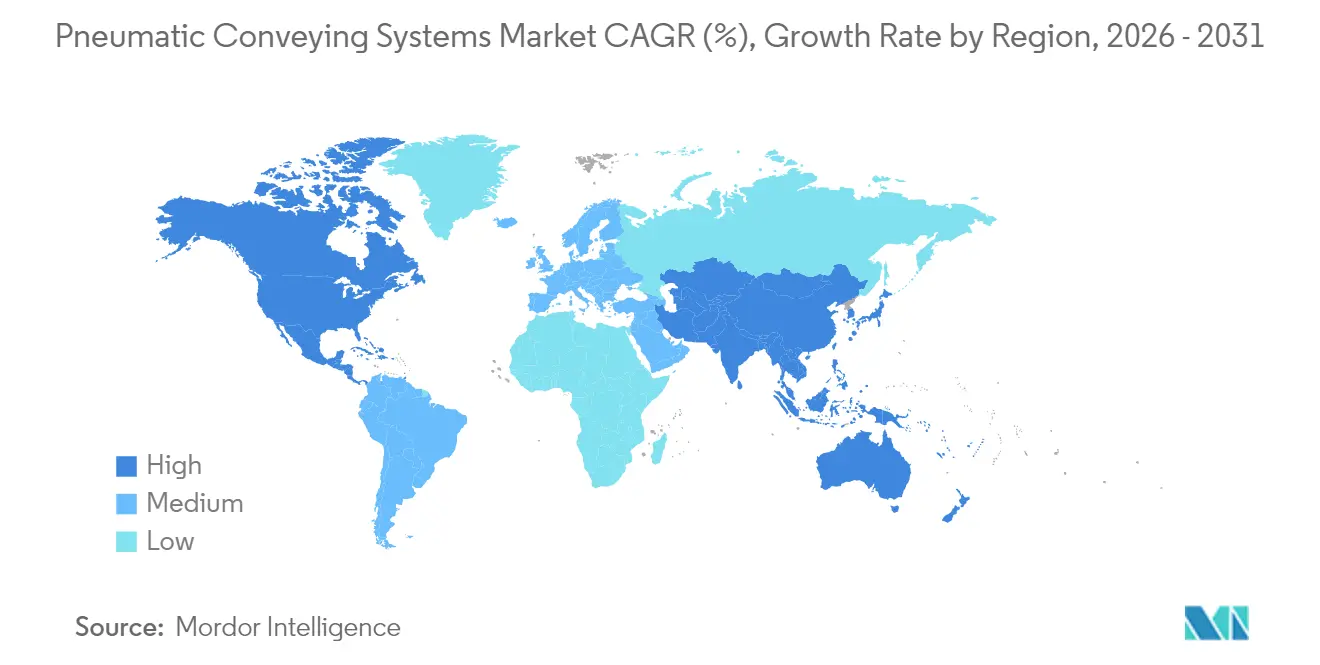
- By geography, North America accounted for 33.08% of the pneumatic conveying systems market share in 2025, while Asia-Pacific is advancing at a 7.46% CAGR to 2031
Note: Market size and forecast figures in this report are generated using Mordor Intelligence’s proprietary estimation framework, updated with the latest available data and insights as of 2026.
Global Pneumatic Conveying Systems Market Trends and Insights
Drivers Impact Analysis*
| Driver | (~) % Impact on CAGR Forecast | Geographic Relevance | |
|---|---|---|---|
| Rising demand for energy-efficient bulk-handling automation | +0.8% | North America, Europe | Medium term (2-4 years) |
| Stringent food & pharma hygiene regulations favouring closed conveying | +1.2% | North America, EU | Long term (≥ 4 years) |
| Rapid capacity build-out of battery-materials gigafactories | +0.9% | Asia-Pacific, spill-over to North America & Europe | Short term (≤ 2 years) |
| AI-enabled airflow optimisation software cuts OPEX | +0.6% | North America, Europe, emerging Asia-Pacific | Medium term (2-4 years) |
| Growth of bio-based plastics requiring gentle transport | +0.4% | Europe, North America, emerging Asia-Pacific | Long term (≥ 4 years) |
| Increasing retrofits to comply with dust-explosion ATEX codes | +0.7% | Europe, North America | Medium term (2-4 years) |
| Source: Mordor Intelligence | |||
Rising Demand for Energy-Efficient Bulk-Handling Automation
Compressed air systems account for nearly 10% of total industrial electricity use in developed economies, prompting manufacturers to scrutinise energy performance. Dense phase technology operates at lower velocities and uses less air, resulting in up to 50% energy savings compared to dilute phase conveying. Variable-frequency drives, smart sensors, and energy audit programs further optimize consumption, delivering typical payback periods of 18-24 months. Across 206 audited plants, analysts identified potential annual savings of USD 228 million from compressed-air optimisation. These benefits drive sustained upgrades and position dense-phase systems as a strategic lever for achieving decarbonization targets.
Stringent Food & Pharma Hygiene Regulations Favouring Closed Conveying
FDA 21 CFR 110.40 and USDA 7 CFR 58.228 require corrosion-resistant, sanitary transport surfaces, making enclosed pneumatic conveying essential for contamination-free movement of powders and tablets. Vacuum configurations provide negative pressure, preventing product escape and airborne dust, which supports cGMP documentation and HACCP compliance. ISO 8573 oil-free compressed-air standards and air-quality monitoring provisions further cement demand for sealed systems with easy-clean designs. The regulatory compliance imperative secures long-term adoption across food and pharmaceutical facilities.
Rapid Capacity Build-Out of Battery-Materials Gigafactories
Lithium-ion cell production requires gentle, contamination-free handling of cathode and anode powders. Pneumatic conveying accommodates inert-gas purging to manage moisture-sensitive materials, as demonstrated at the ENTEK lithium separator plant in Indiana, where systems span extrusion, coating, and drying lines.(1)U.S. Department of Energy, “Environmental Assessment ENTEK Lithium Separator Manufacturing Facility,” energy.gov Gigafactory roll-outs demand modular conveying designs that scale from pilot to multi-ton flows, presenting sizeable opportunities for specialised vendors. With electric vehicle penetration accelerating, battery plants remain a clear growth catalyst over the next decade.
AI-Enabled Airflow Optimization Software Cuts OPEX
SmartFLX controls, introduced by Conair, apply machine-learning algorithms to adjust vacuum levels, receiver distance, and bulk-density parameters in real-time, trimming energy use by up to 15%. IoT sensors generate granular data that feeds predictive-maintenance models, mitigating downtime and extending component life. Busch Vacuum Solutions’ O11O digital services suite demonstrates retrofit potential by linking multiple generators to a cloud-based dashboard accessible on mobile devices, providing operators with continuous system visibility. These digital innovations strengthen the business case for modernising existing lines and reinforce the transition toward self-optimising networks.
Restraints Impact Analysis*
| Restraint | (~) % Impact on CAGR Forecast | Geographic Relevance | Impact Timeline |
|---|---|---|---|
| High up-front CAPEX versus mechanical conveyors | -1.1% | Global, particularly price-sensitive emerging markets | Short term (≤ 2 years) |
| Component erosion & pipeline wear raise maintenance cost | -0.8% | Global, especially high-throughput applications | Medium term (2-4 years) |
| Carbon-pricing on compressed-air electricity use | -0.5% | Europe & North America leading carbon pricing schemes | Long term (≥ 4 years) |
| Scarcity of dense-phase design & tuning expertise | -0.3% | Global, with acute shortages in emerging markets | Medium term (2-4 years) |
| Source: Mordor Intelligence | |||
High Up-Front CAPEX Versus Mechanical Conveyors
Pneumatic solutions often cost 40-60% more than belt or drag conveyors because they require compressors, filtration units, and pressure vessels. Added engineering expertise raises design fees, making justification difficult for small manufacturers that prioritise immediate cost reduction. Capital intensity slows adoption in price-sensitive regions, even when lifecycle savings in labour and hygiene compliance favour pneumatic choices.
Component Erosion & Pipeline Wear Raise Maintenance Cost
High-velocity flows of abrasive powders accelerate wear on elbows and pipelines, especially at directional changes. Specialty induction-hardened, or ceramic-lined elbows, extend service life but command premium prices and complex replacement procedures. Centrifugal fan studies indicate that wear increases quadratically with speed, forcing operators to balance throughput against maintenance downtime. Frequent part replacement increases total ownership costs and tempers investment enthusiasm for extremely abrasive duty cycles.
*Our forecasts treat driver/restraint impacts as directional, not additive. The impact forecasts reflect baseline growth, mix effects, and variable interactions.
Segment Analysis
By Conveying Phase: Dense Phase Gains Momentum
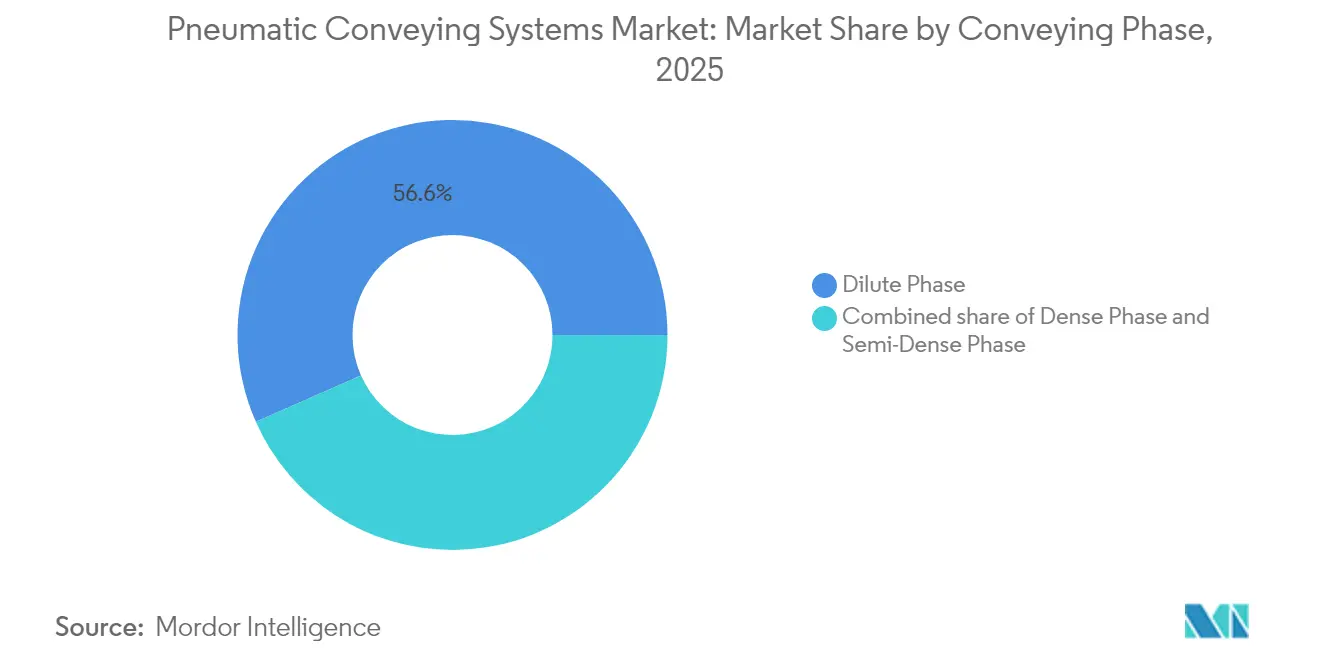
In 2025, the dilute phase accounted for 56.62% of the pneumatic conveying systems market, but the dense phase is projected to post the highest CAGR of 6.74% from 2026 to 2031. Dense phase operations occur at lower air velocities, reducing energy use by 30-50% while preserving fragile particles, which appeals to pharmaceutical and specialty chemical processors. Semi-dense phase serves intermediate needs and remains a niche option for moderate distances.
Growing regulatory pressure for energy efficiency and reduced dust emissions is accelerating the adoption of dense phase. Vendors enhance their offerings with advanced pressure-control valves and wear-resistant pipeline materials. As manufacturers pursue sustainability certifications, dense-phase solutions are increasingly replacing legacy dilute lines, supporting the trajectory of the pneumatic conveying systems market.


By Operating Principle: Vacuum Systems Accelerate
Positive-pressure technology dominated the pneumatic conveying systems market in 2025 due to proven long-distance capability and lower capital outlay. Nevertheless, vacuum conveying is set to expand at a 7.01% CAGR because its negative-pressure design prevents product escape and protects operators, aligning with stricter hygiene rules. Combination systems that toggle between modes appeal to multi-material plants but represent a smaller share of revenue.
Pharmaceutical buyers increasingly specify vacuum lines for API transfer, while food processors choose them for allergen segregation. Atlas Copco’s oil-free compressors bolster USP-grade air quality, further boosting uptake. Investments in sensor-rich control panels enable automatic leak detection and flow optimisation, enhancing vacuum system reliability and expanding addressable applications.
By End-User Industry: Battery Manufacturing Surges
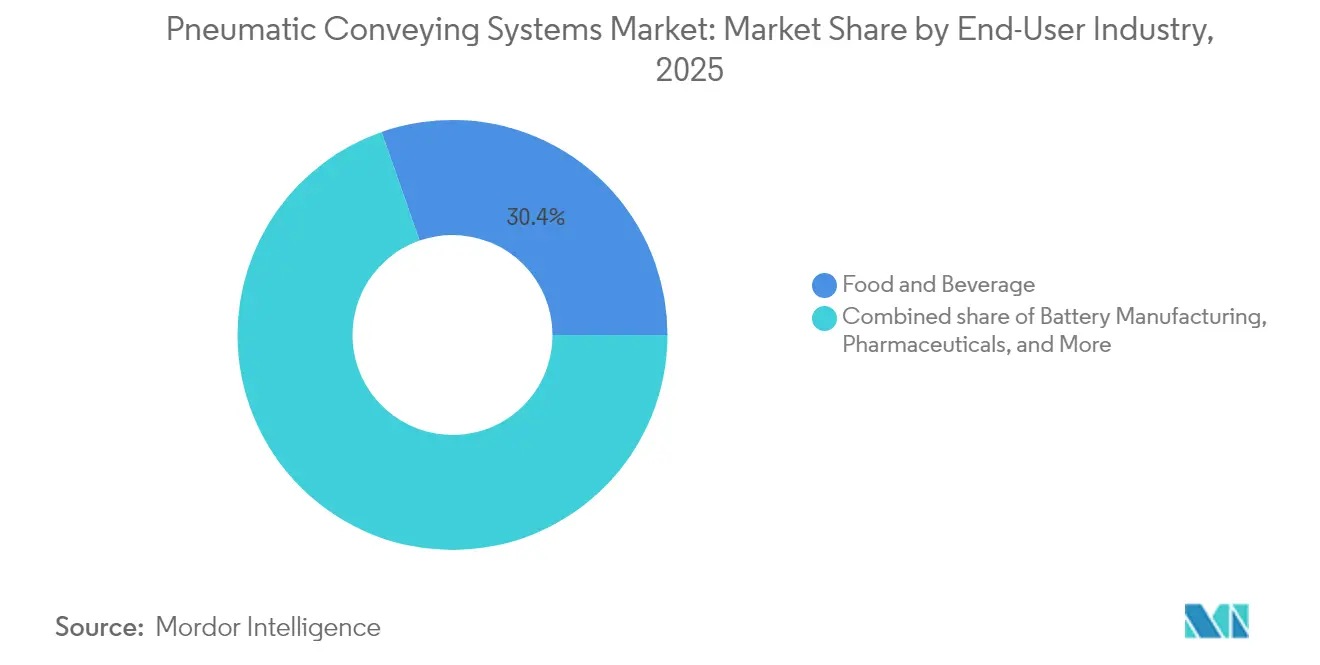
Food and beverage applications contributed 30.35% of 2025 revenue thanks to pervasive ingredient-handling needs and entrenched sanitary codes. Battery manufacturing, although smaller today, is forecast to log the fastest 8.85% CAGR to 2031, as electric-vehicle demand triggers exponential growth in cathode and separator output.
Chemicals and petrochemicals continue to utilize pneumatic systems for the safe transfer of corrosive powders, while pharmaceuticals show steady gains from the adoption of continuous manufacturing. Plastics processors benefit from pellet and regrind handling flexibility, and mineral processors use pneumatic lines for niche fine-powder tasks despite erosion risks. The breadth of end-use diversity underpins stable baseline demand for the pneumatic conveying systems market.
Geography Analysis
North America led with a 33.08% share in 2025, supported by mature food processing, expansive pharmaceutical capacity, and early uptake of AI-enabled upgrades. Stringent FDA and USDA standards create recurring retrofit cycles, while infrastructure investment incentives encourage energy-efficient revamps. United States installations dominate, followed by Canadian grain and Mexican automotive suppliers that favour sealed systems for paint and resin powders.
The Asia-Pacific is the fastest-growing region, with a 7.46% CAGR from 2026 to 2031, owing to India’s National Manufacturing Policy and China’s acceleration of Industry 4.0. New lithium-ion plants, plastics complexes, and packaged-food facilities specify enclosed conveying from inception, leapfrogging older open-belt alternatives. Local players, such as Tianjin FeiYun, now under the Piab Group, extend the reach of vacuum technology and shorten delivery cycles.
Europe maintains a steady uptake, anchored in ATEX explosion-protection directives and carbon-reduction targets that favour dense-phase solutions. Germany’s chemicals corridor, France’s food sector, and the United Kingdom’s pharmaceutical industry spearhead investments, while Eastern Europe rises due to regulatory synchronisation with EU norms. Nordic manufacturers prioritise ultra-low energy consumption and source advanced, dense-phase packages to meet sustainability charters.

Regulatory Landscape
Pneumatic conveying systems are governed by machinery safety, pressure containment, and dust and explosion-risk rules that vary by end use and geography. In the European Union, suppliers commonly align designs and technical files to the Machinery Regulation (EU) 2023/1230, ATEX Directive 2014/34/EU for equipment used in potentially explosive atmospheres, and the Pressure Equipment Directive 2014/68/EU for pressurized components. Food-contact applications also intersect with Regulation (EC) No 1935/2004 for materials intended to come into contact with food.
In the United States, workplace safety requirements relevant to pneumatic conveying installations include OSHA rules such as 29 CFR 1926.555 (conveyors) and 29 CFR 1910.272 for grain handling facilities, alongside combustible dust guidance and enforcement attention under OSHA programs. For combustible dust hazards, many design choices (bonding and grounding, isolation and venting, and prevention measures) map to NFPA standards such as NFPA 654, with explosion venting and prevention commonly addressed through NFPA 68 and NFPA 69 depending on the material and facility risk assessment.
Competitive Landscape
Market concentration remains moderate as global leaders continue to pursue acquisitions to expand their technology portfolios and regional footprints. Atlas Copco strengthened its North American presence by purchasing Air Way in November 2024, adding application engineering capacity in high-margin industries. Coperion finalised the integration of Schenck Process FPM in 2024, consolidating 140 years of engineering expertise under a unified brand and broadening dense phase offerings. Piab’s SEK 250 million acquisition of Tianjin FeiYun has enhanced its China-based vacuum conveying capabilities, catering to clients in additive manufacturing and the battery sector.
Technology differentiation now hinges on AI-driven control software, predictive maintenance analytics, and oil-free compression. Conair’s SmartFLX platform and Busch’s O11O digital services demonstrate how data integration enables 24/7 performance optimization and energy savings. Vendors also develop application-specific wear-resistant elbows to cut lifecycle costs in abrasive duties, addressing a key user pain point. While price competition persists in commodity dilute phase systems, premium dense phase and digitally packaged products command attractive margins, encouraging sustained innovation.
Emerging challengers target cost-sensitive Asian markets with simplified modular skids, but incumbents leverage global service networks and deep process knowledge to defend share. Overall, the pneumatic conveying systems market rewards suppliers that pair mechanical know-how with software intelligence and region-specific support.
Pneumatic Conveying Systems Industry Leaders
Atlas Copco AB
Coperion GmbH
Schenck Process Holding GmbH
Flexicon Corporation
Piab AB
- *Disclaimer: Major Players sorted in no particular order


Market Opportunities and Future Outlook
Energy management and digital controls remain a key whitespace, particularly because compressed air is a meaningful electricity load in industrial plants, and the report context points to upgrades such as AI-enabled airflow optimization and IoT dashboards. This supports opportunities for vendors that package dense-phase conveying with instrumentation, variable-speed drives, and software, alongside retrofit offerings that assess and correct leaks and tuning issues that often limit real-world efficiency. The report also indicates scope to expand validation and application engineering services in fast-growing manufacturing regions, where customers can trial powders, routing, and wear components before committing to CAPEX.
Battery-materials and contamination-sensitive powders continue to drive deployment pull-through for sealed conveying, supported by ongoing gigafactory build-outs and hygiene requirements in food and pharmaceuticals. At the same time, oil-free air quality demands (aligned with sanitary and compressed-air quality practices referenced in the report context) create room for integrated packages combining oil-free compression or vacuum generation with filtration and monitoring. Separately, published work on improving pulverized-fuel pneumatic conveying performance and energy use suggests incremental redesign needs for distributors, lines, and controls, while conversions from hydraulic ash handling to pneumatic handling point to replacement-driven demand where environmental compliance and operability are prioritized.
Recent Industry Developments
- April 2026: Coperion announced an optimized EGR eccentric pelletizer with conveying-related improvements that cut energy consumption by up to 75% versus earlier models. The update reinforces a broader push to reduce the energy intensity of material handling around pelletizing and downstream conveying, supporting users facing rising operating-cost scrutiny.
- April 2026: Qlar Group (formerly Schenck Process) opened a pneumatic conveying test center in Bangalore, India, featuring a 680-meter dense-phase conveying line. The investment expands regional capability to validate difficult-to-handle powders and long-distance routing, shortening commissioning cycles for projects in growth industries such as cement, metals, and energy.
- November 2024: Atlas Copco completed the acquisition of Air Way, adding application engineering capacity and strengthening its North American presence. The acquisition supports Atlas Copco's ability to bundle compressors, air treatment, and system engineering for pneumatic conveying projects, increasing competitiveness in hygiene- and uptime-driven end markets.


Research Methodology Framework and Report Scope
Market Definition and Coverage
This market is defined as revenue earned from pneumatic conveying systems used to move bulk solids (powders, pellets, and granules) through pipelines using air flow, including major equipment and system integration sold into industrial facilities.
Scope exclusions: We exclude standalone compressed-air generation equipment, general dust collection sold as an isolated product, and non-pneumatic mechanical conveying solutions.
Segmentation Overview
- By Conveying Phase
- Dilute Phase
- Semi-Dense Phase
- Dense Phase
- By Operating Principle
- Positive-Pressure Conveying
- Vacuum Conveying
- Combination (Vacuum + Pressure)
- By End-User Industry
- Food and Beverage
- Chemicals and Petrochemicals
- Pharmaceuticals
- Plastics and Rubber
- Minerals and Metals
- Battery Manufacturing
- Others
- By Geography
- North America
- United States
- Canada
- Mexico
- Europe
- Germany
- United Kingdom
- France
- Italy
- NORDIC Countries
- Russia
- Rest of Europe
- Asia-Pacific
- China
- India
- Japan
- South Korea
- ASEAN Countries
- Rest of Asia-Pacific
- South America
- Brazil
- Argentina
- Rest of South America
- Middle East and Africa
- Saudi Arabia
- United Arab Emirates
- South Africa
- Egypt
- Rest of Middle East and Africa
- North America
Data Sources, Market Sizing, and Validation
Desk Research
Desk research helped us set the market boundary and build the first cut of regional demand patterns. We referenced public and official sources such as US Census Bureau manufacturing data, Eurostat industrial production series, UN Comtrade trade statistics, and USGS minerals and materials indicators to understand where bulk materials handling activity is concentrated.
To link that macro view to what buyers purchase, we also reviewed company annual reports and investor presentations, regulatory and safety guidance tied to combustible dust handling (where relevant), and updates shared by industry associations and reputed trade press. In parallel, we used paid subscriptions for company financials and intelligence, patent databases, and shipment-level import and export datasets to cross-check supplier exposure and product activity. These sources are illustrative, and we used other public and paid references as well to support data collection, validation, and clarification during the research.
Primary Interviews and Surveys
Primary interviews and surveys were used to validate what is typically included in a system sale, how projects are priced, and how demand shifts by end-use industry and plant expansion cycles. We spoke with a mix of system integrators, component suppliers, engineering teams at end users, and distributors across APAC, EMEA, and the Americas so gaps from desk research could be resolved using real buying conditions.
Distribution of primary research fieldwork respondents
| Company type | Respondent position | Region |
|---|---|---|
| Top tier: 28% | CXOs: 12% | APAC: 43% |
| Mid tier: 54% | Functional/Unit leaders: 34% | EMEA: 37% |
| Smaller Players: 18% | Managers: 54% | Americas: 20% |
Market-Sizing & Forecasting
Sizing was built using a top-down and bottom-up logic, where industrial output and bulk-material processing activity by region are first used to reconstruct the demand pool for pneumatic conveying projects, which is then translated into revenue using typical system pricing ranges. In practice, we start from end-use demand signals and capital spending direction, and then allocate that demand into positive-pressure, vacuum, and combination solutions based on how plants are designed and operated.
To keep the model practical, we relied on a small set of measurable inputs, such as manufacturing production indices in chemicals and food processing, capacity additions in plastics and rubber, the pace of battery manufacturing line build-outs, the share of greenfield versus retrofit projects, and average system value changes driven by energy efficiency and automation add-ons. The totals were corroborated with selective bottom-up approximations, including supplier revenue exposure checks, sampled project price x volume math from channel conversations, and sanity checks against import and export flows for relevant equipment classes. Where gaps remained, we used conservative ranges first and then revalidated through interviews.
Forecasting was done using scenario analysis supported by variable-level expectations gathered from industry experts, since investment cycles and project timing can shift faster than simple time-series trends. We tested a base case against faster and slower capex cycles, and then finalized year-by-year growth after confirming assumptions on pricing, project lead times, and end-user expansion plans.
Data Validation & Update Cycle
Outputs are checked through triangulation across independent signals, and large variances are investigated before final sign-off. We run consistency checks across regions and end users, and outliers are reviewed against recent project activity, trade patterns, and the latest public financial disclosures that can explain demand swings.
A multi-step analyst review is followed, and re-contacts are triggered when an assumption moves beyond an expected range, such as a sharp change in project pricing or a sudden shift in end-user capex sentiment. Reports are refreshed annually, with interim updates when material events occur. Before delivery, an analyst completes a final pass so clients receive the most current view available at that time.
Mordor Intelligence's Pneumatic Conveying Systems Market Sizing Compared With Other Published Estimates
Published market sizes for pneumatic conveying systems can look different because analysts do not always count the same revenue lines, and they may also use different base years and currency timing. The table below makes the spread visible, which is useful since it points to where scope and pricing assumptions likely differ.
The table shows a noticeable gap that often comes from what is counted as a complete conveying system versus adjacent material-handling equipment bundled in plant projects, and from whether service and aftermarket are added as full value or treated as partial. In Mordor Intelligence's model, the 2026 total is built around system-level revenue tied to pneumatic conveying (including major equipment and integration where it is part of the system sale), and it is cross-checked using end-user activity and project pricing interviews rather than assuming a uniform ASP uplift across all regions.
Benchmark comparison
| Source | Market Size | Gaps in Research Methodology |
|---|---|---|
| Mordor Intelligence | USD 37.03 B (2026) | |
| Global Consultancy A | USD 33.80 B (2026) | Uses a narrower equipment-only scope that tends to exclude packaged integration and controls, and it applies conservative adoption assumptions for dense-phase systems in chemicals and plastics. |
| Industry Association B | USD 41.60 B (2026) | Broader boundary that can fold in adjacent bulk material-handling hardware and plant-wide air handling upgrades, and it relies more on member shipment value proxies which may overstate installed project revenue. |
Taken together, the comparison suggests that the biggest driver is not the growth rate itself, but the accounting of what a system sale includes and how project values are translated into annual revenue. By keeping the model tied to clear end-user demand indicators, realistic project pricing ranges, and repeatable validation checks, the resulting market size stays traceable and easier to reconcile across regions and end uses.


Key Questions Answered in the Report
What is the projected value of the pneumatic conveying systems market by 2031?
The market is forecast to reach USD 47.53 billion by 2031, growing at a 5.11% CAGR over 2026-2031.
Which conveying phase is expanding the fastest?
Dense phase technology is set to grow at a 6.74% CAGR through 2031 due to its energy efficiency and gentle material handling benefits.
Why are vacuum systems gaining traction despite lower market share today?
Vacuum conveying offers superior containment and hygiene, aligning with stringent food and pharmaceutical regulations and posting a 7.01% CAGR forecast.
Which end-user industry shows the highest growth potential?
Battery manufacturing leads with a 8.85% CAGR as gigafactory investments scale global lithium-ion output.
What digital technologies are influencing future system upgrades?
AI-driven airflow optimisation, IoT-enabled predictive maintenance dashboards and cloud analytics are lowering operating costs and improving system reliability.
Page last updated on:


 Your data is secure and never sold or shared.


