
Plastic Processing Machinery Market Size and Share
Market Overview
| Study Period | 2020 - 2031 |
|---|---|
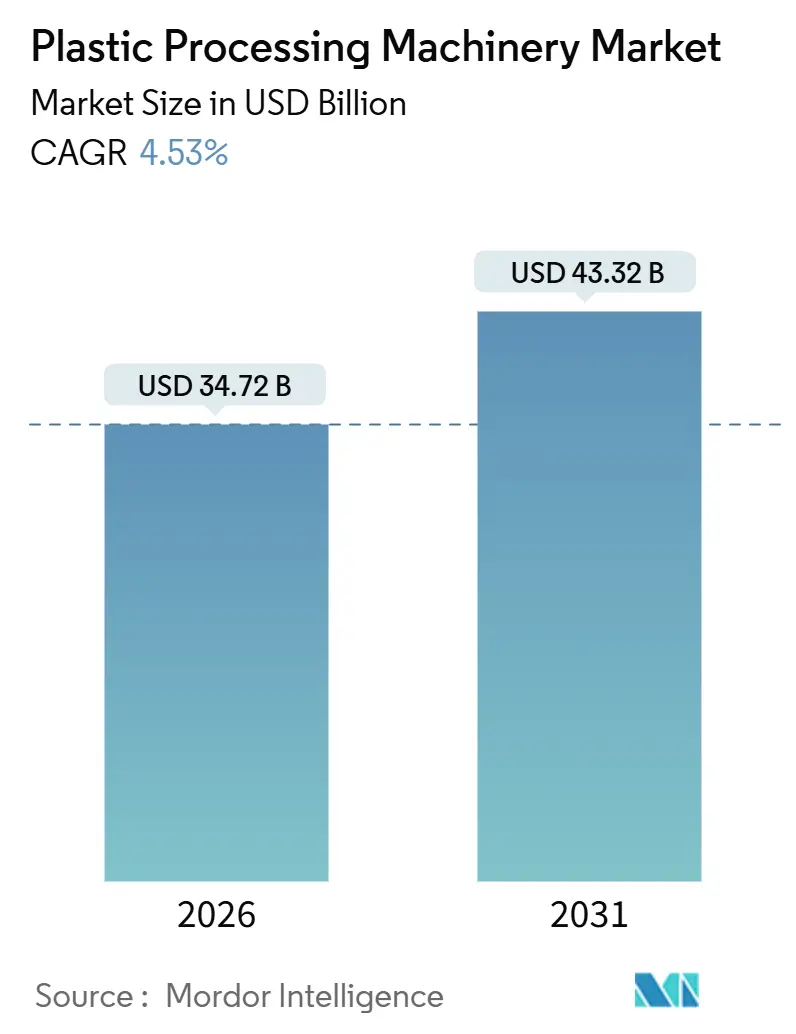
| Market Size (2026) | USD 34.72 Billion |
| Market Size (2031) | USD 43.32 Billion |
| Growth Rate (2026 - 2031) | 4.53 % |
| Fastest Growing Market | South America |
| Largest Market | Asia Pacific |
| Market Concentration | Medium |
Major Players *Disclaimer: Major Players sorted in no particular order Image © Mordor Intelligence. Reuse requires attribution under CC BY 4.0. | |
Plastic Processing Machinery Market Analysis by Mordor Intelligence
The plastic processing machinery market size stood at USD 34.72 billion in 2026 and is projected to reach USD 43.32 billion by 2031, reflecting a 4.53% CAGR during the forecast period. Equipment buyers are channeling investments toward servo-driven presses, closed-loop controls, and traceability modules, rather than raw output, because energy-intensity penalties and extended producer responsibility rules are tightening in the European Union and the Asia-Pacific region. Demand spikes for lightweight automotive components, mono-material flexible packaging, and recycled-content resins are shifting specification sheets from hydraulic horsepower toward precision temperature profiles and vision-guided robotics. European and Japanese suppliers are converting one-time capital transactions into recurring software revenue, while Chinese OEMs are leveraging cost leadership to penetrate first-time automation buyers. These cross-currents explain why the plastic processing machinery market is expanding steadily rather than explosively, even as individual sub-segments post sharper gains.
Key Report Takeaways
- By machine type, injection molding captured 45.18% of the plastic processing machinery market share in 2025.
- By automation level, the plastic processing machinery market size for fully automated systems is projected to grow at a 6.13% CAGR between 2026 and 2031.
- By end-user, packaging captured 41.72% of the plastic processing machinery market share in 2025.
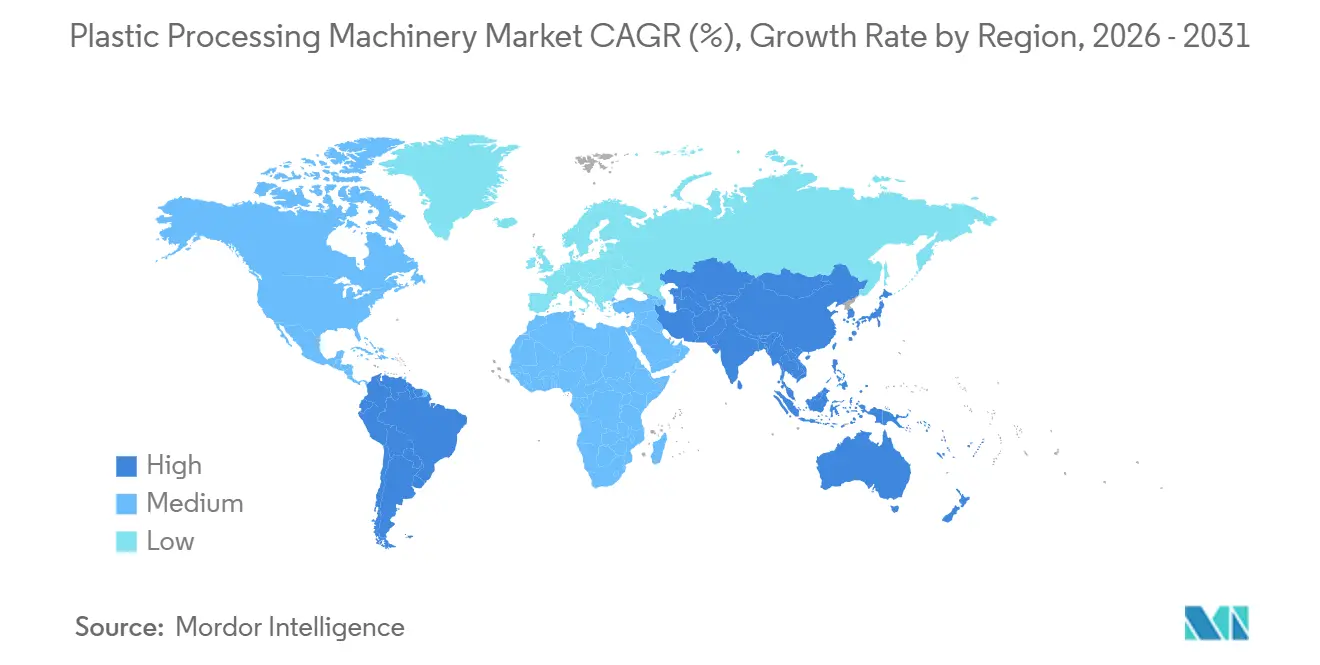
- By geography, the plastic processing machinery market size in South America is projected to grow at a 6.09% CAGR between 2026 and 2031.
Note: Market size and forecast figures in this report are generated using Mordor Intelligence’s proprietary estimation framework, updated with the latest available data and insights as of January 2026.
Market Trends and Insights
Drivers Impact Analysis of Plastic Processing Machinery Market*
| Driver | (~) % Impact on CAGR Forecast | Geographic Relevance | Impact Timeline |
|---|---|---|---|
| Increasing Demand for Light-Weight Automotive Parts | +0.9% | Global, with concentration in Germany, China, Japan, United States | Medium term (2–4 years) |
| Boom in Flexible Packaging Demand | +1.1% | Global, led by Asia-Pacific and South America | Short term (≤ 2 years) |
| Rapid Electrification of Industry 4.0 | +0.7% | North America, Europe, Asia-Pacific core | Medium term (2–4 years) |
| Shift Toward Recycled and Bio-Based Resins | +0.6% | Europe, North America, and emerging in Asia-Pacific | Long term (≥ 4 years) |
| Rising Adoption of Vision-Guided Robotic Palletizers | +0.4% | North America, Europe, Japan, South Korea | Short term (≤ 2 years) |
| Integration of IoT-Based Predictive Maintenance Enhancing Uptime | +0.5% | Global, early adoption in developed markets | Medium term (2–4 years) |
| Source: Mordor Intelligence | |||
Increasing Demand for Light-Weight Automotive Parts
Automakers need to meet European fleet-average CO₂ limits of 93.6 g/km by 2027, so they are substituting metal stampings with glass-fiber-reinforced polypropylene and bio-based polyamides. Stellantis increased the plastic content per vehicle by 8 kg in 2024, and suppliers now order large-tonnage presses exceeding 2,000 t to mold structural parts as long as 1.2 m. General Motors qualified a bio-based polyamide for use in under-body shields in 2025, creating demand for gas-assisted injection systems that reduce material use by 20% while maintaining crash-worthiness targets.[1]General Motors Company, “Supplier Conference Materials 2025,” gm.com Assemblies are consolidating into single-shot over-molded parts, pushing toolmakers to maintain positional tolerances tighter than 0.05 mm and driving sales of precision clamping units.
Boom in Flexible Packaging Demand
Seven-layer co-extruded barrier films with oxygen transmission rates below 0.5 cc/m²/day are now standard for extending shelf life. In 2024, Nestlé transitioned 42% of its European coffee portfolio into recyclable mono-material pouches. The transition lifted global orders for cast-film lines by 19% in the first half of 2025, with Brazil’s flexible-packaging converters absorbing 23% more polyethylene film extrusion systems year-on-year. European rules, effective 2025, mandate a minimum 10% recycled content in flexible films by 2028, forcing machinery engineers to redesign screw geometries to handle inconsistent melt viscosities.
Rapid Electrification of Industry 4.0
All-electric presses consume 35% less energy per cycle than hydraulic units, resulting in an annual savings of USD 18,000 for a 300-ton machine running three shifts. ENGEL reported that 74% of Q1 2025 shipments were servo-driven, up from 61% in 2023, as electricity prices in Germany spiked to EUR 0.32/kWh (USD 0.36/kWh) in January 2025. Fanuc’s edge-computing module now processes 1,200 sensor points per second to auto-tune injection velocity, resulting in a 12% reduction in scrap. Although hydraulic systems still dominate very large blow-molding applications, rising ISO 20430 compliance costs are accelerating the adoption of energy-efficient drives.
Shift Toward Recycled and Bio-Based Resins
Post-consumer polyethylene terephthalate loses 8-12% of its intrinsic viscosity with each re-melt, so converters deploy chain extenders and infrared preform heating with 16-zone control to avoid haze. BASF’s bio-attributed polyamide 6 delivers mechanical parity with fossil grades but commands an 18% price premium, confining early adoption to premium-priced consumer goods. California’s SB 54 requires 25% recycled content in single-use packaging by 2032, and European mandates are stricter, prompting OEMs to validate screw, barrel, and heater designs against feedstock blends containing up to 50% recycled pellets.
Restraints Impact Analysis of Plastic Processing Machinery Market*
| Restraint | (~) % Impact on CAGR Forecast | Geographic Relevance | Impact Timeline |
|---|---|---|---|
| Tightening Single-Use Plastic Bans | -0.8% | Europe, Canada, select Asian markets | Short term (≤ 2 years) |
| Volatile Polymer Pricing | -0.5% | Global | Short term (≤ 2 years) |
| High Capex for All-Electric Machines | -0.3% | Global, acute in price-sensitive emerging markets | Medium term (2–4 years) |
| Skilled-Operator Shortage | -0.4% | North America, Europe, Japan | Medium term (2–4 years) |
| Source: Mordor Intelligence | |||
Tightening Single-Use Plastic Bans
The European Single-Use Plastics Directive reduced demand for 1.2 million tonnes of polystyrene food-service ware in 2024, resulting in 18% of regional injection molding capacity being idled. Canada’s ban on checkout bags and cutlery reduced extrusion-line utilization to 71% in early 2024. Although rigid-packaging press orders fell 9% in Europe, blow-molding units for reusable beverage containers increased by 14% as retailers adopted deposit-return schemes. OEMs are mitigating regulatory risk by offering modular tooling that allows for seamless switching between disposable and durable goods with minimal downtime.
Volatile Polymer Pricing
Asian polypropylene spot prices fluctuated by 22% between January and September 2025, rising from USD 1,020/t to USD 1,245/t, which squeezed converter margins. A mid-2025 survey of 240 molders found that 34% delayed capital purchases until resin prices stabilized. Similar volatility in PET undermines the payback for high-capex electric machines whose energy-saving economics depend on steady throughput.
*Our forecasts treat driver/restraint impacts as directional, not additive. The impact forecasts reflect baseline growth, mix effects, and variable interactions.
Plastic Processing Machinery Market Segment Analysis
By Machine Type:
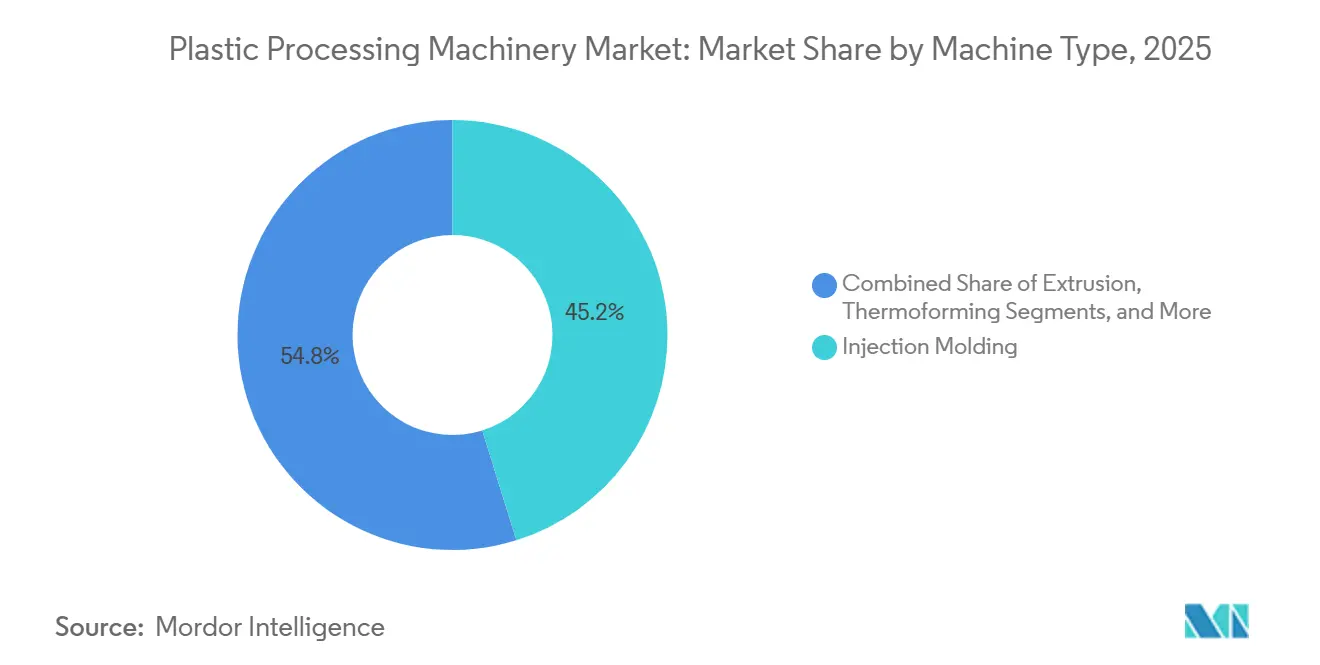
Blow Molding Outpaces Legacy LeadersInjection molding accounted for a 45.18% share of the plastic processing machinery market in 2025. The segment is mature, with a projected 4.2% CAGR for 2026-2031 as buyers prioritize faster cycle times over new capacity. Blow molding, by contrast, is projected to grow at a 5.67% CAGR, the fastest among machine types, as lightweight PET bottle designs now reduce preform weight by 15% and automotive fuel tanks require six-layer HDPE-based structures that meet evaporative-emission limits of less than 300 mg/day.
Ford’s approval of a six-layer blow-molded fuel tank for its 2026 pickup program is catalyzing orders for high-output extrusion-blow systems capable of processing ethylene vinyl alcohol barriers. Thermoforming remains a niche option in medical trays, where qualification cycles can lock in equipment for up to 24 months, while extrusion lines face infrastructure spending but suffer from margin pressure as resin spreads narrow. Injection-compression hybrids, such as ENGEL’s 2024 debut, reduce clamp tonnage by 30% and demonstrate how incumbents defend their share through process innovation rather than capacity expansion.


By End-User Industry:
Electronics Surge Past Mature SegmentsPackaging contributed 41.72% of the plastic processing machinery market size in 2025, yet its growth is slowing as converters extend press lifecycles to 18 years. Electrical and electronics applications are expected to grow at a rate of 6.47% to 2031, driven by 800-volt battery platforms that require injection-molded busbars with dimensional tolerances of under 0.1 mm.
Apple’s move to glass-fiber-reinforced polycarbonate housings for select MacBook models cut per-unit carbon footprint by 18%, boosting demand for precision micro-molding cells. Medical devices post a steady 4.9% CAGR, while construction equipment sales mirror infrastructure cycles; India’s National Infrastructure Pipeline is earmarked at INR 111 lakh crore (USD 1.33 trillion) through 2025 to sustain extrusion-line demand.
By Automation Level:
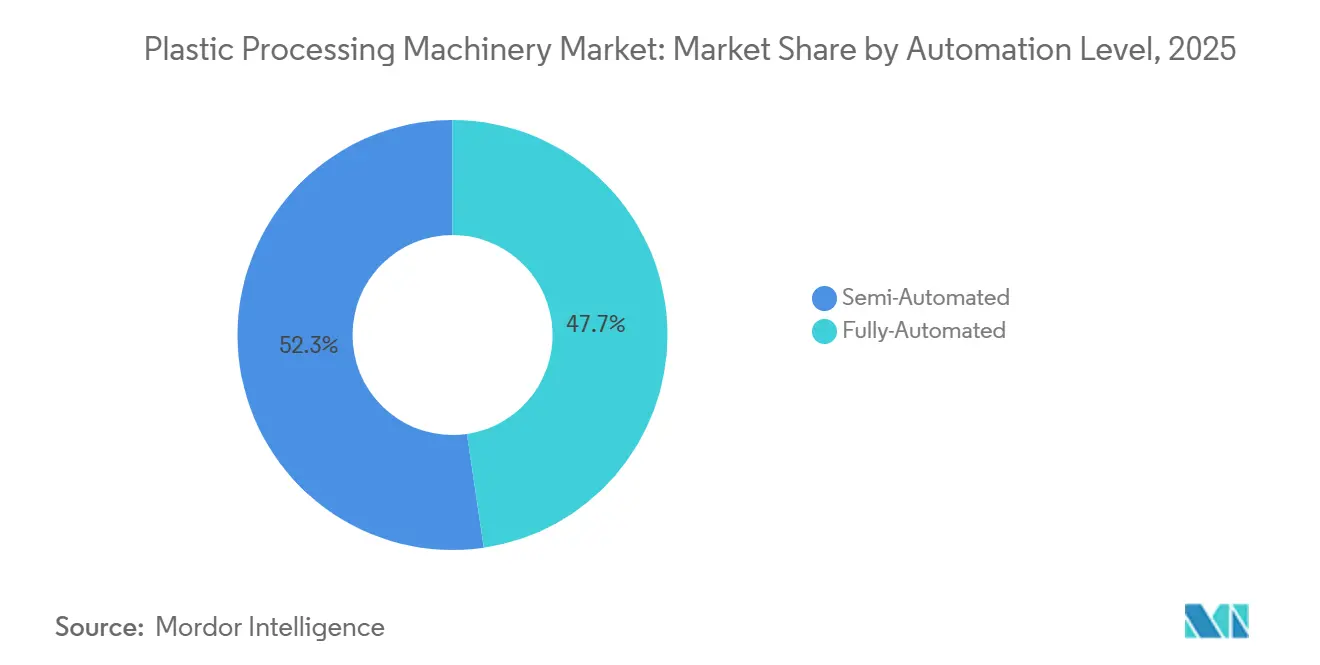
Labor Economics Tilt Toward Full AutomationSemi-automated equipment accounted for 52.33% of the plastic processing machinery market size in 2025, as medical and short-run applications require operator adjustments to maintain process validation. Fully automated cells are forecast to grow at a rate of 6.13% to 2031, as wages rise and skilled operator shortages persist. The average hourly pay for Mexican molding technicians increased by 28% between 2020 and 2024, to USD 6.20, compressing labor arbitrage and favoring robot-packed production.
A Manufacturers Alliance survey revealed that 14% of North American molding posts remained unfilled in Q2 2025, prompting investments in collaborative robots that reduced programming time by 60%. Sumitomo’s cloud platform aggregates vibration, temperature, and pressure data to slash unplanned downtime by 34%, delivering a performance guarantee that tips capital allocation toward fully automated lines.
Geography Analysis
APAC Plastic Processing Machinery Market
Asia-Pacific captured 48.51% of the plastic processing machinery market in 2025, buoyed by China’s 12 GWh of battery-pack housing capacity and India’s INR 1,450 crore (USD 174 million) electronics-manufacturing incentive for fiscal 2025. Precision molds for battery trays and smartphone frames maintain high press utilization in coastal China and southern India. Servo-drive penetration reached 68% of new injection units in the region by mid-2025, as OEMs sought energy savings.
South America Plastic Processing Machinery Market
South America is the fastest-growing region, with a 6.09% CAGR forecasted for 2026-2031. Brazil’s flexible-packaging sector ordered 23% more polyethylene film lines in 2024, and Argentina’s automotive rebound raised component molding volumes by 34% in H1 2025. Chile’s lithium-refining boom, with 210,000 t output in 2024, is spurring blow-molded container demand for chemical logistics.
North America and EMEA Plastic Processing Machinery Market
North America holds a significant market share of the plastic processing machinery market in 2025, supported by the USD 52.7 billion CHIPS and Science Act, which drives demand for cleanroom-ready injection presses for wafer carriers.[2]U.S. Department of Commerce, “CHIPS and Science Act Implementation,” commerce.gov Circular-economy rules underpin Europe’s 22.1% share, yet CAGR expectations hover near 3.8% because single-use bans offset gains from reusable packaging. The Middle East and Africa collectively command 11.2%, with Saudi Arabia’s 8 million tonnes of polyethylene capacity anchoring a low-cost resin supply, although workforce shortages cap machine utilization.

Competitive Landscape
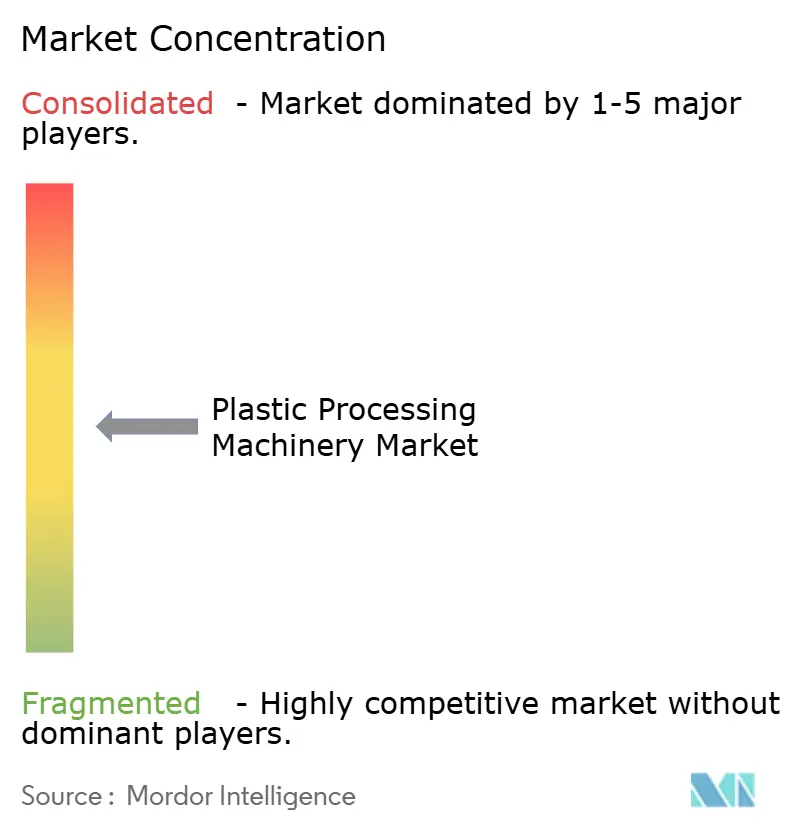
The plastic processing machinery market is characterized by moderate concentration, with the top five suppliers accounting for 38% of injection-press shipments in 2024, while extrusion and blow molding remain relatively fragmented. European and Japanese OEMs bundle IoT-based condition monitoring, transforming one-off equipment sales into service subscriptions that generate annual revenue growth of 12-15%. Chinese vendors cut list prices by 25-30% thanks to commoditized servo drives, expanding into first-time automation accounts across Southeast Asia and Africa.
ARBURG’s gesture-controlled interface trimmed mold-change setups by 18 minutes in 2024 trials, a compelling value proposition for automotive tier-one suppliers that execute up to 60 tool swaps weekly. Haitian International increased servo-drive penetration to 68% of its injection-press catalog by mid-2025, reducing cycle energy by 35% compared to hydraulic benchmarks. KraussMaffei’s 3,500 t all-electric press, launched in August 2025, extended electric-actuation economics into structural automotive components.
Aftermarket opportunities are rising. ISO 20430 safety compliance mandates retrofits on hydraulic presses installed before 2020, while contamination exceeding 200 ppm in recycled pellets degrades the melt-flow index by 15%, creating a pull-through demand for closed-loop temperature feedback.[3]International Organization for Standardization, “ISO 20430 Injection Molding Safety Standard,” iso.org Patent filings increased by 9% in 2024, with 42% related to energy recovery or machine-learning optimization. Additive-manufacturing platforms can print mold inserts within 36 hours, thereby shrinking prototype lead times and potentially threatening traditional tooling revenue.
Plastic Processing Machinery Industry Leaders
ARBURG GmbH + Co KG
Haitian International Holdings Ltd.
ENGEL Austria GmbH
KraussMaffei Group GmbH
Hillenbrand, Inc.
- *Disclaimer: Major Players sorted in no particular order
Plastic Processing Machinery Market Companies Covered in this Report
- ARBURG GmbH + Co KG
- Haitian International Holdings Ltd.
- ENGEL Austria GmbH
- KraussMaffei Group GmbH
- Milacron LLC (Hillenbrand, Inc.)
- Husky Injection Molding Systems Ltd.
- The Japan Steel Works, Ltd.
- Nissei Plastic Industrial Co., Ltd.
- Chen Hsong Holdings Limited
- Wittmann Battenfeld GmbH
- Negri Bossi S.p.A.
- Sumitomo Heavy Industries
- Battenfeld‑Cincinnati Group
- Fanuc Corporation
- Kautex Maschinenbau System GmbH

Recent Industry Developments in Plastic Processing Machinery Market
- October 2025: ENGEL opened a 28,000 m² assembly facility in Jiaxing, China, doubling its regional output capacity and integrating automated guided vehicles for parts handling.
- September 2025: Haitian International entered a joint venture with a European recycling-technology firm to build extrusion systems optimized for PET with up to 50% recycled content.
- August 2025: KraussMaffei unveiled a 3,500 t all-electric injection press that cuts cycle energy by 42% and qualifies for accelerated depreciation under Germany’s climate incentives.
- July 2025: Sumitomo Heavy Industries launched a cloud-based predictive-maintenance suite that aggregates data from 200 presses and cut downtime by 34% during a six-month pilot.


Global Plastic Processing Machinery Market Report Scope
The scope of the study on the Plastic Processing Machinery Market encompasses a comprehensive analysis of the equipment used in transforming raw plastic materials into finished products. It includes machinery for injection molding, extrusion, blow molding, thermoforming, and other specialized processes. The study evaluates market size, growth trends, technological advancements, regional demand patterns, and competitive landscape.
The Plastic Processing Machinery Market Report is Segmented by Machine Type (Injection Molding, Blow Molding, Extrusion, and Thermoforming), Automation Level (Semi-Automated, and Fully-Automated), End-user Industry (Packaging, Consumer Goods, Electrical and Electronics, Construction, Healthcare, and Other End-user Industries), and Geography (North America, South America, Europe, Asia-Pacific, Middle East and Africa). The Market Forecasts are Provided in Terms of Value (USD).
| Injection Molding |
| Blow Molding |
| Extrusion |
| Thermoforming |
| Semi-Automated |
| Fully-Automated |
| Packaging |
| Consumer Goods |
| Electrical and Electronics |
| Construction |
| Healthcare |
| Other End-user Industries |
| North America | United States | |
| Canada | ||
| Mexico | ||
| South America | Brazil | |
| Argentina | ||
| Chile | ||
| Rest of South America | ||
| Europe | United Kingdom | |
| Germany | ||
| France | ||
| Italy | ||
| Spain | ||
| Rest of Europe | ||
| Asia-Pacific | China | |
| India | ||
| Japan | ||
| South Korea | ||
| Australia | ||
| Rest of Asia-Pacific | ||
| Middle East and Africa | Middle East | Saudi Arabia |
| United Arab Emirates | ||
| Turkey | ||
| Rest of Middle East | ||
| Africa | South Africa | |
| Nigeria | ||
| Rest of Africa | ||
| By Machine Type | Injection Molding | ||
| Blow Molding | |||
| Extrusion | |||
| Thermoforming | |||
| By Automation Level | Semi-Automated | ||
| Fully-Automated | |||
| By End-user Industry | Packaging | ||
| Consumer Goods | |||
| Electrical and Electronics | |||
| Construction | |||
| Healthcare | |||
| Other End-user Industries | |||
| By Geography | North America | United States | |
| Canada | |||
| Mexico | |||
| South America | Brazil | ||
| Argentina | |||
| Chile | |||
| Rest of South America | |||
| Europe | United Kingdom | ||
| Germany | |||
| France | |||
| Italy | |||
| Spain | |||
| Rest of Europe | |||
| Asia-Pacific | China | ||
| India | |||
| Japan | |||
| South Korea | |||
| Australia | |||
| Rest of Asia-Pacific | |||
| Middle East and Africa | Middle East | Saudi Arabia | |
| United Arab Emirates | |||
| Turkey | |||
| Rest of Middle East | |||
| Africa | South Africa | ||
| Nigeria | |||
| Rest of Africa | |||


Key Questions Answered in the Report
What is the current value of the plastic processing machinery market?
The market was valued at USD 34.72 billion in 2026 and is projected to reach USD 43.32 billion by 2031.
Which machine type is expanding fastest?
Blow molding machinery is expected to grow at a 5.67% CAGR through 2031 due to lightweight PET bottles and multilayer fuel tanks.
Why are fully automated lines gaining share?
Rising labor costs and predictive maintenance analytics make fully automated cells more cost-effective throughout the equipment lifecycle.
Which end-use sector shows the highest growth?
Electrical and electronics applications are forecast to expand at a 6.47% annual rate, driven by demand for electric vehicles and consumer electronics.
Which region leads in demand, and which grows fastest?
Asia-Pacific held 48.51% of demand in 2025, while South America is set to grow the quickest at a 6.09% CAGR.
How are sustainability mandates influencing equipment design?
Regulations requiring recycled content and lower emissions are driving the adoption of servo-driven presses, closed-loop temperature controls, and multi-layer barrier-film lines.
Page last updated on:


 Your data is secure and never sold or shared.


