
Plantar Fasciitis Treatment Market Size and Share
Market Overview
| Study Period | 2020 - 2031 |
|---|---|
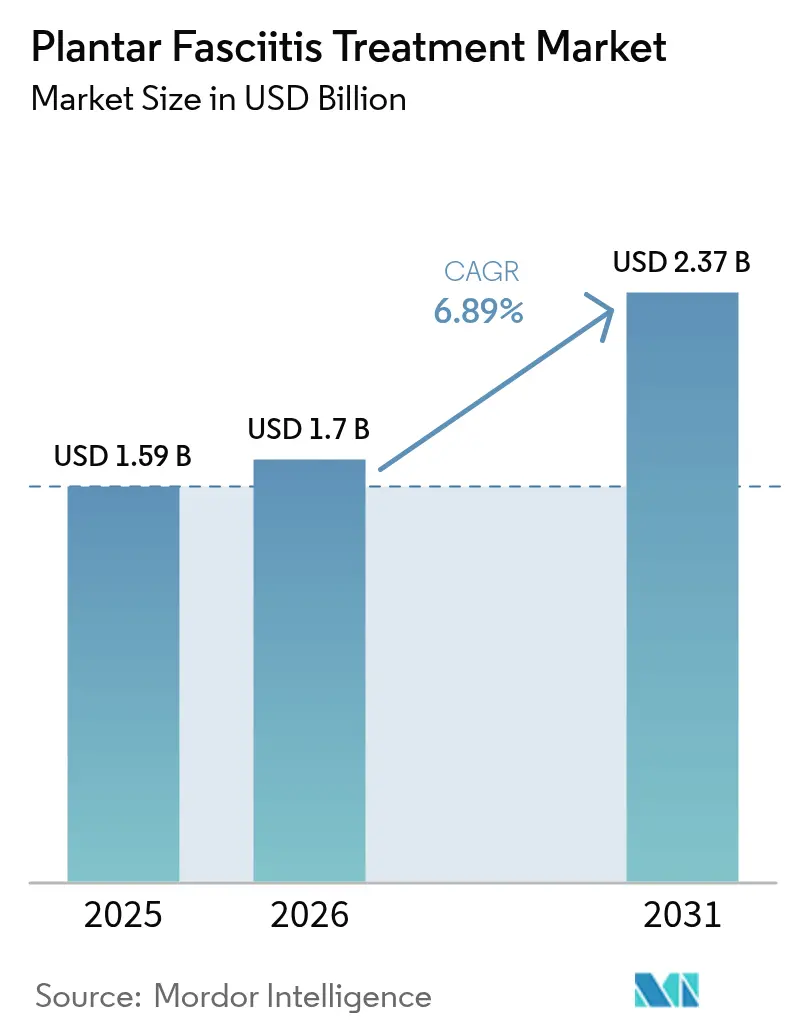
| Market Size (2026) | USD 1.7 Billion |
| Market Size (2031) | USD 2.37 Billion |
| Growth Rate (2026 - 2031) | 6.89 % |
| Fastest Growing Market | Asia Pacific |
| Largest Market | North America |
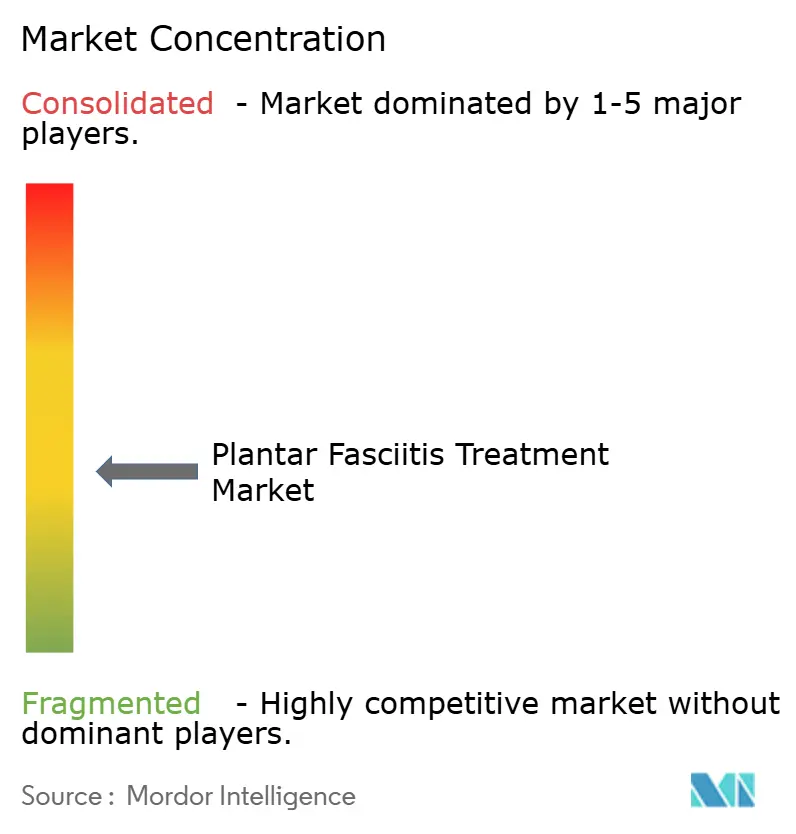
| Market Concentration | Medium |
Major Players *Disclaimer: Major Players sorted in no particular order Image © Mordor Intelligence. Reuse requires attribution under CC BY 4.0. | |
Plantar Fasciitis Treatment Market Analysis by Mordor Intelligence
The plantar fasciitis treatment market size is expected to grow from USD 1.59 billion in 2025 to USD 1.70 billion in 2026 and is forecast to reach USD 2.37 billion by 2031 at 6.89% CAGR over 2026-2031. Orthotic devices remain the backbone of care, but technology-enabled modalities such as extracorporeal shock-wave therapy (ESWT), AI-guided pressure-sensing insoles and ultrasonic fasciotomy are lifting the therapeutic ceiling. Demand growth aligns with the sharp rise in obesity and an aging global population—both proven risk amplifiers for plantar fascia degeneration. Reimbursement progress for outpatient embolization codes in North America, rising sports participation rates in Asia-Pacific and clinician preference for custom biomechanics correction are widening commercial opportunities. Meanwhile, fragmented competitive dynamics create room for consolidation, illustrated by Zimmer Biomet’s USD 5 billion purchase of Paragon 28, a specialist in foot and ankle products.
Key Report Takeaways
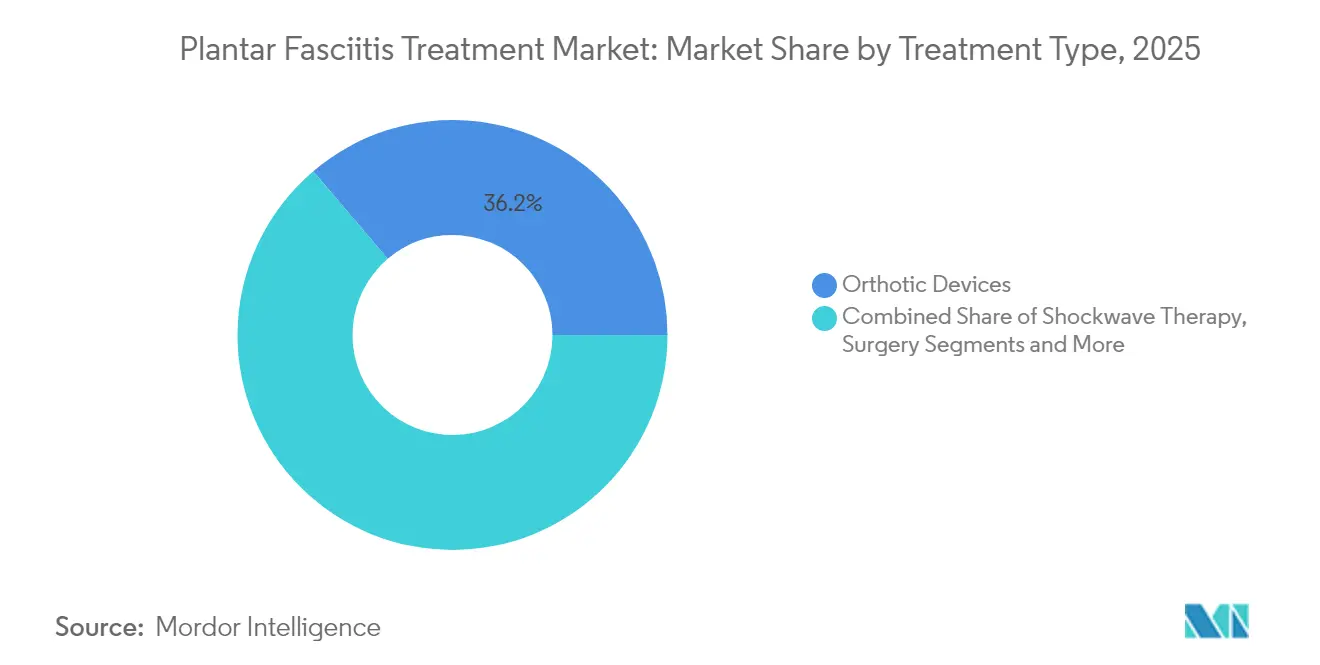
- By treatment type, orthotic devices led with 36.21% of plantar fasciitis market share in 2025; shockwave therapy is projected to expand at a 9.88% CAGR through 2031.
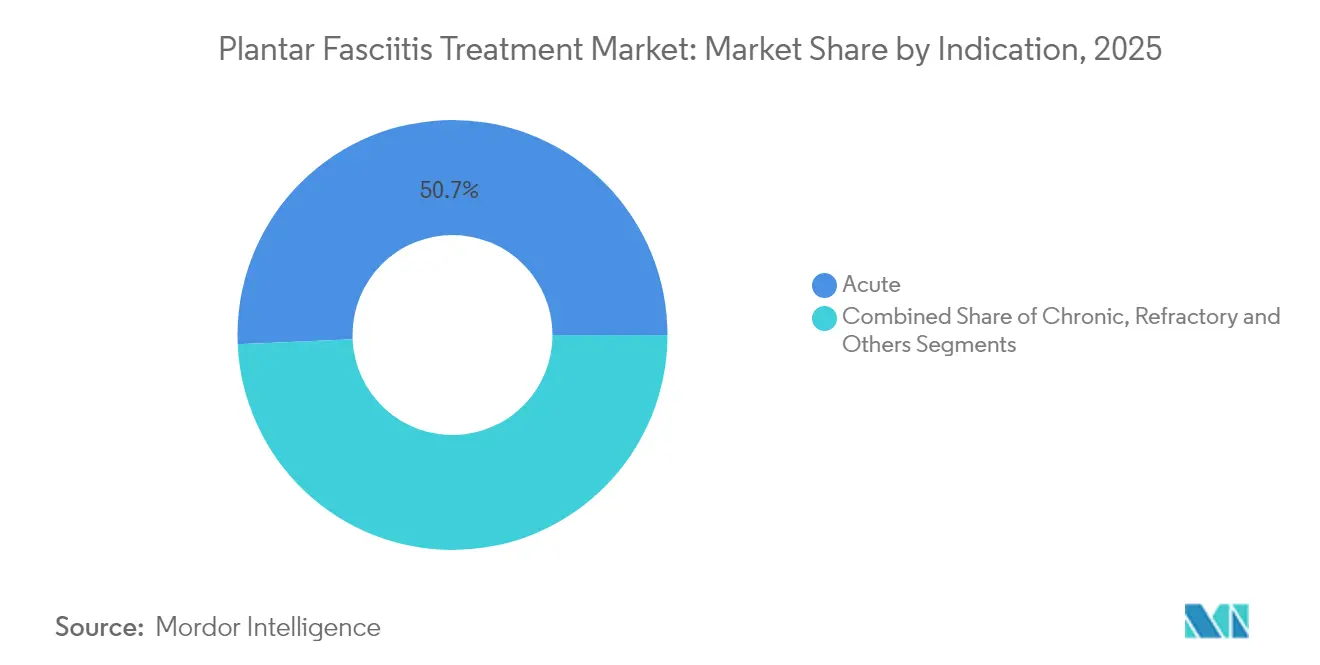
- By indication, acute presentations held 50.68% of the plantar fasciitis market share in 2025, whereas chronic cases are advancing at an 8.36% CAGR to 2031.
- By end user, hospitals accounted for 44.02% of the plantar fasciitis market size in 2025; ambulatory surgical centers are set to grow at an 8.02% CAGR over the same horizon.
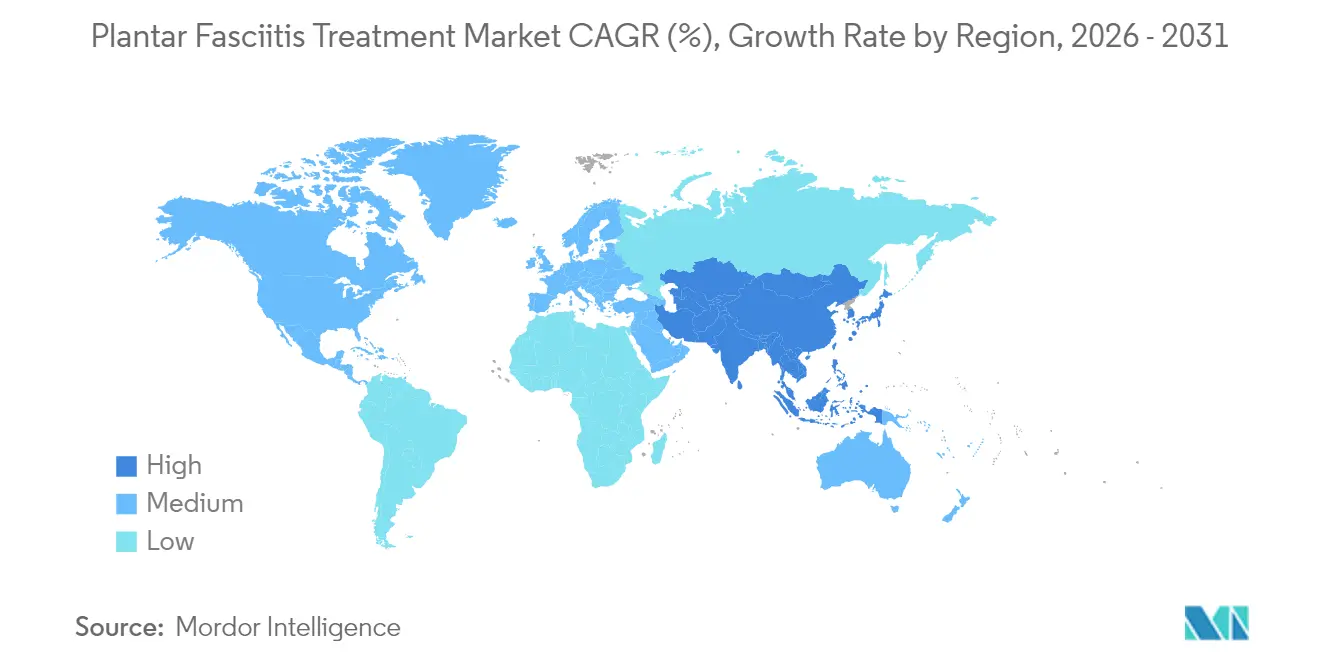
- By geography, North America commanded 39.10% revenue share in 2025; Asia-Pacific is on track for a 8.94% CAGR, the fastest among all regions.
Note: Market size and forecast figures in this report are generated using Mordor Intelligence’s proprietary estimation framework, updated with the latest available data and insights as of 2026.
Global Plantar Fasciitis Treatment Market Trends and Insights
Drivers Impact Analysis*
| Driver | (~) % Impact on CAGR Forecast | Geographic Relevance | Impact Timeline |
|---|---|---|---|
| Rising prevalence of plantar fasciitis fueled by obesity & aging population | +1.8% | North America, Europe | Long term (≥ 4 years) |
| Adoption of custom-made orthotic insoles & night splints | +1.2% | Developed markets worldwide | Medium term (2-4 years) |
| Rapid uptake of minimally-invasive ESWT & ultrasound-guided procedures | +1.5% | North America, Europe, expanding to APAC | Medium term (2-4 years) |
| AI-enabled pressure-sensing insoles enabling tele-rehab compliance | +0.9% | Developed markets first, scaling globally | Long term (≥ 4 years) |
| New outpatient reimbursement codes for embolization & ultrasonic fasciotomy | +0.7% | Primarily North America | Short term (≤ 2 years) |
| Sports-biomechanics data analytics driving preventive plantar products | +0.6% | Global sports-active populations | Medium term (2-4 years) |
| Source: Mordor Intelligence | |||
Rising Prevalence of Plantar Fasciitis Fueled by Obesity & Aging Population
Elevated BMI magnifies risk: adults with BMI ≥ 30 are five times more likely to develop plantar fasciitis than normal-weight peers.[1] Prevalence peaks between ages 45-64, a cohort that is expanding quickly in most developed economies. Gender disparity is notable; women report plantar heel pain 2.5 times more often than men, prompting vendors to design gender-specific orthotics. Health systems now promote early orthotic use because 25% of untreated acute cases progress to daily chronic pain that requires costlier intervention.
Adoption of Custom-Made Orthotic Insoles & Night Splints
Three-dimensional printing with variable stiffness lets clinicians redistribute plantar pressure precisely along patient-specific arch geometry.[2] Trials show custom insoles outperform prefabricated versions on pain relief and recurrence rates, giving payers a clear cost-avoidance argument. Image-generative AI adds cosmetic customization that improves adherence, particularly among younger, fashion-conscious users. Night splints, once sidelined for discomfort, are returning as part of combination protocols that couple nocturnal stretching with daytime insole correction to maximize the healing window.
Rapid Uptake of Minimally-Invasive ESWT & Ultrasound-Guided Procedures
Controlled trials confirm that ESWT paired with targeted trigger-point therapy reduces pain more effectively than standalone waves.[3] The U.S. Department of Veterans Affairs now covers ESWT for chronic plantar fasciitis, a milestone likely to pressure commercial insurers toward broader acceptance. Ultrasound guidance boosts precision for fasciotomy and corticosteroid-sparing injections, while emerging ultrasonic fasciotomy tools remove diseased fascia through incisions <5 mm, lowering post-operative downtime.
AI-Enabled Pressure-Sensing Insoles Enabling Tele-Rehab Compliance
A 22-sensor solar-assisted insole from Ohio State University tracks gait cycles continuously and alerts clinicians when plantar pressures exceed healing thresholds. Machine-learning algorithms detect subtle biomechanical deviations months before pain escalates, letting therapists recalibrate orthotics remotely. Bluetooth connectivity and smartphone dashboards foster patient engagement, addressing a longstanding adherence gap in conservative care pathways.
Restraints Impact Analysis*
| Restraint | (~) % Impact on CAGR Forecast | Geographic Relevance | Impact Timeline |
|---|---|---|---|
| High cost & patchy insurance coverage for advanced therapies | -1.4% | Global, sharpest in emerging markets | Medium term (2-4 years) |
| Counterfeit / low-grade orthotics undermining clinical outcomes | -0.8% | Emerging markets | Long term (≥ 4 years) |
| Shortage of certified podiatrists in emerging economies | -1.1% | APAC, MEA, Latin America | Long term (≥ 4 years) |
| Limited long-term evidence for regenerative injectables | -0.6% | Global premium segments | Medium term (2-4 years) |
| Source: Mordor Intelligence | |||
High Cost & Patchy Insurance Coverage for Advanced Therapies
Despite FDA clearance, many private insurers still label ESWT and ultrasonic ablation as investigational and refuse reimbursement anthem.com. Patients either absorb full procedural costs or revert to repetitive conservative therapy, delaying definitive care and inflating long-run expenditures. Emerging economies face even steeper barriers where out-of-pocket spending already tops 50% of total health expenditure.
Counterfeit / Low-Grade Orthotics Undermining Clinical Outcomes
\Online marketplaces often advertise “custom” insoles at a fraction of legitimate device prices but without clinical assessment or certified materials. Sub-standard arch support fails biomechanical correction and can worsen plantar overload, eroding patient trust in orthotic therapy and diluting brand reputation for bona fide manufacturers.
*Our forecasts treat driver/restraint impacts as directional, not additive. The impact forecasts reflect baseline growth, mix effects, and variable interactions.
Segment Analysis
By Treatment Type: Orthotics Hold Leadership as Shockwave Accelerates
Orthotic devices contributed USD 0.58 billion and held 36.21% plantar fasciitis market share in 2025, underscoring the primacy of biomechanical realignment at the base of the care pyramid. The segment benefits from continuous material innovation—carbon-fiber composites, shape-memory polymers and breathable lattices—delivering lighter, more durable insoles without sacrificing corrective strength. Smart-insole variants are layering electronics atop traditional shells, turning static supports into data generators that inform tele-rehab pathways. Prefabricated inserts anchor entry-level demand, though custom CAD-CAM models grab higher margins and show lower 12-month recurrence.
The shockwave sub-segment is forecast to grow at 9.88% CAGR, fastest within the plantar fasciitis treatment market, aided by portable generators that allow outpatient delivery. Focused ESWT platforms now incorporate ultrasound imaging for real-time targeting, enhancing efficacy and curbing session counts. Regulatory clearances in Japan and Australia are drawing new device makers and regional distributors. Surgical interventions—endoscopic and ultrasonic fasciotomy—remain niche but vital for the 5-10% who fail conservative care. Regenerative therapies, including PRP and stem cells, sit at the innovative frontier yet await robust evidence and reimbursement traction.

By Indication: Acute Dominates but Chronic Expands Rapidly
Acute cases represented 50.68% of 2025 revenue, benefiting from guideline consensus around NSAIDs, stretching regimens and entry-level orthotic support. Early diagnosis campaigns by occupational health departments are trimming diagnostic delay, translating into quicker symptom resolution and lower downstream cost. Hospitals bundle acute care with gait-training programs, improving outcomes inside 12 weeks.
Chronic plantar fasciitis, however, is advancing at 8.36% CAGR and will command a growing slice of plantar fasciitis market size by 2031. The rise ties to lifestyle factors—prolonged standing professions, recreational endurance sports and delayed specialist referral. Chronic pathology unlocks demand for ESWT, ultrasound-guided injections and embolization, each commanding premium pricing. Transcatheter arterial embolization reports 82% pain reduction at 48 months follow-up, bolstering clinician confidence. Device firms position combination protocols, pairing shockwave priming with regenerative injectables, to tackle recalcitrant tissue degeneration.
By End User: Hospitals Retain Scale as Ambulatory Centers Surge
Hospitals generated 44.02% of the plantar fasciitis market size in 2025, leveraging integrated imaging, multidisciplinary staffing and reimbursement leverage. Complex surgeries—open or endoscopic fasciotomy—and comorbidity management occur predominantly in hospital theatres. Academic hospitals double as clinical-trial hubs, validating novel devices and biologics and shaping practice guidelines.
Ambulatory surgical centers (ASCs) are projected to grow at an 8.02% CAGR on the back of minimally invasive techniques and bundled episode-of-care pricing transparency. ESWT, ultrasound-guided corticosteroid injection and percutaneous ultrasonic fasciotomy fit well within ASC workflows that emphasize rapid turnover. Podiatry clinics serve as referral feeders, handling diagnostics and conservative care while channeling advanced interventions to ASCs. The direct-to-consumer home segment is nascent but expanding through smartphone-linked exercise modules and subscription orthotic replacements.
Geography Analysis
North America accounted for 39.10% of 2025 revenue. Mature insurance frameworks cover baseline orthotics and physical therapy, while recent code updates broaden access to outpatient embolization, anchoring the region’s technology adoption curve. The U.S. Food and Drug Administration’s 2025 approvals of pressure-mapped smart insoles and ultrasonic fasciotomy suites validate the innovation pipeline. Academic–industry collaborations feed continuous evidence generation, accelerating guideline acceptance across podiatry and orthopedics.
Asia-Pacific is set to log a 8.94% CAGR, the fastest in the plantar fasciitis treatment market. China’s Healthy China 2030 plan is scaling podiatry clinics inside tertiary hospitals, while India’s Ayushman Bharat insurance expansion improves affordability for outpatient therapies. Rapid urbanization increases sedentary office work and weekend sports participation, both driving plantar heel pain incidence. Device makers adapt with mid-tier ESWT units and subscription-priced 3D-printed insoles to match varied purchasing power.
Europe posts steady growth underpinned by universal healthcare and CE-mark streamlining for novel devices. Germany and the Nordic countries lead ESWT utilization per capita thanks to early payer adoption. Southern Europe reports rising use of electro-acupuncture protocols in chronic cases, blending traditional modalities with Western evidence standards. Regulatory harmonization across the EU eases cross-border supply for orthotic brands, while sports-medicine clinics tied to football clubs drive research into preventive footwear.
Latin America and the Middle East & Africa remain emerging opportunities. Brazil’s private insurance sector reimburses ESWT selectively, and medical tourism in Mexico offers bundled shock-wave packages to U.S. self-pay patients. Gulf Cooperation Council states invest in sports infrastructures ahead of global events, raising awareness of foot-ankle care and spurring demand for specialist clinics. However, podiatry workforce shortages and counterfeit orthotic inflows temper uptake until stronger regulatory enforcement materializes.
Regulatory Landscape
Regulation for plantar fasciitis treatments spans drug and device frameworks, with most innovation centered on medical devices such as ESWT generators, low-level lasers, and minimally invasive fasciotomy tools. In the United States, these products typically use the FDA medical device pathways, commonly Class II devices cleared via 510(k) (special controls apply to several energy-based indications), while selected higher-risk technologies fall under PMA precedents within CDRH databases, shaping documentation, labeling, and post-market surveillance expectations for manufacturers.
In Europe, compliance centers on Regulation (EU) 2017/745 (MDR), which tightened clinical evaluation and introduced notified body capacity constraints for higher-risk devices. The European Commission proposed measures in December 2025 to simplify EU medical device rules, with legislative work continuing into March 2026 as updates progressed around MDR implementation and potential targeted amendments. Separately, the EMA initiated a breakthrough devices (BtX) pilot in Q2 2026, creating an additional pan-European mechanism that innovative device developers can track while planning evidence generation and market access.
Value Chain Analysis
The value chain starts with upstream inputs for orthotic devices and energy-based therapies, including polymers and composites for prefabricated and custom insoles, sensors and low-power electronics for smart insoles, and electromechanical subsystems (generators, applicators, and imaging components) for ESWT and laser platforms. Device manufacturers integrate these components into finished systems and must align design controls and quality systems with regulatory requirements. In the US, many ESWT and laser devices typically rely on the 510(k) pathway by demonstrating substantial equivalence to predicate devices, which in turn affects development timelines and supplier qualification practices.
Downstream, distribution splits between clinician channels (podiatry centers, orthopedics, hospitals, and ambulatory surgical centers) for ESWT, injections, and procedures, and retail or DTC channels for OTC supports, braces, and some orthotic products. Care pathways often require failure of conservative therapy before escalation to ESWT or other procedures, which makes referral networks, payer policies, and imaging access (for ultrasound-guided care) important intermediaries alongside traditional distributors. Service, training, and maintenance providers also matter for energy-based modalities, while digital platforms supporting gait analytics and tele-rehab extend the chain through software updates, data management, and clinical workflow integration.
Competitive Landscape
The plantar fasciitis treatment market remains moderately fragmented, with the top five players controlling about 35% of global sales. Orthotic incumbents such as Hanger and Ottobock leverage long-standing clinician networks, yet face disruption from AI-driven custom-insole start-ups. Device majors Zimmer Biomet and Smith+Nephew are scaling dedicated foot-and-ankle portfolios through acquisitions and targeted R&D. Zimmer Biomet’s absorption of Paragon 28 extends its addressable products from joint replacement into high-growth forefoot reconstruction and plantar fasciitis implants.
Technology convergence is the new competitive yardstick. Firms integrating diagnostics, treatment and remote monitoring—often through cloud dashboards—enhance clinical efficacy and create data moats. Smart-insole pioneers partner with orthopedic giants for distribution reach, while cloud analytics monetize anonymized gait data for product design loops. Meanwhile, reimbursement lobbying remains a core capability; companies that secure Category I CPT codes or positive coverage determinations unlock scaled adoption and clinician loyalty.
Regional challengers pursue white-space strategies. Chinese ESWT manufacturers price devices 20-30% below Western averages, appealing to emerging-market clinics. Indian start-ups exploit the domestic 3D-printing ecosystem to deliver custom orthotics within 48 hours of foot scanning. European SMEs differentiate on sustainability, incorporating bio-based resins into insole fabrication to meet EU circular-economy directives. Consolidation is expected as multinational med-techs snap up niche innovators to reinforce pipeline breadth.
Plantar Fasciitis Treatment Industry Leaders
-
Scholl’s Wellness Co.
-
Ottobock
-
Algeo Limited
-
Bauerfeind
-
Superfeet Worldwide Inc.
- *Disclaimer: Major Players sorted in no particular order
Market Opportunities and Future Outlook
White-space is widening around technology-enabled conservative care and evidence-backed escalation pathways that reduce reliance on repeat corticosteroid injections and prolonged trial-and-error. Smart insole systems and self-powered wearables that capture plantar pressure and gait metrics create an opportunity to pair orthotic correction with remote monitoring and adherence support, particularly as care shifts toward outpatient and home settings. Published innovation work in 2026 reinforces this direction, describing a fully self-powered digital wearable system for plantar fasciitis that uses energy-harvesting arch support for real-time pressure monitoring and gait analysis, consistent with the broader move toward AI-enabled pressure-sensing insoles.
Energy-based and minimally invasive modalities also offer space for more differentiated positioning through comparative evidence and clearer protocol design. In 2026, peer-reviewed studies reported longer-horizon outcomes and biomechanical rationale for shockwave-related interventions, including pressure redistribution effects. A randomized controlled trial publication also compared radiofrequency thermal lesioning versus ESWT and corticosteroid injections for chronic cases over a 12-month horizon. On the clinical development side, clinical trials registered in 2026, including studies evaluating pulsed radiofrequency approaches and high-intensity laser therapy versus focused ESWT, point to active roadmaps that vendors and providers can use to standardize patient selection, define outcome metrics beyond short-term pain scores, and support payer and guideline engagement where coverage for advanced therapies remains inconsistent.
Recent Industry Developments
- July 2026: Ottobock announced the acquisition of Fesia Technology, S.L., a Spanish specialist in functional electrical stimulation (FES) orthoses. The acquisition expands Ottobock's neuro-orthotics footprint and adds a technology platform that complements lower-limb mobility solutions adjacent to orthotic-driven plantar care. It also strengthens a pathway for integrating stimulation-based rehabilitation with device ecosystems that increasingly include digital monitoring.
- May 2026: Scholl's Wellness Co. completed the acquisition of VKTRY, a manufacturer of carbon fiber performance insoles, marking a push into the performance athlete category. The deal broadens Scholl's insole portfolio beyond mass retail comfort positioning into energy-return materials and sports-oriented use cases. It increases competitive pressure on incumbent orthotic brands and accelerates premium insole segmentation tied to biomechanics and performance claims.
- February 2026: Ottobock invested in Series A financing for Blue Arbor Technologies, Inc., the developer of the RESTORE neuromuscular interface system for prosthesis control. Although centered on advanced mobility, the investment signals continued capital flow toward interfaces and control systems that can migrate into orthotic and rehabilitation workflows. It supports the broader convergence trend in lower-limb care, where hardware, sensing, and software are bundled into integrated therapeutic platforms.
Research Methodology Framework and Report Scope
Market Definition and Coverage
This market covers the value of therapies and interventions used to reduce pain and improve function in people diagnosed with plantar fasciitis, across care settings. It includes products and procedures that are used as part of conservative care and advanced treatment pathways.
Scope exclusions: General foot care items that are not used for plantar fasciitis management, along with treatments for unrelated ankle or tendon disorders, are excluded from this sizing.
Segmentation Overview
- By Treatment Type
- Pharmacological Treatment
- NSAIDs
- Corticosteroid Injections
- Other Pharmaceuticals (botulinum toxin, analgesics)
- Orthotic Devices
- Prefabricated Insoles
- Custom-made Insoles
- Night Splints & Foot Braces
- Shockwave Therapy
- Extracorporeal Shockwave Therapy (ESWT)
- Focused Shockwave
- Radial Shockwave
- Surgery
- Endoscopic Plantar Fasciotomy
- Open Plantar Fasciotomy
- Ultrasonic Fasciotomy
- Regenerative & Novel Interventions
- Platelet Rich Plasma (PRP) Injections
- Stem-cell & Growth-factor Therapies
- Transcatheter Arterial Embolization
- Other Treatment Types
- Pharmacological Treatment
- By indication
- Acute
- Chronic
- Refractory and Others
- By End User
- Hospitals
- Ambulatory Surgical Centers
- Specialty Foot Clinics & Podiatry Centers
- Home-care / Direct-to-Consumer
- By Geography
- North America
- United States
- Canada
- Mexico
- Europe
- Germany
- United Kingdom
- France
- Italy
- Spain
- Rest of Europe
- Asia-Pacific
- China
- Japan
- India
- Australia
- South Korea
- Rest of Asia-Pacific
- Middle East and Africa
- GCC
- South Africa
- Rest of Middle East and Africa
- South America
- Brazil
- Argentina
- Rest of South America
- North America
Data Sources, Market Sizing, and Validation
Desk Research
Desk research starts by framing the diagnosed patient pool and the care pathway typically followed from self-care to specialist care, then mapping what can be monetized as treatment value. We used public health and clinical references such as CDC data on obesity and activity, NIH and NCBI literature, and WHO health statistics to understand risk factors and symptom duration when care is delayed.
To keep inputs grounded, we also reviewed materials including FDA device listings and safety communications, Medicare and CMS fee schedules for common office visits and procedures, and clinical guidance from organizations such as the American Orthopaedic Foot and Ankle Society. We used company filings, investor presentations, reputable medical journals, and major hospital system education pages to cross-check adoption of orthotics, physical therapy, and shockwave therapy. Patent databases and a paid subscription for company financials and news were used selectively to confirm product activity and pricing direction. These examples are not exhaustive, and we reviewed many other public sources for data capture, cross-checks, and clarifications.
Primary Interviews and Surveys
Primary work was used to pressure test the treated share of diagnosed patients, the typical sequencing of care (starting with orthotics and physical therapy, followed by injections or shockwave therapy), and how pricing changes by channel. We spoke with a mix of clinical users, distributors, and industry roles across APAC, EMEA, and the Americas, so assumptions on utilization, repeat treatments, and procedure mix could be corrected when desk signals were too broad.
Distribution of primary research fieldwork respondents
| Company type | Respondent position | Region |
|---|---|---|
| Top tier: 37% | CXOs: 16% | APAC: 42% |
| Mid tier: 46% | Functional/Unit leaders: 33% | EMEA: 36% |
| Smaller Players: 17% | Managers: 51% | Americas: 22% |
Market-Sizing & Forecasting
Sizing uses a top-down approach where population and obesity-related risk signals, sports and occupational standing exposure, and diagnosis rates are used to reconstruct the treated demand pool by region. We then translate demand into value through a realistic care mix. Totals are corroborated with selective bottom-up approximations such as sampled price points for orthotic devices, session counts for physical therapy, and procedure volumes for shockwave and surgical interventions, which are then used to adjust any overstatement.
Key inputs include the share of acute versus chronic cases, the percentage moving from self-care to clinician-led treatment, utilization rates for orthotics and rehab, repeat cycles for shockwave therapy, and the split between outpatient clinics and hospital settings. When data is thin for smaller countries, we apply proxy indicators such as physician density and reimbursement availability before rechecking with expert feedback.
For forecasting, we run scenario analysis anchored on expected shifts in conservative care adoption, reimbursement stability, and device availability, and then validate against expert consensus on how quickly newer modalities are being accepted in routine practice. Growth is not projected off a single CAGR, since we also track changes in treatment intensity and pricing over time.
Data Validation & Update Cycle
Validation compares model outputs with independent signals such as procedure setting mix, typical visit pathways, and observed pricing ranges, then rechecks any large year-on-year jumps. Where regional splits look unusual, we revisit assumptions, rerun sensitivities, and re-contact relevant experts to confirm whether the shift is real or driven by the model.
Before sign-off, the work is reviewed in multiple steps so inputs, conversions, and totals match the defined scope, and checks are repeated at segment and regional levels. Reports are refreshed annually, and interim updates are made when there are material changes such as reimbursement shifts, regulatory actions, or major treatment adoption changes. Right before delivery, we complete a final pass so clients receive the most current view available.
Mordor Intelligence's Plantar Fasciitis Treatment Market Size Compared With Other Published Estimates
Different published market values for plantar fasciitis treatment can vary widely, even when they describe the same clinical condition. Common drivers include what is counted as treatment value, the anchor year used, and how therapy intensity is assumed across regions.
The main gap comes from whether adjacent foot care spending and broader pain management categories are included in the total, or whether only therapy and procedure spending directly tied to plantar fasciitis is counted. Some estimates also assume faster uptake of advanced modalities and apply stronger price inflation, while others use older currency timing or do not re-check utilization rates with clinician feedback.
Benchmark comparison
| Source | Market Size | Gaps in Research Methodology |
|---|---|---|
| Mordor Intelligence | USD 1.70 B (2026) | |
| Global Research Publisher A | USD 1.41 B (2025) | Uses a 2024 anchored series with faster assumed expansion into advanced therapies, and the scope description is less clear on how orthotics, shockwave cycles, and procedure intensity are normalized across regions. |
| Healthcare Data Publisher B | USD 1.53 B (2024) | Anchors the market to 2024 and applies a broad end-user split, which can understate later-year value when repeat therapy cycles and pricing progression for devices and procedures are updated. |
The table shows that the spread mostly comes from the base year chosen and how quickly treatment mix is assumed to move from conservative care into higher value modalities. The main gap comes from how orthotic devices and repeat shockwave sessions are counted inside the treated patient pool, a step that Mordor Intelligence calibrates using acute versus chronic case mix and real-world utilization checks so the final value stays traceable to clear drivers and repeatable math.
Key Questions Answered in the Report
What is the current value of the plantar fasciitis treatment market?
The market is worth USD 1.70 billion in 2026 and is projected to reach USD 2.37 billion by 2031 at a 6.89% CAGR.
Which treatment segment holds the largest share today?
Orthotic devices lead with 36.21% share in 2025 owing to widespread physician endorsement of custom biomechanical correction.
Why is shockwave therapy growing so quickly?
Clinical evidence and new coverage determinations are pushing ESWT to a 9.88% CAGR, the fastest among all modalities.
Which region will grow the fastest through 2031?
Asia-Pacific is forecast at a 8.94% CAGR, driven by expanding healthcare access, aging demographics and rising sports participation.
How are smart insoles changing plantar fasciitis management?
AI-enabled pressure-sensing insoles provide real-time gait analytics, improving treatment compliance and enabling tele-rehab pathways.