
Plant Asset Management Market Size and Share
Market Overview
| Study Period | 2020 - 2031 |
|---|---|
| Market Size (2026) | USD 11.01 Billion |
| Market Size (2031) | USD 19.51 Billion |
| Growth Rate (2026 - 2031) | 12.12 % |
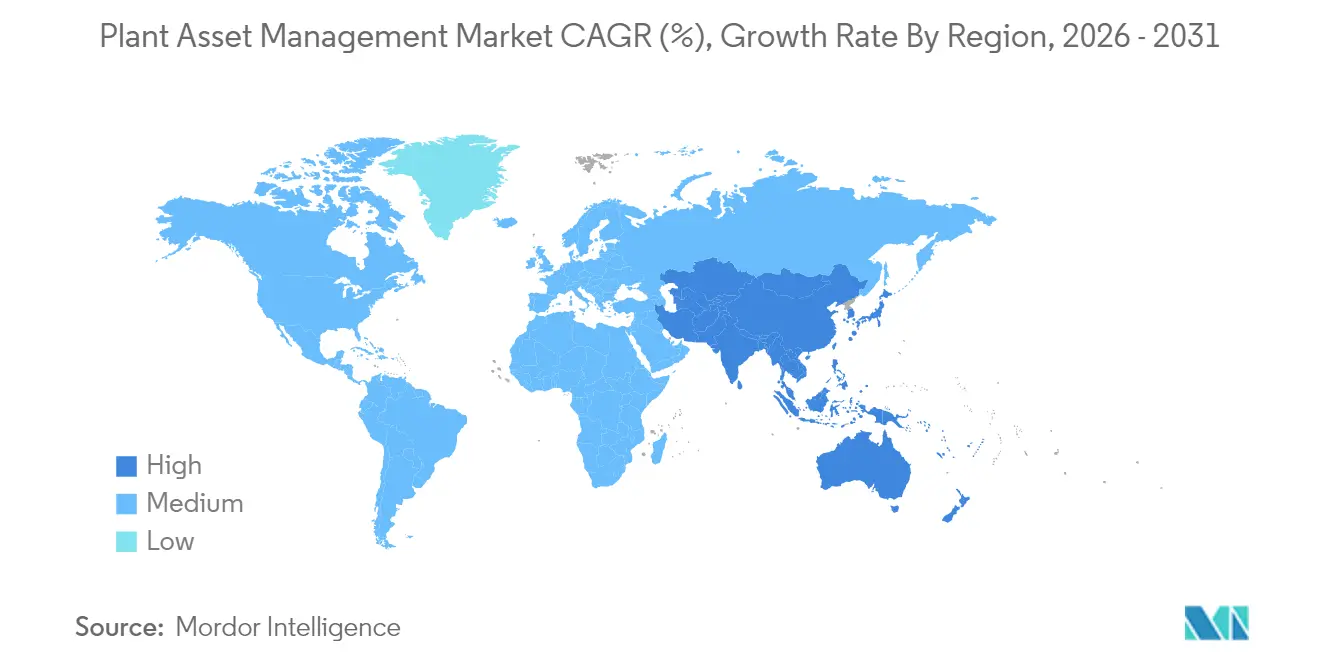
| Fastest Growing Market | Asia Pacific |
| Largest Market | North America |
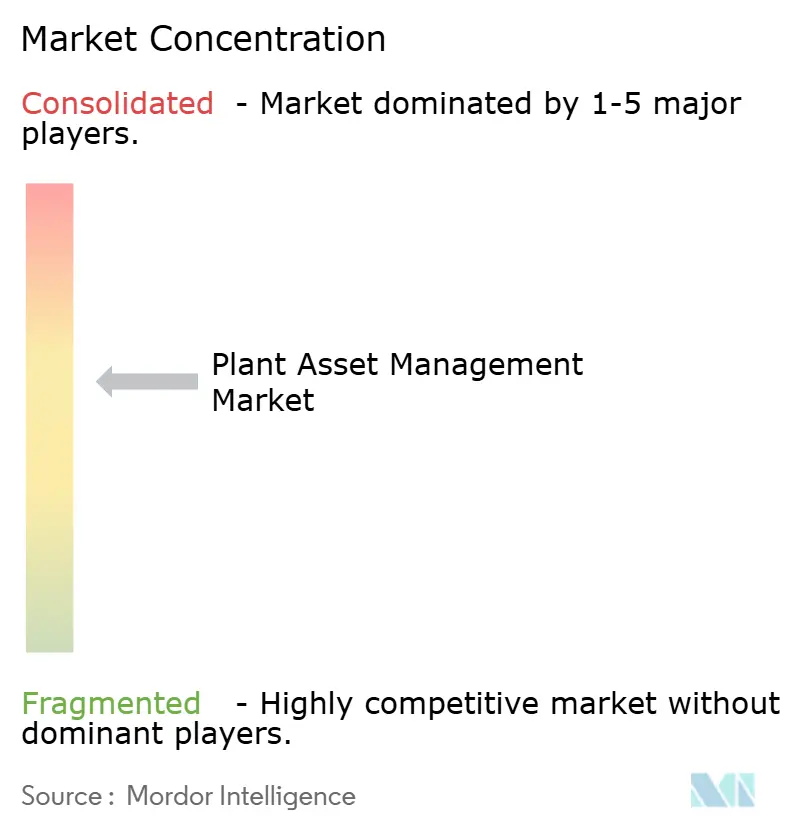
| Market Concentration | Medium |
Major Players *Disclaimer: Major Players sorted in no particular order Image © Mordor Intelligence. Reuse requires attribution under CC BY 4.0. | |
Plant Asset Management Market Analysis by Mordor Intelligence
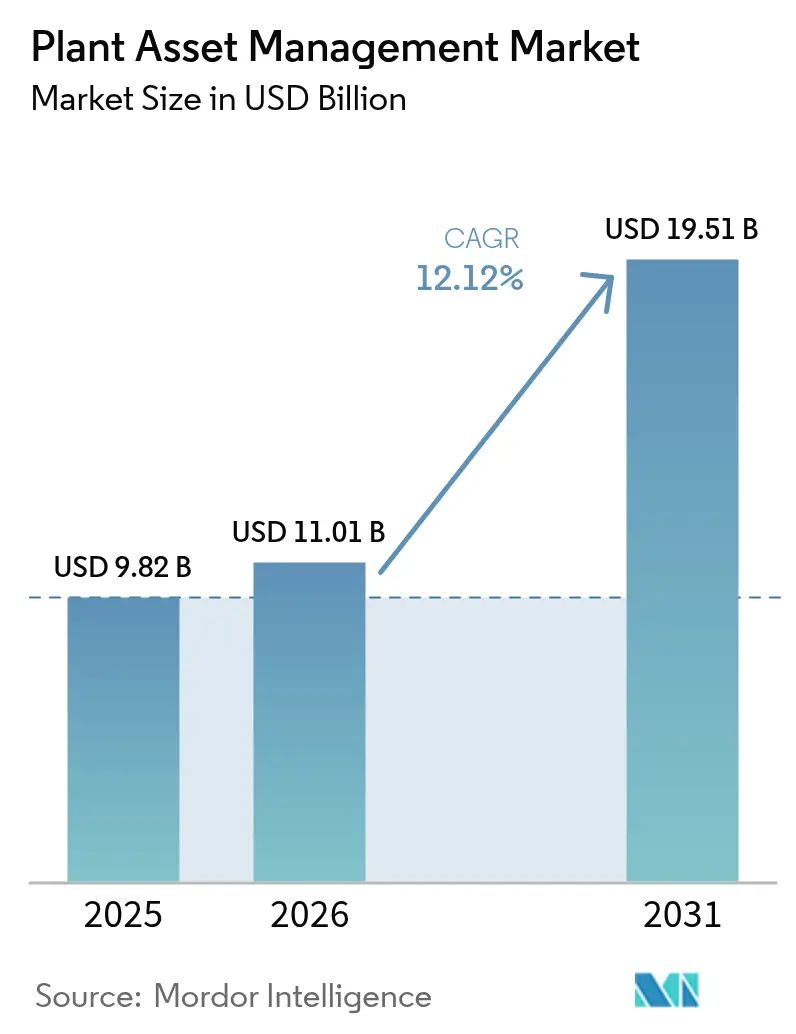
The plant asset management market size is expected to grow from USD 9.82 billion in 2025 to USD 11.01 billion in 2026 and is forecast to reach USD 19.51 billion by 2031 at 12.12% CAGR over 2026-2031. Expanding demand stems from industrial digitalization programs, stricter safety and sustainability rules, and the urgent need to improve aging electrical and mechanical infrastructure. Private 5G pilots, such as Korea Electric Power Corporation’s wireless IoT network for real-time substation monitoring, illustrate how ultra-low-latency connectivity is broadening asset visibility and shortening intervention cycles[1]. Software platforms hold sway as firms shift from reactive to predictive maintenance, while hybrid cloud designs alleviate data-sovereignty fears and speed analytics deployment. Rapid growth in services mirrors the scarcity of skilled reliability engineers and the complexity of integrating decades-old operational technology with new analytics layers. Regionally, North America keeps the lead thanks to mature infrastructure and tight environmental enforcement, but Asia-Pacific is scaling fastest as renewables, manufacturing expansion, and government-backed digital factories converge.
Key Report Takeaways
- By offering, software retained 50.70% revenue share in 2025; services are advancing at a 12.74% CAGR to 2031.
- By deployment, on-premise models held 53.20% of the plant asset management market in 2025, whereas cloud platforms are growing at 13.05% CAGR to 2031.
- By asset type, electrical assets captured 43.10% of plant asset management market share in 2025; rotating equipment is forecast to expand at 12.58% CAGR through 2031.
- By end user, oil and gas led with 24.10% plant asset management market share in 2025; mining and metals is the fastest riser at 12.34% CAGR to 2031.
- By organization size, large enterprises owned 71.80% of 2025 revenues, yet SMEs are growing at 13.02% CAGR to 2031.
- By region, North America accounted for 40.80% of 2025 sales; Asia-Pacific is on track for 12.76% CAGR to 2031.
Note: Market size and forecast figures in this report are generated using Mordor Intelligence’s proprietary estimation framework, updated with the latest available data and insights as of 2026.
Market Trends and Insights
Drivers Impact Analysis of Plant Asset Management Market*
| Driver | (~) % Impact on CAGR Forecast | Geographic Relevance | Impact Timeline |
|---|---|---|---|
| IIoT-enabled real-time analytics adoption | +2.8% | Global, APAC leadership | Medium term (2-4 years) |
| Growth in predictive and prescriptive maintenance programs | +2.5% | North America and EU, spreading to APAC | Short term (≤ 2 years) |
| Digital-twin integration across brownfield plants | +2.1% | Global, energy‐sector focus | Long term (≥ 4 years) |
| Stringent safety and environmental compliance mandates | +1.8% | North America and EU | Medium term (2-4 years) |
| Private 5G networks for asset data | +1.6% | APAC core | Long term (≥ 4 years) |
| Edge-AI sensors lowering monitoring cost | +1.5% | Global manufacturing hubs | Short term (≤ 2 years) |
| Source: Mordor Intelligence | |||
IIoT-enabled Real-time Analytics Adoption
Continuous sensor streams lift overall equipment effectiveness by 30% in plants that marry IIoT devices with edge computing, enabling millisecond-level anomaly detection and swift operator response[2]. Large manufacturers record 15% cost savings by removing manual inspections and triggering predictive tasks automatically. Pairing AI with IIoT yields self-diagnosing assets that schedule repairs without human input, a pivotal shift for facilities facing an aging asset base. These benefits are tempered by data-interoperability gaps and fresh cybersecurity risks when operational networks connect to IT domains. Standardized protocols and zero-trust architectures are therefore gaining board-level attention to support wider IIoT rollout.
Growth in Predictive and Prescriptive Maintenance Programs
Early adopters tally 5:1 to 10:1 returns on predictive projects as unplanned downtime plummets and maintenance windows shrink. Transitioning from time-based to condition-based routines extends asset lifespans by up to 40% and cuts maintenance spend by 18-25%. Prescriptive analytics now takes the baton by suggesting optimal fixes and scheduling them for minimal disruption. Accuracy gains reduce false alarms that once eroded technician trust, while falling sensor prices and pay-per-use cloud models lower barriers for newcomers. Plants achieving holistic programs report 50% fewer breakdowns and double-digit gains in asset availability.
Digital-twin Integration Across Brownfield Plants
Ninety-six percent of surveyed executives see significant value from digital twins that replicate equipment behaviour and stress-test scenarios in software rather than on the factory floor. Firms document 19% cost cuts and comparable revenue boosts by optimizing capacity and supply-chain flows within the twin. Aerospace leaders employ the concept for design validation and flight scenario simulation, and the energy sector uses twins to balance throughput, safety, and emissions in aging refineries. Adoption hurdles arise around data continuity and high-speed connectivity, especially where decades-old control systems lack digital interfaces. Standard frameworks and modular component libraries are being forged to streamline future rollouts.
Stringent Safety and Environmental Compliance Mandates
The US Environmental Protection Agency’s FY 2025 plan accelerates enforcement actions that hinge on continuous emissions data and predictive risk models. Parallel requirements under the EU Corporate Sustainability Reporting Directive demand granular asset-level monitoring that feeds verified sustainability metrics. Firms now integrate safety and environmental parameters directly into plant asset management market platforms, avoiding fines that can reach seven figures. Unified dashboards consolidate condition, energy, and compliance data, letting operators demonstrate adherence in real time. These mandates are motivating investments that also yield productivity benefits, aligning operational excellence with regulatory duty.
Private 5G Networks for Ultra-low-latency Asset Data
Industrial 5G trials deliver sub-10 millisecond round-trip times, supporting mobile robots and high-frequency sensor arrays in harsh environments[3]. Energy utilities and semiconductor fabs deploy local spectrum to guarantee deterministic connectivity where Wi-Fi falters. Vendors bundle 5G with edge computing nodes, letting mission-critical analytics run on-site while archiving reports to the cloud. Spectrum costs and specialized radio skills initially confined uptake to large enterprises, yet managed-service models are now targeting SMEs. As regulation clarifies local licensing and device certification, private 5G is expected to become a backbone for next-generation asset orchestration.
Edge-AI Sensors Driving Cost-effective Monitoring
Custom silicon and energy-efficient neural networks enable sensors that both measure and analyse vibration, temperature, or acoustics locally, flagging abnormal patterns in real time. Such devices eliminate bandwidth overload by transmitting only exception data, lowering the total cost of ownership by up to 40% compared with streaming raw waveforms. Battery-powered nodes simplify retrofits on rotating machines where cabling is prohibitive. Wider use hinges on secure firmware updates and cross-vendor data models that ensure compatibility with broader analytics stacks. As standards mature, edge-AI sensing is set to permeate every level of the plant asset management market.
Restraints Impact Analysis of Plant Asset Management Market*
| Restraint | (~) % Impact on CAGR Forecast | Geographic Relevance | Impact Timeline |
|---|---|---|---|
| High upfront CAPEX and ROI uncertainty | –1.9% | Global, notably SMEs | Short term (≤ 2 years) |
| Shortage of domain-skilled reliability engineers | –1.4% | North America and EU | Medium term (2-4 years) |
| Cyber-security and data-sovereignty concerns | –1.1% | Global | Medium term (2-4 years) |
| Legacy OT protocol fragmentation | –0.8% | Mature industrial regions | Long term (≥ 4 years) |
| Source: Mordor Intelligence | |||
High Upfront CAPEX and ROI Uncertainty
Full-featured systems can surpass USD 1 million per site when sensors, gateways, licences, and training are bundled, a daunting outlay for many SMEs. Although documented ROI ranges from 5:1 to 10:1, payback can straddle several budget cycles, complicating approvals. Outcome-based services that shift expenditure to operating budgets are gaining traction, with vendors guaranteeing uptime or energy-savings thresholds. Phased pilot-to-scale strategies also soften risk, enabling proof points before enterprise rollouts. Growing availability of rental sensors and subscription analytics is therefore pivotal for widening participation in the plant asset management market.
Shortage of Domain-skilled Reliability Engineers
Manufacturing had more than 600,000 vacancies in 2025, and maintenance roles are especially pressured because they demand both mechanical acumen and data literacy. Retirements outstrip new entrants, forcing 22% of firms to outsource maintenance or rely on OEM service contracts. Training academies, digital twins for virtual upskilling, and augmented-reality work instructions are partial salves. Vendors that bundle consulting and 24/7 monitoring fill the competency gap, but wage pressure heightens cost structures for all players.
Cyber-security and Data-sovereignty Concerns
Asset data is converging with enterprise IT, widening the attack surface. Industrial ransomware events rose 50% year-on-year in 2024, pushing insurers to demand proof of zero-trust architectures and real-time threat monitoring. Jurisdictions such as the EU apply strict rules on exporting operational data, prompting hybrid deployments where raw telemetry stays on-site. Certification schemes like IEC 62443 are becoming procurement prerequisites, and platforms now integrate anomaly-detection engines fine-tuned for OT traffic patterns.
Legacy OT Protocol Fragmentation Inflating Integration Cost
Plants often host dozens of field-bus and proprietary protocols that pre-date Ethernet. Mapping this heterogeneity into a unified data model drives up project hours and middleware licence fees. Edge gateways with protocol conversion help, yet vendor lock-in risks persist. Open-source data brokers and OPC UA adoption are slowly improving interoperability, but brownfield refits still consume the lion’s share of integration budgets. Standardisation roadmaps featured prominently in recent industry consortium charters, a promising step toward lower integration barriers.
*Our forecasts treat driver/restraint impacts as directional, not additive. The impact forecasts reflect baseline growth, mix effects, and variable interactions.
Plant Asset Management Market Segment Analysis
By Offering:
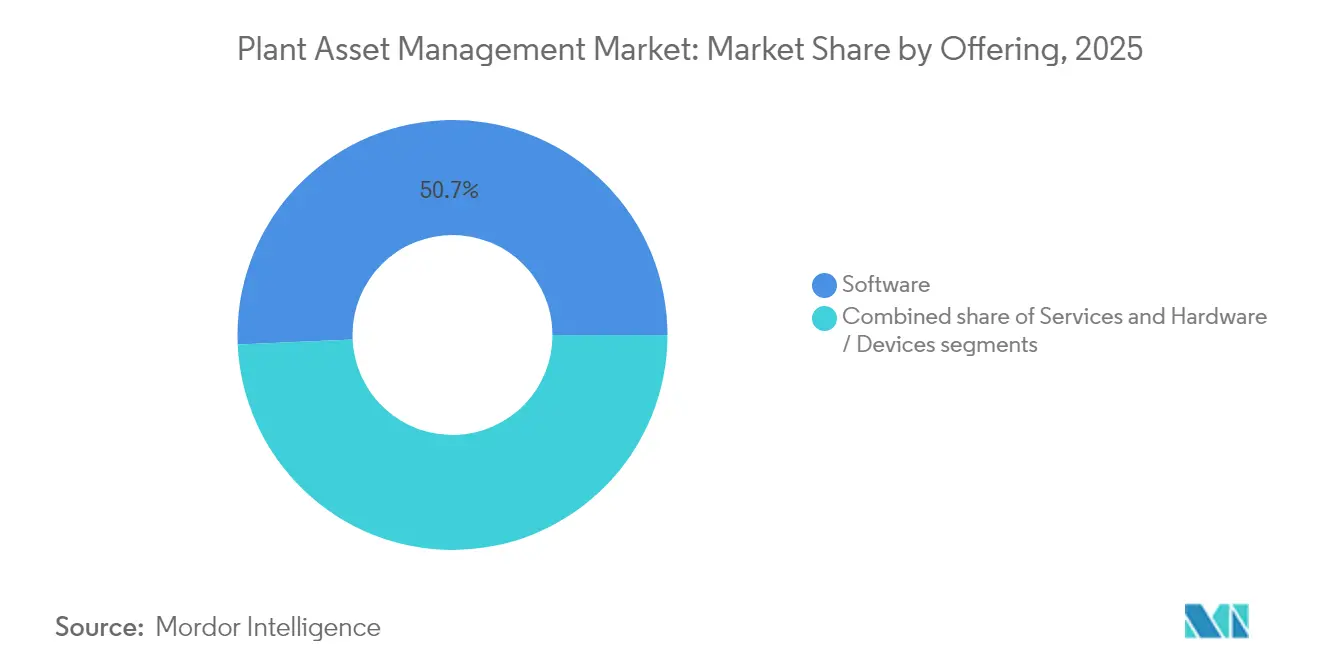
Services Accelerate Despite Software DominanceSoftware commanded 50.70% of revenue in 2025 as enterprises anchored reliability programs around condition monitoring dashboards, asset performance management suites, and analytics engines. Implementation complexity and skill shortages are propelling services at 12.74% CAGR, the fastest growth in the plant asset management market. Consulting, integration, and training projects remain prime revenue streams because each brownfield site brings distinct control architectures that demand bespoke data pipelines. SME clients prefer outcome-based contracts that tie fees to uptime or energy-savings milestones, lowering risk and securing internal buy-in. Vendors increasingly package hardware, software, and advisory expertise to differentiate in crowded bids. AI-infused sensors that perform on-board analytics are nudging hardware revenues upward, yet the largest profit pools still derive from recurring software licences and long-term service agreements that cement customer stickiness.
Integrated solutions catalyse OEM strategies: Emerson noted 48% annual expansion in software and control solutions in FY 2024, lifting those lines to 30.5% of its total turnover. Such traction underscores the shift toward converged stacks that shave integration time and ease security assurance. As domain-specific AI models mature, software teams are embedding cause-analysis libraries that let technicians troubleshoot failures faster, reinforcing the software segment’s primacy within the plant asset management market.

By Deployment:
Cloud Gains Ground Despite On-premise LeadershipOn-premise deployments retain 53.20% market share because many industrial clients insist on local governance for operational data and require deterministic response times unattainable over wide-area links. Yet cloud subscriptions are clocking 13.05% CAGR as policymakers clarify data-residency rules and hyperscalers roll out regional zones with industry-specific controls. Hybrid designs lead the plant asset management market size calculations for new projects; companies stream raw telemetry to edge nodes for instant processing, then batch insights to cloud repositories for fleet-level optimisation. This pattern pairs latency-critical control with elastic analytics that would otherwise overwhelm on-site infrastructure budgets.
Private 5G networks deepen the attraction of distributed architectures by connecting thousands of mobile or hard-to-reach assets without the interference and roaming issues that hobble Wi-Fi. Energy, oil, and gas players still lean toward air-gapped or DMZ-secured systems due to stringent safety audits, whereas discrete manufacturers gravitate to SaaS suites that minimise capex. Over the forecast horizon, multisite enterprises are expected to refactor legacy installs into cloud-connected nodes, unlocking benchmarking insights across geographies and boosting vendor opportunities for advanced analytics modules.
By Asset Type:
Rotating Equipment Momentum BuildsElectrical assets attracted 43.10% of 2025 revenues because power failures can cascade across entire plants, jeopardising safety and production quotas. Rotating equipment, however, is scaling fastest at 12.58% CAGR, propelling a notable slice of the plant asset management market size toward vibration, acoustic, and thermographic sensing. Edge-AI chips analyse waveform signatures on the motor casing, spotting misalignment or lubrication faults hours earlier than human rounds. These early warnings let operators plan repairs during scheduled stops instead of halting production, a boon for continuous-process industries.
Fixed equipment such as pressure vessels and heat exchangers remains vital; digital twins simulate fatigue and corrosion rates, guiding maintenance capital over long horizons. Instrumentation health monitoring also gains momentum as smart valves, flowmeters, and pressure transmitters periodically self-diagnose, guarding against measurement drift that could skew control loops. Vendors that unify rotating and electrical analytics in one pane of glass win preference because plant teams favour holistic dashboards over siloed point solutions.
By End User:
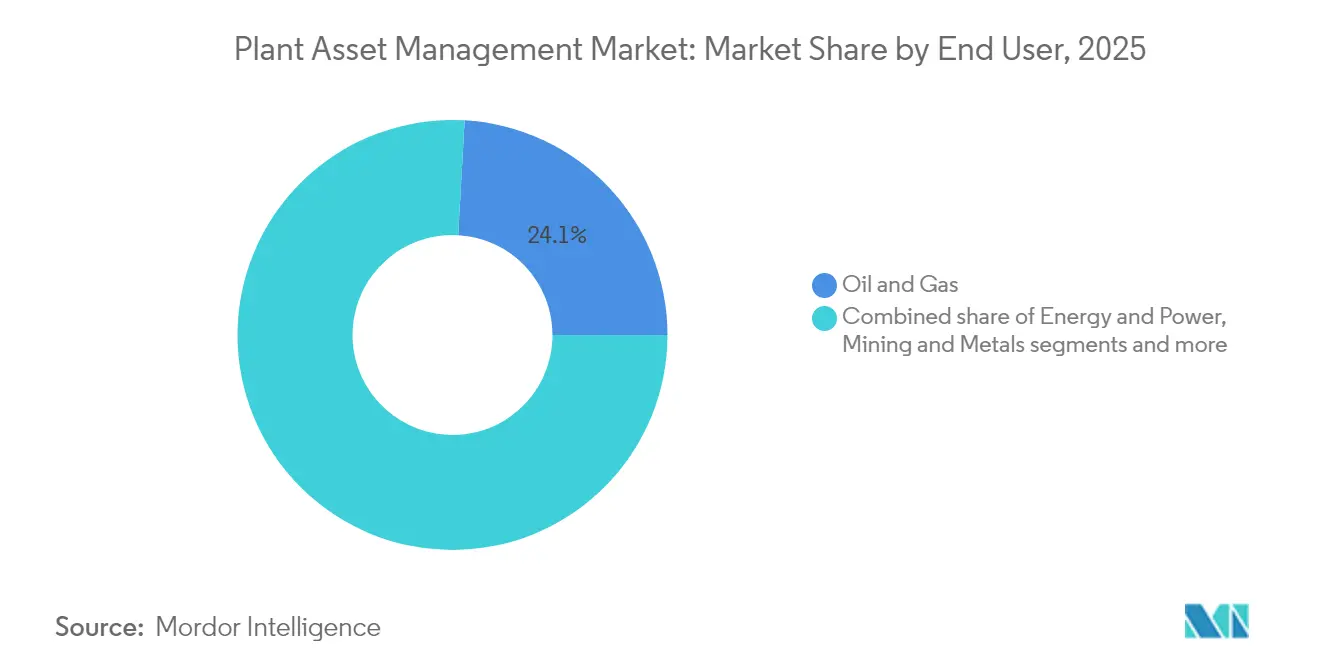
Mining Accelerates Beyond Oil and Gas LeadershipOil and gas captured 24.10% of revenue in 2025, testament to offshore platforms and refineries where a single hour of downtime can erase millions of USD. Digital twins forecast equipment stress under varying feedstock mixes, fine-tuning run rates for both output and emissions. Mining and metals, however, will post 12.34% CAGR, the steepest in the plant asset management industry, as haul-truck fleets, crushers, and conveyers embed sensors that curtail unscheduled stoppages in remote pits. Sibanye-Stillwater documented median ROIs above 200% from process-optimization twins that trimmed energy costs and upped throughput.
Power and utilities exploit asset analytics to balance renewables and ageing thermal plants, while chemicals face severe compliance scrutiny, spurring investments in leak detection and predictive relief-valve maintenance. Aerospace and defence push the envelope on digital twins for design validation, whereas food, beverage, and pharmaceuticals focus on hygienic maintenance and traceability. Water utilities, spurred by AMP8 in the UK, are earmarking billions toward smart pumping, digitised pipe networks, and net-zero targets that dovetail with advanced asset management.
By Organization Size:
SME Growth Outpaces Enterprise AdoptionLarge enterprises controlled 71.80% of spending in 2025, reflecting multi-site asset inventories and dedicated transformation budgets. Yet SMEs are expanding at 13.02% CAGR, broadening the addressable base of the plant asset management market. Cloud subscriptions eliminate the need for in-house servers, while plug-and-play wireless sensors slash installation labour. SMEs report the fastest wins in energy savings and reduced scrap rather than broad digital overhauls. Financing models such as Equipment-as-a-Service transfer capex to opex, aligning with SME cash-flow cycles.
Workforce constraints loom larger for smaller firms, prompting demand for turnkey managed services. Vendors courting SMEs emphasize rapid ROI dashboards that display avoided downtime in monetary terms, easing internal justification. As frontline technicians gain confidence in data-guided interventions, adoption accelerates and referrals ripple across local industry clusters, multiplying growth prospects.
Geography Analysis
North America Plant Asset Management Market
North America owned 40.80% of 2025 revenue owing to legacy infrastructure, mature 5G rollouts, and strict environmental oversight that encourages real-time emissions tracking. Federal incentives for grid modernization and tax credits for energy-efficiency upgrades underpin high adoption across utilities and heavy manufacturing. Regional universities and OEMs collaborate on pilot labs that showcase AI-enabled maintenance, further anchoring leadership in the plant asset management market.
APAC Plant Asset Management Market
Asia-Pacific is accelerating at a 12.76% CAGR to 2031, propelled by China’s expansive renewable installations and India’s Production-Linked Incentive scheme that prioritises smart factories. Governments in Japan and South Korea sponsor 5G and robotics testbeds, reducing perceived risk for private firms. Low median asset ages combine with aggressive capacity expansion, letting many plants leapfrog directly to predictive maintenance rather than incremental upgrades. Local vendors bundle affordable sensors with cloud back ends hosted in-region to satisfy data residency mandates, catalyzing uptake among SMEs.
EMEA and South America Plant Asset Management Market
Europe shows steady growth under the European Green Deal and Corporate Sustainability Reporting Directive, both of which necessitate granular asset-level data for energy and climate disclosures. Digital twin pilots in Germany’s process industries streamline ESG reporting while trimming maintenance spend. Eastern Europe’s emerging manufacturing hubs view asset analytics as a route to competitiveness against higher-wage Western peers. South America and the Middle East, and Africa remain smaller today but post solid mid-single-digit growth as mining, water, and energy diversification agendas unlock investments, especially where sovereign funds prioritise digital infrastructure.
Regulatory Landscape
Plant asset management deployments are increasingly influenced by cybersecurity and industrial interoperability requirements that affect OT data collection, remote access, and lifecycle governance. In industrial control environments, the ISA/IEC 62443 series is a common reference for Industrial Automation and Control Systems (IACS) security programs, and EN IEC 62443-2-1:2024 formalizes requirements for security policies and procedures relevant to PAM implementations spanning long asset lifecycles.
In Europe, the NIS2 Directive (EU 2022/2555) required transposition into national law by 17 October 2024, with rules applying from 18 October 2024, raising compliance stakes for essential and important entities that rely on connected industrial systems. The EU also adopted Implementing Regulation (EU) 2024/2690 on 17 October 2024, specifying technical and methodological requirements for cybersecurity risk management, which strengthens buyer demand for PAM architectures that support auditable controls, segmentation, and secure operations across on-premise, cloud, and hybrid deployments.
Value Chain Analysis
The value chain begins with sensing and data capture (vibration, temperature, corrosion, electrical condition, and instrumentation diagnostics), followed by edge gateways and connectivity that normalize plant-floor data before it reaches analytics layers. Interoperability inputs such as OPC UA and MQTT support data mobility between field devices, edge compute, and cloud environments, while software platforms cover condition monitoring, APM, and adjacent EAM/CMMS functionality used to plan work orders and manage asset history. Major automation OEMs and platform suppliers (ABB, Emerson, Rockwell Automation, Siemens, GE Vernova, Yokogawa) participate across multiple layers, bundling devices, software, and services.
System integrators and specialized service providers act as key intermediaries by mapping legacy OT protocols into modern data models, deploying cybersecurity controls aligned to industrial standards, and configuring enterprise integrations (ERP, historian, SCADA, MES). The most visible bottlenecks remain brownfield integration complexity, the shortage of reliability engineers needed to operationalize analytics, and dependencies on specialized edge-computing components for on-site inference. Commercial differentiation is shifting toward open, vendor-agnostic ecosystems and platform approaches (for example, Siemens Industrial Asset Hub for device and data management), alongside AI-driven lifecycle and digital-twin workflows that reduce time-to-value for multi-site rollouts.
Competitive Landscape
The plant asset management market hosts a mix of automation incumbents and analytics newcomers. ABB, Siemens, Honeywell, and Emerson rely on vast installed bases and decades-deep process know-how to cross-sell software, while nimble software specialists differentiate through domain-specific AI and intuitive dashboards. Market fragmentation is moderate; the top five command a sizeable but not dominant portion, leaving room for regional champions to flourish.
Acquisition activity intensified in 2024-2025 as vendors sought portfolio breadth. ABB’s purchase of Aurora Motors added high-efficiency motors that feed richer data to its Ability analytics platform, while Emerson’s buyout of flow-meter expert Flexim bolstered non-invasive sensing capabilities. Cybersecurity specialists such as Nozomi Networks attract strategic stakes from automation vendors eager to embed threat detection natively, reflecting converged OT-IT risk priorities. Managed-service tie-ups, exemplified by NTT DATA and Palo Alto Networks’ 5G-secure offering, underscore customer appetite for turnkey packages that bundle connectivity, security, and analytics.
Competitive success hinges on quantifiable ROI demonstrations and talent support. Vendors that train customer maintenance crews on failure-mode diagnostics and root-cause analysis gain trust and long-term renewals. As standards harmonise and open APIs proliferate, buyers become less tolerant of vendor lock-in, rewarding suppliers that interoperate gracefully with mixed control stacks. The march toward outcome-based contracts is reshaping pricing models, transferring performance risk to solution providers, and tightening alignment between vendor and operator objectives.
Plant Asset Management Industry Leaders
-
ABB Group
-
Emerson Electric Co.
-
Honeywell International Inc.
-
Rockwell Automation, Inc.
-
Siemens AG
- *Disclaimer: Major Players sorted in no particular order
Plant Asset Management Market Companies Covered in this Report
- ABB
- Emerson Electric
- Honeywell International
- Siemens
- Rockwell Automation
- SKF
- Schneider Electric
- General Electric
- Endress+Hauser
- Yokogawa Electric
- AVEVA
- IBM
- AspenTech
- Bentley Systems
- Dassault Systèmes
- Bosch Rexroth
- SAP
- Oracle
- Ramco Systems
Market Opportunities and Future Outlook
A major opportunity area is enterprise-scale digital twin and AI rollout that connects maintenance, inspection, and safety workflows to plant asset health signals instead of running as isolated pilots. In June 2026, Unilever partnered with Accenture to scale AI-enabled digital twins across its global manufacturing network, an approach that increases demand for PAM platforms able to federate data from heterogeneous plants, standardize asset models, and operationalize insights through maintenance systems and operator workflows. In July 2026, GS Caltex reported completion of a turnaround at its Yeosu plant using AI-based asset solutions that included a 3D model app for valve inspections, robots for tube cleaning, and AI CCTV for risk detection, showing how PAM scope is expanding beyond condition monitoring into inspection automation and risk management.
Interoperability and data-exchange standards create whitespace for suppliers that reduce integration cost and vendor lock-in in brownfield environments. IEC 63278-1:2023 establishes the structure for the Asset Administration Shell (AAS) for interoperable industrial asset data exchange, while the Industrial Asset Event Standard (IAES) updated to v1.3 in March 2026 aligns maintenance event data with ISO 13374 and ISO 14224, and IDTA released an Asset Interfaces submodel template (v1.1) in April 2026 covering interfaces such as OPC UA, MQTT, Modbus, and W3C Web of Things. Together, these efforts support opportunities for PAM vendors, hyperscalers, and integrators to package pre-built connectors, canonical asset and event models, and secure hybrid reference architectures that shorten deployments for SMEs and multi-site enterprises dealing with cyber and data-sovereignty constraints.
Recent Industry Developments in Plant Asset Management Market
- July 2026: GS Caltex completed a turnaround at its Yeosu plant by deploying AI-based asset solutions, including a 3D model app for valve inspections, tube-cleaning robots, and AI CCTV for risk detection. The project highlights broader PAM demand beyond classic vibration monitoring into inspection automation and safety risk sensing across complex process assets.
- April 2025: Honeywell announced that its technology would drive process automation for Aker BP operations. The engagement reinforces how asset management capabilities are increasingly sold as part of integrated automation and optimization programs in energy operations where uptime, safety, and compliance requirements are tightly coupled.
- October 2024: The EU set key cybersecurity milestones for NIS2, with transposition due by 17 October 2024 and the rules applying from 18 October 2024, alongside adoption of Implementing Regulation (EU) 2024/2690 on 17 October 2024 specifying cybersecurity risk management requirements. This regulatory step-up increases procurement focus on PAM platforms and services that embed OT security controls, governance, and audit-ready practices across connected plants.
Plant Asset Management Market Report Scope and Research Methodology
Market Definition and Coverage
The plant asset management market is defined as the revenue earned from software and related services used to monitor, maintain, and optimize physical assets inside industrial plants, so uptime, reliability, and maintenance planning can improve over the asset life cycle.
Scope exclusions: We exclude general enterprise asset systems that only consolidate maintenance records without plant-level asset health monitoring or condition data capture.
Segments Covered in This Report
- By Offering
- Software
- Asset Performance Management (APM)
- Condition and Vibration Monitoring
- Predictive Analytics Platform
- Services
- Implementation and Integration
- Training and Support
- Hardware / Devices
- Software
- By Deployment
- On-Premise
- Cloud
- Hybrid / Edge
- By Asset Type
- Rotating Equipment
- Fixed Equipment
- Instrumentation and Control Devices
- Electrical Assets
- By End User
- Energy and Power
- Oil and Gas
- Chemicals and Petrochemicals
- Mining and Metals
- Aerospace and Defense
- Automotive and Transportation
- Food and Beverage
- Pharmaceuticals and Life Sciences
- Water and Wastewater
- Others
- By Organization Size
- Large Enterprises
- Small and Medium Enterprises (SMEs)
- By Geography
- North America
- United States
- Canada
- Mexico
- Europe
- Germany
- United Kingdom
- France
- Italy
- Spain
- Russia
- Rest of Europe
- Asia-Pacific
- China
- Japan
- South Korea
- India
- ASEAN
- Australia and New Zealand
- Rest of Asia-Pacific
- South America
- Brazil
- Argentina
- Rest of South America
- Middle East and Africa
- Middle East
- Saudi Arabia
- UAE
- Turkey
- Rest of Middle East
- Africa
- South Africa
- Nigeria
- Rest of Africa
- Middle East
- North America
Data Sources, Market Sizing, and Validation
Desk Research
Desk work starts with public datasets that help us understand the industrial installed base and the industries where plant asset management tools are most used. Sources such as the US Energy Information Administration, Eurostat, the International Energy Agency, the US Bureau of Labor Statistics, and the World Bank are used to build context on output, capacity additions, and downtime-sensitive sectors.
We also review standards and technical publications, including reliability engineering journals and industrial safety guidance, to align on how condition monitoring, predictive maintenance, and asset performance practices are described in the field. Company annual reports, investor decks, and press releases are reviewed to identify product positioning and typical customer use cases, and patent databases are used selectively to sense where sensing and analytics capability is evolving. The list above is illustrative only, and many other public sources were used during data collection and clarification.
Primary Interviews and Surveys
Primary inputs are collected through expert interviews and structured surveys with plant operations teams, maintenance and reliability leaders, industrial automation integrators, and solution partners across major industrial regions. Respondent feedback is used to confirm adoption levels by end-use industry, typical deployment patterns (on-premise versus cloud), and realistic pricing ranges for software plus services. This closes gaps left by public datasets and improves how the model treats deployment mix and service attachment.
Distribution of primary research fieldwork respondents
| Company type | Respondent position | Region |
|---|---|---|
| Top tier: 37% | CXOs: 14% | APAC: 48% |
| Mid tier: 47% | Functional/Unit leaders: 30% | EMEA: 30% |
| Smaller Players: 16% | Managers: 56% | Americas: 22% |
Market-Sizing & Forecasting
Sizing is built using a top-down demand pool reconstruction, where industrial plant counts and spending capacity are translated into adoption rates for condition monitoring and performance-focused asset tools, and then converted into annual revenue using typical software and services mixes. To keep the totals realistic, we corroborate outputs with selective bottom-up checks, including sampled average selling prices multiplied by estimated active deployments, and channel feedback on renewal and implementation volumes.
Key inputs in the model include the installed base of process and discrete plants, maintenance spending intensity in downtime-sensitive industries, penetration of predictive maintenance programs, the share of connected field devices feeding condition data, and the split of cloud versus on-premise deployments. These variables change how many assets are monitored, how often systems are renewed, and what pricing level is feasible in each region.
For forecasting, scenario analysis is used around adoption speed and pricing progression, since budgets and digitization timelines can shift by industry cycle. Assumptions are anchored by what interviewees expect for rollout pacing, replacement cycles, and service attach rates. Where the checks do not fully align, gaps are handled by using conservative ranges and then re-testing sensitivity on the final total.
Data Validation & Update Cycle
Outputs are checked against independent signals such as industrial production trends, major capex cycles, and reported digital maintenance program adoption to make sure the direction and magnitude are sensible. When a region or end-use total looks unusual, we revisit inputs, stress-test outliers, and trigger follow-up calls to validate the specific assumption that drove the variance.
Before sign-off, the model goes through multi-step analyst review, including arithmetic checks, logic checks across regions, and reasonableness checks versus adjacent markets that share common buying centers. Reports refresh on an annual schedule, with interim updates made when material events occur, and a final pre-delivery pass is completed so clients receive the latest view.
Mordor Intelligence's Plant Asset Management Market Size Measured Against Other Published Estimates
Published market sizes for plant asset management rarely match perfectly because firms do not count the same product set, they anchor different years, and they apply different assumptions for adoption and average pricing. Even small shifts in what is treated as software, services, or connected device revenue can change the total meaningfully.
Enterprise asset management suites that only act as record systems sit outside Mordor Intelligence's scope here, which keeps the estimate focused on plant-level condition and performance capabilities rather than broad maintenance administration. The biggest gaps typically come from whether sensor and intelligent field device revenue is included, how cloud subscription pricing is annualized, and whether aggressive adoption curves are used without checking them against plant counts and renewal cycles.
Benchmark comparison
| Source | Market Size | Gaps in Research Methodology |
|---|---|---|
| Mordor Intelligence | USD 11.01 B (2026) | |
| Industry Publisher A | USD 9.25 B (2024) | Uses an earlier base year and a broader segmentation mix, which can understate later subscription uplift and may blend adjacent industrial software buckets into one figure. |
| Industry Publisher B | USD 9.20 B (2024) | Anchors sizing to 2024 and applies a lower growth track, and it can treat hardware elements within deployments differently, which shifts how much revenue is attributed to plant asset management. |
The spread is mainly explained by year alignment and what gets counted around device-linked deployments and enterprise software adjacency. By keeping the inputs tied to plant-level monitoring adoption, renewal patterns, and pricing that interviewees confirm, the resulting number stays traceable to clear drivers and can be repeated when assumptions are updated.
Key Questions Answered in the Report
What is the current size of the plant asset management market?
The market stands at USD 11.01 billion in 2026 and is projected to climb to USD 19.51 billion by 2031, growing at a 12.12% CAGR.
Which segment is expanding fastest within the plant asset management market?
Services are registering the quickest growth at 12.74% CAGR, driven by system-integration complexity and the shortage of skilled reliability engineers.
How fast is cloud deployment growing compared with on-premise solutions?
Cloud-based implementations are expanding at 13.05% CAGR, more than double the pace of on-premise installations, as hybrid architectures ease data sovereignty concerns.
Why is Asia-Pacific the fastest-growing region?
Strong government support for smart manufacturing, rapid renewable-energy deployment, and widespread adoption of private 5G are propelling Asia-Pacific at a 12.76% CAGR.
What return on investment can predictive maintenance deliver?
Industry case studies report ROI ratios between 5:1 and 10:1 due to lower unplanned downtime, extended asset lifespans, and reduced maintenance spending.
How are private 5G networks impacting plant asset management?
They provide deterministic, ultra-low-latency connectivity that supports mobile robots and high-frequency sensors, enabling real-time analytics inside secure industrial campuses.