Photochromic Lenses Market Size and Share
Market Overview
| Study Period | 2020 - 2031 |
|---|---|
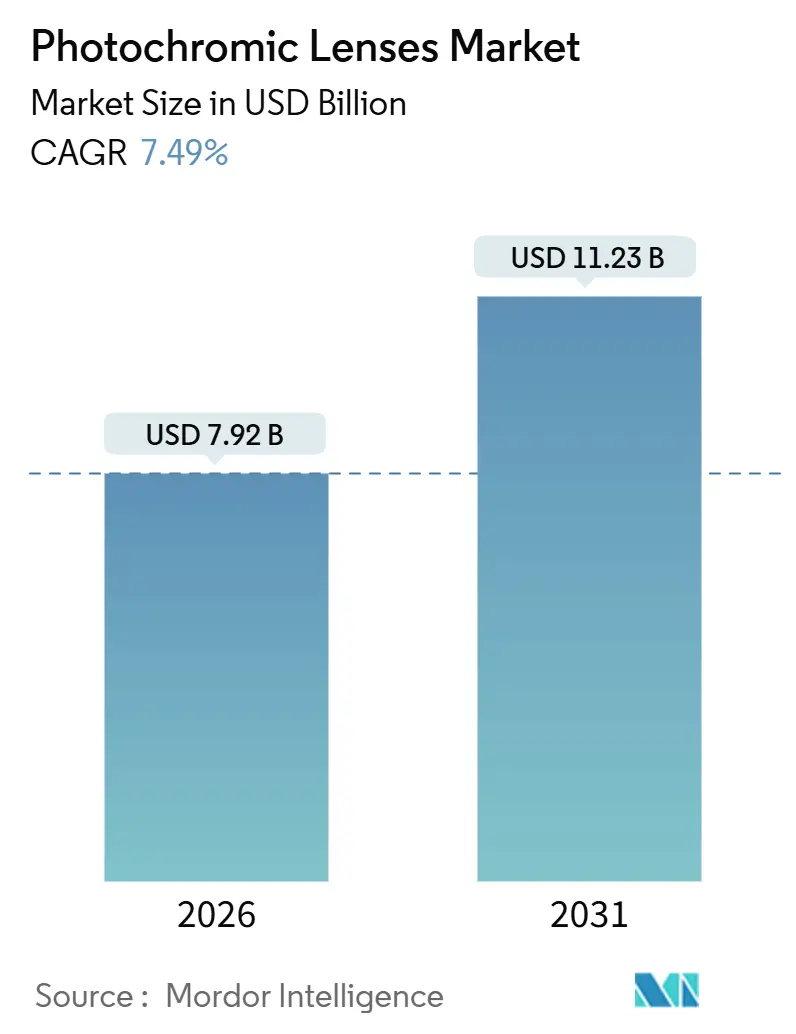
| Market Size (2026) | USD 7.92 Billion |
| Market Size (2031) | USD 11.23 Billion |
| Growth Rate (2026 - 2031) | 7.49% CAGR |
| Fastest Growing Market | Asia Pacific |
| Largest Market | North America |
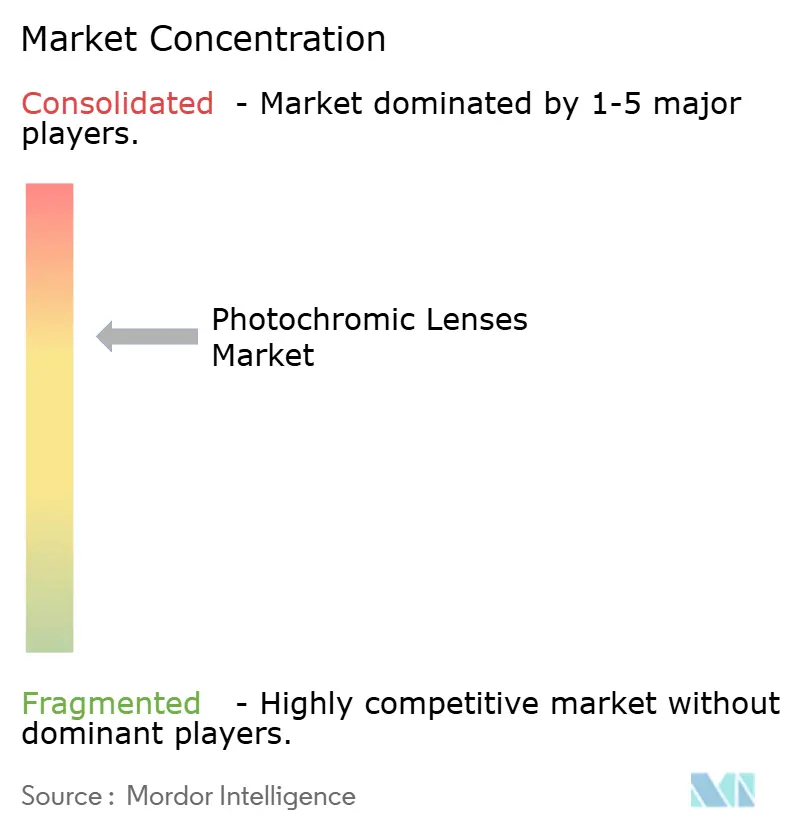
| Market Concentration | Medium |
Major Players *Disclaimer: Major Players sorted in no particular order Image © Mordor Intelligence. Reuse requires attribution under CC BY 4.0. | |
Photochromic Lenses Market Analysis by Mordor Intelligence
The photochromic lenses market size stands at USD 7.92 billion in 2026 and is projected to reach USD 11.23 billion by 2031, reflecting a 7.49% CAGR through the forecast period. This growth is propelled by an aging global population that needs presbyopia correction, rising myopia prevalence in children, and the integration of adaptive-tint technology into emerging smart-glasses platforms. Plastic substrates retain the largest slice of revenue, though polycarbonate is expanding quickly on the back of its impact resistance. UV- and visible-light–activated technologies dominate current sales, yet in-mass and electronically controlled tint systems are carving out premium niches. Strong retail and e-commerce penetration, coupled with material innovation and bio-based chemistries, is widening the addressable base for the photochromic lenses market.[1]Mitsubishi Gas Chemical, “IURESIN and Episleaf Lens Monomers,” Mitsubishi Gas Chemical, mgc.co.jp
Key Report Takeaways
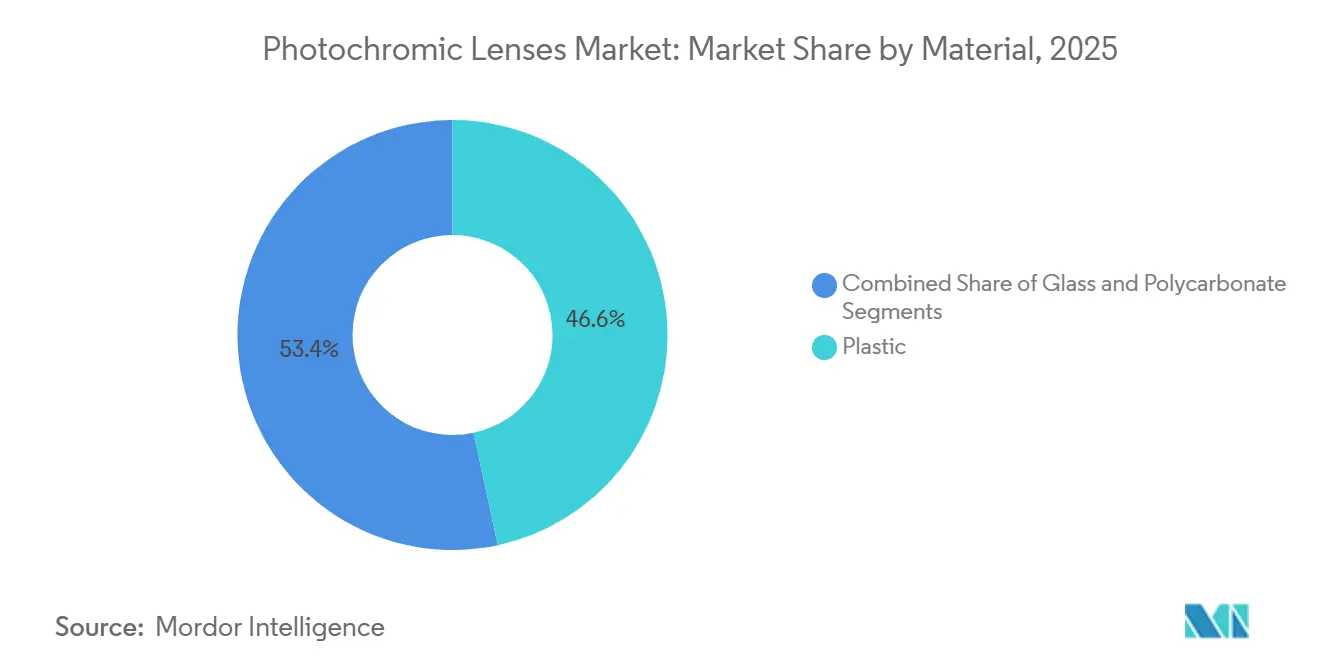
- By material, plastic lenses led with 46.62% of photochromic lenses market share in 2025. Polycarbonate substrates are projected to expand at a 10.63% CAGR through 2031, the fastest rate among materials.
- By technology, UV & visible-light-activated systems accounted for 61.57% of revenue in 2025. In-mass processes will post the highest technology-level CAGR at 8.84% through 2031.
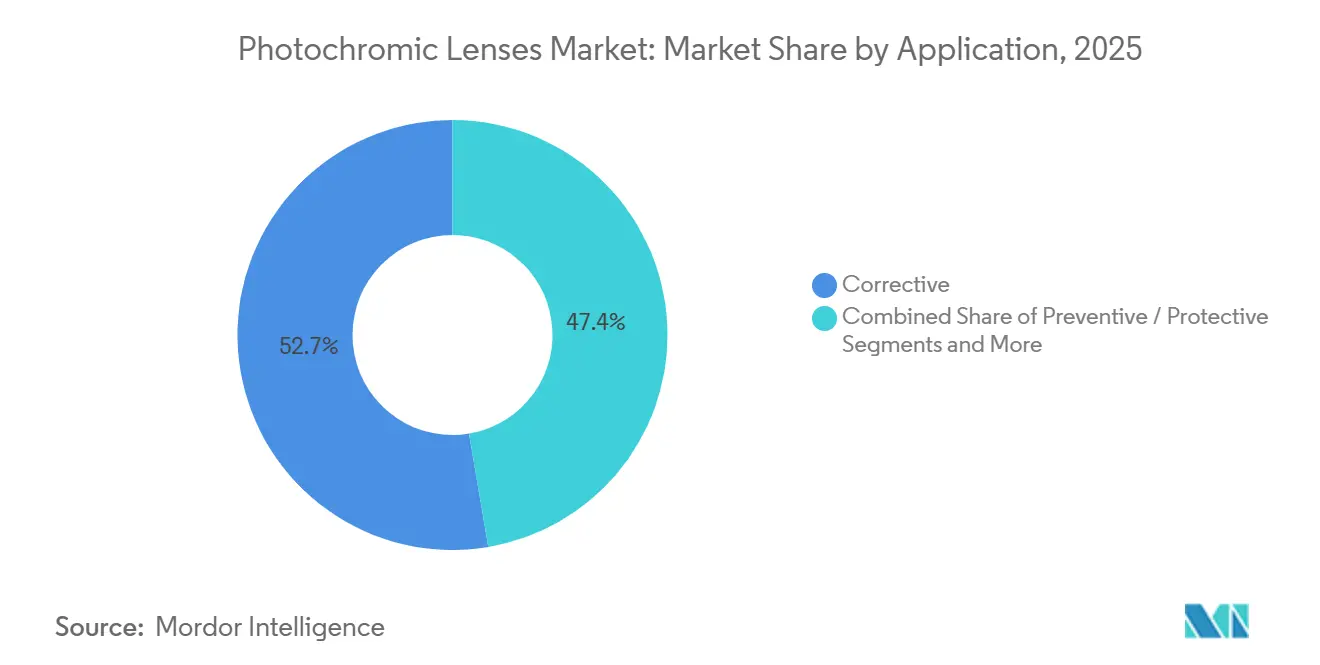
- Corrective prescription lenses held 52.65% of value in 2025; smart wearables are set to grow at 11.34% CAGR to 2031. Adults generated 47.73% of end-user demand in 2025, while children and teens represent the fastest-growing cohort at 10.02% CAGR.
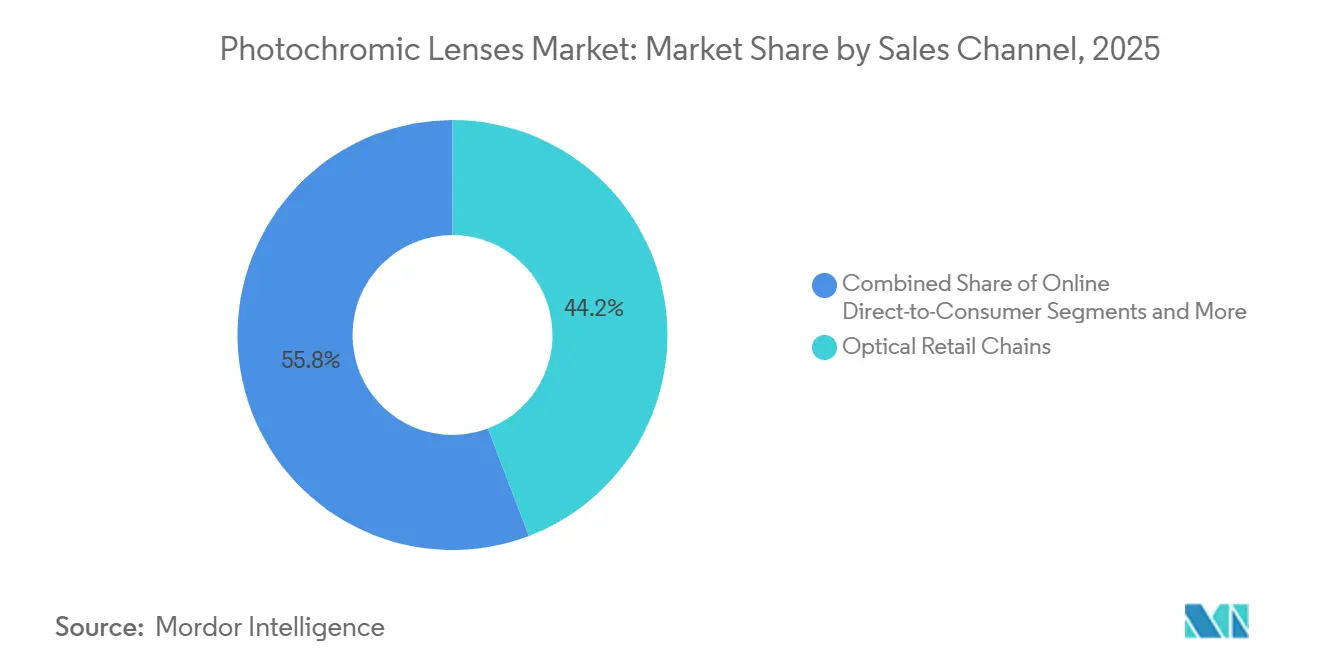
- Optical retail chains captured 44.22% of 2025 sales; online direct-to-consumer channels will advance at 11.77% CAGR through 2031.
- North America commanded 33.24% of 2025 revenue; Asia-Pacific will record the strongest regional CAGR at 10.29% through 2031.
Note: Market size and forecast figures in this report are generated using Mordor Intelligence’s proprietary estimation framework, updated with the latest available data and insights as of January 2026.
Global Photochromic Lenses Market Trends and Insights
Drivers Impact Analysis
| Driver | (~) % Impact on CAGR Forecast | Geographic Relevance | Impact Timeline |
|---|---|---|---|
| Vision disorders and an aging population | +1.2% | North America, Europe, Japan, South Korea | Long term (≥ 4 years) |
| Multipurpose eyewear demand | +0.9% | North America, Europe, Urban Asia-Pacific | Medium term (2-4 years) |
| E-commerce penetration of premium coatings | +0.7% | Global core markets | Medium term (2-4 years) |
| Faster activation and color clarity | +0.6% | North America, Europe | Short term (≤ 2 years) |
| AR smart-glasses integration | +0.5% | North America, Europe, Asia-Pacific | Medium term (2-4 years) |
| Bio-based eco-friendly dye development | +0.4% | Europe, North America | Long term (≥ 4 years) |
| Source: Mordor Intelligence | |||
Prevalence of Vision Disorders and an Aging Population
More than 2.2 billion people live with visual impairment, and presbyopia affects 1.8 billion individuals worldwide.[2]World Health Organization, “Blindness and Vision Impairment,” WHO, who.intPhotochromic lenses let older and presbyopic consumers combine vision correction and UV protection in one pair of glasses, which streamlines daily use. Rising myopia in children adds urgency, with prevalence already at 35% in 2023 and forecast to hit 40% by 2050. Aging markets in Japan and Italy, as well as rapidly urbanizing regions in China and India, therefore constitute strong demand pools. Manufacturers that align product lines with these demographic realities secure a durable growth runway.
Multipurpose Eyewear Demand (Prescription + Sun)
Consumers dislike switching between clear lenses and sunglasses during indoor-outdoor transitions. Modern photochromic products darken in under 30 seconds and clear within 2 minutes, delivering a seamless experience. Transitions Optical’s GEN S and ZEISS PhotoFusion X set the performance benchmark with 25-second activation and 80% faster fade-back compared with prior models. High convenience resonates in North America and Europe, where per-capita eyewear spend tops USD 150, yet demand is spreading into urban Asia-Pacific populations as disposable income climbs. Retailers are bundling adaptive-tint coatings into mid-tier packages, which accelerates uptake by positioning photochromic functionality as standard rather than luxury.
Retail and E-Commerce Penetration of Premium Coatings
Warby Parker posted USD 192.2 million in Q3 2024 revenue, up 13.3% year over year, with 2.42 million active customers using virtual try-on tools. Lenskart completed 13 million eye tests in fiscal 2025, embedding photochromic options in its omnichannel configurator. Such direct-to-consumer models trim distribution costs and narrow the price gap with clear lenses. Traditional outlets have responded by upgrading in-store demos and adopting price-match policies. The ability to personalize offers based on exposure and lifestyle data further heightens conversion rates.
Faster Activation and Color-Clarity Innovations
HOYA’s Sensity 2 doubles fade-back speed, and ZEISS PhotoFusion X curbs residual tint in cold climates. Chamelo’s Aura Rx achieves 0.1-second electronic tint change, although costs remain high. Performance improvements make adaptive-tint lenses attractive for driving and sports, where instant visual adaptation boosts safety. Color neutrality also appeals to fashion-driven buyers who want photochromic benefits without tint-shift trade-offs indoors.
Restraints Impact Analysis
| Restraint | (~) % Impact on CAGR Forecast | Geographic Relevance | Impact Timeline |
|---|---|---|---|
| Premium pricing over conventional lenses | -0.8% | Price-sensitive Asia-Pacific, MEA, South America | Medium term (2-4 years) |
| Counterfeit and low-quality circulation | -0.6% | Asia-Pacific, MEA, South America | Medium term (2-4 years) |
| Temperature-dependent performance limits | -0.4% | Extreme-climate geographies | Long term (≥ 4 years) |
| Regulatory scrutiny on dye chemicals | -0.3% | Europe, North America | Long term (≥ 4 years) |
| Source: Mordor Intelligence | |||
Premium Pricing Over Conventional Lenses
Photochromic products still cost 40-60% more than clear lenses in many emerging markets. Despite aggressive bundling, India’s penetration remains below 15% of lens sales. Retailers employ financing plans and tiered offerings to lessen sticker shock, yet the luxury perception persists and slows adoption in middle-income economies.
Counterfeit and Low-Quality Product Circulation
Safilo introduced holographic labels and blockchain authentication to combat counterfeit lenses that fail to meet ISO 8980-3 standards. Low-quality knock-offs degrade quickly, foster distrust, and suppress pricing power for authentic manufacturers. The threat is acute in markets with weaker intellectual-property enforcement.
Segment Analysis
By Material: Polycarbonate Gains on Impact Resistance
Plastic lenses captured 46.62% of 2025 volume, yet the segment is gradually tilting toward polycarbonate because families and athletes value durability. Polycarbonate is forecast to post a 10.63% CAGR, the highest within the materials hierarchy, while retaining optical quality that meets ISO 8980-3 baselines. Mitsubishi Gas Chemical’s IURESIN™ plant scheduled for 2026 will introduce an ultra-high-index polycarbonate (n = 1.74), enabling thinner, lighter forms that appeal to rimless-frame enthusiasts. Trivex and other mid-index plastics are also gaining ground for ballistic and pediatric use. Meanwhile, glass lenses have fallen to single-digit share due to weight and breakage concerns, remaining mainly in luxury niches.
Mitsui Chemicals’ planned MR monomer facility for 2028 underscores the importance of continued material innovation and signals the next leap in premium-tier differentiation. CR-39 will stay relevant at the budget end, but migration toward impact-resistant and high-index options will gradually trim its share. Regulatory standards guarantee base-line transmittance performance regardless of substrate, but buyers increasingly favor the lighter weight and resilience of polycarbonate.
Note: Segment shares of all individual segments available upon report purchase
By Technology: UV Activation Dominates, In-Mass on the Rise
UV- and visible-light-activated coatings held 61.57% of 2025 revenue, thanks to compatibility with existing production lines and broad substrate applicability. Trans-bonding remains common, yet in-mass embedding—where dyes are mixed directly into monomers—grows rapidly for premium lines because of superior scratch resistance and color stability. Luxexcel’s additive manufacturing uses in-mass dyes to produce complex prescription lenses for AR waveguides, sidestepping traditional coating steps.
Electronic systems such as Chamelo’s liquid-crystal lenses record 0.1-second transitions but remain pricey and require power sources. Over the forecast horizon, UV-activated technology will keep the lion’s share due to cost efficiency, though in-mass and electronic variations will capture incremental high-margin demand.
By Application: Smart Wearables Surge Ahead
Corrective prescriptions represented 52.65% of 2025 shipments, anchoring the core demand. Yet smart wearables, including AR-ready frames, will climb at 11.34% CAGR as tech brands like Meta and Apple commercialize lighter, more affordable headsets. Preventive non-prescription sunglasses grow slower because an increasing share of buyers opts for dual-purpose corrective lenses.
Young tech-savvy users drive smart-wearable adoption, while presbyopic adults dominate corrective sales. The overlap between photochromic functionality and outdoor AR display readability presents a compelling value proposition that is expected to push smart-wearable penetration into double digits by 2031.
Note: Segment shares of all individual segments available upon report purchase
By End User: Children and Teens Accelerate
Adults contributed 47.73% of 2025 demand, but the children and teens group, bolstered by escalating myopia rates, will register a 10.02% CAGR. Pediatric product designs incorporate impact-resistant substrates and tougher coatings, and retailers often offer favorable pricing or financing to parents eager for dual-function lenses. Elderly users still rely heavily on clear lenses, yet awareness campaigns on UV-related eye damage are nudging them toward premium adaptive-tint alternatives.
By Sales Channel: Online Platforms Outpace Retail
Optical retail chains made up 44.22% of 2025 sales, but direct-to-consumer websites will grow at 11.77% CAGR through 2031. Warby Parker’s and Lenskart’s embrace of home eye tests and virtual try-ons slashes friction and showcases tint simulations in real time. Brick-and-mortar outlets respond with omnichannel strategies, while OEM bundling of prescription photochromic lenses into smart-glasses adds an additional distribution path.
Note: Segment shares of all individual segments available upon report purchase
Geography Analysis
North America accounted for 33.24% of 2025 revenue, backed by USD 150-plus annual per-capita eyewear spending and strong optometrist networks. The FDA’s device labeling standards reinforce consumer confidence, and direct-to-consumer leaders such as Warby Parker add momentum.[3]U.S. Food and Drug Administration, “21 CFR Part 801,” FDA, fda.govAlthough growth moderates because penetration is high, ongoing smart-wearable launches sustain a healthy pipeline.
Asia-Pacific will log the fastest 10.29% CAGR. India’s eyewear market is on track to expand from USD 9.2 billion in fiscal 2025 to USD 17.2 billion by fiscal 2030, while China’s expanding middle class buys photochromic lenses for smog and UV protection. Japan and South Korea, already premium markets, lead adoption of advanced dye blends, and Southeast Asia is catching up as e-commerce solves distribution gaps.
Europe remains a hub for high-end developments. Germany, France, and the United Kingdom maintain stringent REACH and ISO compliance, which raise entry barriers but guarantee quality. ZEISS and Rodenstock dominate innovation pipelines with fast-acting, temperature-stable products. Middle East & Africa and South America lag in penetration due to pricing sensitivities, yet rising disposable incomes and extreme UV exposure in regions such as the GCC open white-space opportunities.

Competitive Landscape
Top Companies in Photochromic Lenses Market
EssilorLuxottica, Hoya, and Transitions Optical anchor the competitive map with vertically integrated supply chains and proprietary dye platforms. EssilorLuxottica’s alliance with Meta positions the group at the forefront of smart-glasses convergence. Hoya and ZEISS compete on activation speeds and temperature stability, offering differentiated premium value.
Mid-tier firms—Rodenstock, Seiko, Shamir, and Tokai—capitalize on regional strengths and niche products, such as high-index plastics and myopia-control optics. Luxexcel is a wild-card disruptor, 3D-printing lenses for AR devices and eliminating coating steps. Emerging challengers like Chamelo pursue electronically controlled tints for fashion and wearable tech, even though pricing remains a hurdle. Compliance with evolving regulations is a significant differentiator: firms with robust quality systems avoid costly recalls and can serve tightly regulated markets first.
Photochromic Lenses Industry Leaders
Corning Incorporated
Carl Zeiss AG
Hoya Corporation
EssilorLuxottica SA
Rodenstock GmbH
- *Disclaimer: Major Players sorted in no particular order
Recent Industry Developments
- November 2025: HOYA Vision Care Canada unveiled HOYA Daynamic Pro, a premium backside progressive lens that offers enhanced clarity and comfort.
- April 2025: Innovative Eyewear launched Lucyd Armor smart safety glasses, the first to pair photochromic lenses with walkie-talkie functionality and Rx-adaptable optics
- April 2025: Melon Optics introduced the Vantage Photochromic Lens Collection.
- January 2025: ZEISS expanded its prescription sun lens palette with four new colors for full UV protection.
Global Photochromic Lenses Market Report Scope
As per the scope of the report, photochromic lenses are closed, transparent (or almost clear) eyeglass lenses that naturally darken when exposed to sunlight. Depending on the type of lens and product, photochromic lenses darken through different processes. Some alternate terms used are variable tint lenses and light-adaptive lenses.
The photochromic lens market is segmented by material, technology, application, end user, sales channel, and geography. The market is segmented by material into Glass, Polycarbonate, and Plastic. By technology, the market is bifurcated into UV & Visible-Light Activated, Imbibing, and In-Mass. By Application, the market is segmented into Corrective, Preventive, and Smart Wearables. By End User, the market is segmented into Adults, children and teens, and the Elderly. By Sales Channel, the market is segmented into Clinics, Retail Chains, Online, and OEM. By geography, the market is divided into North America, Europe, Asia-Pacific, the Middle East and Africa, and South America. The report provides market sizes and forecasts in USD for the above segments.
| Glass | |
| Polycarbonate | |
| Plastic | CR-39 (Standard Resin) |
| Trivex | |
| High-Index Plastics |
| UV & Visible-Light Activated |
| Imbibing & Trans-bonding |
| In-Mass (Bulk) |
| Other Emerging Technologies |
| Corrective (Prescription) |
| Preventive / Protective (Non-Rx, Sunglass Replacement) |
| Smart Wearables & Connected Eyewear |
| Adults |
| Children & Teens |
| Elderly (65+) |
| Specialty Clinics & Optometrists |
| Optical Retail Chains |
| Online Direct-to-Consumer |
| OEM Partnerships (Smart-glasses Makers) |
| North America | United States |
| Canada | |
| Mexico | |
| Europe | Germany |
| France | |
| United Kingdom | |
| Italy | |
| Spain | |
| Rest of Europe | |
| Asia-Pacific | China |
| Japan | |
| India | |
| South Korea | |
| Australia | |
| Rest of Asia-Pacific | |
| Middle East & Africa | GCC |
| South Africa | |
| Rest of Middle East & Africa | |
| South America | Brazil |
| Argentina | |
| Rest of South America |
| By Material | Glass | |
| Polycarbonate | ||
| Plastic | CR-39 (Standard Resin) | |
| Trivex | ||
| High-Index Plastics | ||
| By Technology | UV & Visible-Light Activated | |
| Imbibing & Trans-bonding | ||
| In-Mass (Bulk) | ||
| Other Emerging Technologies | ||
| By Application | Corrective (Prescription) | |
| Preventive / Protective (Non-Rx, Sunglass Replacement) | ||
| Smart Wearables & Connected Eyewear | ||
| By End User | Adults | |
| Children & Teens | ||
| Elderly (65+) | ||
| By Sales Channel | Specialty Clinics & Optometrists | |
| Optical Retail Chains | ||
| Online Direct-to-Consumer | ||
| OEM Partnerships (Smart-glasses Makers) | ||
| By Geography | North America | United States |
| Canada | ||
| Mexico | ||
| Europe | Germany | |
| France | ||
| United Kingdom | ||
| Italy | ||
| Spain | ||
| Rest of Europe | ||
| Asia-Pacific | China | |
| Japan | ||
| India | ||
| South Korea | ||
| Australia | ||
| Rest of Asia-Pacific | ||
| Middle East & Africa | GCC | |
| South Africa | ||
| Rest of Middle East & Africa | ||
| South America | Brazil | |
| Argentina | ||
| Rest of South America | ||
Key Questions Answered in the Report
How large will the photochromic lenses market be in 2031?
It is projected to reach USD 11.23 billion by 2031, growing at a 7.49% CAGR from 2026.
Which region shows the fastest growth for photochromic lenses?
Asia-Pacific is forecast to expand at a 10.29% CAGR, driven by rising middle-class demand in China and India.
Why are polycarbonate photochromic lenses gaining popularity?
Their high impact resistance suits children’s and sports eyewear, leading to a 10.63% CAGR through 2031.
What is the main technology used in photochromic lenses today?
UV- and visible-light-activated coatings dominate, holding about 61.57% of 2025 revenue.
Which sales channel is expanding most rapidly?
Online direct-to-consumer platforms are expected to grow at 11.77% CAGR because virtual try-on and home eye tests cut purchase friction.
How are smart glasses influencing demand?
Integration of photochromic optics into devices such as Meta Ray-Ban frames is driving an 11.34% CAGR in the smart-wearables segment.