
Pharmaceutical Customer Relationship Management Software Market Size and Share
Market Overview
| Study Period | 2020 - 2031 |
|---|---|
| Forecast Data Period | 2026 - 2031 |
| Historical Data Period | 2020 - 2024 |
| Growth Rate | 10.32 % |
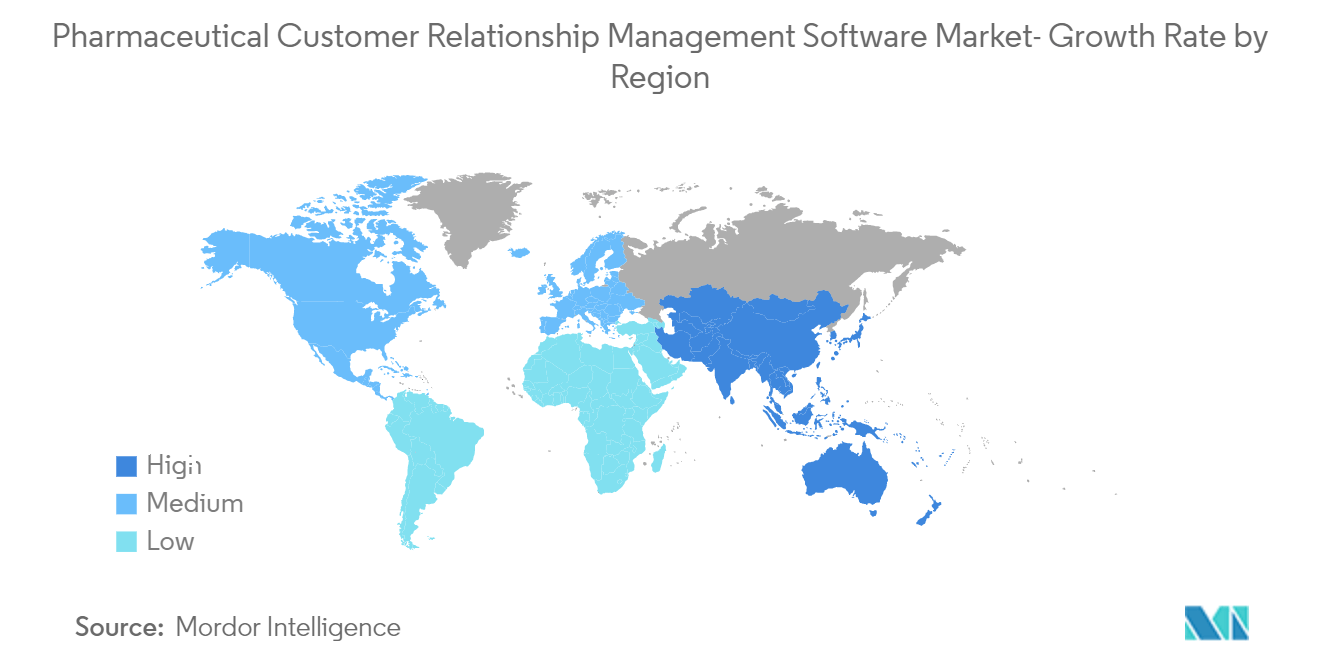
| Fastest Growing Market | Asia-Pacific |
| Largest Market | North America |
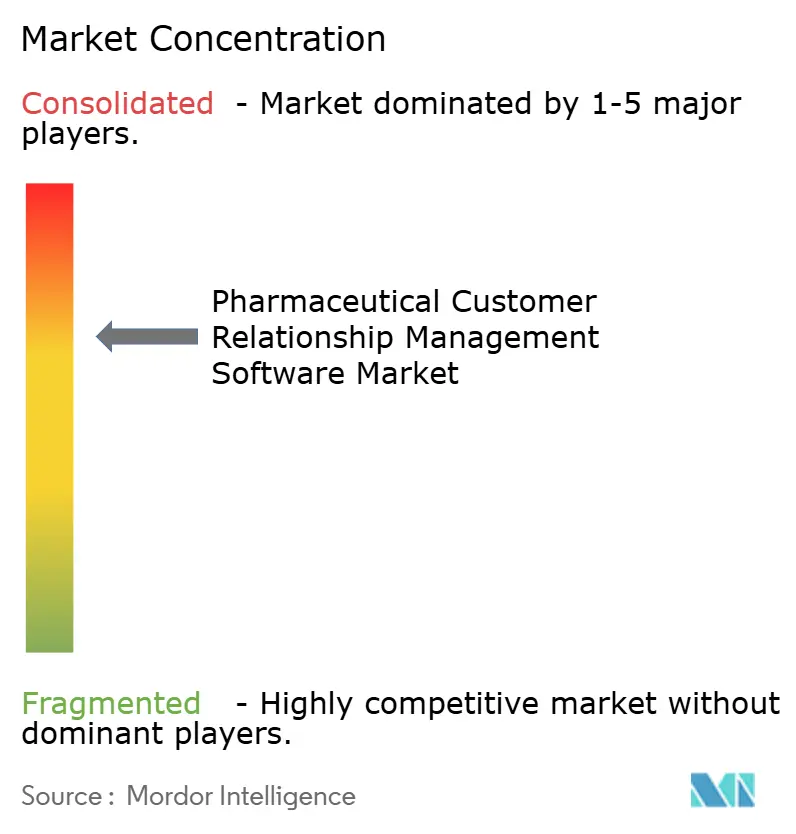
| Market Concentration | Medium |
Major Players *Disclaimer: Major Players sorted in no particular order Image © Mordor Intelligence. Reuse requires attribution under CC BY 4.0. | |
Pharmaceutical Customer Relationship Management Software Market Analysis by Mordor Intelligence
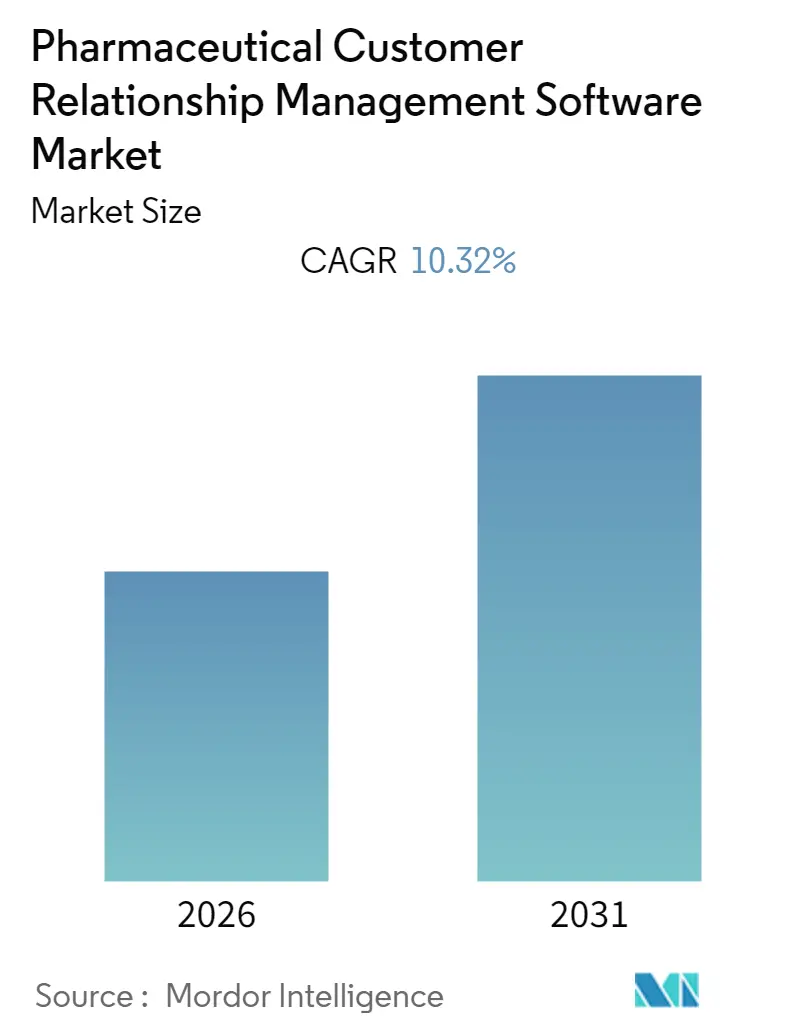
The Global Pharmaceutical Customer Relationship Management Software Market size is expected to register a CAGR of 10.32% during the forecast period.
The emergence of the COVID-19 pandemic harmed the world economy and the healthcare system. There is a need to streamline the healthcare process during the COVID-19 times. A CRM software streamlines rapid point-of-care and Polymerase Chain Reaction (PCR) testing for laboratories, private employers, government agencies, and COVID-19 testing centers and offers a system that expedites vaccine administration, distribution, and reporting indicating the benefits of CRM software during the COVID-19 times. For instance, in September 2021, Salesforce launched Health Cloud 2.0, a technology designed to empower businesses and governments to deliver better health and safety for their employees, customers, and communities. It enables robust and scalable COVID-19 safety protocols for in-person attendees, including managing proof of vaccination, integrating with testing vendors, and delivering automated personalized communications throughout the process to help ensure a safer environment for attendees, staff, and the community. Thus, COVID-19 has surged the demand for CRM software, thus significantly impacting the market growth.
The factors propelling the studied market growth are the rising patient pool associated with the growing burden of chronic and acute diseases, the rise in client engagement activities, and the growing pharmaceutical industry. Additionally, CRM software launches and strategic initiatives by key market players are expected to contribute to significant market growth.
The growing burden of chronic diseases such as cancer, HIV, and cardiac diseases is increasing the demand for CRM software, which helps prepare healthcare organizations to take action for a given service or procedure. For instance, According to a study published by the British Heart Foundation in July 2020, there were approximately 7.5 million people with heart disease in the United Kingdom and nearly 170,000 deaths each year, an average of 460 fatalities each day or one death every three minutes happen in the United Kingdom due to cardiovascular disorders (CVDs). Due to the high burden of chronic diseases, pharmaceutical companies need to bring targeted medicine based on the data pool generated by CRM software. Therefore, the benefits of CRM software for the pharmaceutical industry are expected to boost the studied market globally.
According to the article 'Validity Launches 2022 State of CRM Data Health Report, Finds Data Confidence Does Not Match Reality,' published in February 2022, a survey was conducted for more than 1,200 CRM users and stakeholders across the United States, United Kingdom, and Australia. They reported that 57% expect their company to increase data management budgets in 2022, while 56% of those who do not currently have a full-time employee(s) dedicated to CRM data quality have active plans to make hires in the next 6 months. This trend indicates that there will be an increasing demand for CRM software as organizations are finding the benefits of the data pool generated by CRM software, thus, expecting the market to be highly driven during the study period.
Additionally, strategic initiatives by key market players enhancing CRM software implementation for the pharmaceutical industry will also boost the studied market growth. For instance, in February 2022, Customer times has recently undertaken projects with three global consumer health organizations in Western Europe to increase their existing OTC and prescription drug business segments and facilitate expansion into new, rapidly growing markets. For the streamlined workflow for these projects, Customertimes will be implementing CRM solutions for multichannel pharmacy and HCP engagement, thus increasing the demand for CRM software and driving the market.
Therefore, owing to the aforementioned factors, the studied market is expected to grow significantly during the study period. However, limited awareness about CRM software among healthcare professionals and the high price associated with this software is expected to hinder the market growth during the forecast period.
Note: Market size and forecast figures in this report are generated using Mordor Intelligence’s proprietary estimation framework, updated with the latest available data and insights as of 2026.
Global Pharmaceutical Customer Relationship Management Software Market Trends and Insights
Cloud Segment is Expected to Account for the Largest Market Share During the Forecast Period
Cloud-based solutions are comparatively newer approaches and are mostly used by organizations that lack the internal infrastructure to support them. The installation cost of this software is lower than the on-premise systems. Moreover, this software eradicates the need for in-house maintenance, which is likely to be the primary factor driving their increasing demand.
Cloud-based systems are ideal for complex, multisite clinical studies because all information (study protocols, patient data, outcomes, etc.) are stored in a central location and maintained by a third-party service provider. The cloud-based delivery model makes the software extremely flexible regarding scalability (pay-as-you-go storage utilization). It simplifies and consolidates storage resources to reduce costs and enhance workflow by eliminating departmental silos of clinical information.
The launch of new CRM software for the pharmaceutical industries is expected to drive the studied market growth during the forecast period. For instance, in April 2022, Cured launched the next evolution of its digital marketing and customer relationship management (CRM) platform built for healthcare, further enabling the company to deliver on its mission to bring care full circle. This software includes a robust suite of in-application dashboarding and analytics capabilities, providing easy access to metrics and performance across curations. Thus, the launch of new software with added advantages of implementing them will increase their demand, thus, bolstering the market.
Additionally, in February 2022, Salesforce, a vendor for CRM software, expanded the Safety Cloud to help people get together safely. Safety Cloud helps businesses and communities better manage testing, health, and entry protocols to create safer in-person experiences at events and in the workplace. Safety Cloud supports integrations with at-home, pharmacy, and on-site testing options, including CVS Health, eMed, Cue Health, Ixlayer, and Senneca DX. These supported testing options can be connected directly to Safety Cloud, making the testing experience easier. Thus, such expansion of existing offerings expands the product capabilities and geographical footprints, which drives the studied market growth.
Thus, due to the abovementioned factors, the studied segment is expected to contribute to the significant growth of the market.
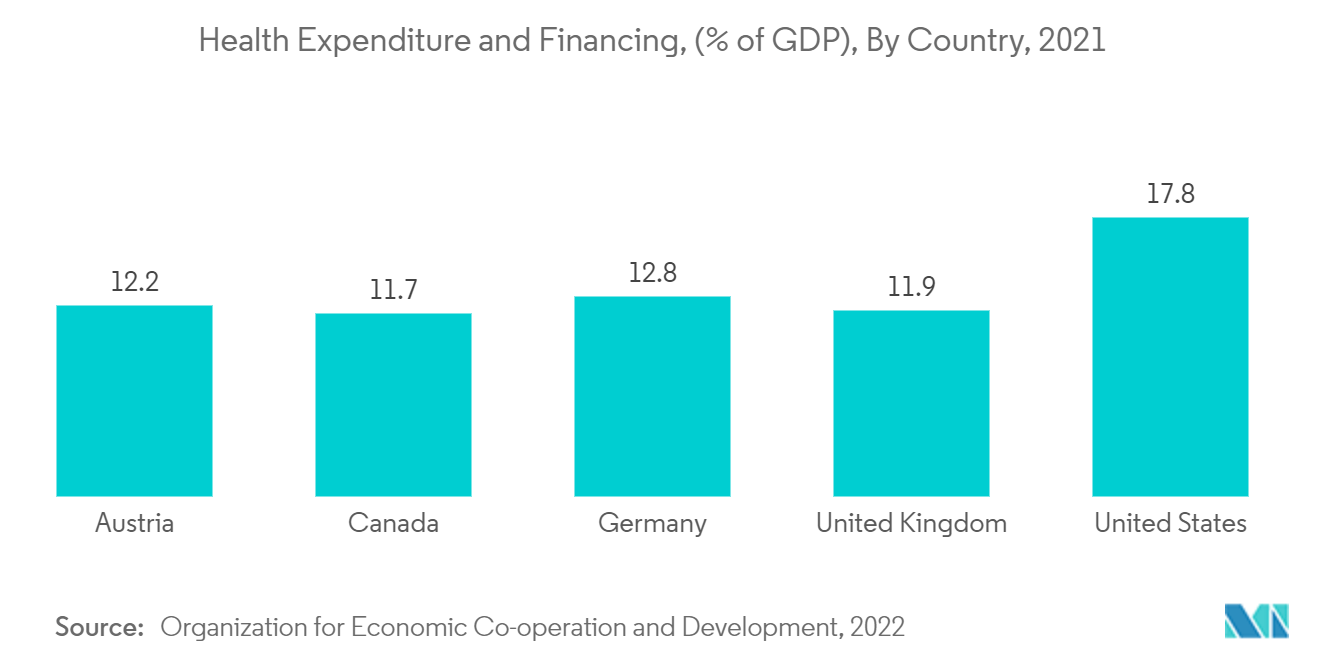


North America is Expected to Hold a Significant Share in the Market and Expected to do Same in the Forecast Period
The primary driving factors for the North American pharmaceutical customer relationship management software market growth are the increasing patient pool, rising demand for client engagement, and the growing pharmaceutical industry. In addition, rising CRM software launches, a rise in the burden of chronic diseases, and other strategic initiatives such as mergers and acquisitions and partnerships are also expected to drive the market growth.
The United States within North America is expected to hold a significant share of the studied market during the study period. For instance, according to the Centers for Disease Control and Prevention (CDC)'s Article titled 'Heart Disease Facts,' updated in September 2020, Heart disease is one of the leading causes of death in the United States. The same source also reports that about 805,000 Americans have a heart attack every year. Due to the high burden of cardiac disease, there is an increasing demand for client engagement activities to identify the symptoms of fatal conditions and guide the patients accordingly. Therefore, the demand for customer relationship management software in the pharmaceutical industry is expected to boost the market's growth.
Additionally, rising research and development expenditure in the pharmaceutical industry within the United States will also empower the deployment of CRM software in healthcare organizations, thus driving the market. For instance, Additionally, as per the US Research and Development Funding and Performance: Fact Sheet, 2020, the R&D expenditures in the United States in 2018 were estimated at USD 580 billion, of which USD 96.5 billion was invested in basic research, USD 115.0 billion on applied research, and USD 368.5 billion was employed in the development sector. The R&D expenditure is expected to increase during the study period leading to more targeted therapy approvals, which will require a high amount of patient data generated by CRM software, thus increasing the demand for CRM software and driving the market.
Additionally, strategic initiatives such as partnerships, mergers, and acquisitions by market players enhancing the use of CRM in the pharmaceutical industry will also drive the studied market growth. For instance, in March 2022, SDG group and Snowflake partnered to launch the Healthcare and Life Sciences Data Cloud to bring better patient care and business results. As part of the Healthcare and Life Sciences portfolio, the companies include SDG Eagle Pharma solution, which combines performance, activity, and market share data from sources such as Veeva CRM and IQVIA to better understand products and healthcare professionals' performance. This factor indicates that CRM software is expanding its use in the country, propelling the market's growth during the forecast period.
Therefore, due to the abovementioned factors, the studied market is expected to lead to lucrative growth of the market in North America.

Competitive Landscape
The studied market is fragmented and moderately competitive. The key market players readily adopt strategies such as partnerships, mergers, and acquisitions, boosting the studied market growth. The key players in the market are Kapture, Medsimo technologies, Actis Sales Technologies, Synergistix Inc., SoftDent, and Others.
Pharmaceutical Customer Relationship Management Software Industry Leaders
Kapture
Medsimo Technologies
Actis Sales Technologies
Synergistix Inc.
SoftDent
- *Disclaimer: Major Players sorted in no particular order

Market Opportunities and Future Outlook
Commercial teams are consolidating field, inside sales, and omnichannel engagement workflows onto fewer, pharma-specific CRM platforms. This creates a clear opportunity for vendors that can replace fragmented point solutions with a unified operating layer across brand teams and geographies. Recent enterprise decisions in 2026 point to that consolidation, including Teva’s global commitment to Veeva Vault CRM and Viatris’s selection of Salesforce Agentforce Life Sciences as a global customer engagement platform spanning more than 165 countries, which also surfaces the need for standardized data models and cross-country governance.
Execution in CRM is shifting from add-on analytics toward embedded, agentic workflows, such as preparing for HCP interactions and automating content and note drafting. That change raises buyer requirements for auditability, permissions, and controlled content in regulated environments. Platform migration also stands out as a near-term whitespace, as companies plan around the December 31, 2029 end-of-support date for legacy Veeva CRM on Salesforce, while Veeva reported more than 125 customers live on Vault CRM in March 2026. Against these buying cycles, validated compliance capabilities, including alignment with 21 CFR Part 11 requirements, and integration into broader healthcare and life sciences data stacks, including cloud data platforms used for commercial analytics, remain the main differentiators vendors can build on.
Recent Industry Developments
- June 2026: Close-Up International reported that AGEPHA Pharma deployed its AI-powered CRM platform across the company’s US sales force to support real-time HCP insights and omnichannel engagement. The deployment signals a shift from basic sales-force automation to AI-assisted execution within pharma CRM workflows, lifting expectations for embedded analytics and field productivity capabilities.
- May 2026: Teva Pharmaceuticals committed to global adoption of Veeva Vault CRM, expanding the footprint of Vault CRM among large multinational pharmaceutical companies. The decision reinforces the migration cycle toward next-generation, life-sciences-specific CRM platforms and increases competitive pressure around regulated CRM feature depth and global rollout readiness.
- January 2026: PharmaForceIQ acquired Aktana to combine CRM-adjacent orchestration with commercial engagement execution in a single offering. The transaction highlights consolidation around optichannel and decisioning capabilities that sit on top of CRM systems, increasing the importance of interoperable architectures and partner ecosystems.


Research Methodology Framework and Report Scope
Market Definition and Coverage
This market covers software used by pharmaceutical companies to plan, run, and track relationships and interactions with healthcare customers and stakeholders, mainly across sales, marketing, and medical engagement workflows. Revenue is counted from software licensing or subscriptions tied to pharma CRM deployments.
Scope exclusions: We exclude generic enterprise CRM revenue that is not configured and sold for pharmaceutical use, and we also exclude broader consulting-only projects that are not sold as CRM software.
Segmentation Overview
- By Product Type
- On-Premise
- Cloud
- By Size
- Large Enterprises
- Medium and Small Enterprises
- Geography
- North America
- United States
- Canada
- Mexico
- Europe
- Germany
- United Kingdom
- France
- Italy
- Spain
- Rest of Europe
- Asia-Pacific
- China
- Japan
- India
- Australia
- South Korea
- Rest of Asia-Pacific
- Middle-East and Africa
- GCC
- South Africa
- Rest of Middle-East and Africa
- South America
- Brazil
- Argentina
- Rest of South America
- North America
Data Sources, Market Sizing, and Validation
Desk Research
Desk research was used to set market boundaries and to build an initial set of assumptions that could later be tested through interviews. We relied on public sources such as the US FDA for compliance context, the US Centers for Medicare and Medicaid Services for healthcare spending signals, OECD health statistics for cross-country comparability, World Bank macro indicators for country normalization, and ITU indicators for connectivity trends that support cloud adoption.
To translate those signals into a usable market model, we also reviewed company annual reports and earnings call transcripts, product documentation, and credible industry press focused on pharma commercial operations and digital engagement. Where available, we used paid subscriptions for company financials and intelligence, plus patent databases to understand where CRM features are moving, for example privacy, consent, and field force workflow automation. The desk source list is illustrative, and other public and paid references were used to collect data, validate assumptions, and clarify gaps.
Primary Interviews and Surveys
Primary work focused on validating what portion of CRM spending is truly pharma-specific, and how pricing and deployment patterns differ by company size and geography. We interviewed and surveyed a mix of software providers, system implementers, and pharma commercial and medical operations users, and we covered demand signals across APAC, EMEA, and the Americas so regional adoption differences could be normalized. When a desk assumption looked weak, for example the pace of cloud migration or typical contract duration, we rechecked it with follow-up outreach and adjusted model inputs.
Distribution of primary research fieldwork respondents
| Company type | Respondent position | Region |
|---|---|---|
| Top tier: 27% | CXOs: 20% | APAC: 38% |
| Mid tier: 53% | Functional/Unit leaders: 25% | EMEA: 35% |
| Smaller Players: 20% | Managers: 55% | Americas: 27% |
Market-Sizing & Forecasting
The core sizing was built using a top-down approach where pharma commercial IT spend and software mix were reconstructed by region, and then filtered down into the share that is typically allocated to CRM platforms used by field and digital teams. After that, selective bottom-up checks were added using sampled vendor revenue cues, channel checks with implementers, and a simple ASP times active-user approximation for a limited set of use cases, which helped us adjust totals where spend intensity looked off.
Key inputs in the model included the split between cloud and on-premise deployments, average subscription pricing bands by enterprise size, estimated number of commercial and medical users tied to CRM seats, renewal rates and contract length patterns, and the pace of digital engagement with healthcare professionals that shifts CRM usage away from purely face-to-face activity. For forecasting, we used scenario analysis with an exponential smoothing backbone on historical adoption indicators, and then the growth path was cross-checked against expert views on compliance-driven workflow needs, data privacy constraints, and integration work that can slow rollouts. Where bottom-up evidence was incomplete for smaller countries, we filled gaps using regional ratio methods based on pharma market footprint and enterprise density, followed by a final reasonableness review.
Data Validation & Update Cycle
Validation was done in layers so the final number is not dependent on one data stream. We compared model outputs against independent signals such as regional pharma commercial spending direction, cloud penetration patterns, and the implied revenue per user to catch values that drifted outside realistic ranges. When large variances appeared, assumptions were reworked and, if needed, a second round of expert checks was triggered before internal sign-off.
Each report is refreshed annually, and interim updates are made when material events change the outlook, such as major regulatory shifts, pricing changes, or notable platform transitions from on-premise to cloud. Before delivery, the analyst runs a fresh pass to confirm the latest data points are reflected and that the forecast still matches the most current market signals.
Mordor Intelligence's Pharmaceutical Customer Relationship Management Software Market Size Measured Against Other Published Estimates
Published market sizes for pharmaceutical CRM software often do not match because each publisher draws the line differently on what counts as pharma-specific CRM, and they also vary in how they treat services, company size mix, and regional weighting. Differences also show up when one estimate leans on vendor lists and another leans on spending pools, which can change the implied price and user assumptions.
Some figures group pharma and biotech together and may also fold adjacent commercial technology modules into the same bucket, which can push the total up. Mordor Intelligence counts only pharmaceutical CRM software revenue that is sold and deployed for pharma commercial and medical engagement workflows, and it excludes broader enterprise CRM that is not positioned for pharma use cases and excludes non-software consulting-only spend.
Benchmark comparison
| Source | Market Size | Gaps in Research Methodology |
|---|---|---|
| Mordor Intelligence | USD 0.00 B (2024) | |
| Industry Publisher A | USD 4.33 B (2024) | Uses a combined pharma and biotech scope and reports a broader software stack that can include adjacent commercial technology layers, which expands the counted revenue pool beyond pharma-only CRM. |
| Industry Publisher B | USD 2.07 B (2024) | Relies heavily on a defined vendor list and feature buckets, and the vendor mix can skew toward smaller CRM products, which tends to undercount enterprise pharma deployments and global rollouts. |
The spread in the table is mainly explained by scope and counting rules, not simple arithmetic differences. By keeping the spend pool tied to pharma-specific CRM use and then checking it against pricing, user counts, and deployment mix, the estimate stays traceable to clear variables that can be rechecked as the market shifts.


Key Questions Answered in the Report
What is the current Global Pharmaceutical Customer Relationship Management Software Market size?
The Global Pharmaceutical Customer Relationship Management Software Market is projected to register a CAGR of 10.32% during the forecast period (2026-2031)
Who are the key players in Global Pharmaceutical Customer Relationship Management Software Market?
Kapture, Medsimo Technologies, Actis Sales Technologies, Synergistix Inc. and SoftDent are the major companies operating in the Global Pharmaceutical Customer Relationship Management Software Market.
Which is the fastest growing region in Global Pharmaceutical Customer Relationship Management Software Market?
Asia-Pacific is estimated to grow at the highest CAGR over the forecast period (2026-2031).
Which region has the biggest share in Global Pharmaceutical Customer Relationship Management Software Market?
In 2025, the North America accounts for the largest market share in Global Pharmaceutical Customer Relationship Management Software Market.
What years does this Global Pharmaceutical Customer Relationship Management Software Market cover?
The report covers the Global Pharmaceutical Customer Relationship Management Software Market historical market size for years: 2019, 2020, 2021, 2022, 2023 and 2024. The report also forecasts the Global Pharmaceutical Customer Relationship Management Software Market size for years: 2026, 2027, 2028, 2029, 2030 and 2031.
Page last updated on:


 Your data is secure and never sold or shared.


