
Market Overview
| Study Period | 2020 - 2031 |
|---|---|
| Market Size (2026) | USD 12.38 Billion |
| Market Size (2031) | USD 16.63 Billion |
| Growth Rate (2026 - 2031) | 6.11 % |
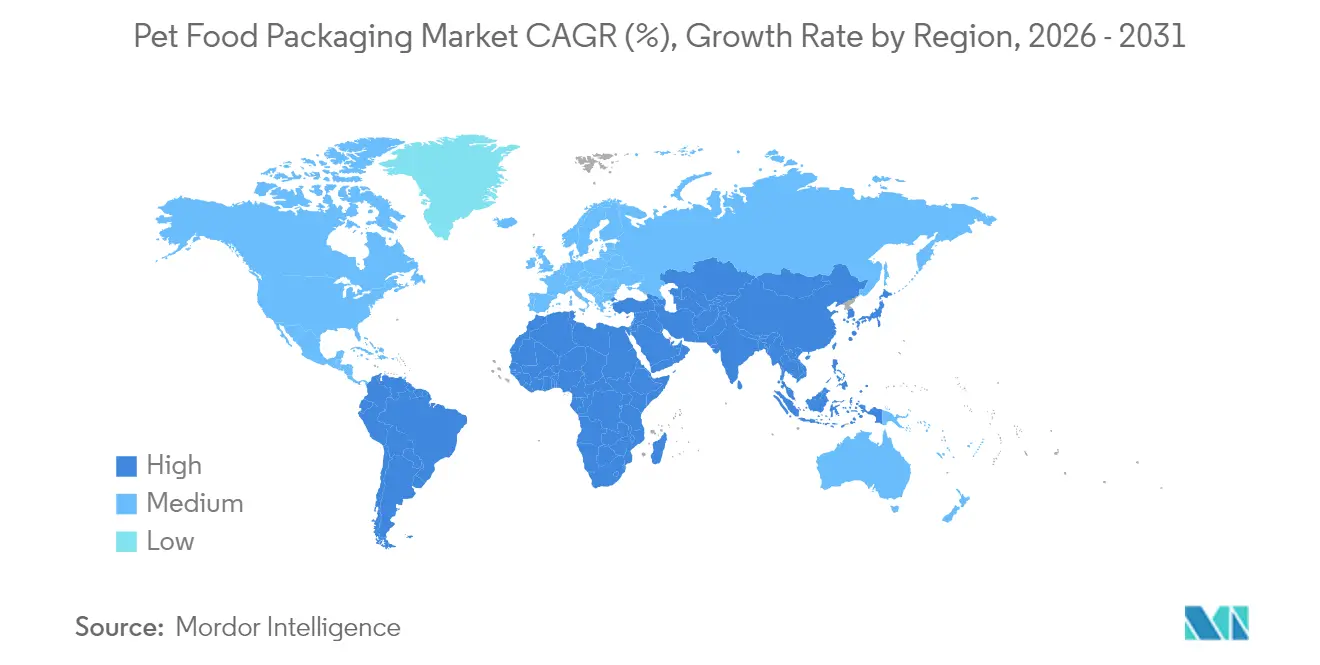
| Fastest Growing Market | Asia Pacific |
| Largest Market | North America |
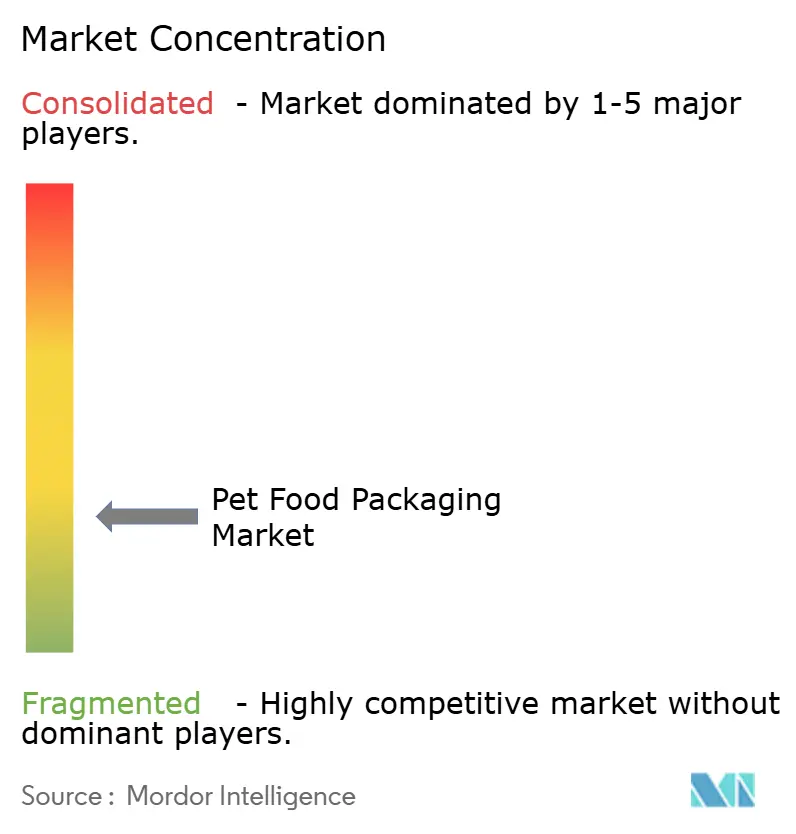
| Market Concentration | Low |
Major Players *Disclaimer: Major Players sorted in no particular order Image © Mordor Intelligence. Reuse requires attribution under CC BY 4.0. | |
Pet Food Packaging Market Analysis by Mordor Intelligence
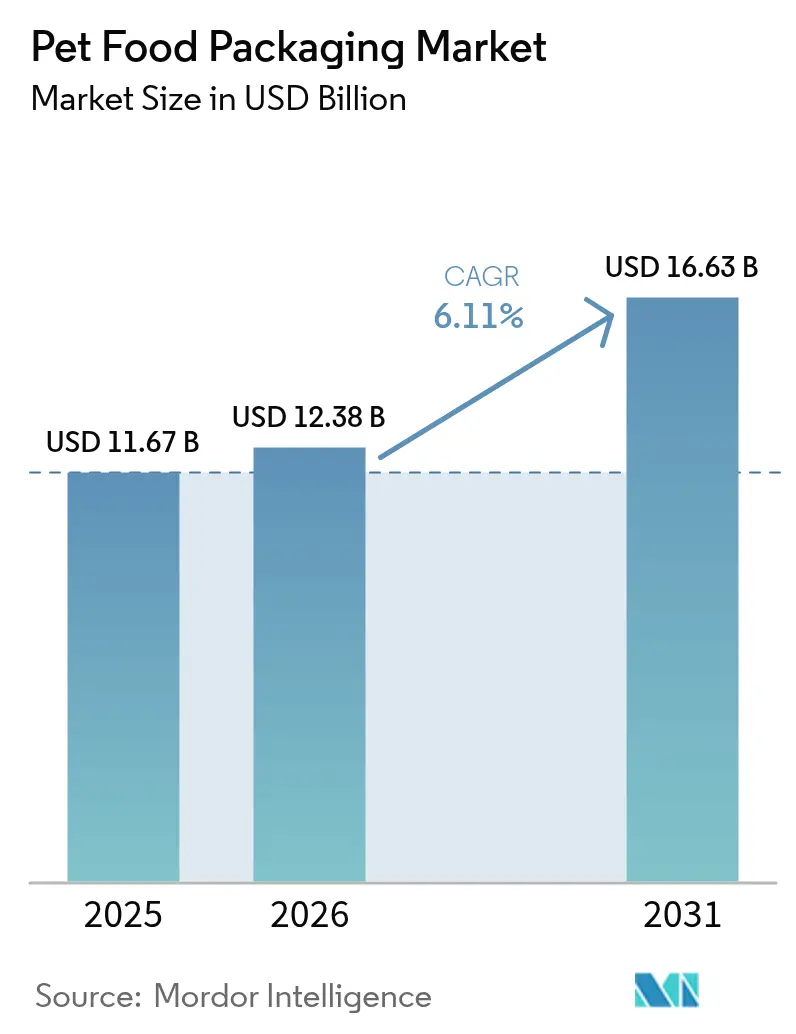
pet food packaging market size in 2026 is estimated at USD 12.38 billion, growing from 2025 value of USD 11.67 billion with 2031 projections showing USD 16.63 billion, growing at 6.11% CAGR over 2026-2031. Growing regulatory pressure in Europe and the United States, rapid premiumization of wet formats, and disruptive material science innovations together create a steady demand pipeline for solutions that balance barrier protection with recyclability. North America remains the largest consuming region, supported by strong e-commerce penetration and early adoption of mono-material flexibles, while Asia-Pacific records the fastest regional growth as urban pet ownership rises in China. Brand owners’ 2025 sustainability pledges, rising raw-material volatility, and the FDA’s phase-out of 35 PFAS food-contact approvals reinforce the need for converters to shift away from conventional multi-layer plastics toward recyclable paper, mono-PE, and bio-composite alternatives. Competitive intensity stays moderate as large integrated players capitalize on scale, but nimble specialists gain share by offering PFAS-free barriers, smart-packaging features, and design-for-recycling services that major brand owners increasingly require.
Key Report Takeaways
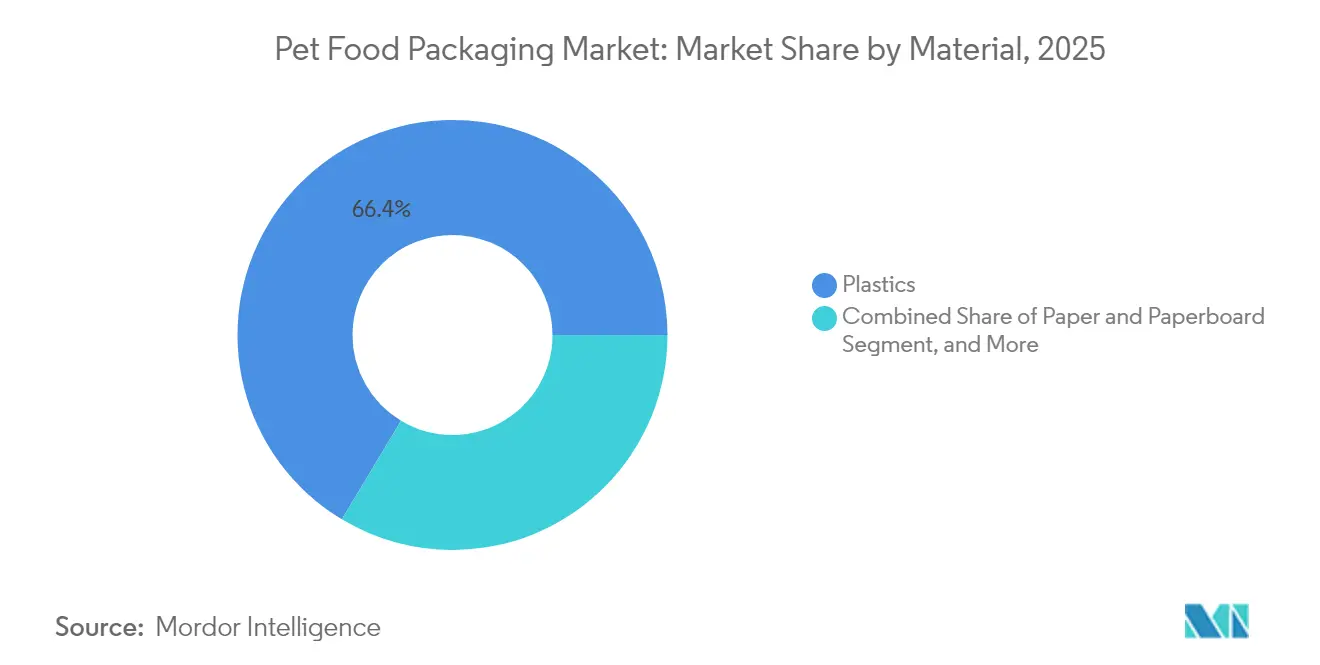
- By material, plastics retained 66.40% of the pet food packaging market share in 2025, while biobased and composite alternatives are poised for a 10.2% CAGR through 2031.
- By product type, pouches held 42.30% revenue share of the pet food packaging market in 2025; smart formats and other emerging solutions are forecast to rise at a 9.3% CAGR to 2031.
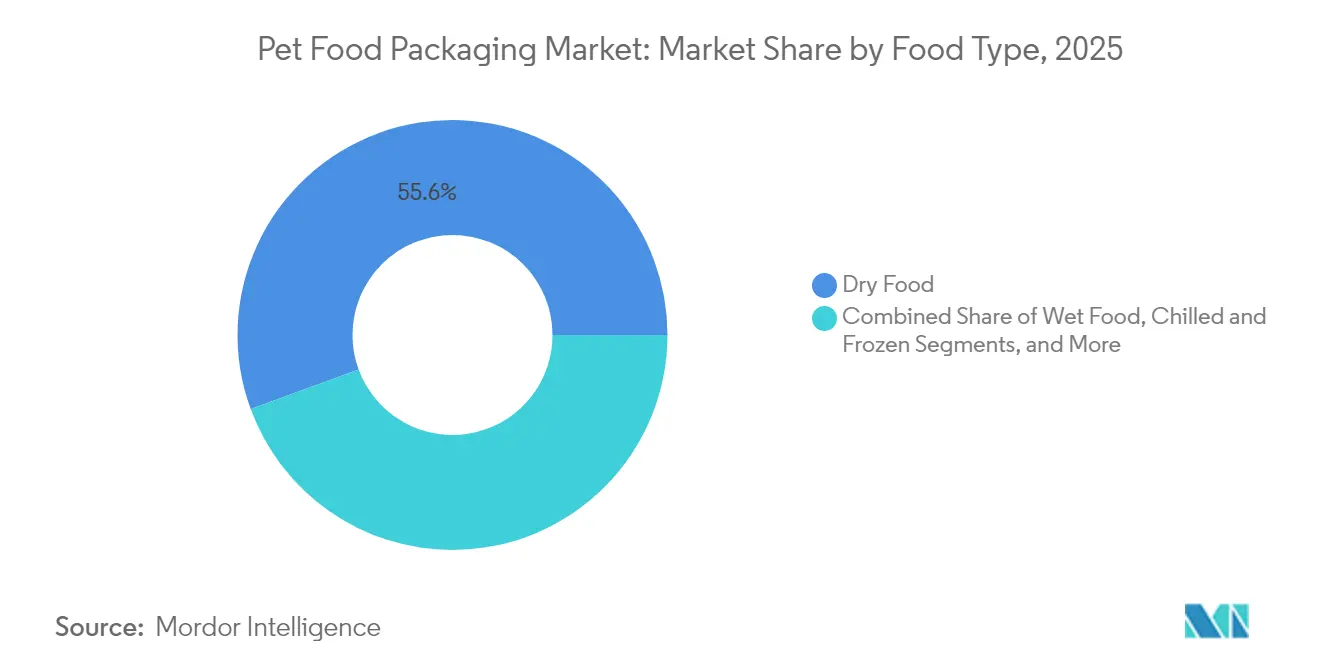
- By food type, dry formulations accounted for 55.60% share of the pet food packaging market size in 2025; wet foods are projected to grow at an 8.6% CAGR between 2026-2031.
- By pet type, dog food commanded 46.50% of the pet food packaging market in 2025, whereas cat food is expected to expand at an 7.9% CAGR through 2031.
- By region, North America led with 33.70% of the pet food packaging market share in 2025; Asia-Pacific is set to post a 7.3% CAGR to 2031.
Note: Market size and forecast figures in this report are generated using Mordor Intelligence’s proprietary estimation framework, updated with the latest available data and insights as of 2026.
Market Trends and Insights
Drivers Impact Analysis of Pet Food Packaging Market*
| Driver | (~) % Impact on CAGR Forecast | Geographic Relevance | Impact Timeline |
|---|---|---|---|
| Surge in Demand for Recyclable Mono-Material Pouches Post-Europe SUP Directive | +1.2% | Europe, spill-over to North America | Medium term (2-4 years) |
| Premiumization of Wet Dog Food Driving High-Barrier Retort Pouch Adoption in North America | +0.9% | North America, expanding to APAC | Short term (≤ 2 years) |
| Urban Pet Ownership Boom in China Fueling Small-Pack Formats with Reclosable Zippers | +0.8% | APAC core, particularly China | Long term (≥ 4 years) |
| E-commerce Growth for Specialty Diets Accelerating Lightweight Flexible Packaging in the US | +0.7% | North America, expanding globally | Medium term (2-4 years) |
| Brand Owner 2025 Sustainability Pledges Catalyzing Paper-Based Bag Investments in Europe | +0.6% | Europe, with global influence | Short term (≤ 2 years) |
| EU Regulation 2024/354 on Mineral-Oil Migration Spurring Functional Barrier Laminates | +0.5% | Europe, regulatory spill-over globally | Medium term (2-4 years) |
| Source: Mordor Intelligence | |||


Surge in demand for recyclable mono-material pouches post-SUP Directive
European Single-Use Plastics rules compel brand owners to abandon complex laminates, prompting converters to commercialize mono-PE structures that equal traditional barrier performance yet meet recyclability targets.[1]European Commission, “Directive (EU) 2019/904 on Single-Use Plastics,” europa.euSiegwerk’s CIRKIT coatings now enable grease, oil, and oxygen protection inside mono-PE, while Longdapac’s 100% recyclable high-barrier pouches for North American brands confirm regulatory ripple effects beyond Europe.
Premiumization of wet dog food driving retort pouch adoption
North American consumers pay 30-50% premiums for chef-style wet formats, spurring investments in Amcor’s AmLite HeatFlex recycle-ready pouches that preserve nutrients during thermal sterilization. Inline seal-inspection systems such as Special Dog Company’s 100% coverage model safeguard quality, and NaturPak Pet’s 50 million-carton annual capacity illustrates scalability requirements for premium growth.
Urban pet ownership boom in China fueling small formats
China’s pet economy exceeded USD 41.8 billion in 2024, with 57% of food bought online, pushing demand for compact, zipper-reclosable pouches that fit smaller apartments and withstand parcel delivery stresses. U.S. pet-food exports of USD 296.6 million in 2024 also accelerate packaging upgrades that convey origin, freshness, and portion control.
E-commerce growth for specialty diets accelerating flexibles
In the United States, online sales growth and shipping-cost sensitivity steer brands toward 20-30% lighter flexible formats that still withstand automated handling. Amcor’s ISTA-certified labs ensure packages survive the e-commerce journey, while direct-to-consumer startups leverage digital printing for on-pack personalization.
Restraints Impact Analysis of Pet Food Packaging Market*
| Restraint | (~) % Impact on CAGR Forecast | Geographic Relevance | Impact Timeline |
|---|---|---|---|
| Volatile PET and Aluminum Prices Squeezing Converter Margins for Wet-Food Cans | -0.8% | Global, particularly Europe and North America | Short term (≤ 2 years) |
| US PFAS Bans in Food-Contact Boards Forcing Costly Reformulations | -0.6% | North America, regulatory spill-over globally | Medium term (2-4 years) |
| EVOH Barrier Resin Shortages Limiting Stand-Up Pouch Capacity in APAC | -0.5% | APAC core, supply chain impacts globally | Short term (≤ 2 years) |
| Limited Curb-Side Recyclability of Retort Structures Discouraging Retailers | -0.4% | Global, particularly Europe and North America | Long term (≥ 4 years) |
| Source: Mordor Intelligence | |||
Volatile PET and aluminum prices squeezing converter margins
Anti-dumping measures and logistics disruptions pushed European PET above EUR 1,130 t in early 2025, while global aluminum demand for cans topped USD 59 billion, compressing converter profits and hastening interest in recycled content or alternative substrates.
U.S. PFAS bans triggering costly reformulations
The FDA’s withdrawal of 35 PFAS food-contact clearances by January 2025 forces board-and-paper suppliers to adopt new barriers, with compliance documentation and line retrofits disproportionately burdening small converters.[2]FDA, “35 PFAS Food-Contact Notifications No Longer Effective,” fda.gov
*Our forecasts treat driver/restraint impacts as directional, not additive. The impact forecasts reflect baseline growth, mix effects, and variable interactions.
Pet Food Packaging Market Segment Analysis
By Material:
plastics dominance amid bio-based accelerationPlastics supplied 66.40% of 2025 revenues, making the material segment the economic backbone of the pet food packaging market. Yet brand commitments and EU rules spur a 10.2% CAGR for bio-based and composite formats. Polyethylene thrives in mono-material designs, whereas PET’s volatility drives interest in chemically recycled and rPET blends. Paperboard progresses as Packaging-and-Waste Regulation deadlines approach, while lignin-bionanocomposites showcase antioxidant capabilities for future high-barrier adoption. The pet food packaging market size attached to paper and board is projected to expand at a mid-teens pace through 2031, supported by Billerud’s plan to supply 300 kilotons of cartonboard annually.
Second-generation bio-composites use agricultural waste streams to cut carbon intensity without compromising machinability, offering converters a hedge against fossil feedstock risk. Amcor’s Indiana recycled-PE agreement with NOVA Chemicals underpins a North American circular platform, ensuring resin availability for mono-PE pouches. Meanwhile, aluminum’s high recycling rate cushions cost headwinds, keeping cans relevant for retort wet food even as converters investigate PFAS-free epoxy replacements.


By Product Type:
pouches leadership challenged by innovationPouches captured 42.30% 2025 share owing to convenience, shelf appeal, and e-commerce compatibility. Retort variants underpin wet-food premiumization, while stand-up formats benefit from zipper-reseal trends among urban consumers. The other-product-types bucket, expanding at 9.3% CAGR, covers smart labels, portion-controlled dispensers, and paper-based cups that meld fiber strength with barrier coatings. Amcor’s 80%-recyclable AmFiber Performance Paper proves the viability of paper for moisture-sensitive applications without sacrificing branding surface.
Graphics quality, handling efficiency, and pack-to-product ratios keep pouches favorable, yet retailer take-back pilots for curbside recycling remain limited. Smart-packaging prototypes embed freshness sensors and color-change inks, but mass uptake awaits cost parity. Bags still dominate large-volume dry food, though single-serve trends could gradually migrate volume into flexibles. Metal cans hold niche loyalty for heritage wet lines despite aluminum volatility, supported by robust recycling infrastructure.
By Food Type:
dry-food stability versus wet-food dynamismDry kibble commanded 55.60% revenue in 2025 and remains the volume anchor of the pet food packaging market. Its scale reinforces demand for cost-efficient flexibles and bags that preserve freshness and oil stability. The segment embraces mono-PE with EVOH or plasma coatings to satisfy recyclability mandates while protecting against moisture ingress.
Wet food, growing at 8.6% CAGR, is reshaping converter portfolios. Shoppers equate stew-like textures with human-grade meals, propelling adoption of retort pouches, aluminum trays, and shelf-stable cartons that deliver premium cues. Cold-chain chilled products incrementally emerge, requiring high-barrier films capable of seal integrity at sub-zero temperatures. Treats and functional snacks rely on high-definition graphics and window features to showcase product form and reinforce transparency claims.
By Pet Type:
dog-food foundation with cat-food momentumDog products commanded 46.50% 2025 share, favoring bulk-size packaging optimized for pantry storage. Large-bag offerings depend on PE films with anti-grease coatings, while wet dog sub-segments gravitate toward retort pouches for higher-margin single-serve lines. Cat items register an 7.9% CAGR to 2031 as smaller-pack, portion-controlled, and multi-variety packs align with feline eating behavior and rising cat ownership in high-density cities. Other species-birds, fish, reptiles-represent niche but fast-growing spaces for specialized oxygen-barrier sachets and dosing closures.
Geography Analysis
North America Pet Food Packaging Market
North America controlled 33.70% of 2025 sales, reflecting established ownership rates and the region’s early pivot to recycle-ready pouches. High producer-price inflation since 2021 elevates packaging optimization on cost and carbon, driving uptake of lightweight flexibles seasoned for e-commerce shocks. The FDA’s PFAS phase-out accelerates paper-and-polymer barrier R&D, while California and Maine mandates create a patchwork that favors suppliers with lab-validated compliance toolkits.
APAC Pet Food Packaging Market
Asia-Pacific is the fastest-growing region at 7.3% CAGR, led by China’s USD 41.8 billion pet economy and digital-first purchasing habits. Local converters grapple with EVOH resin shortages that cap pouch capacity, prompting R&D into silicon-oxide and plasma-coated mono-PE as substitute barriers. Tier-2 cities show domestic brands advancing localized graphics and QR code traceability to court rising middle-income pet owners.
Europe Pet Food Packaging Market
Europe’s growth remains steady, anchored by robust regulation that forces recyclability and recycled-content integration. The Packaging-and-Packaging-Waste Regulation sets firm 2030 targets, spurring investment in paper-based bag lines and new grease-proof coatings. Single-Use Plastics requirements bring forward design-for-recycling guidelines that displace legacy multilayer structures in dry food. Cross-industry alliances such as Saica–Mondelez transfers know-how to pet food, widening supply of paper flexibles.

Regulatory Landscape
Regulation-led packaging redesign is a key demand driver for pet food, with Europe setting the most prescriptive trajectory through the EU Packaging and Packaging Waste Regulation (PPWR), Regulation (EU) 2025/40. The PPWR entered into force on 11 February 2025 and applies generally from 12 August 2026, tightening requirements around packaging waste prevention and recyclability. This accelerates the shift away from difficult-to-recycle multilayer structures toward mono-material flexibles and fiber-based alternatives.
In the United States and the United Kingdom, compliance focus extends to packaging materials and on-pack information linked to animal feed rules and food-safety systems. The US FDA oversees animal food requirements and has extended the compliance date for FSMA additional traceability records for certain foods to 20 July 2028, reducing near-term timing pressure for supply-chain recordkeeping changes. Labeling modernization workstreams also affect packaging artwork and claims substantiation, including AAFCOs Pet Food Label Modernization (PFLM) project, while UK pet food operators align with animal feed legislation and import requirements for animal by-products under Regulation (EU) 142/2011.
Competitive Landscape
The pet food packaging market features moderate fragmented. Global multi-sleeve players such as Amcor, Mondi, and ProAmpac command scale, proprietary coatings, and multi-regional plant networks that attract multinational brand contracts. Strategic roadmaps emphasize PFAS-free barriers, mono-material architectures, and validated e-commerce durability tests. Innovation portfolios now include paper-based high-barrier laminates, advanced seal-inspection AI, and recycled-resin integration.
M&A activity intensifies. Toppan’s USD 1.8 billion purchase of Sonoco’s flexible unit bolsters retort-pouch know-how, while General Mills’ USD 1.45 billion buy of Whitebridge Pet Brands signals downstream vertical integration that influences packaging specifications. Patent landscapes in lignin-bionanocomposites and active-oxygen scavengers confer defensive moats to early movers. Regional specialists flourish by servicing mid-size pet-food producers seeking fast design iterations and label-ready small batch runs.
Supply risks from raw-material price spikes incentivize converters to tether resin sourcing to recycled streams and long-term metal contracts. ESG investors scrutinize greenhouse-gas footprints, prompting public targets such as ProAmpac’s Science-Based Net-Zero pledge, which ramps up adoption of low-carbon substrates and closed-loop partnerships with U.S. material recovery facilities.
Pet Food Packaging Industry Leaders
American Packaging Corporation
ProAmpac LLC
Constantia Flexibles Group GmbH
Amcor Group GmbH
Crown Holdings, Inc.
- *Disclaimer: Major Players sorted in no particular order
Pet Food Packaging Market Companies Covered in this Report
- Amcor plc
- Mondi plc
- ProAmpac LLC
- Sonoco Products Company
- Constantia Flexibles Group GmbH
- Crown Holdings Inc.
- Ardagh Group SA
- Silgan Holdings Inc.
- Coveris Holdings SA
- American Packaging Corporation
- Huhtamaki Oyj
- Sealed Air Corporation
- Printpack Inc.
- AptarGroup Inc.
- Smurfit Westrock plc
- Goglio SpA
- Glenroy Inc.
- Winpak Ltd.
- Tetra Pak International SA
- Wipak Oy

Market Opportunities and Future Outlook
EU PPWR implementation from 12 August 2026 turns design-for-recycling and chemistry restrictions into near-term commercial whitespace, especially for PFAS-free grease and moisture barrier solutions for high-fat kibble and pet treats, and for recycle-ready retortable structures used in wet food. By 2026, UPM and Royal Vaassen introduced ultra-high barrier, PFAS-free paper packaging for pet treats (Barrywrap Everest), and Coveris launched PFAS-free, mono-material recyclable pet food packaging concepts positioned for PPWR-aligned portfolios. This creates room for converters to qualify compliant barriers without compromising seal integrity and shelf-life performance.
Capacity localization and throughput upgrades are also central as wet-food formats and pouches scale globally. In 2026, Mars opened a pet food pouch facility in Wodonga, Australia, with 290 million pouches annual capacity, and Nestle Purina opened a USD 550 million pet food factory in Batavia, Ohio. These downstream production expansions typically pull packaging specifications, qualification cycles, and local supply partnerships into new regions. On the materials and machinery interface, ExxonMobil, Videplast, and Haver and Boecker validated a high-performance mono-material PE pet food packaging solution capable of 2,400 bags per hour, supporting a path toward downgauged, high-output recyclable bags where traditional multi-material laminates have been used.
Recent Industry Developments in Pet Food Packaging Market
- June 2026: American Packaging Corporation expanded its sustainable packaging portfolio for pet food, highlighting recyclable PE-film and paper-based structures. This broadens converter options for brand owners navigating evolving EPR and recyclability requirements while maintaining performance in bulk dry-food bags and flexible formats.
- May 2026: ExxonMobil, working with Videplast, developed a mono-material polyethylene pet food packaging solution that reduced film gauge from 180 microns to 160 microns. The downgauging milestone supports material reduction and throughput improvements while keeping the structure within a mono-material pathway favored by recyclability programs.
- December 2024: Toppan Holdings agreed to acquire Sonocos Thermoformed and Flexible Packaging unit for USD 1.8 billion, strengthening high-barrier flexible capabilities. The transaction increases scale in pouch and barrier packaging supply, influencing competitive intensity and technology access for pet food converters and brand owners.


Pet Food Packaging Market Report Scope and Research Methodology
Market Definition and Coverage
For this study, the pet food packaging market covers packaging materials and formats used to pack commercial pet food, where value is measured as packaging revenue across flexible and rigid packs supplied to pet food brands and co-packers.
Scope exclusions: Packaging used only for veterinary pharmaceuticals, pet litter, and toys, plus secondary transport packaging that does not touch the pet food pack, is excluded.
Segments Covered in This Report
- By Material
- Plastic
- Polyethylene (PE)
- Polypropylene (PP)
- Polyethylene Terephthalate (PET)
- Other Plastics
- Paper and Paperboard
- Metal
- Biobased and Composite Materials
- Plastic
- By Product Type
- Pouches
- Bags
- Metal Cans
- Other Product Types
- By Type of Food
- Dry Food
- Wet Food
- Chilled and Frozen
- Treats and Snacks
- By Pet Type
- Dog Food
- Cat Food
- Other Pet Food
- By Geography
- North America
- United States
- Canada
- Mexico
- Europe
- Germany
- United Kingdom
- France
- Italy
- Spain
- Rest of Europe
- Asia-Pacific
- China
- India
- Japan
- South Korea
- ASEAN
- Australia and New Zealand
- Rest of Asia-Pacific
- South America
- Brazil
- Argentina
- Rest of South America
- Middle East and Africa
- Middle East
- Saudi Arabia
- United Arab Emirates
- Rest of Middle East
- Africa
- South Africa
- Kenya
- Nigeria
- Rest of Africa
- Middle East
- North America
Data Sources, Market Sizing, and Validation
Desk Research
Desk research was used to set the basic market map and to anchor the model with repeatable data series. We referenced public sources such as US Census Bureau and Bureau of Labor Statistics series for packaging and plastics signals, USITC and UN Comtrade trade statistics for packaging materials, and Eurostat for comparable packaging and manufacturing indicators. We also reviewed publications from bodies such as the US FDA and the European Commission to understand food contact packaging requirements that shape material choices.
To ground the commercial context, we checked company annual reports, investor presentations, and press releases for packaging mix commentary and capacity additions, along with association websites and reputable industry press for sustainability and recycling developments. In addition, paid databases were used selectively for company financials and patent databases to understand barrier-material innovation trends that influence packaging value. These sources are not exhaustive, and many other public references were used to collect data, validate assumptions, and clarify gaps during analysis.
Primary Interviews and Surveys
Primary work focused on interviews and structured surveys with packaging converters, material suppliers, and pet food brand and co-packer teams, so that pricing, format mix, and adoption timing could be verified. Since this is a global market, inputs were cross-checked across APAC, EMEA, and the Americas to reflect differences in wet versus dry mix, recycling rules, and supply chain constraints, and then the assumptions were adjusted where responses showed consistent variance.
Distribution of primary research fieldwork respondents
| Company type | Respondent position | Region |
|---|---|---|
| Top tier: 29% | CXOs: 16% | APAC: 41% |
| Mid tier: 51% | Functional/Unit leaders: 40% | EMEA: 36% |
| Smaller Players: 20% | Managers: 44% | Americas: 23% |
Market-Sizing & Forecasting
Sizing starts with a top-down build where pet food production and consumption signals, combined with packaging intensity by format, are used to reconstruct packaging demand by region and then translate that into value using observed price bands. To keep the totals realistic, we corroborate them with selective bottom-up approximations, such as sampled converter revenues, channel checks on format shares (pouches, bags, cans), and volume times ASP cross-checks for key materials.
Inputs that materially shape the model include pet food volume mix (dry versus wet and treats), packaging format shifts (especially stand-up pouches and reclosable features), material substitution trends (paper-based structures, mono-material plastics, and metal can demand), resin and paper price movement, and regulation-led design changes for recyclability and food contact compliance. Forecasting is primarily done using scenario analysis supported by expert consensus on price pass-through timing and adoption rates, and then the trajectory is compared against macro indicators like pet population and premiumization trends. Where bottom-up visibility is limited for smaller local converters, assumptions are filled using regional conversion factors and then re-tested in follow-up calls until the variance narrows to a reasonable band.
Data Validation & Update Cycle
Validation is done through multiple checks so that one data point does not drive the final number. Model outputs are compared with independent signals like packaging material demand trends, trade flows for key inputs, and announced capacity additions, and then outliers are investigated before results move to sign-off. If a variance is explained by a definitional difference or a sudden price swing, the assumptions are revisited and the relevant experts are re-contacted.
Each report goes through multi-step analyst review, where calculations, unit conversions, and currency timing are checked again using the latest available public releases. The study is refreshed annually, and interim updates are made when material events occur, such as major regulation changes or sharp raw material price moves. Before delivery, a final refresh pass is completed so clients receive the most current view available at that time.
Mordor Intelligence's Pet Food Packaging Market Size Compared Against Other Published Estimates
Published market sizes for pet food packaging can look far apart because each publisher uses a different definition of what counts as packaging value, which geographies are treated as in-scope, and how pricing is carried forward during volatile input cycles.
The main gap comes from whether adjacent packaging like secondary transport packs and broader pet care packaging are counted, and how quickly price normalization is assumed after resin and paper swings, where Mordor Intelligence keeps the scope tied to primary pet food packs and applies region-specific ASP updates only after converter feedback and public input-cost signals align.
Benchmark comparison
| Source | Market Size | Gaps in Research Methodology |
|---|---|---|
| Mordor Intelligence | USD 12.38 B (2026) | |
| Global Consultancy A | USD 12.87 B (2025) | Uses a different base year and can blend broader packaging spend assumptions into 2025, which changes the implied price level versus a 2026 reset after input-cost movement. |
| Industry Publisher B | USD 14.41 B (2025) | Often reflects a wider value bucket that may include additional pack types or looser inclusion rules around pet-related packaging, which lifts the 2025 total beyond primary pet food packs alone. |
Across the three figures, the spread is mainly explained by scope inclusion and base-year pricing logic, and not by a single demand driver. When the pack type is clearly limited to primary pet food packaging and pricing is updated with traceable input signals and interview checks, the resulting market value stays easier to reproduce and to track over time for planning.


Key Questions Answered in the Report
What is the current value of the pet food packaging market?
The pet food packaging market is valued at USD 12.38 billion in 2026 and is forecast to reach USD 16.63 billion by 2031.
Which region holds the largest share of pet food packaging sales?
North America accounts for 33.70% of global revenues, driven by high e-commerce penetration and early adoption of recyclable mono-material pouches.
Why are mono-material pouches gaining traction?
They meet Single-Use Plastics and recyclability mandates while providing comparable barrier protection, creating a regulatory-compliant alternative to multilayer laminates.
How fast is the Asia-Pacific market growing?
Asia-Pacific is projected to expand at a 7.3% CAGR, fueled by China’s surging urban pet ownership and dominant online retail channels.
What is the biggest challenge for converters between 2025 and 2031?
Volatile PET and aluminum prices, compounded by PFAS regulatory bans, are squeezing margins and forcing accelerated material innovation.
Which companies lead sustainable packaging innovation?
Amcor, Mondi, and ProAmpac spearhead the development of PFAS-free coatings, high-barrier paper solutions, and recycle-ready mono-PE structures.
Page last updated on:


 Your data is secure and never sold or shared.


