
Global Personal Health Records Software Market Size and Share
Market Overview
| Study Period | 2020 - 2031 |
|---|---|
| Market Size (2026) | USD 10.56 Billion |
| Market Size (2031) | USD 16.47 Billion |
| Growth Rate (2026 - 2031) | 9.32 % |
| Fastest Growing Market | Asia-Pacific |
| Largest Market | North America |
| Market Concentration | Medium |
Major Players *Disclaimer: Major Players sorted in no particular order Image © Mordor Intelligence. Reuse requires attribution under CC BY 4.0. | |
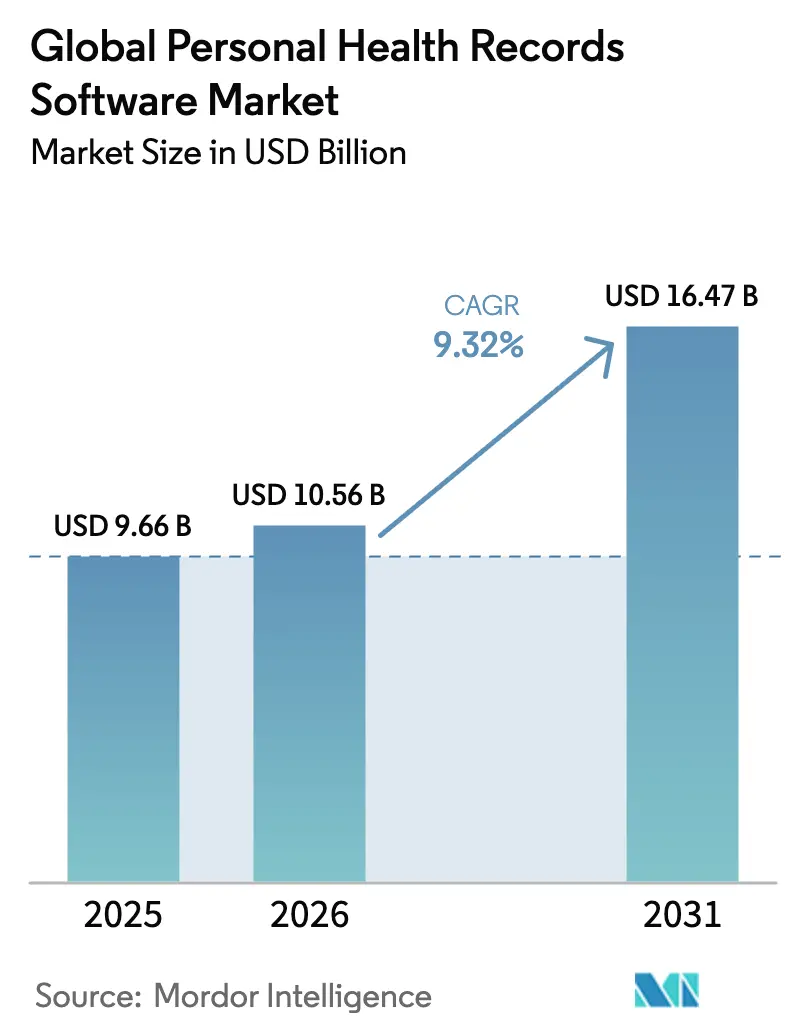
Global Personal Health Records Software Market Analysis by Mordor Intelligence
The Personal Health Records Software market size is expected to grow from USD 9.66 billion in 2025 to USD 10.56 billion in 2026 and is forecast to reach USD 16.47 billion by 2031 at 9.32% CAGR over 2026-2031.
This robust personal health records software market expansion mirrors the move to patient-centered care, the proliferation of cloud deployment, and the growing need for real-time data exchange between consumers, providers, and payers. Interoperability mandates such as the CMS Patient Access API rule, the fast uptake of wearable devices, and the convergence of telehealth and remote patient monitoring are reinforcing adoption momentum. Mounting cybersecurity spending, artificial-intelligence-driven analytics, and service-centric business models are redefining competitive positioning. Vendors that blend strong privacy safeguards with friction-free cross-platform user experiences are expected to capture a disproportionate share of future growth in the personal health records software market.
Key Report Takeaways
- By component type, Software & Mobile Apps led with 54.10% of personal health records software market share in 2025, while Services is projected to record a 11.12% CAGR to 2031.
- By deployment mode, cloud-based systems captured 50.35% of the personal health records software market size in 2025 and are advancing at a 13.05% CAGR through 2031.
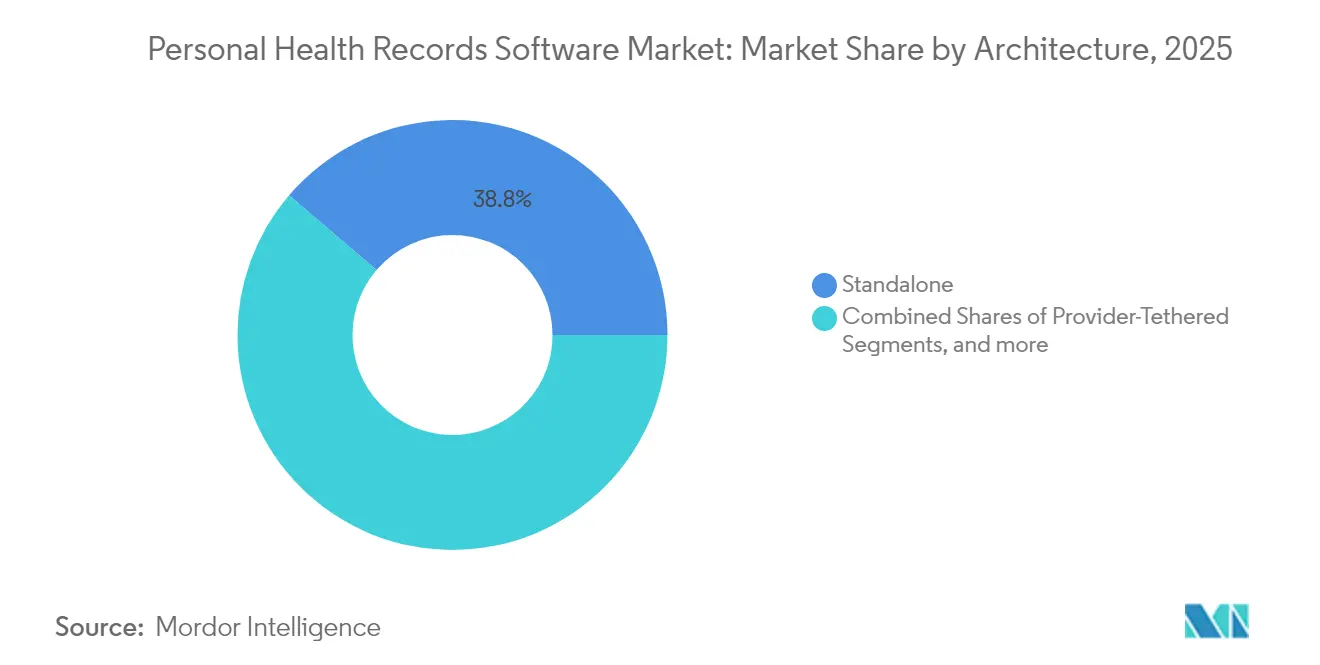
- By architecture, standalone solutions accounted for 38.75% of personal health records software market size in 2025; interoperable/third-party platforms are forecast to expand at a 11.85% CAGR.
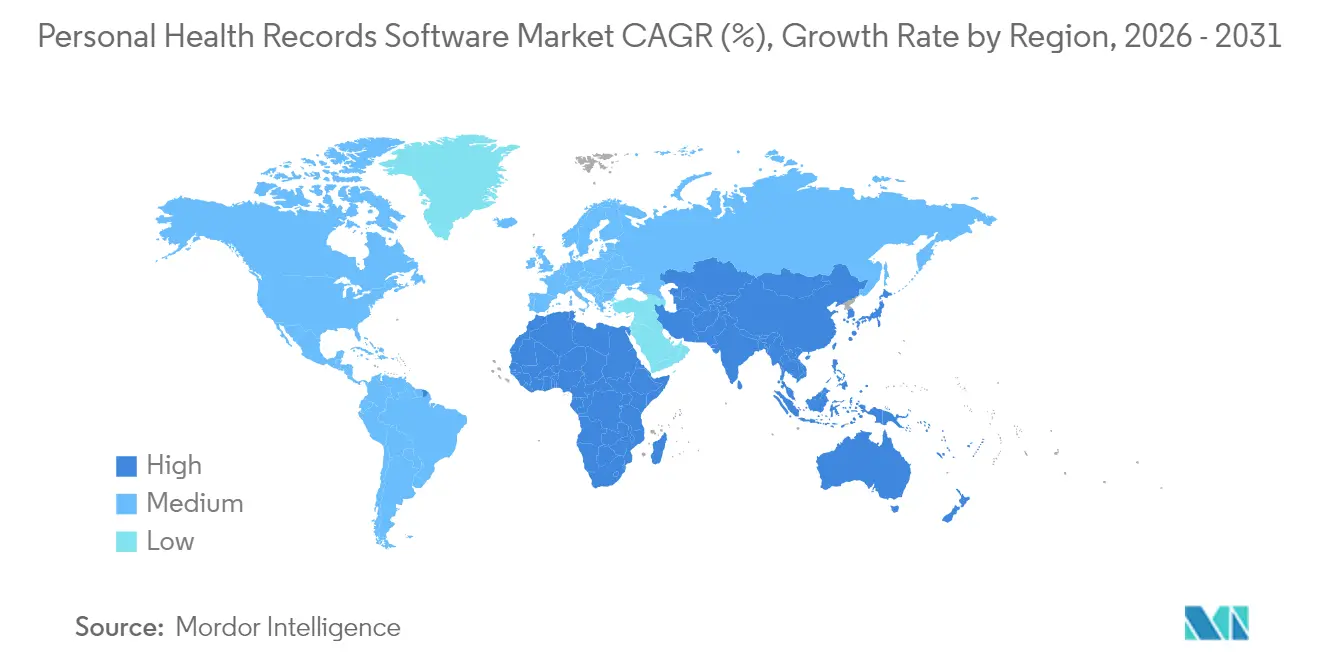
- By geography, North America held 53.30% of personal health records software market share in 2025, whereas Asia-Pacific is set to grow 11.60% annually during 2026-2031.
Note: Market size and forecast figures in this report are generated using Mordor Intelligence’s proprietary estimation framework, updated with the latest available data and insights as of 2026.
Market Trends and Insights
Drivers Impact Analysis of Global Personal Health Records Software Market*
| Driver | % Impact on CAGR Forecast | Geographic Relevance | Impact Timeline |
|---|---|---|---|
| Increasing Need for Streamlined Healthcare Information and Rising Initiatives to Encourage Patient Centric Personal Care | 2.6% | Global, with stronger impact in North America and Europe | Medium term (2-4 years) |
| Rising Government Initiatives for Online Data Integration | 2.3% | North America, Europe, and emerging Asia-Pacific markets | Medium term (2-4 years) |
| Surging Chronic Disease Burden Driving Continuous Patient Engagement Needs | 1.7% | Global, with significant impact in aging populations (Japan, Europe, North America) | Long term (≥ 4 years) |
| Telehealth & Remote Monitoring Expansion Requiring Seamless Data Exchange | 1.4% | North America, Europe, and urban centers in Asia-Pacific | Short term (≤ 2 years) |
| Smartphone Surge Enabling Mobile-First PHR Adoption | 1.2% | Asia-Pacific, Latin America, and emerging markets globally | Short term (≤ 2 years) |
| Cloud Cost-Optimization Expanding SaaS PHRs | 1.0% | Global, with particular impact on SMEs and cost-conscious organizations | Medium term (2-4 years) |
| Source: Mordor Intelligence | |||
Streamlined information & patient-centric care
Healthcare data sit in multiple silos, pushing patients to demand one-stop visibility into medications, test results, and visit notes. The 21st Century Cures Act bans information blocking, triggering portal log-ins that show 90% of users reviewing lab values and 70% reading clinical notes.[1] Smartphone comfort levels remain high, with 51% of Americans accessing records on mobile apps. Providers deploying intuitive portals report higher satisfaction metrics, and cross-industry consumer expectations continue to pressure laggard systems. The personal health records software market therefore benefits from better clinical workflows, easier data aggregation, and growing provider incentives tied to value-based contracts.
Government online data-integration mandates
Public-sector policies now require standardized APIs that give consumers friction-free control over data. The CMS Patient Access, Provider Access, and Payer-to-Payer APIs must all be live by 2027.[2] India’s Ayushman Bharat Digital Mission has already created more than 7.3 billion health accounts, providing a model of mobile-first enrollment. The CDC’s USD 500 million Data Modernization Initiative is modernizing surveillance and reporting pipelines.[3] Indonesia’s FHIR-based Satusehat platform underscores the global preference for the HL7 FHIR standard. These mandates collectively accelerate the adoption curve in the personal health records software market by lowering vendor integration barriers.
Rising chronic-disease burden
Sixty percent of U.S. adults now live with at least one chronic condition, expanding demand for continuous engagement tools. Medicare reimburses remote patient monitoring when at least 16 days of data are captured within 30 days, powering AI-driven early-warning algorithms. Evidence in Nature shows that digital interventions using feedback, reminders, and social support increase adherence to self-care behaviors nature.com. As vendors embed predictive analytics into PHR dashboards, the personal health records software market is transitioning from passive repositories into active disease-management platforms.
Telehealth & RPM expansion
Eighty percent of providers are raising health-IT budgets in 2025, prioritizing interoperability that merges telehealth video consults, connected-device feeds, and clinic visits. Validic now pushes continuous glucose-monitoring streams directly into Epic and Oracle Health EHR fields. Physician groups foresee comprehensive patient engagement powered by wearables, AI summarization, and integrated coaching. Seamless aggregation of multimodal data differentiates solutions in the personal health records software market, boosting both clinical efficiency and patient retention.
Restraints Impact Analysis of Global Personal Health Records Software Market*
| Restraint | % Impact on CAGR Forecast | Geographic Relevance | Impact Timeline |
|---|---|---|---|
| Security Concerns Regarding the Software | -1.6% | Global, with higher impact in North America and Europe | Medium term (2-4 years) |
| Lack of Awareness Among Rural Patients | -1.1% | Rural areas globally, with significant impact in developing regions | Long term (≥ 4 years) |
| Cyber-Liability Insurance Cost Spike Limiting SME Adoption | -0.8% | North America and Europe, particularly affecting small healthcare providers | Short term (≤ 2 years) |
| Fragmented HIT Standards Hindering Payer-Tethered Interoperability | -0.9% | Global, with particular impact in regions with diverse healthcare systems | Medium term (2-4 years) |
| Source: Mordor Intelligence | |||
Security concerns regarding software
Ninety-two percent of healthcare organizations suffered cyberattacks in 2024, and breaches cost an average USD 9.8 million. The Change Healthcare incident alone exposed data on 190 million individuals. Health records fetch up to 50 times the price of financial data on dark web markets, prompting CIOs to assign 19% of IT budgets to security. Staffing shortages persist, with 53% of firms citing inadequate in-house expertise. Blockchain pilots aim to restore trust by giving patients granular consent controls while meeting HIPAA requirements. Unless addressed, these threats may slow conversions in the personal health records software market.
Lack of awareness among rural patients
Rural physicians show 21% lower odds of certified-EHR adoption and record lower Promoting Interoperability scores (80 vs 92 urban). Lower smartphone ownership, patchy broadband, and limited digital-literacy programs constrain PHR on-boarding. Socioeconomic hurdles deepen the divide as rural patients lose out on preventive insights, thereby widening health-equity gaps. Infrastructure grants, easy-language interfaces, and community-based training schemes are needed to sustain personal health records software market penetration in remote geographies.
*Our forecasts treat driver/restraint impacts as directional, not additive. The impact forecasts reflect baseline growth, mix effects, and variable interactions.
Global Personal Health Records Software Market Segment Analysis
By Component Type:
Services Outpace Software GrowthThe Software & Mobile Apps segment commanded 54.10% of the personal health records software market in 2025, buoyed by high smartphone penetration and AI-enabled personalization dashboards. Yet only 2% of users currently combine information from multiple portals, revealing interoperability pain points. Predictive algorithms now summarize lab results, flag medication conflicts, and recommend lifestyle interventions, thereby lifting patient engagement scores and retention. Vendors differentiate through UX design, low-code configuration, and seamless FHIR APIs.
Services held 45.90% in 2025 but will grow faster at 11.12% annually as organizations seek implementation partners for workflow redesign, staff training, and data-quality audits. Managed-service models help smaller clinics bypass capital outlays, while large systems rely on consultants to meet value-based reporting demands. Generative-AI documentation reduces clinician burden, and troubleshooting hot-lines strengthen user loyalty. The personal health records software market size for services is projected to expand more quickly than that for software, giving professional-services firms a larger revenue slice by 2031.


By Deployment Mode:
Cloud Solutions Dominate MarketCloud platforms carried 50.35% of the personal health records software market in 2025 and remain the fastest-growing deployment at 13.05% CAGR. Their subscription model lowers upfront hardware costs; a five-year ownership estimate of USD 58,000 per provider attracts small practices. Seventy-two percent of physicians note better anywhere-access; 85% cite higher patient convenience. Native elasticity supports AI model training and voice-note transcription workflows. Integration blueprints now standardize SSO, MFA, and audit logging, easing compliance.
Web-based/on-premise installs still hold 49.65% but face slower uptake. They satisfy organizations with strict data-sovereignty rules, yet updates lag behind cloud peers. Maintenance cycles and patch management inflate total cost and complicate scalability. As AI adoption accelerates—77% of providers budget for AI CapEx—cloud supremacy in the personal health records software market should widen.
By Architecture:
Interoperability Drives Future GrowthStandalone systems represented 38.75% personal health records software market share in 2025, favored by privacy-conscious consumers who aggregate data manually. Only 11% of U.S. adults maintain such a record, and just 5 of 19 audited portals met more than half of patient-desired functions. Manual data entry suppresses engagement frequency, particularly among chronic-disease cohorts needing automated device uploads.
Interoperable/third-party models, although smaller, will rise at 11.85% CAGR. FHIR-ready connectors sync with hospital EHRs, pharmacy databases, and home sensors, turning PHRs into hubs for longitudinal health analytics. Provider-tethered and payer-tethered approaches offer convenience but restrict cross-provider visibility; hybrid orchestration layers are therefore emerging. As API economies mature, the personal health records software market size attributed to interoperable platforms will grow faster than any other architecture class.
Geography Analysis
North America Personal Health Records Software Market
North America secured 53.30% of the personal health records software market in 2025 on the back of HITECH-funded infrastructure and early consumer portal mandates. The CMS final rule forcing Patient Access APIs promises to tighten integration baselines further by 2027. Nonetheless, cybersecurity remains a caveat; three in four Americans were touched by a breach in 2024. Market resilience stems from payer incentives, mature cloud ecosystems, and a tech-savvy consumer base favoring mobile-first access.
APAC Personal Health Records Software Market
Asia-Pacific is the fastest-growing territory at 11.60% CAGR. India’s Ayushman Bharat Digital Mission enrolled 7.3 billion health IDs, while Indonesia’s Satusehat platform demonstrates scalable FHIR adoption. High smartphone penetration and government e-health grants accelerate pilot rollouts in urban clinics. Domestic vendors partner with telecom operators to deliver SMS-based reminders, ensuring inclusion of feature-phone users. By 2030 the regional personal health records software market size is expected to rival Europe’s current level.
EMEA and South America Personal Health Records Software Market
Europe commands considerable share anchored by the General Data Protection Regulation and the forthcoming European Health Data Space. Estonia already migrated from CDA to FHIR, proving national-scale semantic interoperability. Data-localization rules increase vendor compliance costs yet also engender consumer trust. Communications regulators in France and Germany are evaluating mobile-SIM authentication frameworks to streamline access. Meanwhile, Middle East & Africa plus South America are in the early digitization phase but benefit from leapfrog mobile strategies. Refugee and migrant health programs highlight the utility of portable EPHRs amid continuity-of-care challenges.
Regulatory Landscape
Personal health records (PHR) software operates under tightening privacy, security, and interoperability requirements that increasingly favor standardized APIs and auditable data exchange. In the United States, PHR-adjacent capabilities that touch regulated health information and participate in federally recognized exchange ecosystems are shaped by HIPAA-aligned privacy and security expectations and by the Office of the National Coordinator for Health Information Technology (ONC) Health IT Certification Program criteria under 45 CFR Part 170, including technical expectations for interoperability and data exchange.
Across markets, functional and implementation standards also act as a practical compliance anchor for product teams and procurement. The HL7 Personal Health Record System Functional Model (PHRS FM, Release 2) frames requirements around patient privacy, confidentiality, and secure exchange, and consumers and regulators increasingly scrutinize transparency of data practices. That scrutiny is pushing vendors toward clearer disclosures, such as the ONC Model Privacy Notice (MPN), and it shapes choices across architecture (standalone versus interoperable), security controls (identity, access, auditability), and vendor selection by providers, payers, and public programs.
Competitive Landscape
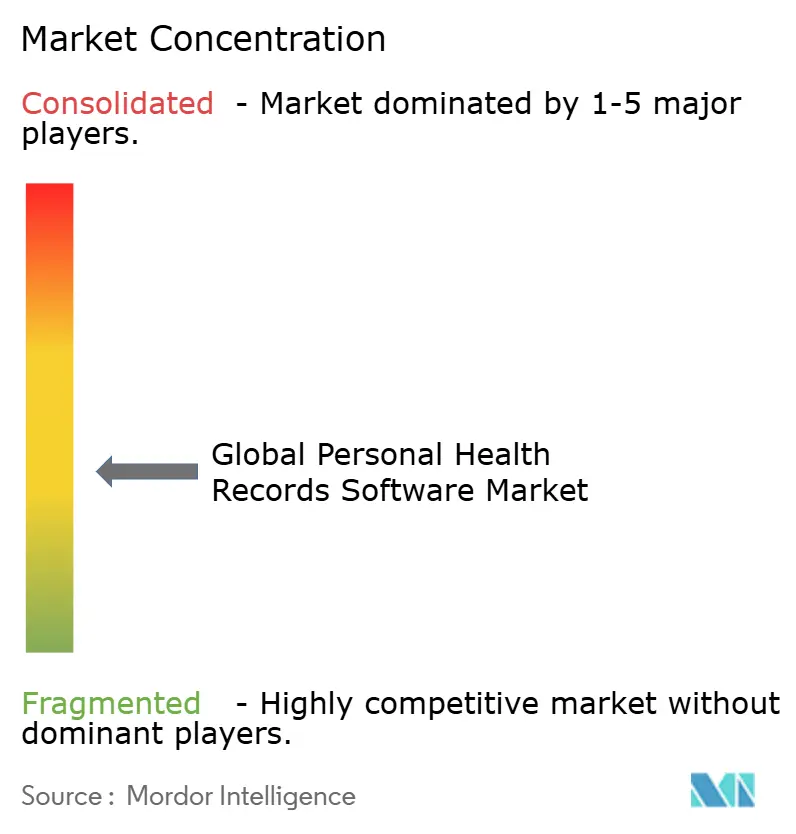
The personal health records software market is moderately concentrated. Epic’s MyChart remains the most widely used patient portal in U.S. hospital systems and continues to cross-sell telehealth modules. Oracle Health holds a major share in acute-care EHR share and courts defense and Veterans Affairs facilities. Apple Health Records and Microsoft Azure Health Data Services leverage consumer ecosystems and hyperscale cloud to elevate UI expectations.
Strategic integrations redefine value propositions. Validic’s continuous-glucose feed into Epic and Oracle Health reduces manual data reconciliation. Samsung’s collaboration with Eka Care embeds India-specific e-wallet IDs into its wearables. Experity’s tie-up with ChartSwap expedites urgent-care record exchange, minimizing claimant wait times.
Artificial intelligence now tips the playing field. In February 2025, Validic released a generative-AI engine that auto-summarizes RPM streams, shaving minutes off each encounter. Oracle updated its EHR to include AI-driven note suggestions and population-health forecasting. White-space opportunities persist in rural connectivity, low-literacy UX, and blockchain-verified consent management. Vendors excelling at security, simplicity, and standards alignment are set to broaden their footprint in the personal health records software market.
Global Personal Health Records Software Industry Leaders
-
Innovaccer, Inc.
-
Healthspek
-
Zapbuild
-
kaaspro
-
Validic
- *Disclaimer: Major Players sorted in no particular order
Global Personal Health Records Software Market Companies Covered in this Report
- Epic Systems
- Oracle Health (Cerner)
- Veradigm (Allscripts)
- Validic
- Healthspek
- NoMoreClipboard
- Patient Ally
- Health Companion
- Knapsack Health
- Zapbuild
- Records For Living Inc.
- kaaspro (Health Cure)
- SoftClinic (JVS Group)
- 75Health
- Practice Fusion
- Medfusion
- NextGen Healthcare
- Apple Health Records
- Innovaccer
Read Analysis of Global Personal Health Records Software Companies
Market Opportunities and Future Outlook
Interoperability and enterprise-grade data platforms open near-term whitespace for PHR vendors that can operationalize longitudinal patient data beyond basic viewing and downloading. With the API requirement trajectory (including the CMS Patient Access, Provider Access, and Payer-to-Payer APIs that must be live by 2027), buyers are prioritizing FHIR-native connectors, consent management, and normalization layers that unify EHR, payer, and remote monitoring streams into consumer-facing experiences. This direction also aligns with the broader shift toward cloud deployments and third-party interoperable platforms, where buyers increasingly weigh implementation services, governance, and security hardening alongside core software.
Vendor moves in 2026 show where budgets and product roadmaps are concentrating. Innovaccer extended platform reach through partnerships with Snowflake (January 2026) and Databricks (March 2026), which signals sustained demand for PHR-adjacent data unification, analytics, and scalable AI operations inside healthcare organizations. Program-led digitization remains another structural opportunity in Asia-Pacific and the Middle East, supported by national-scale initiatives and alliances such as the Innovaccer and Infinia Technologies partnership in the UAE in April 2026, aimed at connecting consumer records, care coordination, and value-based reporting into a single engagement layer.
Recent Industry Developments in Global Personal Health Records Software Market
- May 2026: Innovaccer announced the asset acquisition of CaduceusHealth to integrate full-stack revenue cycle management into its Flow suite for ambulatory care. Directly enlarges healthcare IT and PHRS workflow footprint. Expands revenue-cycle and interoperability capabilities within PHRS ecosystem.
- March 2026: Innovaccer achieved Built on Validated Partner status with Databricks to use lakehouse and ML within Innovaccer Autonomous Healthcare Platform. Strengthens AI-enabled data processing for PHRS workflows. Accelerates enterprise AI deployment and data interoperability in PHRS market.
- January 2026: Innovaccer entered a partnership with Snowflake to integrate Gravity Healthcare Intelligence Platform with Snowflake AI Data Cloud and Cortex AI services. Enhances cloud-native PHRS analytics and data exchange. Entrenches Innovaccer in enterprise cloud ecosystems for PHRS analytics.
Global Personal Health Records Software Market Report Scope and Research Methodology
Market Definition and Coverage
This market covers software used to create, store, manage, and share an individual's health information in a personal health record, including web and cloud products used by consumers, providers, and payers.
Scope exclusions: Excludes full enterprise EHR/EMR core systems, pure telehealth visit platforms, and general fitness or wellness apps that do not function as a personal health record.
Segments Covered in This Report
- By Component Type
- Software and Mobile Apps
- Services
- By Deployment Mode
- Cloud-Based
- Web-Based
- By Architecture
- Provider-Tethered
- Payer-Tethered
- Standalone
- Interoperable / Third-Party
- By Geography
- North America
- United States
- Canada
- Mexico
- Europe
- Germany
- United Kingdom
- France
- Italy
- Spain
- Rest of Europe
- Asia-Pacific
- China
- Japan
- India
- Australia
- South Korea
- Rest of Asia-Pacific
- Middle East & Africa
- GCC
- South Africa
- Rest of Middle East & Africa
- South America
- Brazil
- Argentina
- Rest of South America
- North America
Data Sources, Market Sizing, and Validation
Desk Research
Desk research was used to set the market perimeter, build the country coverage, and collect the basic demand signals that explain where PHR software adoption is moving. We leaned on public healthcare digitization indicators and interoperability policies because they often explain why a PHR gets funded, connected, and maintained over time.
Sources included official and non-paywalled references such as the US ONC interoperability and health IT program materials, CMS digital health and patient access rule resources, OECD health statistics, World Bank health and ICT indicators, and publications from groups such as HIMSS. We also reviewed company filings, product documentation, investor presentations, reputable press, patent databases, and selective company financials and news intelligence subscriptions. This list is not exhaustive, and many other public and paid sources were also used for data collection, cross-checking, and clarification.
Primary Interviews and Surveys
Primary work focused on validating which PHR architectures are actually being purchased and used, and how spending is split between software and related services. Inputs were gathered from provider IT leaders, payer digital teams, implementation partners, and product specialists across major geographies, which helped us pressure test adoption timing, pricing movements, and the role of interoperability mandates.
When desk data looked inconsistent at the country level, we rechecked assumptions with follow up discussions so the final model stayed aligned with real buying cycles and deployment patterns.
Distribution of primary research fieldwork respondents
| Company type | Respondent position | Region |
|---|---|---|
| Top tier: 38% | CXOs: 14% | APAC: 48% |
| Mid tier: 47% | Functional/Unit leaders: 27% | EMEA: 30% |
| Smaller Players: 15% | Managers: 59% | Americas: 22% |
Market-Sizing & Forecasting
Sizing starts with a top-down build where health IT and digital patient engagement spending pools are reconstructed by region, and then filtered using adoption and use indicators that are specific to personal health records. Those totals are then corroborated using selective bottom-up checks such as sampled vendor revenue disclosures, channel conversations on typical deal sizes, and an ASP-by-user or ASP-by-organization sanity check in markets where deployments are more standardized.
Key inputs used in the model include the pace of interoperability rollouts and patient access policies, provider and payer digitization budgets, cloud deployment mix, share of tethered versus standalone architectures, and service intensity tied to integration and ongoing maintenance. For forecasting, we used scenario analysis supported by expert views, because policy timing, integration depth, and procurement cycles can shift the adoption curve even when long term demand is clear. Where vendor revenue was not observable, gaps were handled through peer-group pricing bands and adoption-rate proxies that were reviewed during primary discussions.
Data Validation & Update Cycle
Outputs are checked against independent signals such as healthcare IT budget trends, cloud migration pace in provider settings, and policy-driven milestones that influence patient data access. Large variances are investigated at the country and segment level, and the model is reviewed in steps by another analyst before sign-off so that arithmetic, assumptions, and units align.
Reports are refreshed annually, and interim updates are triggered when material events occur, such as major regulatory changes, sharp currency moves, or visible shifts in deployment patterns. Before delivery, a final check is completed to ensure the latest public releases and expert feedback are reflected in the numbers.
Mordor Intelligence's Personal Health Records Software Market Estimate Compared With Other Published Estimates
Published market values for personal health records software can look far apart because teams do not always count the same product set, buyer group, or pricing basis. Differences also come from how quickly assumptions are refreshed, and whether the totals are anchored to adoption signals that are visible country by country.
Consumer wellness apps that store activity data but do not operate as a true personal health record sit outside Mordor Intelligence's scope, which is one practical reason our 2025 value does not match estimates that blend adjacent digital health categories. Gaps also show up when a study assumes uniform price growth across regions, uses one-time currency conversion for a base year, or applies global adoption ratios that are not revalidated with current interoperability and patient access timelines.
Benchmark comparison
| Source | Market Size | Gaps in Research Methodology |
|---|---|---|
| Mordor Intelligence | USD 9.66 B (2025) | |
| Industry Report A | USD 9.20 B (2023) | Uses an earlier base year and a longer forecast window, and the scope appears to mix PHR software with broader patient-facing digital tools, which changes the starting value and the implied ramp. |
| Industry Report B | USD 9.57 B (2024) | Relies on a single-year market value with limited visibility on architecture splits, and it is unclear how services and integration-heavy deployments were treated across regions. |
Overall, the spread is largely explained by what gets counted as a PHR, the base year chosen, and how pricing and adoption are carried forward across regions. Our method stays traceable because the totals are tied back to observable deployment patterns, policy-driven demand signals, and cross-checks that keep the final value realistic for the year stated.
Key Questions Answered in the Report
What is the current personal health records software market size and growth outlook?
The personal health records software market size is USD 10.56 billion in 2026 and is projected to hit USD 16.47 billion by 2031, a 9.32% CAGR during 2026-2031.
Which deployment mode leads the market?
Cloud-based platforms held 50.35% personal health records software market share in 2025 and will expand at a 13.05% CAGR through 2031.
Which region is growing the fastest?
Asia-Pacific is the fastest-growing region, expected to register a 11.60% CAGR during 2026-2031 thanks to large-scale government digital-health programs.
What is the biggest restraint to adoption?
Cybersecurity concerns remain the top barrier, with breaches costing USD 9.8 million per incident on average and driving up security spending to 19% of health-IT budgets.
Which emerging technology is most influential?
Artificial intelligence, especially generative-AI summarization of remote patient monitoring data, is becoming a key differentiator for vendors targeting clinical-workflow efficiency.