
Pension Administration Software Market Size and Share
Market Overview
| Study Period | 2020 - 2031 |
|---|---|
| Market Size (2026) | USD 5.33 Billion |
| Market Size (2031) | USD 7.87 Billion |
| Growth Rate (2026 - 2031) | 8.12 % |
| Fastest Growing Market | Asia Pacific |
| Largest Market | North America |
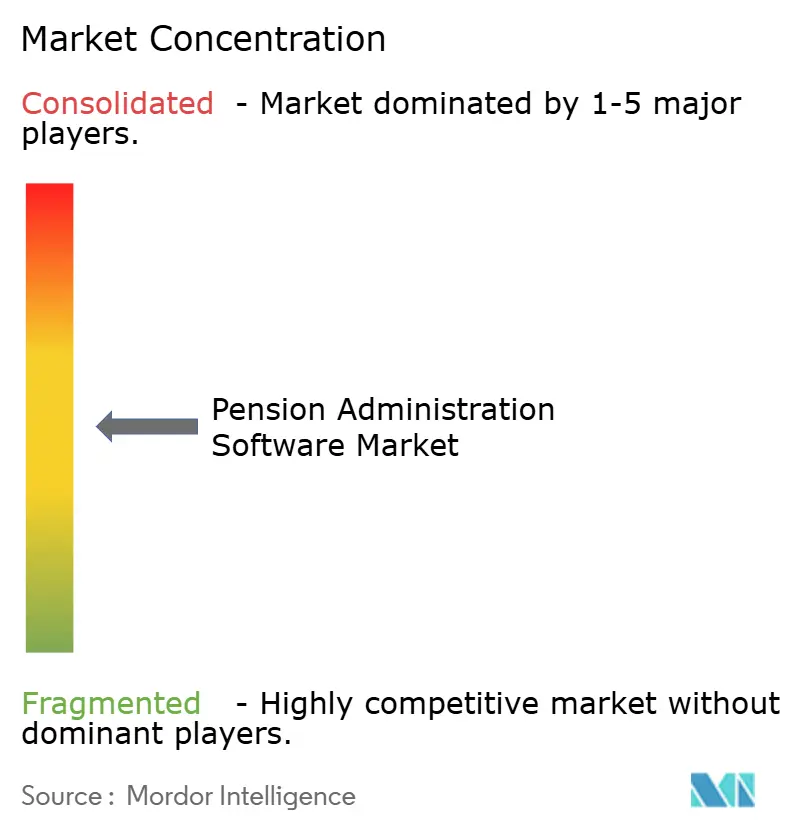
| Market Concentration | Medium |
Major Players *Disclaimer: Major Players sorted in no particular order Image © Mordor Intelligence. Reuse requires attribution under CC BY 4.0. | |
Pension Administration Software Market Analysis by Mordor Intelligence
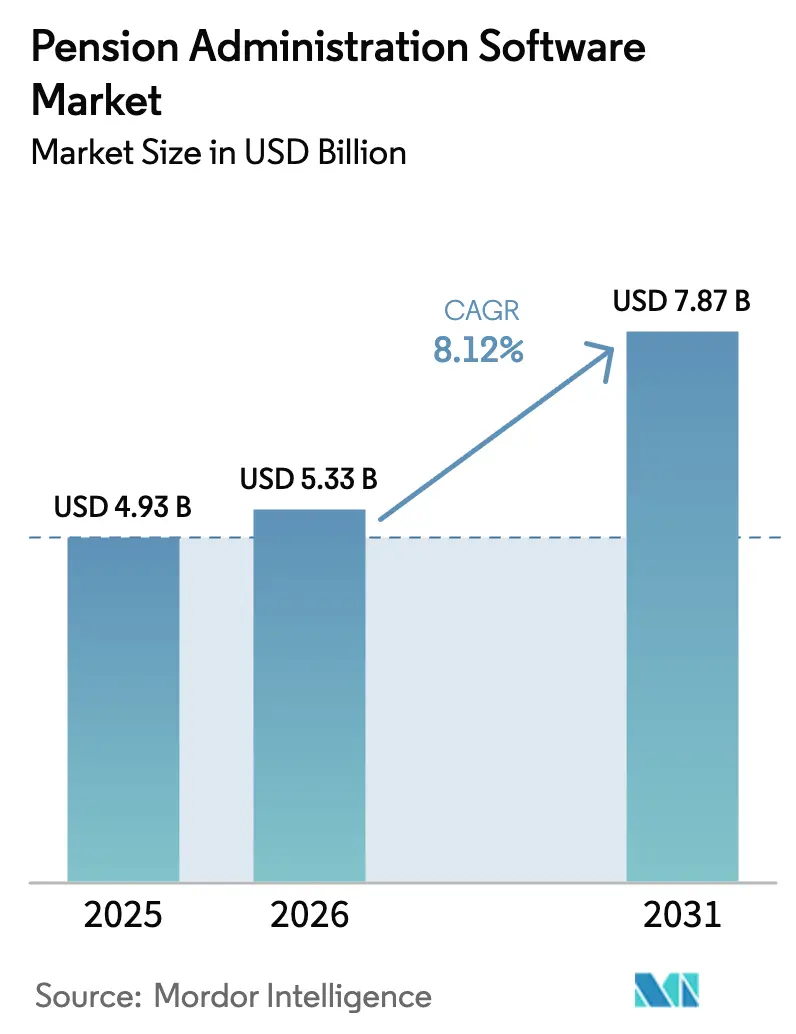
The pension administration software market size is expected to grow from USD 4.93 billion in 2025 to USD 5.33 billion in 2026 and is forecast to reach USD 7.87 billion by 2031 at 8.12% CAGR over 2026-2031. Growth is propelled by accelerated digitization, regulatory pressure for real-time reporting, and the urgent replacement of aging legacy systems. Organizations are shifting workloads to the cloud to avoid hardware refresh cycles and shrink IT overhead, while public-sector modernization mandates inject sizable budgets into system upgrades. At the same time, cybersecurity incidents and integration costs temper the pace of adoption, creating a dynamic landscape in which vendors differentiate through AI-enabled analytics, automated compliance, and intuitive self-service portals.
Key Report Takeaways
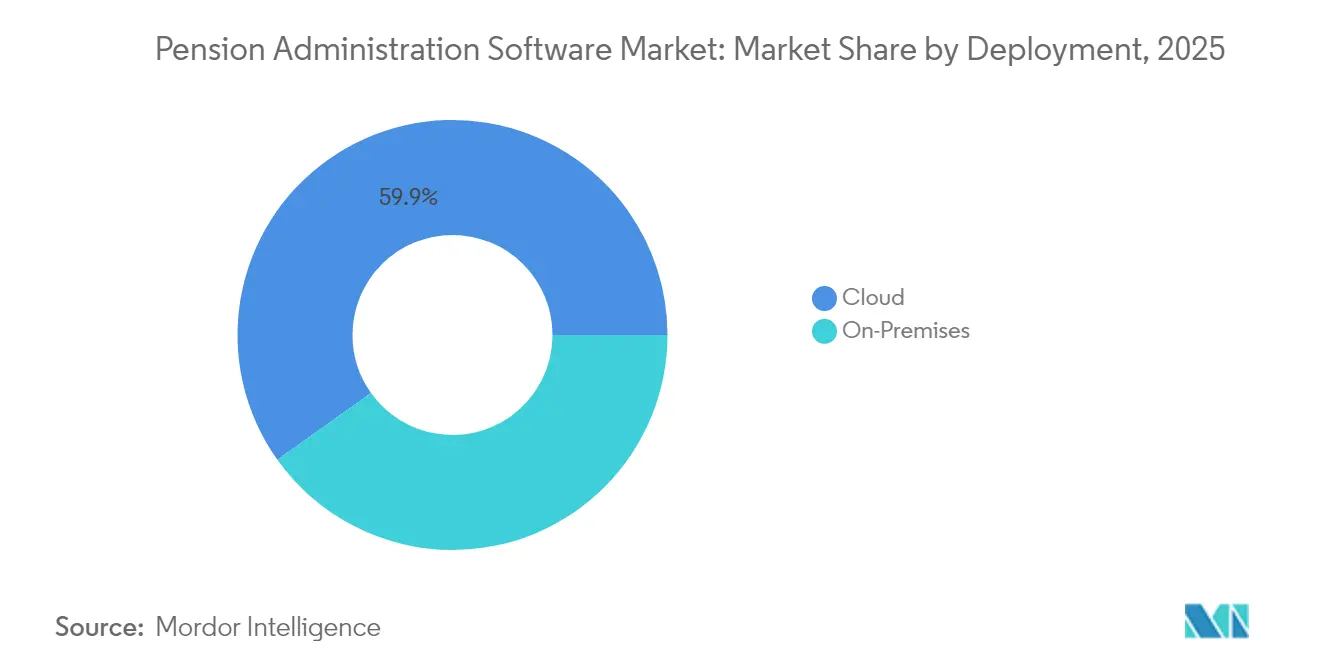
- By deployment, cloud models held 59.85% of the pension administration software market share in 2025, and this segment is expanding at a 12.35% CAGR to 2031.
- By enterprise size, government entities led with 42.35% revenue share in 2025, while SMEs posted the quickest rise at an 10.62% CAGR through 2031.
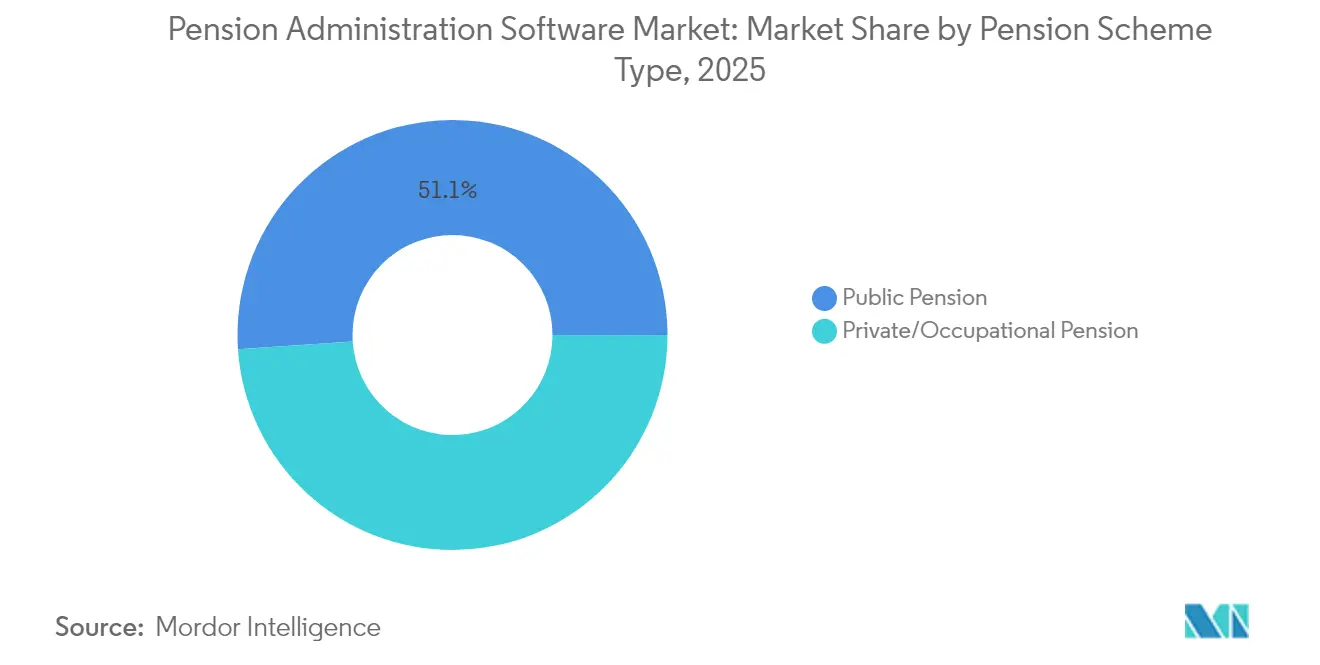
- By pension scheme type, public plans accounted for 51.05% of the pension administration software market size in 2025; private and occupational schemes are on track for a 9.98% CAGR to 2031.
- By functionality, contribution and payroll processing remained the largest category at 26.55% in 2025, whereas self-service portals are advancing at a 12.05% CAGR to 2031.
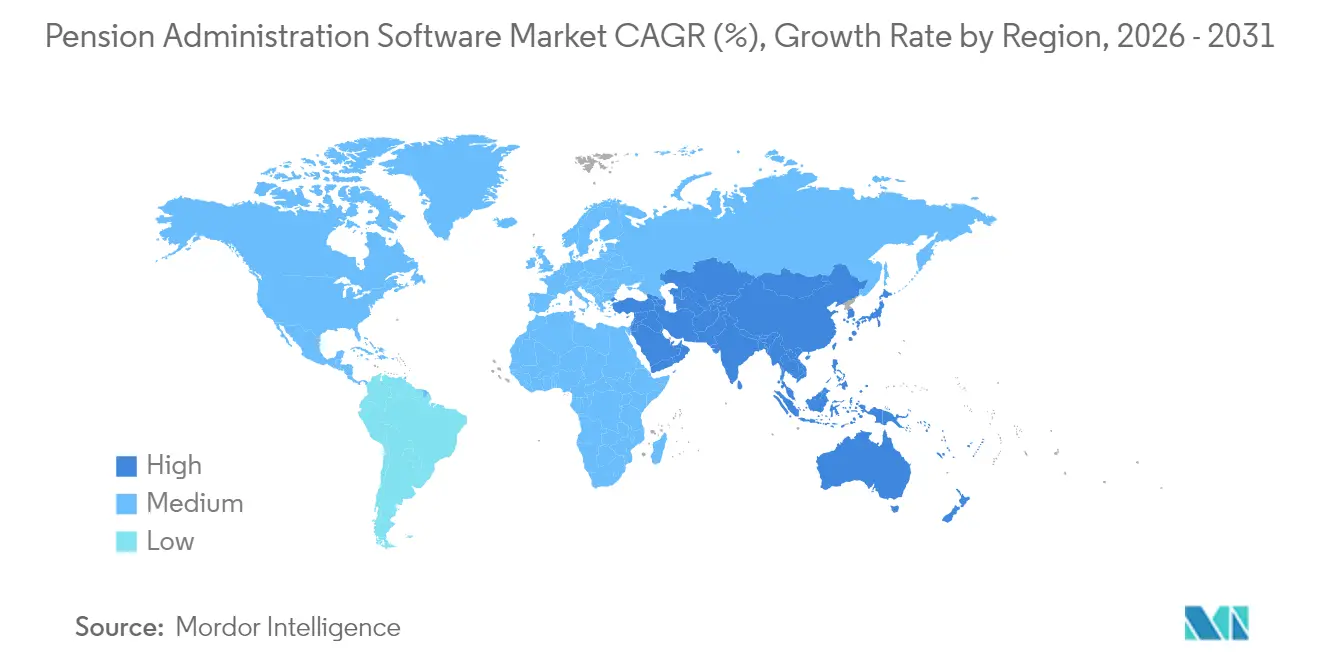
- By geography, North America dominated with 33.85% market share in 2025, and Asia-Pacific is growing the fastest at 13.35% CAGR to 2031.
Note: Market size and forecast figures in this report are generated using Mordor Intelligence’s proprietary estimation framework, updated with the latest available data and insights as of 2026.
Market Trends and Insights
Drivers Impact Analysis of Pension Administration Software Market*
| Driver | (~) % Impact on CAGR Forecast | Geographic Relevance | Impact Timeline |
|---|---|---|---|
| Cloud-native deployments slash IT overhead | +2.1% | North America and EU first movers; global diffusion | Medium term (2-4 years) |
| Regulatory shift toward real-time reporting | +1.8% | Led by US ERISA and EU GDPR | Short term (≤ 2 years) |
| Public-sector modernization mandates | +1.5% | North America and APAC core; spill-over to EU | Medium term (2-4 years) |
| Ageing workforce boosts pension complexity | +1.2% | Developed economies worldwide | Long term (≥ 4 years) |
| AI-based risk analytics gain traction | +0.9% | North America and EU early adopters; APAC catching up | Medium term (2-4 years) |
| Tokenised pension asset pilots | +0.4% | US, UK, Singapore | Long term (≥ 4 years) |
| Source: Mordor Intelligence | |||
Cloud-native Deployments Slash IT Overhead
Moving pension workloads to cloud environments is producing 30–40% reductions in total cost of ownership, helped by vendors such as Oracle, whose 2024 filings show cloud services rising to 37% of revenue after USD 8.9 billion of R&D spending. SAP’s Q1 2024 results mirror this pattern with 24% cloud revenue growth, backed by an EUR 14.2 billion (USD 16.49 billion) backlog. Despite these gains, agencies migrating from on-premises systems—Wiltshire Pension Fund is a notable example—encounter temporary cost spikes linked to data reconciliation and staff retraining.
Regulatory Shift Toward Real-time Reporting
The January 2025 U.S. Department of Justice rule restricting access to sensitive personal data intensifies compliance demands for pension systems that handle cross-border information, with enforcement commencing in April 2025. The Department of Labor’s Field Assistance Bulletin 2025-02 lays out additional annual funding notice stipulations under the SECURE 2.0 Act.[2] European guidelines are tightening concurrently, as EIOPA reviews sustainability risk disclosures that require ESG data capture.
Public-sector Modernization Mandates
Governments are reallocating significant budgets to overhaul aging platforms. The U.S. Technology Modernization Fund granted USD 18.3 million to the Office of Personnel Management in December 2024 to migrate systems supporting 2.8 million annuitants.[1] California Teachers’ Retirement System is investing USD 523.1 million to finish its Pension Solution Project by late 2025. In Asia, China’s 2025 Government Work Report underscores expanded digital infrastructure spending to prepare for demographic shifts.
Ageing Workforce Boosts Pension Complexity
Rising life expectancy increases the intricacy of benefit calculations, pushing administrators toward configurable software that can manage multiple plan designs. The Virginia Retirement System disbursed USD 6.47 billion in 2024 while serving more than 832,000 members across varied schemes. Emerging markets follow suit, with Somalia introducing a defined-benefit plan for civil servants in 2024 that employs career-average formulas. Multiple Latin American reforms, led by Mexico’s lower retirement age and Panama’s proposed hikes, create further software complexity.
Restraints Impact Analysis of Pension Administration Software Market*
| Restraint | (~) % Impact on CAGR Forecast | Geographic Relevance | Impact Timeline |
|---|---|---|---|
| Rising migration and integration costs | -1.4% | Most acute in North America and EU | Short term (≤ 2 years) |
| Cyber-security and data-sovereignty concerns | -0.8% | Global; amplified in cross-border operations | Medium term (2-4 years) |
| Source: Mordor Intelligence | |||
Rising Migration and Integration Costs
CEM Benchmarking calculates that pension administration expenses jumped 15.6% year-on-year in 2024, nearly triple the peer average, lifting total cost per member to USD 51. Smaller plans face an added burden: SECURE 2.0’s automatic-enrollment mandate, effective January 2025, introduces compliance work that pushes many SMEs toward external solutions. Each year’s IRS cost-of-living adjustments compel continuous software updates, inflating operating budgets.
Cyber-security And Data-sovereignty Concerns
The December 2024 breach at Carruth Compliance Consulting exposed personally identifiable information for more than 40,000 education workers and generated multiple lawsuits. Public retirement associations warn that inadequate vendor vetting and minimal employee training combine to heighten breach risk. At a policy level, new U.S. data-sovereignty rules restrict foreign access to sensitive records, which may narrow hosting options for global plans seeking unified platforms.
*Our forecasts treat driver/restraint impacts as directional, not additive. The impact forecasts reflect baseline growth, mix effects, and variable interactions.
Pension Administration Software Market Segment Analysis
By Deployment:
Cloud Dominance Accelerates Infrastructure TransformationCloud models claimed 59.85% of the pension administration software market share in 2025, outstripping on-premises alternatives and projecting a 12.35% CAGR through 2031. This momentum stems from lower ownership costs and elastic scaling that better match fluctuating member volumes. The pension administration software market size attached to cloud platforms is on course to multiply as agencies fund multi-year conversions. Migration, however, exposes complexity in data validation and retraining, often leading to interim cost spikes. Hybrid environments are now bridging the gap, enabling sensitive data to stay behind a firewall while analytics leverage cloud horsepower.
On-premises deployments persist in jurisdictions with stringent data localization mandates or entrenched infrastructure investments. Yet as leading vendors secure ISO 27001 certifications and sovereign-cloud offerings expand, the value proposition of pure on-premises stacks erodes. Investment disbursements such as the USD 18.3 million Technology Modernization Fund grant underline how public budgets are migrating to cloud-first architectures.

By Enterprise Size:
Government Leadership Drives SME AccelerationPublic entities dominated the pension administration software market with a 42.35% share in 2025, reflecting the scale of government benefit obligations and the rigor of statutory reporting. Even so, SMEs register the fastest expansion at 10.62% CAGR to 2031 as subscription pricing lowers entry barriers. Mandatory automatic enrollment under SECURE 2.0 intensifies compliance pressures on small plans that lack in-house expertise, steering them into turnkey cloud services.
Large employers continue steady adoption, focusing on deep analytics and multi-plan coordination. The pension administration software market size allocated to SMEs remains comparatively small, but its growth trajectory signals democratization of capabilities once reserved for billion-dollar plans.
By Pension Scheme Type:
Private Sector Innovation Challenges Public DominancePublic schemes controlled 51.05% of global revenue in 2025, yet private and occupational schemes are set for a 9.98% CAGR to 2031 as employers seek agile tools that integrate actuarial insight with HR platforms. Private providers such as Smart Pension leverage technology to consolidate assets quickly, evidenced by ten master-trust acquisitions that lifted its assets to GBP 6 billion (USD 7.4 billion) in 2024.
Public plans wield budget stability and clear oversight but face lengthier procurement cycles. Meanwhile, the pension administration software market share held by private schemes expands as employers chase faster member services and automated contribution management.
By Functionality:
Self-Service Portals Lead Digital Member Experience RevolutionContribution and payroll processing accounted for 26.55% of 2025 revenue, yet self-service portals deliver the fastest rise at 12.05% CAGR; they streamline transactions and meet member expectations for on-demand access. Secure portals enable retirees to update information, view statements, and initiate withdrawals without administrator intervention, cutting call volumes and latency.
Risk and actuarial analytics gain ground as longevity and investment volatility challenge funding strategies. Administrators demand unified dashboards that overlay AI-driven models on contribution data, reinforcing the pension administration software market's ambition to cover every step from enrolment to payout within a single stack.
Geography Analysis
North America Pension Administration Software Market
North America held 33.85% of 2025 revenue, buoyed by large-scale modernization such as the USD 523.1 million CalSTRS Pension Solution Project and the USD 18.3 million OPM upgrade, both aimed at eliminating 1990s-era platforms. SECURE 2.0 adds fresh compliance layers that improve commercial prospects for domestic vendors skilled in U.S. regulation. Canada and Mexico inject additional opportunities through phased reforms and age-eligibility changes.
Europe Pension Administration Software Market
Europe maintains solid momentum as GDPR and evolving ESG rules pressure pension trustees to improve data governance and sustainability disclosures. EIOPA consultations on prudential treatment of climate risk and the growing prevalence of net-zero targets across 29% of European funds reinforce software demand for granular asset tagging and emissions tracking. The pension administration software market size for EU jurisdictions grows steadily, with vendors tailoring multilingual interfaces and data-protection controls.
APAC and MEA Pension Administration Software Market
Asia-Pacific outpaces all regions with a 13.35% CAGR through 2031. China’s plan to channel long-term pension capital into domestic markets requires robust risk and portfolio analytics, while Japan accelerates digital government commitments that include modern pension records. India, Singapore, and Australia diversify demand with blockchain pilots and advanced mobile services, positioning the pension administration software market as a critical layer in national aging strategies. Regions in the Middle East and Africa enter earlier stages of reform, signalling future lift once legislative frameworks solidify.
Regulatory Landscape
Regulation in the pension administration software market is tightening around data governance, disclosure, and digital connectivity, shaping what software must support for auditability, reporting cadence, and hosting decisions. In the United States, SECURE 2.0-related guidance and the U.S. Department of Labor Field Assistance Bulletin 2025-02 add specific notice and reporting stipulations for plans, while the U.S. Department of Justice final rule restricting access to sensitive personal data (issued January 2025, enforced from April 2025) increases controls for cross-border data handling in systems that manage participant records.
In the United Kingdom, the Pension Schemes Act 2026 (Royal Assent on 29 April 2026) strengthens governance and oversight, including superfund supervision and value-for-money requirements, and reinforces a compliance environment where administrators need structured data and workflow controls. Separately, pensions dashboards rules and standards, including those from the Money and Pensions Service (MaPS) and oversight by The Pensions Regulator (TPR) and the Financial Conduct Authority (FCA), drive connectivity and data-readiness requirements, with in-scope schemes required to connect to the dashboards digital architecture by 31 October 2026. In Europe, GDPR enforcement and evolving sustainability disclosure expectations referenced in EIOPA reviews continue to push administrators toward systems with granular data capture, permissions, and traceable reporting outputs.
Competitive Landscape
Competition is moderately fragmented. Oracle and SAP command entrenched client bases, leveraging extensive R&D and global delivery teams; Oracle devoted USD 8.9 billion to research in 2024 and now earns 37% of revenue from cloud services. Specialized vendors such as Sagitec Solutions focus on public-sector tenders, securing a spot on the GovTech 100 list as proof of niche expertise.
Smart Pension underscores consolidation trends, completing its tenth master trust acquisition in March 2025, thereby topping GBP 6 billion (USD 8.17 billion) in assets and using proprietary platforms to streamline onboarding. Alight Solutions, after divesting non-core segments for USD 1.0 billion, doubles down on its Worklife platform to deepen benefits administration and wellness features.
Product differentiation increasingly rests on AI-enabled fraud detection, configurable APIs, and sovereign-cloud deployment options. Vendors cultivate partnerships with analytics firms and cybersecurity specialists to address data-sovereignty hurdles highlighted by the 2024 Carruth breach. Talent scarcity presents a systemic risk: a 2025 Financial Services Skills Commission survey flags data analysis and AI as the most acute gaps hindering implementation speed.
Pension Administration Software Industry Leaders
-
Heywood Limited
-
Milliman, Inc.
-
SAP SE
-
Oracle Corporation
-
Capita plc.
- *Disclaimer: Major Players sorted in no particular order
Pension Administration Software Market Companies Covered in this Report
- Oracle Corporation
- SAP SE
- Capita plc
- Equiniti Group plc
- Civica Group
- Heywood Limited
- Sagitec Solutions
- Milliman Inc.
- Buck Global LLC
- Smart Pension Ltd.
- Alight Solutions
- LandP Systems Ltd.
- Aon plc
- Mercer LLC
- PensionSoft Ltd.
- Aquila Heywood
- Vitech Systems Group
- Itek Systems Management
- PensionFusion
- FIS Global
Market Opportunities and Future Outlook
A key whitespace area is software that operationalizes new digital connectivity and disclosure mandates into production-grade workflows, especially where administrators need to normalize member data, support secure identity and consent flows, and handle high-volume data queries. The UK dashboards program is a near-term catalyst for vendors offering integrated service provider connectivity, data validation tooling, and ongoing monitoring aligned with MaPS standards and TPR/FCA expectations. In the U.S., compliance change cycles tied to SECURE 2.0 and related Department of Labor guidance also sustain demand for configurable notice generation, audit trails, and reporting templates that reduce manual work.
Modernization programs and large, multi-year public-sector projects also create space for cloud-native, API-first platforms that reduce reconciliation effort across payroll, HR, and finance systems, particularly where legacy pension stacks were not built for real-time reporting and cybersecurity controls. Already visible initiatives include the U.S. Technology Modernization Fund awarding USD 18.3 million (December 2024) to the Office of Personnel Management to migrate retirement systems supporting 2.8 million annuitants, and CalSTRS investing USD 523.1 million to complete its Pension Solution Project by late 2025. These efforts align with buyer demand for consolidated recordkeeping, self-service portals, and governed data layers that can support AI-enabled document processing and automated compliance tasks, alongside heightened security scrutiny following incidents such as the December 2024 Carruth Compliance Consulting breach affecting more than 40,000 education workers.
Recent Industry Developments in Pension Administration Software Market
- June 2026: Won a $395.8 million, 10-year federal HR 2.0 contract from the Office of Personnel Management to consolidate HR systems, including payroll and benefits integration. The award expands cloud-based pension and benefits administration across a major public sector market. The capacity addition strengthens Oracle's position in federal market by integrating HR and payroll systems at scale.
- June 2026: Announced a definitive agreement to acquire Milliman’s retirement plan and benefits administration business for USD 340 million. The consolidation in retirement plan administration services broadens Empower's capabilities to offer DB/DC/H&W solutions and accelerates portfolio diversification and scale in pension administration services.
- June 2026: Selected by Imperial County Employees’ Retirement Services ICERS for a comprehensive pension administration modernization programme. The engagement broadens Heywood’s footprint in US public pension modernization and public sector deployments.
Pension Administration Software Market Report Scope and Research Methodology
Market Definition and Coverage
This market covers software used to run pension plans end to end, including member records, contributions, benefit calculations, disbursements, compliance reporting, and member self-service, delivered as cloud or on-premises solutions for public and private plan administrators.
Scope exclusions: This sizing excludes general HR/payroll suites that do not have pension-specific administration modules, and it excludes pure consulting-only engagements that are not tied to software licensing or recurring software subscriptions.
Segments Covered in This Report
- By Deployment
- Cloud
- On-Premises
- By Enterprise Size
- SMEs
- Large Enterprises
- Government Entities
- By Pension Scheme Type
- Public Pension
- Private/Occupational Pension
- By Functionality
- Contribution and Payroll Processing
- Benefit Calculation and Disbursement
- Compliance and Reporting
- Risk and Actuarial Analytics
- Self-Service Portals
- By Geography
- North America
- United States
- Canada
- Mexico
- Europe
- United Kingdom
- Germany
- France
- Italy
- Rest of Europe
- Asia-Pacific
- China
- Japan
- India
- South Korea
- Rest of Asia-Pacific
- Middle East
- Israel
- Saudi Arabia
- United Arab Emirates
- Turkey
- Rest of Middle East
- Africa
- South Africa
- Egypt
- Rest of Africa
- South America
- Brazil
- Argentina
- Rest of South America
- North America
Data Sources, Market Sizing, and Validation
Desk Research
Desk work starts by mapping the pension administration workflow and the main buying centers, so the market model only counts software spend that directly supports pension administration tasks. We then align the scope to public signals on retirement system activity and compliance needs, using sources such as the U.S. Department of Labor (EBSA) releases, OECD pension indicators, World Bank pension and social protection publications, and national statistics offices that publish demographic and retirement system datasets.
Next, we layer in supplier-side context from company filings, annual reports, investor decks, and reputable press coverage on platform migrations and cloud modernization. Supporting checks also come from patent databases (to see where automation and analytics are concentrated) and, in select regions, an import-export shipment-level database when it helps validate adjacent IT infrastructure flows. This list is illustrative, and other public and internal reference sources were used to collect, cross-check, and clarify data points during the study.
Primary Interviews and Surveys
Primary work focuses on interviews and structured surveys with pension plan administrators, public sector entities, systems integrators, and software product teams, so pricing logic and adoption timing are validated against how deals are signed and renewed. We also use these conversations to test assumptions around cloud migration pace, replacement cycles for legacy platforms, and what is being bundled into subscriptions (for example, reporting add-ons versus core recordkeeping).
Distribution of primary research fieldwork respondents
| Company type | Respondent position | Region |
|---|---|---|
| Top tier: 35% | CXOs: 13% | APAC: 41% |
| Mid tier: 46% | Functional/Unit leaders: 30% | EMEA: 34% |
| Smaller Players: 19% | Managers: 57% | Americas: 25% |
Market-Sizing & Forecasting
Sizing is built using a top-down and bottom-up approach, where plan and administrator demand pools are reconstructed from retirement system coverage and digitization signals, and then translated into software spending. In practice, we start with the installed base of pension administration activity by region, apply software adoption and modernization rates, and then estimate average annual software spend per administrator based on deployment type and complexity.
To keep the model realistic, we use a short list of inputs that respondents could validate, such as the mix of cloud versus on-premises deployments, typical contract durations and renewal patterns, implementation intensity by plan complexity, and the relative weight of compliance and reporting requirements that trigger upgrades. Where bottom-up detail is missing for smaller geographies, we apply proxy ratios from similar markets and adjust them through interview feedback. Selective bottom-up checks are then used to corroborate totals, including sampled price ranges for subscriptions, channel checks with implementers, and revenue sanity checks from public financial disclosures where pension administration is visible as a line of business.
Forecasting is done using scenario analysis supported by variable-level views from primary experts, since budget cycles and public sector modernization programs can move faster or slower than trend lines suggest. The scenarios mainly flex cloud migration speed, replacement cycles, and subscription pricing progression, and the final forecast reflects the most consistent view across those variables.
Data Validation & Update Cycle
Validation is done through multiple checks so the final numbers do not rely on one single data stream. We compare model outputs against independent signals like cloud adoption narratives, public procurement and modernization announcements, and observable shifts in compliance reporting expectations, and then investigate any large variances before sign-off.
Anomaly checks are run across regions and year-to-year transitions, followed by an internal analyst review where assumptions and calculations are re-tested for consistency. If a key input moves materially, respondents are re-contacted to confirm what changed and whether the change is temporary or structural. Reports are refreshed annually, with interim updates for material events, and a fresh pre-delivery pass is completed so clients receive the latest updated view.
Mordor Intelligence's Pension Administration Software Market Sizing Compared With Other Published Estimates
Published market values for pension administration software can vary widely, even when the growth story sounds similar, because each publisher draws the line around what counts as software revenue. Differences also come from how cloud subscriptions are annualized, how implementation and managed services are treated, and how fast legacy replacement is assumed to happen.
The main gap comes from whether the estimate counts only pension administration applications revenue or it also includes broader platform and service components, and in Mordor Intelligence's treatment, the total is built to include pension-specific functional software across cloud and on-premises deployments rather than a narrower apps-only cut.
Benchmark comparison
| Source | Market Size | Gaps in Research Methodology |
|---|---|---|
| Mordor Intelligence | USD 4.93 B (2025) | |
| Industry Research House A | USD 4.60 B (2024) | Uses a different base year and may apply broader component bundling across solution and services, which can shift timing of revenue recognition and inflate or deflate the core software-only total. |
| Industry Benchmark Publisher B | USD 0.29 B (2024) | Appears to reflect an applications revenue subset focused on a defined vendor list, which can exclude implementation-linked subscriptions, public sector deployments outside the tracked set, and non-listed provider revenues. |
The comparison shows that most of the spread is explained by what is being counted and when it is being counted, not by a disagreement on demand direction. By keeping inputs tied to observable adoption signals and interview-checked deal structures, the resulting figure stays traceable to repeatable steps such as adoption rates, deployment mix, and validated spending ranges.
Key Questions Answered in the Report
What is driving the current demand for pension administration software?
Regulatory pressure for real-time reporting, cloud-native cost savings, and government mandates to modernize legacy systems are the leading demand catalysts.
How fast is the pension administration software market expected to grow?
The market is projected to rise from USD 5.33 billion in 2026 to USD 7.87 billion by 2031, delivering an 8.12% CAGR.
Which deployment model is gaining the most traction?
Cloud-based deployments already represent 59.85% of 2025 revenue and are advancing at a 12.35% CAGR as administrators shift away from on-premises hardware.
Why are self-service portals becoming so important?
Portals give members instant access to statements and benefit calculations, reducing call-center loads and expanding at a 12.05% CAGR—faster than any other functional category.
Which region offers the highest growth potential?
Asia-Pacific leads with a 13.35% CAGR to 2031, fueled by large-scale pension digitization programs in China, Japan, and India.
What are the main obstacles to adoption?
High migration costs for legacy data and rising cyber-security risks, highlighted by recent breaches, remain the top restraints for new system rollouts.