
Passenger Car Accessories Market Size and Share
Market Overview
| Study Period | 2019 - 2031 |
|---|---|
| Market Size (2026) | USD 279.82 Billion |
| Market Size (2031) | USD 365.48 Billion |
| Growth Rate (2026 - 2031) | 5.49 % |
| Fastest Growing Market | Asia-Pacific |
| Largest Market | Asia-Pacific |
| Market Concentration | High |
Major Players *Disclaimer: Major Players sorted in no particular order Image © Mordor Intelligence. Reuse requires attribution under CC BY 4.0. | |
Passenger Car Accessories Market Analysis by Mordor Intelligence
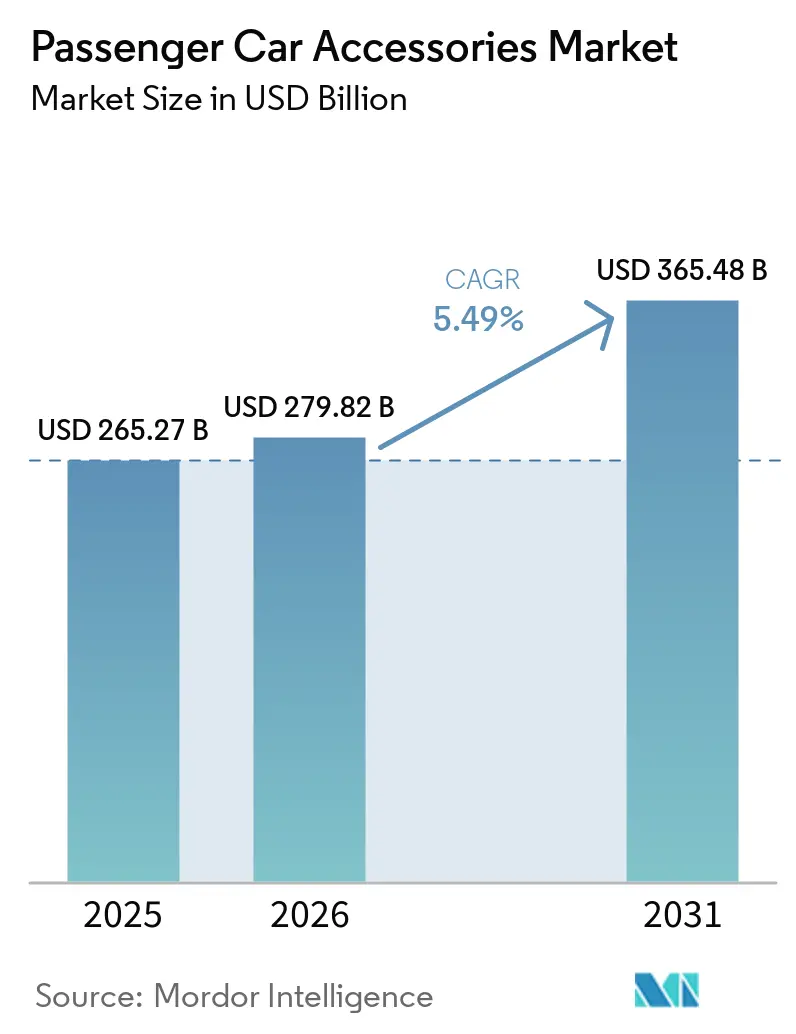
The passenger car accessories market was valued at USD 265.27 billion in 2025 and estimated to grow from USD 279.82 billion in 2026 to reach USD 365.48 billion by 2031, at a CAGR of 5.49% during the forecast period (2026-2031). Steady growth stems from rising SUV and crossover sales, e-commerce-led aftermarket expansion, and OEM moves toward subscription-based connected-car features. Asia-Pacific retains demand leadership, reflecting China’s component manufacturing scale and India’s rapid electric-mobility adoption. Interior upgrades, especially infotainment and smart-surface solutions, drive recurring revenue, while exterior categories gain momentum from lifestyle modifications and lightweight EV-compatible designs. Competitive intensity remains moderate as platform consolidations, ADAS-ready accessories, and sustainable material innovations reshape value pools within the wider car accessories market.
Key Report Takeaways
- By application, interior accessories led with 57.68% revenue share in 2025; exterior accessories are projected to grow at an 8.18% CAGR through 2031.
- By sales channel, the OEM segment held 75.63% of the car accessories market share in 2025, while the aftermarket is set to expand at a 9.71% CAGR to 2031.
- By vehicle type, compact and mid-size SUVs and CUVs captured 36.05% of the car accessories market size in 2025; electric vehicles are forecast to record the fastest 8.61% CAGR during 2026-2031.
- By material, plastic maintained 49.54% share of the overall market in 2025, whereas vegan and synthetic leather alternatives are expected to rise at an 8.08% CAGR.
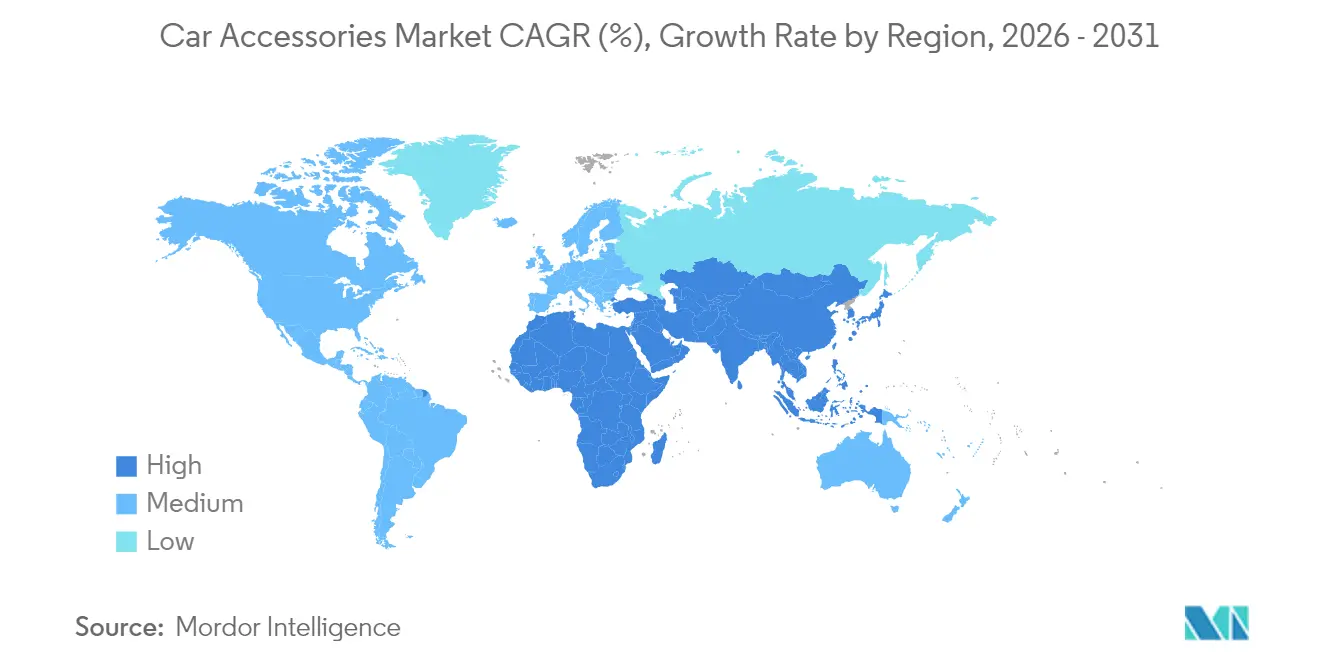
- By geography, Asia-Pacific commanded 63.78% revenue share in 2025 and is projected to post the strongest 7.63% CAGR over the outlook period.
Note: Market size and forecast figures in this report are generated using Mordor Intelligence’s proprietary estimation framework, updated with the latest available data and insights as of 2026.
Market Trends and Insights
Drivers Impact Analysis of Passenger Car Accessories Market*
| Driver | (~) % Impact on CAGR Forecast | Geographic Relevance | Impact Timeline |
|---|---|---|---|
| Surge in SUV and CUV Accessorizing | +1.2% | Global, strongest in North America and APAC | Medium term (2-4 years) |
| Growth of E-Commerce-Led Aftermarket | +1.1% | Global, led by North America and China | Short term (≤ 2 years) |
| OEM Focus on Connected-Car Upgrade Cycles | +0.9% | Global, premium segments first | Medium term (2-4 years) |
| Rising Average Vehicle Age in Core Markets | +0.8% | North America and Europe primarily | Long term (≥ 4 years) |
| Lightweight Modular Accessories for EV Range-Boost | +0.7% | APAC core, spill-over to EU and North America | Long term (≥ 4 years) |
| Smart Interior Surfaces (HMI/Gesture) Adoption | +0.6% | Global, luxury trickle-down pattern | Medium term (2-4 years) |
| Source: Mordor Intelligence | |||
Surge in SUV and CUV Accessorizing
In the Passenger Car Accessories Market, the growing dominance of sport utility vehicles and crossovers is reshaping demand patterns, accelerating sales of roof carriers, running boards, body cladding, cargo organizers, and protective trims that are less relevant for traditional sedans. Compact SUVs, particularly in urban areas, are driving higher personalization trends as consumers increasingly seek aesthetic upgrades, tech add-ons, and lifestyle-oriented enhancements aligned with global styling preferences. This shift is boosting revenue in the exterior and utility accessory segments while also increasing demand for premium interior customization packages. At the same time, the proliferation of advanced driver assistance systems is compelling manufacturers to redesign accessories to ensure that cameras, radar sensors, and parking modules remain unobstructed. Accessory suppliers certifying sensor integrity products secure premium positioning across the broader car accessories market[1]“Emerging Trends Among SUV Enthusiasts,” Specialty Equipment Market Association, sema.org.
Growth of E-Commerce-Led Aftermarket
Online parts portals are outpacing traditional brick-and-mortar channels in the Passenger Car Accessories Market as AI-powered fitment tools improve search accuracy, increase conversion rates, and significantly reduce product returns. Platforms such as NAPA Auto Parts, through its online channel, have demonstrated the scale advantages of digital commerce, with hundreds of thousands of monthly transactions highlighting strong repeat demand and streamlined logistics efficiencies. E-commerce also enables smaller and niche accessory brands to bypass multilayer distributor networks, directly reaching consumers and monetizing long tail demand across regions. However, the rapid expansion of online marketplaces has increased exposure to counterfeit and substandard components, prompting investments in QR-based authentication, blockchain-backed traceability, and verified seller programs to safeguard consumer trust and protect the growing digital share of the car accessories ecosystem.
OEM Focus on Connected-Car Upgrade Cycles
Manufacturers now treat accessories as software-enabled services rather than one-time hardware sales. Panasonic Automotive’s Neuron compute platform reduces control units by up to 80% and supports over-the-air feature activation, creating subscription revenue streams[2]“Neuron High-Performance Compute Platform,” Panasonic Corporation, panasonic.com. Harman International forecasts that infotainment and connected services will emerge as the second-largest automotive software revenue pool by 2030, highlighting the structural shift toward software-defined value creation within the Passenger Car Accessories Market. Early deployment across premium vehicle lines is expected to cascade into mid-range and mass market models as hardware becomes standardized and feature activation increasingly moves to over-the-air updates. However, tighter OEM control over operating systems, encrypted gateways, and centralized vehicle architectures may limit independent aftermarket coding and retrofitting access. This evolution is likely to redraw competitive boundaries, concentrating value capture among OEM-aligned suppliers while compelling traditional accessory players to pivot toward certified digital integrations and subscription-compatible enhancements.
Rising Average Vehicle Age in Core Markets
With the average vehicle age in the United States reaching around 12.5 years, owners are increasingly choosing to upgrade interiors, electronics, and protective accessories instead of purchasing new cars, reinforcing resilience in the Passenger Car Accessories Market. Extended ownership periods are stimulating replacement cycles for floor mats, seat covers, infotainment retrofits, ambient lighting kits, and protective coatings, particularly as repair and financing costs remain elevated. A comparable dynamic is visible across Europe, where aging vehicle fleets gradually shift from authorized dealer servicing to independent workshops once warranties expire, expanding aftermarket sales channels. This mature-vehicle demographic typically prioritizes interior comfort, cosmetic refreshment, and connectivity upgrades over performance modifications, generating stable, recurring demand that helps offset the cyclical volatility of new vehicle sales within the broader car accessories industry.
Restraints Impact Analysis of Passenger Car Accessories Market*
| Restraint | (~) % Impact on CAGR Forecast | Geographic Relevance | Impact Timeline |
|---|---|---|---|
| Counterfeit and Grey-Market Parts Penetration | -0.9% | Global, strongest impact in emerging markets | Short term (≤ 2 years) |
| Reduced Parts Count In BEVs Curbing Demand | -0.8% | APAC and EU primarily, spreading globally | Long term (≥ 4 years) |
| Safety-Critical ADAS Sensors Limiting Exterior Mods | -0.7% | Global, led by EU and North America regulations | Medium term (2-4 years) |
| Raw-Material Price Volatility (Plastics and Alloys) | -0.5% | Global, manufacturing-heavy regions | Short term (≤ 2 years) |
| Source: Mordor Intelligence | |||
Counterfeit and Grey-Market Parts Penetration
Illicit parts erode consumer confidence and trigger safety recalls. The industry-led “Brakes on Fakes” campaign highlights risks from sub-standard brake components that can fail under load[3]“Brakes on Fakes Initiative,” Auto Care Association, autocare.org. E-commerce anonymity further amplifies counterfeit exposure in the Passenger Car Accessories Market, particularly across price-sensitive regions where consumers often prioritize lower upfront costs over brand verification. Limited physical inspection and third-party marketplace structures make it easier for unauthorized sellers to distribute imitation or substandard components. In response, manufacturers are adopting blockchain-based provenance tracking, serialized QR code authentication on packaging, and tamper-evident labeling to enhance supply chain transparency and protect brand integrity. However, the capital investment required for traceability infrastructure, digital verification platforms, and packaging redesign places financial strain on small and mid-sized suppliers, potentially accelerating market consolidation in favor of larger players with stronger compliance and technology budgets.
Safety-Critical ADAS Sensors Limiting Exterior Mods
Mandatory safety suites such as emergency lane keeping and automatic braking require unobstructed radar and camera zones, fundamentally influencing accessory design and installation standards in the market. Exterior add-ons, including grille guards, bumper protectors, light bars, windshield tints, and even license plate frames, must now be engineered to avoid interference with forward-facing cameras, radar modules, and ultrasonic sensors. The EU’s General Safety Regulation II applies to all new vehicles from July 2024, effectively outlawing bull bars or grille guards that block sensor grids[4]“Understanding EU General Safety Regulation II,” Continental AG, continental.com. Accessory makers now engineer ADAS-friendly bumper covers and badge mounts, yet redesign cycles increase production costs and lengthen time-to-market for exterior innovations.
*Our forecasts treat driver/restraint impacts as directional, not additive. The impact forecasts reflect baseline growth, mix effects, and variable interactions.
Passenger Car Accessories Market Segment Analysis
By Application:
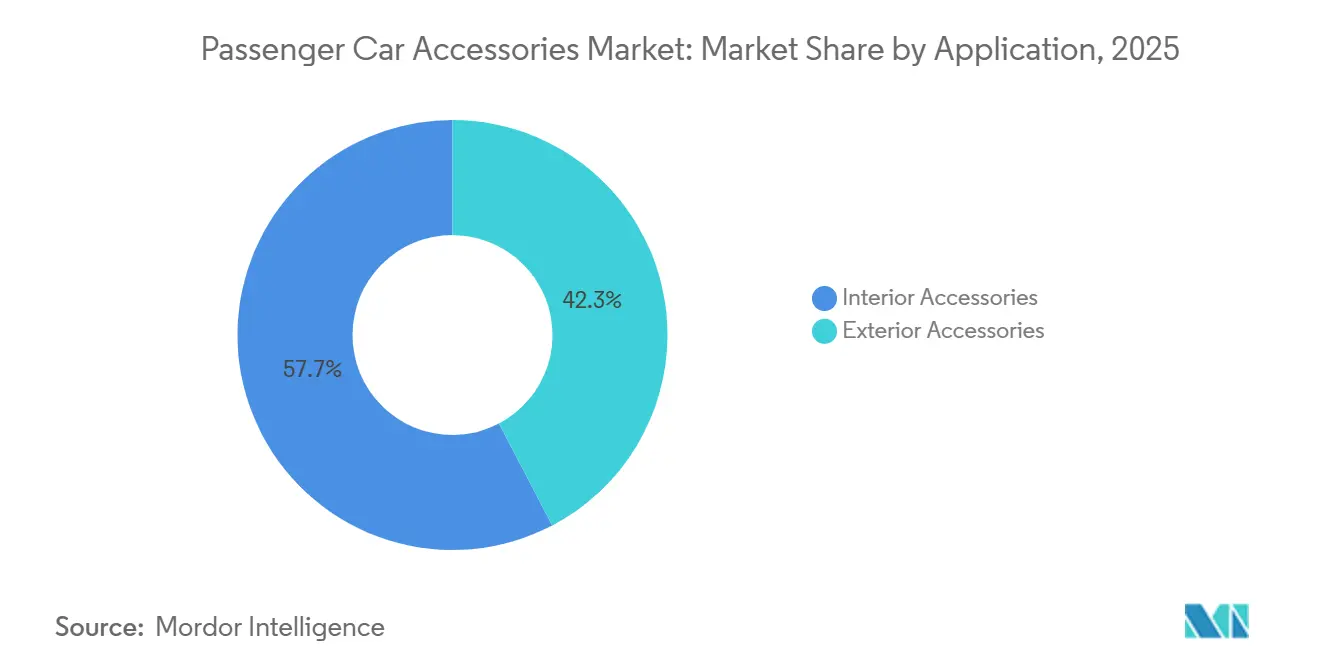
Interior Dominance Meets Exterior InnovationInterior accessories accounted for 57.68% of the car accessories market in 2025, driven by strong demand for infotainment upgrades, premium seat upholstery, and electronic security systems. OEM shifts toward software-defined vehicle platforms enable feature enhancements through over-the-air updates, extending revenue opportunities beyond the initial sale. High-replacement products such as floor mats, climate-regulating seat covers, digital cockpit add-ons, and ambient lighting systems continue to generate recurring income across longer ownership cycles, reinforcing interior accessories as the core revenue contributor.
Exterior accessories are projected to grow at the fastest 8.18% CAGR, supported by rising consumer interest in personalization and utility-focused upgrades. LED lighting kits, aerodynamic styling components, and modular roof rack systems are seeing strong uptake, particularly among SUV and crossover owners. Expanding outdoor recreation trends and increasing EV adoption are steering innovation toward lightweight, energy-efficient materials, enabling the exterior segment to outpace overall market growth.


By Sales Channel:
OEM Control Versus Aftermarket AgilityThe OEM channel held 75.63% of the market share in 2025, supported by bundled factory-approved components backed by warranty coverage and assured fitment standards. Automakers increasingly use connected-car data and embedded telematics to promote service packages and subscription-based accessory upgrades via in-vehicle interfaces. This vertically integrated ecosystem strengthens brand loyalty, enhances lifecycle revenue capture, and helps stabilize margins across the car accessories market.
The aftermarket is projected to expand at a robust 9.71% CAGR, driven by e-commerce penetration, wider product assortments, and price competitiveness. Advanced inventory algorithms and VIN-based fitment tools enable independent sellers to replicate OEM-level accuracy and consumer confidence. As digital marketplaces scale globally, the car accessories industry is gradually rebalancing, with niche and cross-border brands gaining visibility despite OEM efforts to protect share through proprietary software controls and data integration frameworks.
By Vehicle Type:
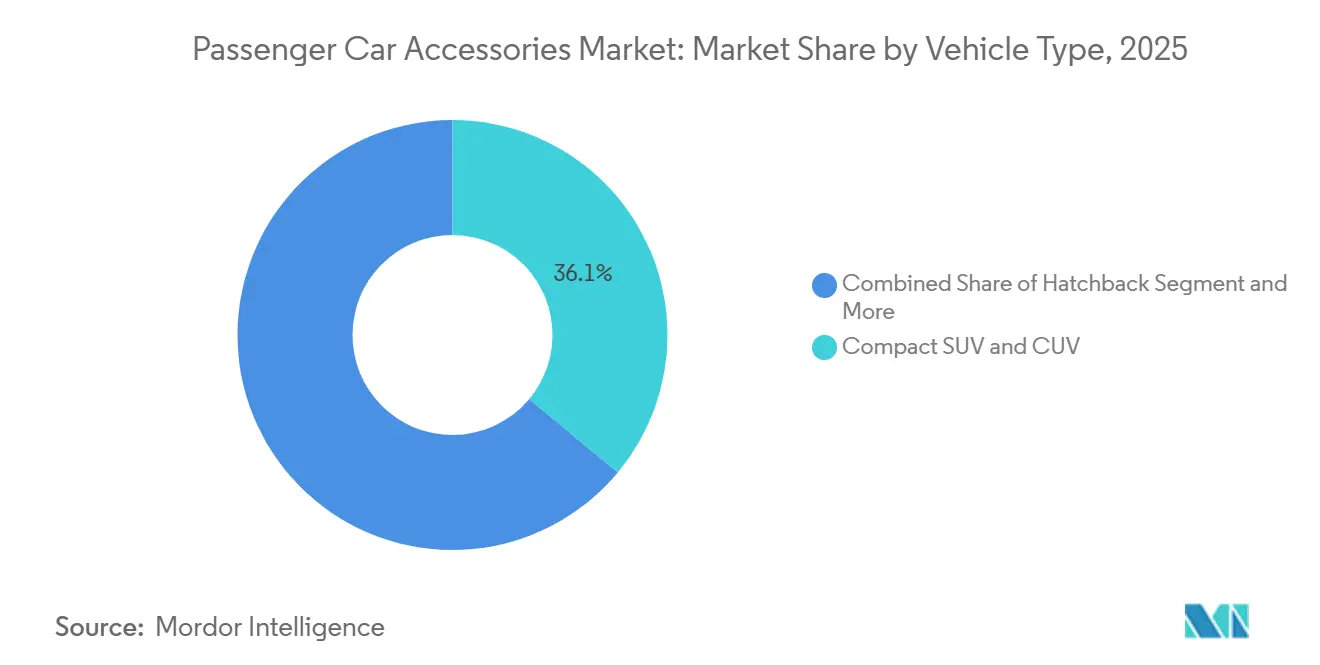
SUV Platforms Drive Accessorization TrendsCompact and mid-size SUVs accounted for 36.05% of the car accessories market size in 2025, reflecting consumer preference for versatile vehicles compatible with roof carriers, side steps, cargo organizers, and protective body cladding. Higher ride height and modular platforms naturally support accessory customization, increasing attachment rates at the dealership level. Strong SUV penetration across North America and China further amplifies bundled accessory sales, reinforcing this segment’s revenue dominance.
Electric vehicles are forecast to register the fastest 8.61% CAGR through 2031, supported by rising global electrification targets and expanding model availability. Demand is growing for lightweight modular add-ons, aerodynamic wheel inserts, charging-port protection systems, and EV-specific interior enhancements designed to preserve driving range. Suppliers that meet electromagnetic compatibility standards and safeguard battery thermal management systems are securing early advantages, accelerating EV-focused diversification within the broader car accessories market.

By Material:
Sustainability Reshapes Supply ChainsPlastic maintained a 49.54% share in 2025, supported by its cost-efficient injection molding, durability, and compatibility with complex interior contours and exterior styling components. Its lightweight properties also aid fuel efficiency and EV range optimization. Advancements in recycled polycarbonate blends and bio-based resins are strengthening circular-economy positioning while preserving mechanical strength and price competitiveness, sustaining plastic’s leadership across high-volume accessory categories.
Vegan and synthetic leather alternatives are projected to grow at an 8.08% CAGR as automakers and consumers prioritize animal-free, lower-carbon interior materials. Innovations such as water-based polyurethane coatings, including Covestro’s INSQIN technology that reduces water consumption by 95% and CO2 emissions by 45%, are accelerating commercialization. Adoption is strongest in premium EV models before gradually extending to mass-market vehicles as production scales improve cost efficiency, increasing the market share of sustainable upholstery solutions.
Geography Analysis
APAC Passenger Car Accessories Market
Asia-Pacific held 63.78% revenue in 2025 and is projected to grow 7.63% CAGR through 2031. China’s component manufacturing output expands exponentially and feeds OEM and aftermarket pipelines. India’s electric-mobility push widens demand for lightweight modular add-ons suited to local road conditions. Japan contributes design and HMI leadership, while South Korea supports supply-chain depth for display and battery integration. ASEAN markets ride rising disposable incomes and online retail proliferation, which enlarges the car accessories market.
North America Passenger Car Accessories Market
North America remains a vital profit center. Aging fleets and a strong DIY culture spur floor mats, lighting, and towing equipment sales. Although differing safety regulations fragment accessory homologation, Canada and Mexico anchor manufacturing and distribution corridors.
Europe Passenger Car Accessories Market
Europe confronts regulatory complexity but leverages engineering heritage. The EU’s General Safety Regulation II curbs certain exterior add-ons but fosters a premium for ADAS-compatible solutions that preserve sensor integrity. Continental’s 2024 aftermarket expansion added 700 SKUs, raising European market coverage by 50%. Germany and the United Kingdom dominate demand for premium interior tech, while France, Italy, and Spain emphasize cost-effective replacements. Eastern Europe’s role as a manufacturing hub grows as suppliers seek proximity to EU markets under resilient trade agreements.

Regulatory Landscape
Safety, data, and trade rules increasingly shape passenger car accessories design and go-to-market, especially for exterior fitments and connected interior upgrades. In Europe, General Safety Regulation II applying to all new vehicles from July 2024 tightens constraints on exterior modifications that can interfere with radar and camera fields. This is accelerating demand for ADAS-compatible lighting, mounts, and fascia-related accessories. At the same time, UNECE WP.29 continues to update harmonized vehicle regulations, including amendments adopted in March 2026 to UN Regulation No. 48 affecting lighting functionality and compatibility with driver assistance controls, raising compliance expectations for LED and auxiliary lighting accessory makers selling across multiple homologation regimes.
Regulation is also moving deeper into the aftermarket information layer and connected-vehicle supply chains. The EU Commission Delegated Regulation (EU) 2026/699 requires standardized, machine-readable access to vehicle parts information (including OE parts numbers and VIN-based compatibility) for independent operators, which can change how digital fitment tools, catalog platforms, and independent repair ecosystems compete. On consumer protection, Directive (EU) 2024/1799 (repair of goods) requires Member States to apply national rules from 31 July 2026, reinforcing availability of repair options that support replacement and upgrade cycles for interior and exterior accessories. In the United States, connected-vehicle-related ICTS supply-chain scrutiny published in the Federal Register (January 2025) and heightened import enforcement behavior, including tariff classification and valuation checks, add compliance and documentation burdens for accessory importers and e-commerce sellers with cross-border flows.
Value Chain Analysis
The passenger car accessories value chain starts with raw materials and components, including plastics and coatings for trim, metals for racks and wheels, and electronics for infotainment, lighting, sensors, and power distribution. These then flow through Tier 2 and Tier 1 suppliers into OEM fitment programs and the aftermarket. OEM channels dominate volume through factory-approved accessories bundled at the dealership, increasingly tied to software-defined vehicle architectures that enable feature activation and upgrades. The aftermarket chain includes brand owners, distributors and wholesalers, installers, and rapidly growing e-commerce marketplaces where fitment data, authentication, and reverse logistics (returns) have become core capabilities alongside inventory management.
Supply-side constraints and regionalization dynamics shape cost and availability for accessory categories with high electronic content and specialized materials. Export controls and critical material bottlenecks can disrupt upstream supply, while tight capacity in automotive-grade legacy-node semiconductors (28 nm to 90 nm) constrains ECU-related accessory production and lead times for connected interior upgrades. Margin pressure across the supplier base, driven by higher R&D spend on electrification and digital components, is pushing portfolio optimization and deeper partnerships, while distributors and platforms consolidate to gain scale in logistics, data, and fulfillment. Across both OEM and aftermarket routes, compliance, provenance, and VIN-level fitment data are becoming value-chain differentiators rather than back-office functions.
Competitive Landscape
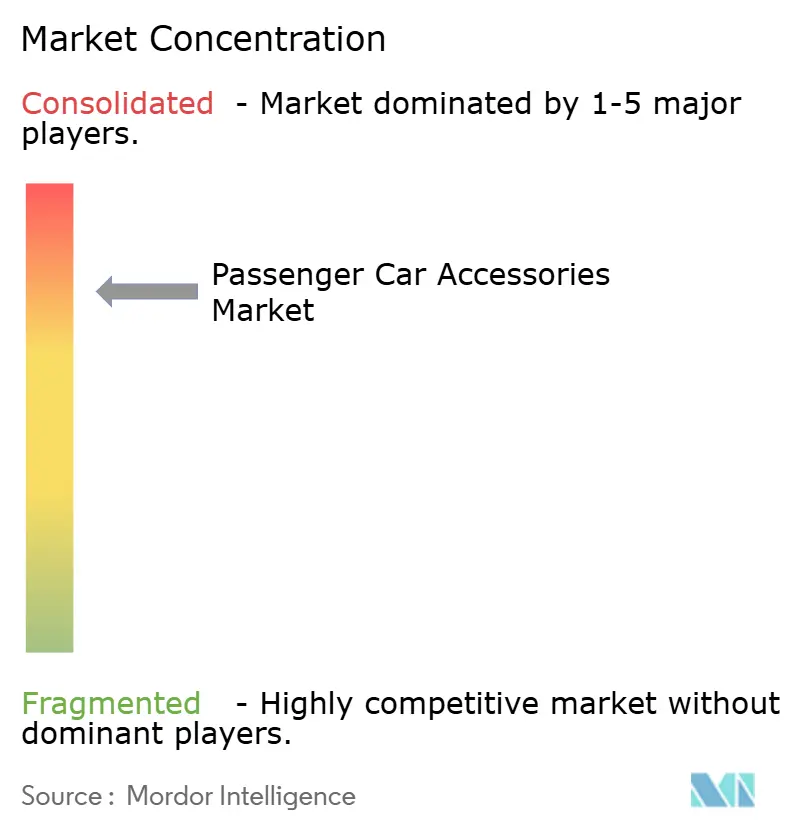
The car accessories market is moderately fragmented. Top players pursue scale and technology depth via acquisitions and partnerships, while hundreds of regional specialists target niche categories. FORVIA’s merger of Faurecia and HELLA unites seating, lighting, and electronics platforms, enabling bundled cockpit solutions for OEM programs. Panasonic’s strategic pact with Arm to standardize software-defined vehicle architecture reduces development time for connected accessories.
Aftermarket distributors also consolidate. Carlyle’s purchase of Worldpac from Advance Auto Parts in August 2024 reshaped parts logistics and intensified competition for installer loyalty. Suppliers invest in AI personalization engines that tailor accessory recommendations based on driving data, reinforcing customer lock-in. Yet, entrepreneurial brands flourish by launching ADAS-ready grille inserts, sustainable seat fabrics, or EV-specific cargo kits on global e-commerce platforms, highlighting persistent entry pathways within the car accessories industry.
Mergers and acquisitions occurred in reccent years were aimed at securing connected-tech capability, vertical integration, or regional expansion. Strategic moves such as Continental’s impending spin-off of its Automotive business and Adient’s automation pact with Paslin illustrate focus on agility and cost optimization as profit pools migrate from mechanical components to software-enabled services.
Passenger Car Accessories Industry Leaders
Lear Corporation
Faurecia SE
Continental AG
Denso Corporation
Panasonic Holdings Corp.
- *Disclaimer: Major Players sorted in no particular order
Passenger Car Accessories Market Companies Covered in this Report
- Adient PLC
- Grupo Antolin
- Panasonic Holdings Corp.
- Faurecia SE
- Lear Corporation
- Continental AG
- Denso Corporation
- Harman International
- Robert Bosch GmbH
- JVCKenwood Corp.
- Alps Alpine Co.
- Magna International
- Pioneer Corporation
- Garmin Ltd.
- Covercraft Industries
- Webasto SE
- Thule Group AB
- 3M Company
- Katzkin Leather
- Valeo SA
- Gentex Corporation
- Momo Srl
- Visteon Corporation
- Yokohama Wheels
- Clarion Co.

Market Opportunities and Future Outlook
ADAS proliferation and the regulatory push for sensor-safe vehicle configurations are expanding addressable whitespace for accessories engineered to preserve radar and camera performance, particularly in exterior lighting, mounts, and fascia-adjacent parts. The opportunity is concentrated in products and services that pair hardware with calibration-aware installation and diagnostics, an emphasis reflected in technical aftermarket coverage positioning ADAS and diagnostics as a 2026 capability focus. Interior accessories also benefit from software-defined architectures and zonal computing, where OEMs package features as upgrades. Suppliers that provide electronics, HMI surfaces, and power distribution modules can attach to new vehicle platforms while continuing to support retrofit and replacement cycles in older fleets.
Right-to-repair and data-access debates are creating additional whitespace for independent operators and digital platforms that can operationalize parts and diagnostic information into accurate fitment, pricing, and service workflows. In the United States, a House hearing in January 2026 explored the REPAIR Act and access to repair and diagnostic data for software-driven vehicles, while in Europe, supplier association CLEPA called for clearer guidance on in-vehicle data access under the European Commission Data Act. Europe is also formalizing machine-readable, VIN-linked parts information access requirements through Commission Delegated Regulation (EU) 2026/699, which supports scalable cataloging and compatibility services for independent channels. On the demand side, specialty equipment remains a sizable, measurable pool in categories that overlap with passenger-vehicle personalization and utility; SEMA reported nearly USD 53 billion for the specialty-equipment aftermarket in its 2026 market reporting, reinforcing the commercial relevance of accessory-led upgrade behavior.
Recent Industry Developments in Passenger Car Accessories Market
- June 2026: FORVIA secured a major European program for an advanced inside rear-view mirror that integrates an occupant and driver monitoring system camera. The award embeds safety sensing into a traditional interior component, increasing the content value of cabin accessories aligned with monitoring and HMI trends. Production is scheduled to start in June 2029 at a European manufacturing facility, indicating a long-cycle OEM pipeline for camera-enabled interior systems.
- February 2026: FORVIA was awarded a multi-year project to supply seat sets for the Luxeed premium electric brand, with start of production scheduled for August 2026. The program includes a new production line in Wuhu, China, supported by component plants in Jiaxing, Wuxi, and Yancheng, strengthening regional supply for premium interior upgrades. This reinforces seating as a high-value accessory-adjacent domain where comfort features and premium materials drive differentiation in EV platforms.
- May 2024: Genuine Parts Company acquired Motor Parts & Equipment Corporation, adding 181 NAPA stores to its network. The transaction expands aftermarket distribution reach and improves last-mile availability for fast-moving accessory categories such as mats, lighting, and protective products. A larger store footprint also supports omni-channel fulfillment models that blend online ordering with local pickup and installer support.


Passenger Car Accessories Market Report Scope and Research Methodology
Market Definition and Coverage
For this study, the passenger car accessories market includes add-on and replacement products purchased for passenger vehicles to improve comfort, appearance, safety, and convenience. The market value is counted in USD at the point these accessories are sold into the market, covering both OEM-fitted demand and aftermarket demand.
Scope exclusions: heavy commercial vehicles, two-wheelers, and vehicle repair labor or service revenue are not included in the market value.
Segments Covered in This Report
- By Application
- Interior Accessories
- Infotainment Systems
- Floor Carpets and Mats
- Seat Covers
- Electrical and Electronic Systems
- Security Systems
- Others
- Exterior Accessories
- LED and Auxiliary Lighting
- Alloy Wheels
- Body Kits and Aero Parts
- Roof Racks and Carriers
- Window Films and Tinting
- Covers (Car, Wheel, Spare-tire)
- Crash Guards and Bull Bars
- Others
- Interior Accessories
- By Sales Channel
- OEM Fitted
- Aftermarket
- By Vehicle Type
- Hatchback
- Sedan
- Sports and Luxury Cars
- Compact SUV and CUV
- Mid and Full-size SUV
- Pick-up Trucks and Light Trucks
- By Material Type
- Plastic
- Metal
- Leather
- Others
- By Geography
- North America
- United States
- Canada
- Rest of North America
- South America
- Brazil
- Argentina
- Rest of South America
- Europe
- Germany
- United Kingdom
- France
- Italy
- Spain
- Russia
- Rest of Europe
- Asia-Pacific
- China
- India
- Japan
- South Korea
- Rest of Asia-Pacific
- Middle East and Africa
- Saudi Arabia
- United Arab Emirates
- Turkey
- Egypt
- South Africa
- Rest of Middle East and Africa
- North America
Data Sources, Market Sizing, and Validation
Desk Research
Desk research was used to build the fact base around the passenger car parc, new passenger car sales, and accessory purchasing behavior by region. We referenced public sources such as national transport ministries and vehicle registration statistics, UN Comtrade trade flows for key accessory categories, customs and tariff schedules, and road safety agencies that publish fitment and compliance signals for items like lighting and camera-related add-ons.
To translate these signals into a practical sizing model, we also reviewed company annual reports and filings, investor presentations, and product catalogs that indicate accessory mix and pricing ranges. In a few cases, paid subscriptions that compile company financials, news and financials, shipment-level import and export records, and patent filings were used to cross-check the direction of price and feature upgrades in popular accessories. The desk sources listed here are not exhaustive, and many other public references were also reviewed to clarify and validate individual assumptions.
Primary Interviews and Surveys
Primary work focused on validating what is counted as an accessory sale, how OEM-fitted and aftermarket volumes split in practice, and how average selling prices move as content becomes more electronic. Interviews covered accessory brands, distributors, and retailers, along with informed buyers. We collected feedback across APAC, EMEA, and the Americas to reduce single-region bias when final assumptions were locked.
Distribution of primary research fieldwork respondents
| Company type | Respondent position | Region |
|---|---|---|
| Top tier: 31% | CXOs: 16% | APAC: 41% |
| Mid tier: 53% | Functional/Unit leaders: 29% | EMEA: 36% |
| Smaller Players: 16% | Managers: 55% | Americas: 23% |
Market-Sizing & Forecasting
Sizing starts with a top-down build where passenger car parc and new car sales are reconstructed by region, and then mapped to typical accessory attach rates and replacement cycles by product family. After shaping the demand pool, average selling prices are applied with checks for channel mix, since OEM-fitted content and aftermarket baskets do not price the same.
The inputs that mattered most were passenger car parc by country, new passenger car sales, the share of OEM-fitted versus aftermarket purchases, e-commerce participation in accessory buying, and the steady shift toward electronic and safety-related add-ons, such as camera and lighting upgrades. Where desk data was thin, we filled gaps with interview-based ranges, then tested outputs against visible signals like trade movement for accessory-heavy categories and reported revenue direction from major accessory sellers.
For forecasting, scenario analysis was used so the model could adjust with different paths for vehicle sales, consumer discretionary spend, and the speed of feature upgrades in accessories. The final outlook was adjusted only after directional assumptions were confirmed by primary respondents, then cross-checked with selective bottom-up approximations, such as sampled price points multiplied by realistic volumes for a few high-penetration accessory groups.
Data Validation & Update Cycle
Validation was done through triangulation across three layers: macro vehicle indicators, accessory demand assumptions, and price logic by channel. Analysts ran variance checks at the region level to flag outliers, then revisited the inputs that caused mismatches, such as attach rates that appeared too high for the local vehicle parc profile.
Before sign-off, results go through a multi-step review so the math trail stays clear and consistent, and re-contacts are triggered when a key metric shifts or when the channel split looks different across sources. Reports are refreshed annually, with interim updates when material events occur, and a final pre-delivery pass is done so clients receive the latest updated view.
Mordor Intelligence's Passenger Car Accessories Market Size Measured Against Other Published Estimates
Published market sizes for passenger car accessories can look far apart, even when the topic sounds the same, because each publisher draws the line around products and channels in a slightly different way. Differences also show up when the base year changes, when exchange-rate timing is not consistent, and when the forecast assumes either a faster or slower shift toward higher-priced electronic accessories.
The biggest gap drivers in this market usually come from scope choices, such as whether broad automotive components are mixed in, whether only the aftermarket is counted, and whether interior, exterior, and electronic add-ons are treated as accessories in every case. Another common driver is how OEM-fitted content is valued, since factory-fit bundles and dealer-installed packs can be counted differently, which then shifts the starting market size before growth is applied.
Benchmark comparison
| Source | Market Size | Gaps in Research Methodology |
|---|---|---|
| Mordor Intelligence | USD 279.82 B (2026) | |
| Global Research Firm A | USD 283.39 B (2024) | Uses a different base year and a broader segmentation set that can shift the effective accessory mix, and the growth window begins later, which can lift the implied trajectory versus a 2026-based model. |
| Industry Research Group B | USD 383.68 B (2025) | Employs a wider parts-style definition that can pull in adjacent vehicle components and electrical devices beyond typical accessory baskets, and it does not clearly separate OEM-fitted versus aftermarket value capture. |
The spread in the table mostly comes down to what is treated as an accessory sale and how OEM-fitted content is priced, and those choices move the starting point more than the growth rate. By keeping the count limited to passenger car accessories sold through OEM-fitted and aftermarket channels, and by checking attach rates and price progression against trade and channel feedback, a more repeatable market total is produced, which is the approach applied by Mordor Intelligence.


Key Questions Answered in the Report
What is the current size of the car accessories market?
The car accessories market size reached USD 279.82 billion in 2026 and is projected to rise to USD 365.48 billion by 2031.
Which region dominates demand for car accessories?
Asia-Pacific leads with 63.78% revenue share in 2025 and is also forecast to post the fastest 7.63% CAGR through 2031.
Which product category holds the largest share?
Interior accessories commanded 57.68% of 2025 sales, driven by infotainment upgrades, seat covers, and connectivity add-ons.
How fast is the aftermarket channel growing?
Aftermarket sales are expected to expand at a 9.71% CAGR between 2026 and 2031, outpacing the OEM channel.
What is the biggest restraint facing accessory suppliers?
Counterfeit and grey-market parts reduce consumer trust and impose negative impact on the market’s CAGR, especially in emerging economies.
How will electric vehicles influence accessory demand?
EVs create an 8.61% CAGR opportunity for lightweight, modular accessories that preserve driving range while adding utility and personalization.
Page last updated on:


 Your data is secure and never sold or shared.


