
Market Overview
| Study Period | 2020 - 2031 |
|---|---|
| Forecast Data Period | 2026 - 2031 |
| Base Year Market Size (2025) | 502.63 Million liters |
| Market Volume (2026) | 513.49 Million liters |
| Market Volume (2031) | 571.62 Million liters |
| Growth Rate (2026 - 2031) | 2.16 % |
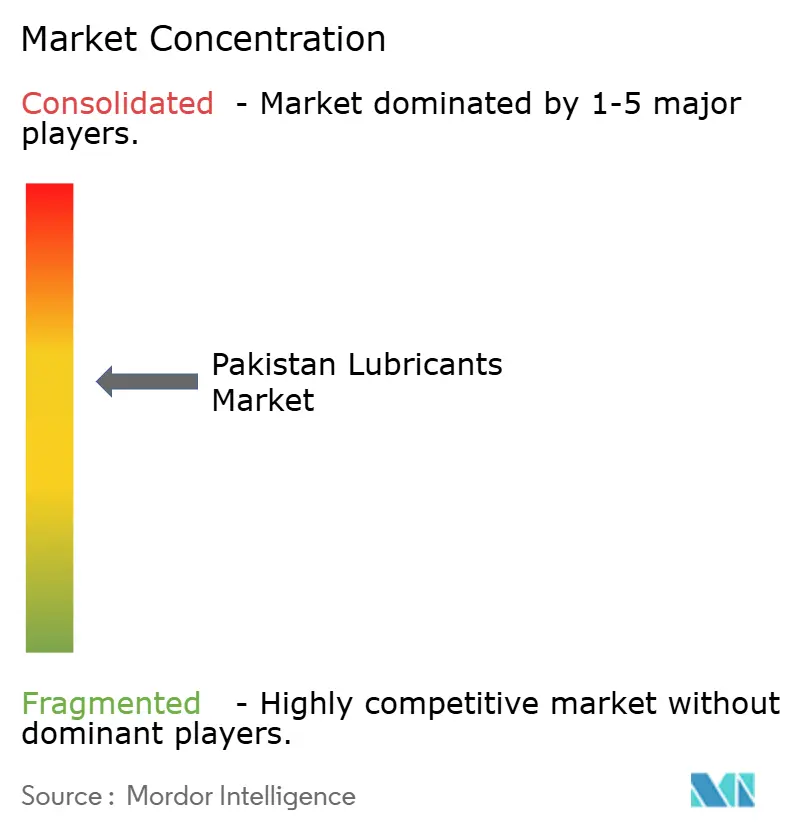
| Market Concentration | Medium |
Major Players *Disclaimer: Major Players sorted in no particular order Image © Mordor Intelligence. Reuse requires attribution under CC BY 4.0. | |
Pakistan Lubricants Market Analysis by Mordor Intelligence
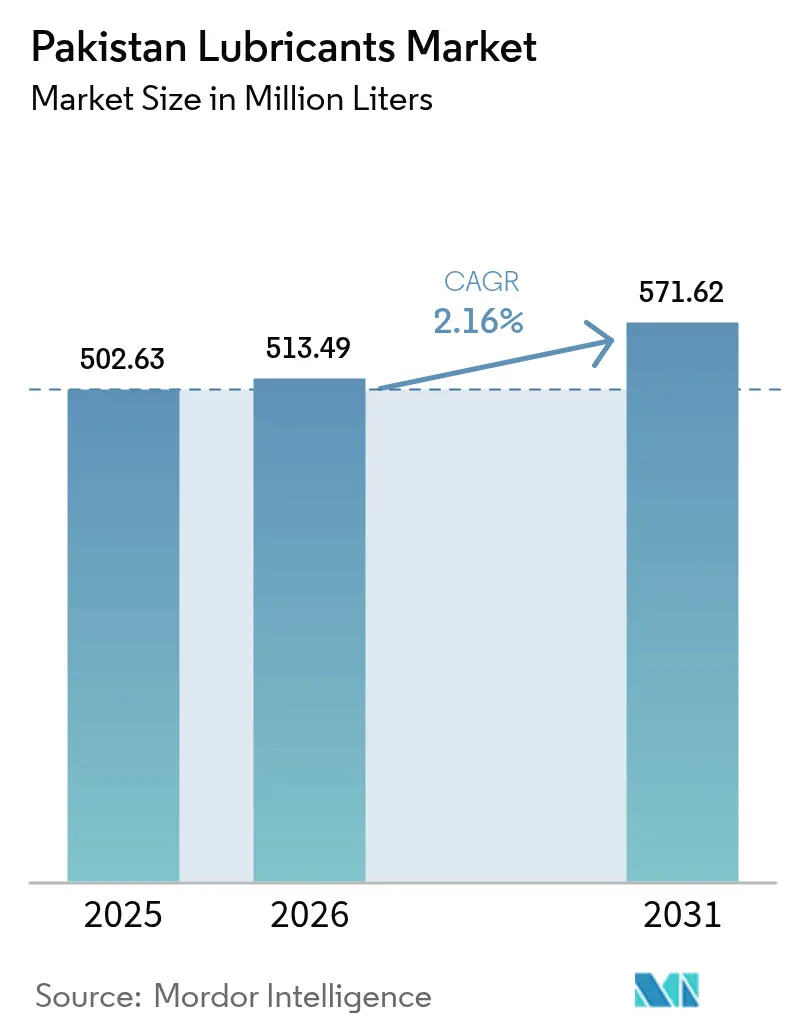
Pakistan Lubricants Market size in 2026 is estimated at 513.49 million liters, growing from 2025 value of 502.63 million liters with 2031 projections showing 571.62 million liters, growing at 2.16% CAGR over 2026-2031. Stable industrial recovery, infrastructure spending tied to the China-Pakistan Economic Corridor, and steady vehicle parc growth are anchoring demand. Heightened power generation activity, capacity additions in refining and blending, and a gradual shift toward synthetic grades are further supporting volume expansion. Strategic retail and blending investments by multinationals underline long-run confidence despite currency volatility and energy constraints. A surge in e-commerce-driven logistics, stricter equipment performance standards, and supportive tariff reforms are opening premium opportunities for early movers within the Pakistan lubricants market.
Key Report Takeaways
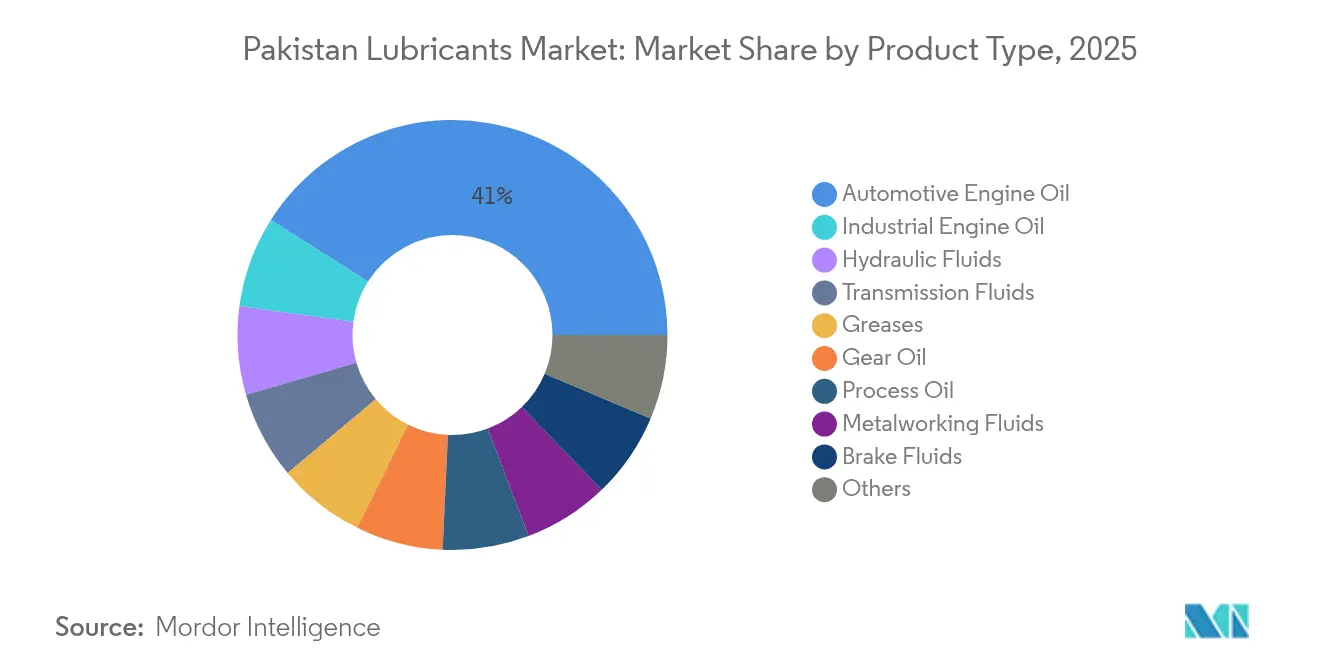
- By product category, automotive engine oil led with a 41.02% share of the Pakistani lubricants market in 2025; industrial engine oil is forecast to expand at a 2.29% CAGR through 2031.
- By end-user industry, the automotive segment accounted for 54.01% of the Pakistan lubricants market size in 2025, while industrial applications are projected to advance at a 2.18% CAGR through 2031.
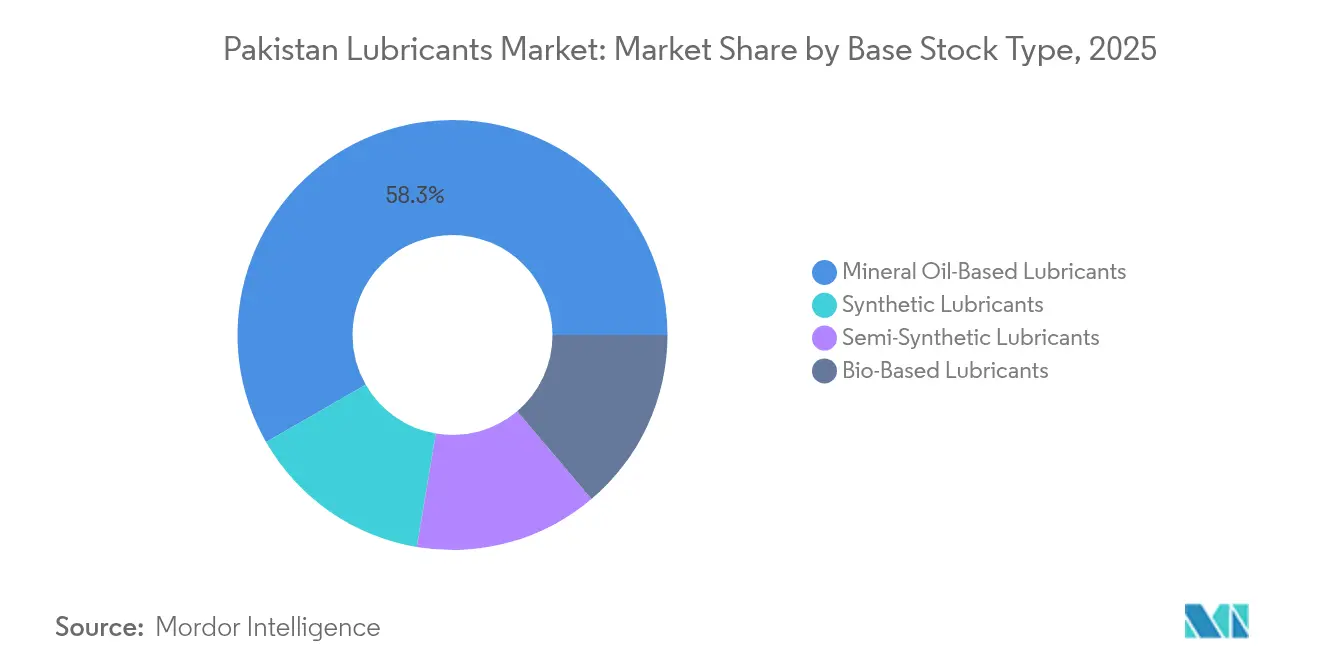
- By base stock, mineral oils captured 58.29% of Pakistan's lubricants market share in 2025; bio-based lubricants posted the fastest growth at a 3.02% CAGR to 2031.
Note: Market size and forecast figures in this report are generated using Mordor Intelligence’s proprietary estimation framework, updated with the latest available data and insights as of 2026.
Pakistan Lubricants Market Trends and Insights
Drivers Impact Analysis*
| Drivers | (~) % Impact on CAGR Forecast | Geographic Relevance | Impact Timeline |
|---|---|---|---|
| Steady recovery in industrial and transportation sectors post-COVID-19 | +0.8% | Punjab and Sindh industrial hubs | Medium term (2-4 years) |
| CPEC-linked growth in trucking and logistics corridors | +0.5% | Along Gwadar–Kashgar route | Long term (≥ 4 years) |
| Industrialisation and new power projects boosting lube consumption | +0.4% | Industrial zones and power sites | Long term (≥ 4 years) |
| Increasing shift toward synthetic lubricants for extended drain intervals | +0.3% | Urban centers and commercial fleets | Medium term (2-4 years) |
| Government incentives for local blending and packaging plants | +0.2% | Karachi, Lahore, Faisalabad | Short term (≤ 2 years) |
| Source: Mordor Intelligence | |||
Steady Recovery in Industrial and Transportation Sectors Post-COVID-19
Manufacturing utilization has rebounded, spurring lubricant offtake in textiles, steel, and petrochemicals. Trucking mileage has normalized, lifting demand for heavy-duty engine oils across Pakistan's lubricants market routes. PSO reported 9.7% growth in lubricant sales for FY 2024, outpacing overall volume expansion, underscoring a resilient end-use demand[1]. Freight operators are refreshing their fleets, which require higher-specification oils, while power plants running on furnace oil maintain a steady draw for turbine and generator lubricants. Together, these trends sustain baseline volume and tilt usage toward mid-tier synthetic blends across the Pakistan lubricants market.
CPEC-Linked Growth in Trucking and Logistics Corridors
The 3,000 km corridor from Gwadar to Kashgar is creating a dense network of logistics lanes. Extended-haul trucks require premium multigrade oils that can withstand higher thermal loads, which increases the value per liter sold. The construction of roads, ports, and special economic zones requires hydraulic fluids and gear oils for excavators and cranes deployed on site. Chinese contractors often specify global OEM-approved lubricants, positioning international suppliers with local blending ties to capture share. As cross-border freight costs rise, fleet operators favor extended drain formulations that reduce downtime, deepening synthetic penetration within the Pakistani lubricants market.
Industrialisation and New Power Projects Boosting Lube Consumption
Planned and operating thermal plants demand transformer oils, turbine lubricants, and gas-engine oils. Caltex fields GST and HDAX lines that target these niches. Refinery upgrading programs, such as Cnergyico’s USD 1 billion modernization, will require specialty process oils during shutdowns and restart phases. Gains in broader manufacturing sectors, including steel, textiles, and chemicals, increase the demand for metalworking fluids and gear lubricants. Premium formulations are increasingly preferred for critical equipment, helping to migrate volume from basic mineral oils to higher-value lines in the Pakistani lubricants market.
Increasing Shift Toward Synthetic Lubricants for Extended Drain Intervals
Fleet owners and industrial operators are adopting synthetic lubricants to reduce maintenance cycles and improve fuel economy. Shell unveiled “Shell Lubricant Solutions” in May 2024 to capitalize on this shift toward premium grades. New-generation engines entering Pakistan’s vehicle mix mandate API SP and ACEA C3 classifications that require synthetic or semi-synthetic base stocks. Lower oil change frequencies are compelling for long-haul trucks, where workshop access along rural routes remains limited. As additive technology and local blending sophistication improve, synthetics are poised to capture incremental points of Pakistan's lubricants market share.
Restraints Impact Analysis*
| Restraints | (~) % Impact on CAGR Forecast | Geographic Relevance | Impact Timeline |
|---|---|---|---|
| Base-oil import dependency impacting cost stability | -0.6% | Coastal refineries and blenders | Short term (≤ 2 years) |
| High prevalence of counterfeit and unorganised brands | -0.4% | Rural and semi-urban markets | Medium term (2-4 years) |
| Energy shortages and inflationary pressure curbing industrial output | -0.3% | Energy-intensive industries nationwide | Short term (≤ 2 years) |
| Source: Mordor Intelligence | |||
Base-Oil Import Dependency Impacting Cost Stability
Nearly all Group II and Group III feedstocks are imported, exposing blenders to currency swings and freight shocks. The National Tariff Policy 2025-30 maintains an 11% duty on base oils versus 20% on finished lubes, nudging firms to blend locally yet still leaving them vulnerable to volatile import bills. Exchange rate depreciation compresses margins for players unable to pass costs downstream. Inventory buffers become pricier, straining working capital and occasionally tightening supply, especially for premium synthetics within the Pakistan lubricants market.
High Prevalence of Counterfeit and Unorganised Brands
Informal recyclers re-refine used oils with minimal processing, flooding the market with cheap, counterfeit packs. Research shows 61% of collected engine oil is repurposed directly as commercial fuel or sub-standard lubricant[2]. Counterfeits erode trust and reduce willingness to pay for branded synthetics, particularly outside major cities. Legitimate players must invest in tamper-proof packaging and consumer education, thereby increasing marketing spend and complexity in rural channels of the Pakistani lubricants market.
*Our forecasts treat driver/restraint impacts as directional, not additive. The impact forecasts reflect baseline growth, mix effects, and variable interactions.
Segment Analysis
By Product Type: Engine Oils Maintain Leadership as Industrial Grades Accelerate
Automotive engine oil retained a 41.02% share of the Pakistan lubricants market in 2025, reflecting a large and aging vehicle parc that follows traditional maintenance practices. Industrial engine oil, driven by power and manufacturing investments, is the fastest-growing segment, with a 2.29% CAGR through 2031. Transmission fluids and gear oils are benefiting from the increased deployment of heavier off-road machinery on CPEC projects, while hydraulic fluids are tracking the sales of construction equipment. Brake fluids and greases, although smaller in volume, are gaining relevance as vehicle safety standards become increasingly stringent. Specialty grades such as turbine oil and transformer oil serve critical power assets, with OEM approvals driving premium pricing. Premium synthetics now permeate multiple product lines, elevating average selling prices in the Pakistan lubricants market.
The rising adoption of synthetic products is reshaping product mix dynamics. OEM drain-interval guidance is lengthening, and fleet operators prefer multigrade full synthetics for diesel engines that travel high mileages on the Karachi–Lahore corridor. Industrial buyers are migrating to anti-wear hydraulic oils that extend component life under intermittent power outage conditions. Process oils, used in rubber and plastic goods, correlate with localized consumer manufacturing. Metalworking fluids are seeing incremental demand from steel mill overhauls and export-oriented light engineering clusters, broadening product diversity within the Pakistani lubricants market.the production of

By End-User Industry: Automotive Dominates, Industrial Consumption Gains Traction
The automotive channel accounted for 54.01% of Pakistan's lubricants market share in 2025, encompassing passenger cars, buses, trucks, and a substantial two-wheeler segment. Industrial usage is expanding at a 2.18% CAGR as energy and manufacturing investment drive higher lubricant intensity. Construction and mining machinery are increasingly relying on high-load gear oils and EP greases, while growing urbanization is fueling the use of these products in generator sets. Marine volumes are modest but increasing, driven by the renewal of the coastal fleet and the activity at Gwadar port. Aerospace remains a nascent market but may grow if national carrier fleet modernization proceeds, hinting at future niche volumes for high-specification turbine oils in the Pakistani lubricants industry.
Power generation stands out as a key industrial sub-segment. Turbine and transformer fluids experience a dependable demand from legacy thermal plants with long-term fuel supply contracts. Textile processing needs high-speed spindle oils that resist oxidation at elevated loom temperatures. Steel production growth sustains demand for open-gear lubricants in continuous casting and rolling mills. Oil and gas drilling requires mud motor oils and downhole lubricants that withstand high pressure, adding premium pockets to the Pakistan lubricants market.
By Base Stock Type: Mineral Oils Lead but Sustainable Alternatives Outpace
Mineral oil products captured 58.29% of the Pakistani lubricants market in 2025, due to their price competitiveness and established supply chains. Bio-based lubricants, though small, post the quickest climb at 3.02% CAGprovide oxidative stability and cold-start performance, which are essential for engine longevity and crucial for fleets facing risks of fuel adulteration, supported by global sustainability mandates that filter into multinational fleet procurement policies. Full synthetics gain market share in power, mining, and long-haul trucking, as local blenders secure Group III and import blends, and invest in additive packages. Semi-synthetics serve as a cost-effective bridge, offering drain interval benefits at mid-range price points.
Bio-lubricants leverage waste cooking oil and crop residue feedstocks, aligning with circular economy goals. Government clean-fuel initiatives and potential green procurement clauses could accelerate the growth of this niche. Synthetics deliver oxidative stability and cold-start performance, which are crucial for engine longevity and vital for fleets facing fuel adulteration risks. As OEM warranty compliance becomes tighter, demand for factory-approved synthetic grades is expected to continue gaining market share in Pakistan's lubricants market.
Geography Analysis
Pakistan's lubricants market demand is concentrated along the Karachi–Lahore–Islamabad industrial belt that houses most manufacturing, processing, and service activities. Karachi anchors import logistics through Port Qasim and hosts the PSO’s Lubricants Manufacturing Terminal, ensuring a reliable supply to the southern and central regions. Punjab, with its dominance in the textile and agribusiness sectors, consumes high volumes of diesel engine oils, hydraulic fluids, and gear lubricants for its agro-processing equipment. Sindh’s petrochemical base drives specialized process oil demand, while port and shipping operations require marine cylinder oils and greases.
Khyber Pakhtunkhwa is emerging as a strategic transit province because of the CPEC road alignments. Hi-Tech Lubricants’ retail expansion to twelve new stations in the province enhances product reach for long-haul fleets navigating mountainous terrain. Balochistan remains relatively under-penetrated; yet, Gwadar’s deep-sea port is poised to trigger increased sales of lubricants for cargo handling equipment and ancillary logistics chains. Cross-border trucking with Afghanistan also channels incremental volumes of heavy-duty engine oils.
Retail footprint intensity mirrors regional demand. PSO operates 3,580 outlets nationwide, providing unrivaled last-mile reach, while Attock Petroleum’s 800-plus sites reinforce competitive presence in northern corridors. Aramco’s branded entry through its stake in Gas and Oil Pakistan brings an additional 1,200 stations under international supply protocols, which is likely to lift lubricant quality benchmarks. Rural markets still favor low-cost mineral oils; however, education campaigns by major lubricant manufacturers are slowly shifting preferences in the Pakistani lubricants market toward certified grades.
Regulatory Landscape
Pakistan's lubricants value chain operates under the Oil and Gas Regulatory Authority (OGRA), which regulates midstream and downstream oil activities under the Pakistan Oil (Refining, Blending, Transportation, Storage and Marketing) Rules, 2016. OGRA licensing applies across lubricant marketing companies and lube oil blending, reclamation, and grease plants, with distinct requirements and fee structures that affect entry and capacity formalization (for example, lubricant marketing company licensing includes a minimum investment requirement of PKR 20 million, plus an OGRA license fee and an annual fee linked to gross sales).
Product quality oversight is anchored by the Pakistan Standards and Quality Control Authority (PSQCA) under the PSQCA Act, 1996, which issues and promulgates standards for lubricants including internal combustion engine lubricating oils. In parallel, the Ministry of Energy (Petroleum Division) has circulated draft Petroleum Rules 2025 covering petroleum product importation and storage, which keeps compliance attention focused on inbound supply and terminal operations that are material for a market with heavy dependence on imported base oils and additives.
Value Chain Analysis
The lubricants value chain in Pakistan starts with imported base oils (notably Group II/III for premium grades) and additive packages, then moves to local blending and packaging into finished lubricants. OGRA licensing under the Pakistan Oil (Refining, Blending, Transportation, Storage and Marketing) Rules, 2016 structures participation across lubricant marketing companies and blending/reclamation/grease plants, shaping how brands balance local blending versus importing finished lubricants.
Midstream and downstream execution is centered on blending terminals and storage, followed by distribution through depots, installations, and retail networks. Pakistan State Oil (PSO) operates a Lubricants Manufacturing Terminal with an automatic batch blending system and 50,000 metric tons per annum capacity, and supports market reach through a nationwide network of over 3,500 outlets, alongside multiple installations and depots using road, rail, and pipeline movement where available. Other licensed players such as Hascol operate blending capacity (40,000 metric tons) with associated storage footprints (including facilities cited in Shikarpur and Machike) and leverage partnerships such as its license arrangement with Fuchs Oil Middle East for industrial lubricants, reflecting how international formulations and technical support are brought to local industrial and power customers. Key bottlenecks and cost drivers in the chain include imported feedstock exposure, working-capital needs for inventory buffering, and last-mile channel control in semi-urban and rural markets, where counterfeits and informal supply can dilute branded sales.
Competitive Landscape
The market is moderately consolidated. Strategic alliances are proliferating. ENOC signed an exclusive distribution agreement with Flow Petroleum, reflecting the international appetite for Pakistan’s rising oil volumes. White-space opportunities remain in bio-lubricants and high-performance industrial fluids where local competitors lag in formulation capability. Counterfeit mitigation, aided by OGRA’s stricter licensing regime, is likely to favor branded players that can authenticate supply chains. Product innovation and technical services differentiate contenders. Chevron leverages Caltex Havoline and Delo branding to pursue passenger car and heavy-duty segments, respectively, while also offering turbine and gas-engine lubricants for power plants. Collectively, technology, network reach, and service quality will shape competitive positions in the Pakistan lubricants market through 2030.
Pakistan Lubricants Industry Leaders
-
Shell plc
-
PARCO Gunvor Limited (PGL)
-
Chevron Pakistan Lubricants
-
Pakistan State Oil
-
Hi-Tech Lubricants Limited
- *Disclaimer: Major Players sorted in no particular order
Market Opportunities and Future Outlook
Premiumization and OEM-aligned channels create a concrete whitespace as Pakistan's vehicle parc adds new-generation engines that call for higher-spec classifications and synthetic or semi-synthetic formulations. Saudi-backed Wafi Energy Pakistan, as the majority shareholder of Shell Pakistan (since November 2024), moved further into OEM-linked supply by signing a co-branded lubricant supply agreement with Hyundai Nishat Motors in January 2026, including Shell Helix HX8 0W-20 AH for Hyundai vehicles. Such programs offer a direct pathway to factory-fill and aftersales demand while tightening quality benchmarks in workshops and dealership networks.
Local blending and packaging depth also presents an execution opportunity, given the market's structural dependence on imports for higher-quality base oils, even as tariff structures and OGRA licensing support formal, compliant operations. The base oil import ecosystem remains sizable (imports cited at over 290,000 tonnes in 2025), and leading importers include Chevron Pakistan, Shell Pakistan, and PARCO Gunvor Limited, indicating where procurement scale and supply assurance can be converted into differentiated availability for premium grades. With OGRA-regulated licensing and PSQCA product standards, branded players can combine compliant supply chains with anti-counterfeit packaging and authenticated distribution through large retail footprints (for example, PSO's nationwide outlet network) to capture share from unorganized and recycled-oil alternatives, particularly outside major cities where trust and verification influence purchase decisions.
Recent Industry Developments
- May 2026: Wafi Energy Pakistan and Indus Motor Company signed an agreement for the supply of Toyota Genuine Motor Oil (TGMO) in Pakistan, covering Petron Plus 10W-30 and Petron 20W-50 grades. The deal strengthens OEM-tied lubricant pull-through in dealership and workshop networks and adds scale to Wafi Energy's post-acquisition downstream platform built around the Shell lubricants portfolio.
- September 2025: Chevron committed USD 30 million for an automated lubricants blending plant in Pakistan to expand production beyond its existing 70 million-liter annual volume. The investment targets tighter control over local supply, product consistency, and the ability to serve higher-spec formulations as synthetics and semi-synthetics gain share.
- May 2024: Shell introduced its "Shell Lubricant Solutions" offering in Pakistan to address demand for higher-performance lubricants and extended drain intervals. The move expanded the technical-services and premium-product toolkit used to win fleet and industrial accounts, where uptime and maintenance economics influence lubricant selection.
Research Methodology Framework and Report Scope
Market Definition and Coverage
The Pakistan lubricants market is defined as finished lubricant products sold for use in vehicles, industrial equipment, and other machinery in Pakistan. Volume is measured as finished lubricants consumed or sold within the country during the study period.
Scope exclusions: Excludes base oils as standalone commodities and excludes automotive fuels and additives that are not sold as lubricants.
Segmentation Overview
- By Product Type
- Automotive Engine Oil
- Industrial Engine Oil
- Transmission Fluids
- Gear Oil
- Brake Fluids
- Hydraulic Fluids
- Greases
- Process Oil (Including Rubber Process Oil and White Oil)
- Metalworking Fluids
- Turbine Oil
- Transformer Oil
- Other Product Types
- By End-user Industry
- Automotive
- Passenger Vehicles
- Commercial Vehicles
- Two-Wheelers
- Marine
- Aerospace
- Heavy Equipment
- Construction
- Mining
- Agriculture
- Industrial
- Power Generation
- Metallurgy and Metalworking
- Textiles
- Oil and Gas
- Other End-Use Industries
- Automotive
- By Base Stock Type
- Mineral Oil-Based Lubricants
- Synthetic Lubricants
- Semi-Synthetic Lubricants
- Bio-Based Lubricants
Data Sources, Market Sizing, and Validation
Desk Research
Desk research was used to build the Pakistan demand context and to set realistic ranges for volumes, mix shifts, and pricing direction before interviews were run. In practice, we referenced public statistical releases and sector indicators such as Pakistan Bureau of Statistics publications, Pakistan Customs trade statistics, Ministry of Energy petroleum updates, State Bank of Pakistan macro series, and Pakistan Automotive Manufacturers Association industry releases. We also reviewed technical notes from trade and journal sources that discuss lubricant performance and drain interval behavior.
To connect the model to on-the-ground constraints, we reviewed annual reports, investor presentations, and public announcements from local blenders and importers, plus association and refinery websites that describe capacity, grade availability, and distribution footprints. Where needed, subscribed datasets were used for company financials and intelligence, patent lookups, and shipment-level import and export checks to validate trade flow direction and product mix. The sources named here are illustrative only, and we used additional public documents for cross-checking, clarification, and consistency checks.
Primary Interviews and Surveys
We use interviews and surveys with lubricant blenders, importers, distributors, service outlets, fleet operators, industrial buyers, and regulatory specialists in Pakistan. Respondent input helps separate formal sales from informal and reclaimed-oil activity, refine price and product-mix assumptions, and explain differences between public trade data and conditions reported through local channels before the model is finalized.
Distribution of primary research fieldwork respondents
| Company type | Respondent position |
|---|---|
| Top tier: 30% | CXOs: 20% |
| Mid tier: 50% | Functional/Unit leaders: 30% |
| Smaller Players: 20% | Managers: 50% |
Market-Sizing & Forecasting
Sizing starts from the demand pool that can be reconstructed using Pakistan-specific consumption signals, where production and trade data are used to rebuild apparent availability of finished lubricants and then adjusted using local channel realities. Totals are corroborated with selective bottom-up approximations, including sampled pack mix and average selling price checks, distributor throughput discussions, and sanity checks on key end-use pockets. This is to avoid overstating segments that appear in trade data but are not widely consumed.
Several market fingerprints guide the model inputs, including vehicle parc and oil change frequency, share of motorcycles versus passenger and commercial vehicles, industrial operating rates in lubricant-heavy sectors, substitution between mineral and synthetic grades, and the split between bulk versus packaged sales, since that affects how we track volume across channels. When data gaps show up, the missing pieces are handled through conservative ranges agreed in interviews, and the impact is kept visible in the assumptions log.
Forecasts are built using scenario analysis supported by short trend models on demand drivers, then refined using what respondents considered plausible for drain intervals, industrial activity, and import affordability under currency movements. This approach keeps the forecast steps repeatable, even when reporting across end users and product types is uneven.
Data Validation & Update Cycle
Outputs are checked against independent signals before sign-off, including trade movement direction, vehicle and industrial activity indicators, and whether product mix shifts match what channels are reporting. Outliers are reviewed in a second analyst pass, and if a variance cannot be explained with available evidence, follow-up questions are taken back to respondents to close the gap.
The model is refreshed on an annual cycle so year-over-year changes in demand drivers and pricing assumptions are captured, with interim updates when material events occur. Examples include sharp currency moves, major policy actions, and notable shifts in import patterns. Before delivery, a final freshness check is completed so clients receive a view based on the latest available information.
Mordor Intelligence's Pakistan Lubricants Market Estimate Compared With Other Published Estimates
Different sources often show different market sizes for Pakistan lubricants because they do not always measure the same thing, and they also pick different base years and conversion logic. In practice, the main gaps usually come from whether the number is reported in liters or in USD, whether imports are treated as finished lubricants versus base oil inputs, and how pricing is averaged across bulk and packaged formats.
The main gap comes from mixing volume-first market sizing with value-first reporting, where Mordor Intelligence keeps the core sizing in liters for Pakistan and converts only using explicit assumptions on pack mix and realistic average price points, instead of applying a single blended price to the whole market. Some published figures also appear to include a wider set of petroleum oils and greases under broad categories, and a few do not clearly state how they handle currency timing when USD values are shown.
Benchmark comparison
| Source | Market Size | Gaps in Research Methodology |
|---|---|---|
| Mordor Intelligence | USD 502.63 M (2025) | |
| Industry Research Publisher A | USD 2.28 B (2024) | Value-led estimate that may use broad lubricant definitions and blended pricing, with limited clarity on bulk versus packaged mix and how currency timing is handled for USD conversion. |
| Trade Journal B | USD 2.28 B (2024) | Repeats a secondary value figure and discusses wide volume ranges, but the underlying conversion assumptions and inclusion of adjacent petroleum oil categories are not fully specified. |
The comparison shows that the spread is largely explained by unit choice and what gets included in the counted product set, rather than a true disagreement on underlying demand direction. By keeping assumptions traceable to observable drivers such as vehicle servicing patterns, industrial activity, and import signals, our estimate is easier to replicate and easier to stress-test when conditions change.
Key Questions Answered in the Report
What is the forecast volume for lubricant demand in Pakistan by 2031?
The market is projected to reach 571.62 million litres by 2031, advancing at a 2.16% CAGR.
Which product category currently holds the largest share in Pakistan?
Automotive engine oil accounts for a 41.02% share of the total volume.
Which segment shows the fastest growth through 2031?
Industrial engine oil is projected to post the highest product-level CAGR at 2.29%.
How significant is the growth in demand for bio-based lubricants in Pakistan?
Bio-based grades record a 3.02% CAGR, outpacing all other base stock categories.
What key factor restrains the cost stability of lubricant producers?
Heavy reliance on imported base oils exposes blenders to currency and freight volatility.